

By Will
On June 12 I visited Blue Star Farm and documented breeding evidence for the following birds:
- American Robin (Feeding Young)
- Carolina Wren (Territorial Singing)
- Chipping Sparrow (Nest with Young)
- Common Yellowthroat (Territorial Singing)
- Gray Catbird (Feeding Young)
- Indigo Bunting (Feeding Young)
- Killdeer (Fledgling)
- Pileated Woodpecker (Territorial drumming)
- Red-eyed Vireo (Territorial Singing)
- Red-winged Blackbird (Feeding Young)
- Song Sparrow (Nest with Young)
- Warbling Vireo (Feeding Young)
- Wood Thrush (Feeding Young)
- Yellow Warbler (Feeding Young)
Each section of Blue Star Farm contained unique habitats that hosted a variety of farm and edge-loving species of birds.
Native shrubs such as Staghorn Sumac and large legacy Sugar Maples planted long ago shared space with common non-natives such as Buckthorn, Autumn Olive, and Japanese Honeysuckle (all fruiting shrubs that attract birds) between the farm’s vegetable fields and the main road. Northern Cardinals and Gray Catbirds fed on berries as a Northern Flicker, a yellow-spotted medium woodpecker, investigated nesting cavities in the mature Sugar Maples.
Weediness is a given in most vegetable production systems and they are often the top management challenge. My farm, despite my best efforts to cultivate and hand weed, is often a riot of weeds and I’m slowly learning to make peace with that. Weeds, that catch-all term for an uninvited variety of herbaceous surprises in crop zones, can and often do rob crops of critical moisture and nutrients, but they often include many seed-bearing grasses and forbs that attract insect prey for birds, serve as cover for nesting sites, and feed many ground-feeding sparrows, particularly in fall and winter.
Weeds can be a particular problem for organic farmers because there are limited options available to chemically control them. ‘An ounce of prevention is worth a pound of care,’ is old country advice for dealing with weeds, advising farmers to stay on top of weeds early or else suffer the consequences. A farming manual I have from 1915 has slightly more bellicose advice: “Man must wage continual warfare against weeds should he wish to prevail.”
Just how much weediness a farm can endure depends on the tolerance of the crop and a lot on the time, resources, and philosophy of the grower. I find weeds are most prevalent during dry years (those fast-growing annual weeds seem to thrive in conditions when cultivated crops struggle to keep up). I find that most crops can handle some weediness once they are established and if mowed out shortly after harvest, the weed seed load is mitigated. Like so many things in life, timing is everything.
At Blue Star, A Song Sparrow built a nest in a weedy tangle at the edge of black plastic mulch. An adult foraged for small beetles along the edge of the mulch and noticing me it paused on a spray of Lambsquarter. I stayed motionless until its instinct to feed its young overcame its instinct to be wary of this large mammal. Red-winged Blackbirds perched on the tomato stakes nearby and Chipping Sparrows foraged in the Clover-Wheat cover crops adjacent to the vegetable patch.
I heard a familiar rollicking whistle overhead and noticed a pair of Ospreys flying overhead
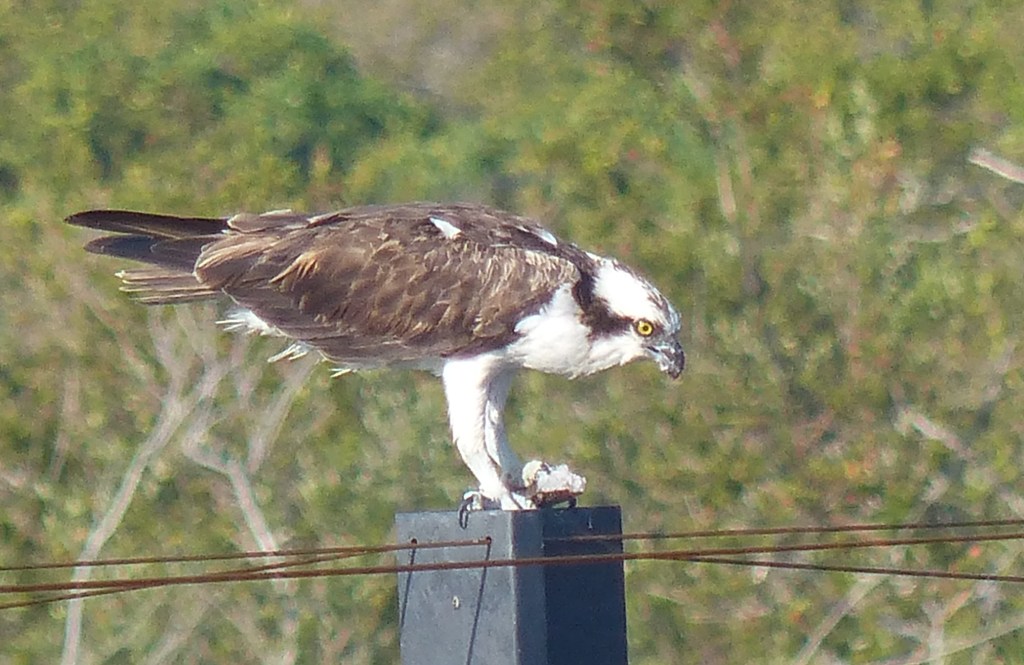
The Osprey or Fish Hawk have rough scaled feet perfect for grabbing and holding onto fish plucked from the water
The two fish-eating raptors seemed out of place on a farm, but here in Stuyvesant the Hudson River is a short distance away. Osprey are just starting to nest again in the middle stretches of the Hudson River Valley. They commonly breed downstate and on Long Island and populations nest on lakes at the foothills of the Adirondacks, but for decades they were not present as breeders in the Hudson Valley even as Peregrine Falcons and Bald Eagles (other raptors recovering from DDT poisoning) repopulated historic ranges.
Their absence was long a local ornithological mystery. In the 1980s students from Columbia-Greene Community College erected nesting platforms on the Hudson River to entice them to settle here, but Ospreys are famously uncritical about where they build nests, and lack of nesting sites was probably not the limiting factor. In Florida, they commonly appropriate power line posts, commercial signs, and even flat roofs in developed areas. Perhaps the population just needed to build up over time to infill suitable habitats. Few things authenticate a large body of water better than an Osprey and its dramatic hover and dive to catch fish. I’m always amazed at how quickly local bird populations can wax and wane within the span of a human life.
A single Wild Turkey launched out and flew noisily from a cover crop patch of rye and wheat into the distant woodlot. Turkeys are another great success story in our area, benefiting both from regrowing forests and reintroduction programs. Victims of habitat loss and overhunting in the early 20th Century, they are now common throughout the Hudson Valley and have even adapted to suburban yards. They are one of two native North American birds that have been domesticated (the other is the Muscovy Duck of Mexico). Spanish explorers sent the Turkey back to Europe in the 1500s where they were further domesticated and spread throughout Europe. English colonists a century later brought them back “home” to North America. Wild Turkeys are found in all states except Alaska (yes, there are even wild introduced populations in the upper elevations of Hawaii!).
I hear the gulping distinctive “KOWP KOWP KOWP” song of a Yellow-billed Cuckoo just to the north of the farm in the old woodlot. 2024 has been a banner year for our two native species of Cuckoo, the Black-billed and Yellow-billed as their regional populations follow outbreaks of hairy caterpillars. The large outbreak of Spongy Moth caterpillars in Columbia County and Duchess County has attracted migrating cuckoos to our area and provided an abundance of easy prey. Cuckoos are some of the only birds able to digest Spongy Moth caterpillars and they can eat more than 100 of them at a time, so many in fact, that the caterpillar hairs become matted into a digestive felt inside the cuckoo’s stomach inhibiting its ability to absorb nutrients. Cuckoos are among the few birds in North America able to feed heavily on hairy caterpillars and have evolved the ability to regurgitate their entire stomach lining and grow a fresh one anew. Although the cuckoos barely put a dent in the spongy moth populations, the spongy moths are a boon for the cuckoos which gain the extra nutrition to lay multiple clutches of eggs.

Cuckoos can be incredibly difficult to see when perched. They are masters at remaining perfectly still and they keep their wings tucked tight when foraging. Mike Birmingham captured this wonderful image of a Yellow-billed Cuckoo on an exposed perch.
The edge between the unmoved pastures and adjacent woodlot hosted several species of forest and edge-adapted species including American Crow, American Goldfinch, Common Yellowthroat, Eastern Wood Pewee, Gray Catbird, Great-crested Flycatcher, Pileated Woodpecker, Red-bellied Woodpecker, Red-eyed Vireo, Rose-breasted Grosbeak, Song Sparrow, Warbling Vireo, White-breasted Nuthatch, and Wood Thrush
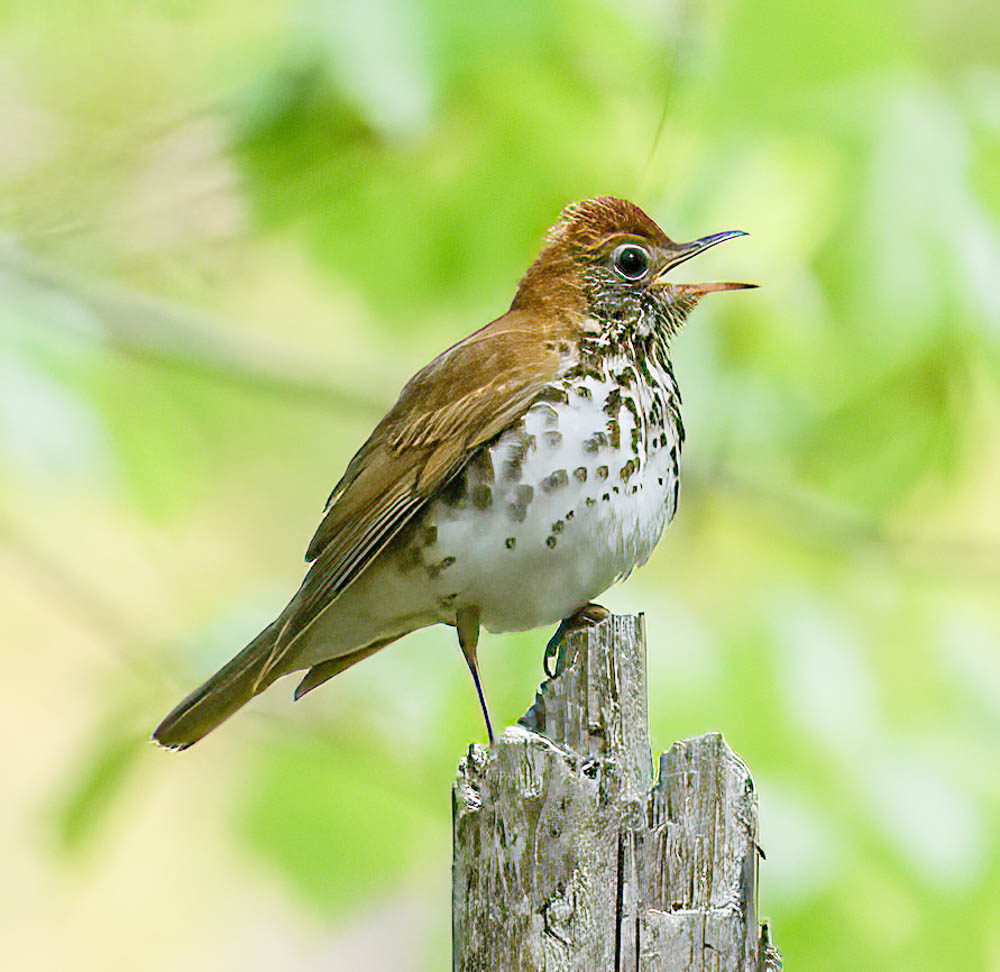
This stunning image of a local Wood Thrush was captured by Chris Franks. Wood Thrushes require at least some undisturbed woodland. Although they have survived forest fragmentation better than other woodland thrushes, their numbers have still declined by half in the last fifty years in New York State.
One hotspot of bird activity at Blue Star is the farm pond that lies to the north of their vegetable plots. Many farms in our region build fewer ponds these days as soil and water district grants have dried up, the importance of ponds for watering livestock has declined with the overall decline in animal agriculture, and many vegetable operations now opt for wells and drip irrigation. Homeowners still build ponds for aesthetic reasons, but new pond construction on farms is now rare. Nevertheless, a multitude of legacy ponds dot the Hudson Valley and can serve as oases for birds.
Blue Star’s pond hosted two territories of Song Sparrow, a pair of Red-winged Blackbirds, Barn Swallows, and several Yellow Warblers that caught some unidentified beetles at the waters edge to feed their young in adjacent willows. A small clan of Killdeer, black-and-white inland shorebirds, foraged along the pond’s muddy edge. While the nearby Hudson River is ancient, natural ponds are recent landscape features and quite rare because the fate of most ponds are to fill in quickly over time. The intentional disturbance created by pond construction in the last two centuries has provided a wealth of habitat value for our area. Are there ponds on your farm or property? If so, how long has it been there and what sorts of organisms does it host?
Not all disturbances are net negative events for wildlife. The sad looking oaks defoliated by Spongy Moths throughout the Hudson Valley this June have generated the highest populations of cuckoos I’ve ever seen and the oaks will surely rebound. The soil disturbances associated with Blue Star’s vegetable production created a flush of annual weed seeds now enjoyed by sparrows and their farm pond has produced the insects feeding a variety of native song birds. How to we measure ‘creative destruction’ and gauge how some disturbance is valuable or harmful? What values do we bring to that question and how does it affect the management decisions we make?
 Farmer-Ecologist Research Circle