
By Will
Peruse any aerial photograph of the Hudson Valley from the 1960s and you will see field after field dotted with fruit trees, their neat rows show up as pointillist parcels in even the most blurry photos. There used to be a lot of commercial orchards in the Hudson Valley. Several successful commercial orchards still remain in what is today a very difficult and competitive agro-economy, but New York is no longer the Big Apple and much of its market share has been overtaken by the irrigated apples of Washington state, New Zealand, and other far-flung places. The regional commercial orchards that persist today are either ruthlessly efficient or creative in their direct marketing to tourists and visitors.
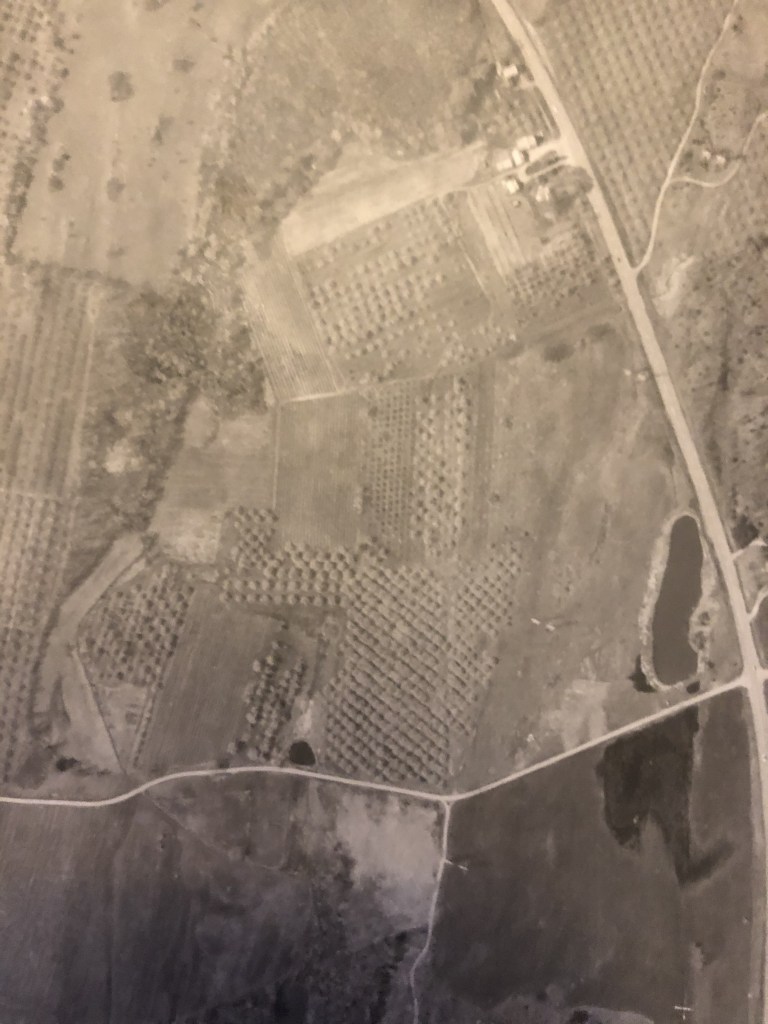
This photo (Livingston, Columbia County) shows the extent to which orchards once dominated “hedgerow to hedgerow” on many farms. 1965.
To be truthful, most commercial orchards in the Hudson Valley do not rise to the top of my list as places to see birds, which is why the bird diversity of Rose Hill was a refreshing surprise.
For birds to survive they need places to roost and rest, insects in May to replenish their exhausted bodies after typically long migrations, places to build nests free from disturbance, and still more insects in June and July to feed their rapidly developing offspring. Most commercial orchards are some of the most intensively managed farmscapes in the Hudson Valley. Many pesticides (both organic and conventional) are necessary to raise the high-quality fruit that consumers demand. It’s been over 50 years since Joni Mitchell proudly sang that she can live with “spots on her apples” but we have a long way to go to convince most American consumers that the tradeoff is worth it for a healthier ecosystem. Our changing regional climate, with its warmer springs still punctuated with snap freezes, and new invasive pests in the pipeline (Brown-Marmorated Stinkbug the newest arrival and Spotted Lanternfly at our doorstep) don’t make things any easier.
I’ll let Rose Hill speak for themselves on their growing practices and philosophy, but as a visiting farmer and ornithologist, a few key features stood out:
- Mechanical (rather than chemical) removal of weeds under trees at a reduced rate that provide a lot of structural plant diversity within orchard rows.
- Reduced spray schedule and use of non- or less-toxic spray alternatives
- Retention of landforms in orchard blocks (vegetated shale ridges, for example)
- Adjacent blocks of native vegetation.
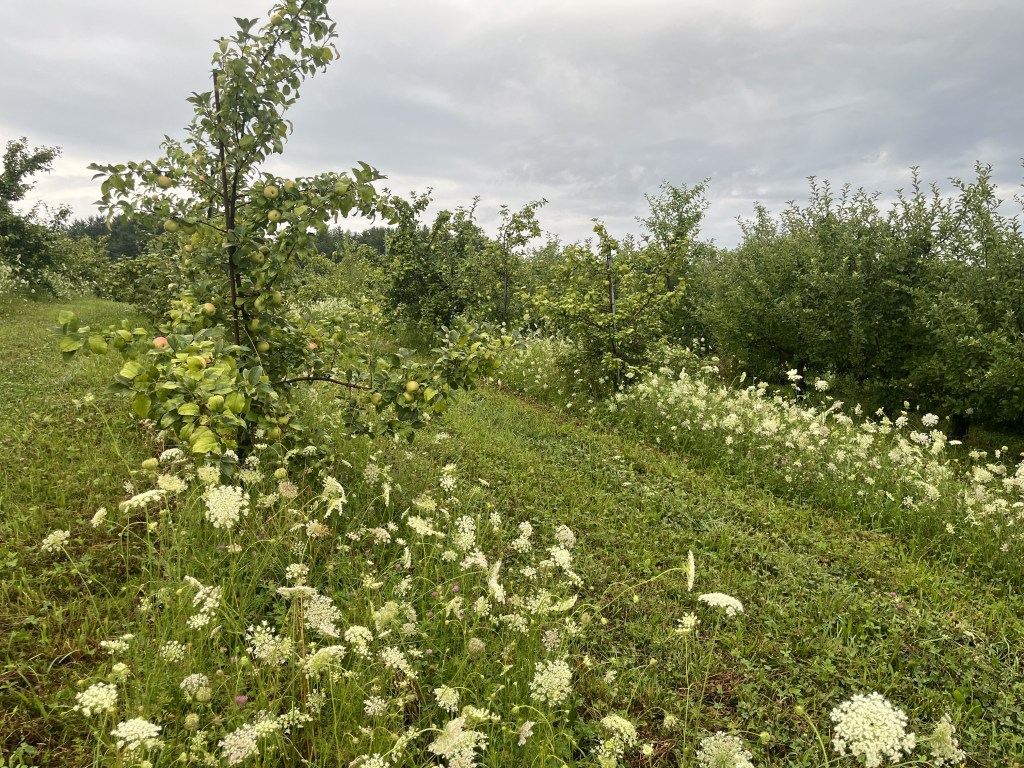
The vegetated strips between trees that cannot be reached by mowers provides spaces for pollinators, and for insect prey that birds depend upon. This structural heterogeneity is closer to the appearance of Hudson Valley orchards in the 19th and early 20th Centuries.
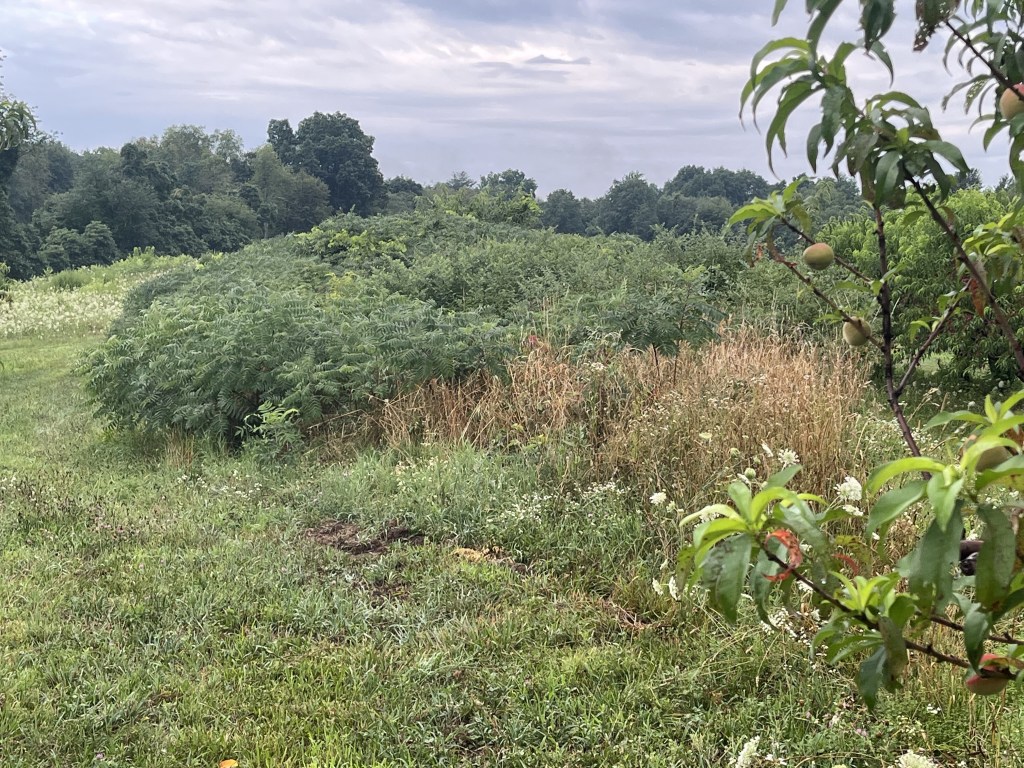
Rather than bulldozing and infilling shale ridges, Rose Hill has left them in place providing important micro shelters and feeding zones for birds.
The savannah-like structure of orchards actually attract a few species of birds who preferentially nest in the grassy matrix of trees.
I find that one of the most common orchard birds, which nests directly in fruit trees, can thrive when spray programs are kept to a minimum. The Eastern Kingbird is a type of flycatcher that builds a grassy cup in the fork of a tree branch that looks like a Disney cartoon of a nest. They are famously aggressive towards other birds and mammals (but oddly, not humans). On a spring day when you look up and see some smaller songbird attacking and chasing a Red-tailed Hawk and think, wow, that bird has chutzpah, chances are that it’s an Eastern Kingbird.

Chris Franks shared this image of a local Eastern Kingbird. These birds perch conspicuously on wires and the tops of trees sallying forth for large flying insects. They have a white band on their tails that identifies the bird in flight even from a distance without binoculars.
Cedar Waxwings often nest in orchards as well. On my farm, I typically see them nesting in plums and early peaches, constructing their nests just as the harvest is winding down. They rarely bother to eat peaches and large fruit but can be considered a management challenge in cherry and small-berry crops. There are plenty of native species of fruit that these birds frequent, and yes, as the name implies, they eat Eastern Red Cedar (juniper) berries, as well as serviceberries, wild grape, hawthorn, and winter berry. Many fruit-eating birds separate the flesh and seeds in their crops and regurgitate the seeds, but waxwing digestion shunts both the pulp and seeds through their bodies and they are a key species for spreading many fruiting trees and shrubs (they can also spread less desirable invasive species such as Japanese Honeysuckle and Multiflora Rose). Sometimes in the fall when fruits such as wild grape partially ferment and produce alcohol the birds can become intoxicated and fly awkwardly.

The “waxy” red tips on the wings, yellow tail band and raccoon mask of the Cedar Waxwing are unmistakable. Their song, if you can call it much of one, is an almost an inaudible high pitched trill. Photo: Chris Franks
The aptly named Orchard Oriole, seen in the apricot orchard at Rose Hill, has a brick-red chest (unlike the tangerine orange of the far more common Baltimore Oriole). They feed on fruit, flowers, nectar, and insects and unusual for orioles, sometimes nest communally in appropriate habitat. The 60-plus-year-old records of the Alan Devoe Bird Club has shown this species increasing in our area for unknown reasons. It may be due to the current successional sweet spot in the Hudson Valley with many young forests and abandoned orchards that provide the structure this species favors without the intensive pesticide use. I never find them in modern commercial orchards and its presence at Rose Hill was a surprise, although my visit in mid July is at the end of their breeding cycle and this individual could have been a migrant on its way back to Central America.
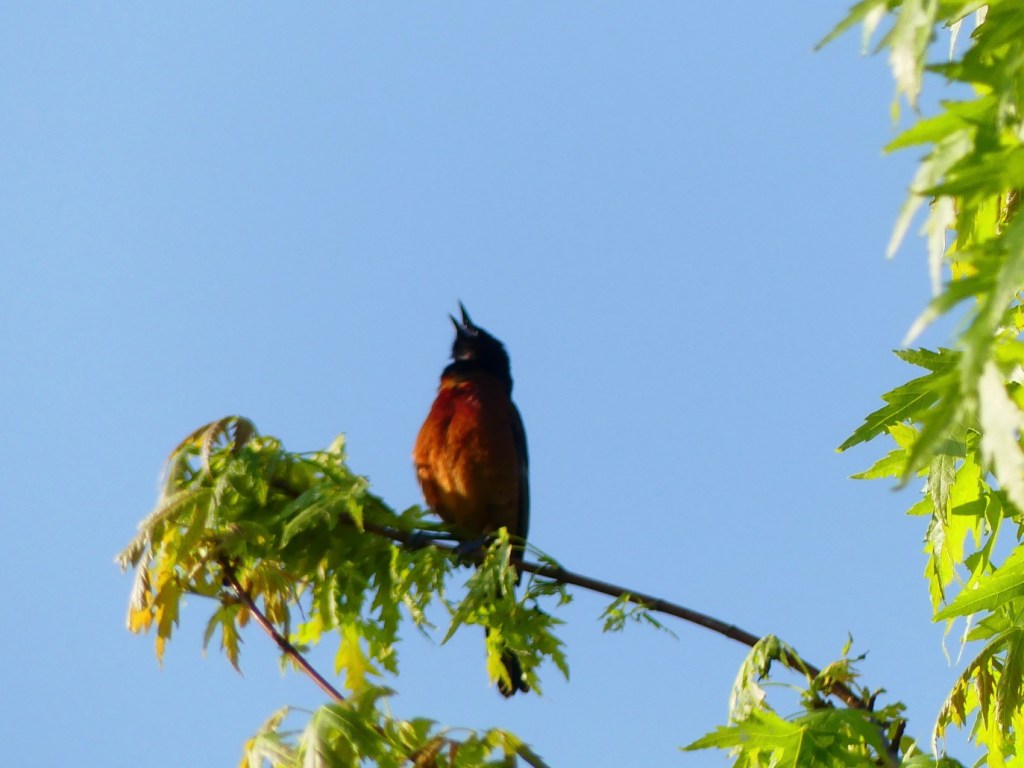
Marian Sole shared this image of a local male Orchard Oriole. Like all orioles, it has a rich lilting complex song.
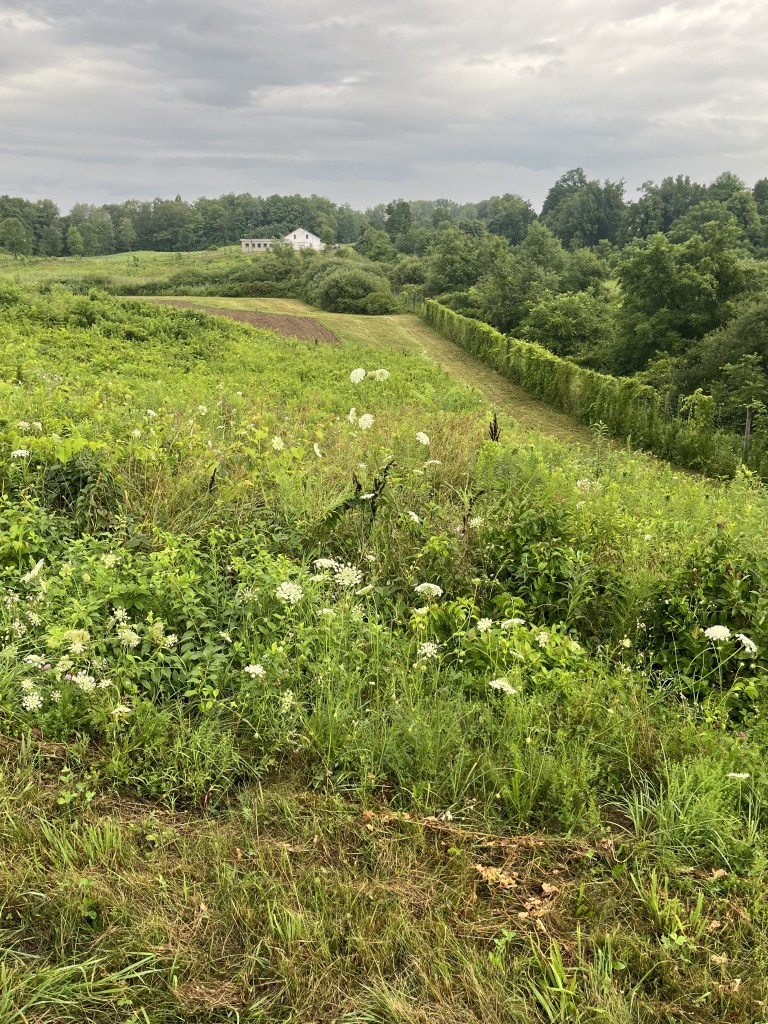
This lightly managed section of the orchard edge (with native vegetation on the opposite side of the fence) was a “birdy” section of the farm and contained a Common Yellowthroat nest with young.

This female Common Yellowthroat foraged for insects in a young planting of plums. Close enough for my iPhone!
Common Yellowthroats are small yellow-olive warblers that nest in brushy tangles and like to be near water. They are a common bird in our area the summer and their ‘whitchity-whitchity-whitchity’ song is a familiar sound if you train your ear to recognize it. They frequently struggle with brood parasitism from another native species, the Brown-headed Cowbirds. Cowbirds do not construct their own nests, but rather like Eurasian Cuckoos, they lay a single egg in the nests of other birds and abandon them for the host bird to raise. Their hatching offspring grow at a fast rate and therefore elbow the lion’s share of the incoming insect food from parents which seem instinctually inclined to shove food into any open mouth regardless of species.
This is a two-way evolutionary race, however, and some populations of Common Yellowthroat have learned to recognize the cowbird’s egg and will build a layer of grass overtop it to isolate it. If that fails, they may abandon the nest and attempt to renest completely at a great cost of energy. The North American Breeding Bird Survey has documented a 26 percent loss of Common Yellowthroats in North America since 1966, probably due to habitat loss. Farms can be essential places for these birds since the unmowed edges, unused fields or the vegetation around irrigation ponds can be more than enough habitat for this species to successfully raise young. A few have learned to use more heavily vegetated suburban yards. You don’t need a lot of land to attract and retain this species, but they can’t eke out a living on mowed lawns dotted with ornamental shrubs–they need a patch of rank growth.
Rose Hill has a wonderful planting of blueberries as part of their U-Pick offerings. The mature plants were heavy with berries on the July morning I visited and although they were not open for customers, more than 30 birds helped themselves to the berries in the patch. American Robins, Gray Catbirds, and Baltimore Orioles dominated the flock, with a smattering of Eastern Towhees, Northern Mockingbird, and a Brown Thrasher. I’ve talked to growers with divergent views on netting berries to prevent birds, some swear it’s essential and others feel there is plenty to go around. I’ve found that birds can nearly wipe out small plantings of a 50 bushes or less, but larger blocks seem to satiate the robbers and leave plenty for us.
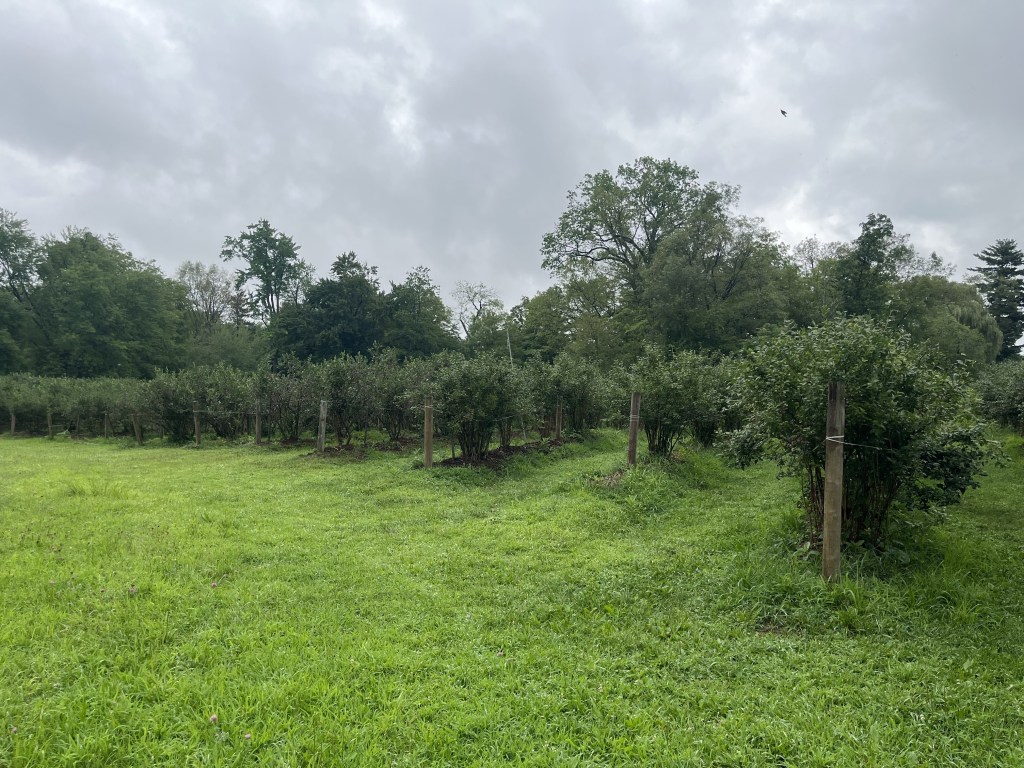
This planting of blueberries hosted 5-6 species of birds attracted to the free fruit
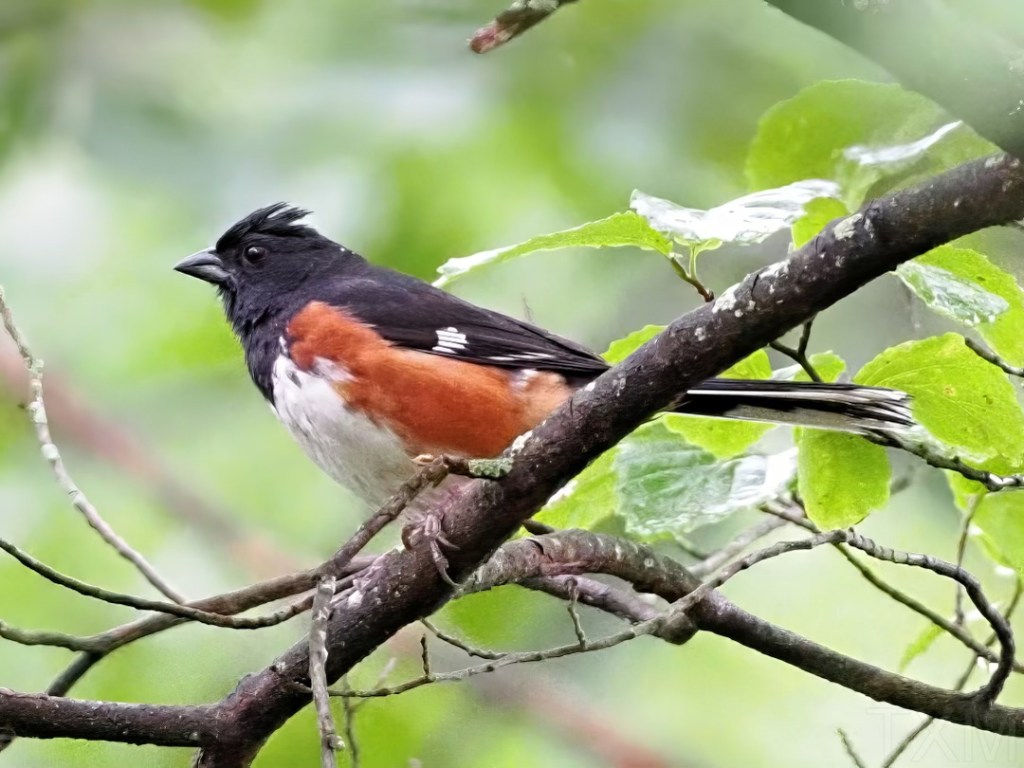
The former name of the Eastern Towhee is the aptly named Rufous-Sided Towhee. Related to sparrows, this is a common bird of scrublands and early successional forests. They scratch through leaf litter with a two foot hop, pouncing on exposed insects. They commonly add fruit to their diet as well
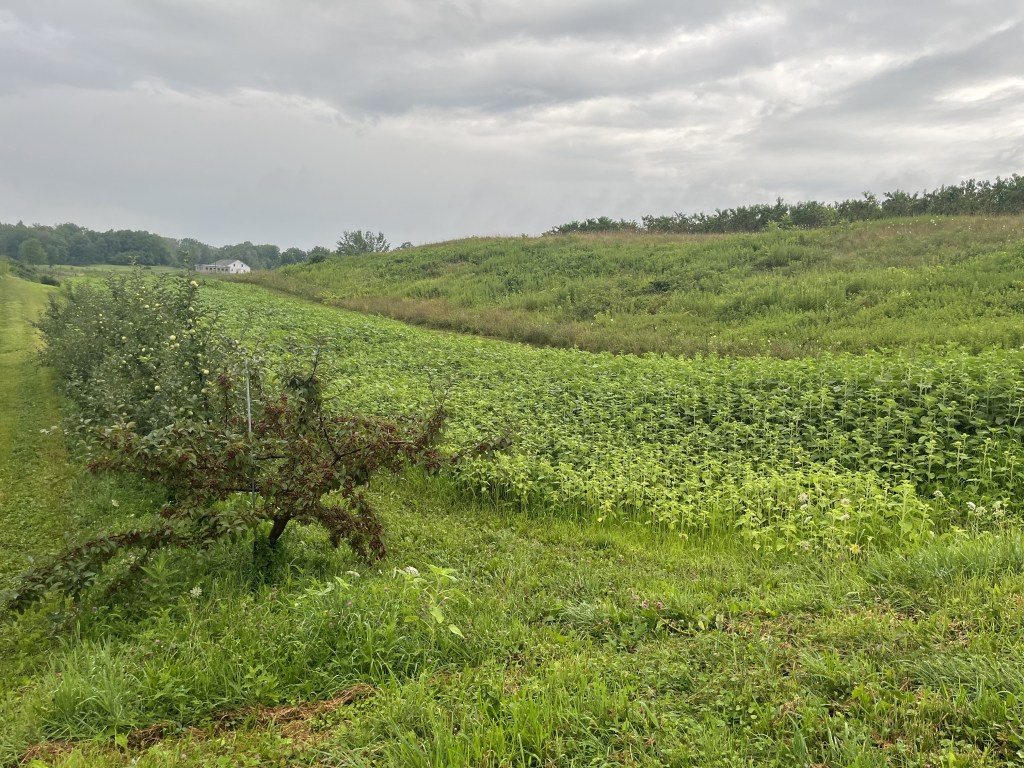
In a month these sunflowers will attract pollinators and if left to go to seed, a calorie-rich seed for a variety of birds
So many of the fruits that we expect and enjoy at commercial orchards — from peaches to apricots, apples to pears, are eurasian imports to North America, non-natives that require a lot of skill and work to bring to fruitfulness and profit. That Rose Hill has managed to do all of this and still leave patches on their farm to attract native birds and other organisms is deliberate proof that this complex relationship of native and non-native, cultivated and fallow, management and benign neglect, can yield positive ecological relationships. All of us who farm and care about wildlife are searching for our own models to achieve something akin to a balance of what we take from nature and what we leave.
 Farmer-Ecologist Research Circle