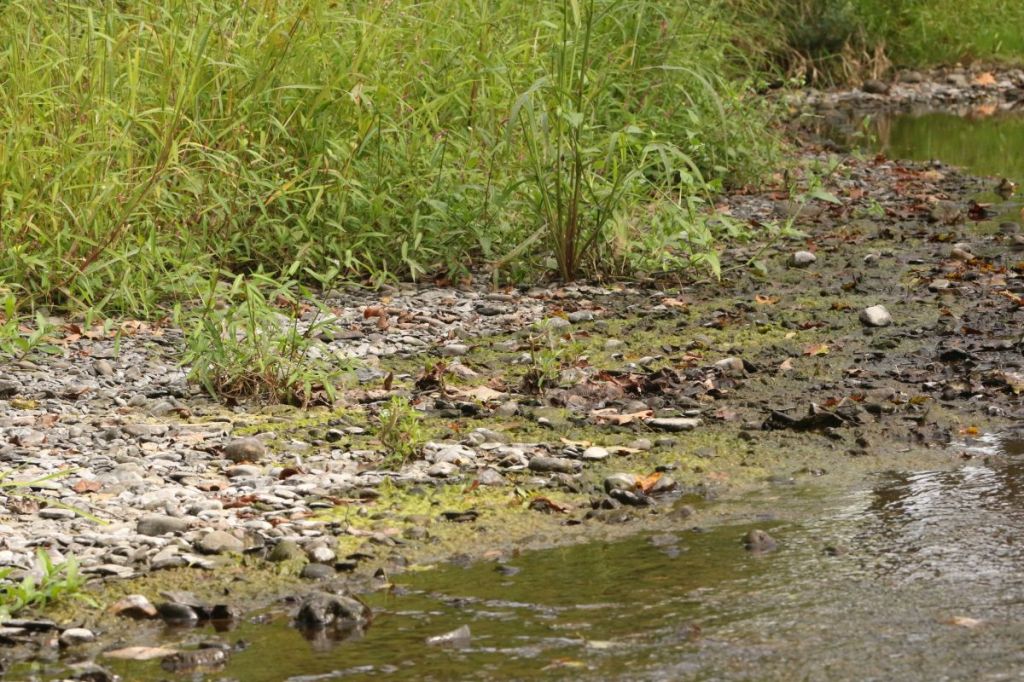
The rocky shore of the North Peters Kill, prime habitat for certain ground beetles.
by Conrad.
Sorry, but the field season, got in the way of our best intentions of keeping this blog ‘live’. We have now made most of our farm visits and over the next couple of months plan to post the reports of those visits here, albeit two-three months behind the times! As a little teaser, this is a short profile of some of the beetles we found by the North Peters Kill, which runs along the southwest edge of Hudson Valley Seed Company’s Airport Rd property in Accord, NY. We made this visit on 6 Sept. 2024.
As some of you may know, ground beetles and I go back a long way together. I first got interested in ground beetles when we were doing a floodplain forest study many years ago – such forests and the associated stream banks tend to have a diversity of ground beetles, and so they can be used to assess forest ‘condition’. Later, as we started doing more agroecology work, the ground beetle interest turned to the question ‘how can these purported beneficials be encouraged on farms?’. We currently have various projects related to that question at the Hudson Valley Farm Hub.
However, as they say, it’s nice to get back to ones roots…
While snooping along the rock margins of the North Peters Kill, I came across an appealing cross-section of stream-bank ground beetles. With a few exceptions, stream-bank ground beetles rarely venture into agricultural fields, so I won’t claim that the beetles profiled here are somehow integral to sustainable agriculture; I just want to make the case that, in their own little ways, they’re exquisite.
First, before talking beetles, imagine this stream-edge habitat. Rocks sit waist deep in water, ‘fertilized’ by whatever periodically washes downstream or grows in this moist, often sunny, environment. This is prime habitat for scavengers who feed directly on the flotsam and rock fuzz (that’s NOT a scientific term!) and for predators feeding on those scavengers. Largely but not completely missing are those banner scavengers, the ants.
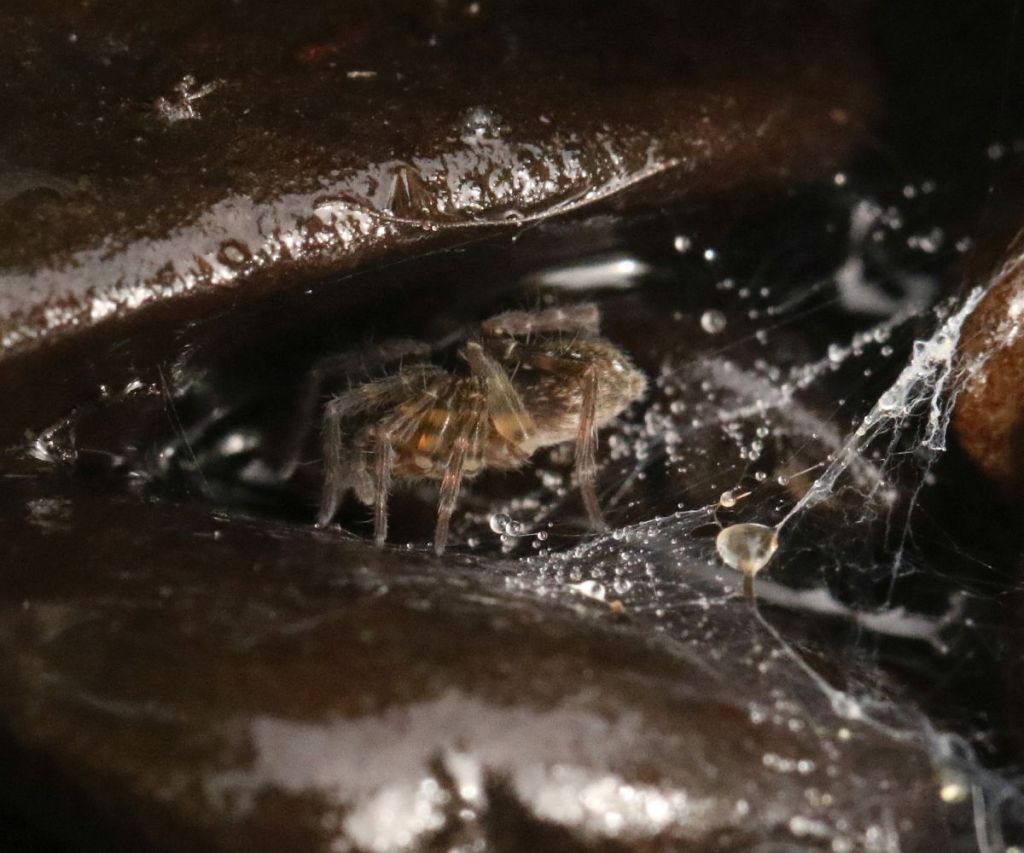
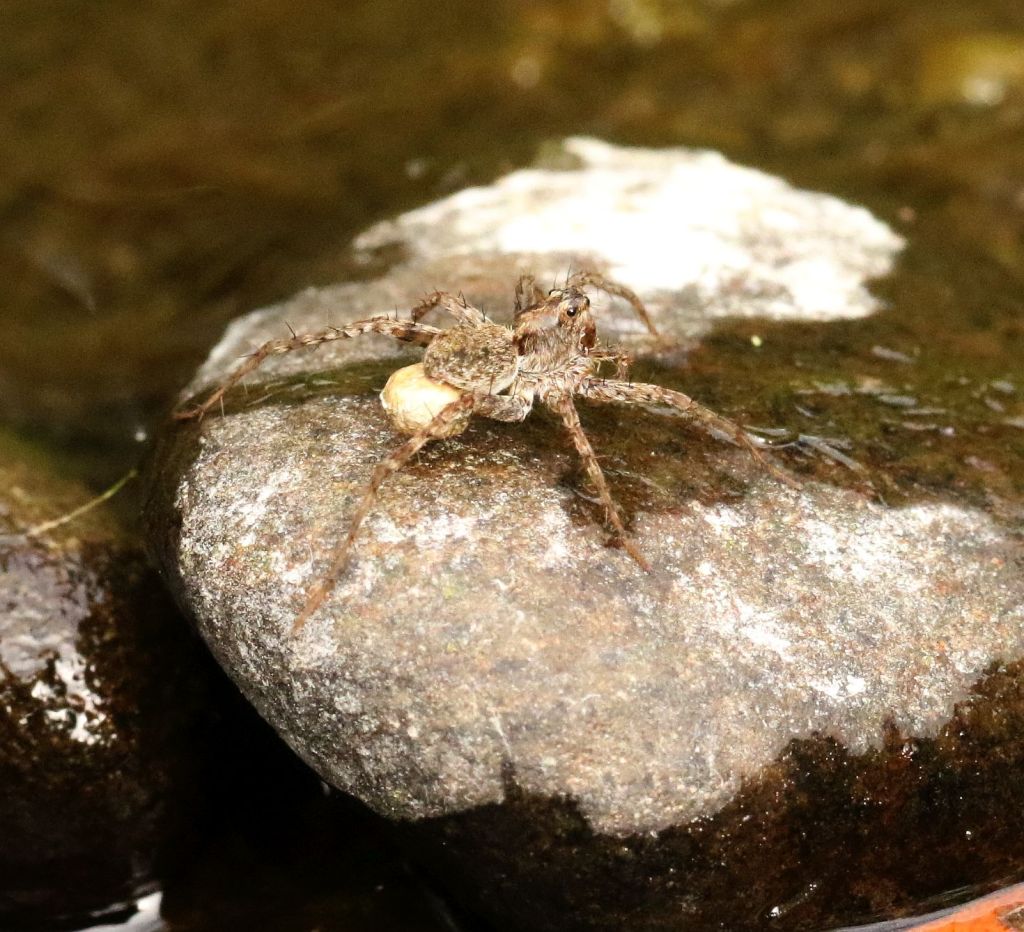
Among the other invertebrates who seem to appreciate these haunts are spiders.
Here, a wolf spider mother carries her egg sac across wet rocks. Once they hatch, the young spiders will ride their mother’s back for a while before striking out on their own. Who said only vertebrates exhibit maternal care?
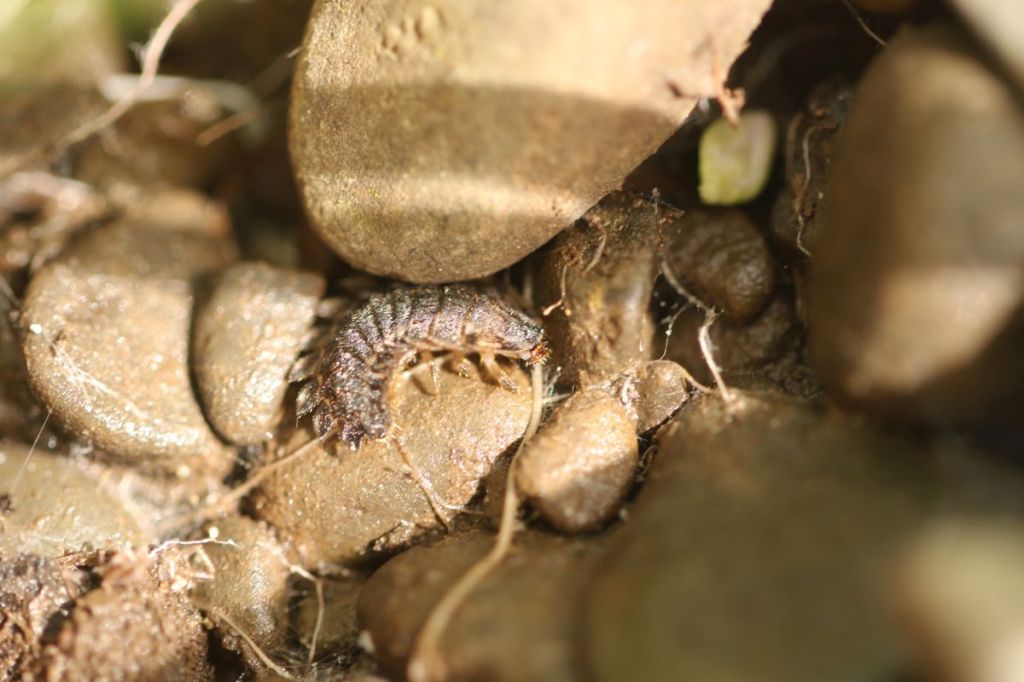
This appears to be a firefly grub; these forage for soft-bodied invertz.
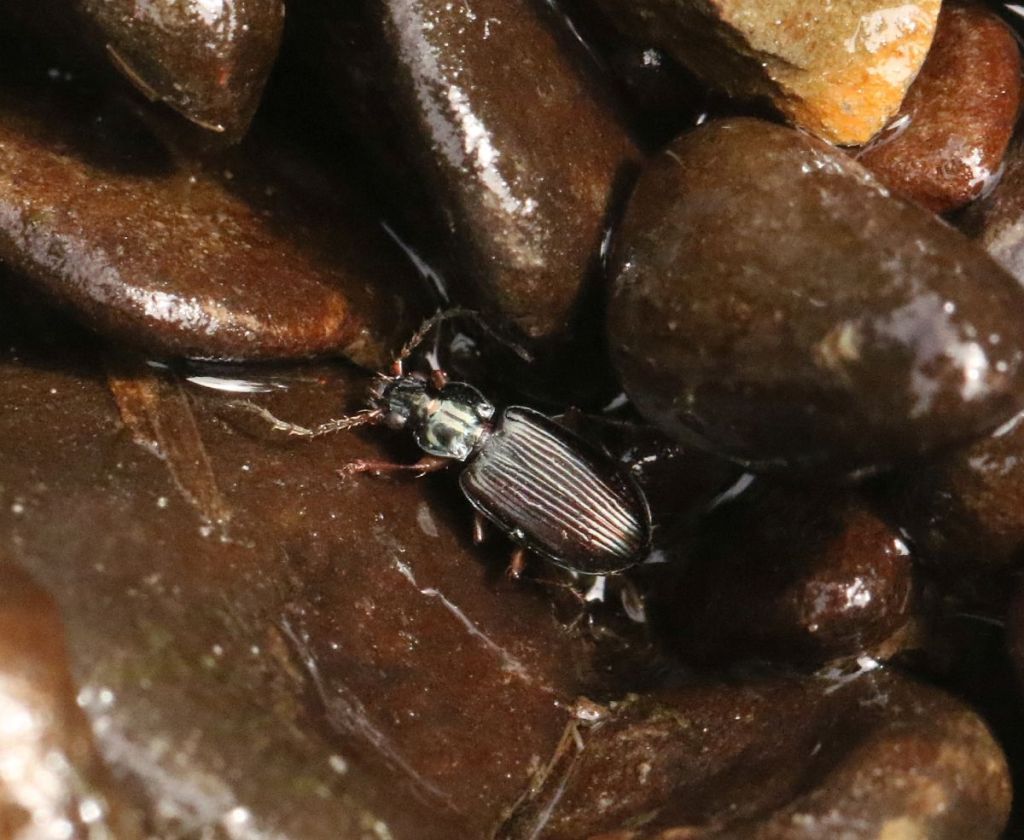
The stereotypical ground beetle is an elongate, black oval with relatively long legs and a propensity to scurry. And some creekside ground beetles do fit the mold. Agonum is a genus of ground beetles which includes, but is not limited to, a range of medium-sized, relatively nondescript (until you get out the microscope) beetles of wetter areas.
This probable Agonum was about 1/4″ long. This species seemed to be the most common ground beetle of these rocks – quickly running off when I lifted stones. This may be an omnivore, scavenging on vegetable matter and preying on smaller creatures.
But more exotic beetles may lurk beneath the rocks….
True, no ground beetles in this picture, but that brown stain on my thumb is a chemical burn left by the defensive actions of a Bombardier Beetle.
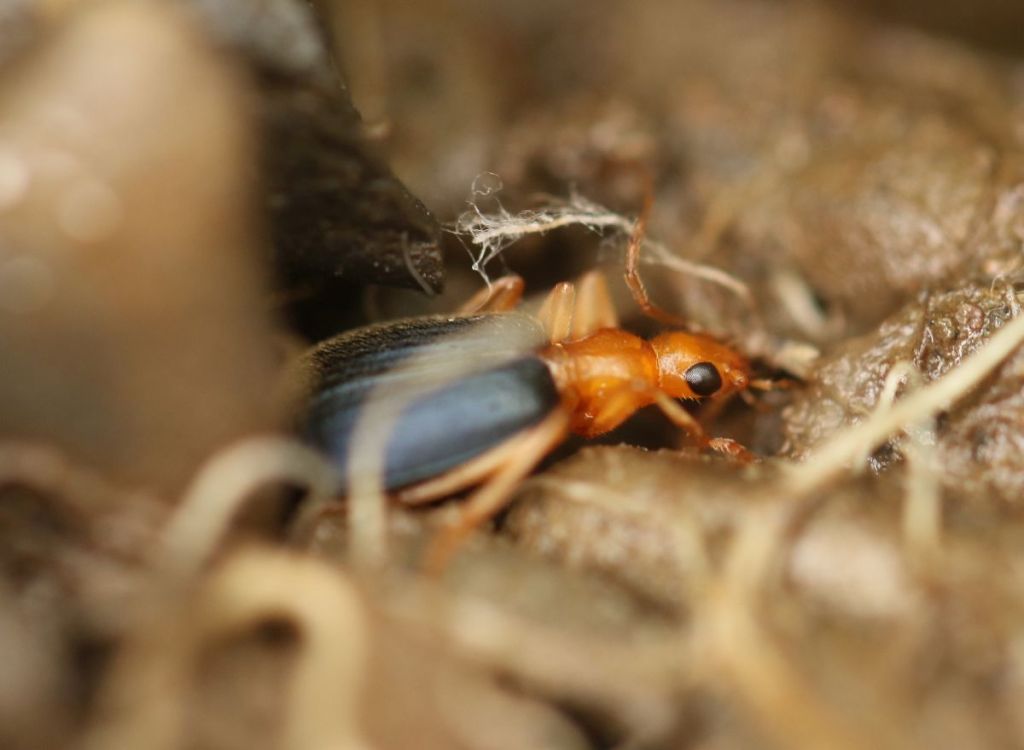
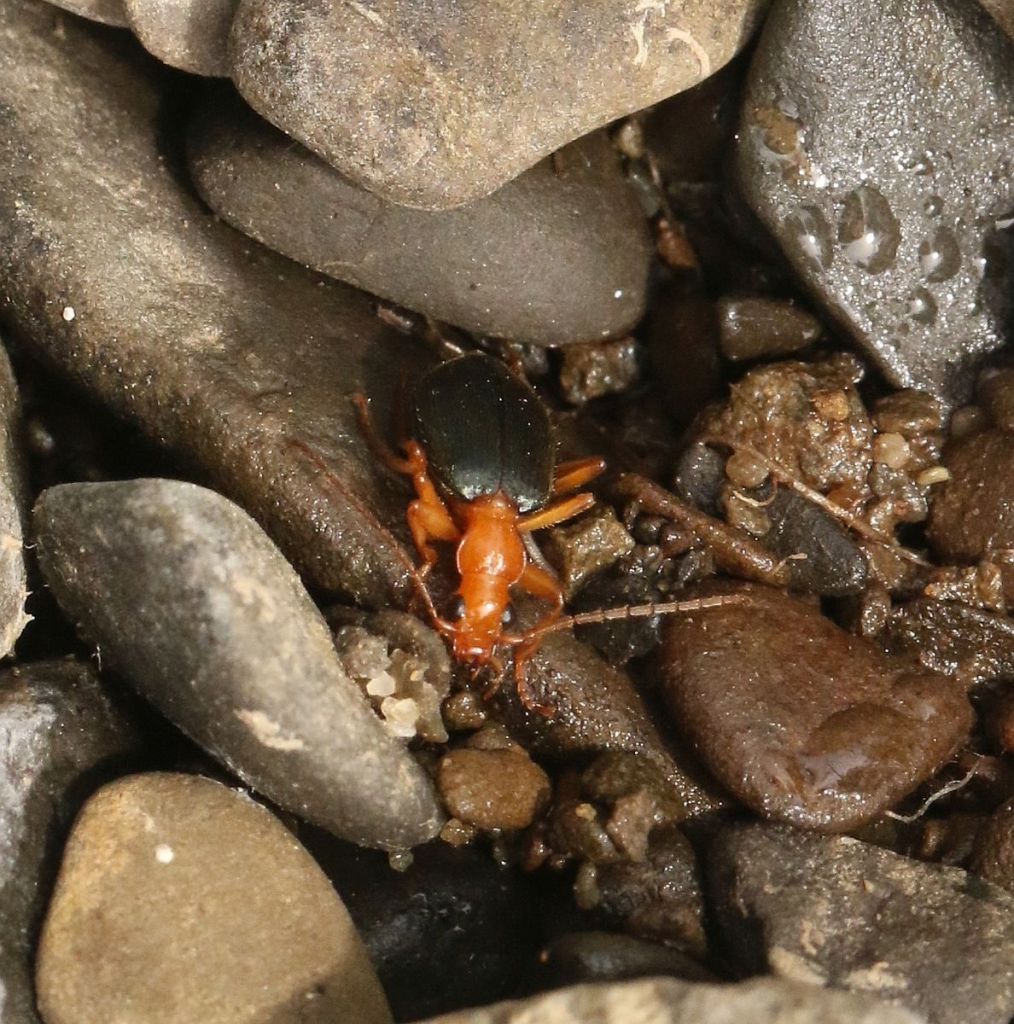
Bombardier Beetles, like many other ‘noxious’ (at least to their would-be predators) insects are conspicuous. Their colors say, “Eat me and you’ll regret it.”. Inside their bodies are two chemicals which, when mixed together, become a very caustic substance. When irritated, the beetles combine these two chemicals and squirt the new compound out the directional nozzle on their rear ends. (For videos of this in action, go to 3 mins into this BBC clip.) The burn on my thumb came when I picked up a Bombardier Beetle. There was a faint “Ffffft” and a base-ball sized cloud of vapor which left this ‘wound’ on my thumb. I didn’t feel anything but I wouldn’t want to be a bird who got that in the eye or a small insect who was bathed in it.
These beetles are reported to be mainly carnivorous. Could they also use their scalding hose to hunt?
These Bombardier Beetles were mainly found amongst the drier rocks above water level. Their brightcoloration makes them hard to miss and easy to remember, in the same way that Monarch butterfliesdon’t try to be inconspicuous.
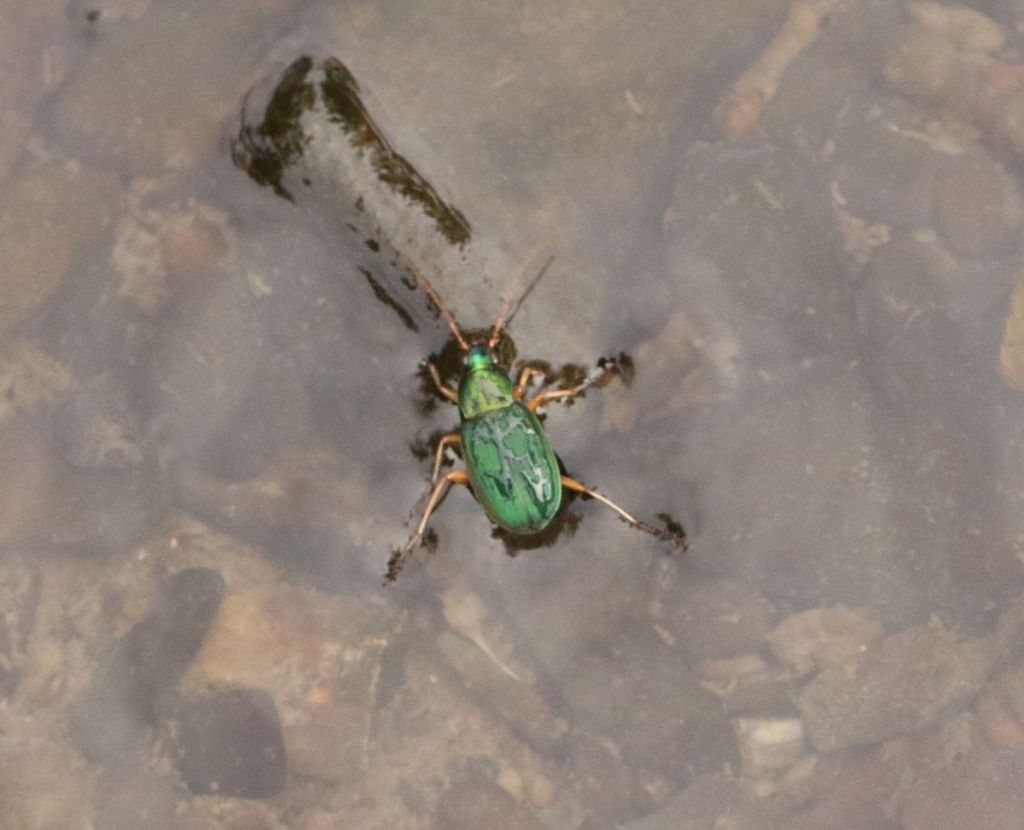
Another showy ground beetle of the North Peters Kill banks is, to use its scientific name, Chlaenius sericeus. This is a large, startlingly green beetle covered in a fine fuzz. It is reportedly another predator on the prowl. While these beetles don’t possess the Bombardier’s chemical canon, they are not short on odor – for most of the rest of the afternoon after picking one of these up while taking these photographs, my fingers smelt of rancid butter. This is a hairy genus of ground beetle, literally. Most ground beetles are relatively smooth-surfaced. A few upland species are fuzzy, and this tends to accumulate the dust of their surroundings, seemingly providing effective camouflage. But these are wetland creatures, not apt to get dust covered, so what might be the utility of the pelage?
To suggest an answer to that, I need to talk about photography. I sometimes take the ‘desert island’ approach to photographing live ground beetles. Ground beetles are fast. Often, if you just put one down on the ground, it’s gone before you can snap a picture. So, I put them on a rock surrounded by water and, while they try to figure out their predicament, I take some photos before usually releasing them somewhere back on dry land. For many ground beetles that approach works but, as it turns out, not for Chlaenius. Those beetles either crawl down the side of the rock and voluntarily fully submerge themselves or they take off in a skating/swimming motion across the water. In either case, those hairs could help. By trapping air, they could make the ground beetle more buoyant, facilitating swimming. Alternatively, if they can pull themselves underwater, that trapped air could serve as a diving bell of sorts, providing them with an air reserve.
This is a cool beetle who really deserves a good common name, any suggestions?
This Chlaenius sericeus was found along the same, rocky North Peters Kill beach. These are large (ca.1/2″), beautifully colored ground beetles.
When confined to its ‘desert island’, this same beetle scuttered away across the water, perhaps aided by air trapped on its fuzzy body (it’s underside is also fuzzy).
This is an earlier photo of a related species taken elsewhere. On at least a couple of instances, I have seen rock-bound Chlaenius such as this one purposefully clamber over the edge and down into thewater. This photo shows the silvery air bubble trapped in the beetle’s fuzz.
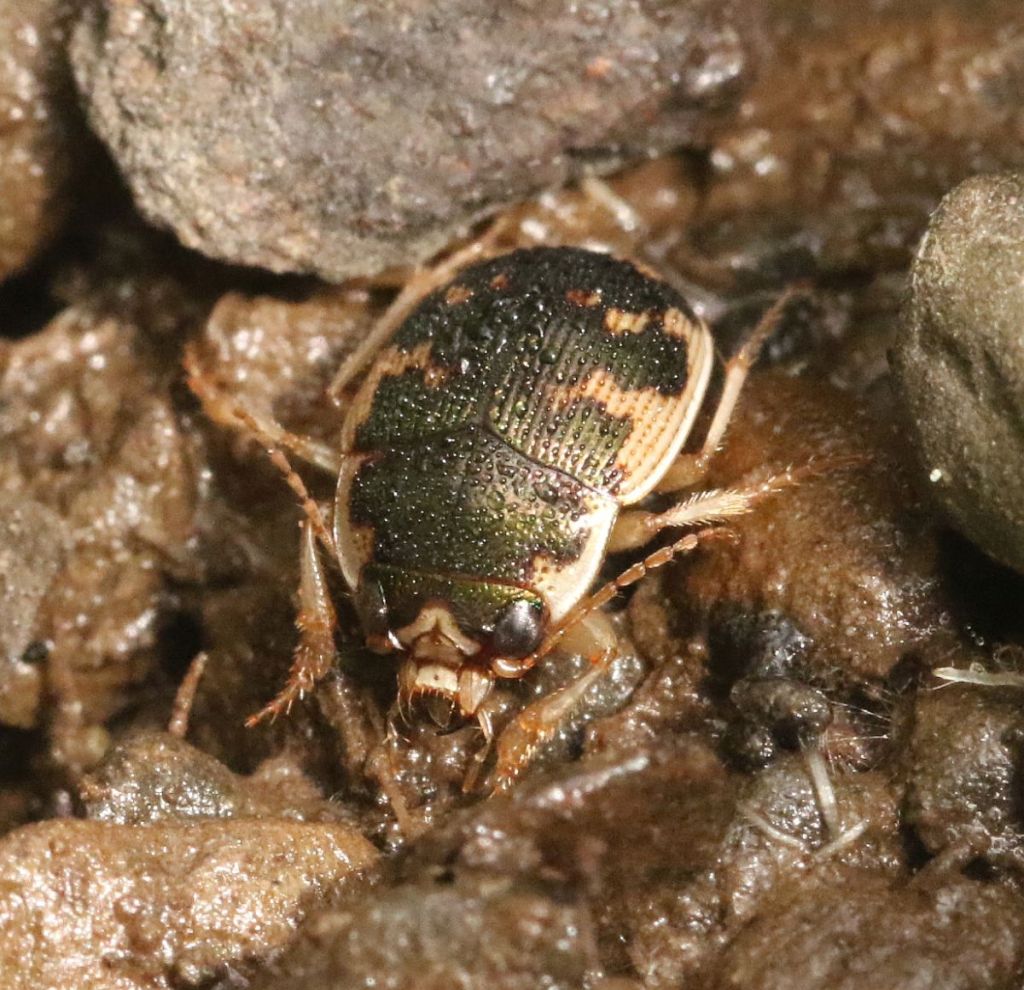
To add to this exotic fauna, we have the pill-shaped Omophron americanus. A ground beetle so oddly shaped that it is hard to believe it’s even a ground beetle. These are beetles of gravelly or sandy stream banks. It has been suggested that their round shape helps them quickly bury themselves in loose sand. One often finds them by pouring water on such beaches and then waiting to see who pops out of the ground for air (it is an understandable general behaviour of stream-side ground beetles that when water arrives, they head for higher ground). As their impressive mandibles suggest, they are predatory.
This North Peters Kill Omophron kindly waited around for photographs.
Most of the above-mentioned ground beetles are found primarily along waterways or around water bodies. Only rarely do we find them in farm fields. But Patrobus longicornis is an exception. This polished, black ground beetle is supported by spindly, light-colored legs that make it a spritely runner. I didn’t actually find this species in my short visit to the North Peters Kill, but have seen it along many other regional creeks. However, we also regularly find it in and around farm fields. It’s an omnivore and could, conceivably, be consuming weed seeds. One of our current projects is exploring the diets of on-farm ground beetles to see if we can better describe their potential agronomic role.
However, to end back at the beginning, it’s sometimes nice to forget about utility and just spend some time appreciating the ‘exotic’ in our own backyards.
A Patrobus longicornis photographed elsewhere. This is a relatively common beetle of both stream banks and farm fields.
by Conrad (with some photos and field assistance from Laura & Meg).
First of all, I’m not trying to ‘back date my check’ by associating this with a date of 9 days ago – that is when we visited Rose Hill, not the date on which this was written. Because phenology changes rapidly, it seems important to use the date we were actually on the ground.
In 1936, on the current land of Rose Hill Farm only the northwest corner appeared to be in orchard.
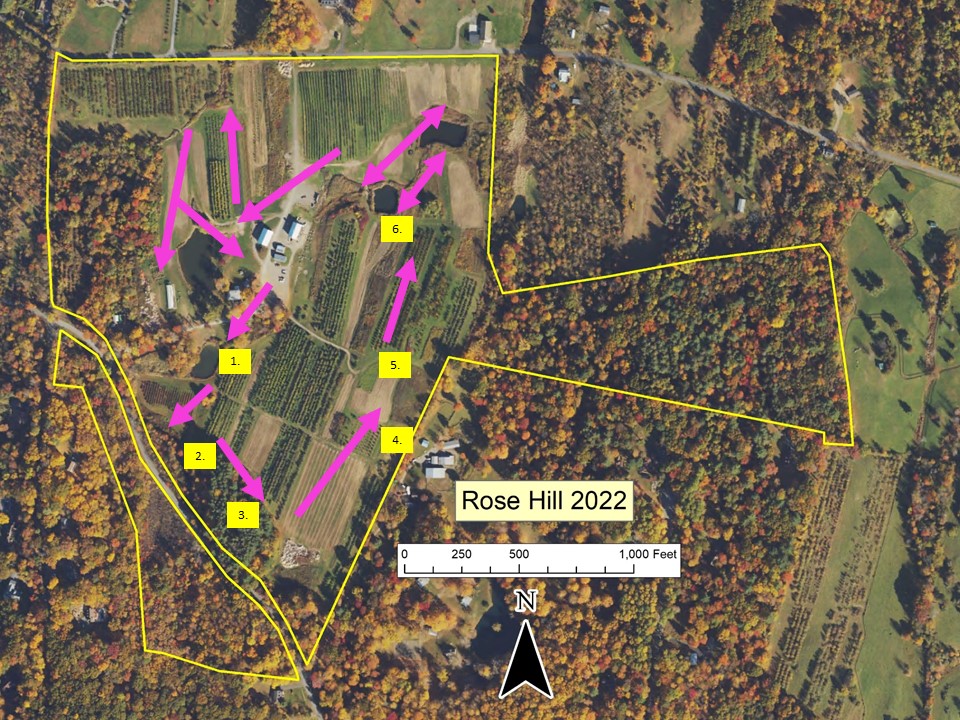
Today, orchards of various sorts fill much of Rose Hill. Surprisingly, one of the areas reverting to forest is that northwest area which appeared to be orchard in the earlier image. The pink line refers to our approximate path, and yellow-boxed numbers indicated the approximate locations of some of the below landscape shots.
Several ponds are scattered across Rose Hill. This photograph was taken looking southwest from roughly point 1 on the above map. All ponds probably had predatory fish, possibly reducing their ecological value for some dragonflies.
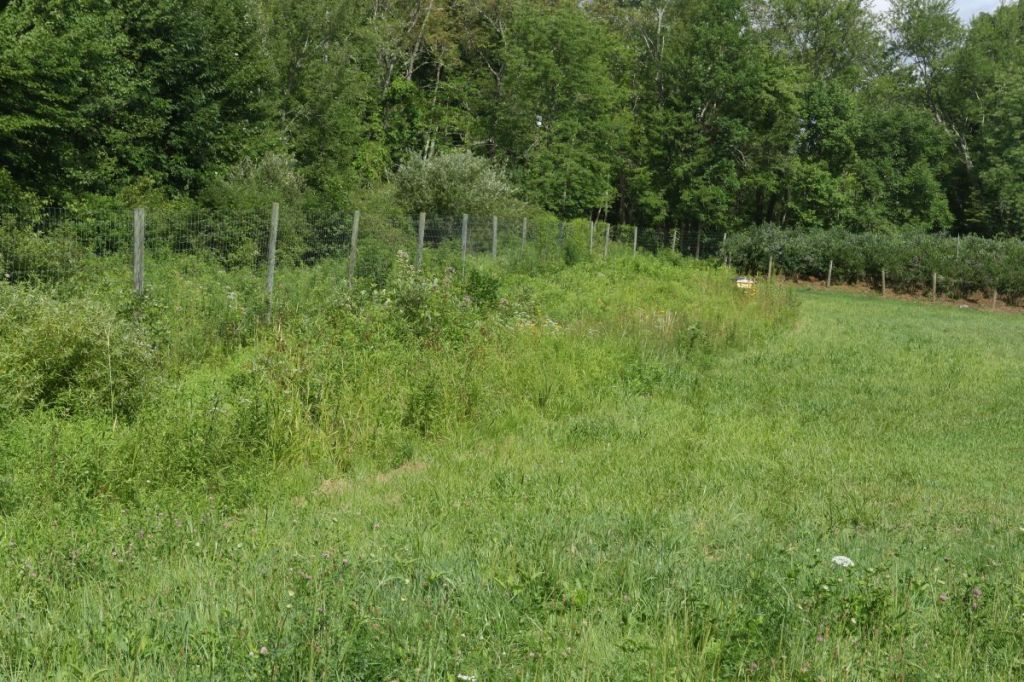
One of the ecologically most interesting areas was the wet meadow shown in this photo, taken looking west-northwest along the fence from near point 2. There is wetland beyond the fence here and that wetland has snuck into Rose Hill.
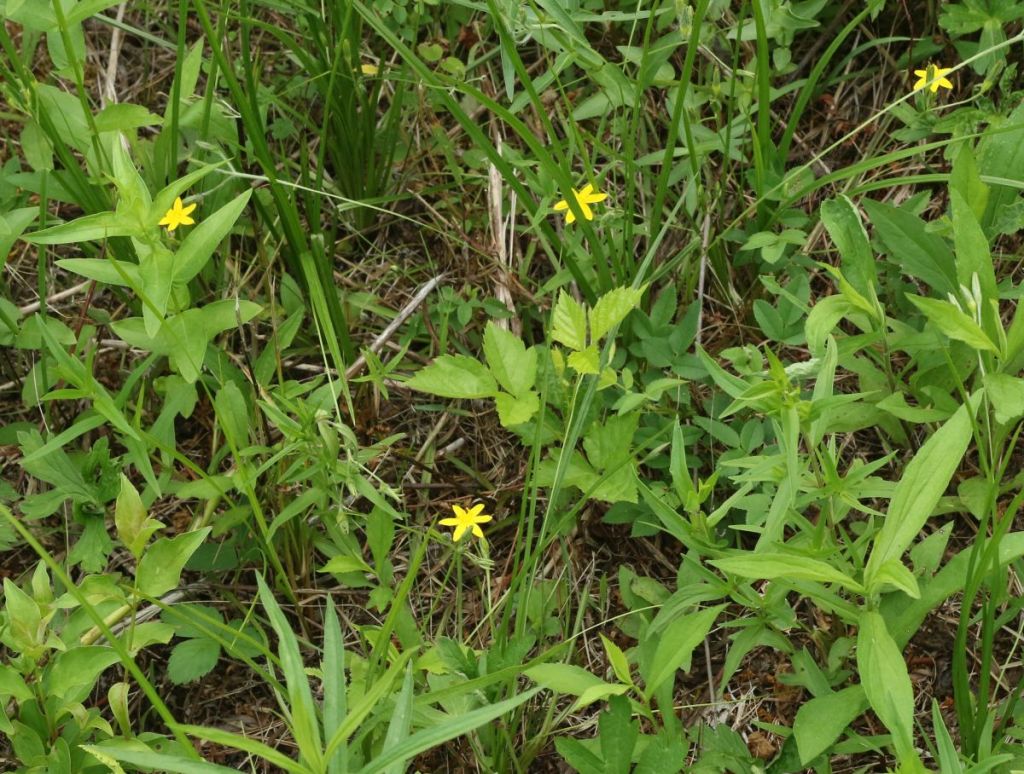
Among the fun plants spotted in this area were Yellow Star Grass (a somewhat unusual plant found in both wetlands and dry forests) and…
Square-stemmed Monkey Flower, a moist-meadow plant.
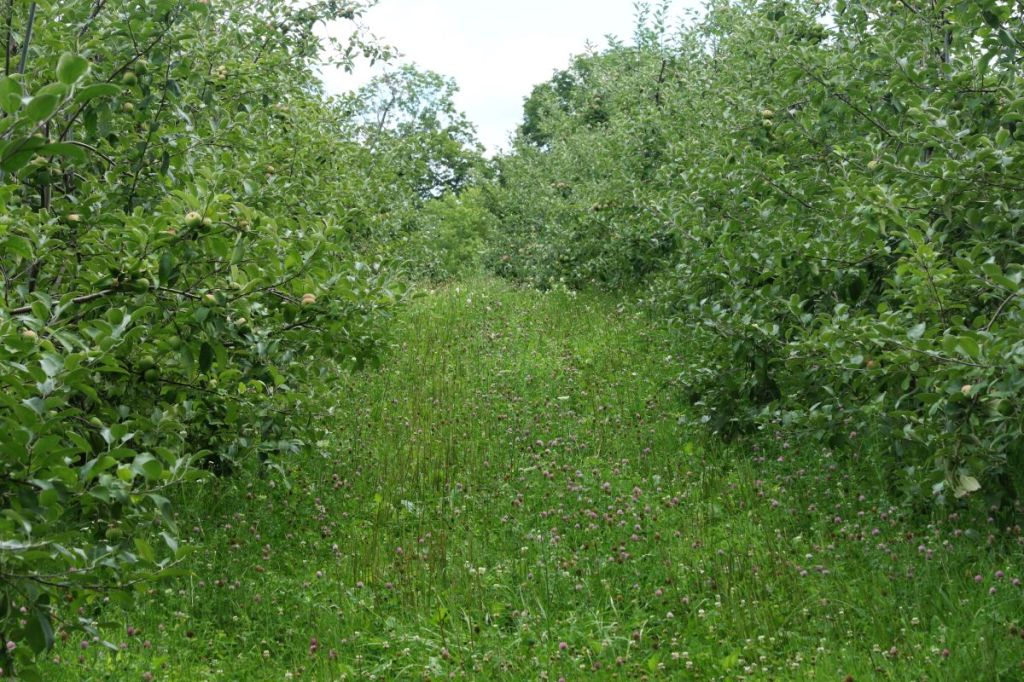
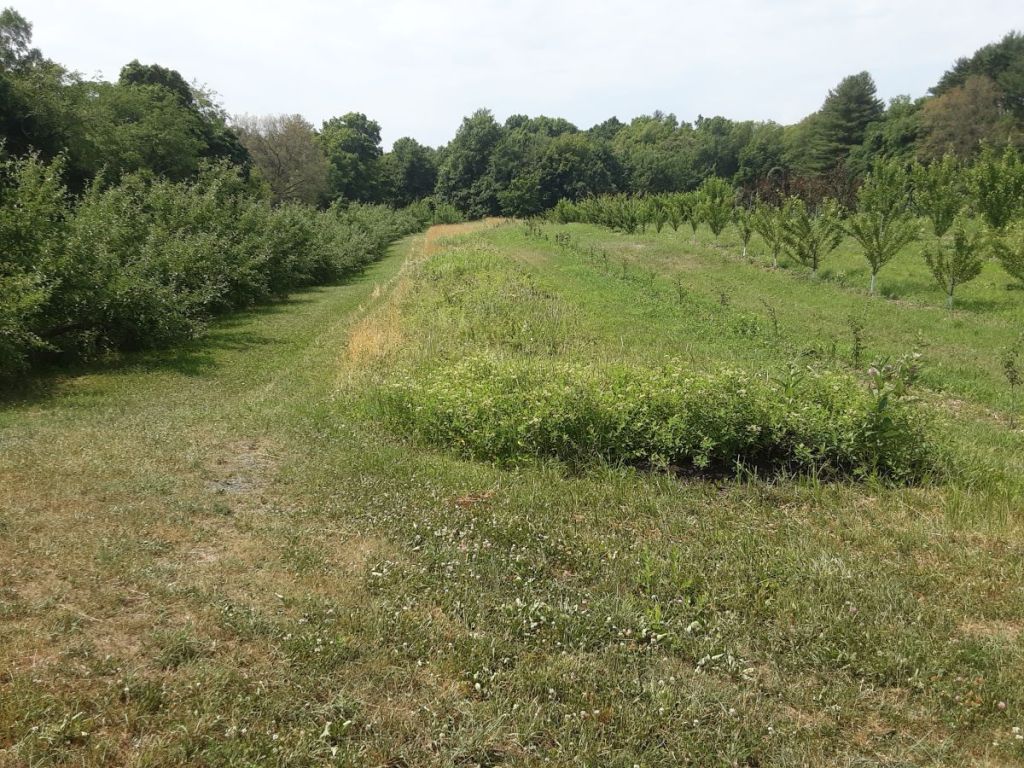
Some of the strips between trees had been left unmowed, leaving a welcome abundance of clover. This picture was taken near point 2, looking north.
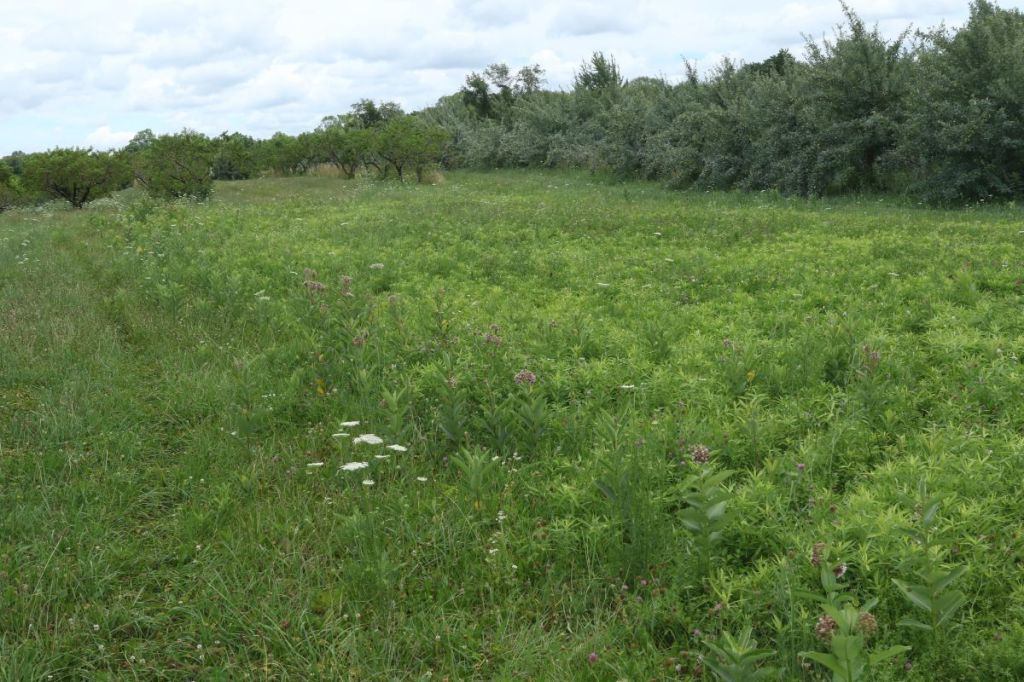
Mowing had occurred between the rows of some smaller trees, although taller vegetation, including Common Milkweed and Indian Hemp, was growing up within rows but between the trees. This photo was taken looking northeast from around point 3.
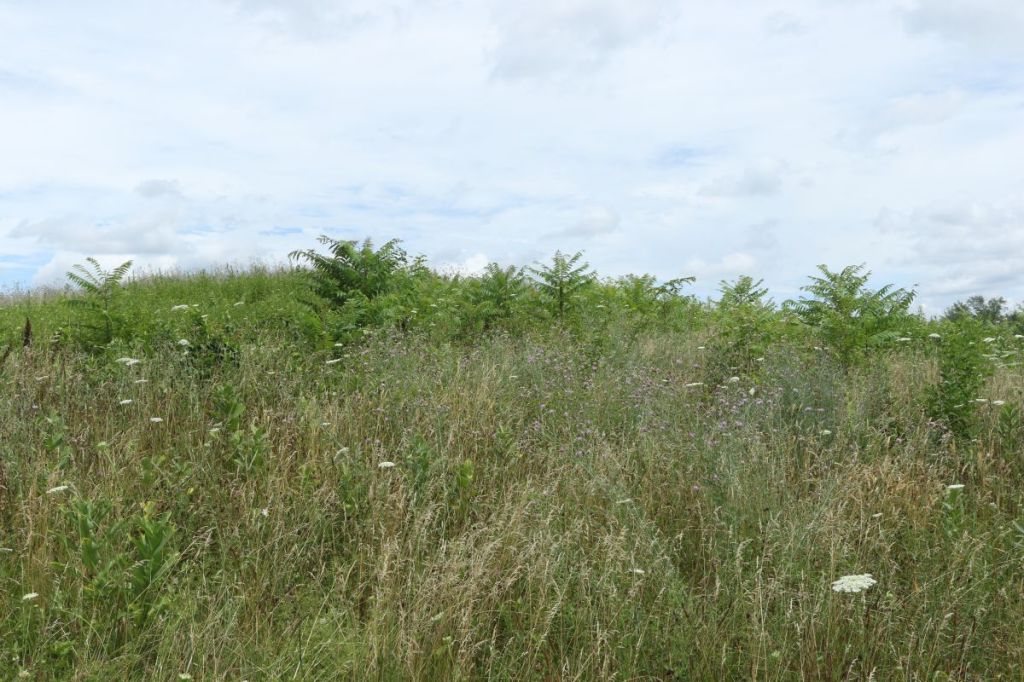
There were also larger patches of uncut vegetation, including this dry hillock north of point 4 and capped by sumach and knapweed.
This moister, unmowed block was located roughly north of point 5. Flowers included Queen Anne’s Lace (aka Wild Carrot) and Common Milkweed. The Rose Hill bioblock, where they are experimenting with organic production, is located just beyond this meadow, but we did not enter because it had recently been sprayed with organic pesticides.
This photo was taken looking north from point 6; a pond is hidden behind the bushes and surrounded by this wetter meadow.
We split up and circled around these ponds before rejoining for a quick lunch near the main parking lot and heading out for a final loop through the northwest section of the Farm.
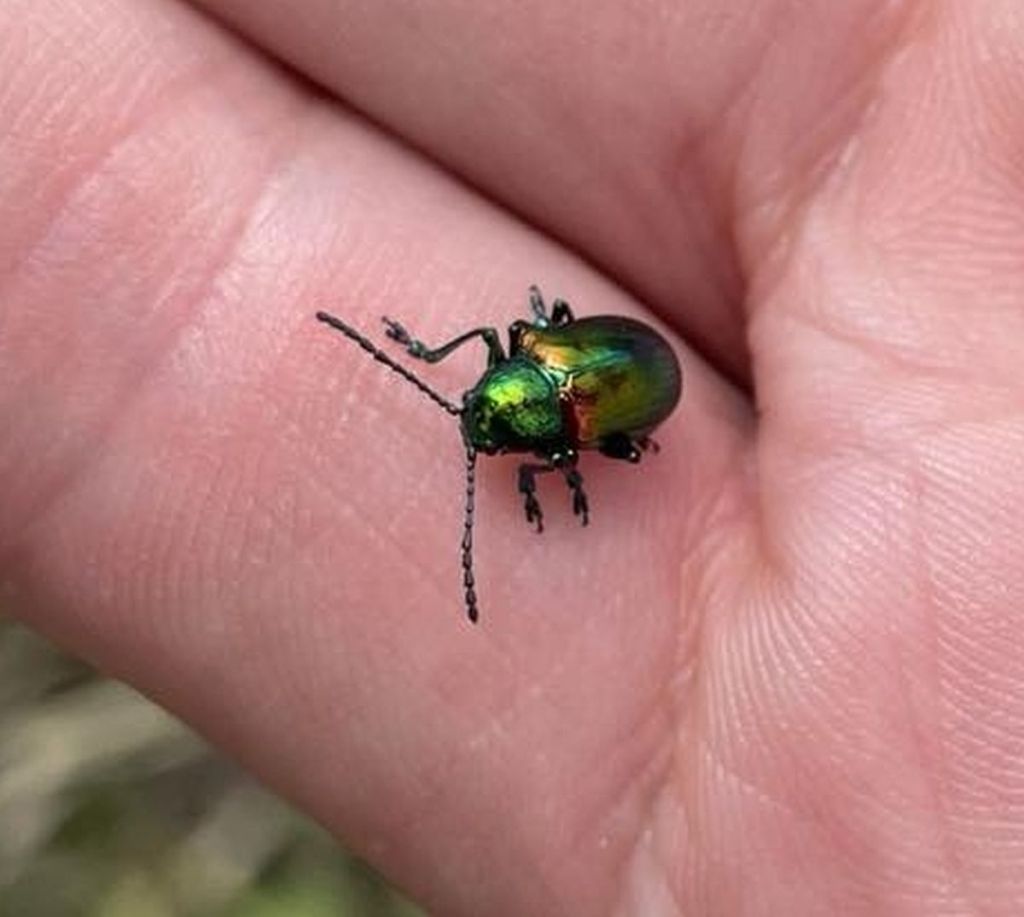
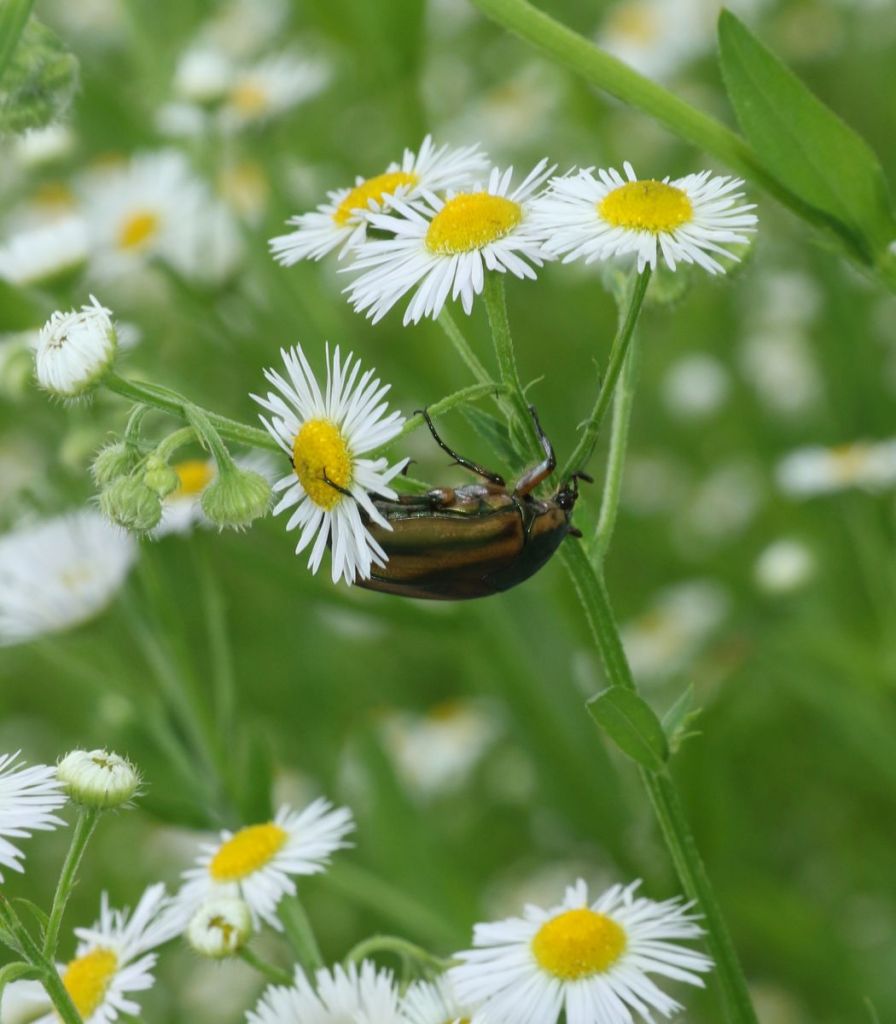
We’ll begin our ‘insect hodge-podge’ section with this species, the elegant, iridescent Dogbane Beetle, which we found hanging out in the Indian Hemp (a species of Dogbane).
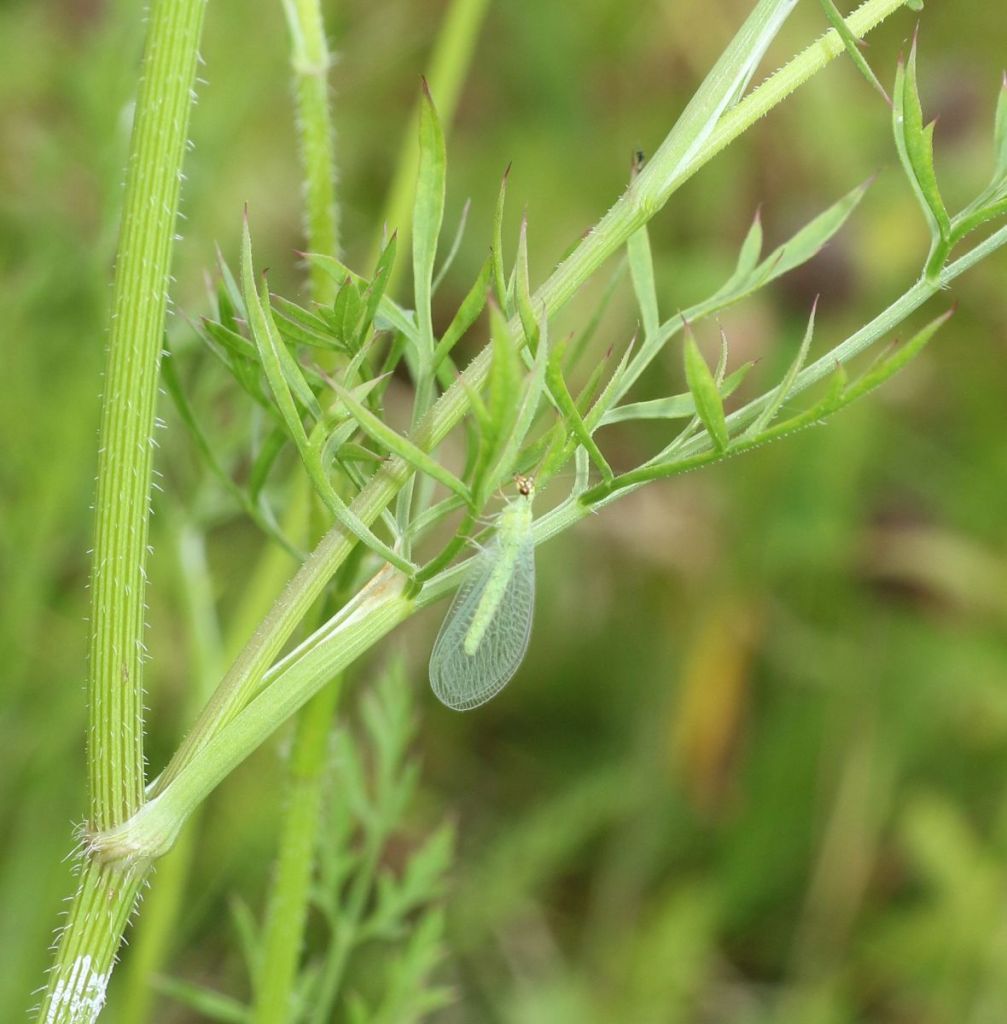
Lacewings are described as beneficials, largely because of their predatory larvae. One can even buy them commercially. However, we see their adults and larvae so rarely that it’s hard to believe that, in our region at least, they are usually having much of a demographic impact on pests. If you have observed otherwise, please let us know!
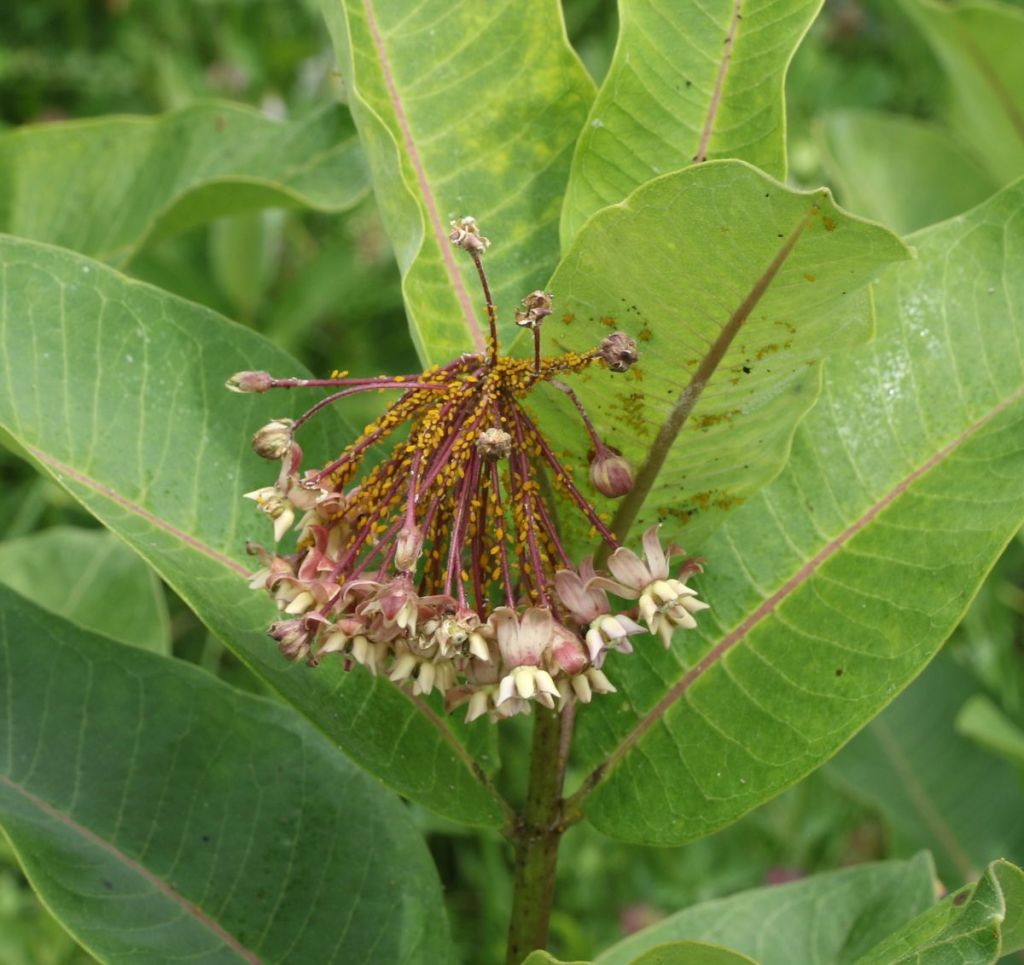
Crops aren’t the only plants afflicted by aphids – here Common Milkweed flowers appear to sag under their aphid load.
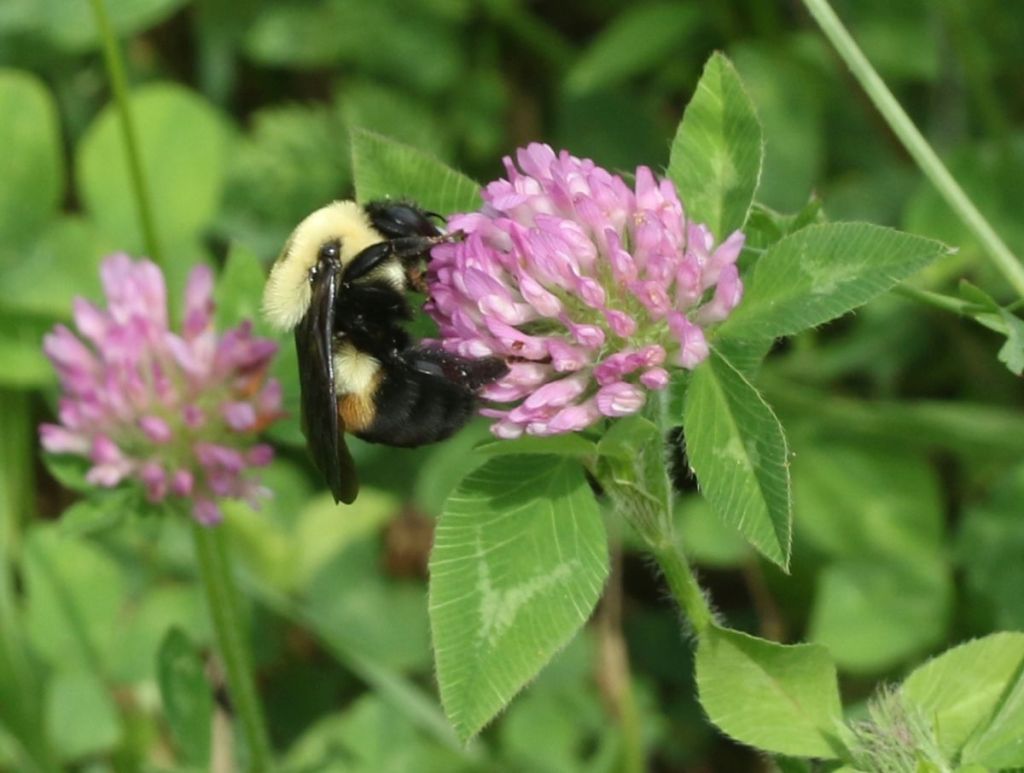
Honey Bees were the most common bee we observed (not surprising, given the on-farm bee hives), however we did observe some other bees including this Brown-belted Bumble Bee (Bombus griseocollis) and this…
This is a Giant (or “Sculptured”) Resin Bee. I was rather baffled by this bee, and do not recall having seen it before. This is an Asian bee that was apparently accidentally introduced to the US in the early 1990s; it now occurs throughout most of the East Coast. It is solitary and makes its solo nests in wood cavities. It apparently doesn’t make its own excavations, and so sometimes uses the holes pre-drilled by our native carpenter bees.
Dragonfly and damselfly diversity was not particularly high, perhaps because of the presence of fish. Among the species we noted were the following:
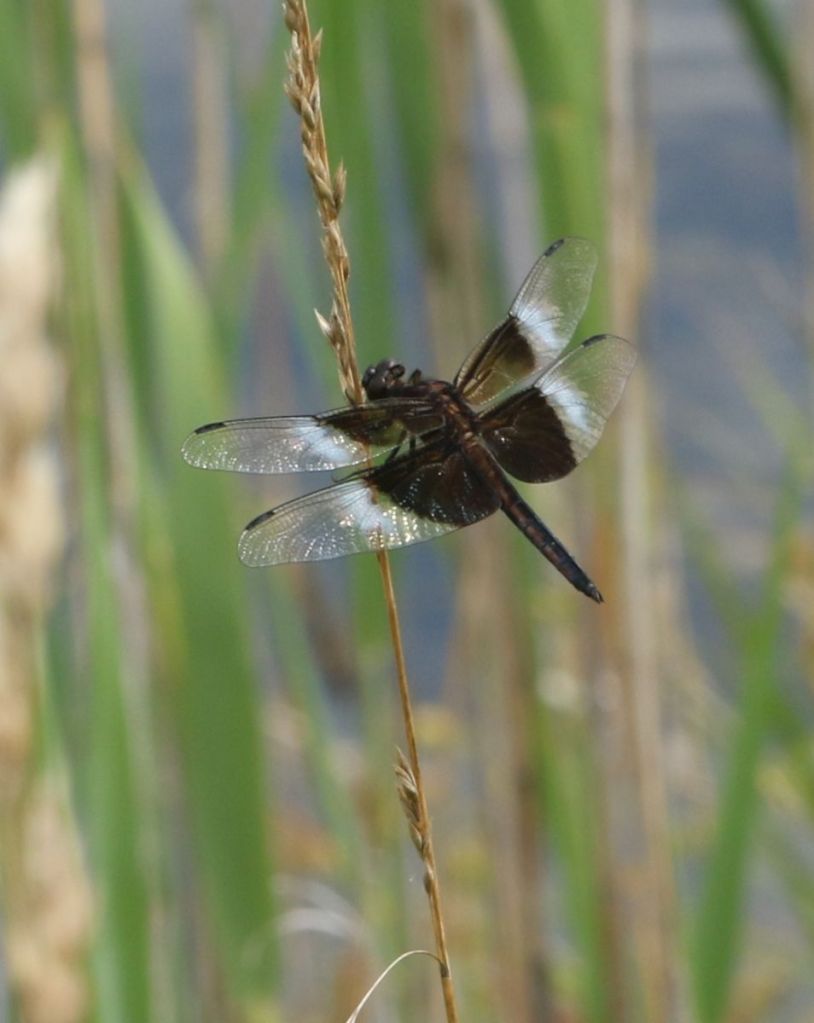
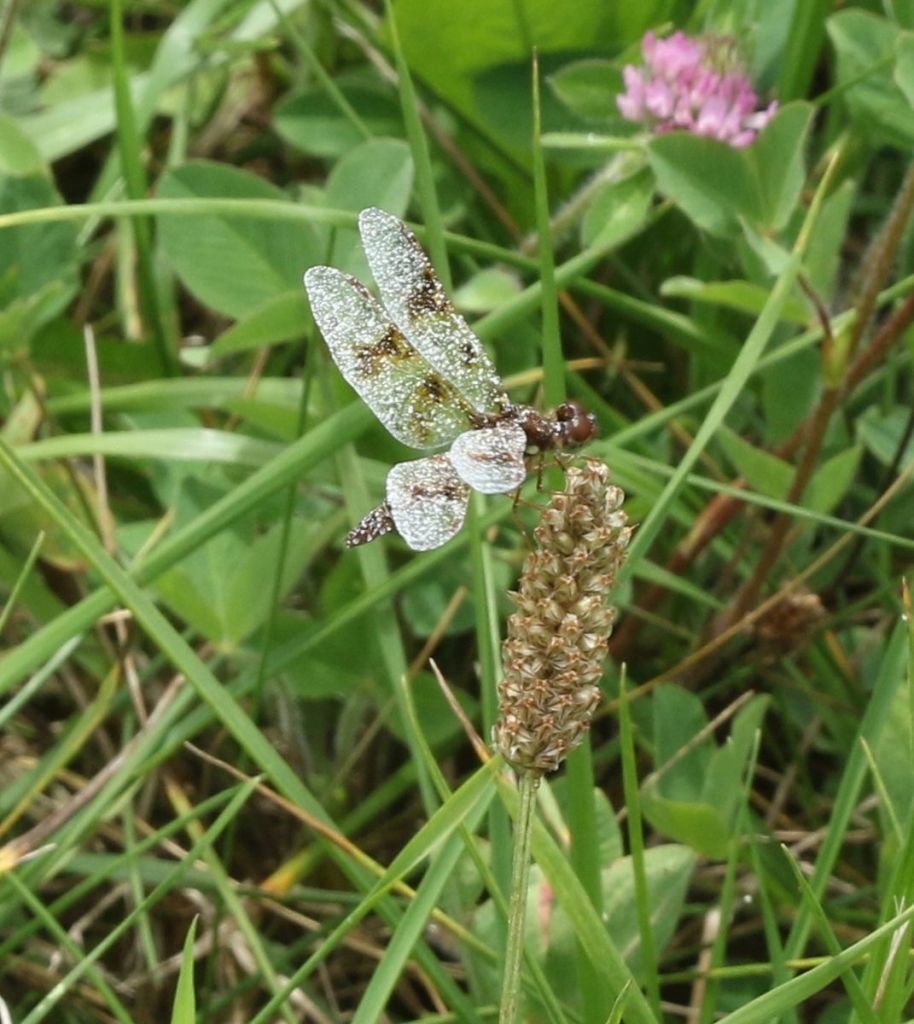
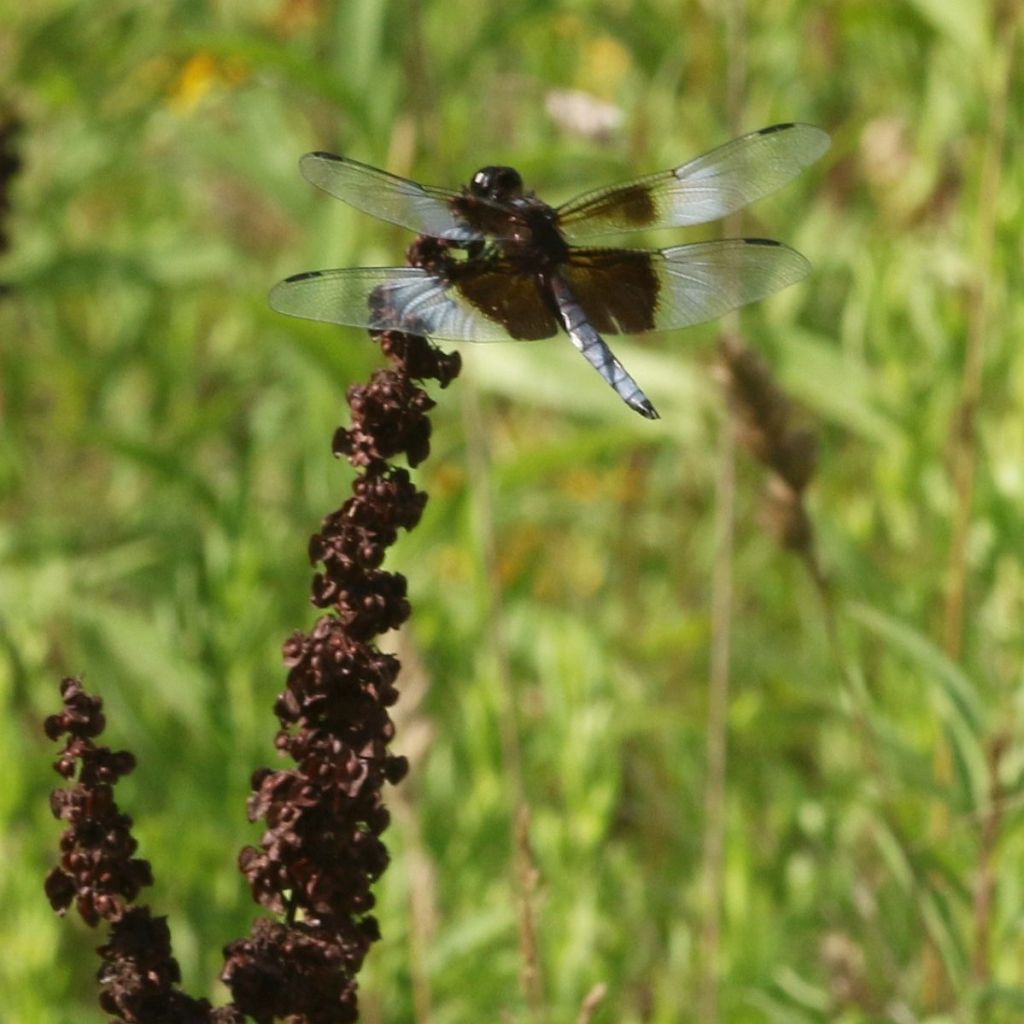
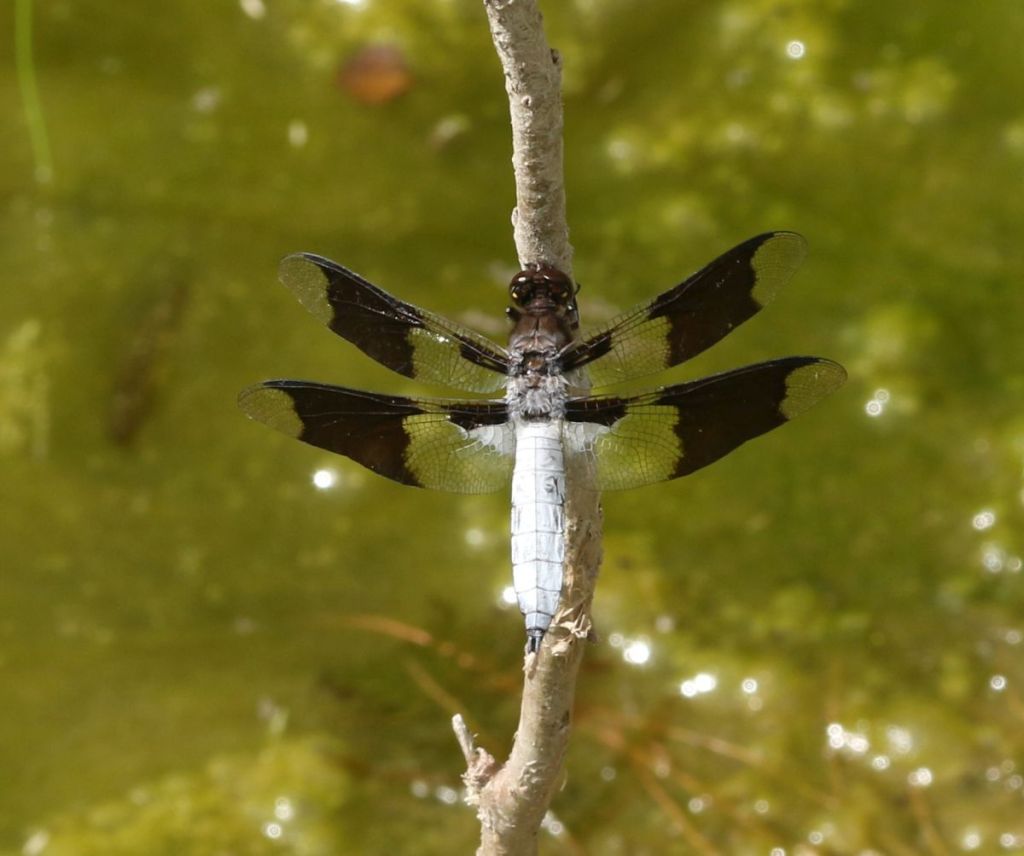
The common, widespread Widow Skimmer; this mature male shows the characteristic black wing bases fringed with white frosting.
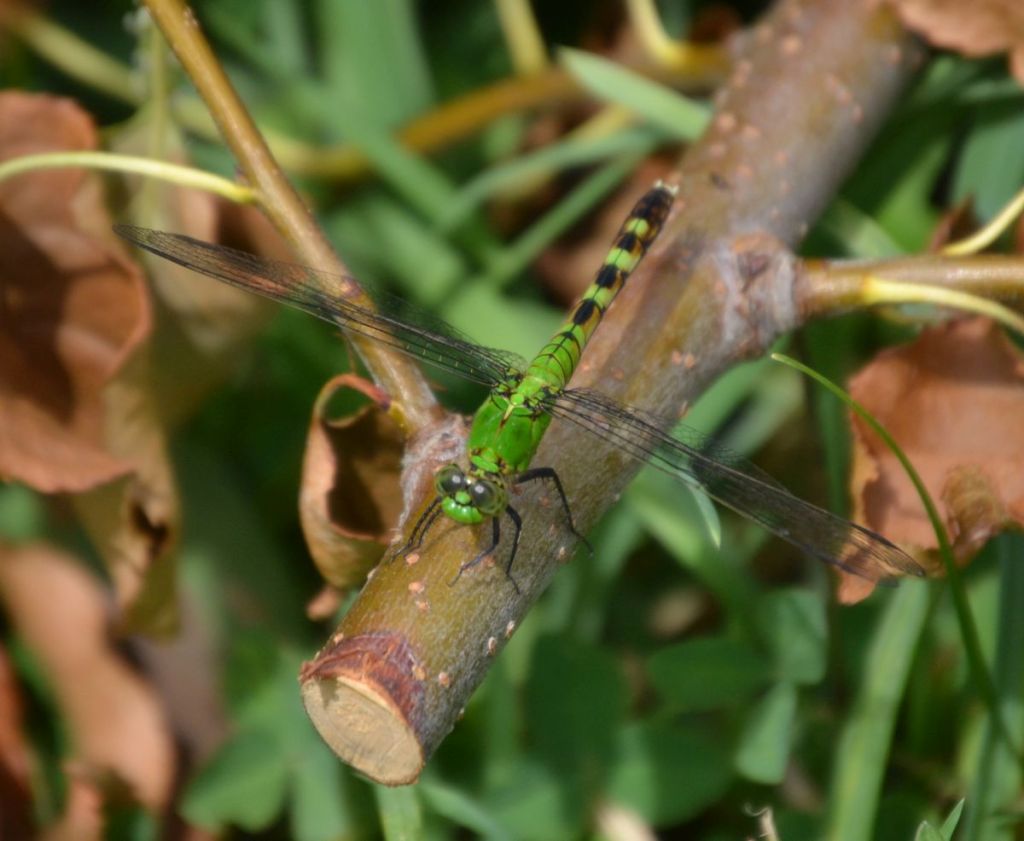
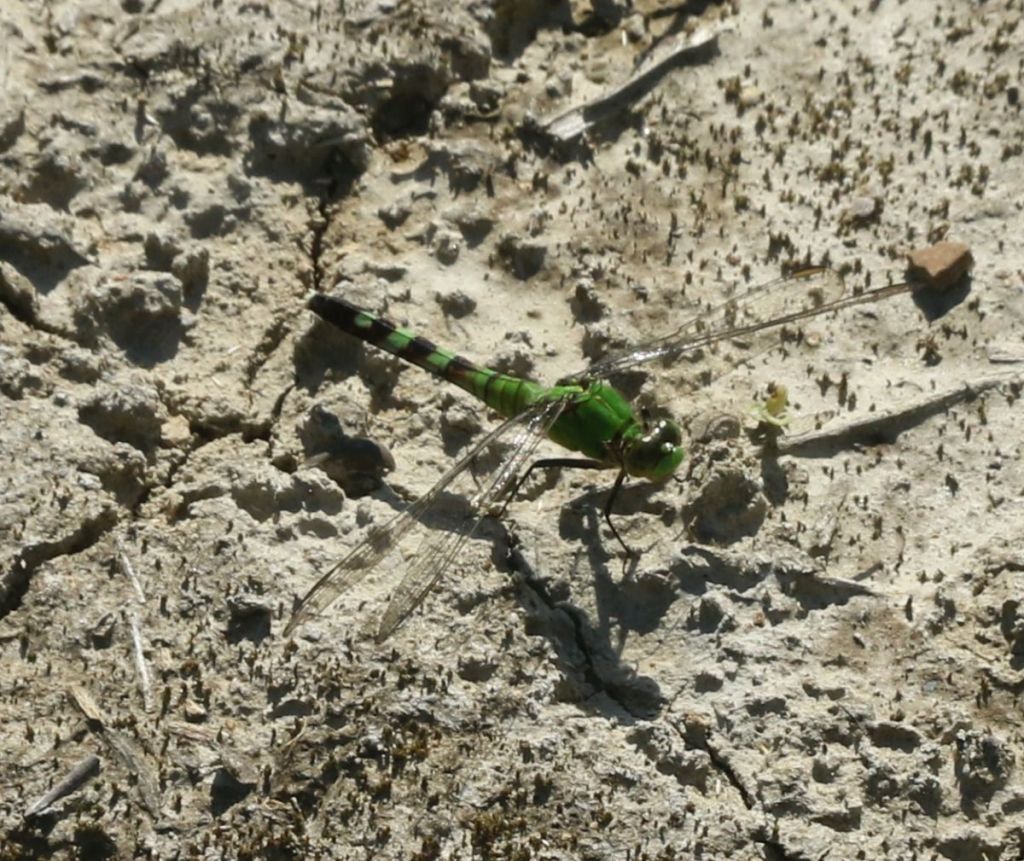
This bright green beast is a female Eastern Pondhawk; she’s really our only dragonfly with such a vibrant green coloration.
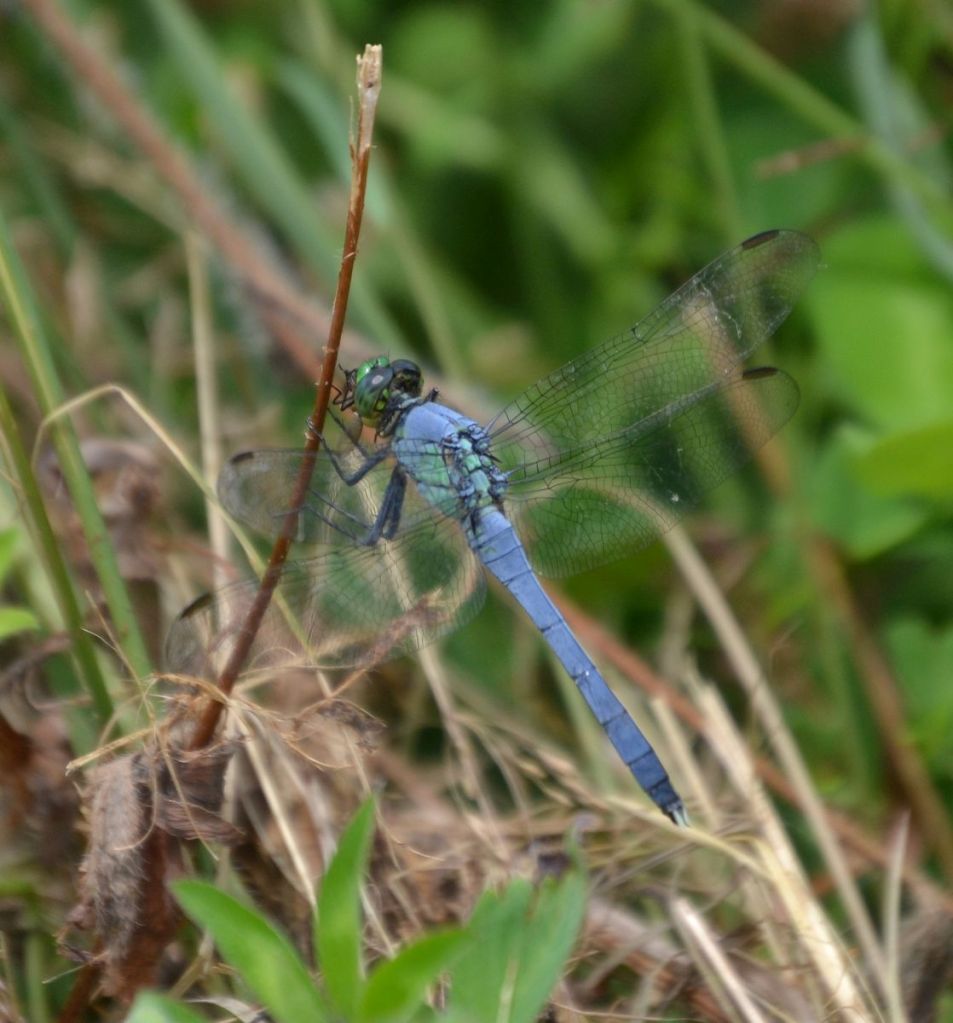
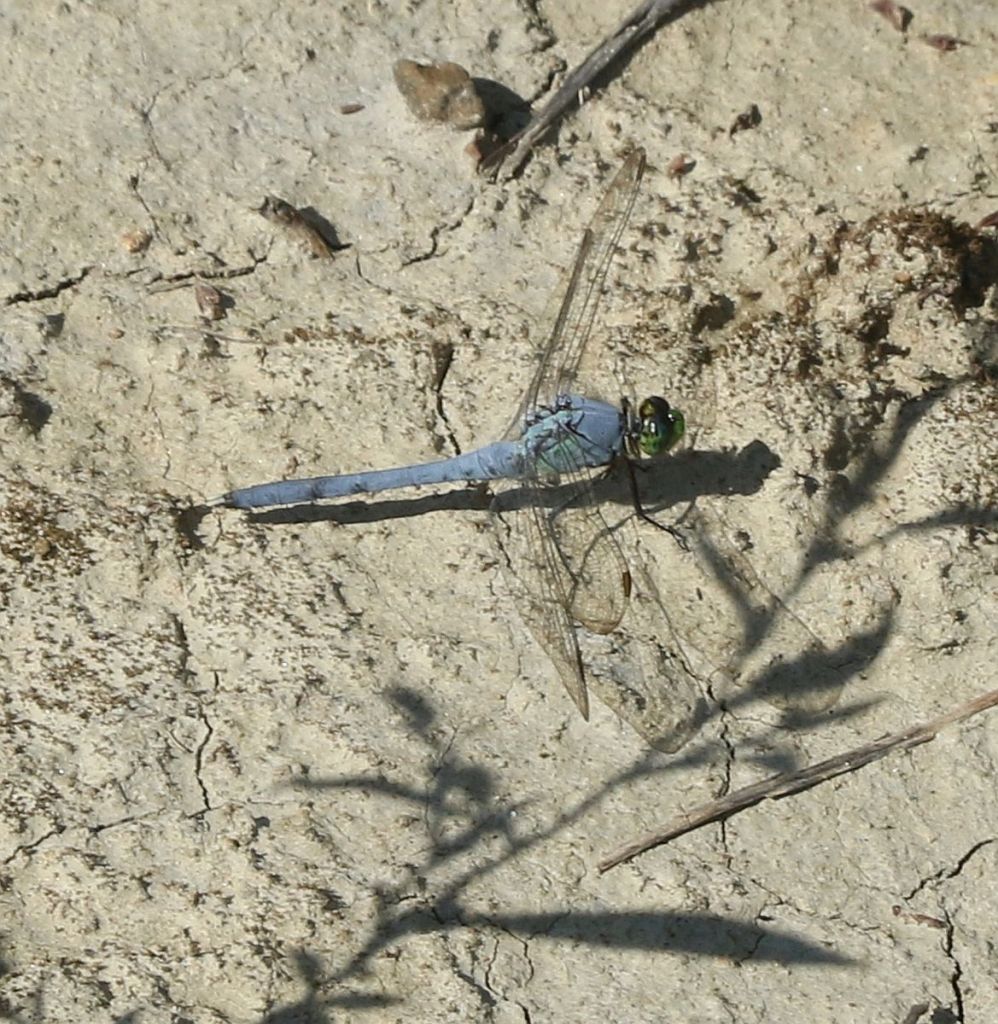
The maturing blue male of the Eastern Pondhawk, both sexes have that white tail tip.
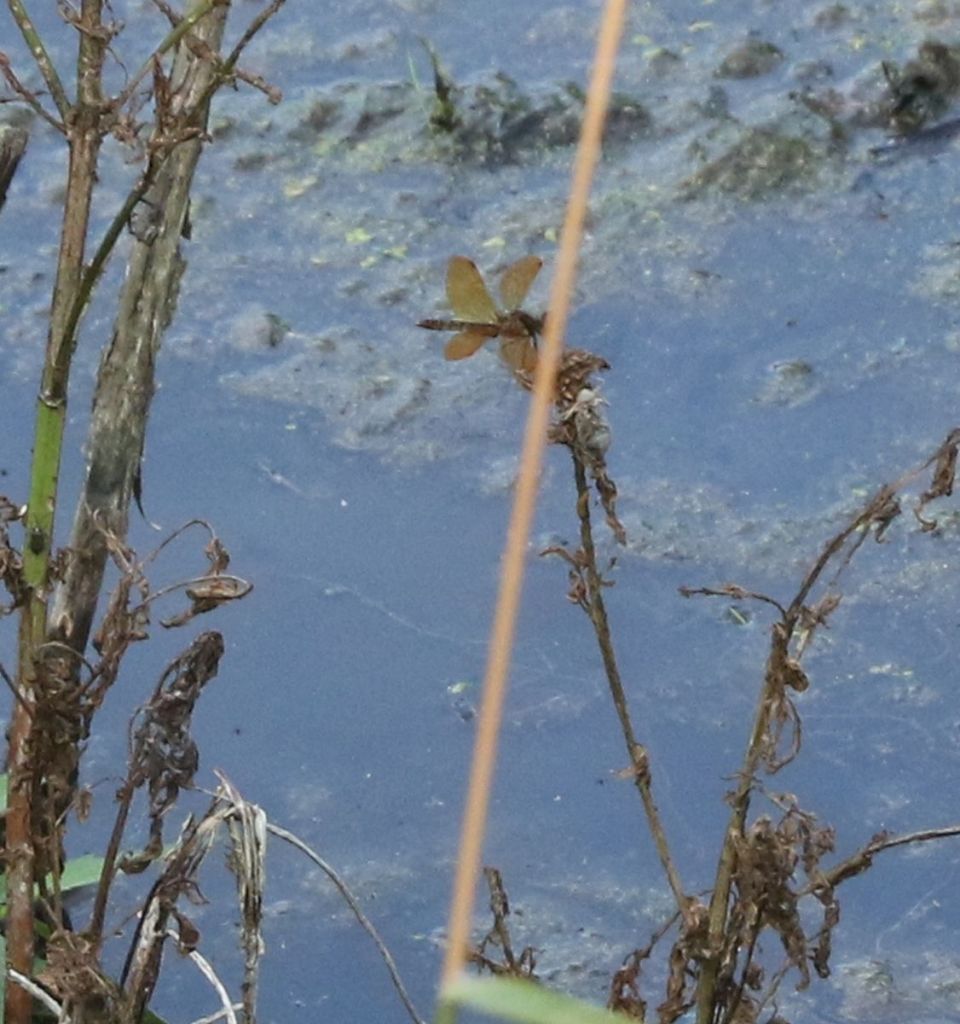
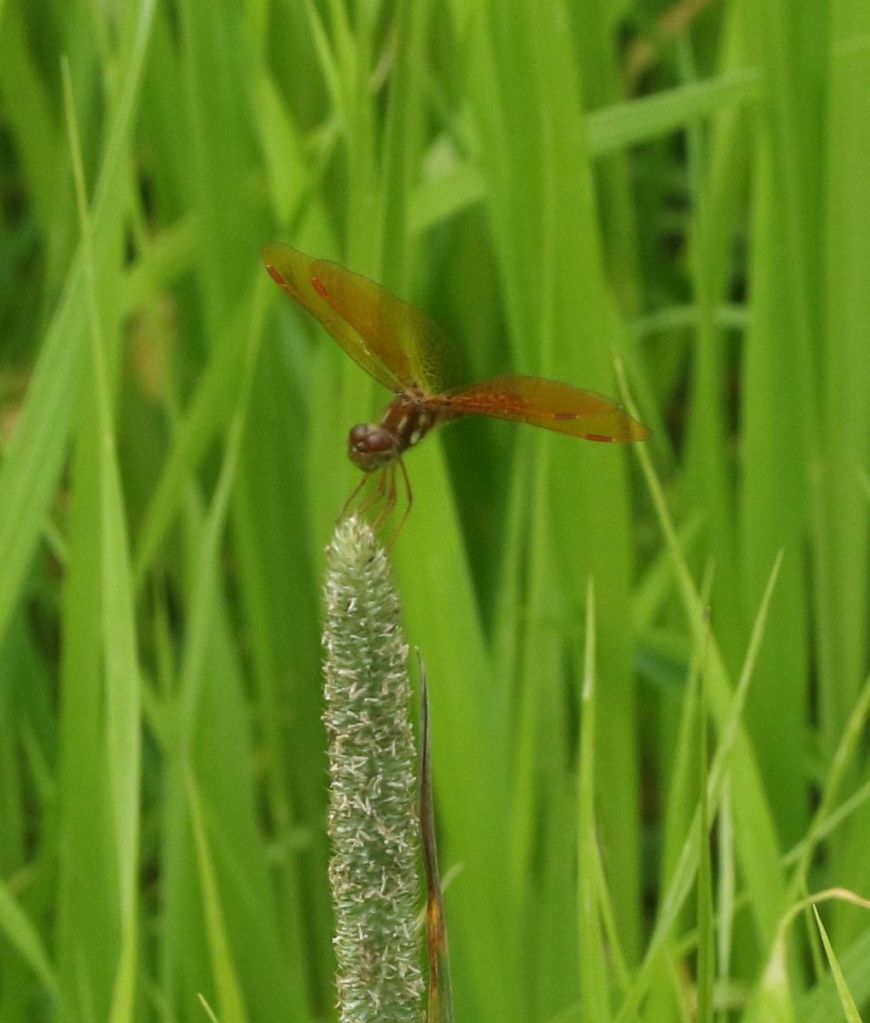
Sorry for the ‘headless’ photograph, but at least this image shows the distinctive orange wings of the male Eastern Amberwing.
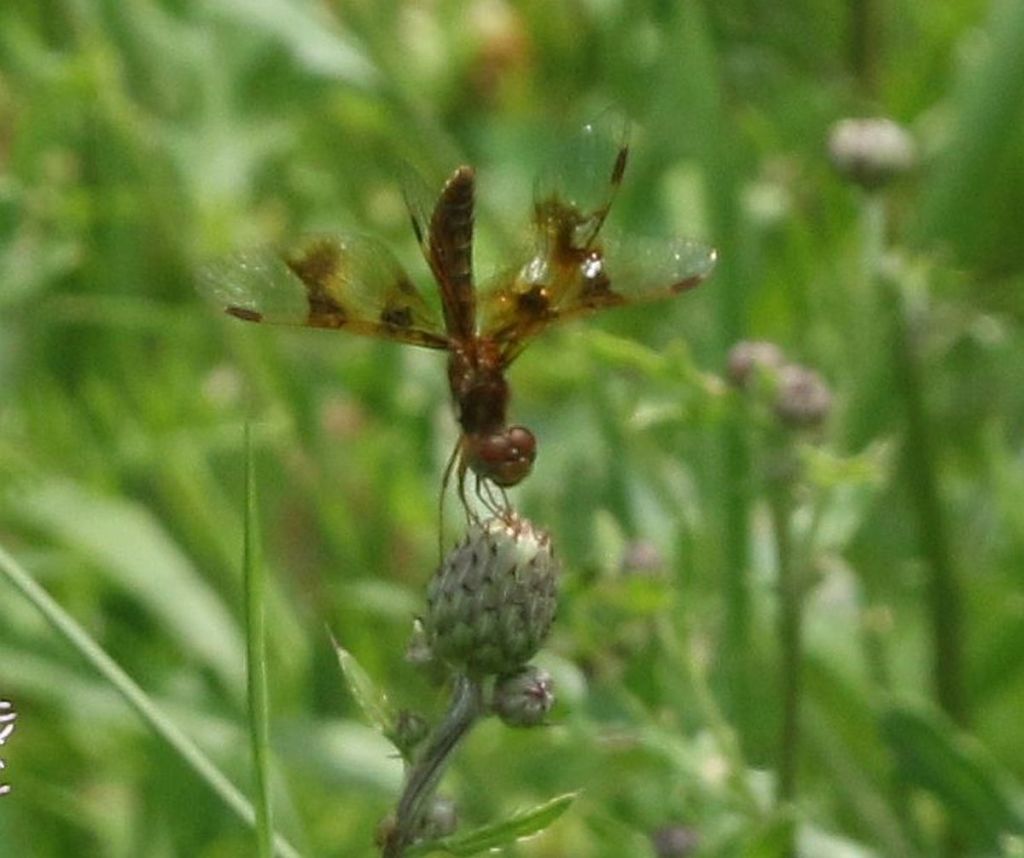
It appears that this female Eastern Amberwing may have flown too close to the clay sprayer. In organic orcharding, a clay compound is used to coat fruit with a protective clay layer.
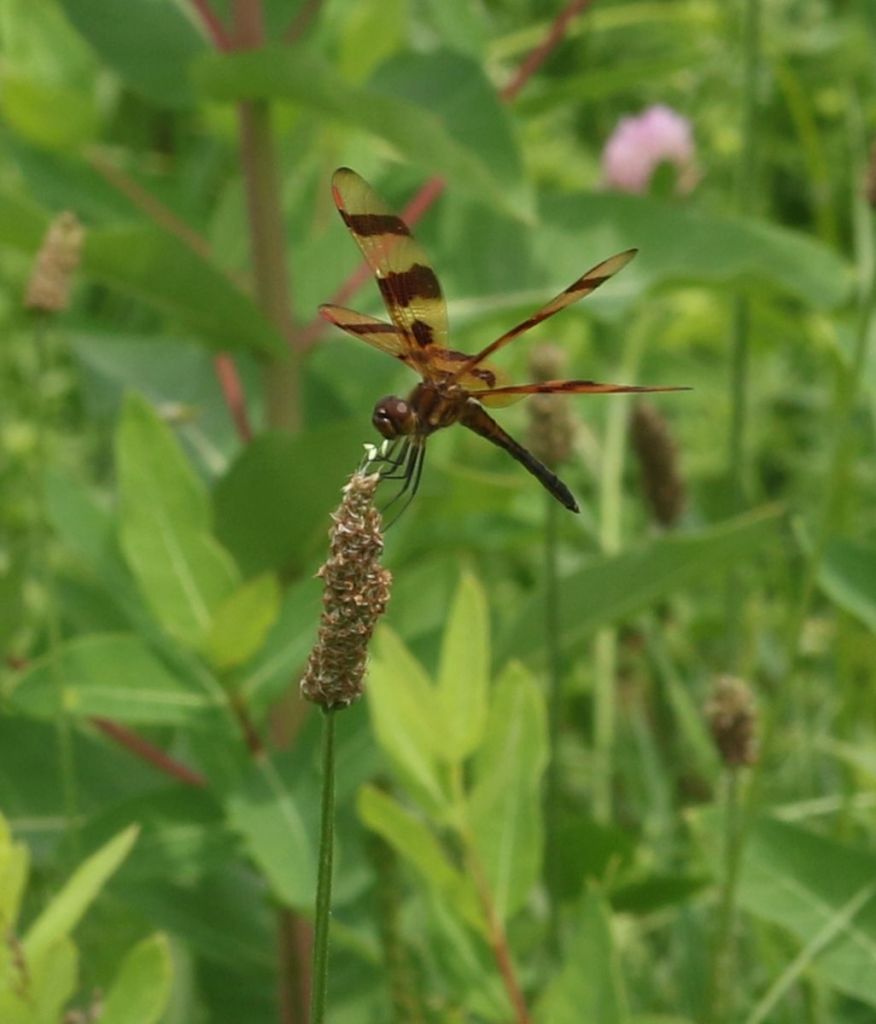
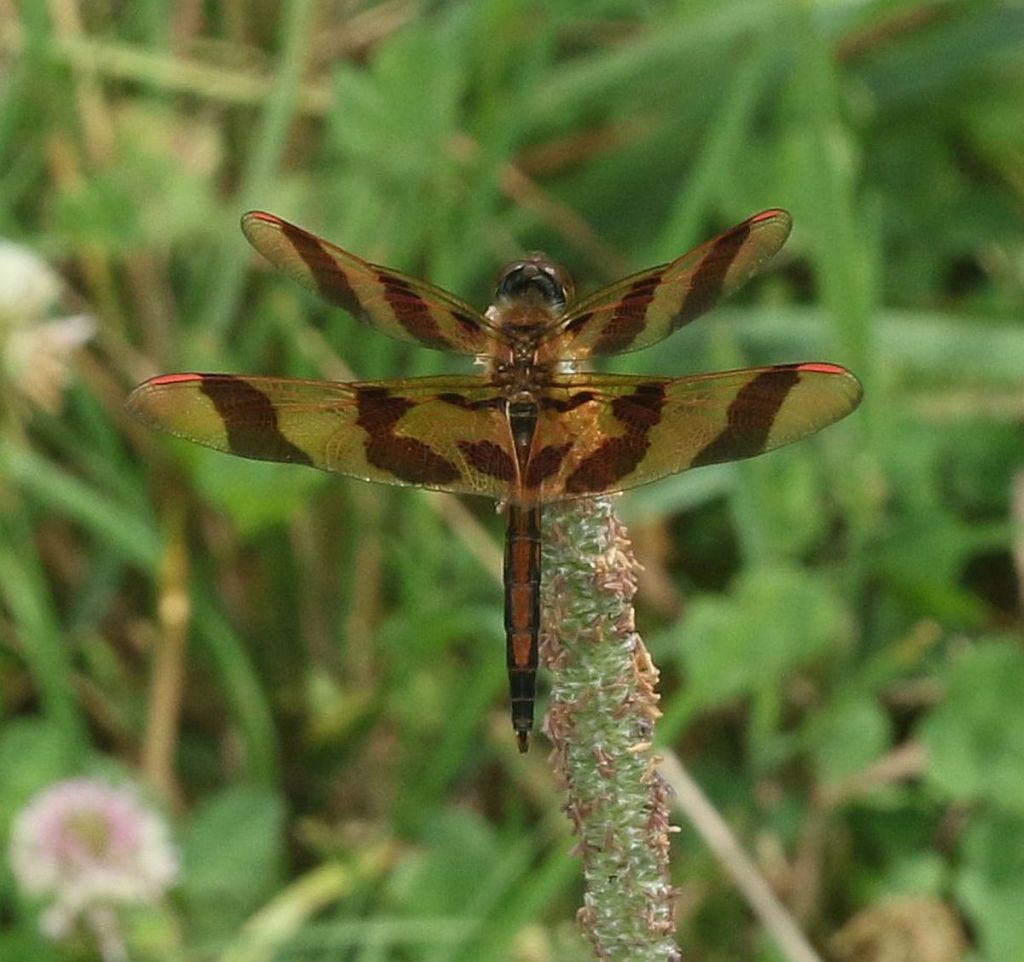
The colorful Halloween Pennant is common in our fields at this time of year.
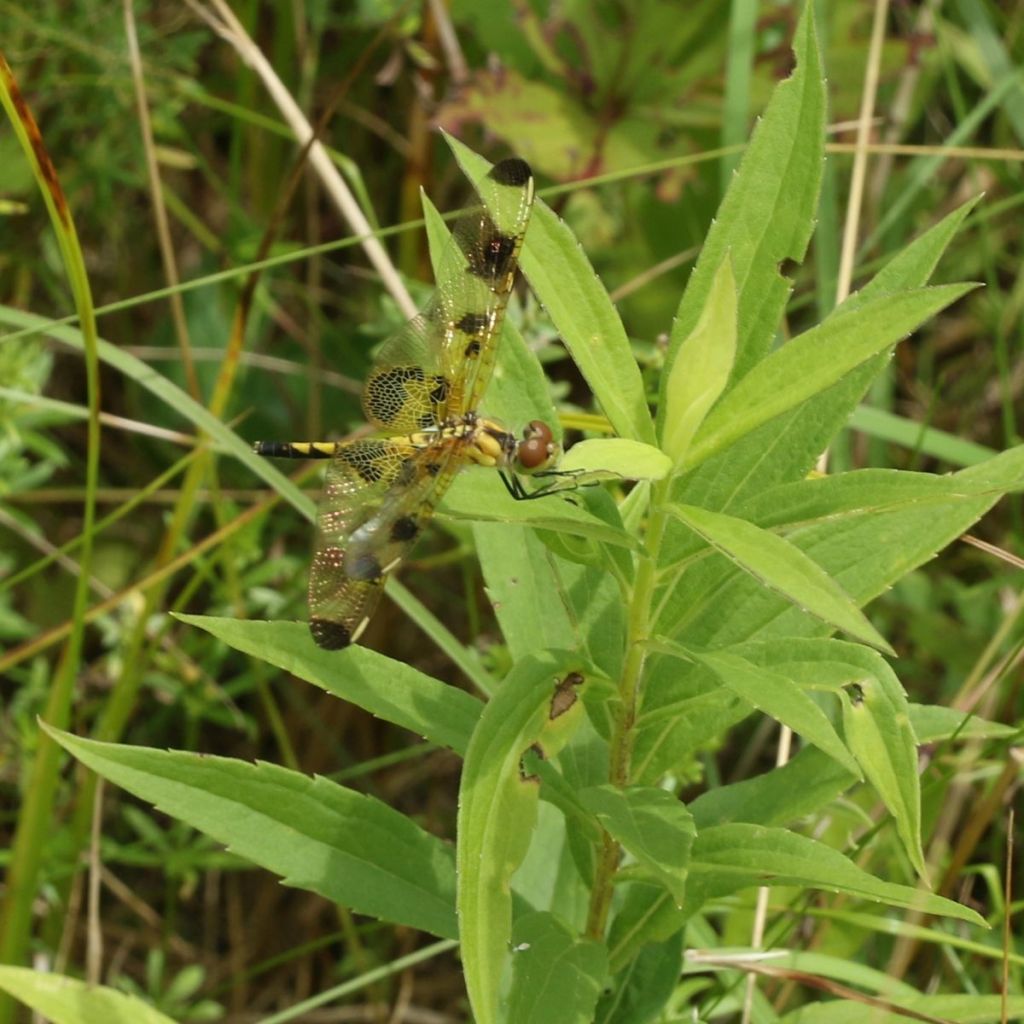
For longer than I should have, I mistook this for the preceding species because of its similar size, behaviour,and orange-yellow coloration. However, note the different patterning of the dark dots on the wings. This is a Calico Pennant, whose females and young males look like this. Mature males are…
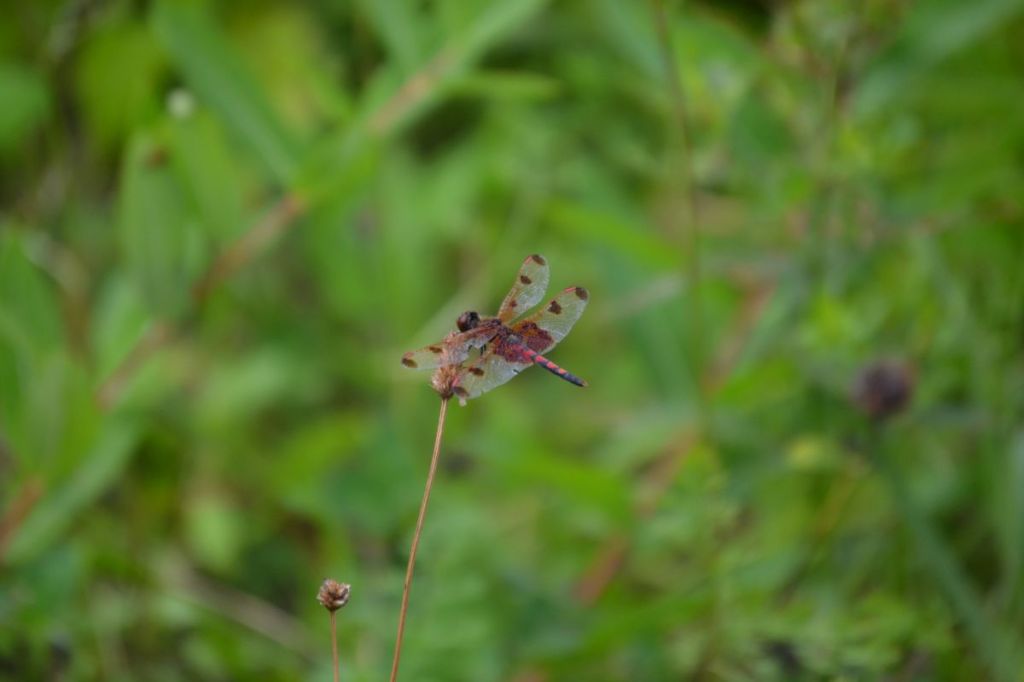
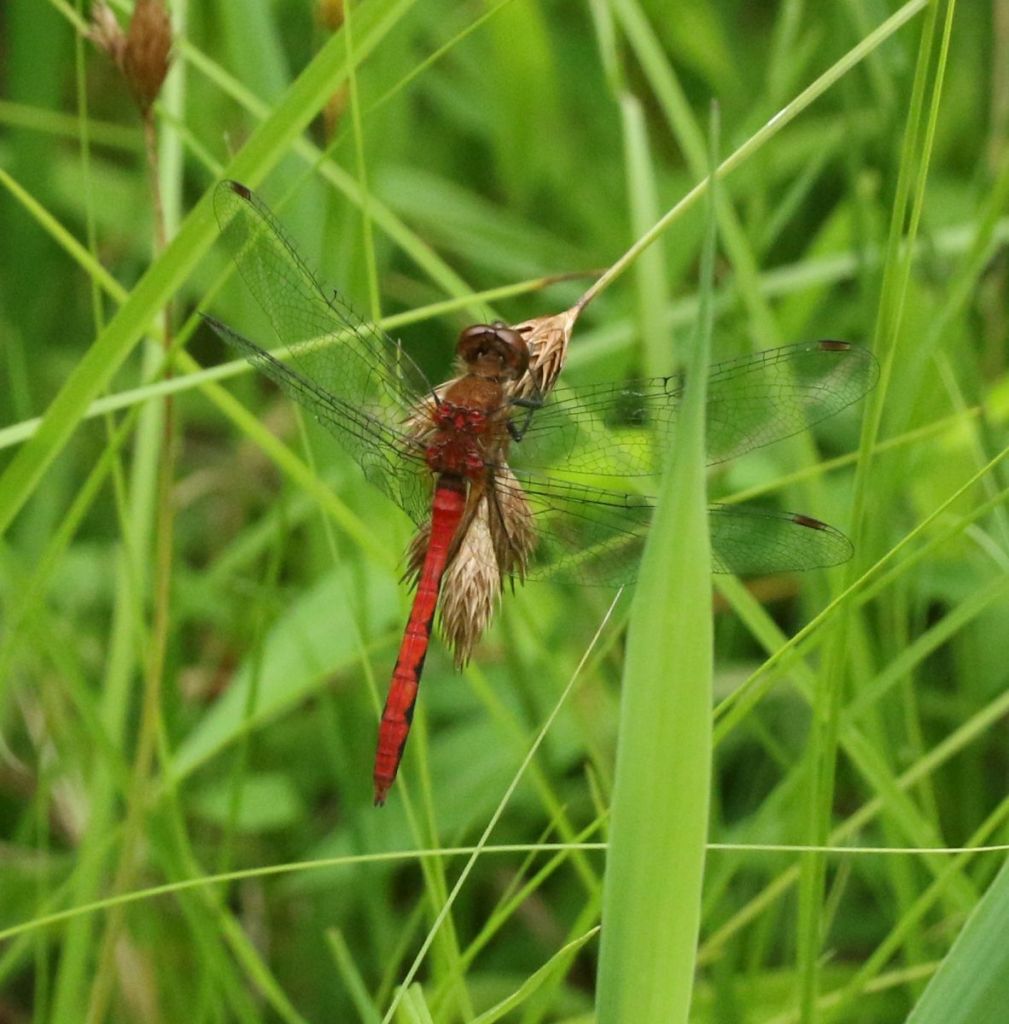
a distinct red (but don’t mistake them for Meadowhawks!).
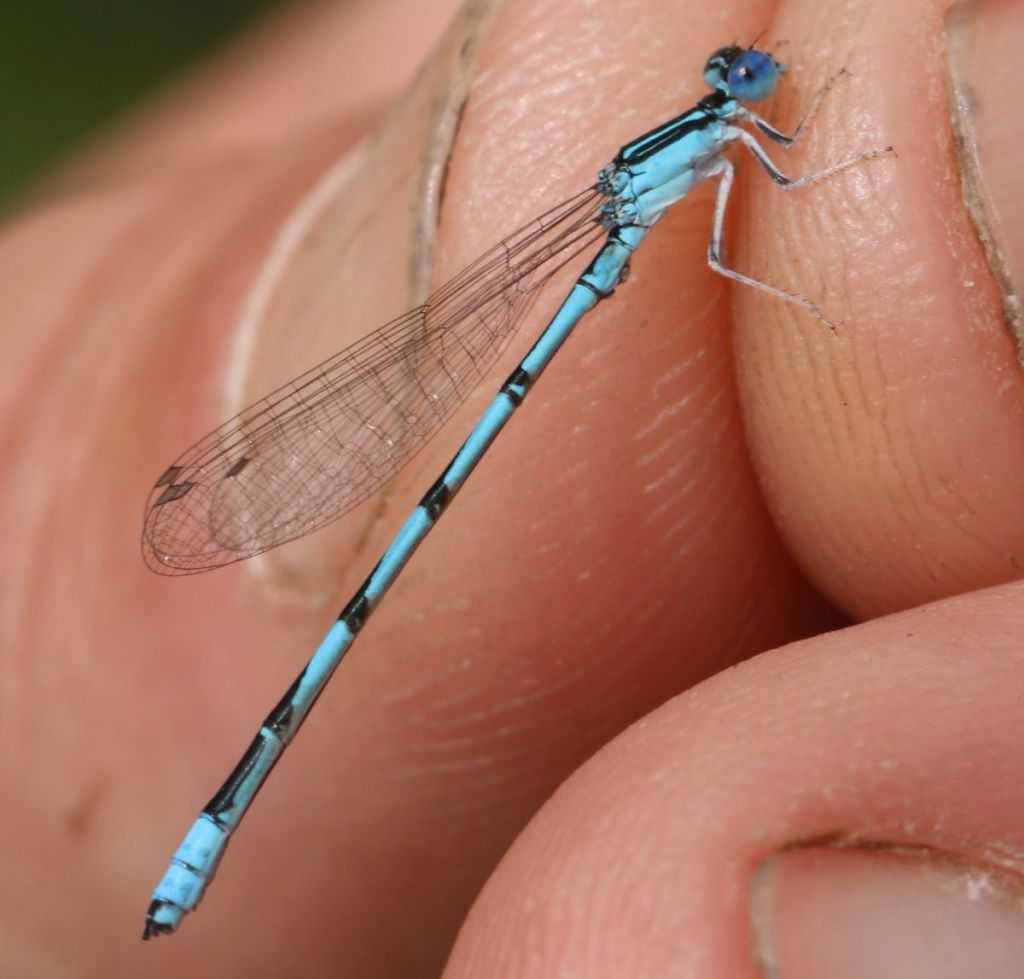
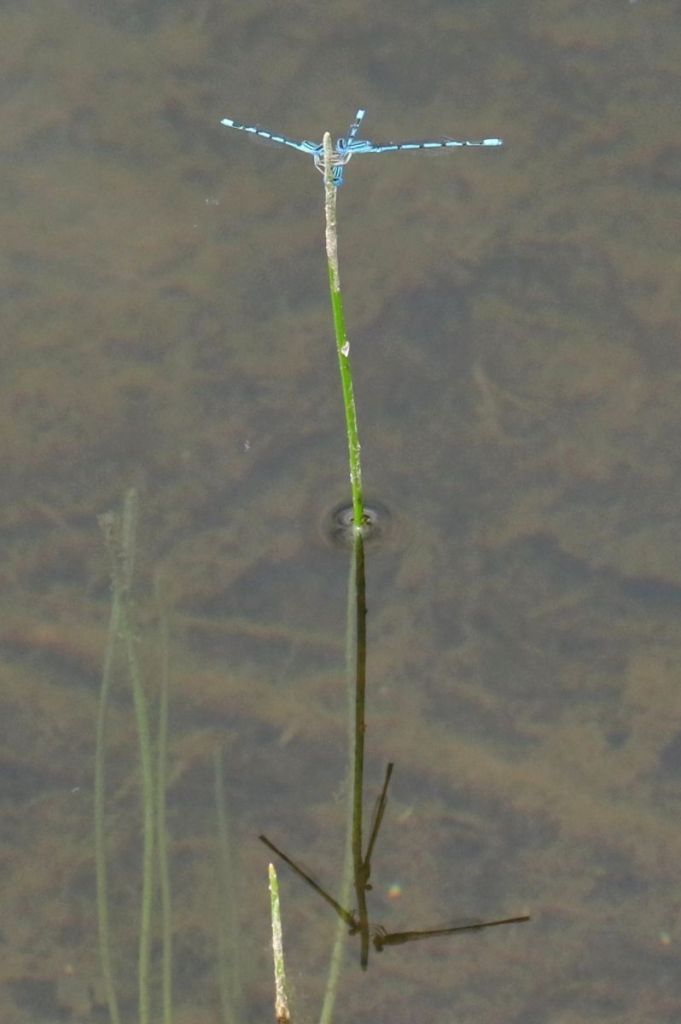
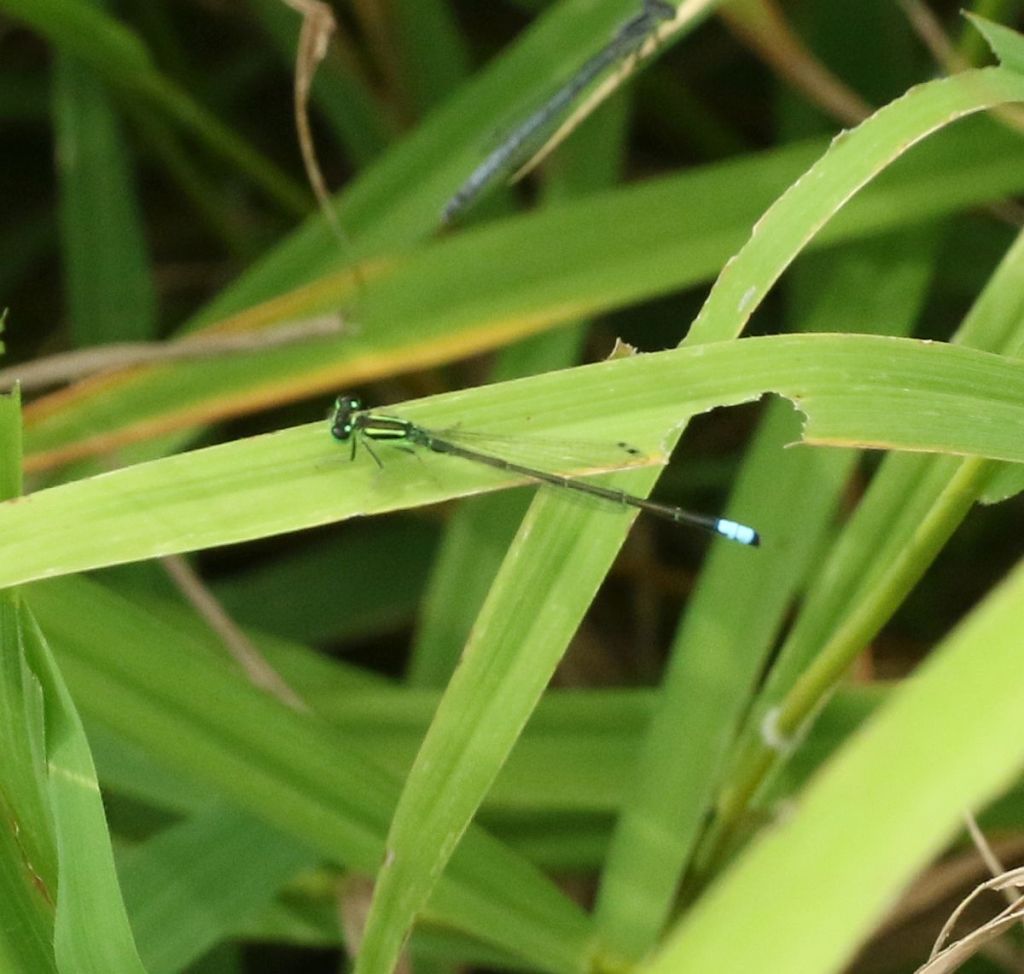
Damselflies, such as this bluet, tend to be smaller and thinner.
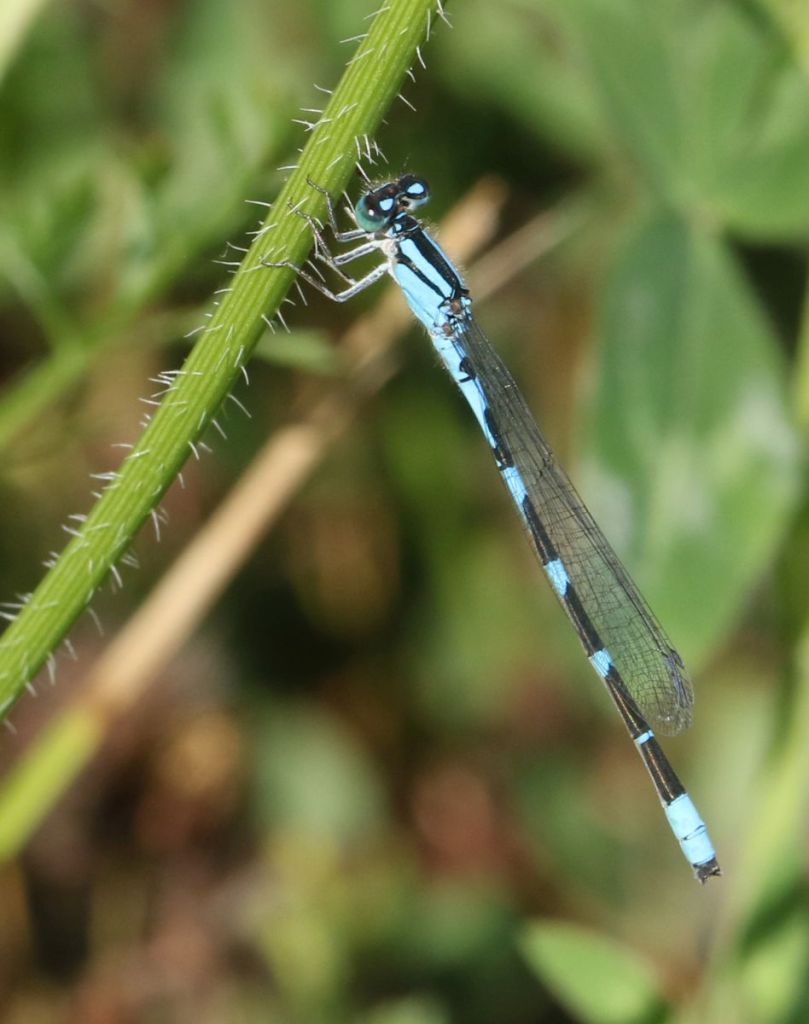
One of the key characteristics for identifying these insects is the shape of the so-called claspers – the structures that the males use to grasp the females behind the head. Because that physical pairing is a integral part of the mate bonding, clasper structure tends to be unique, perhaps creating something like a lock-and-key with the architecture of the female. The shape of these claspers (together with features of its coloration) suggest that this is a Familiar Bluet. As the name suggests, this is a common species; it found throughout almost the entire continental US.
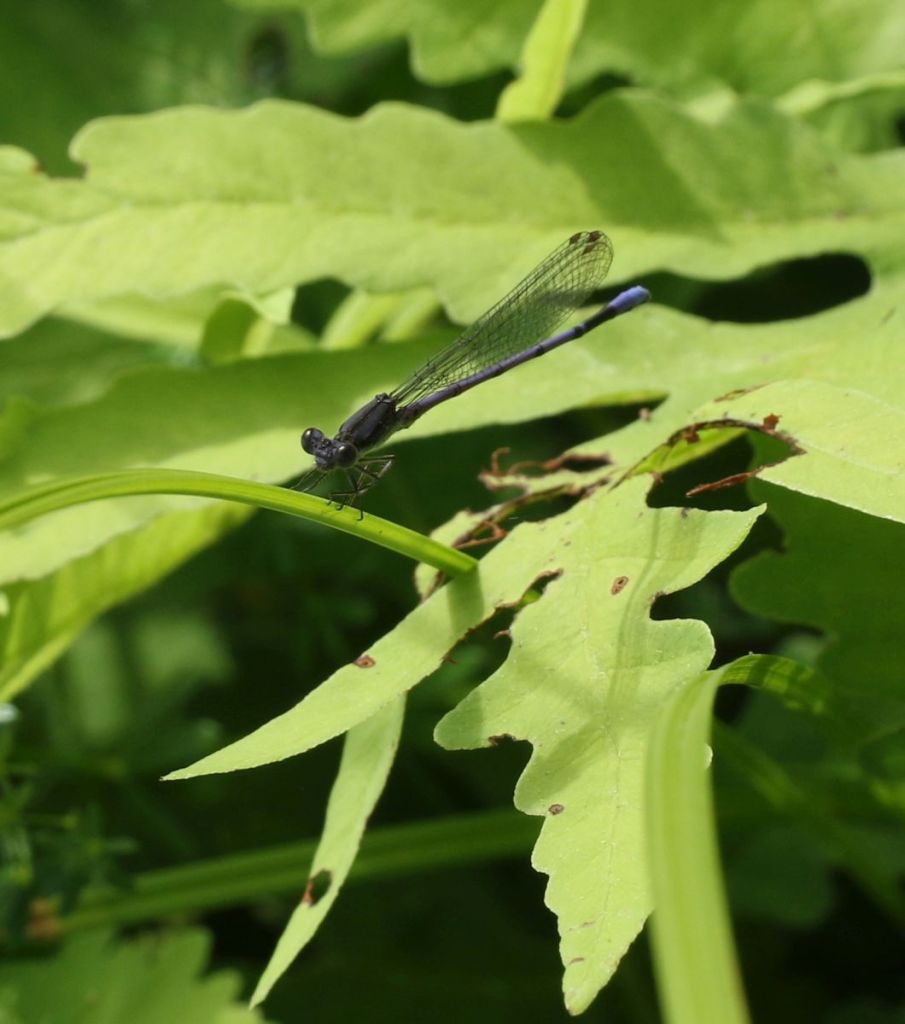
The purplish hue of this damselfly earmark it as a Variable Dancer. This another relatively common species, with the core of its distribution in the eastern US.
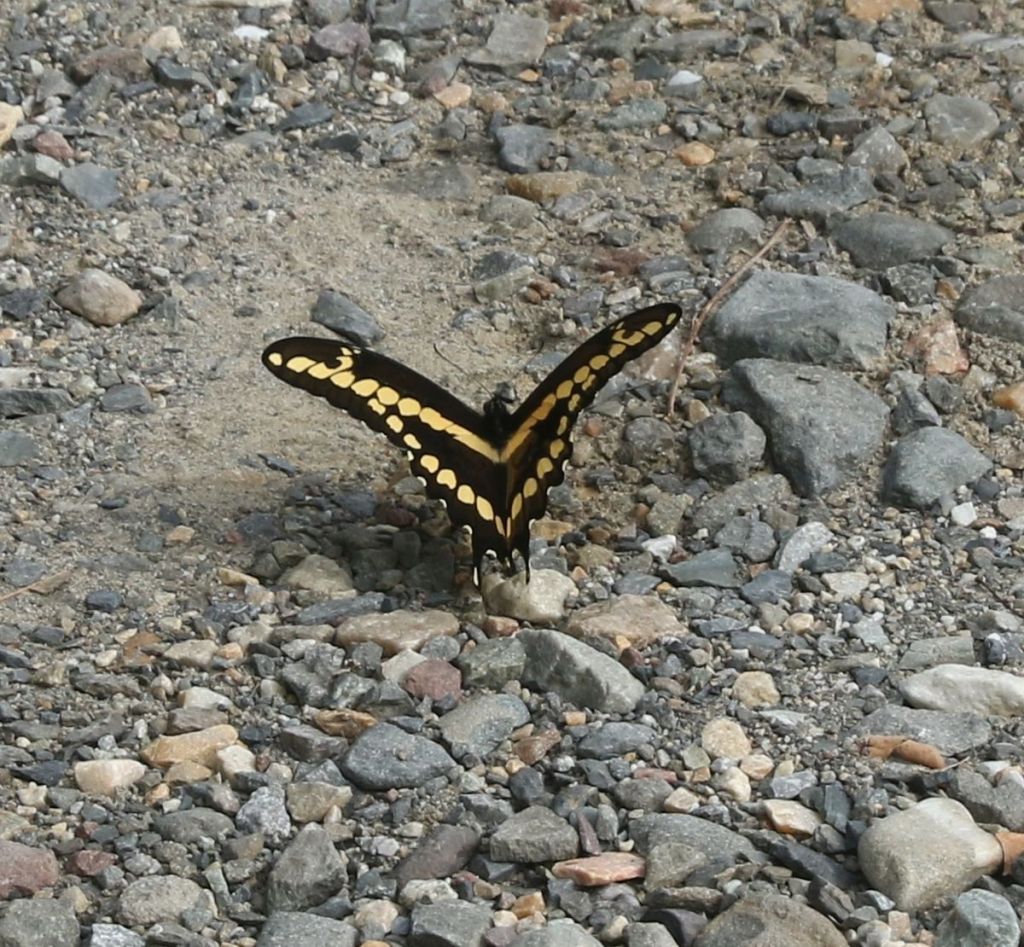
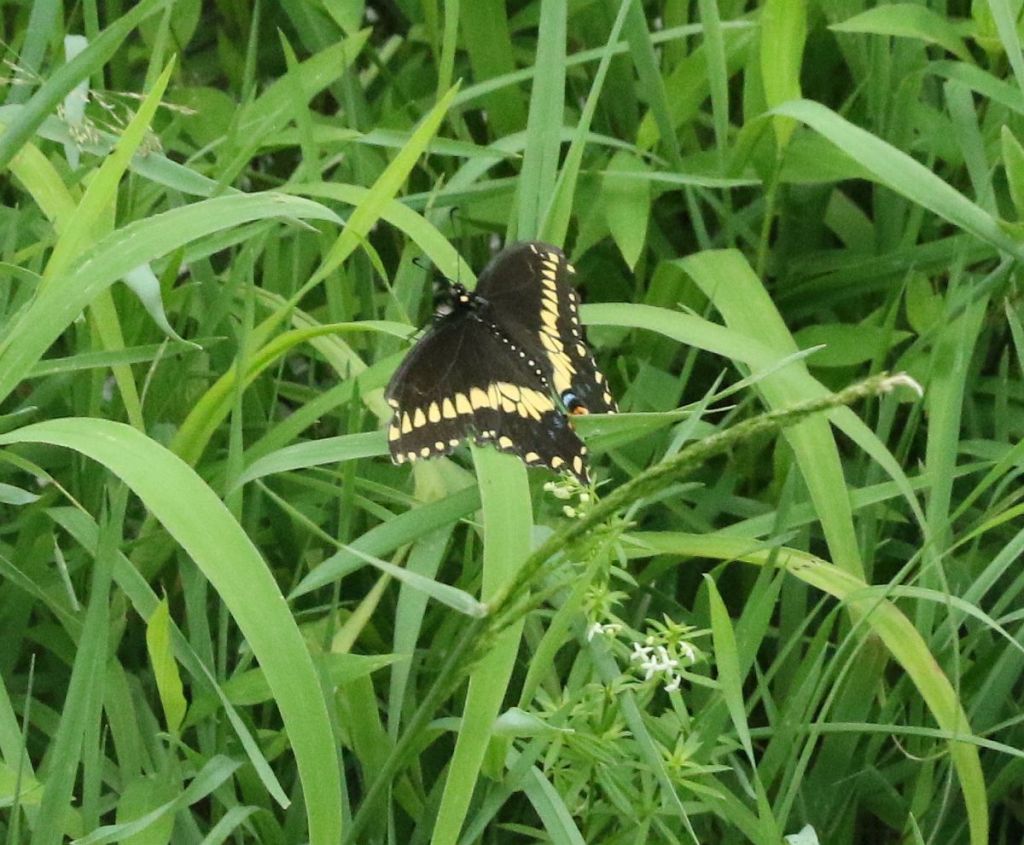
Turning to the butterflies, we were welcomed to the parking lot by a Giant Swallowtail. As the name implies, this is our largest swallowtail species. Unique among our species, it appears to be yellow with black markings below and black with yellow markings above. This is a southern species that occasionally comes north in greater or lesser numbers. This years seems to be a relatively good one for it, as we have noted it at various locations. Its only regional caterpillar foodplant (outside of some garden exotics) is probably Northern Prickly Ash, a sparsely distributed species in our region.
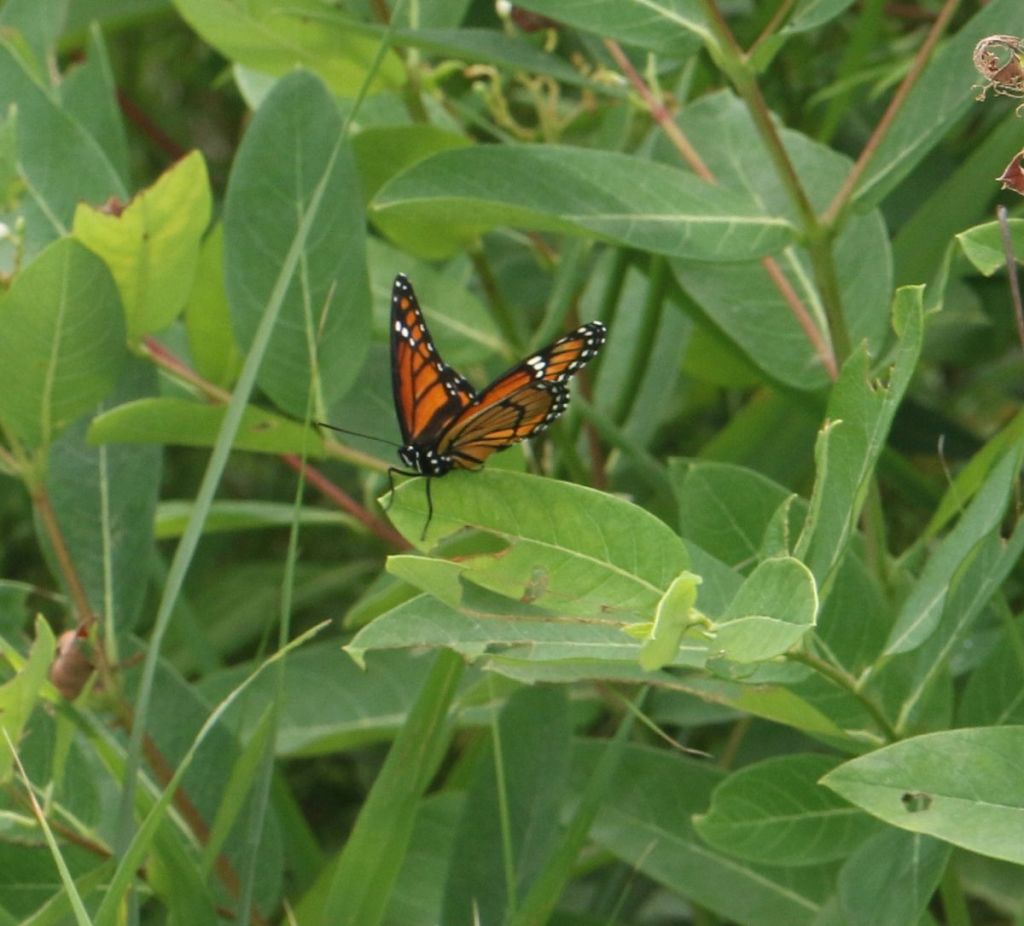
A Viceroy hanging out on Indian Hemp, as documented below…
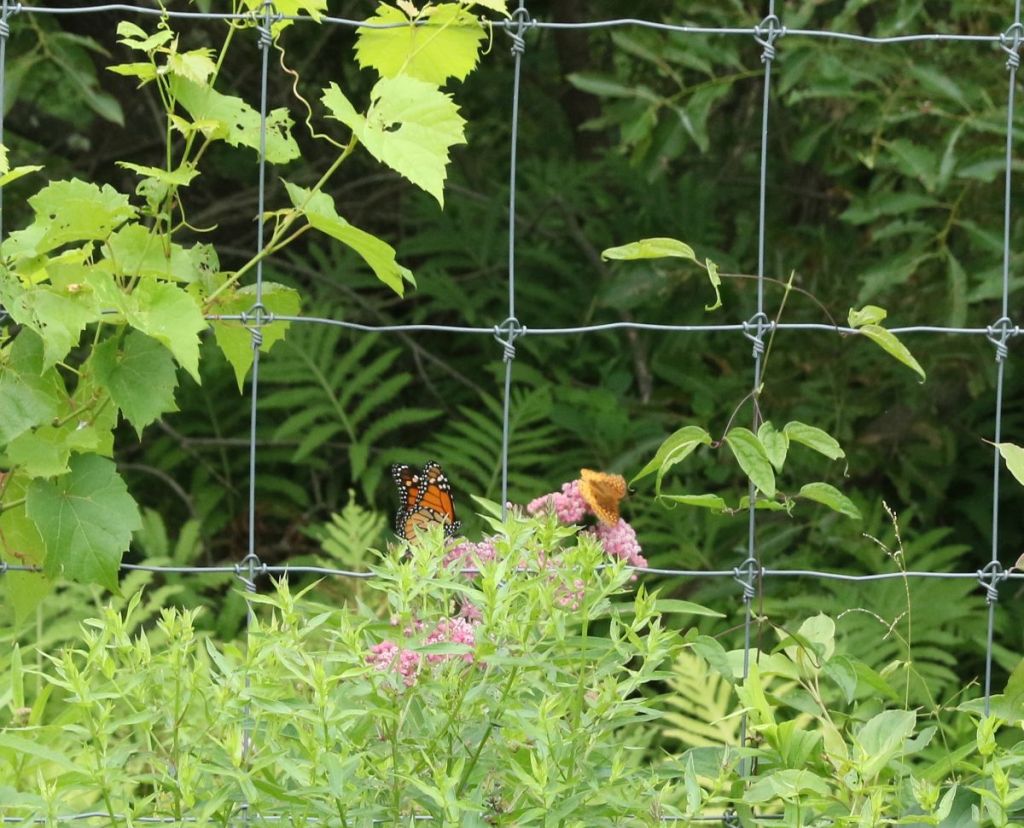
its look-alike, the Monarch, was also present. It was once thought that the palatable Viceroy mimicked the distasteful Monarch. It is now believed that both are distasteful and so reinforce each other’s warning coloration. Here, a Monarch visits milkweed in the wet meadow of the southwest corner. Also present in this photo is..
what appears to be a Great Spangled Fritillary. Last year was a banner year for this species, they seem noticeably less abundant this year. Because their caterpillars eat violets, they tend to be associated with forest edges. Although we didn’t get a good photograph of it, we also saw one individual of the Great Spangled’s smaller cousin, the Meadow Fritillary.
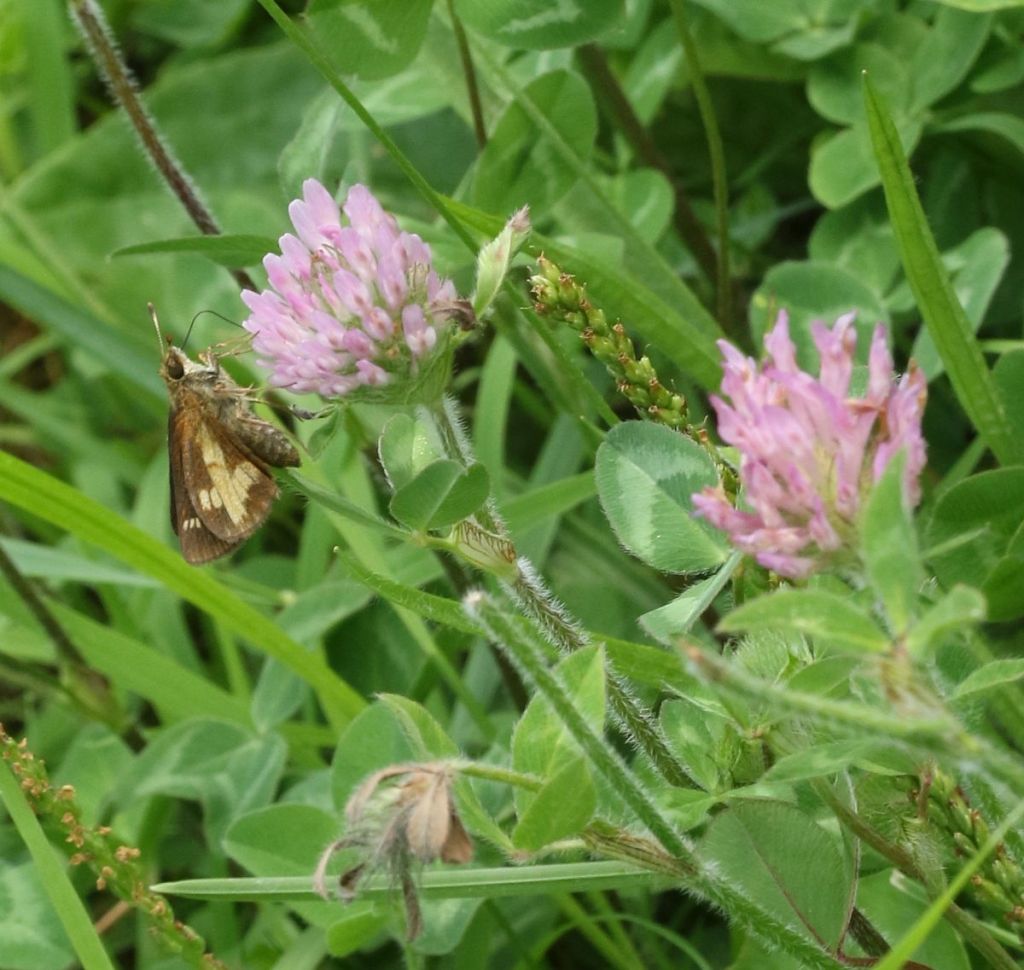
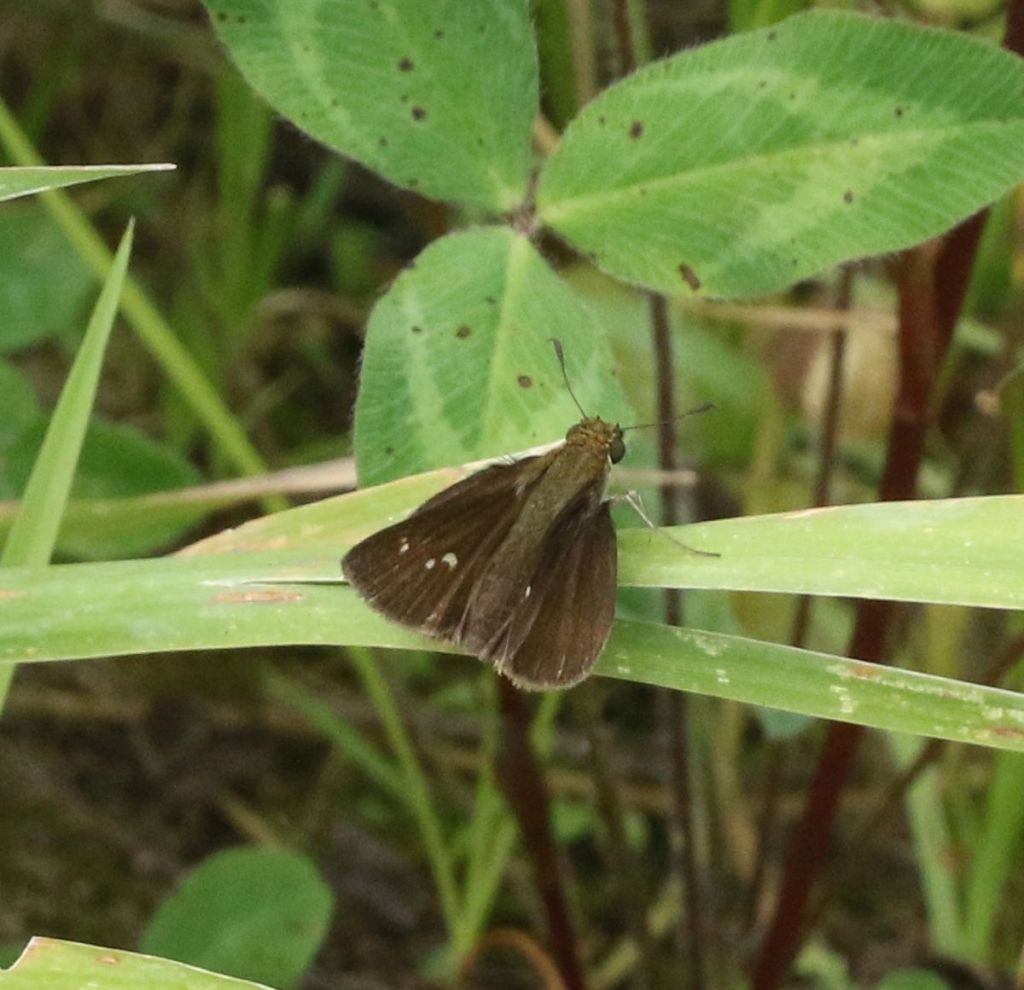
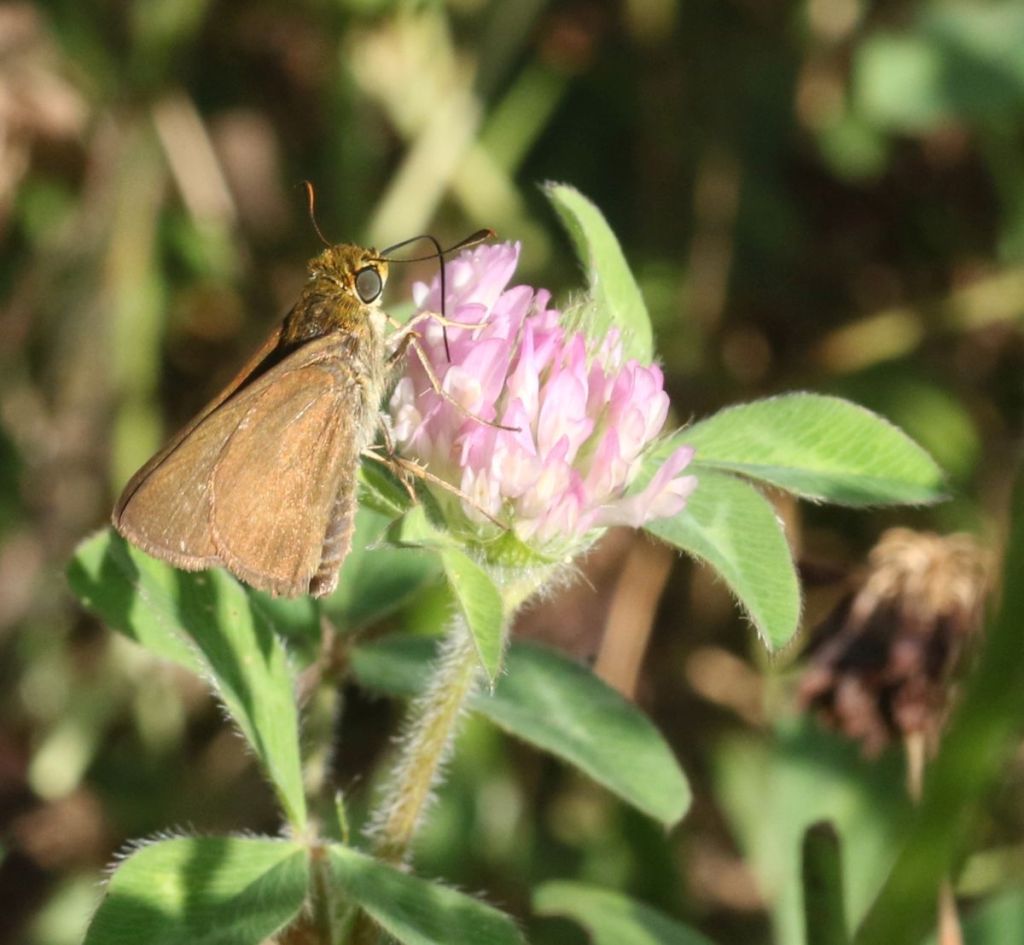
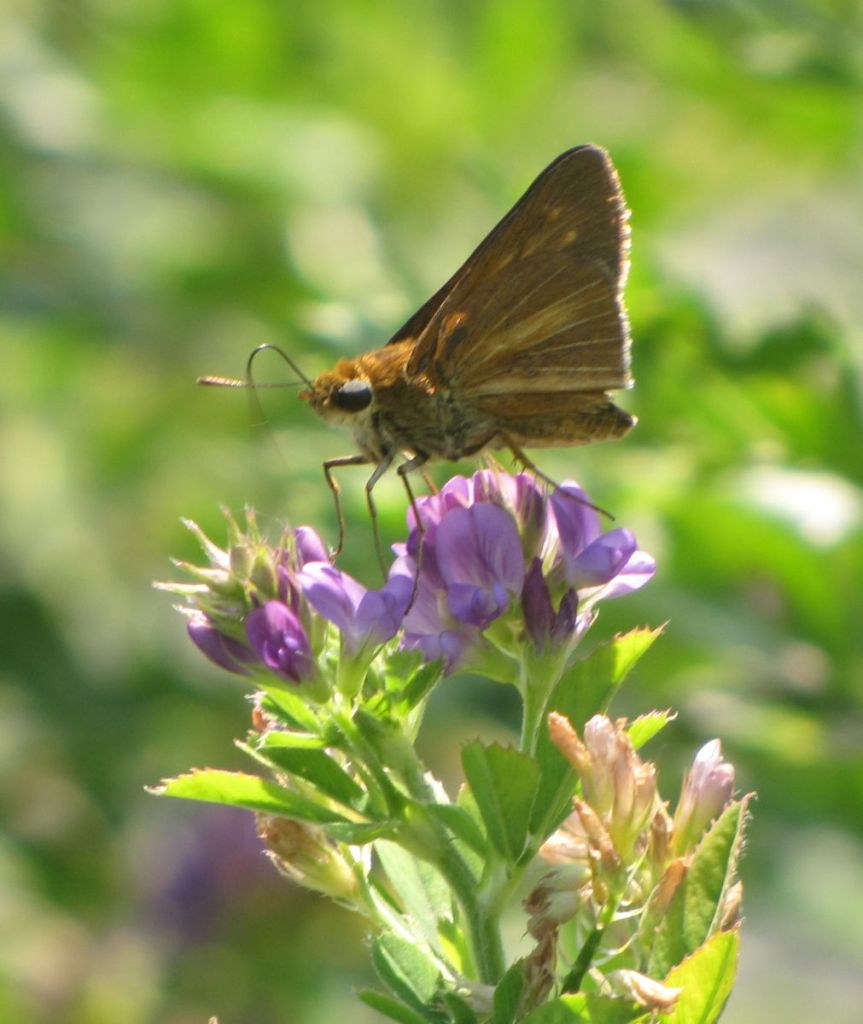
This sharply marked little skipper was found relatively near that same wet meadow. This is a Mulberry Wing (so named because some fresh individuals have a distinctly purplish hue). Its caterpillars feed on sedges and we generally associate it with well-developed, older wetlands, and we consider it somewhat unusual.
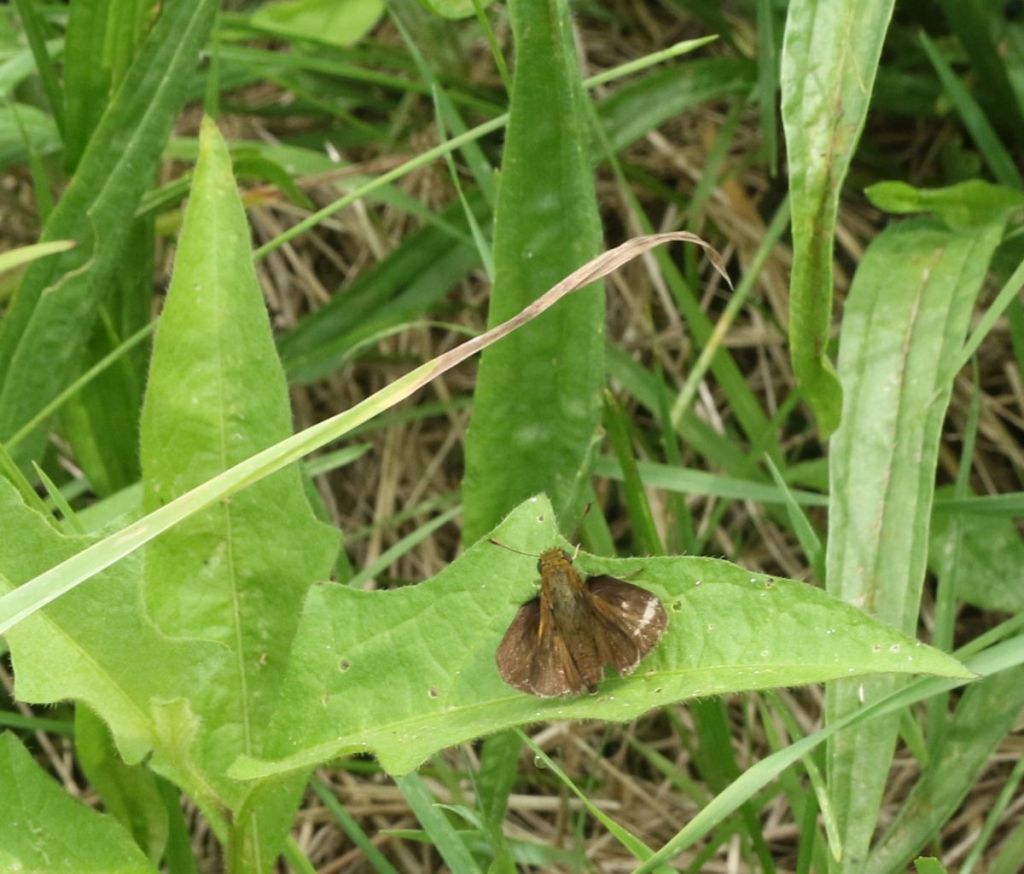
Dun Skippers were more common. This individual has an atypical white wing marking on one side, perhaps associated with some developmental quirk or a post-metamorphosis run-in. Its caterpillars are also sedge feeders, but it doesn’t seem to be a tightly associated with wetlands.
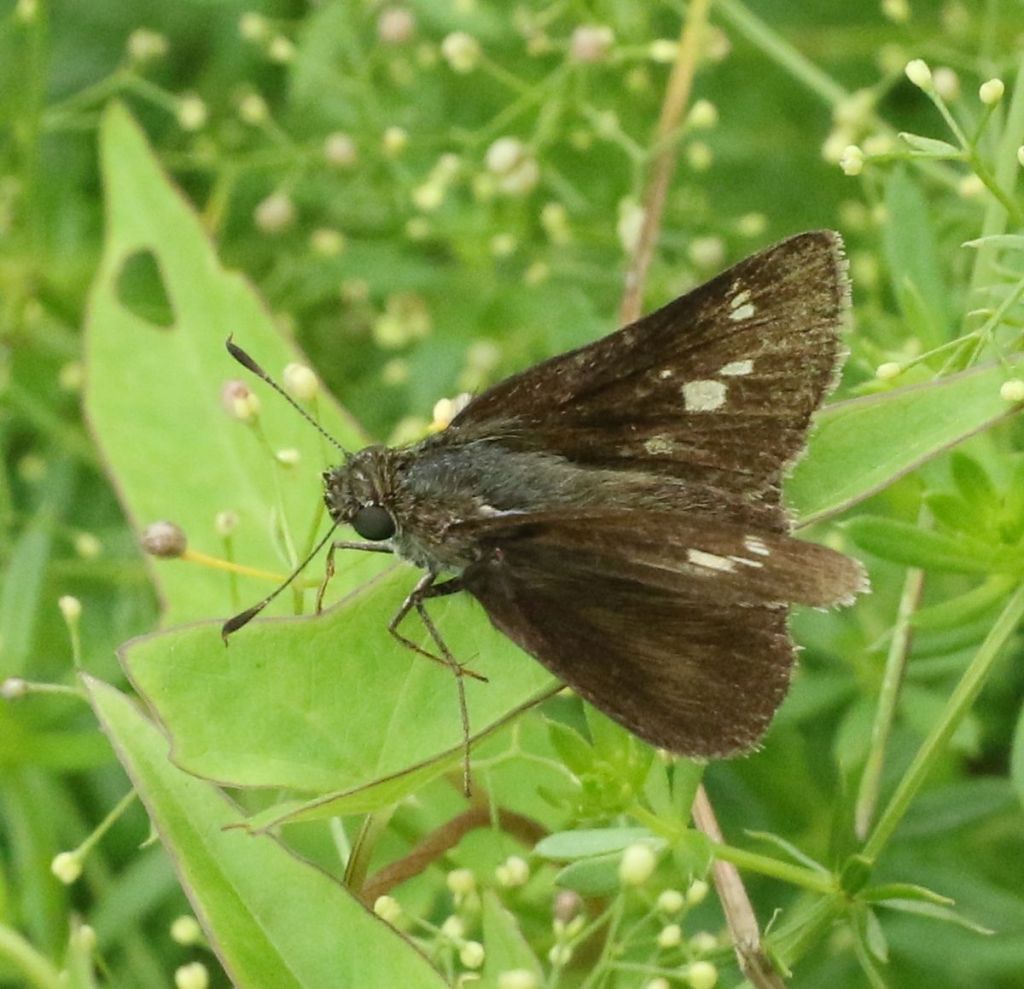
To finish with the skippers, this large species was relatively common both here and at other farms – which butterfly is it?
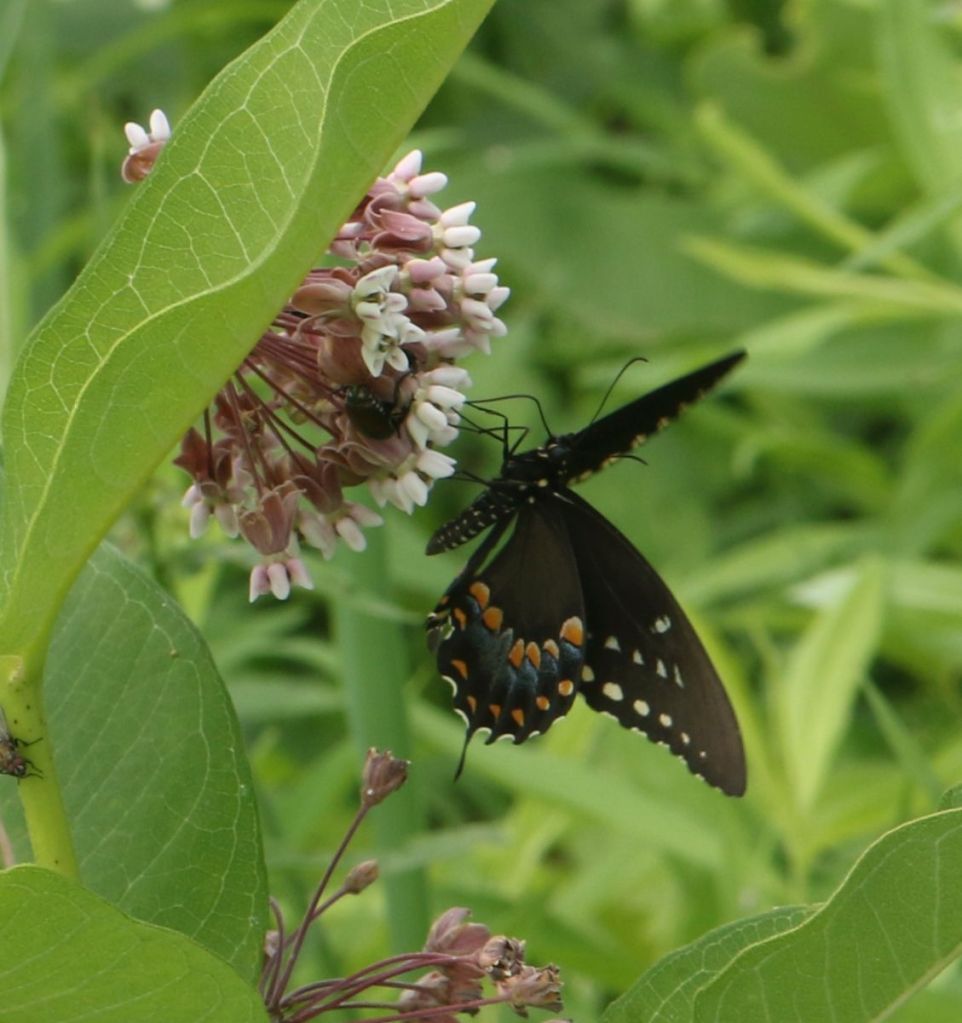
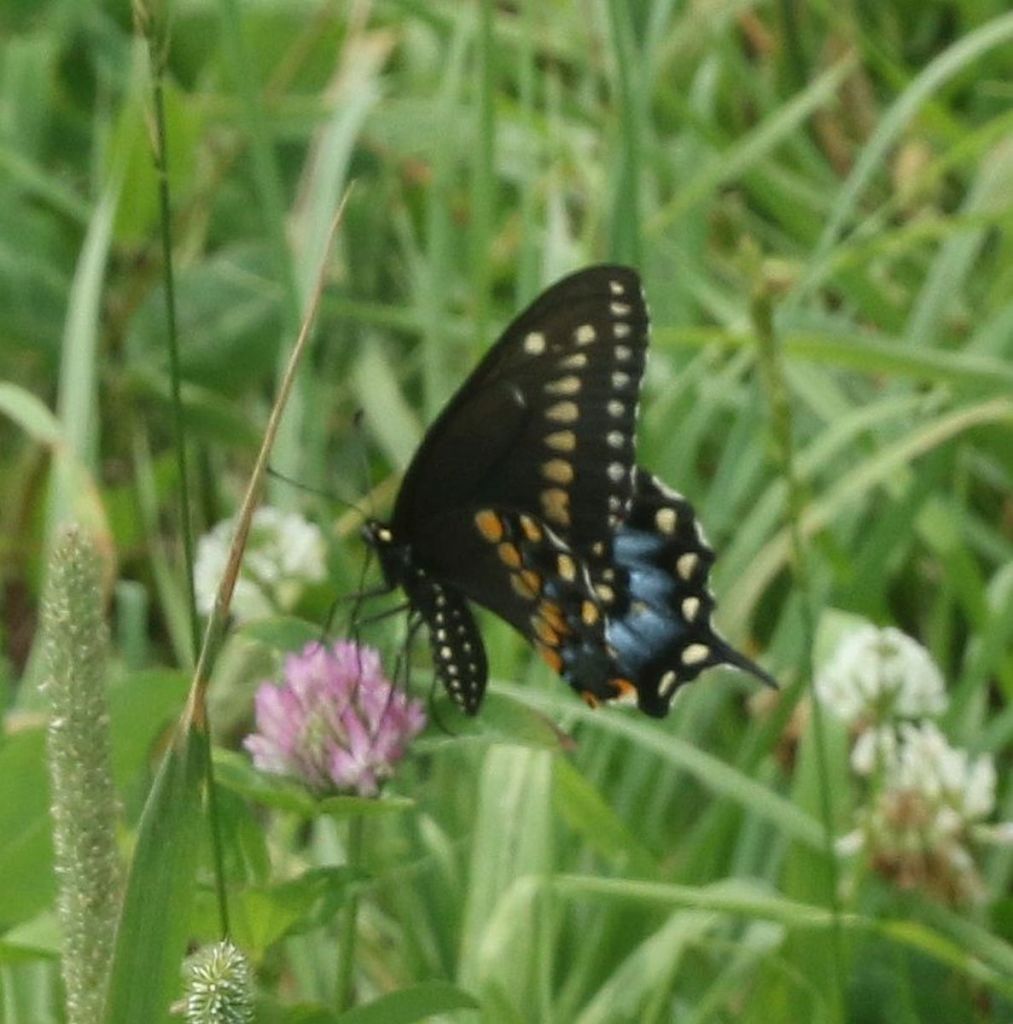
At first glance, one might think that both of these are Black Swallowtails, but actually only the top photograph is that species. The bottom is a Spicebush Swallowtail (so identified by the one missing orange spot along the inner row of orange spots on the underside of the hind wing); as the name implies, its caterpillars feed on Spicebush, a shrub of wet areas.
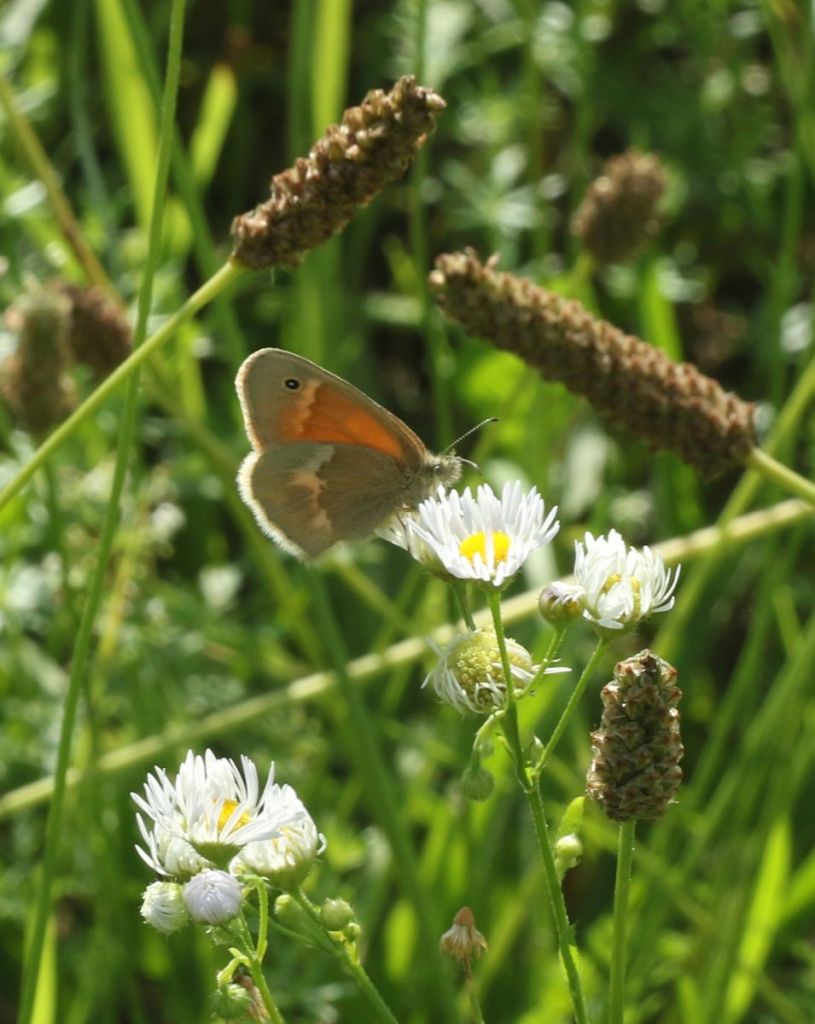
Common Ringlet, a butterfly that should already be familiar if you have read previous blogs; it is regularly found bouncing across old fields at this time of year.
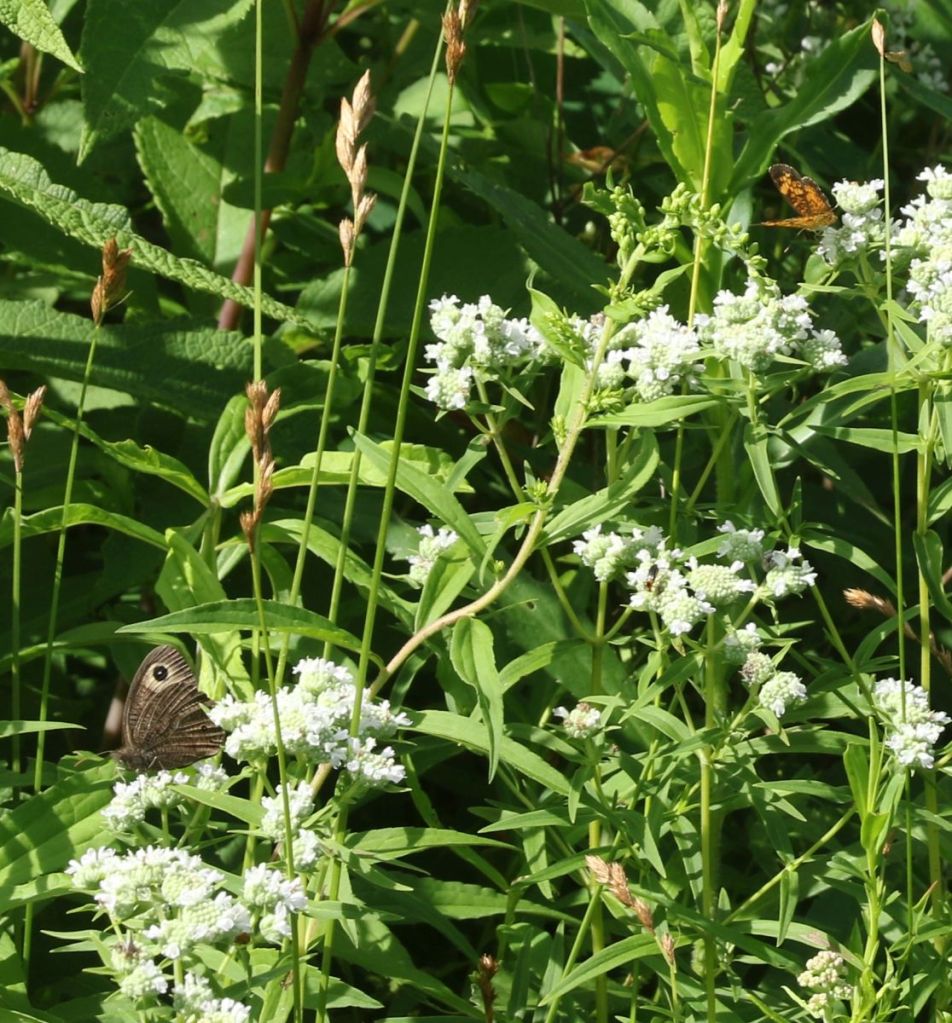
Two more welcome ‘regulars’ during this time of year, a Common Woodnymph (lower left) and Pearl Crescent (upper right).
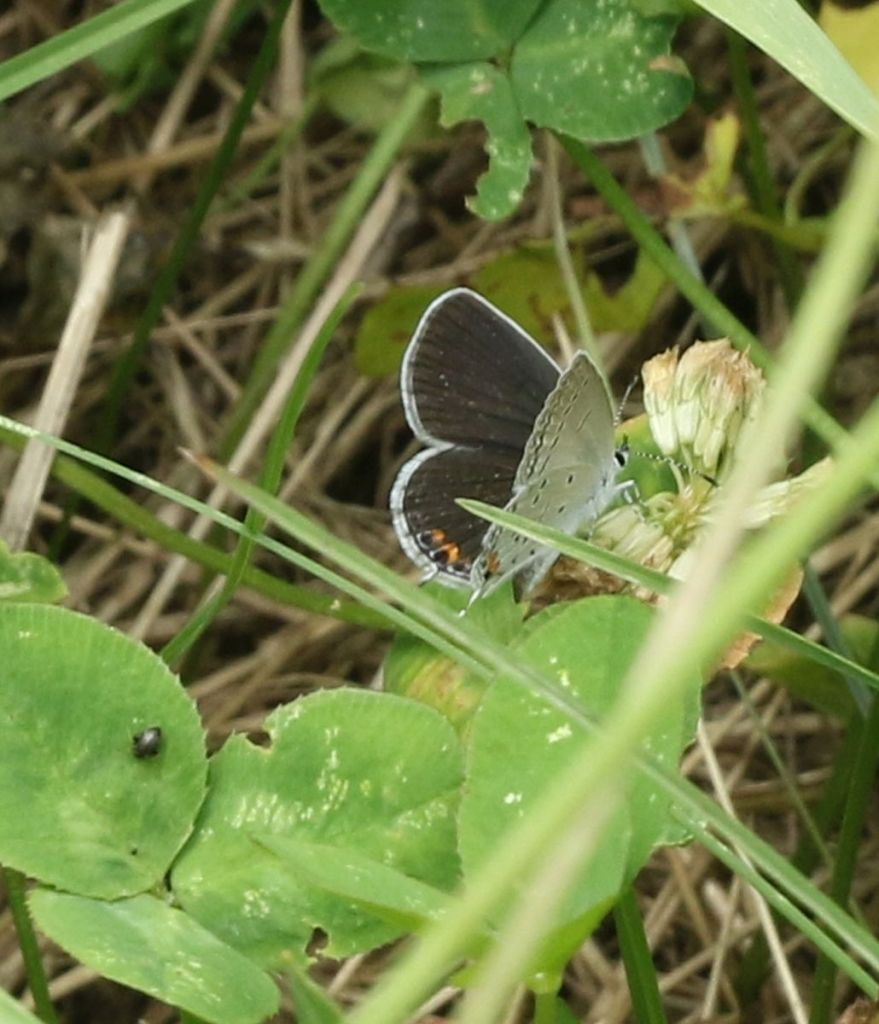
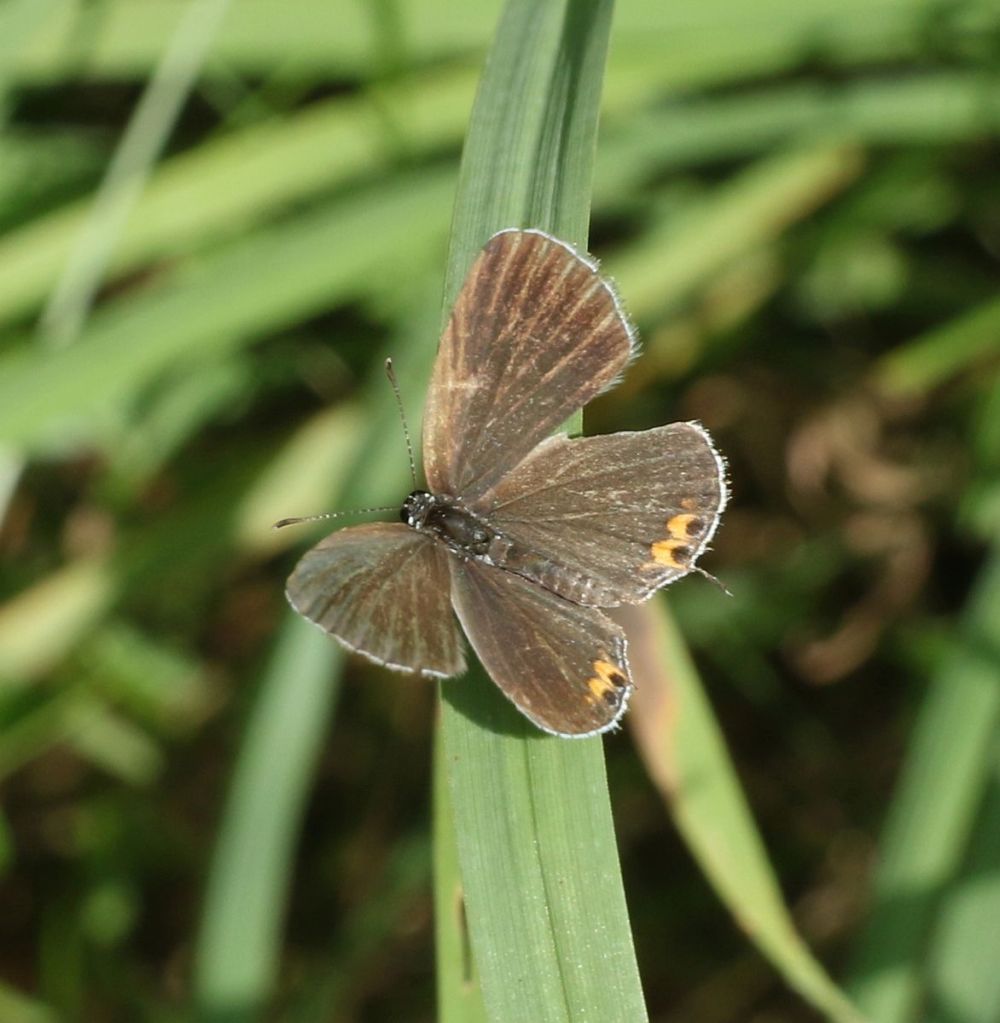
Eastern Tailed-blues tend to be most common (or at least visible!) in short, grassy areas. Sooty grey means this is a female.
This beauty is a good butterfly shot to end with – our only truly green regional butterfly, the Juniper Hairstreak, is widespread but sparsely distributed in our area. Its caterpillars feed on Red Cedar (actually a juniper), and it is usually found near stands of that tree. Its presence at Rose Hill surprised us because we hadn’t come across many Red Cedar on the farm. However, Kevin assured us they are nearby. Some orchardists aren’t fond of Red Cedar, because it is the alternate host of Apple-Cedar Rust.
As listed above, we saw about 21 butterfly species at Rose Hill, the core group of widespread openland butterflies was spiced by a few species associated with damper areas (indicated in blue hues above). While some of these (fainter blue) seem to range more widely, Mulberry Wing and Spicebush Swallowtail (brighter blue) have tighter wetland associations. Also augmenting the diversity were a couple of species that, while not rare, we only see occasionally: Juniper Hairstreak and Giant Swallowtail. The ample flowers left along edges, around ponds, and in ‘roughs’ retained within the orchards helped attract and support this diversity.
As noted, the dragonfly community was primarily composed of relatively common (nothing wrong with that!) pond dragonflies and damselflies.
Blue Star Farm produces a variety of vegetables and the core of the farm is composed of a mosaic of intensively-managed beds, cover crops, fallow fields, and mowed drive strips. Towards the surrounding tree lines and forest patches, there are also less frequently-mowed meadow areas and narrow bands of “soft edges”, where low woody plants provide a transition from field to forest. For my exploration of the wild-growing plants on the farm, I spent around four hours on July 11, 2024 mostly in the less-intensively managed areas of the farm. This included brief visits to two adjacent patches of swamp forest, one ancient (probably not cleared for agriculture for centuries, if ever, and visible as a triangle in the historical aerial photo from the 1940s in Conrad’s blog from yesterday) and the other, just east of the current fields, recently reforested from a formerly cleared area. I also spent some time recording the plants in and around the recently dug irrigation pond. The inventory resulted in a list of 200 plant species, half of which considered native to this region. In this blog, I’ll try to provide a glimpse of the wild-growing plant life on the farm.
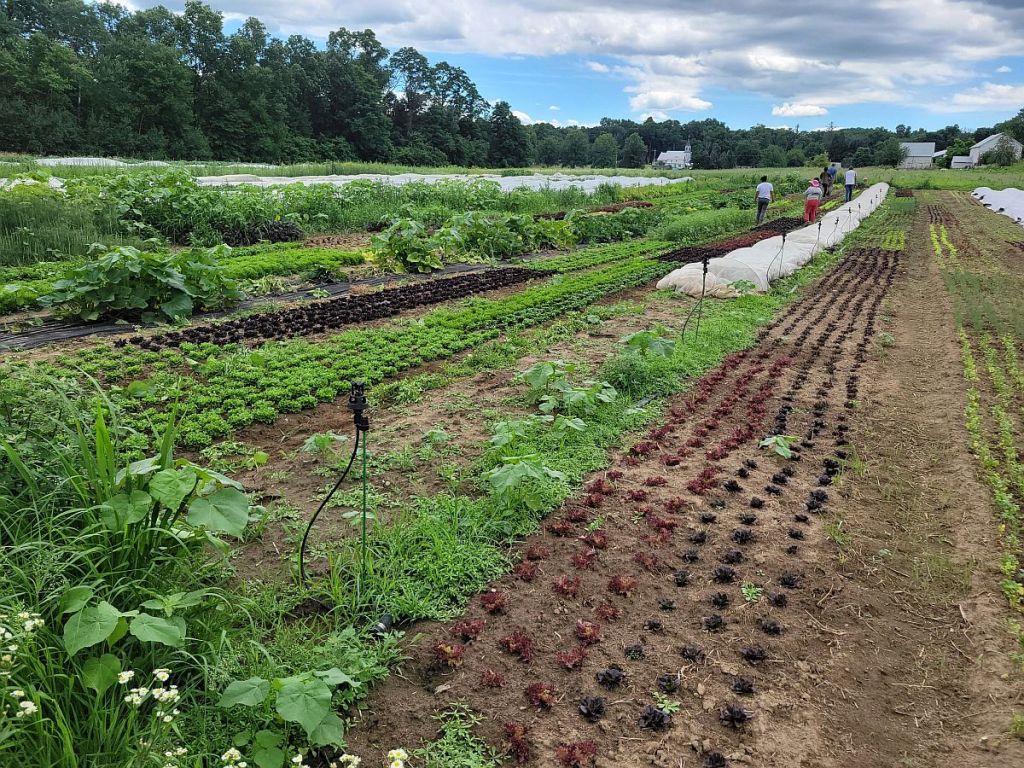
This first picture gives an impression of Blue Star Farm looking south from the approximate center of the fields, with the edge of the young swamp forest on the east side in the background.
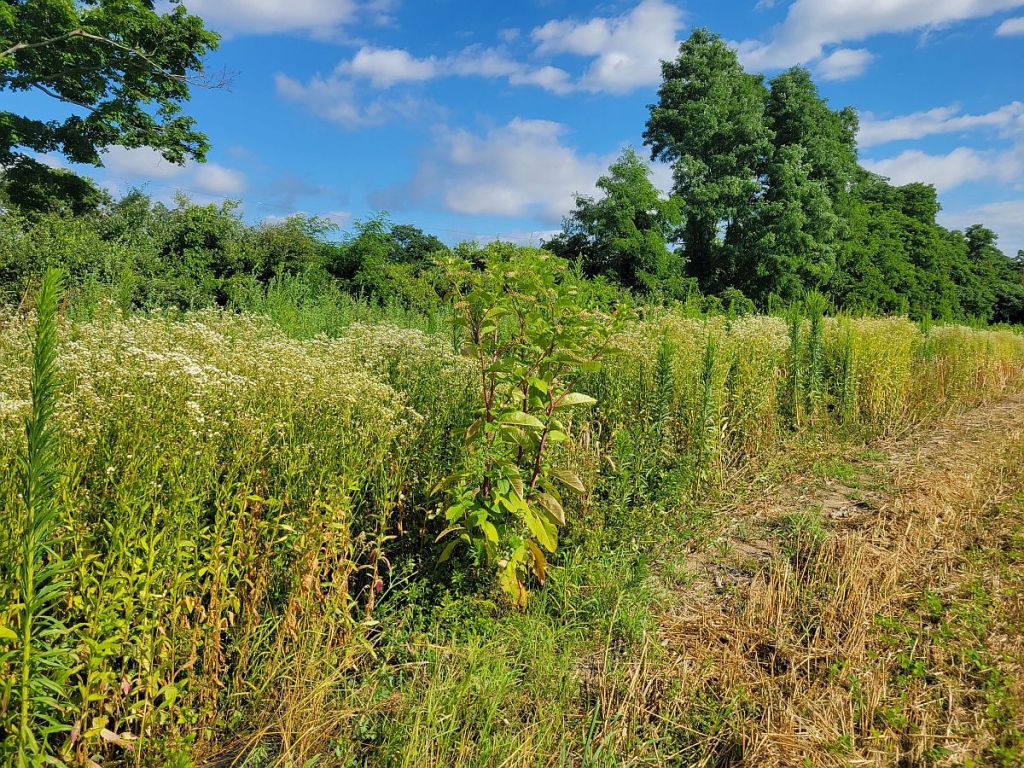
A fallow field (it produced kale last year, but had not been worked this season) along the western edge features some of the most common wild-growing plants in the actively-farmed area: Daisy Fleabane (Erigeron annuus; sea of white flowers) and Horseweed (Erigeron canadensis; slender, tall plants, not yet in bloom). Both species are native to Northeastern North America and can become quite common in 1st year fallows of formerly tilled fields. Their shallow flowers provide nectar to small insects, including parasitoid wasps. The picture also shows a single individual of Pokeweed (Phytolacca americana).
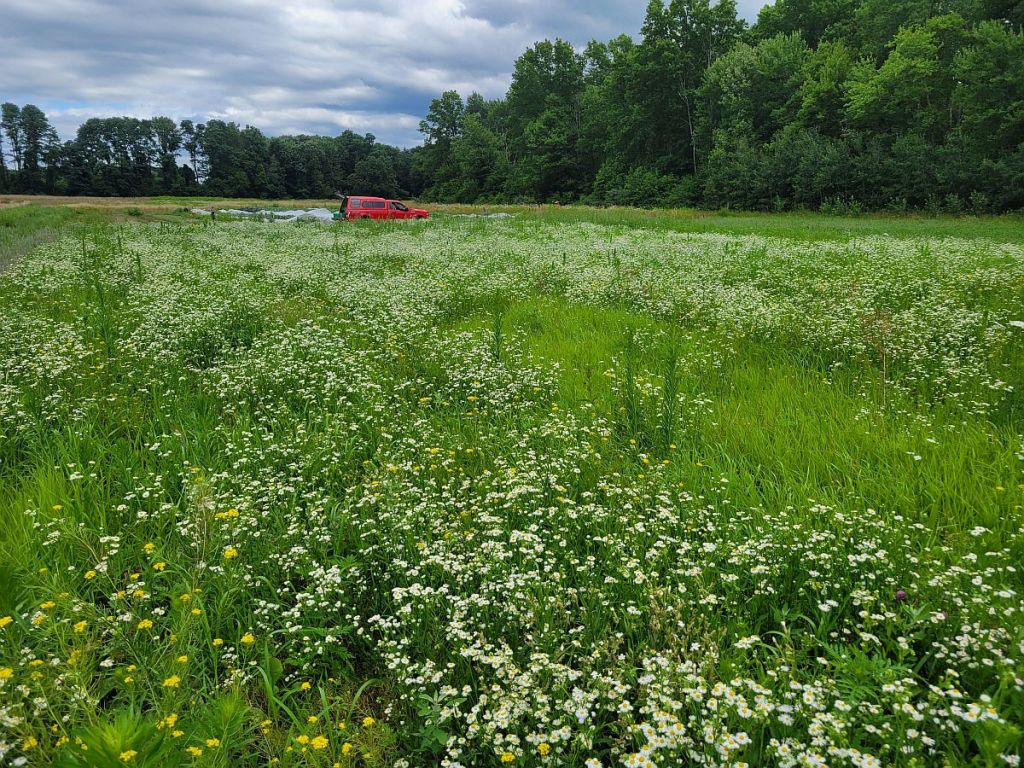
Another fallow field along the eastern edge supports a similar plant community.
A closer look at the daisy-like flower heads of Daisy Fleabane. This species can be seen in bloom from May to October and has smaller flower heads than Oxeye Daisy (Leucanthemum vulgare), which also blooms in early summer. It has more white ray flowers (arranged like petals around the yellow disk flowers) than the many similar-looking aster species, which will open their flowers in August/September.
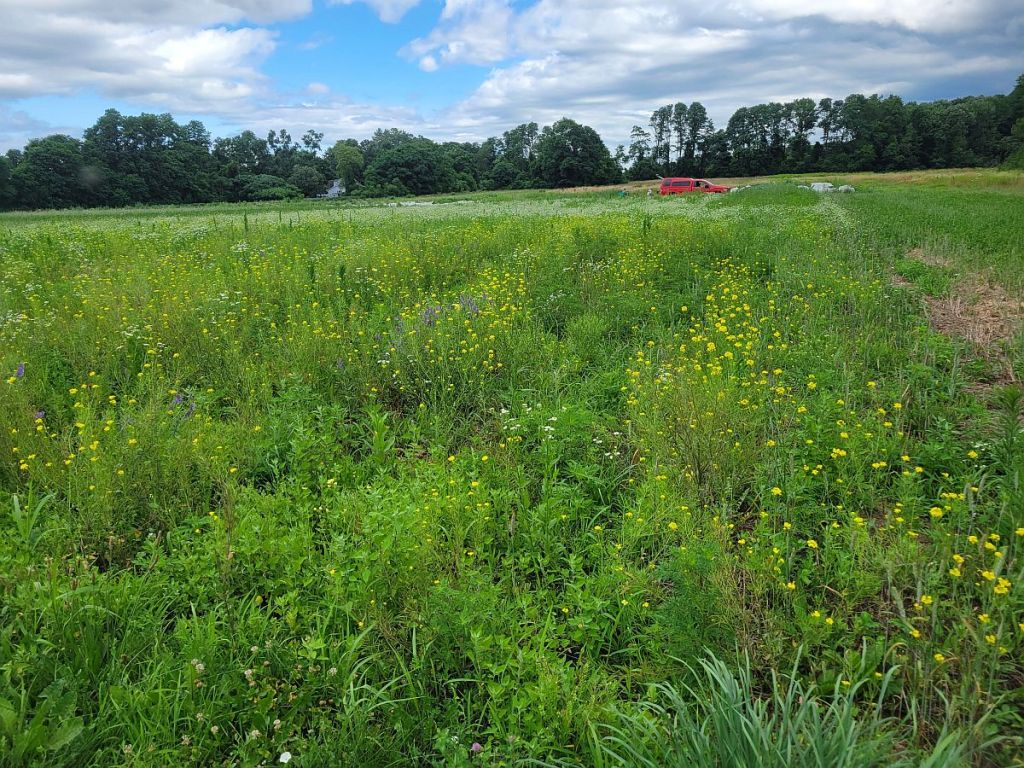
Another common wild-growing plant in 1st year fallow fields was the yellow-flowering Tall Hedge-mustard (Sisymbrium loeselii). It is a European plant that has been spreading relatively recently and rapidly across North America and is not included in my favorite field guide. Therefore, I suspect that I might have been mis-identifying it for a few years as one of the more established, and better-known species in the same genus.
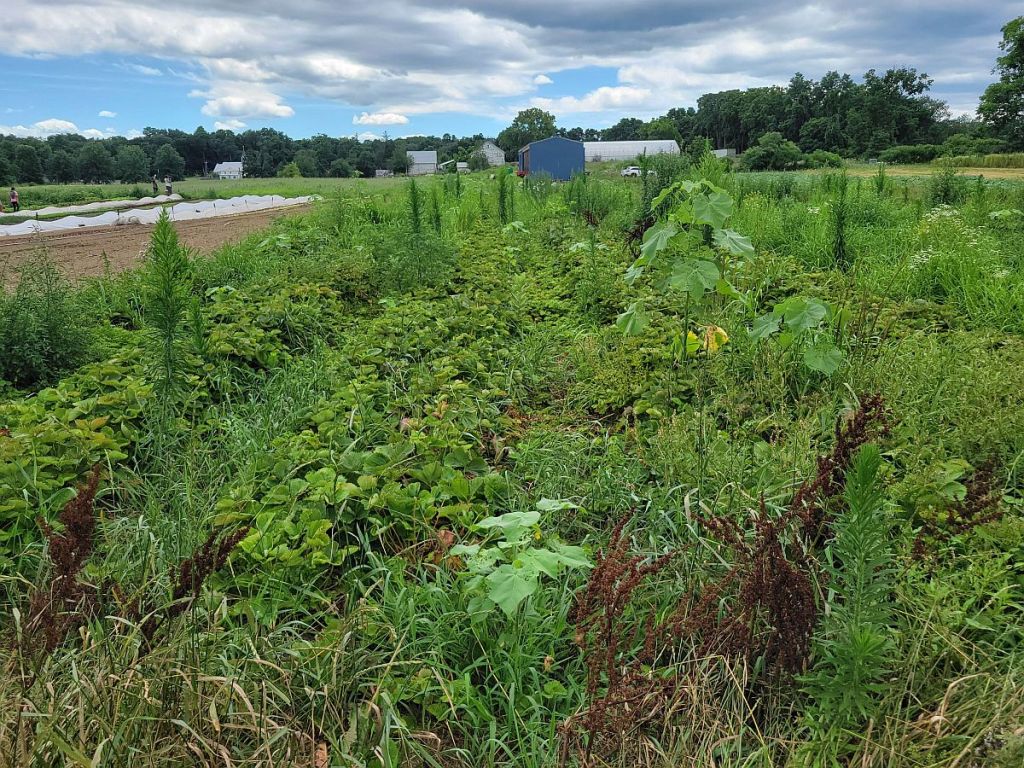
This former strawberry field has a good representation of the most common weeds at Blue Star Farm, including Velvetleaf (Abutilon theophrasti), which is easily recognized by its large, heart-shaped (and velvety) leaves. Reportedly, it has been intentionally introduced to America as a source of fiber. In Asia, where this species originated, it is also used for medicinal and veterinary purposes. In a quick internet search, I could not find any reference about what an abundance of this plant might tell us about the soil conditions (this was a question Sue brought up during our visit–sorry, no new insights).
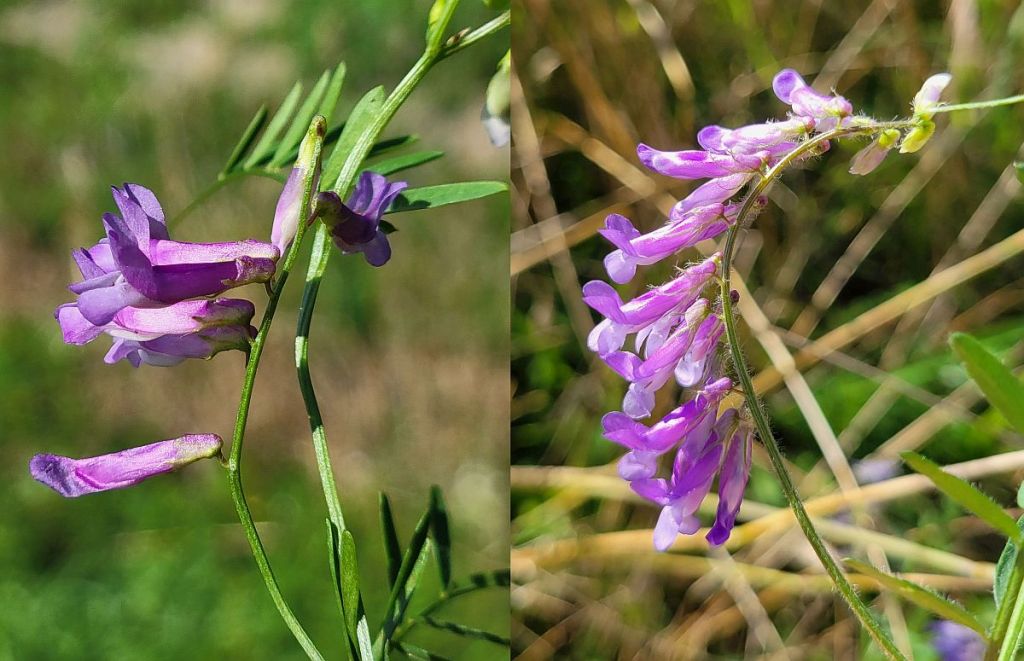
Here and there in the fallow fields and unmowed areas of the farm, one finds examples of (I think) two very similar-looking vetch species: Cow, Bird, or Tufted Vetch (Vicia cracca; left) and Hairy or Winter Vetch (V. villosa) on the right. Tufted Vetch has a larger upper petal (“flag”) and upper calyx lobes that are broadly triangular, while Hairy Vetch has a shorter flag and upper calyx lobes that are narrowly triangular. I might not be getting this right, yet, but both species are reportedly common on farms in our area. A third species, Slender Vetch (V. tetrasperma) is a very delicate plant with much smaller and fewer pink (instead of purple) flowers, and also grows at Blue Star Farm. All three are originally from Europe.
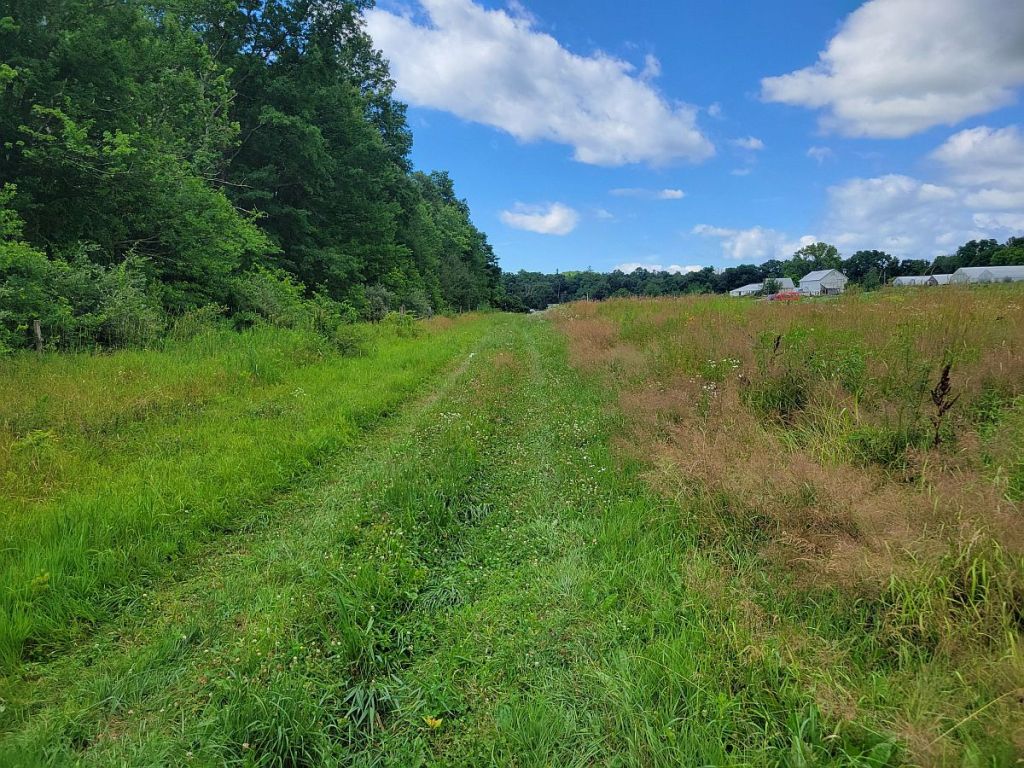
The reddish hue in the fallow field on the right is from Redtop (Agrostis gigantea), a European grass.
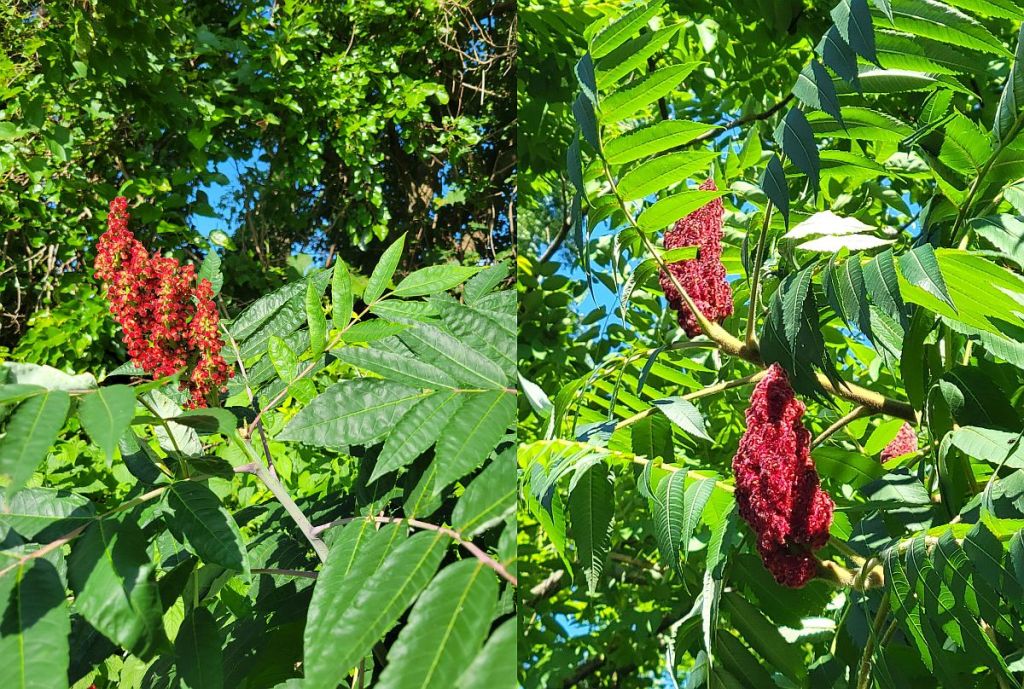
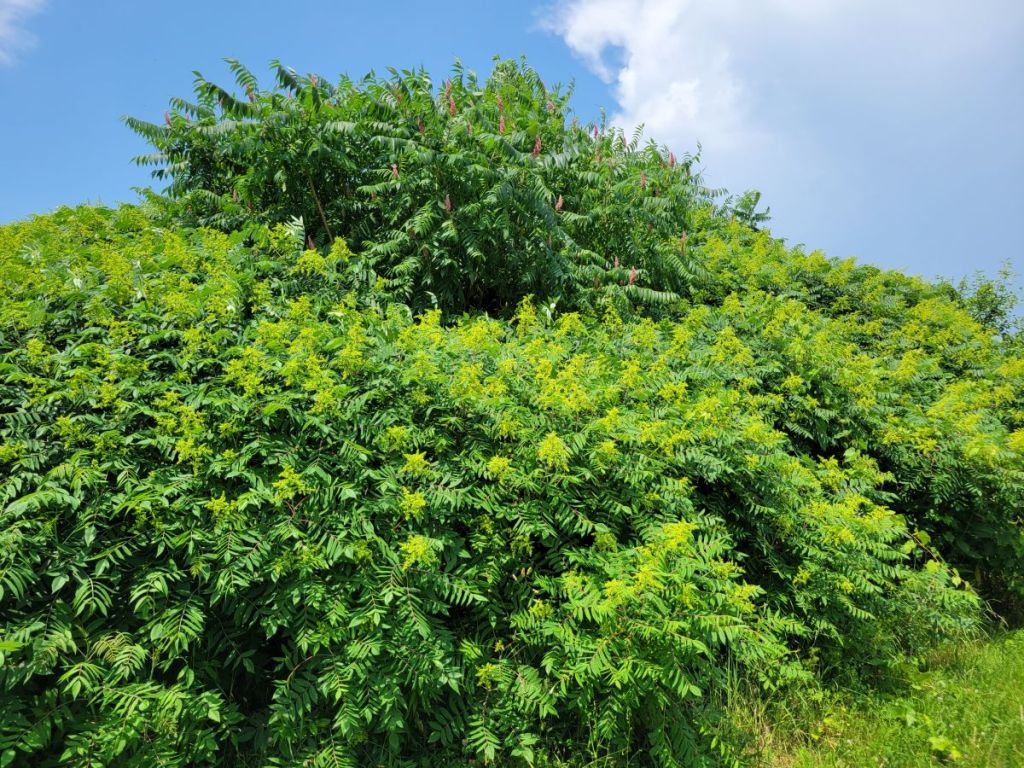
Two species of sumac grow along the western field edge: Smooth Sumac (Rhus glabra; left) and Staghorn Sumac (Rhus typhina; right). Note the difference in the surface texture of their shoots: that of Smooth Sumac is glaucous, with a waxy layer that can be rubbed off, while that of Staghorn Sumac is velvety hairy, like the growing antlers of a deer. Both images show female plants, which are producing berries. Their male counterparts had yellow flowers in the spring, which spread their pollen and are now wilted.
These two species are very different from Poison Sumac (Toxicodendron vernix), which is more closely related to Poison Ivy (T. radicans) and is a shrub with white berries that grows in wetlands. It is not usually found on farms or along roadsides.
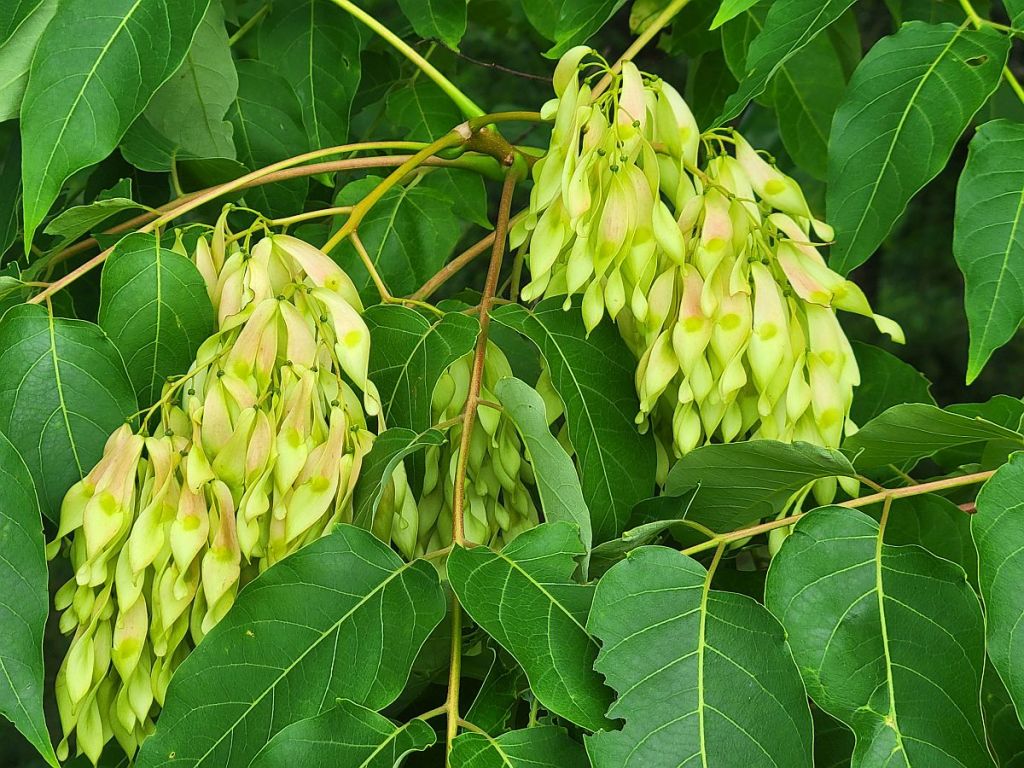
The very invasive, non-native Tree-of-Heaven (Ailanthus altissimus) has leaves similar to those of the native Smooth and Staghorn Sumacs and—like them—forms clonal colonies with a joint root system.
However, the female Tree-of-Heaven plants produce wind-dispersed, propeller-shaped fruits that are very different from the red Sumac berries. If you haven’t tried it, the smell of their leaves is also a good way to distinguish the Sumacs and Tree-of-Heaven. To me, the crushed leaves of Sumacs have a pleasant, aromatic, resinous scent, while crushed Tree-of-Heaven leaves have a rank smell reminiscent of rancid peanut butter.
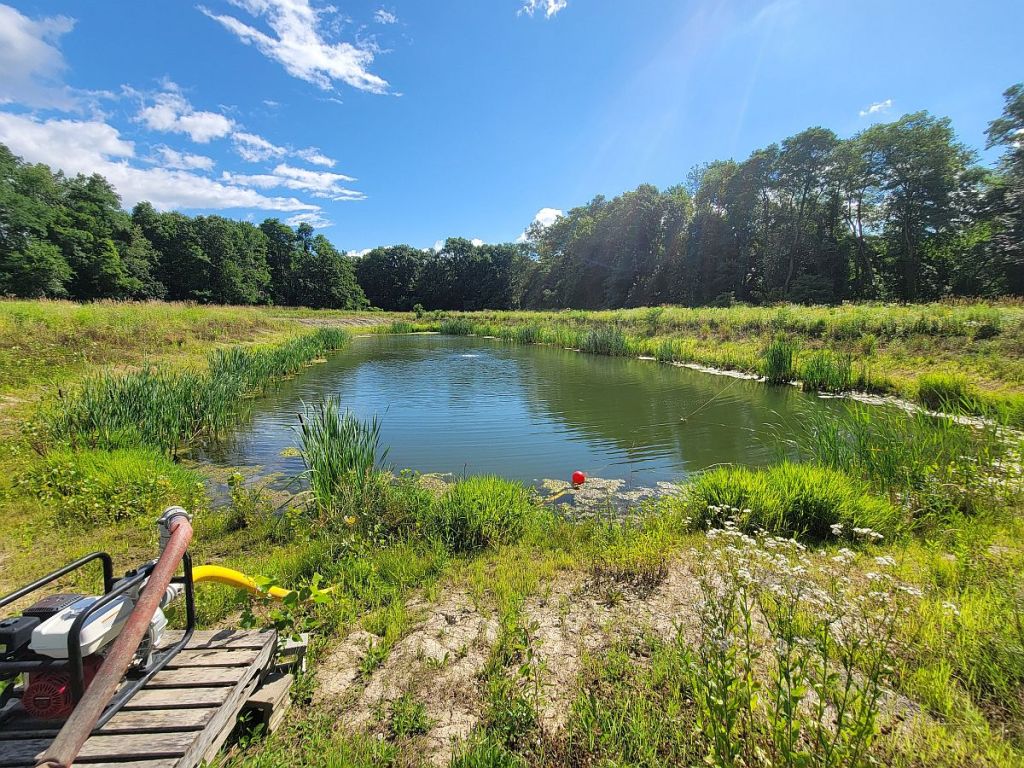
Now, let’s explore a bit the plant life in and around the newly dug irrigation pond. The tall plants right along the water’s edge are two species of native cattails. Although most of the water is clear, you can see some “greenery” floating on the surface around the shoreline.
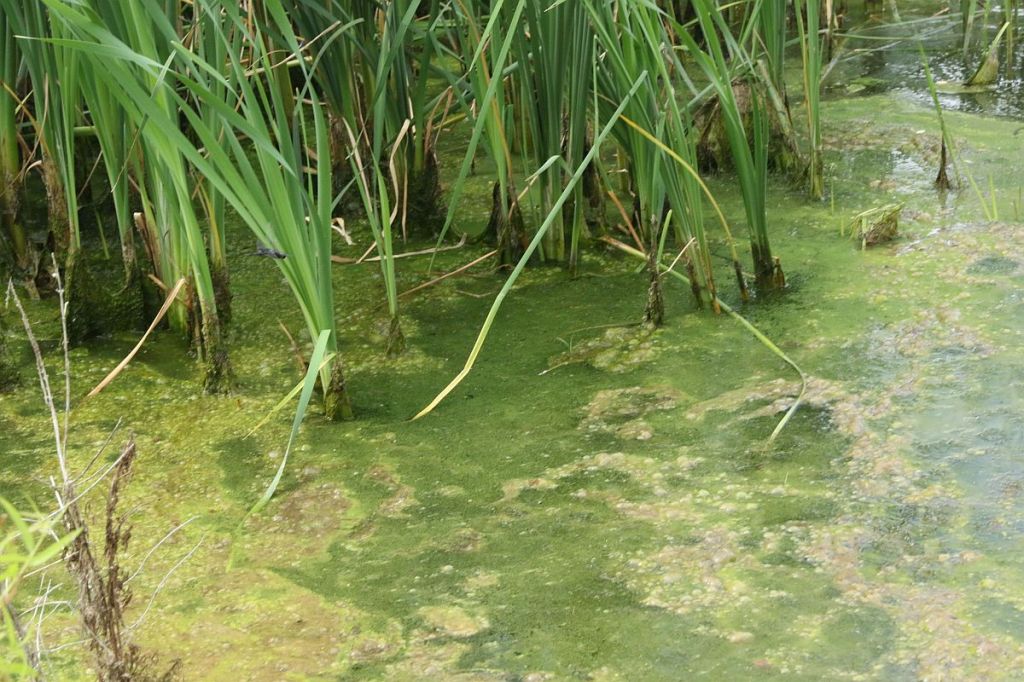
This “pond scum” is most likely composed of filamentous green algae (not to be confused with the sometimes toxic cyanobacteria, which are often referred to as “blue-green algae”). Ecologically, the filamentous green algae are nothing to worry about if they occur in small amounts. They indicate that there are some nutrients in the water, which is not surprising, if a pond is dug in an area that has long been farmed.
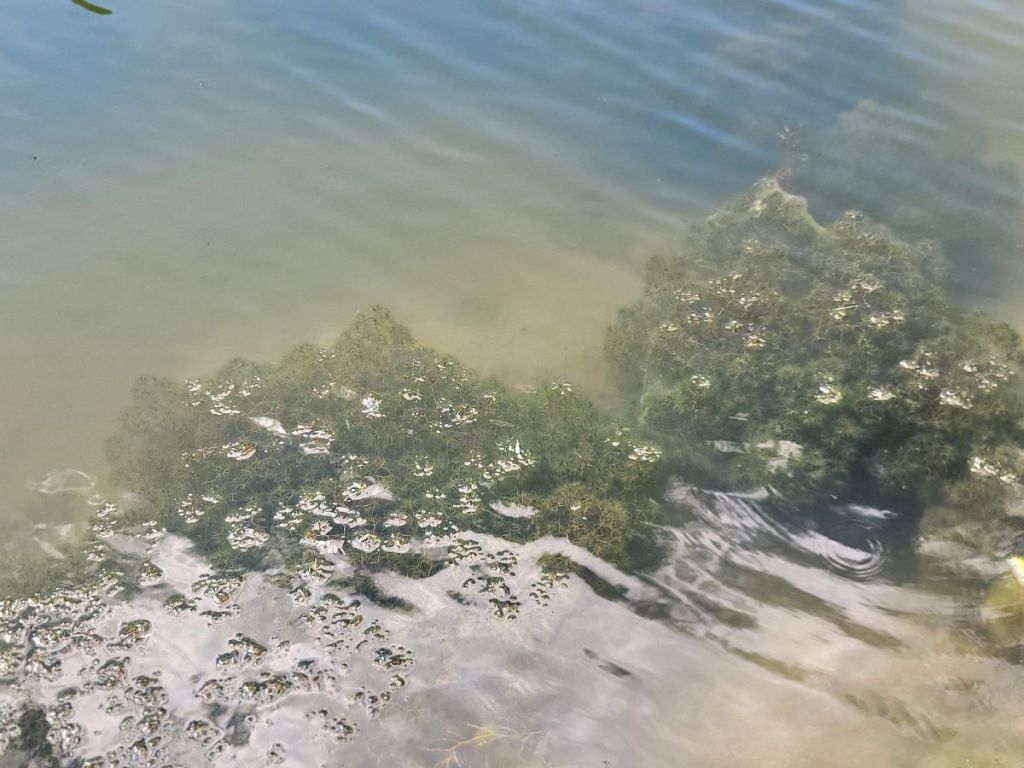
In shallow water, just underneath the surface grows a native aquatic plant, aptly called Eutrophic Water Nymph (Najas minor), another indicator of nutrient-rich water.
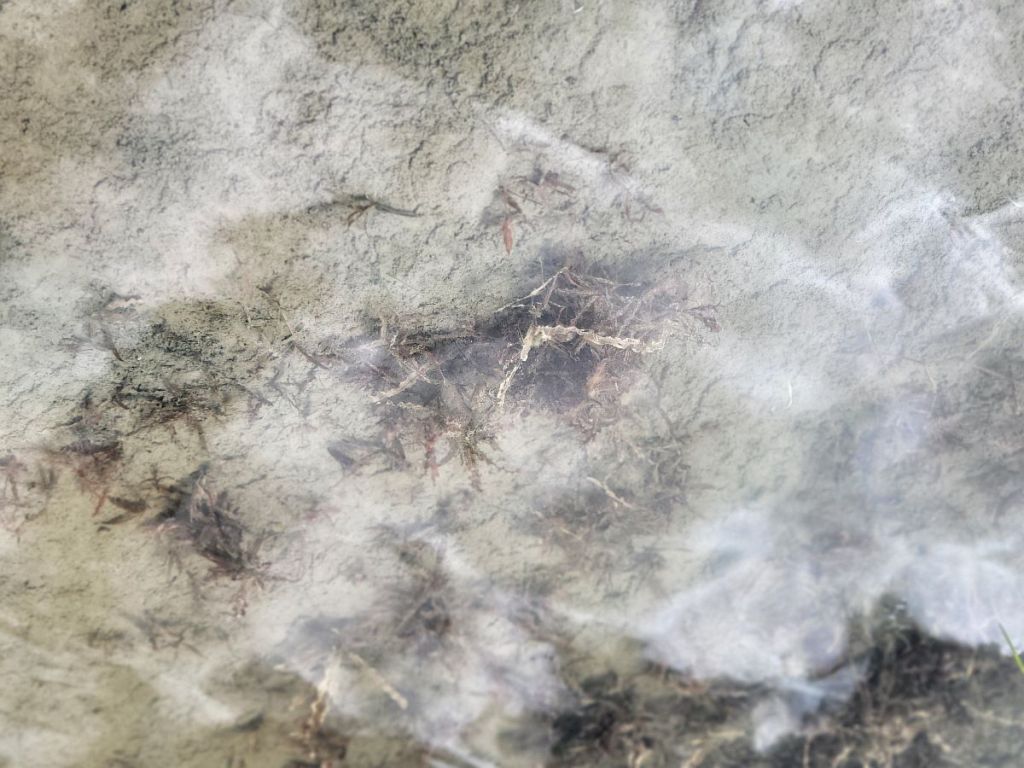
In the shallow water along the shore, there were also some small plants of the invasive, non-native Curly Pondweed (Potamogeton crispus). As the pond matures, it remains to be seen how this species behaves… Some amount of aquatic plants is a very good thing to provide shelter and food for aquatic insects (including dragonfly larvae) and amphibians. Should the aquatic plants ever become too much, please consider mechanical removal (which has the added advantage that the nutrients stored in them get removed from the waterbody) and DO NOT introduce grass carp to control the vegetation! In our experience, these plant-eating fish turn ponds into a turbid soup without any plant life and little habitat value for aquatic insects and amphibians.
On the east side of the pond is a well-established meadow composed of at least 50 (probably many more) different grasses, sedges, wildflowers, as well as some shrubs and vines. This was one of the most flower-rich and botanically-diverse areas of the farm and is a perfect example of a “soft edge” to the neighboring forest.
Common Boneset (Eupatorium perfoliatum) is an example of a native wildflower only seen in this meadow during the botanical survey.
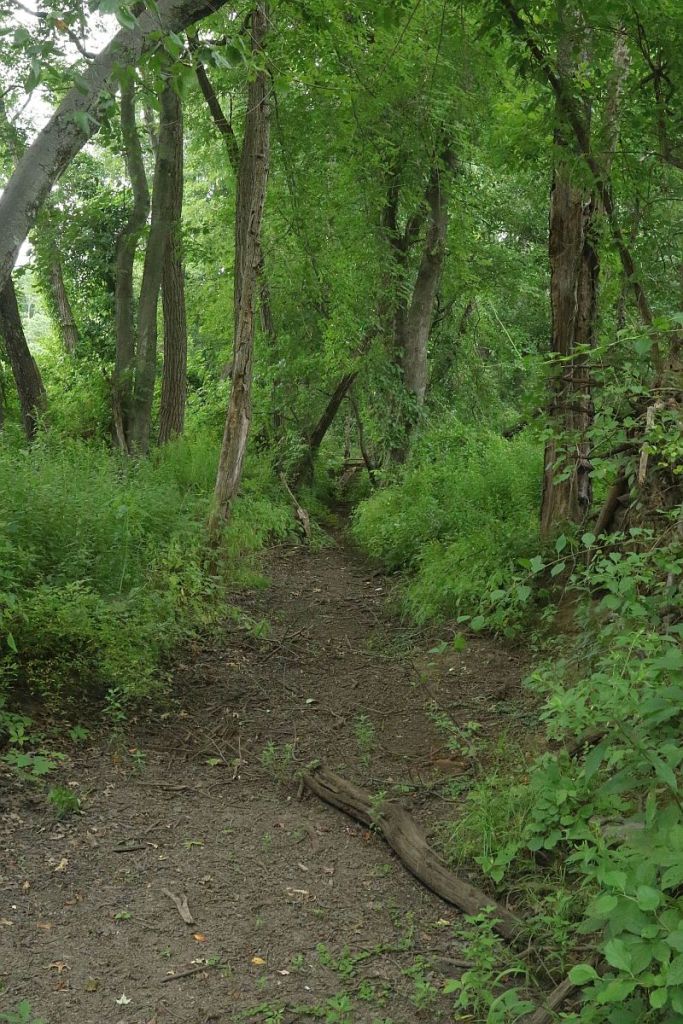
East of the pond is a narrow band of recently reforested swamp forest. We did not take the time for a complete tree inventory, but noted the presence of Pin Oak, Red Maple, Black Cherry, Black Locust, White Mulberry, and Trembling Aspen. This area also harbors some invasive shrubs and seems to be the epicenter of the invasive Japanese Stiltgrass (Microstegium vimineum; not pictured) on the Farm.
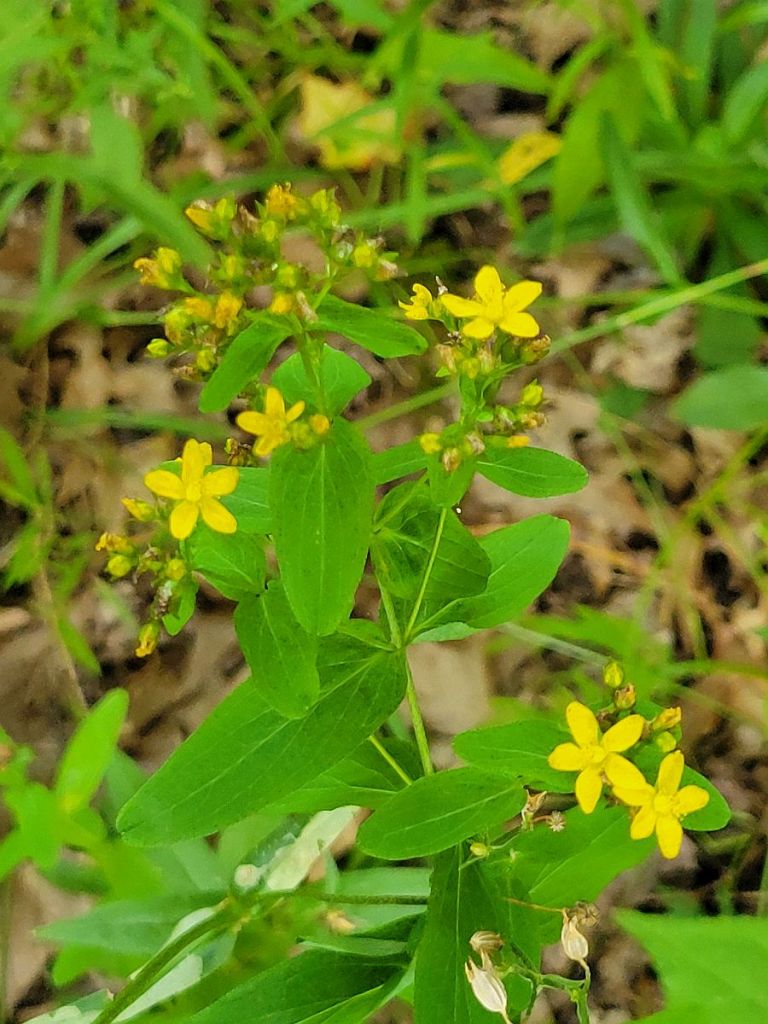
Nonetheless, there were also some native botanical treasures in this young swamp forest, such as the Spotted St. John’s-wort (Hypericum punctatum). This is one of three St. John’s-worts found at Blue Star Farm. The other two are the native Dwarf St. John’s-wort (H. mutilum), spotted on the shore of the irrigation pond, and the non-native Common St. John’s-wort (H. perforatum) which was seen here and there in the unmowed areas.
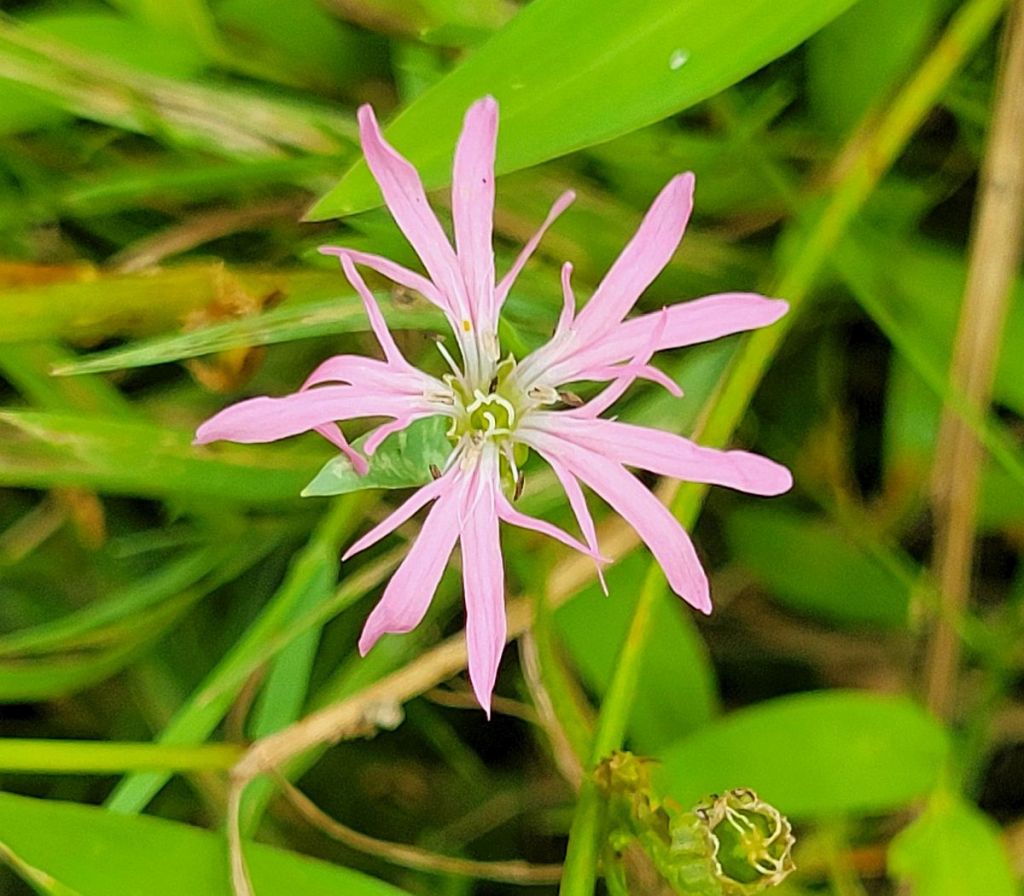
Ragged Robin (Lychnis flos-cuculi) is a European plant, related to chickweeds and carnations. It grew in the young swamp forest and was also found in the meadows east of it.
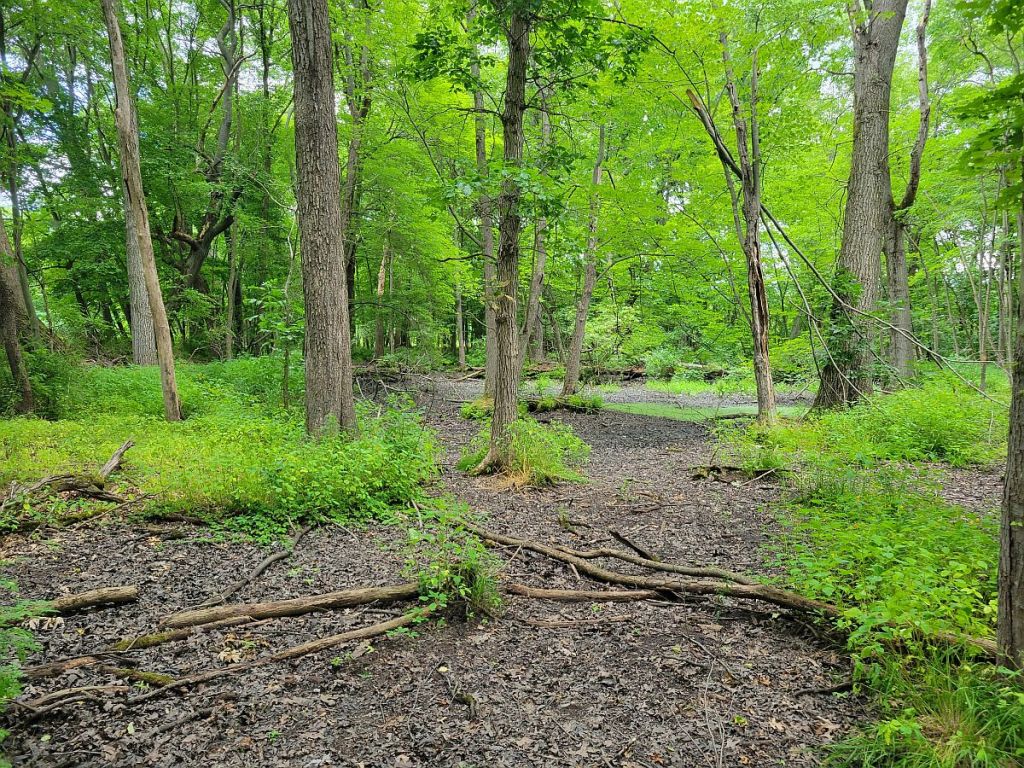
Finally, we reach the patch of ancient swamp forest further east (indicated by the triangular area of forest at the center of the historical aerial photo in Conrad’s post from 13 July). This forest is characterized by very few invasive species and by the presence of some unique tree species, seemingly not found anywhere else on the Farm. The patches without vegetation indicate seasonally flooded areas, which might serve as breeding grounds for vernal pool amphibians, if they hold water long enough in the spring to allow tadpoles of Spotted Salamanders and Wood Frogs to develop. However, the presence of these amphibians on the Farm was not confirmed during our brief survey!
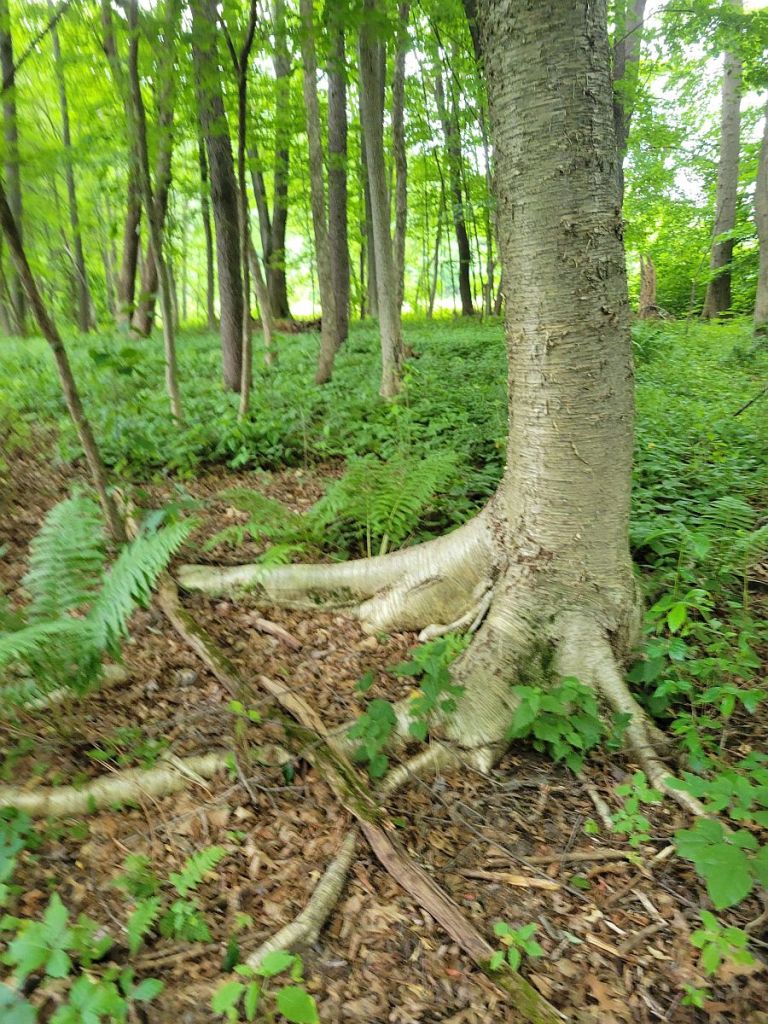
Yellow Birch (Betula alleghaniensis) is easily recognized by its shiny, peeling bark and the often octopus-like, superficial roots. It is one of the two “sweet birches”, whose twigs smell of wintergreen (= root beer). In our experience, this species does not readily establish in post-agricultural forests and—at least in our area—is a good indicator of “ancient forest” (a forest that has not been cleared for agriculture during European colonization.)
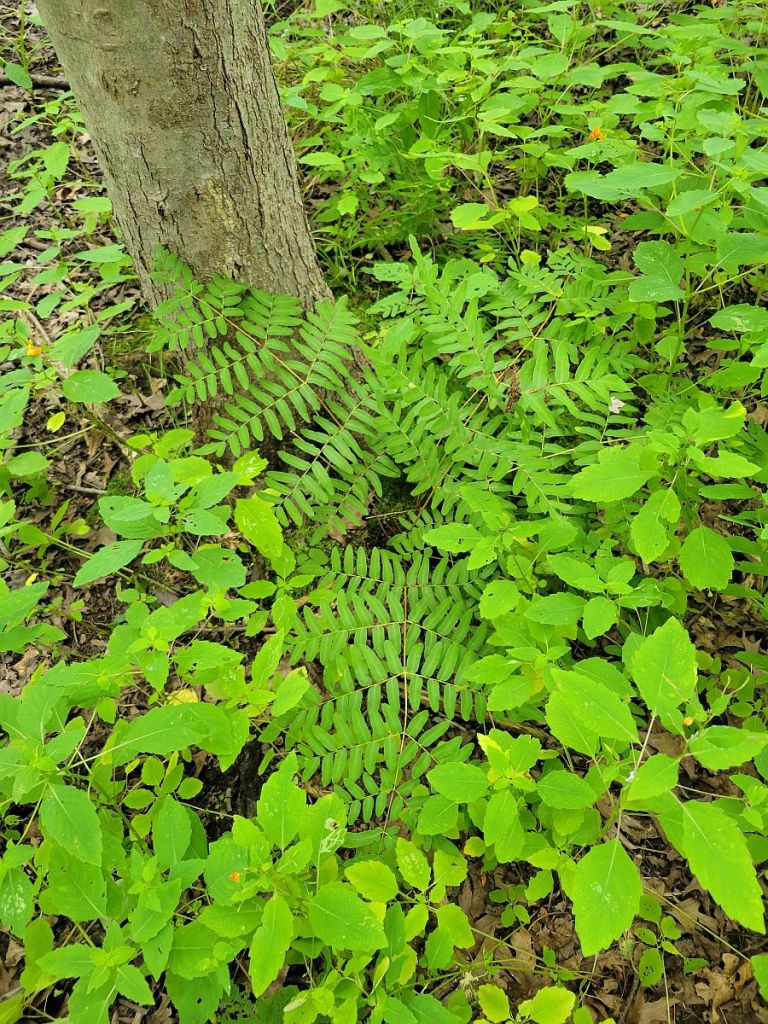
At the center of this image, you see the uniquely-divided leaves of Royal Fern (Osmunda regalis), an uncommon native wetland fern. It is surrounded by Spotted Jewelweed (Impatiens capensis), which made up the bulk of the ground cover in this forest.
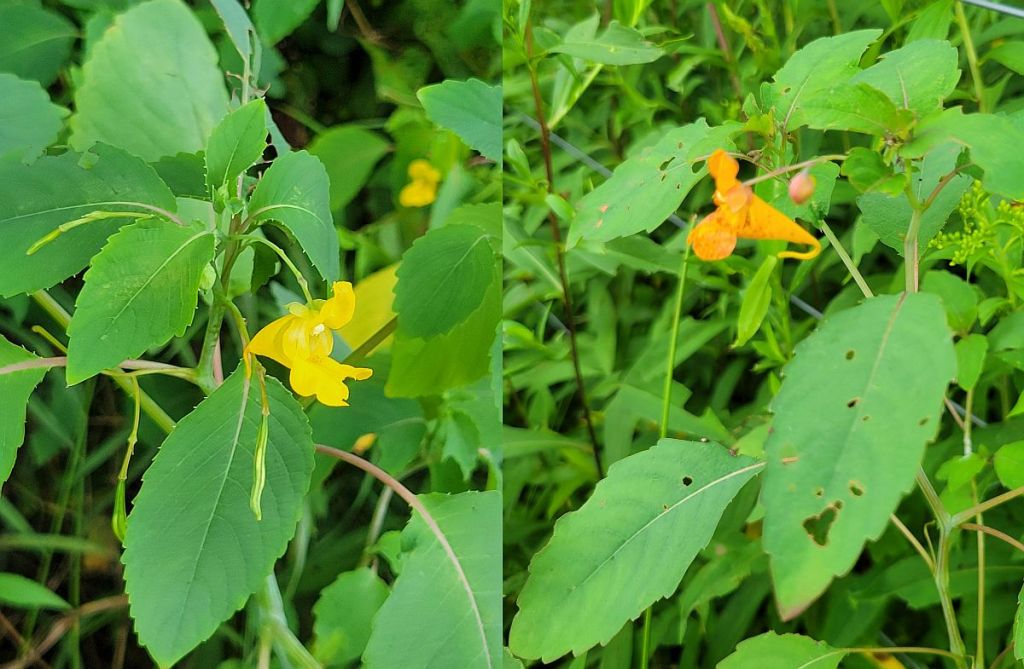
There are two species of native Jewelweeds at Blue Star Farm. Spotted Jewelweed (I. capensis) has orange, spotted flowers and usually no more than nine teeth along the margin of each side of its leaf. As we have seen, it grows abundantly in the ancient swamp forest. Its yellow-flowering cousin is Pale Jewelweed (I. pallida), which was found along the southern edge of the young swamp forest. Note how its leaf margins have more than nine teeth. Fortunately, the invasive, pink-flowering (and much taller!) Himalayan Jewelweed (I. glandulifera) is still quite rare in Columbia County and was not found at Blue Star Farm.
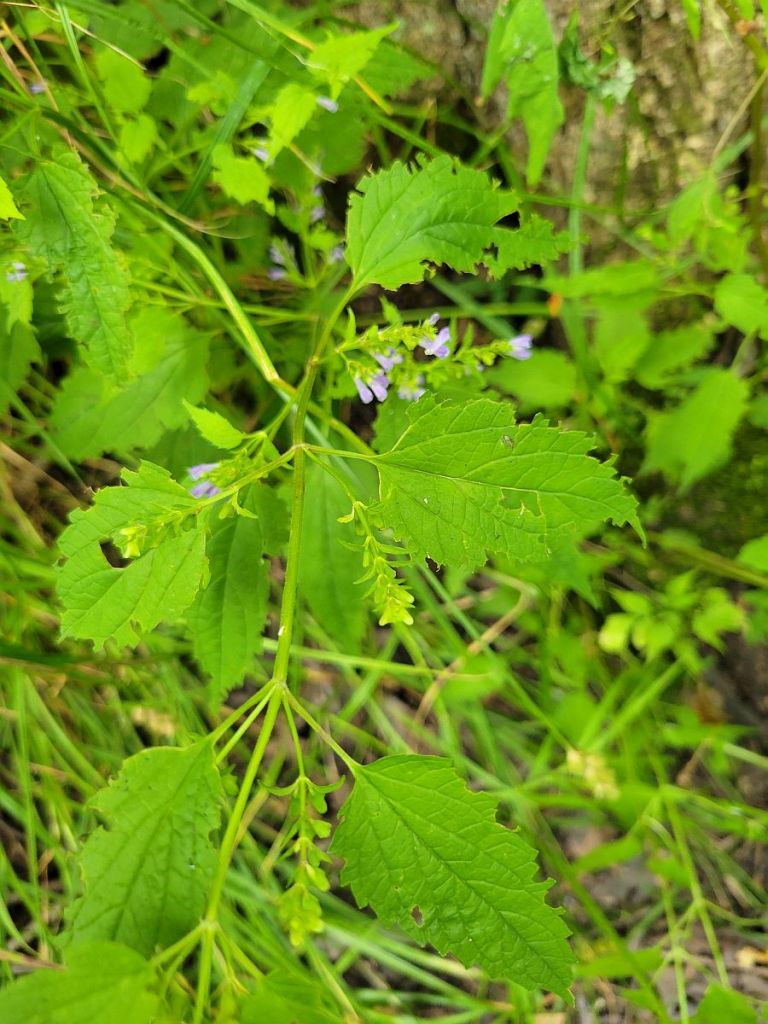
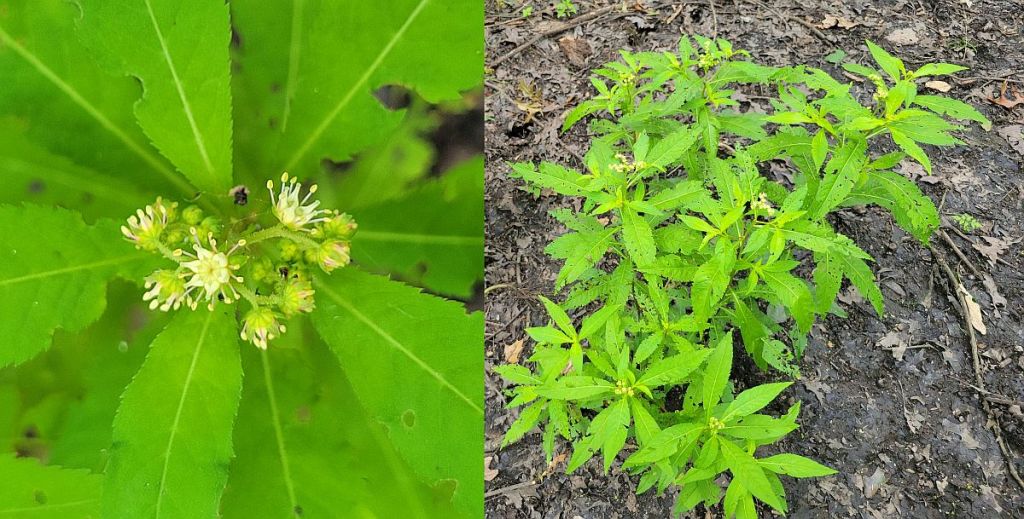
This, admittedly somewhat tattered, plant is Mad Dog Skullcap (Scutellaria lateriflora), a native member of the mint family, which reportedly is used in herbal medicine as a mild sedative and anti-anxiety treatment. In the 18th century, there was a belief that this plant could cure rabies (hence the name “Mad Dog”), but this has been disproven.
Another nice find in the ancient swamp forest was Ditch Stonecrop (Penthorum sedoides), a native wetland plant not seen anywhere else at Blue Star Farm.
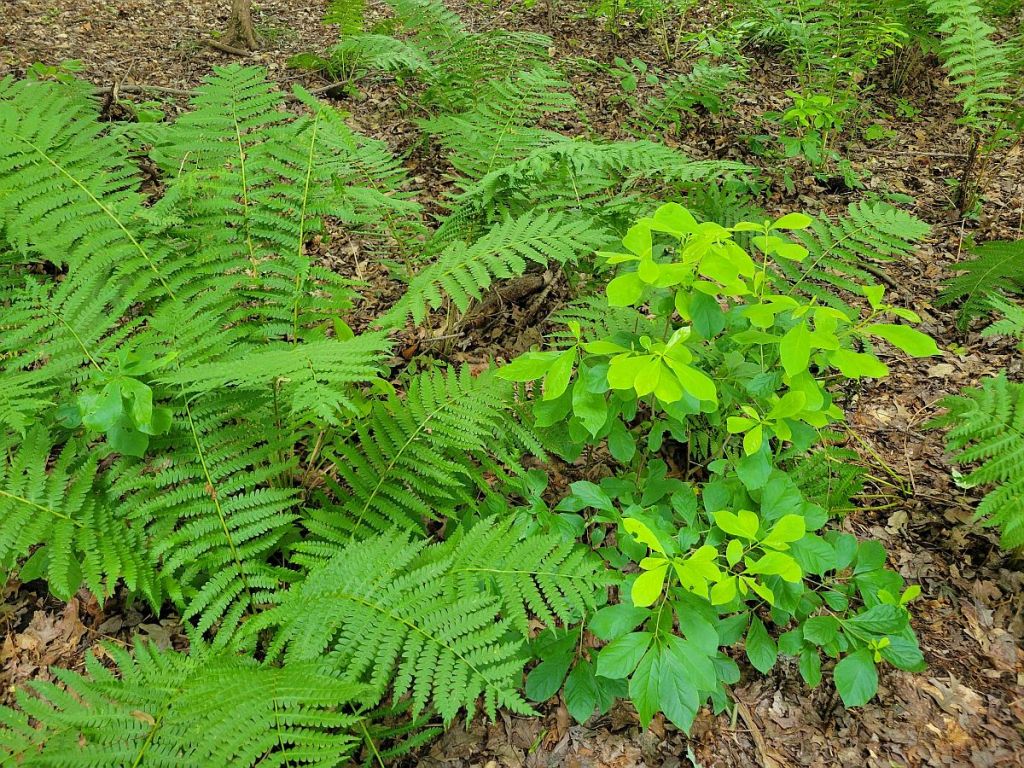
Finally, this parting shot shows a Blackgum (Nyssa sylvatica) seedling, growing next to the luxuriant fronds of Interrupted Fern (Osmunda claytoniana). Blackgum is an uncommon tree in Columbia County, usually found in swamp forests and around vernal pools. Cinnamon Fern (Osmundastrum cinnamomeum) which looks similar to Interrupted Fern, but is not pictured here, was also abundant in the ancient swamp forest.
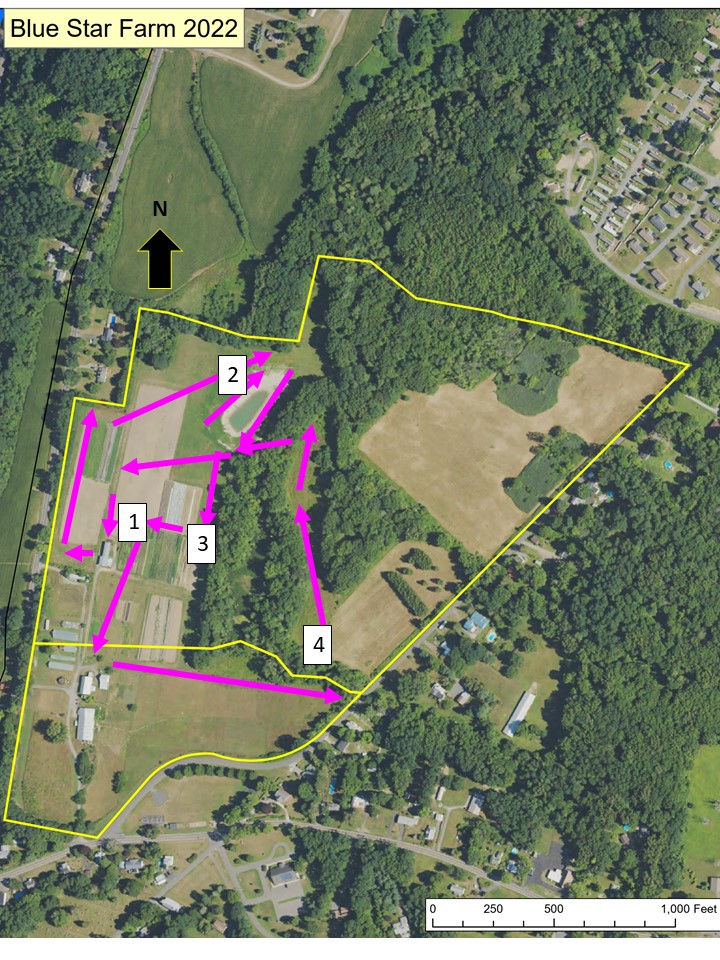
As this LiDAR image shows, the western portion of Blue Star Farm, run by Sue Decker, is located in Stuyvesant NY on terrace land above the Hudson River (seen on the left). A seasonal waterway drains north out of this farm, joining up with Mill Creek shortly before entering the Hudson. Sue’s “home farm” is slightly farther east along route 26A.
We parked just southwest of the “1” on the map and then headed north along veggie and cover crop beds, before cutting northeast to the new pond (near “2”) and then following the forest edge south, before cutting west through veggie plots to flower beds of Damsel Garden, run by land owner Denise Pizzini. We then moved south before turning east along the pastures, and finally bearing north into a finger of wettish meadow. The forested sections in the center of the land are wetland, sporting some interesting trees that Claudia will describe in a subsequent plant post.
In the 1940s, much of the now-forested area was cleared, although a patch of mature swamp forest existed near the center of the parcel. As was typical of this era, orchards were extensive, although they only nudged into the edges of the current farmland
This photograph looks north from near the point marked “1” on the earlier image.
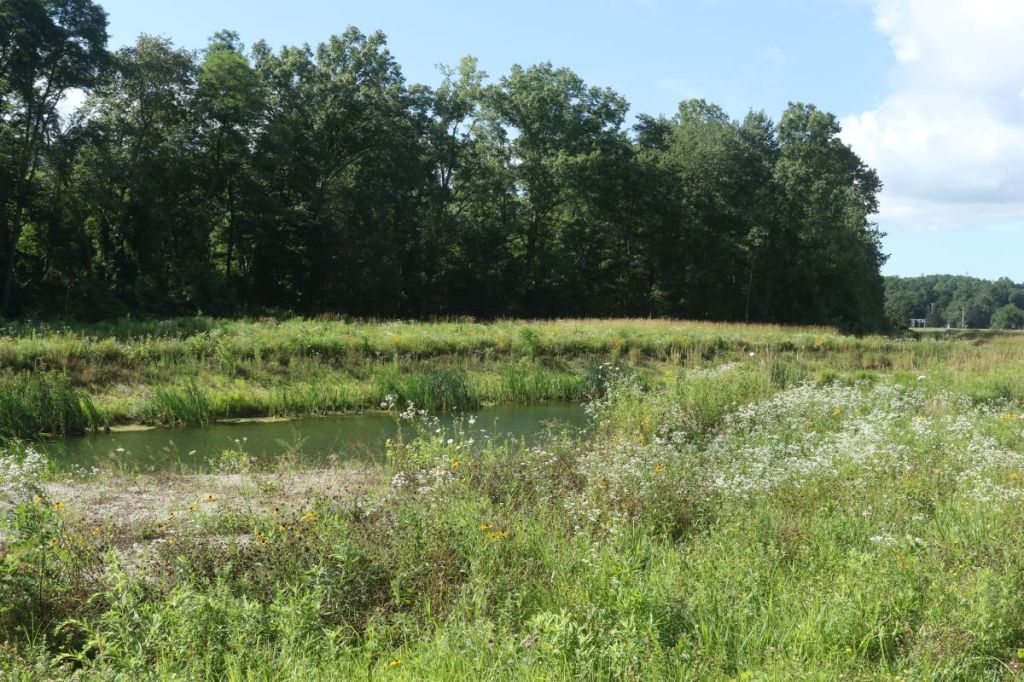
This photograph was taken from near point “2” and looks south, across a pond constructed around 2022. This was a dragonfly hot bed, as we’ll see later.
This picture, taken looking south from a bit north of point “3”, shows the welcoming (at least to insects!) soft edge with the forest.
This photograph was taken around point “3” and looks southwest across Blue Star veggie beds towards the buildings and beds of Damsel Gardens.
This wet meadow was photographed looking north from around point “4”. The mature swamp forest mentioned earlier is on the right.
One characteristic of this farm is its sandy soils, as evidenced here. These are remnants of Glacial Lake Albany beaches (or shallow, submerged sand flats). Making a cameo is one of the numerous grasshoppers we encountered. Most of the time they flushed hurriedly from in front of us, their large wings sometimes fooling us into mistaking them for short-flighted butterflies.
One consequence of the sandy soils seems to be ample habitat for native, ground-nesting bees, such as this Eastern Miner Bee (or close relative).
This graph illustrates data we collected from 19 Columbia County farms back in 2010. In and around tomato beds, we indexed flower abundance (much of which was unplanted “weeds”) and surveyed bees using bowl traps. This graphic shows that, relative to all other farms and especially for those with such low flower abundance, bees were very abundant at the current Blue Star site. Our guess was that this was because the sandy soil made excellent habitat for ground nesting bees. Bee diversity also appeared to be relatively high, ranking fourth in a quick and dirty assessment of diversity. We did not assess flower abundance during our current visit and it may well now be higher.
This native bee may be another species of mining bee.
Many bumble bees are also ground nesters.
The most common bee species observed was the Honey Bee, likely originating from…
these hives along the forest edge. While many of us appreciate the honey, and Honey Bees can definitely be a boon to crop pollination, there is evidence that, at least under certain conditions, they can out compete native bees, thereby reducing the habitat quality for some species. Where native bees are abundant, additional pollinators are usually not needed.
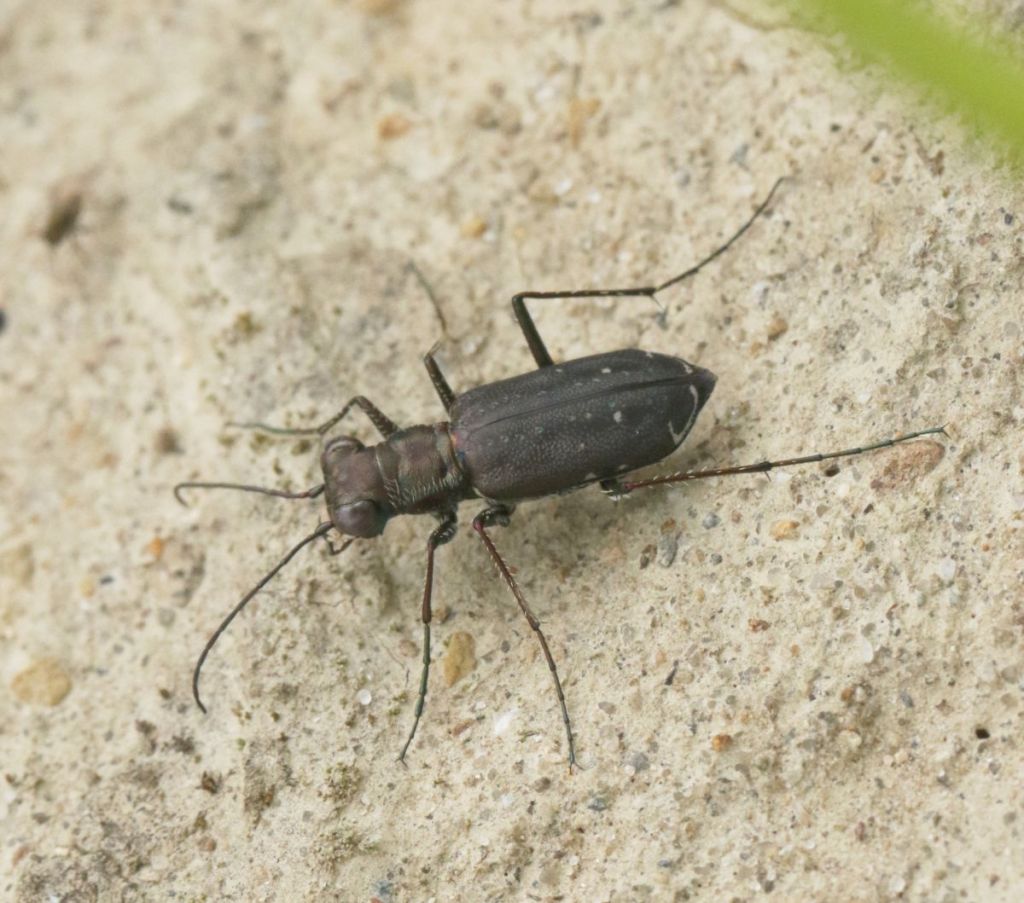
Open sand or clay patches are also favored by tiger beetles. This happens to be a “Punctured Tiger Beetle”, named for the row of point-like indentations along its back.
Speaking of beetles, this is a Green June Beetle, an elegant beetle with a wide-ranging diet, who is sometimes considered a minor agricultural pest.
Most of our attention was focused on dragonflies (& damselflies) and butterflies. We’ll start with the former.
This large dragonfly was seen flying over the aforementioned pond. While the green body and reddish tail could suggest a female Common Green Darner (a species that was also present), the brightness of the red, coupled with an evident white patch below the hind wings (not so evident in this photo, but clearer in others), suggests Comet Darner. Comet Darners are the biggest dragonflies regionally, and they are generally considered rare. We know them from only two other sites in the County.
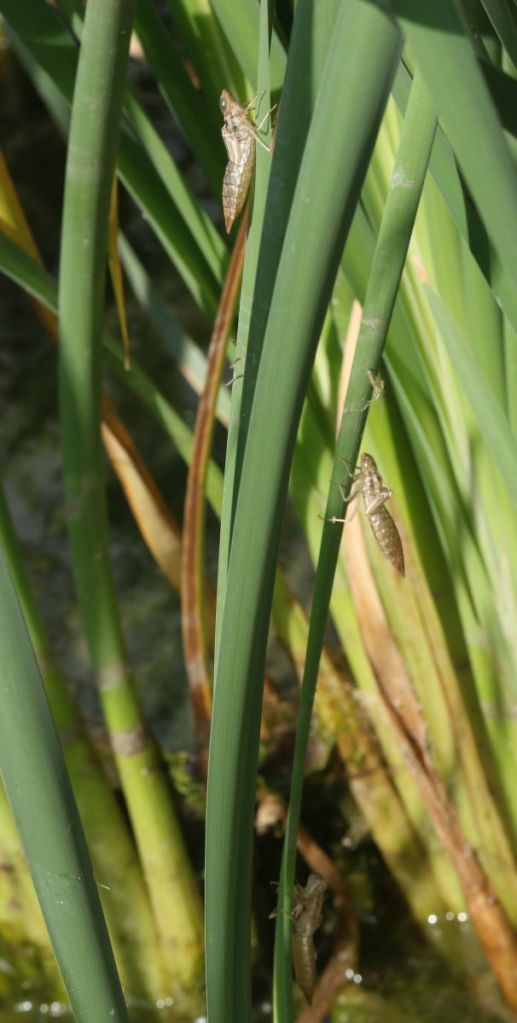
The vegetation around the pond edge sported numerous darner exuvia – the hollow, dry skins left behind when the aquatic nymph clambers out of the water, unzips its diving suit, and flies away. These appear to be exuvia of the Common Green Darner.
Widow Skimmers are common pond dragonflies that range widely in search of prey.
The Eastern Pond Hawk is another relatively common pond dragonfly. This bright green individual is the female, who has a much more verdant coloration than…
the blueish male shown above. One wonders if she is also more apt to hang out in green vegetation. As the traces of green suggest, the coloration of younger males resembles that of the female in many dragonfly species .
The name “Common Whitetail” almost says it all, but only the males have such white abdomens.
This slightly tattered Blue Dasher female also seems to carry its habitat’s design onto its thorax.
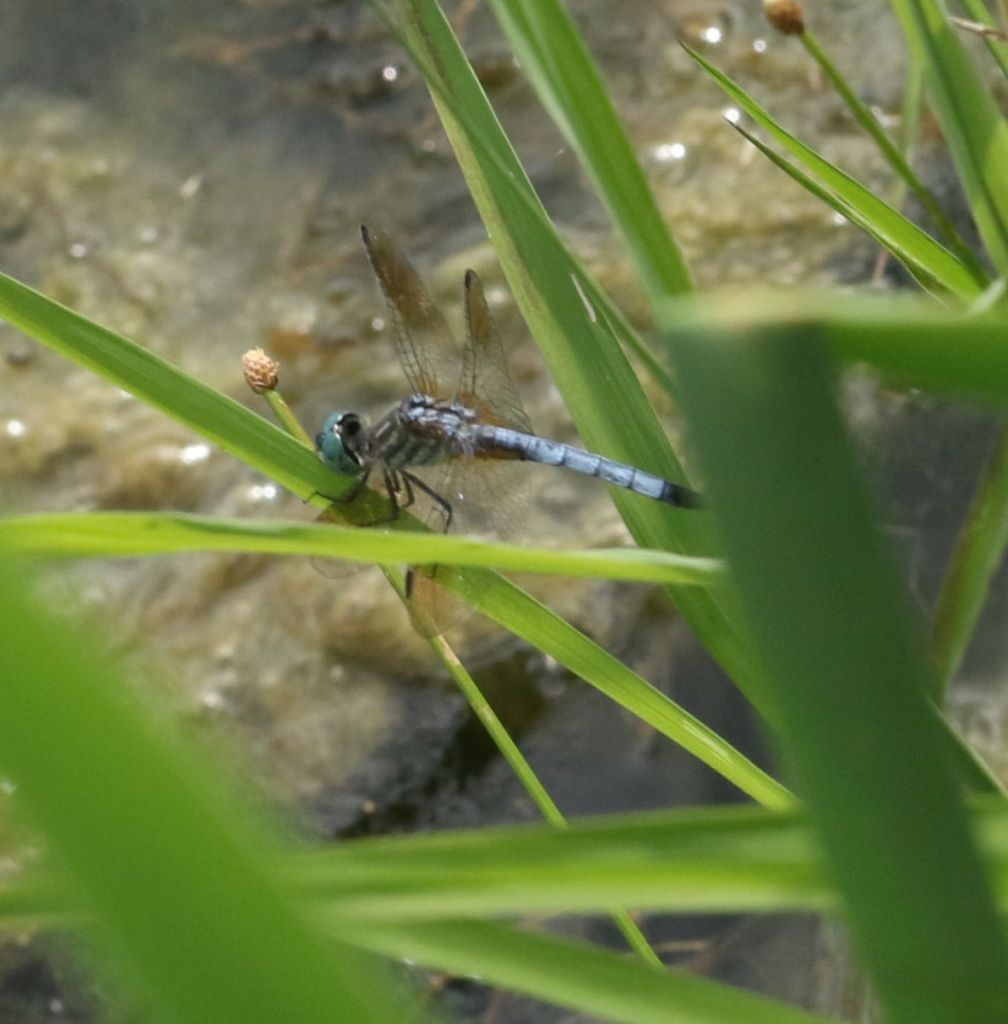
The Blue Dasher male tends to have a blue tail with a black tip.
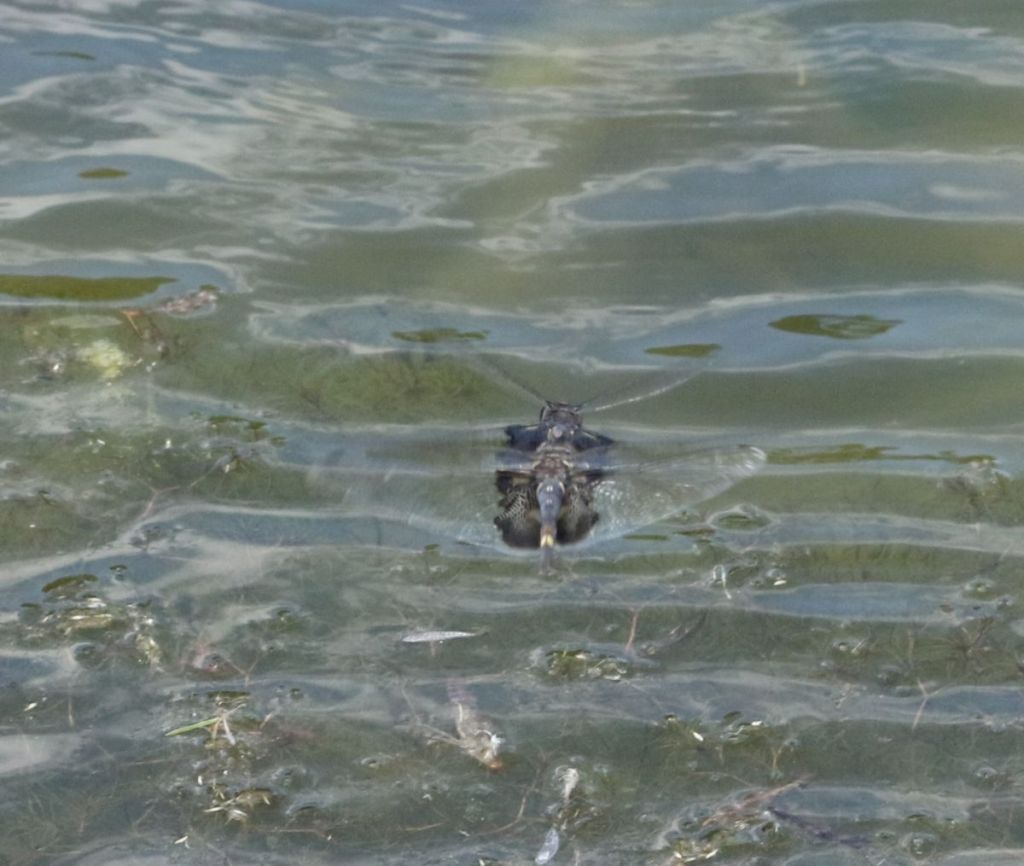
OK, I admit this is an odd angle. It shows a pair of flying Black Saddlebags from the back. The male is in front and is clasping the female behind the head with his aptly named “claspers”. Unlike Widow Skimmers, Pondhawks, and Blue Dashers, Black Saddlebags rarely perch. Rather than ‘hawking’ after prey from stationary resting points, this species does most of its hunting on the wing. This mated pair is probably not hunting, but rather looking for a place where their eggs can be deposited.
A mature male of one of our red-colored Meadowhawks. We have a trio of similar species and, not having tried to catch and inspect this individual more closely, I won’t guess at a species name.
Damselflies are close relatives of the dragonflies, but are generally smaller, slimmer and hold their wings above their backs when perched. This damselfly is an Eastern Forktail, a common if somewhat inconspicuous species.
A Familiar Bluet. The defining characteristic for many damselflies and dragonflies is often those male claspers mentioned earlier; they are found at the very tip of the tail. Probably because they are an important component of the pairing process, their shape tends to be species-specific.
Damselflies can have exuvia too!
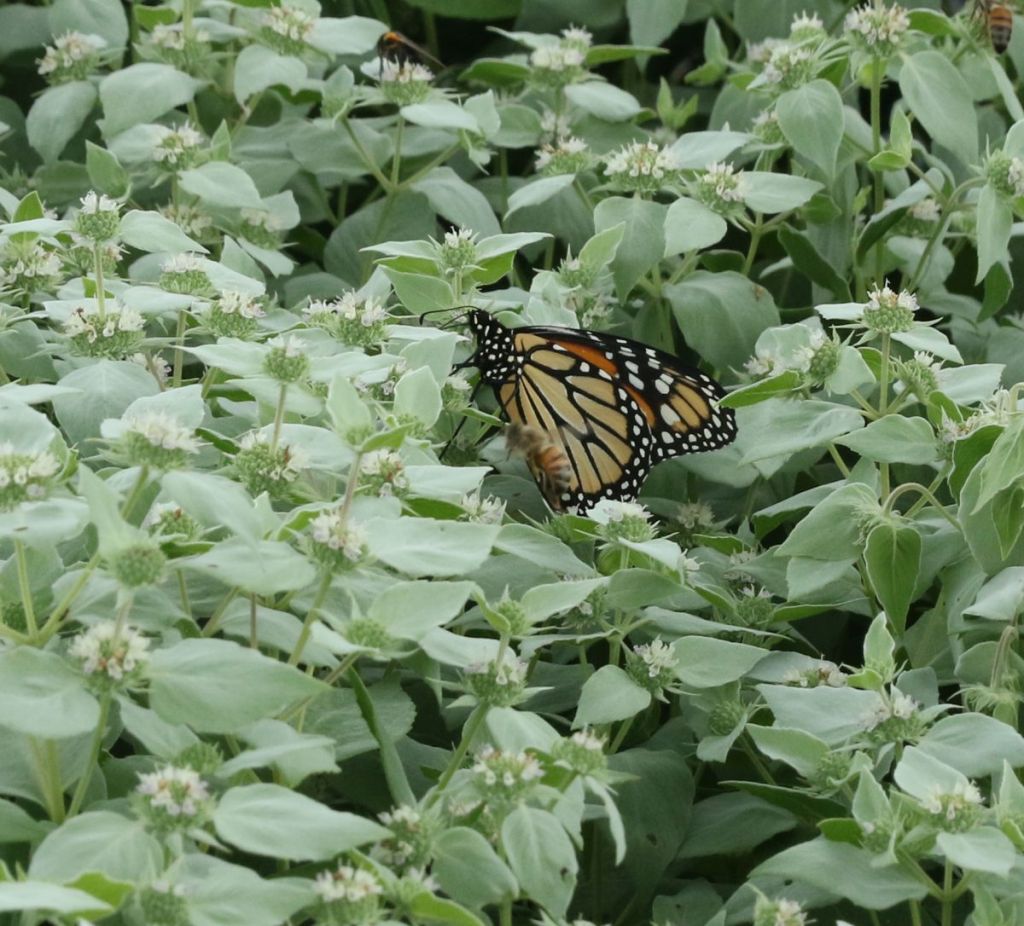
Moving on to butterflies, this is the iconic Monarch. We have seen a scattering of them so far this year.
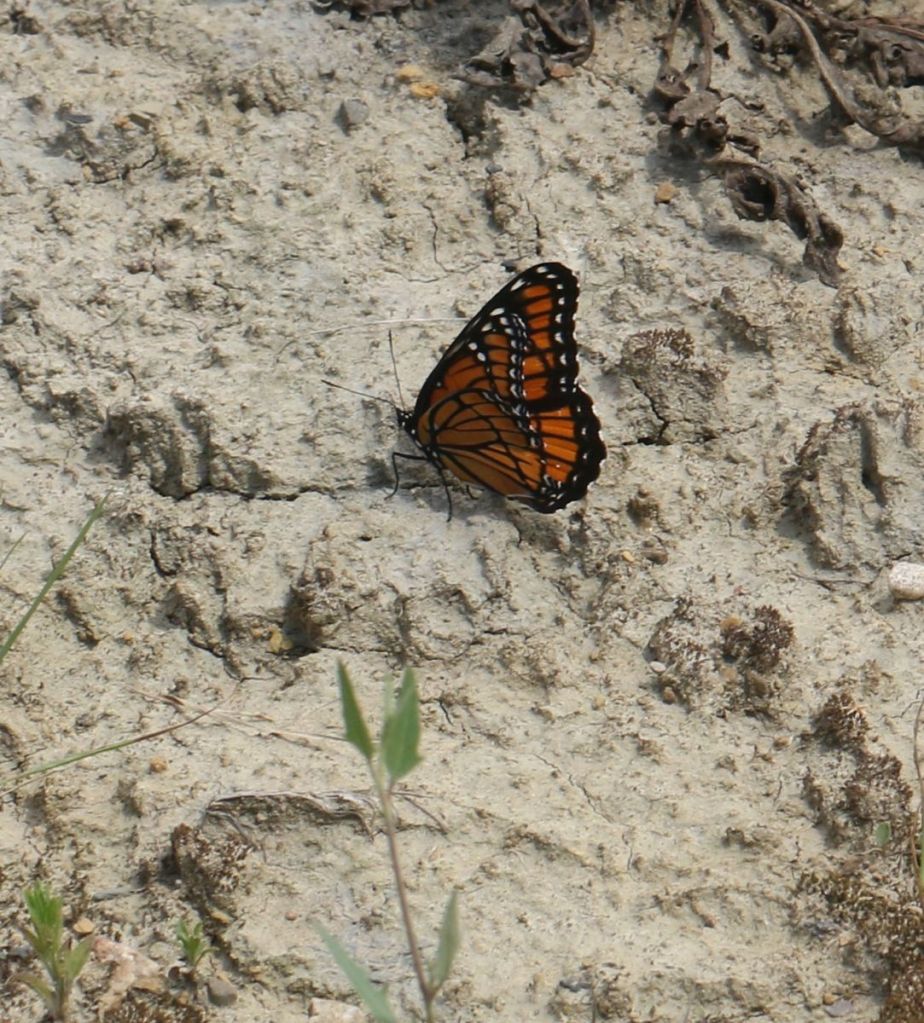
This is the Viceroy, a Monarch look-alike. It is usually smaller than a Monarch and has that distinctive black line paralleling the trailing edge of the hindwing.
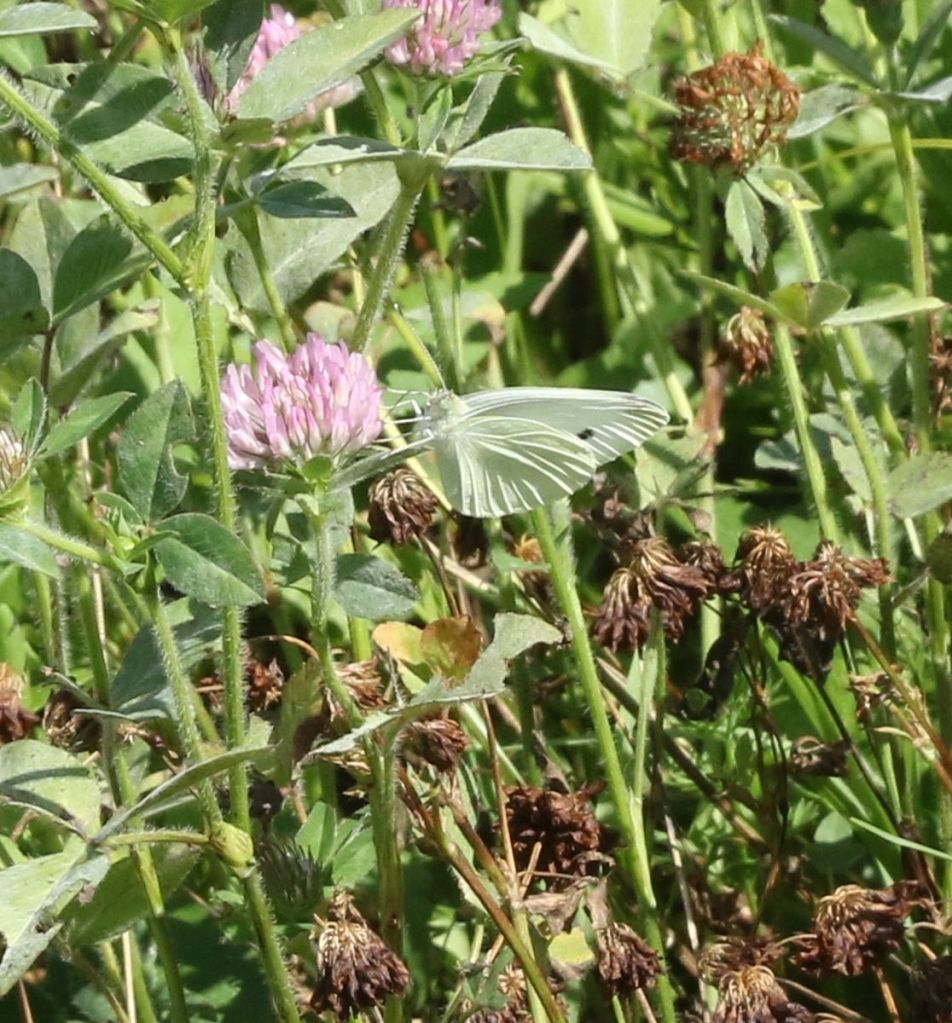
Cabbage Whites were abundant at the farm. As hinted at here, their caterpillars (aka cabbageworms) feed on brassicas and can sometimes be crop pests. Cabbage White are not native, and were first noticed around the ports of Quebec City and New York in the 1860s, probably having hitched a ride on imported cabbages.
Their medium size and bright white wings is almost distinctive. Just to keep things interesting however…
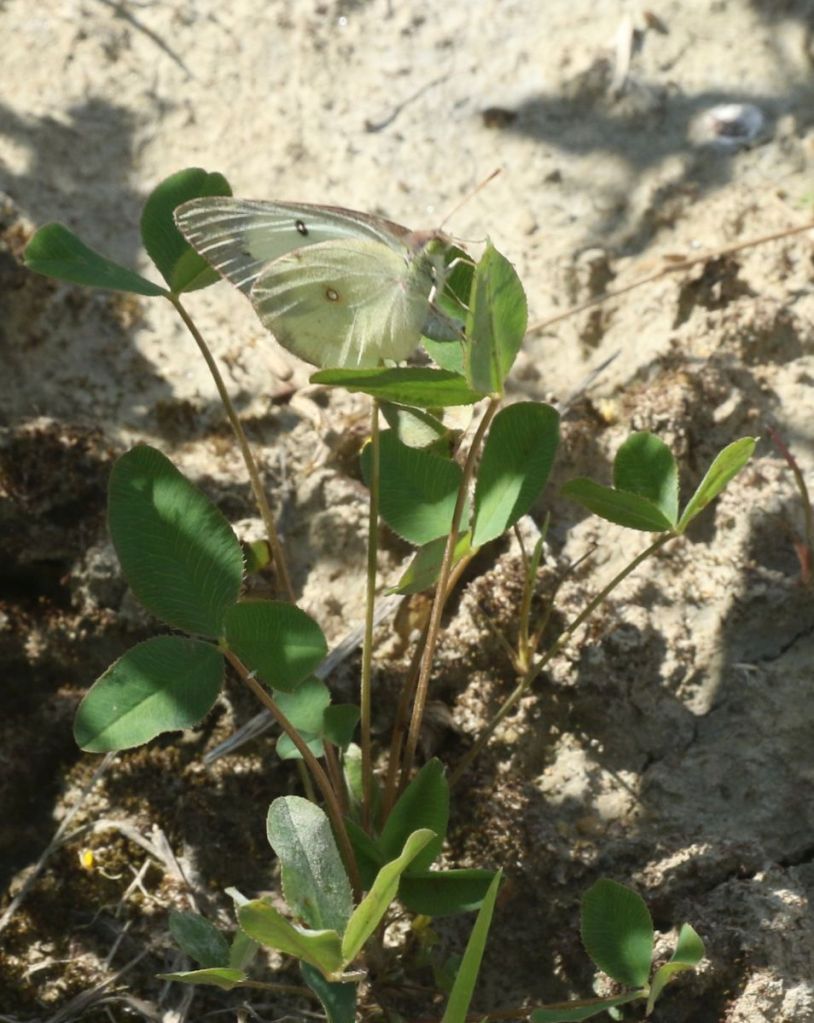
some female sulphur butterflies are white, and so a definitive ID can require a close look. When their wings are closed, sulphurs have a small, brown-outlined eye on their hindwings; Cabbage Whites have no such mark. The tops of the wings are also distinctive but are less commonly seen.
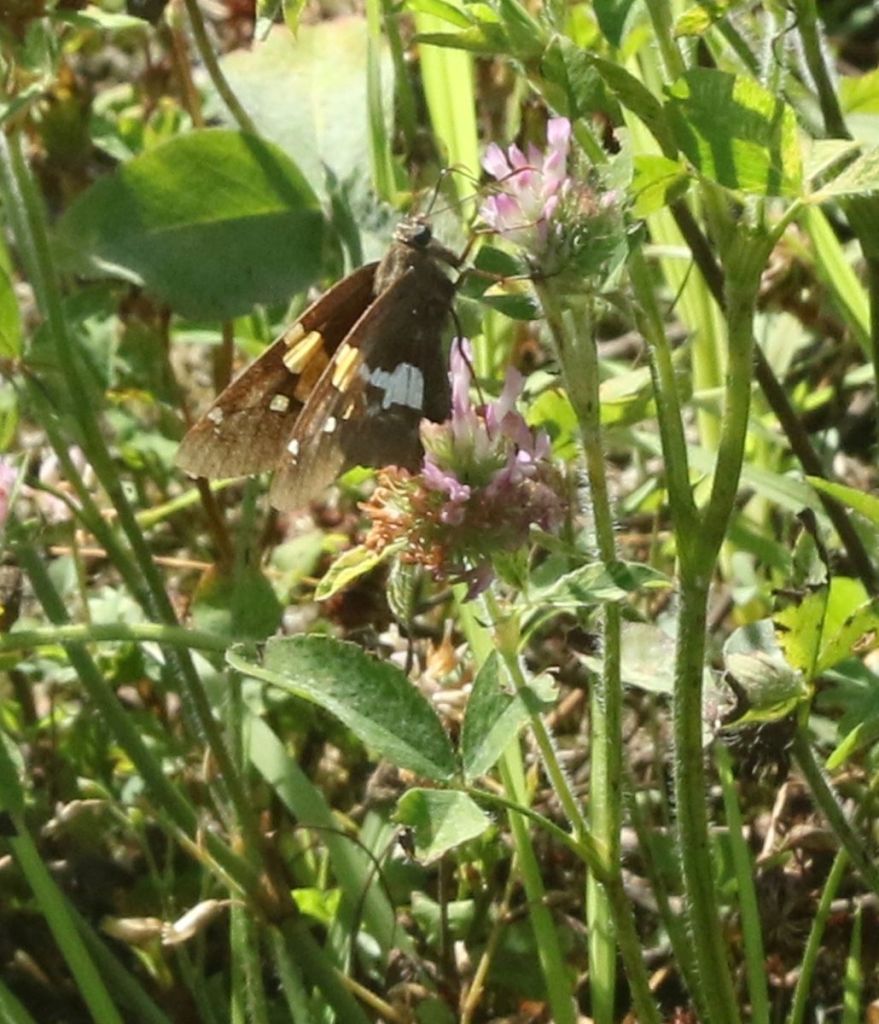
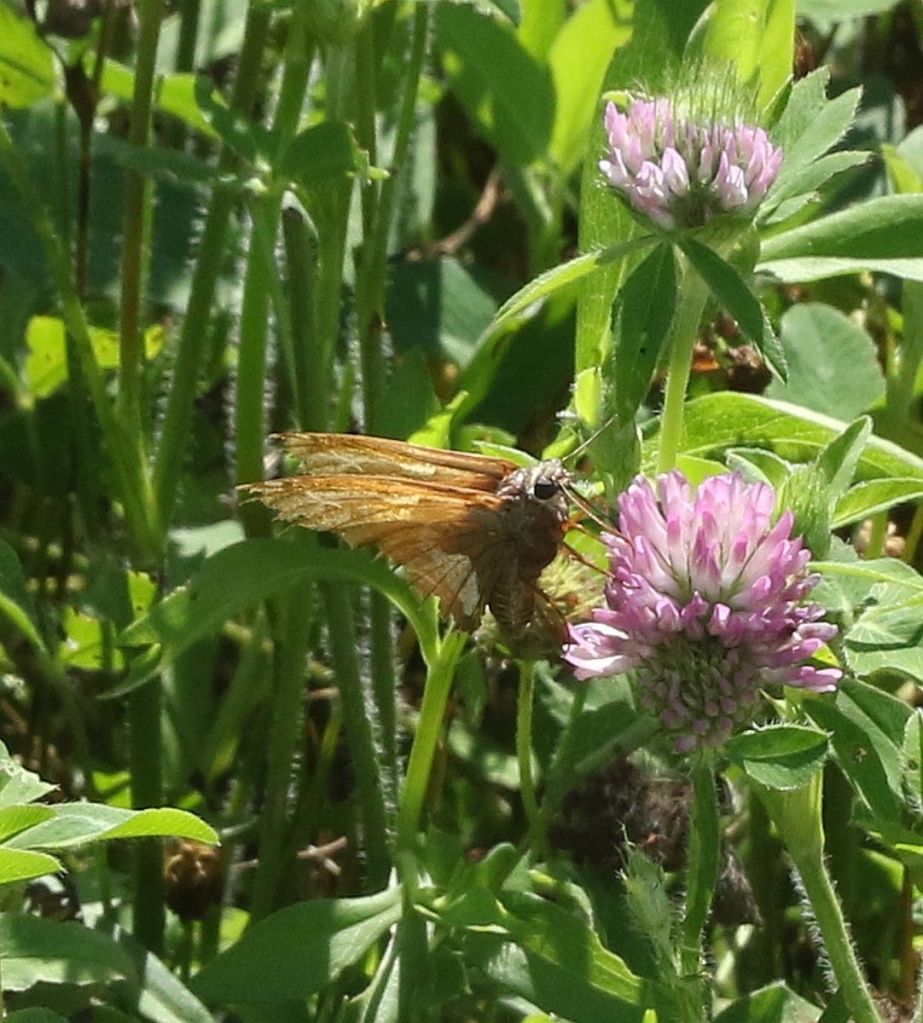
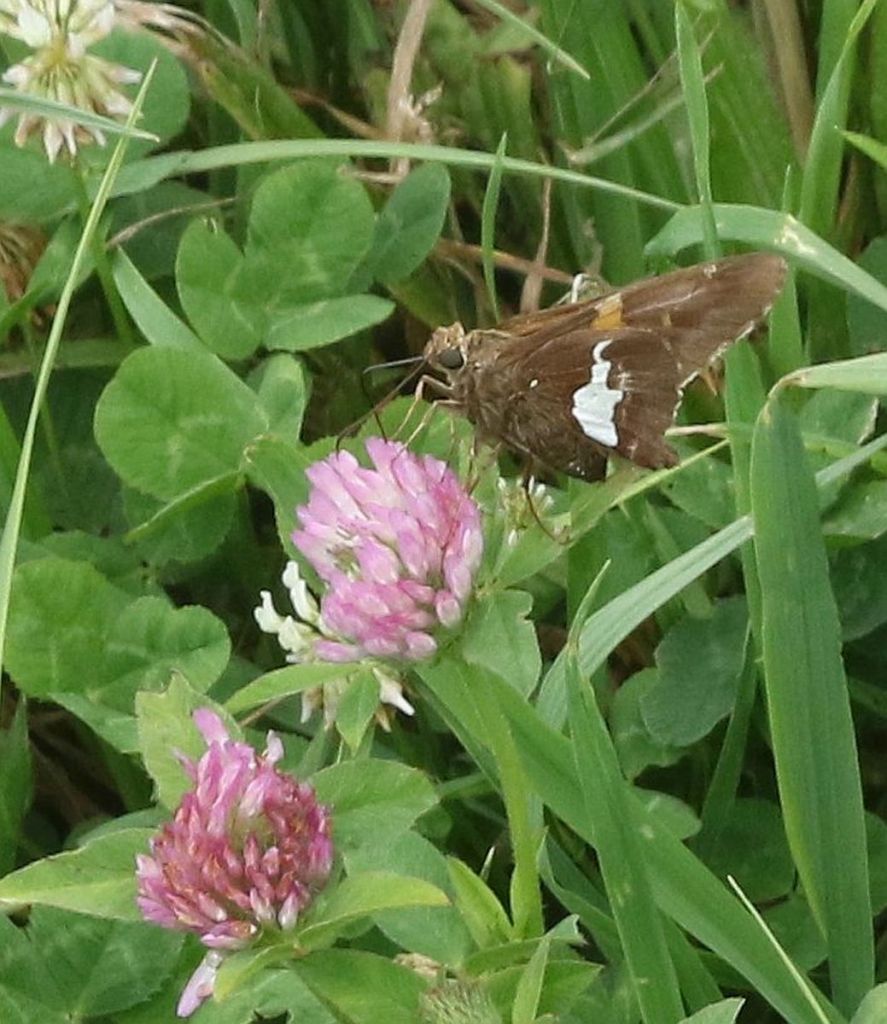
“Skippers” are moth-like butterflies with comparatively large bodies. Their flight is usually hurried, with minimal apparent gliding. This is our largest skipper, the Silver-spotted Skipper. It is a common resident on farms, where its caterpillars feed on various, usually non-commercial legumes.
Butterflies do age. Their wings do not grow back and they progressively lose their scales, hence the tattered, almost translucent wings of this Silver-spotted Skipper.
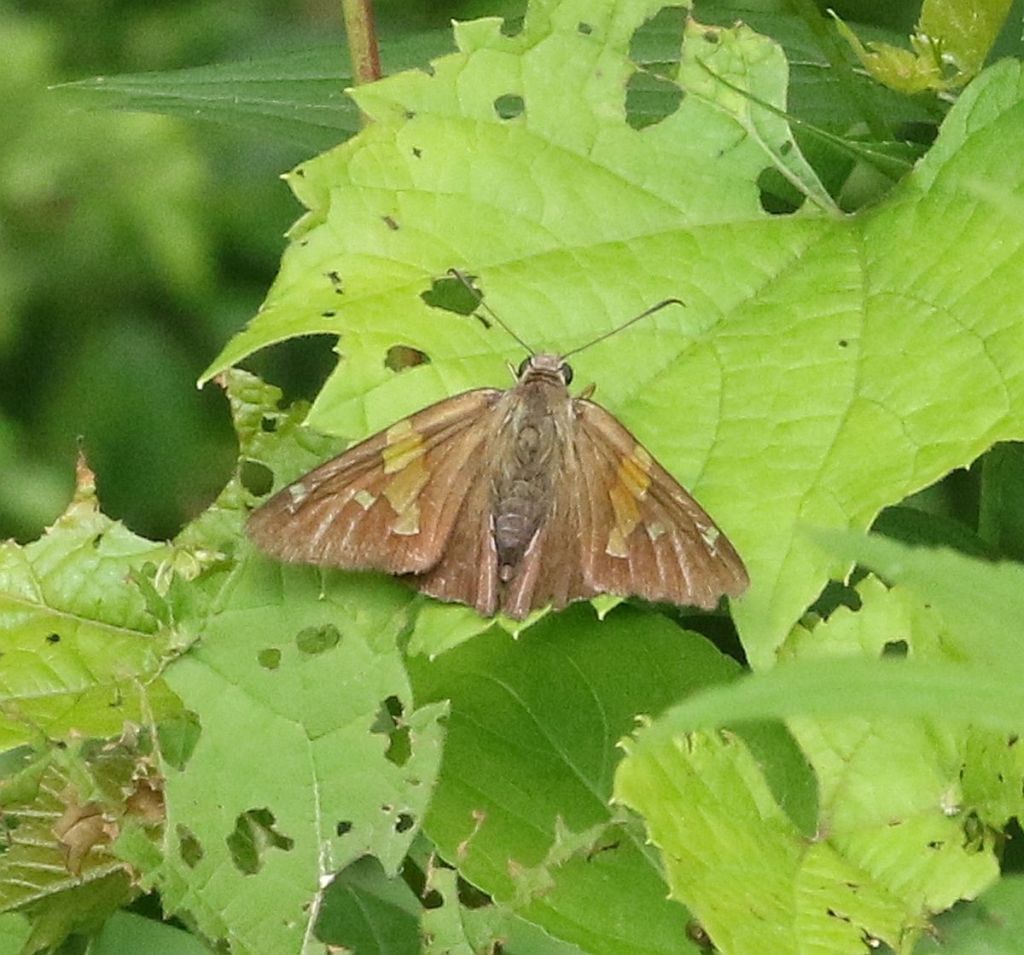
Another Silver-spotted Skipper, this time in the relatively rare open-wing posture.
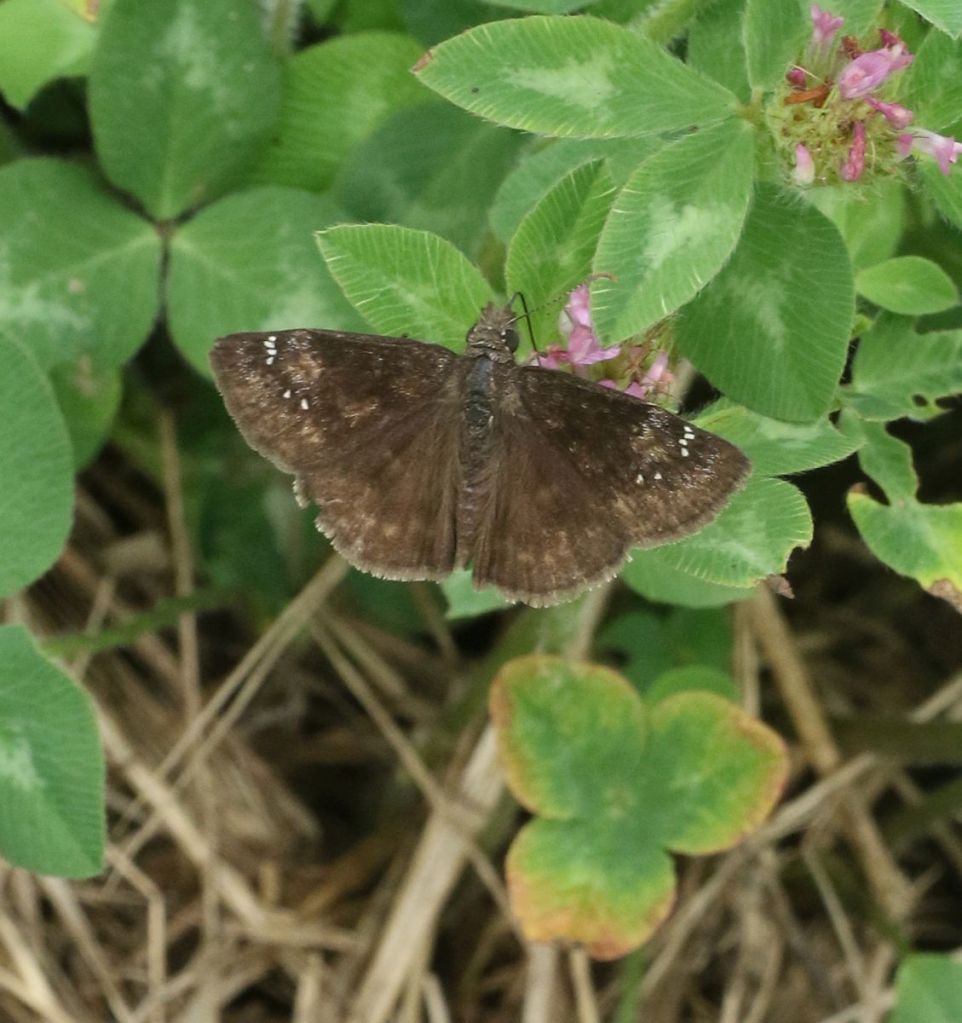
We have a host of tiny skippers that often go relatively unnoticed. They can be tricky to ID, so much so that butterfly aficionados call this and two other darkish skipper species the “Three Witches”. This is a male Little Glassywing, or at least so I have convinced myself!
My guess is that this is a female of the same species. These smaller skippers often perch with their wings in a ‘jet-fighter’ position – the hindwing flat and the forewing at an angle.
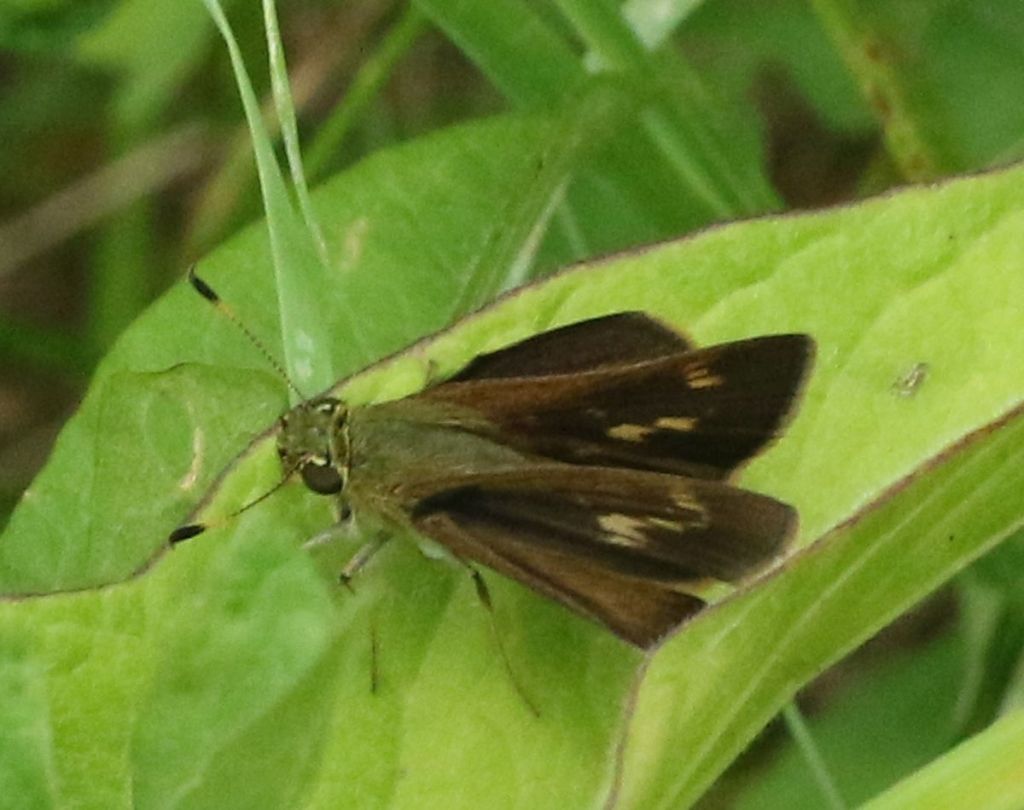
I believe this slightly drabber-colored species is a Dun Skipper, another one of the witches. Unlike the other two witches, the Dun is a sedge feeder; correspondingly, it tends to be most common around wetter areas.
The bronzy head of this fresh individual is a subtle but useful characteristic for recognizing the Dun Skipper.
Some skipper do, however, perch with their wings flat. In fact, one rarely sees these particular species with their wings closed. This is a Wild Indigo Duskywing, a native butterfly whose caterpillars feed on Wild Indigo. This would currently seem to be a losing strategy in our region – how many times have you seen Wild Indigo? However, species aren’t stupid evolutionarily, and the Wild Indigo Duskwing could now be more aptly named the Vetch Duskywing, having accepted introduced vetches into its diet.
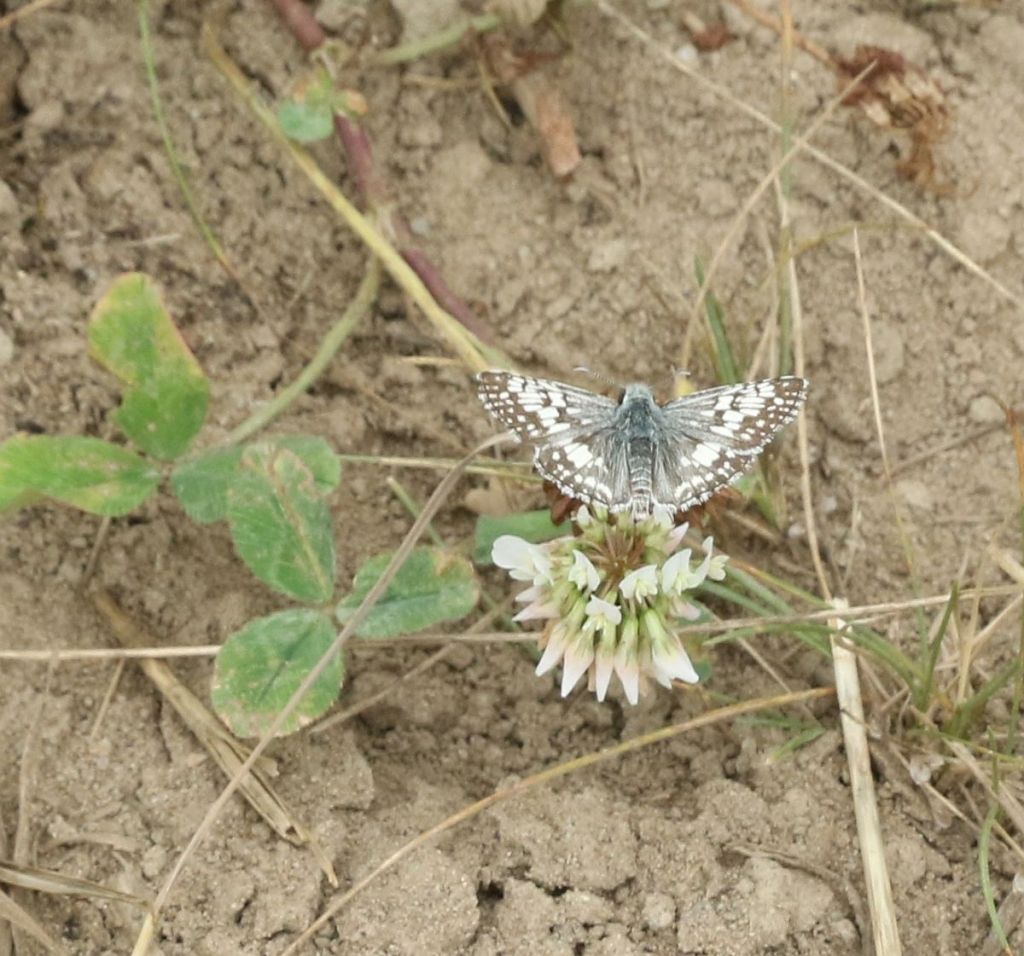
This was the first time I have seen a Common Checkered Skipper for at least a couple of years. We are on the northern edge of this southerly species’ range, and they have not been common locally. It may not overwinter with us and might need to recolonize each summer from farther south. Its caterpillars feed on Velvet Leaf, a farm weed that Sue assured us she has plenty of.
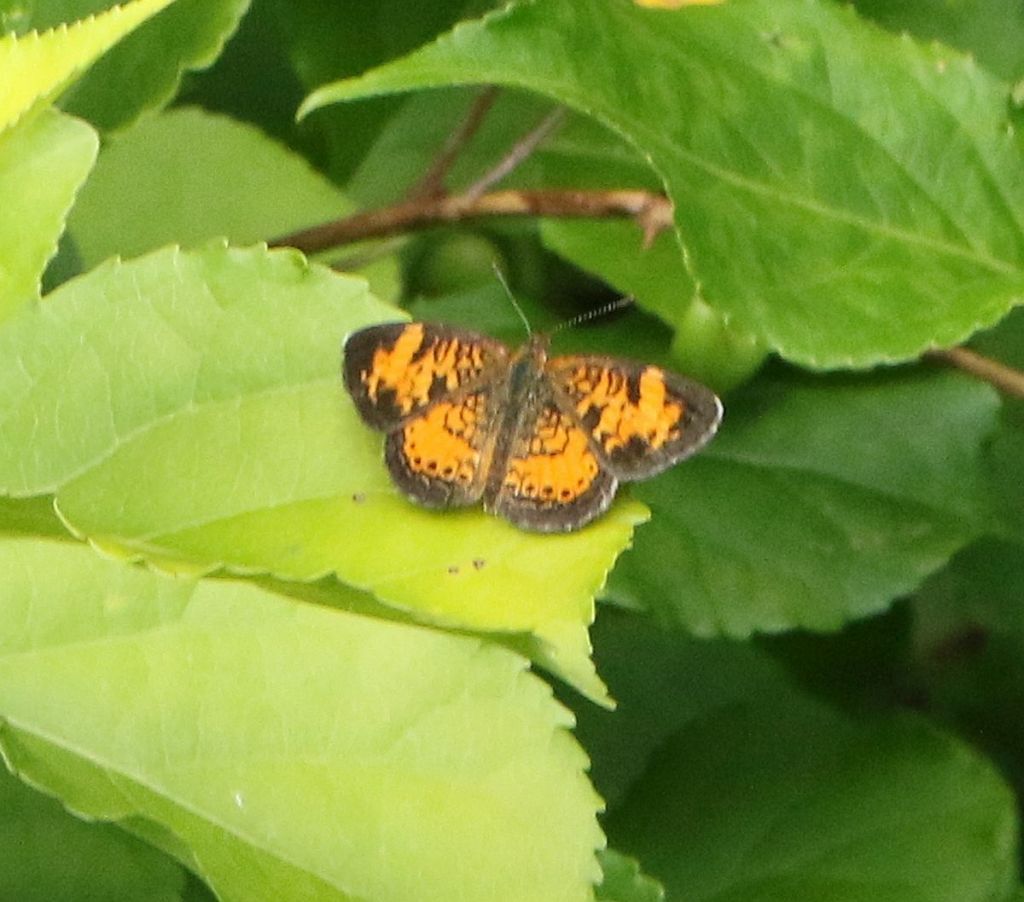
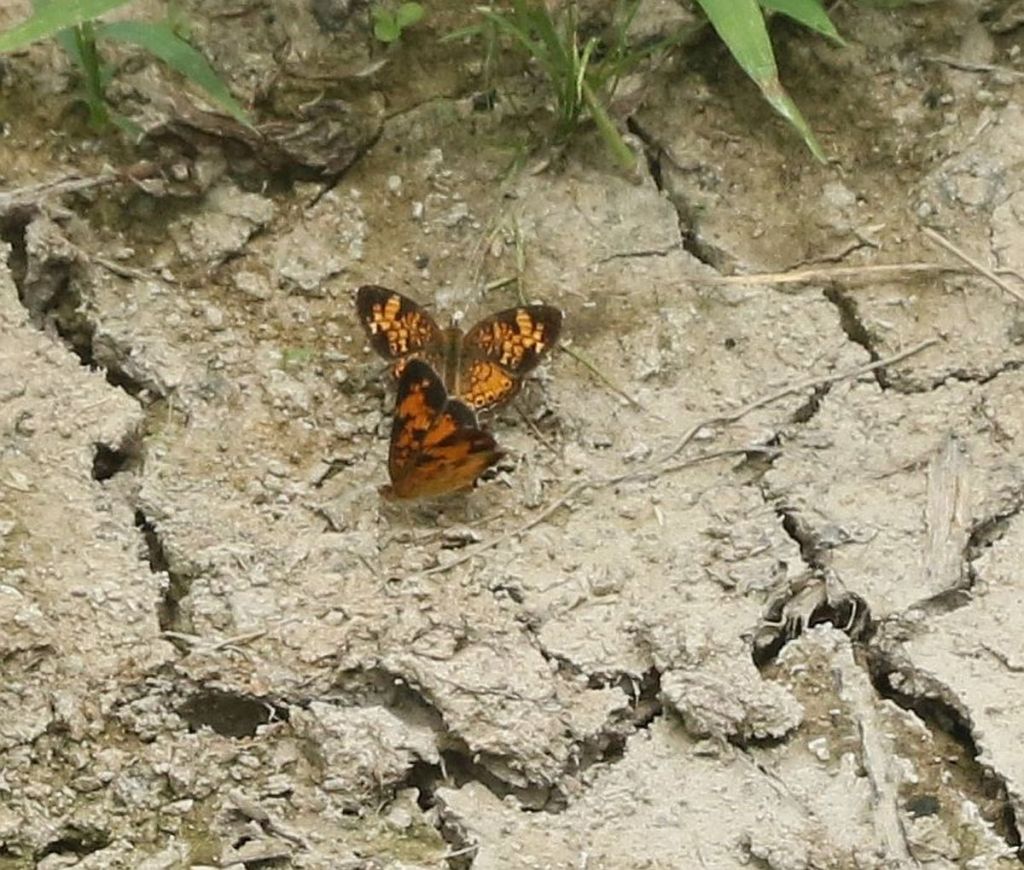
This little beauty is a Pearl Crescent – a small, sometimes common butterfly whose caterpillars feed on asters. They were most common in the flowers between the pond and the forest, but were found throughout the farm.
A mated pair of Pearl Crescents, the larger, more darkly marked female has her wings open.
Crescent taxonomy harbors some confusion. There are probably at least two Crescent species in the County, the widespread Pearl Crescent and the less common Northern Crescent. The distinguishing characteristic is said to be the lack of black dividing lines in the central, orange field of the Northern’s hindwing. So perhaps this is a Northern Crescent, or maybe it’s just a particularly ‘blond’ Pearl Crescent.
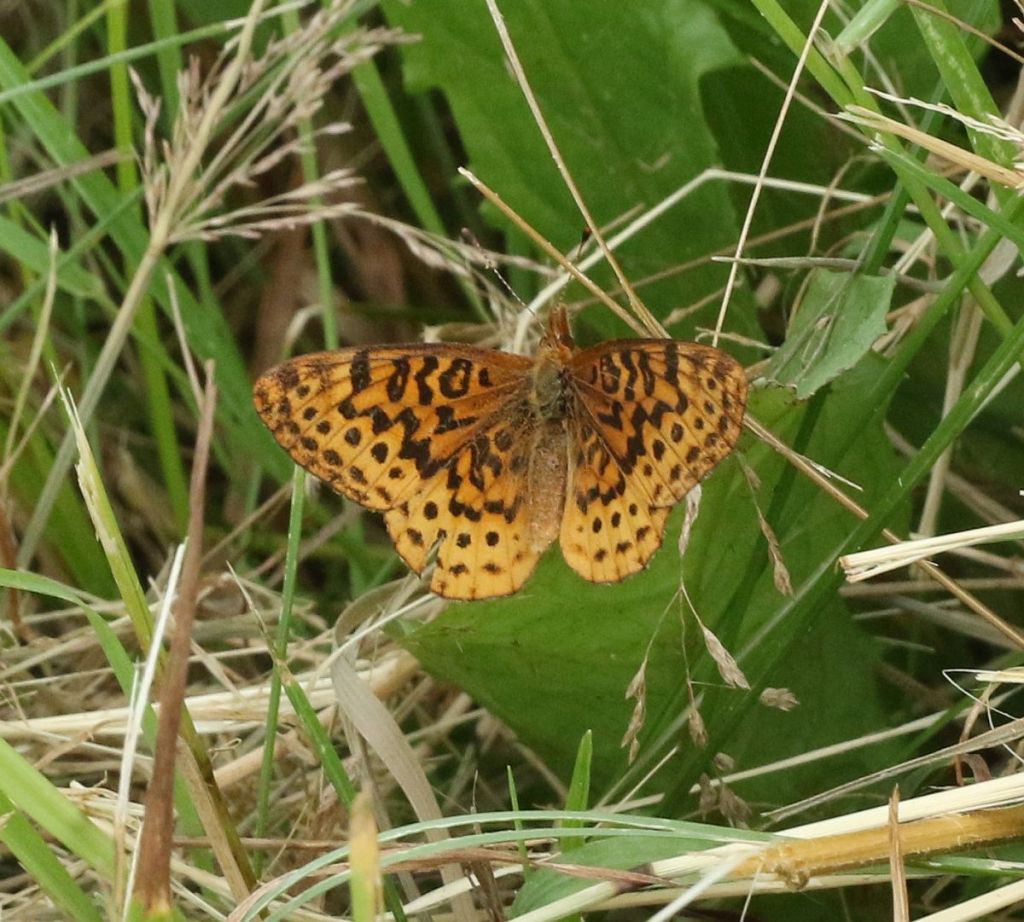
Only slightly bigger than a large, female Pearl Crescent, the Meadow Fritillary seems to be declining regionally for reasons unknown. In the 19th century, for example, its range extended throughout Massachusetts, but now it is mainly found in the western part of the State. It has similarly retracted from the surroundings of NYC. One hopes it will not go the way of the Regal Fritillary – a once relatively widely distributed species, now nearly extinct on the East Coast.
The Meadow Frit’s underwing is well camouflaged.
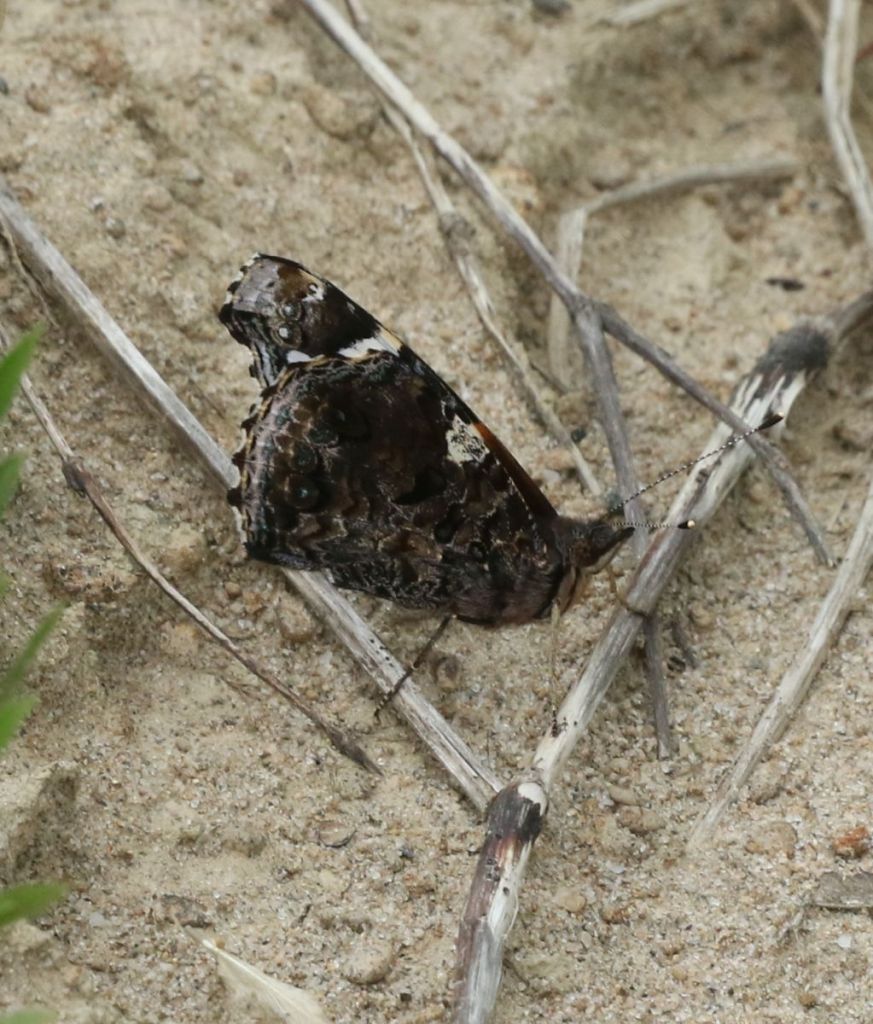
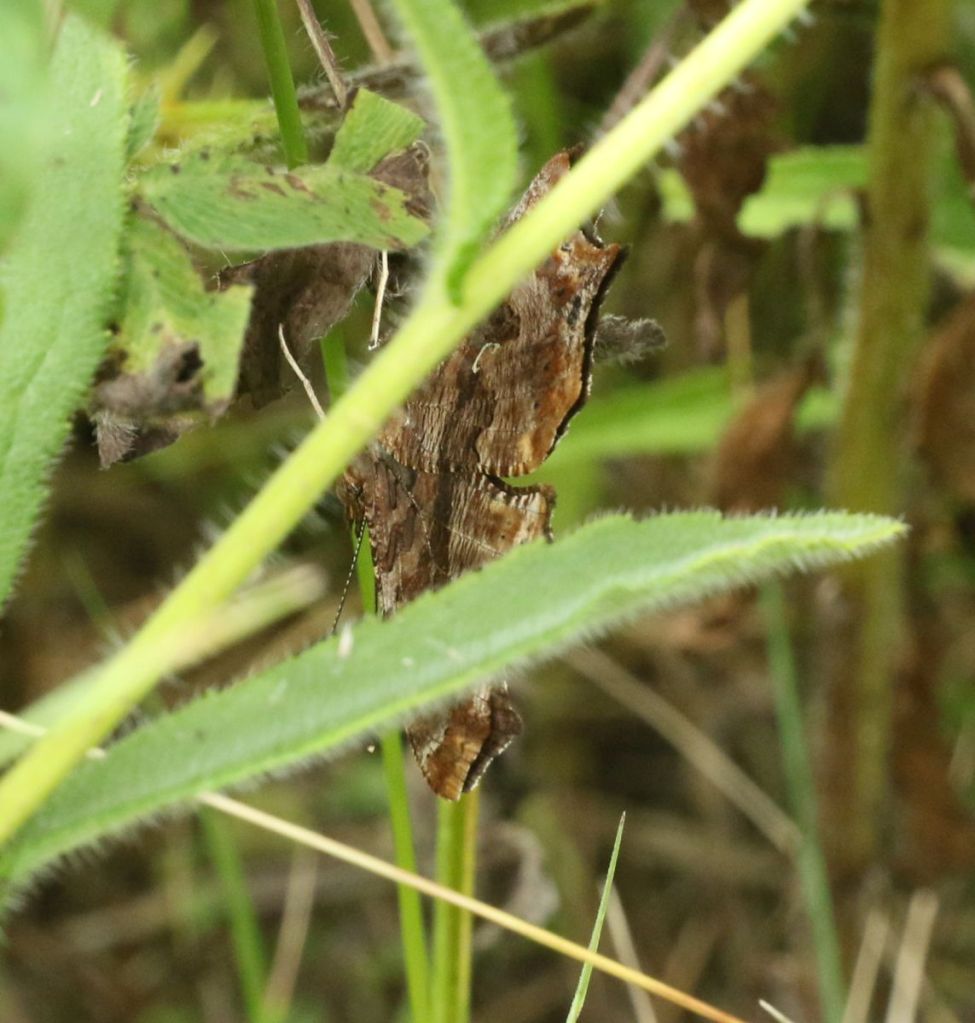
The underwing of this butterfly is also subtle, but, wait a bit and…
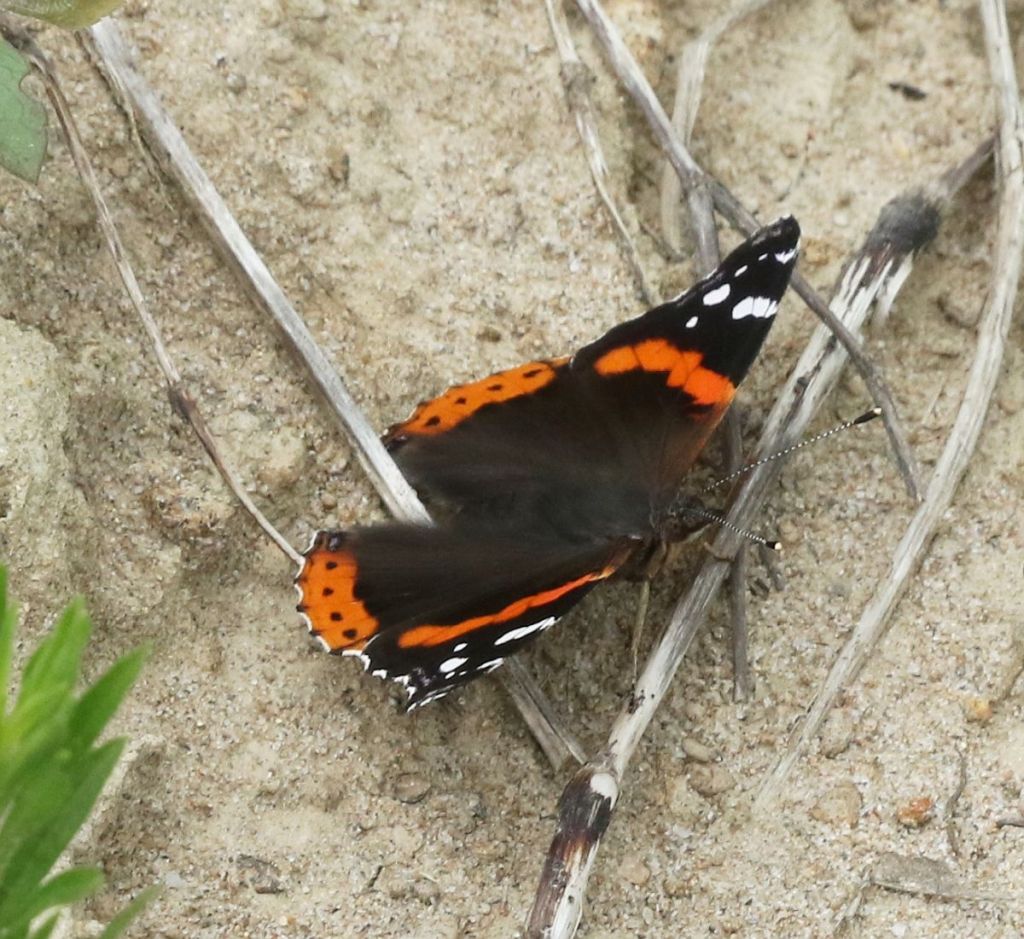
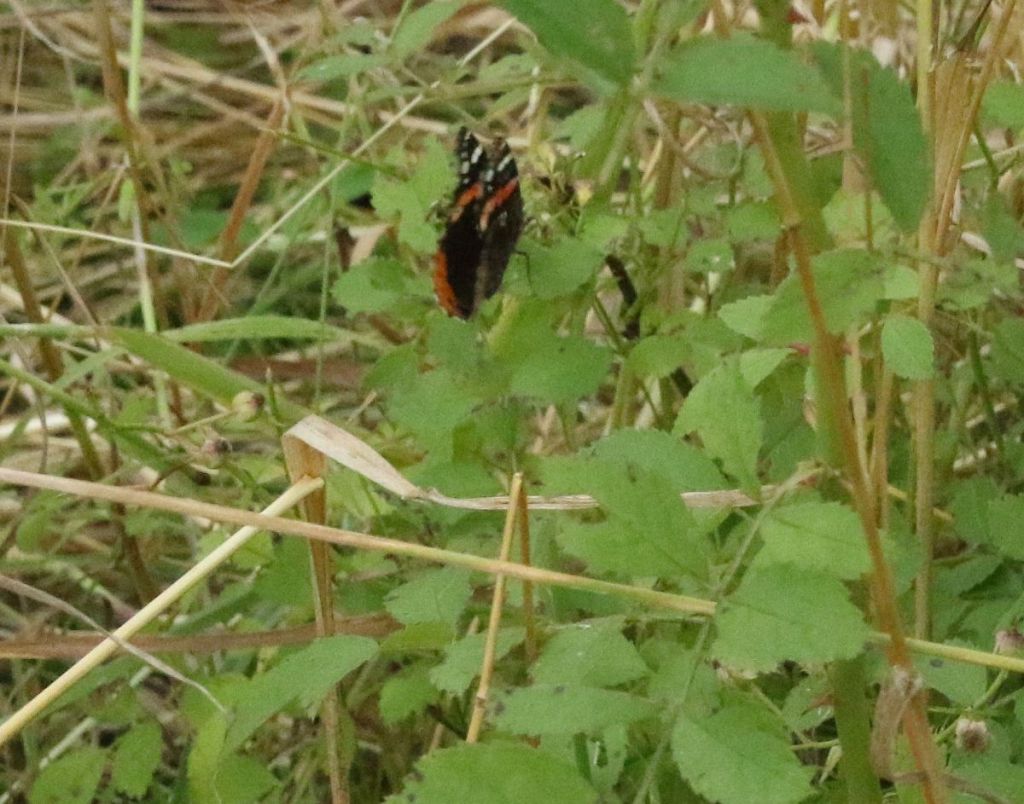
the Red Admiral may flash its more dramatic wing tops. Like the Monarch (and a few other of our species), the Red Admiral is migratory.
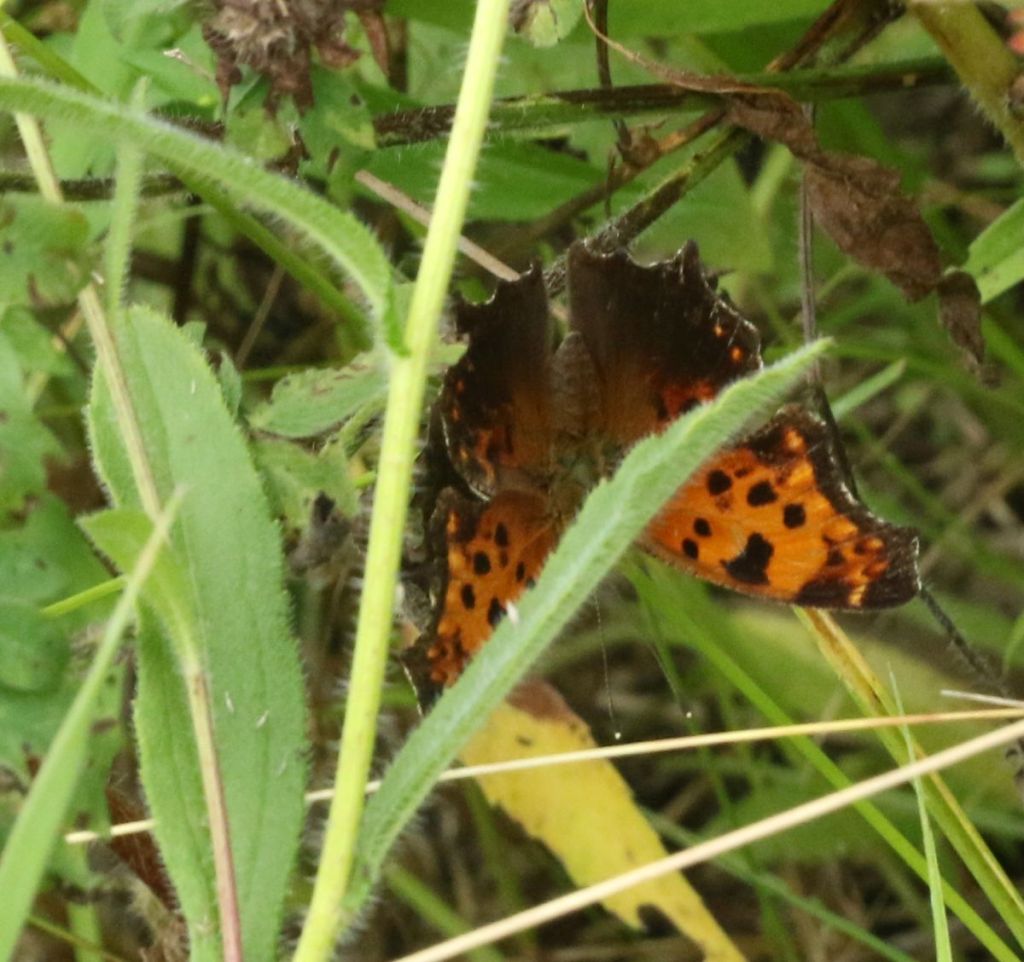
Do you see the butterfly hiding in this picture?
What about now? This is an Eastern Comma. It is thought that such contrasting coloration of the two sides of the wings might play a role in a startle strategy – come too close and a potential predator gets a surprising flash of orange as its intended prey flies away. Alternatively, perhaps the coloration plays a role in inter-species communication but is best kept under wraps much of the time.
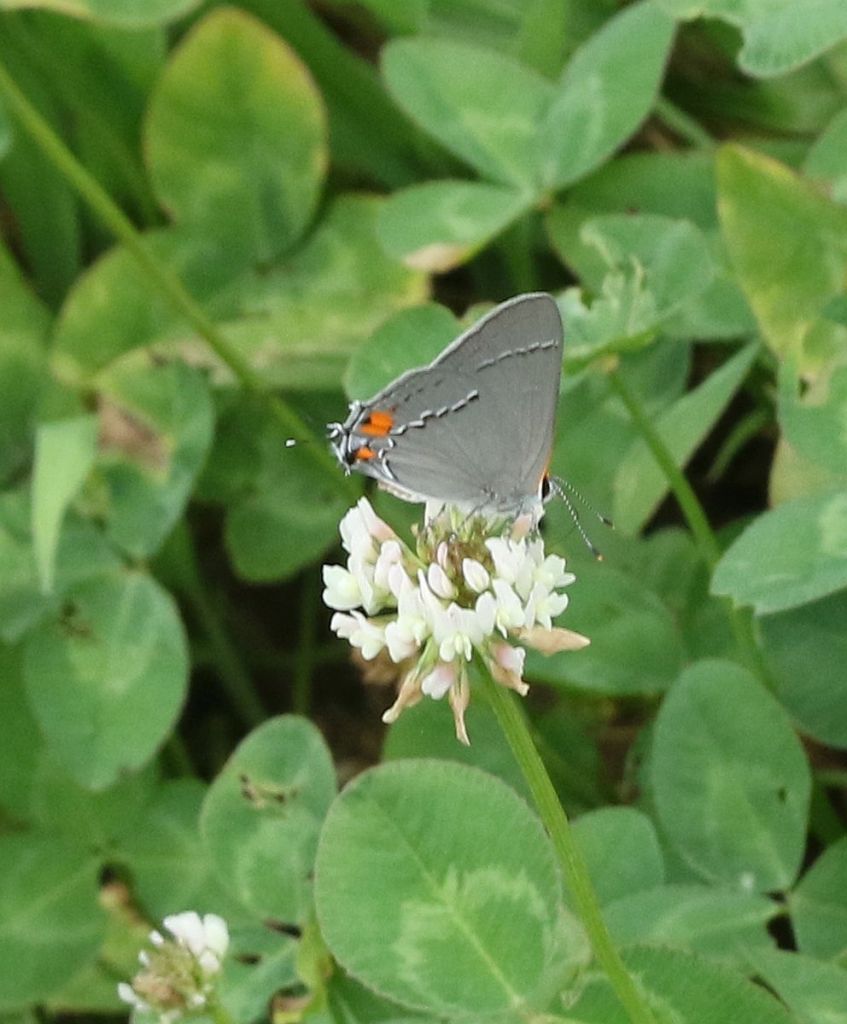
As suggested by the fact we have already seen this hairstreak in our Little Seed Gardens posting, the Grey Hairstreak is probably are most common hairstreak.
A sooty Eastern Tailed-blue female.
Common Ringlets flash their brick orange while flying. Somewhat counterintuitively, this is a northern species which has come south over the past 30 years or so.
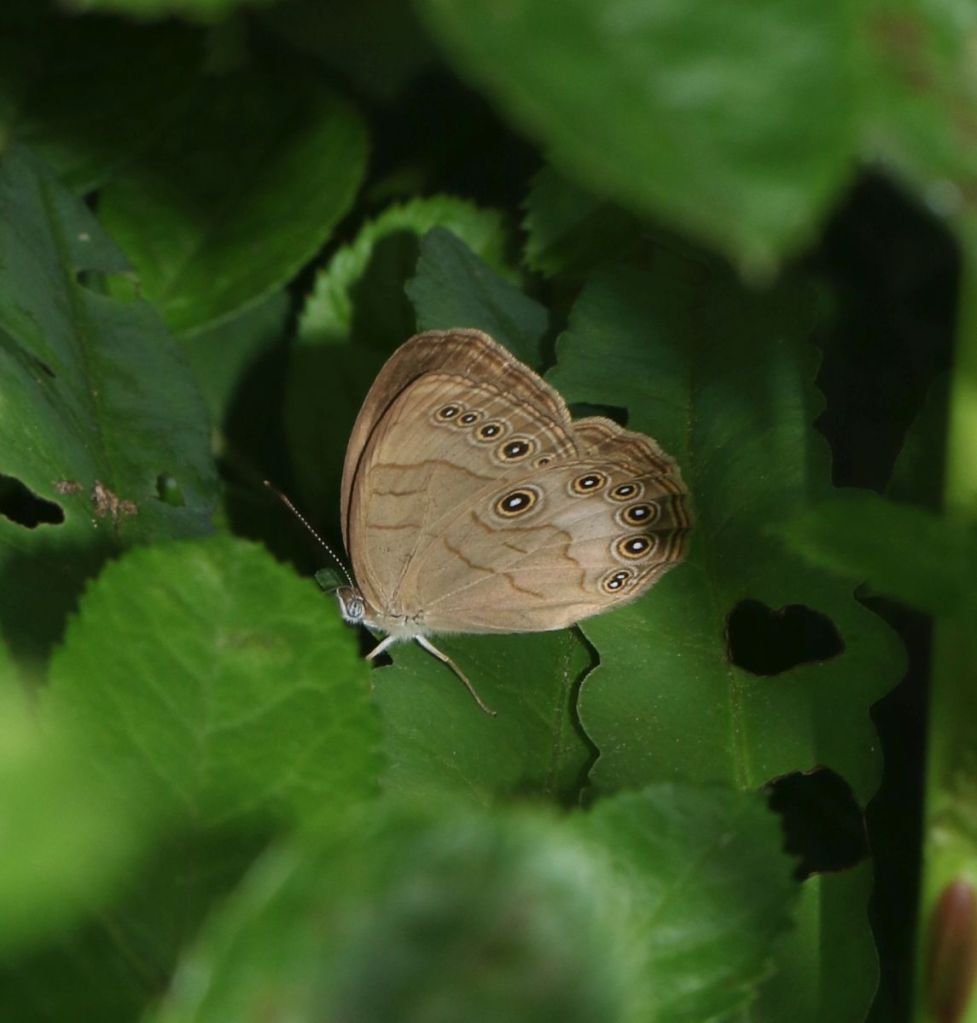
This reclusive butterfly was found hugging the edge of the swamp forest. The Appalachian Brown is largely confined to wetlands, where its caterpillars’ food plants – sedges – are found. Unlike some other wetland butterflies, one rarely sees it on field flowers, perhaps because tree sap and animal dung are its more favored adult foods.
A male Black Swallowtail decked with ample ‘scrambled eggs’.
The female has less yellow. This is a native butterfly, but is sometimes considered an agricultural pest on carrots, dill, parsley and other cultivated relatives. Caterpillars also feed on Queen Anne’s Lace.
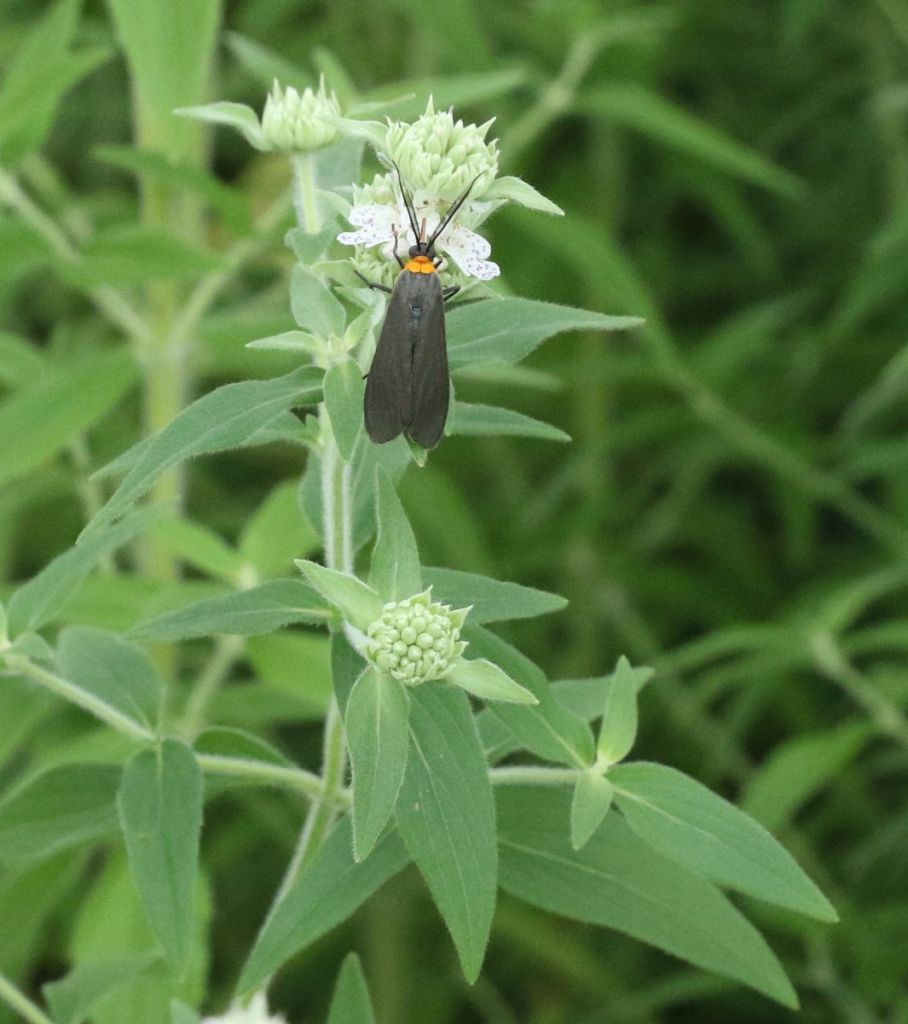
Butterflies aren’t the only ‘Lepidoptera’ out during the day – several of our moths are also day fliers. These Yellow-collared Scape Moths seem especially common this year. Their caterpillars are reportedly grass and sedge feeders, but the adults seem to love nectaring on a range of flowers.
None of the butterflies we saw at this farm were particularly rare, but their abundance and diversity (18 species) were encouraging. This was probably due in part to the diversity of habitats on the farm, from wet meadow to swamp forest to pasture to pond edge, combined with the ecological farming practices used and the ample space for wild-growing flowers.
The dragonflies and damselflies around the new pond were fairly abundant, especially for a pond that is only a couple of year old. One of the key factors that encourages the diversity of these insects is a lack of fish, and we would discourage their introduction. If it does not completely dry out, there might be additional species of dragonflies in the swamp forest, but we did not venture in during this visit.
Today, we visited Little Seed Gardens on a hot, heavy midday with hazy, overcast skies. Little Seed is located on the west bank of the Stony Kill, and that stream unites with Kinderhook Creek in the northeast corner of the farm. They grow organic veggies and raise Randall Cattle (a rare land race from VT).
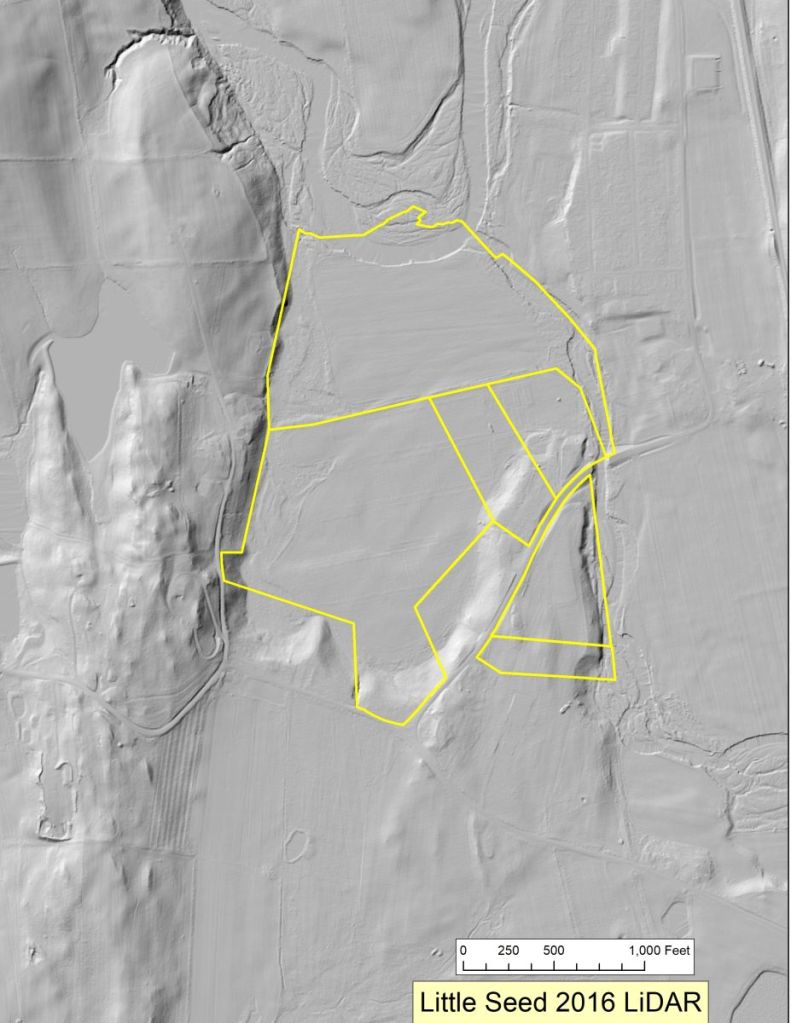
This LiDAR image (LiDAR is way of mapping the detailed, small-scale topography from aerial imagery) suggest that almost the entire farm is in the historical floodplain of Kinderhook Creek.
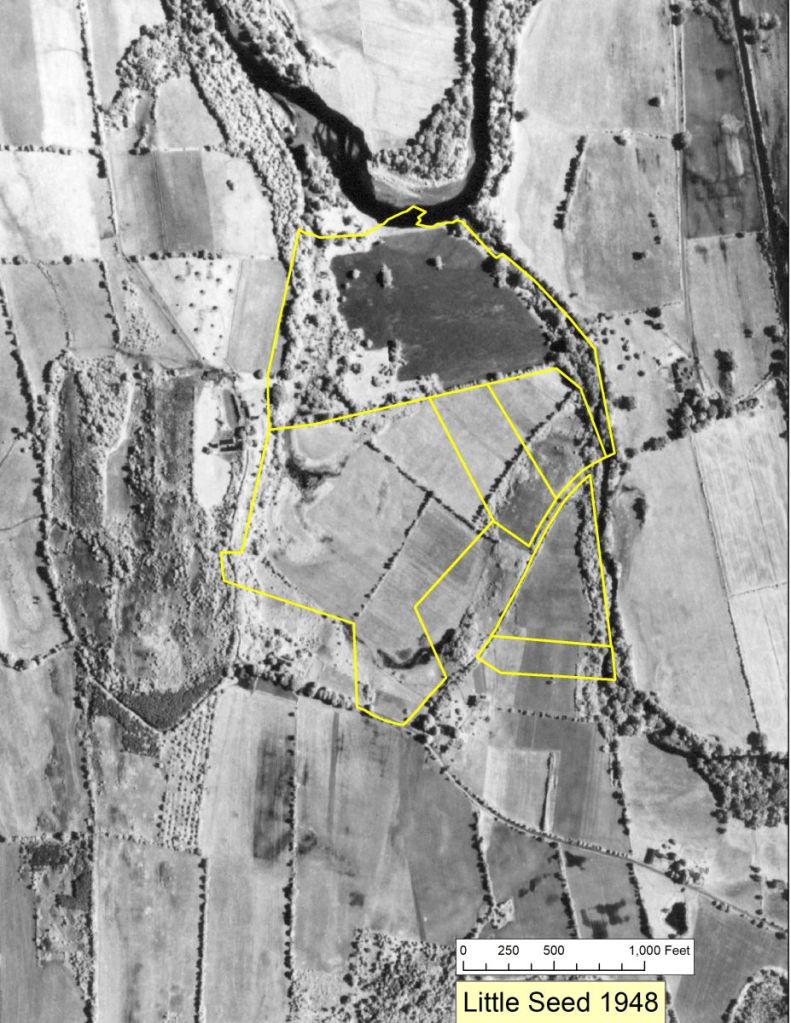
In 1948, the area around Little Seed was somewhat more open, but one of the main differences is the evident movement of the Kinderhook into the northern part of the farm since that year. Aside from that erosion, the northern pasture outline remains largely unchanged, but the smaller fields south of that have been united into a single large field (although, in practice, that is actually divided into a checkerboard of pasture and vegetable beds without large hedgerows).
As roughly indicated by the hot pink arrows, we visited the core of the farm, moving along its southeast edge until we reached the far, currently unoccupied pasture. We then headed northwest, passing by and around some veggie beds, nosing into pasture again before heading east along the hedgerow. We did visit the northern section and the banks of the Kinderhook, although by that time the rain clouds were rolling in.
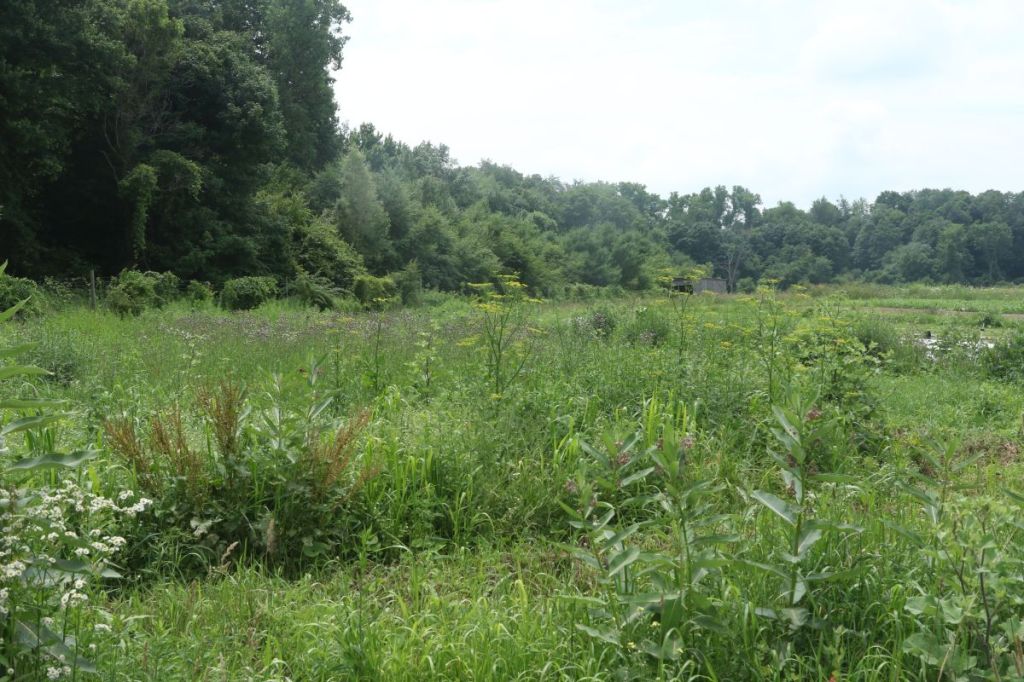
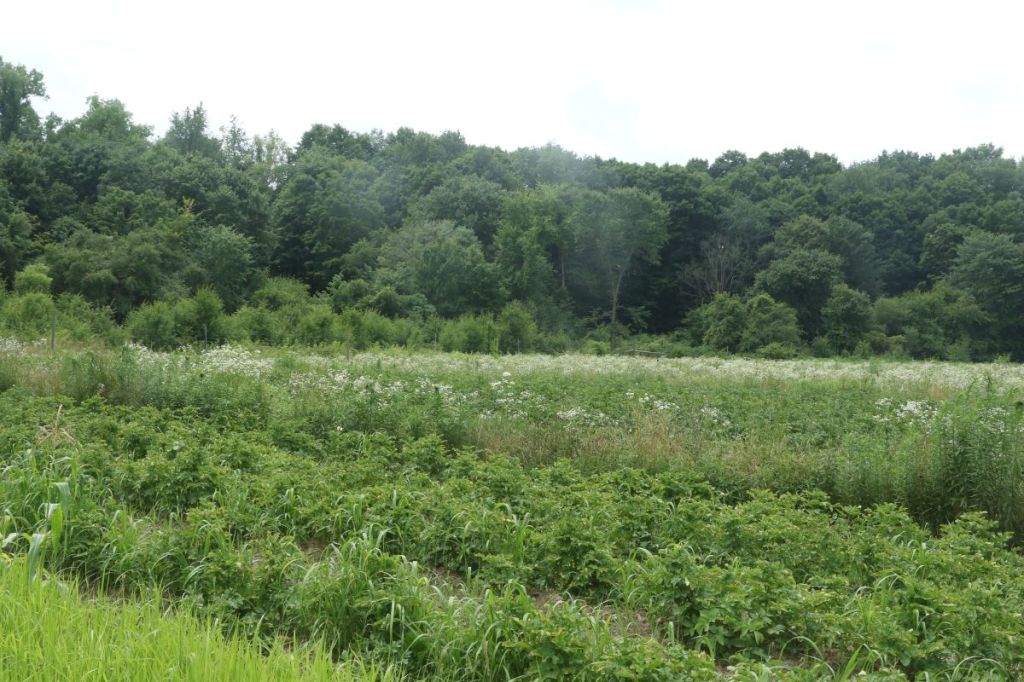
Little Seed has plenty of loosely tended edges as shown by this photograph taken at point 1 looking southwest. In this picture, there is Common Milkweed, Fleabane and (in the background) Canada Thistle, all in flower.
As this photograph (looking southwest between points 1 and 2) shows, some of the same flowers come in around the veggie beds.
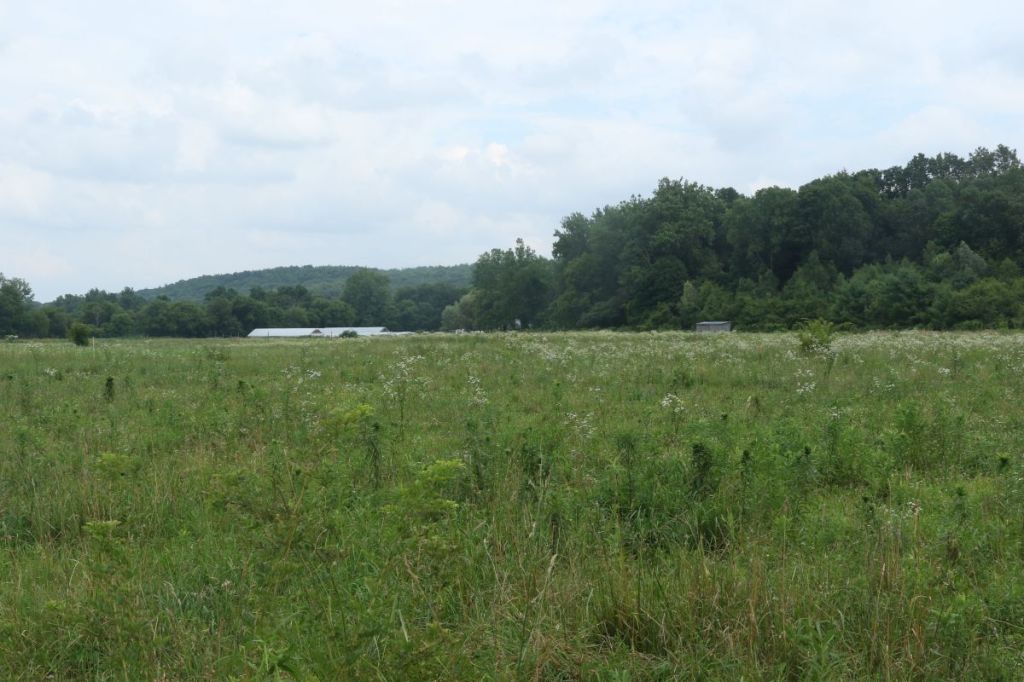
As this picture (taken at point 2 looking northeast), Fleabane is relatively common in the currently unused pasture.
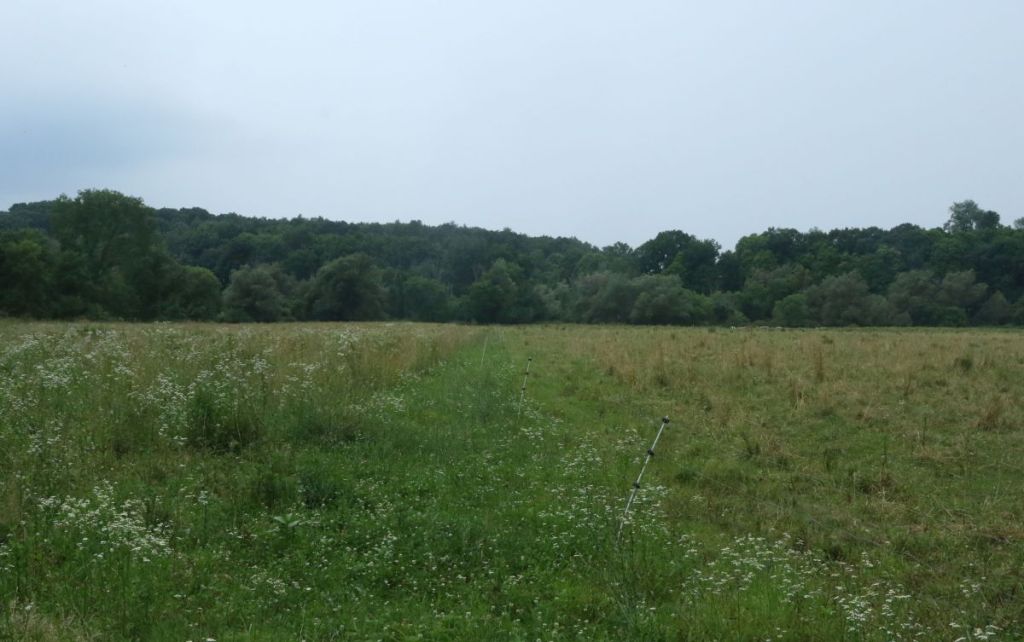
This last landscape shot, taken looking west from around point 3, shows recently grazed pasture on the right and less recently grazed, fleabane-exuberant, pasture on the left.
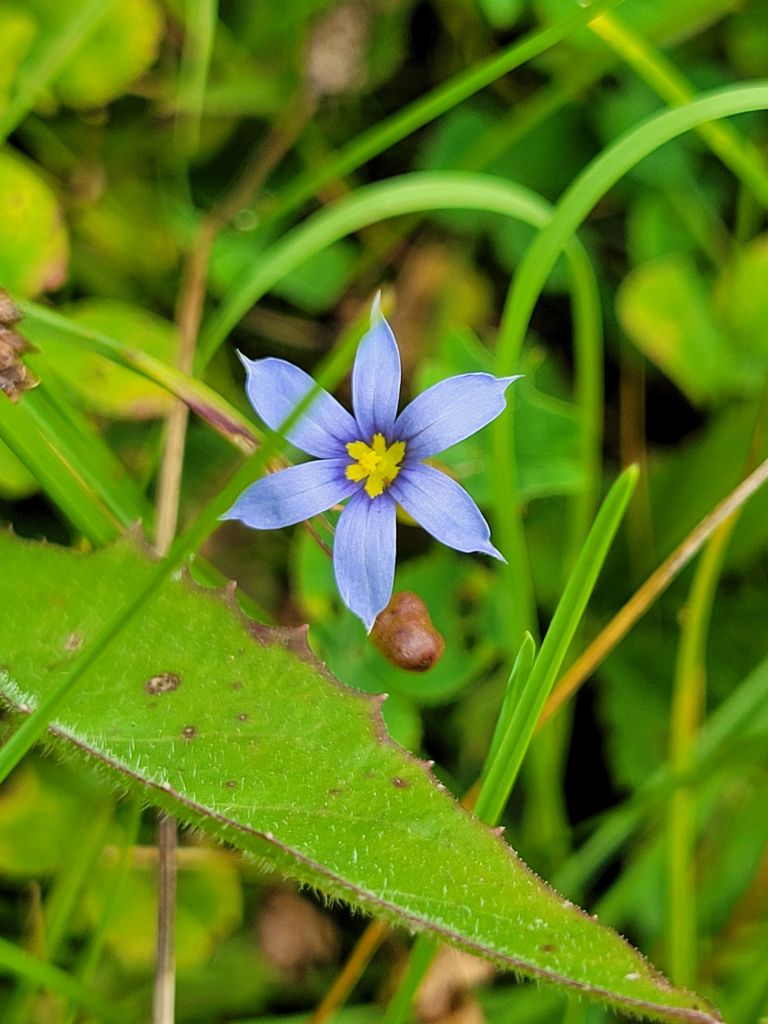
Zooming in on some of the plants, we found Blue-eyed Grass (Sisyrinchium montanum) flowering in one of the pastures. This native plant (which is not a true grass!) can be found here and there in meadows, where its grass-like leaves blend in until its delightful flower announces its presence.
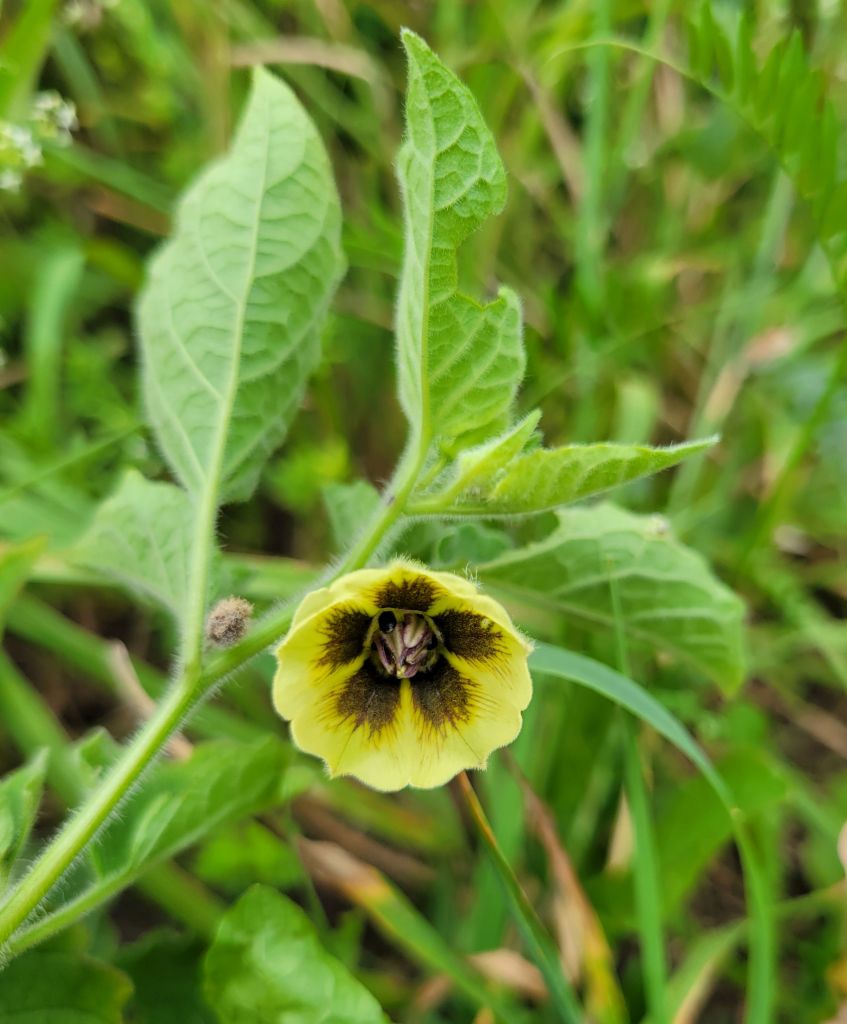
Another native plant, the Clammy Ground-cherry (Physalis heterophylla) was found in unmowed vegetation along an irrigation line. This is a wild relative of potatoes, tomatoes, eggplants, and peppers.
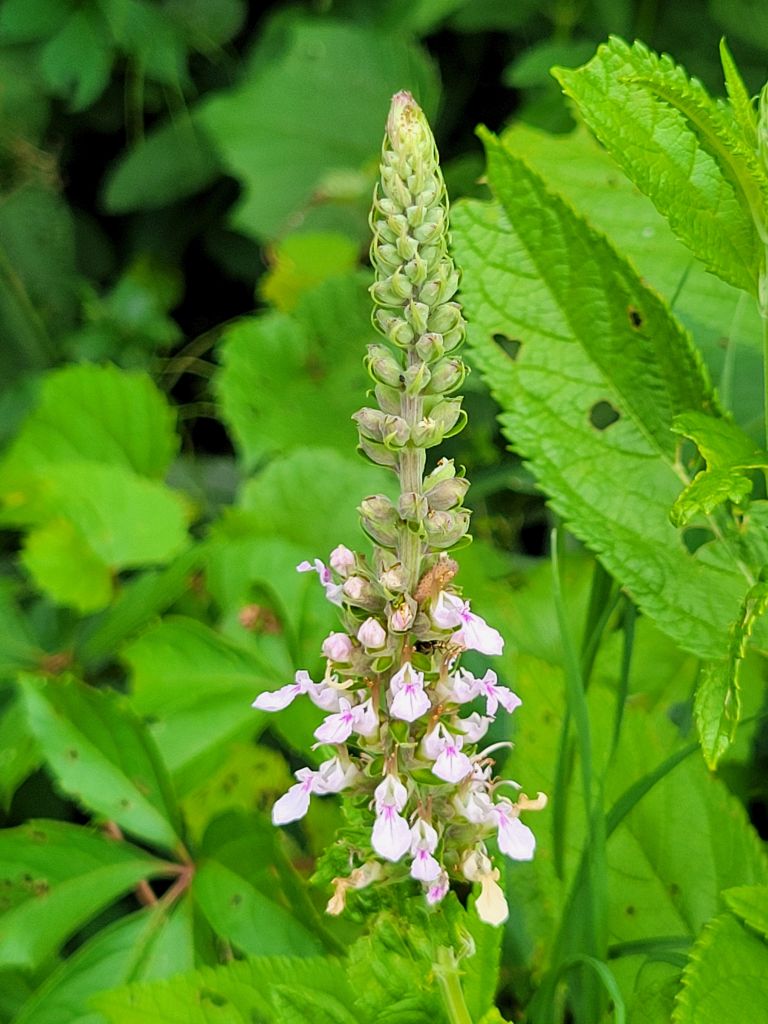
American Germander (Teucrium canadense) was found in several places along the deer fence surrounding the vegetable fields and also along the edge of the riparian forest of Stony Kill. This species is a native member of the mint family.
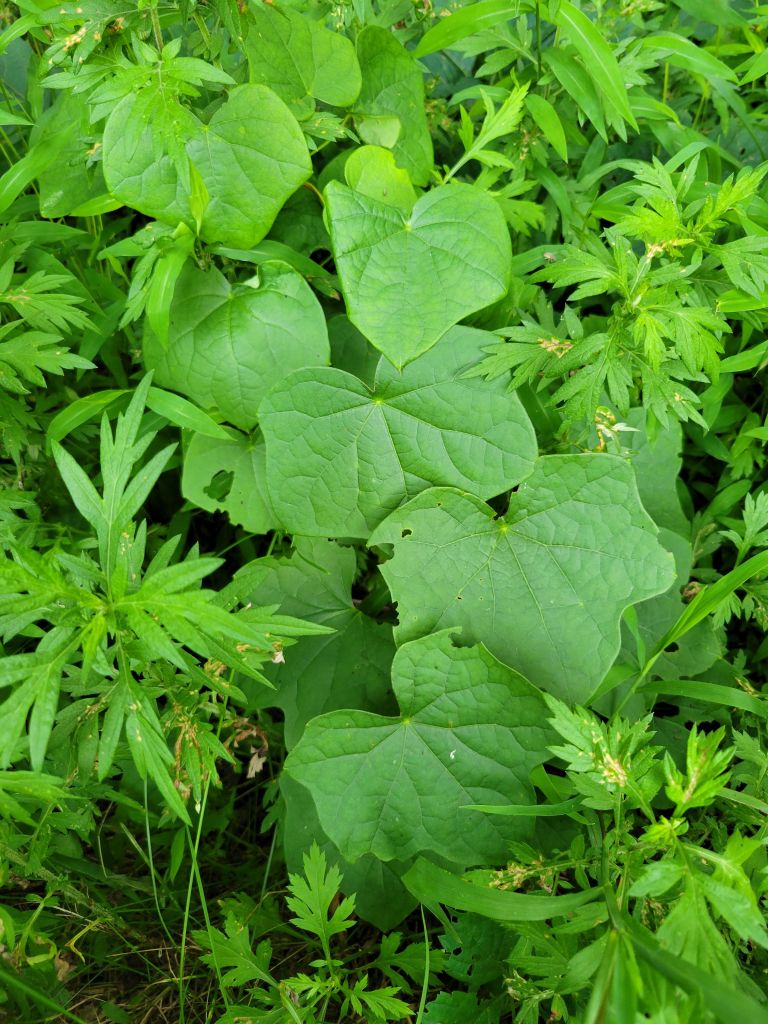
The native vine Moonseed (Menispermum canadense) can easily be recognized by its uniquely-shaped leaves with their stalks attached slightly underneath the leaf blade. Here it mingles with the invasive Mugwort (Artemisia vulgaris) on the edge of the riparian forest along Stony Kill.
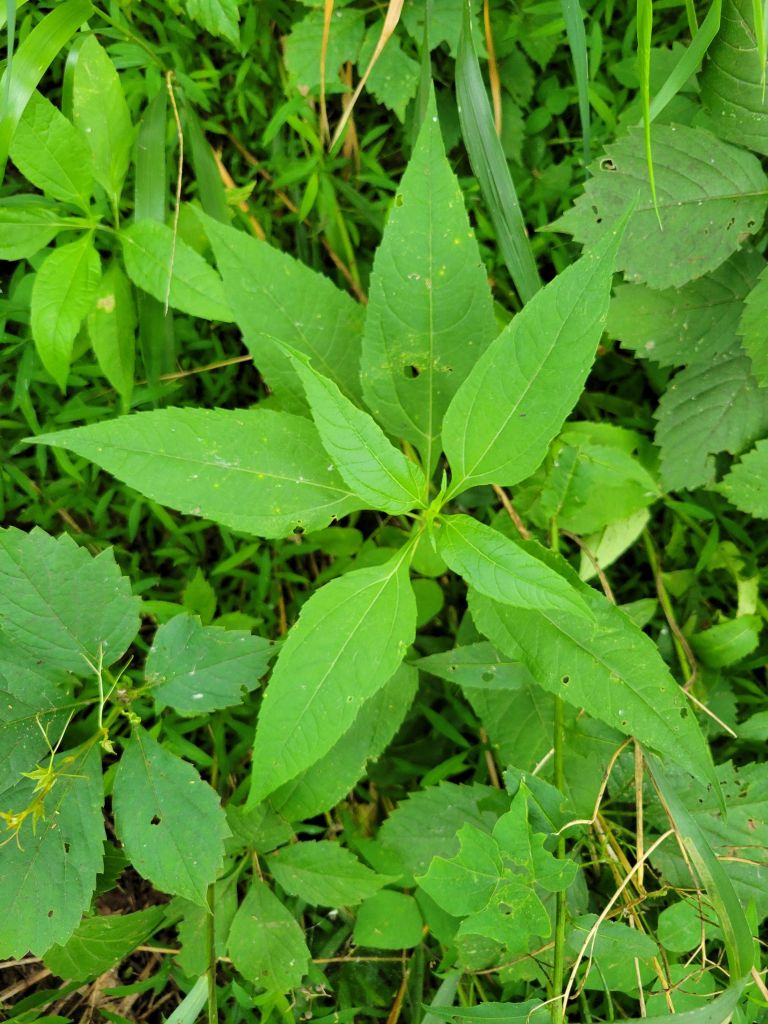
The native Thin-leaved Sunflower (Helianthus decapetalus) is quite common along the forest edges. It will produce small yellow flower heads later in the summer.
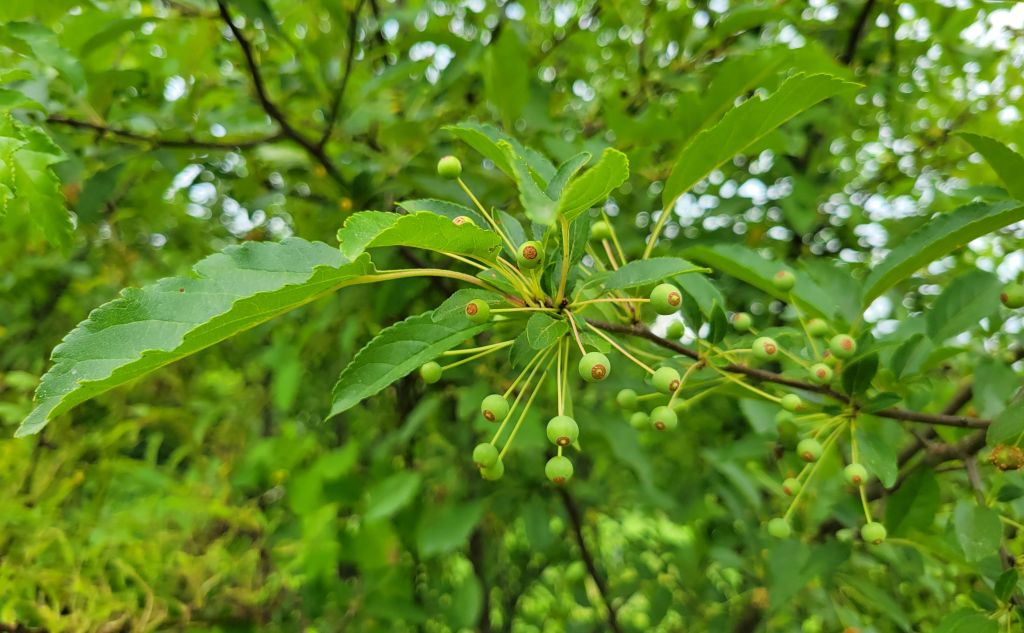
Toringo Crab Apple (Malus sieboldii) is a rapidly-spreading small tree in the north-western part of Columbia County and has been classified as an invasive plant in our region. At Little Seed Gardens, it is the most common woody plant along fence lines. Unfortunately, it still is planted as an ornamental in gardens because of its beautiful white spring bloom. Birds love its small fruit (which turn orange when ripe) and disperse its seeds all over…
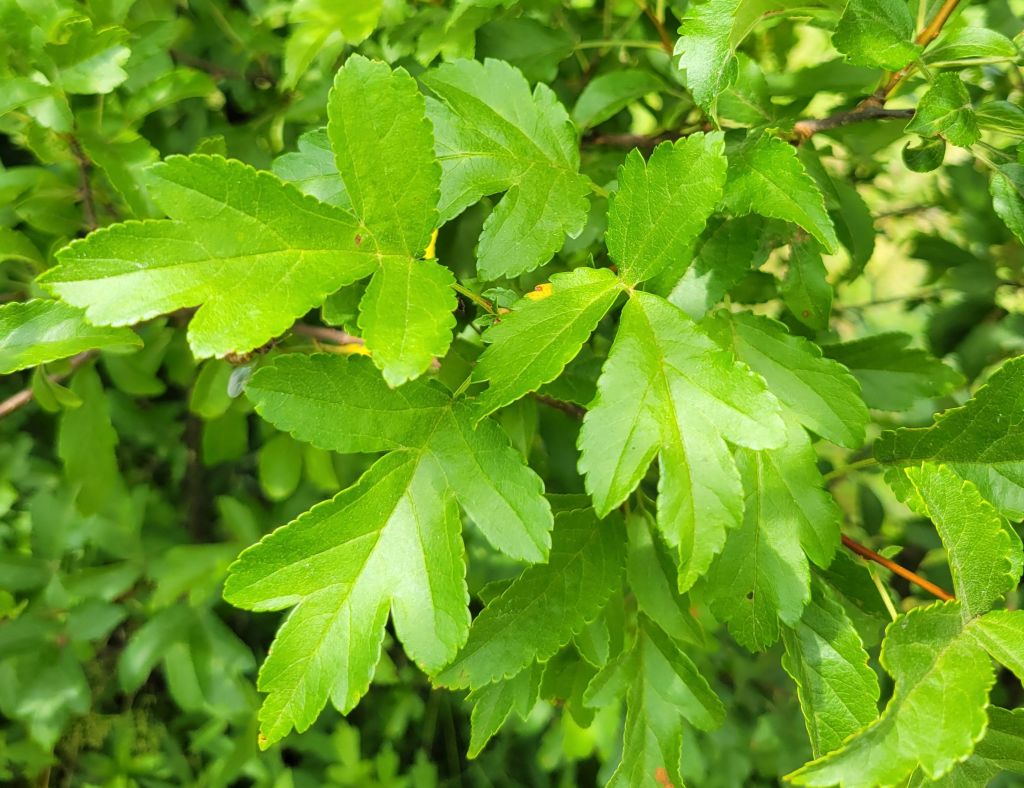
Toringo Crab Apple has variably-shaped leaves. These lobed leaves are from a young plant. Branches that flower and bear fruit usually have more simple, unlobed leaves.
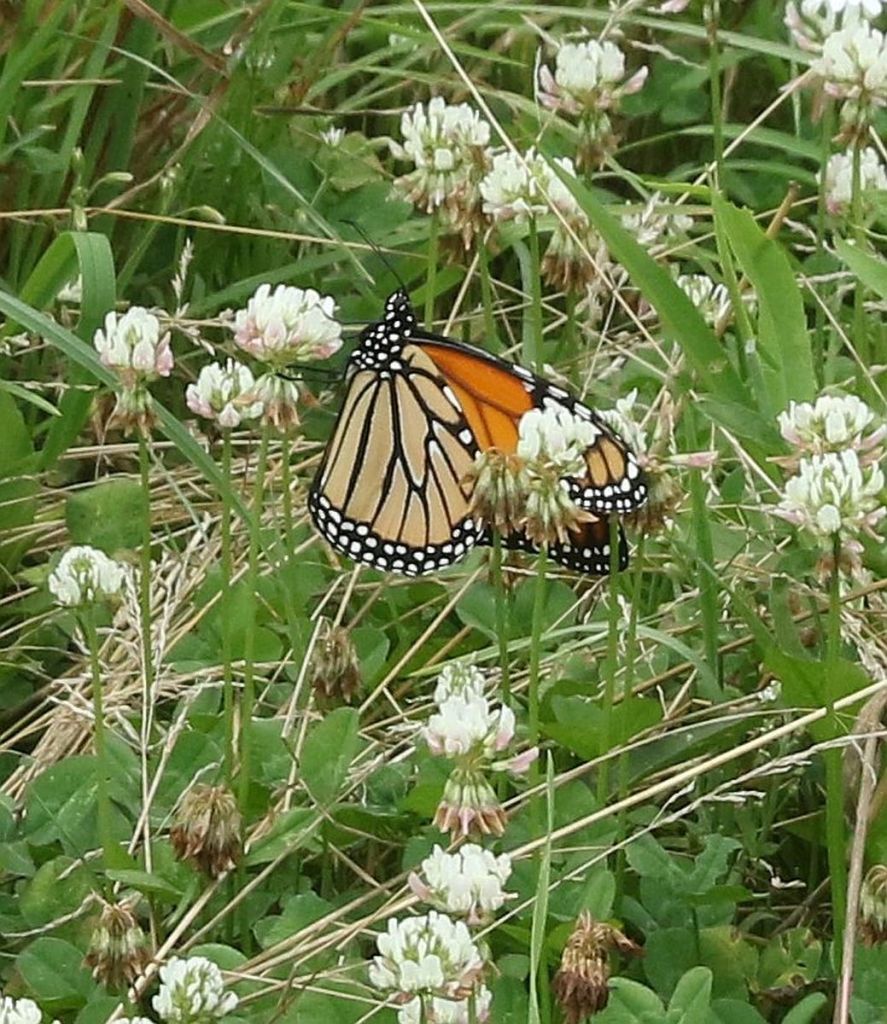
Butterflies were not particularly active, perhaps in part due to the overcast conditions. Nonetheless, we saw about one dozen species. I only saw one Monarch. It would not be surprising if they laid eggs on the ample Common Milkweed on the farm.
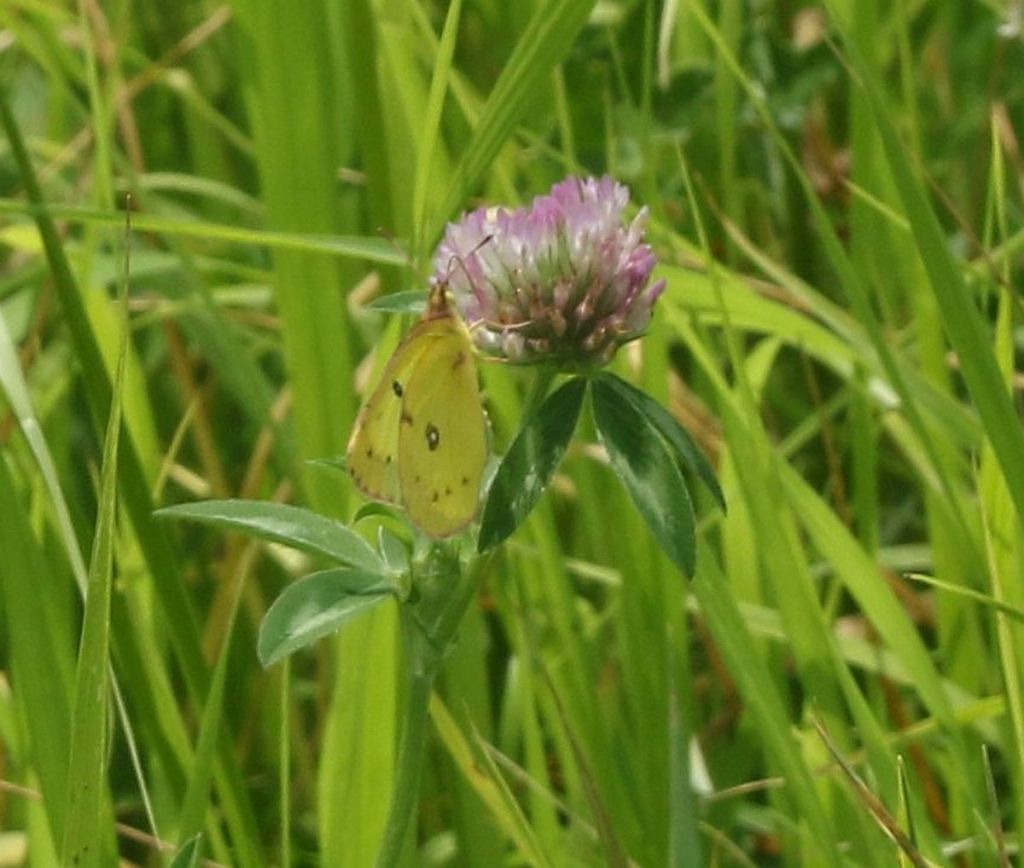
We have two common species of Sulphurs here – the Clouded and the Orange. The Orange Sulphur often, but not always, flashes egg-yolk orange in flight, both species regularly have white females. This individual? Yes, it’s either a Clouded or an Orange… I’m not placing a bet. The Orange has become notably more common after its caterpillars discovered alfalfa as a food plant.
And one Red Admiral (sorry for the bad photo). Both Monarch and Red Admiral probably do not overwinter in the region, meaning that each year they must recolonize from the south. Both do breed here, but those following generations must head south if they are to survive. Red Admiral caterpillars feed on nettles, which probably occur in the wetlands or stream sides around the farm.
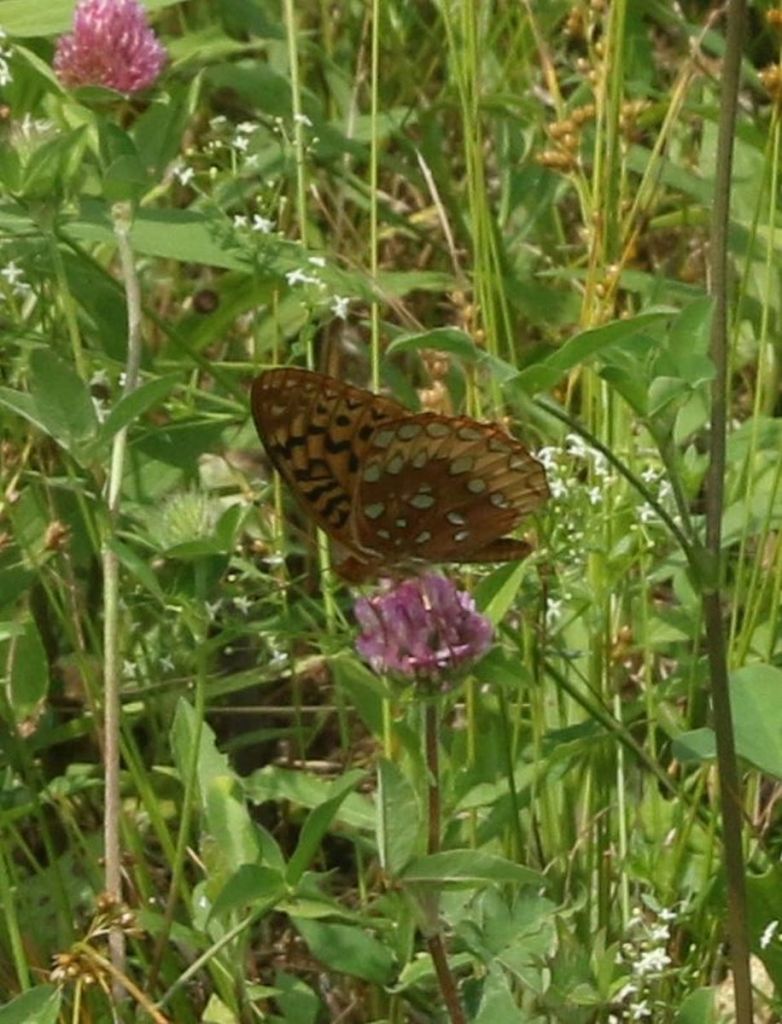
A few Great Spangled Fritillaries flew through during the surveys. We have two or three large fritillary species in the region, but only the Great Spangled as so complete a broad tan band between the silver spots of the hind wing. Their caterpillars are violet feeders.
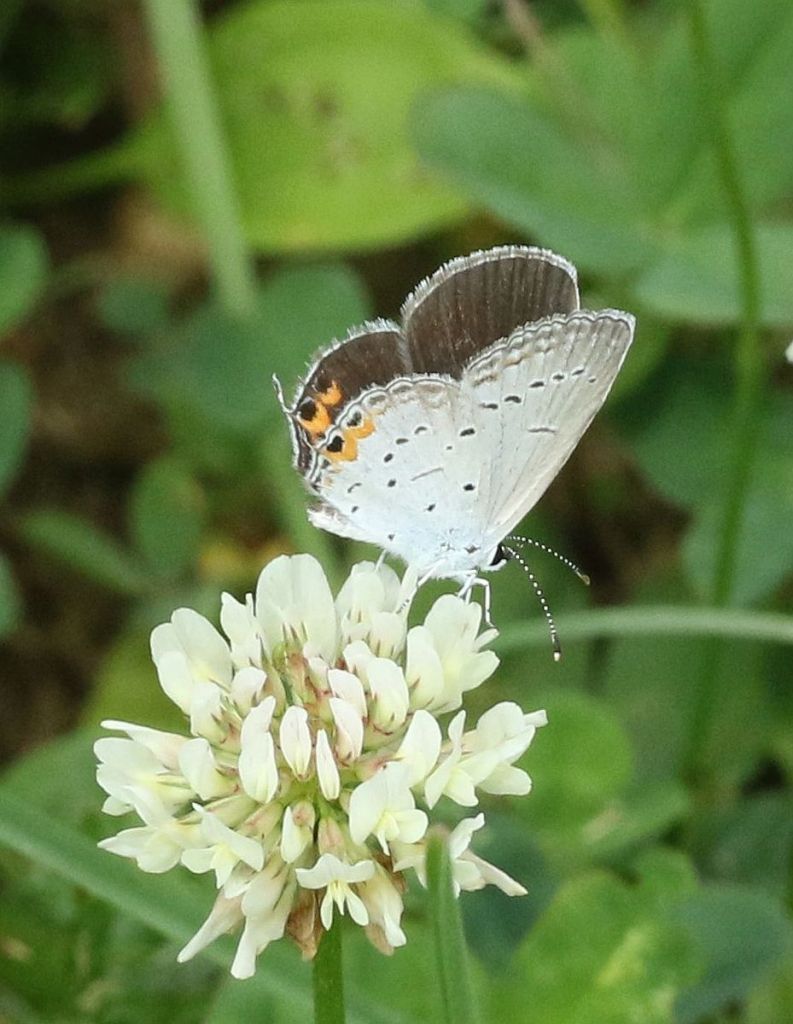
The little Eastern Tailed-blue is common in our fields. The males are markedly blue on the top, but the females, like this one, are sooty.
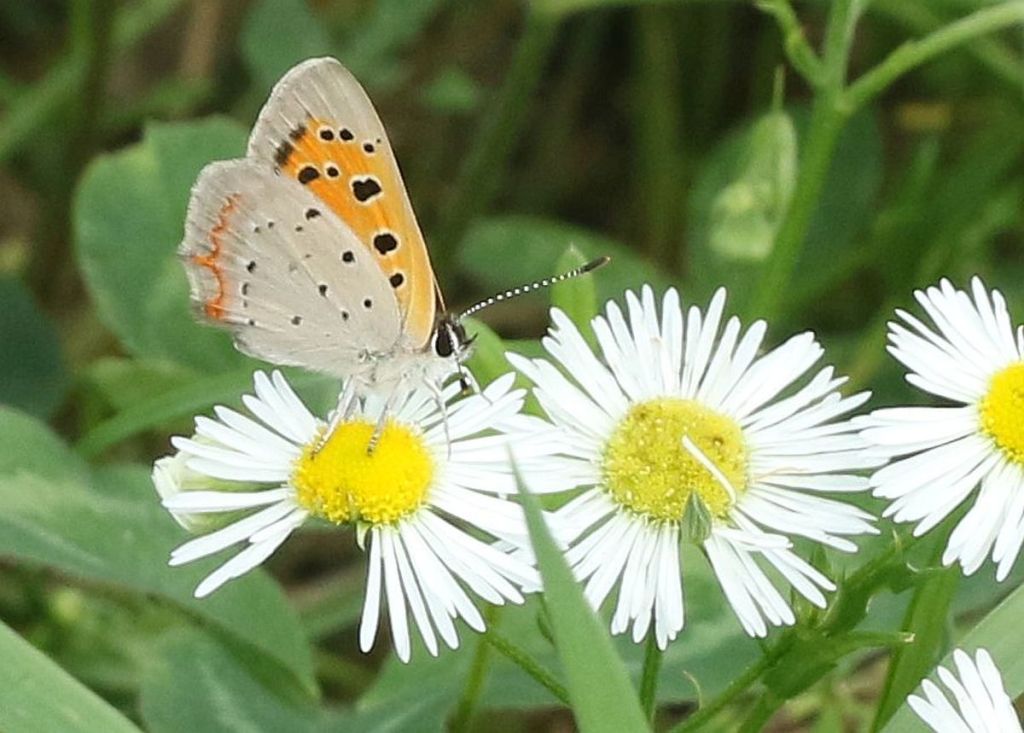
Another little butterfly of fields is the American Copper. Ironically, given the name, some now suspect that, at least here in the East, this species was imported early in the period of European colonization.
Claudia spotted this little beauty while doing plant surveys along the edge of the southwest pasture. The Grey Hairstreak is one of our most common hairstreaks (which isn’t saying much given their general rarity as a group). This relative abundance shouldn’t be surprising because, as one guide book noted, their caterpillars “will reportedly eat almost anything”.
Pearl Crescents are relatively small butterflies, marked with orange and black. This pair was inspecting the mud around a former livestock watering spot. It’s thought that they are probably seeking salts deposited in cattle urine.
Another somewhat blurry photo, but good enough for an ID. This is a Black Swallowtail, of which we saw three individuals. These butterflies are occasionally considered pests because their caterpillars feed on members of the carrot family. The local species most likely to be confused with this butterfly is the Spicebush Swallowtail. The Eastern Tiger Swallowtail also has a dark female form, but it is most common to the south.
Skippers are fast-flying, moth-like (because of their big bodies relative to their wings) butterflies. This is our largest skipper, the Silver-spotted Skipper. Its caterpillars feed on a variety of legumes and it can be relatively common in farm fields, although I have not heard of it referred to as a pest on any leguminous crop.
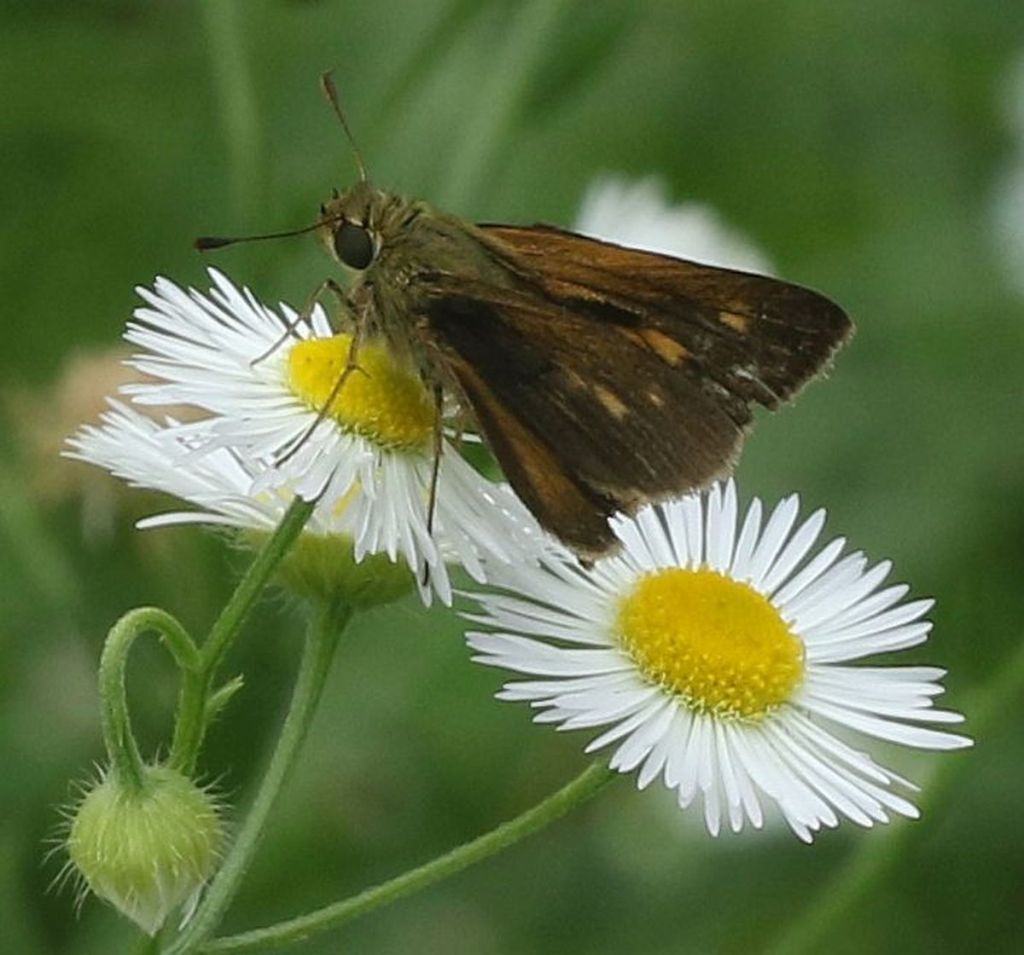
The Northern Broken Dash can be recognized by the ‘3’ outlined in white spots on its hind wing. (OK, so it does take a bit of imagination to see it.) This is one of three small, relatively drab, brownish skippers flying at this time of year. To honor the difficulty of distinguishing them, butterfly folks refer to those species as the “Three Witches”. Just saw a few of these Broken Dashes today.
Here’s the same species starting to open up its wings. Unlike most butterflies, skippers tend to open their wings into a ‘jet fighter’ formation with the hindwing flat, but the forewing at an angle.
Distinctly different, right? Admittedly, skipper ID is something of an art. This is probably a second species of “witch,” the Dun Skipper – the drabbest of the lot, although it often has a vaguely greenish/gold hue to its head. The Dun Skipper caterpillars feed on sedges, while those of the Northern Broken Dash are grass feeders. The third “witch” is another grass feeder, the Little Glasswing. We didn’t see it today, although we did see it earlier in the week at a farm farther south.
The last butterfly for today is this one, caught mid-flight. This is the so-called Question Mark, named for the white dot and arc seen on the underside of its hindwing (and visible here). I only saw this species along the wooded edges. A Least Skipper and probable Cabbage White were also logged but not photographed.
Dragonflies seemed more common, but less diverse than butterflies. Indeed, I noted about 70 of them during the roughly 2 hour survey, but only roughly half that number of butterflies. However, I only ID’d four species of dragonflies vs. roughly a dozen species of butterflies. These are two Widow Skimmers, the most common species I saw during my wanders.
The second most common dragonfly were the Eastern Amberwings (aka ‘Snitches’). These are our smallest butterflies and the golden wings of this individual mark it as a male.
This mottle-winged individual doing a headstand is a female Eastern Amberwing. Males and females often differ markedly in coloration.
Some dragonflies seem to outshine butterflies in terms of color. This is the aptly named Halloween Pennant. Another relatively common dragonfly of grassy fields.
The young of all our dragonflies are aquatic, so these species are probably just visiting the fields for feeding. All of our dragonflies are predators and feed on other insects. These three species (and a fourth, the Blue Dasher) raise their young primarily in still or slow waters, and are probably coming from adjacent ponds or wetlands. The rarest dragonflies on the farm might be found along the Kinderhook, but our time was running out by the time we made it to the Creek. Creek dragonflies seem less likely to spread into adjacent fields.
Fifteen to twenty years ago we also did butterfly surveys at Little Seed. Many of the same ‘suspects’ appeared, but also present were several wetland butterflies – Bronze Copper, Mulberry Wing, and even a Dion Skipper (see shot from Little Seed in July 2010 above, one of only two records we have from Columbia County). Across those surveys, we averaged about 1 butterfly spotted per minute; during yesterday’s surveys, we averaged about half that, largely because we saw much fewer Cabbage Whites.
There are various, non-exclusive explanations for these differences. Foremost, no single day of surveys should be taken as representative. The weather was cloudy and hot yesterday; butterfly activity may have been reduced. Further, butterfly populations can fluctuate markedly across years, because of certain climatic conditions or other factors that boost or bust a given species’ natural history. Generally, this does not seem to have been a good Cabbage White year. Additionally, as a pest species, efforts may have been made on the farm to control this species in particular, although we have not yet talked to Willy and Claudia about that. The relative absence of wetland species might again be chance – each species of butterfly has its own flight calendar and we may have just not hit it right this year (although we know some of those wetlands species are currently flying elsewhere). Alternatively, perhaps some of those wetlands have dried or otherwise been altered – a clue to explore.
Insects rarely provide explicit answers about habitat change but they provide hints and, heck, they can be pretty! (For more on regional butterflies and our recommendations for good field guides, see here.)
A day of preliminary farm visits to a quartet of collaborating farms: Rose Hill Orchard (Red Hook, NY), Treadlight Farm (Kerhonkson, NY), Hudson Valley Seed Company (Accord, NY) and Transgenerational Farm (Accord, NY).
Rose Hill is a pick-your-own orchard and cidery with 190 apple varieties, plus peaches, plums, blueberries, and cherries. They are a low-spray operation and have one ‘bioblock”, where they are trying organic methods. We (Claudia, Josie Laing & Conrad) walked around with farm manager Kevin Clark.
Rose Hill: Trees, mowed strips and areas herbaceous areas where plants like Common Milkweed go to flower.
One of the most noticeable aspects, to an ecologist, is the space provided for wild (literally) flowers. This takes the form of both blocks allowed to grow up until a fall mowing and similarly managed areas between the trees.
Rose Hill: A taller Staghorn Sumach reaches out of as sea of Smooth Sumach.
Fun sightings included Sassafras growing along the eastern edge, and a fruiting Serviceberry with ample, ripe, healthy fruits (elsewhere birds or Apple-cedar Rust generally seem to get to the berries before we do). There were also both Smooth Sumach and Staghorn Sumach. In the abundant flowering milkweed, we noted the occasional bee or beetle ‘captured’ by the Common Milkweed flowers, but also saw them feeding ample visitors including a Banded Hairstreak. We also saw Common Milkweed’s cousin, Indian Hemp, between the trees. Other butterflies noticed during our quick visit were Least Skipper, Tiger Swallowtail (probably Eastern), Meadow Fritillary (they have been declining and so are always nice to see), Common Wood Nymph, Monarch, Silver-spotted Skipper and Great Spangled Fritillary.
Rose Hill: Josie took this picture of a Banded Hairstreak nectaring on Common Milkweed growing up between apple trees. Its caterpillars reportedly feed on oaks, hickories, Black Walnut and Butternut.
This was just our preliminary tour of Rose Hill, so expect more details later. Our visits to the other three farms were only quick orientations from the farmer, and we did not spend time scouting any of them, so expect an introduction to each of them later also. Anne Bloomfield who, together with Will Yandik, will be doing bird surveys joined us for our visits to the ‘west bank’ farms.
The Indian Skipper is a rare butterfly found in dry meadows where the native grass Little Bluestem abounds.
Back in April, we visited some dry meadows managed by Chaseholm Farm and located on thin, dry soil overlooking Ancramdale. Our goal was finding rare butterflies we had last seen there about ten years ago. With a hearty, if hot, crew we ventured out, and it was not long before we found one of our focal species, the Indian Skipper. These little, often skittish, butterflies are very patchy in our region and so far this is the only set of fields where we have found it in Columbia County. Later this year, we hope to visit the site with Sarah Chase to better understand how she has been managing this land.












































 Farmer-Ecologist Research Circle