Farming, Ecology and Landscape Recovery in the Brecklands of Eastern England.
This talk by visitors to the Farmer-Ecologist Research Circle was hosted by Bard College and supported by the Hudson Valley Farm Hub and Hawthorne Valley Farmscape Ecology Program.
Richard Evans, co-founder and lead farmer in the Breckland Farmers Wildlife Network, described his experiences and motivations for protecting and enhancing the biodiversity of the Brecks, (a geographical region in eastern England). He also shared about his efforts to help shape future policy to benefit this area, and consider its current balance of food production and ecology. Chris Sharpe, an ornithologist who has helped gather avian data in the same region, provided an ecologist’s view of the interaction of bird life and agriculture in that landscape.
East Anglia, England—and Breckland in particular—is one of the most intensively managed regions of the UK for food production. Its landscape and environment are consequently highly modified. Although these changes have often reduced biodiversity, some historical human practices have created the very environments upon which now scarce, often threatened, local species depend. The last few decades have seen significant efforts to document and understand the region’s biodiversity with a view toward restoring nature on both agricultural and non-productive land. A growing number of contemporary farmers have enthusiastically adopted nature-friendly management practices.
Evans and Sharpe recounted more than two decades of farming and wildlife interactions in the Brecklands and shared lessons that they hope will shed light on how to organize a community around the values of conservation, both in England and beyond.
“Many of us here in the Hudson Valley are working to find our own balance between the need for our farms to succeed as profitable enterprises that feed our community, and as places that shelter and nurture native wildlife,” said Will Yandik, a member of the Farmer-Ecologist Research Circle. “I think our visitors from England have provided us the opportunity to evaluate our own lands with a fresh perspective.”
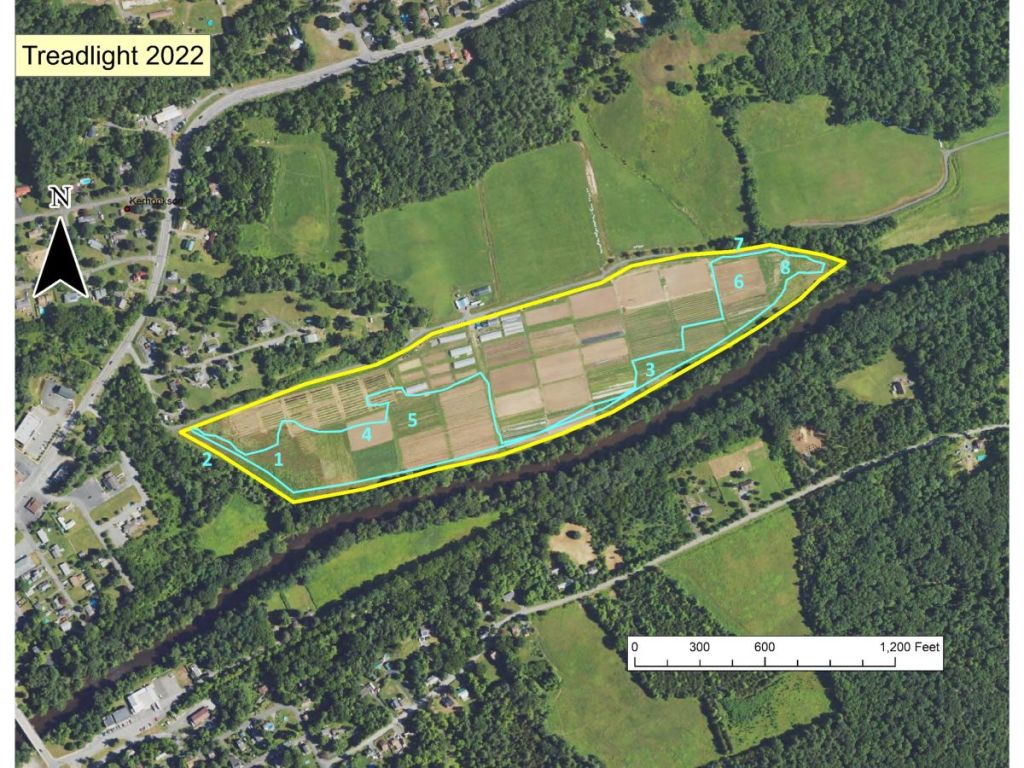
I visited Treadlight Farm in Kerhonkson on 4th Sept. 2024 to survey the wild-growing plants inside the fenced area outlined in yellow on the aerial photo below. The sky blue line indicates the approximate route of my four-hour walk-around. Numbers refer to locations mentioned below.
Aerial photo of Treadlight Farm (surrounded by deer fence indicated in yellow); the sky blue line is the approximate route taken during the botany survey, numbers refer to locations mentioned below
As Conrad has already described in the last posting, Treadlight Farm mainly grows cut-flowers and also produces plugs (mostly of native wildflowers). The farm operates on leased land that has a long history of farming and few semi-wild habitats are found within the farm’s fence. Not surprisingly, the wild-growing plants in the flower beds were largely the usual cast of regionally-common, annual, tilled-field weeds, including Common Ragweed, Daisy Fleabane, Horseweed, Lamb’s-quarters, Crabgrass, and foxtails.
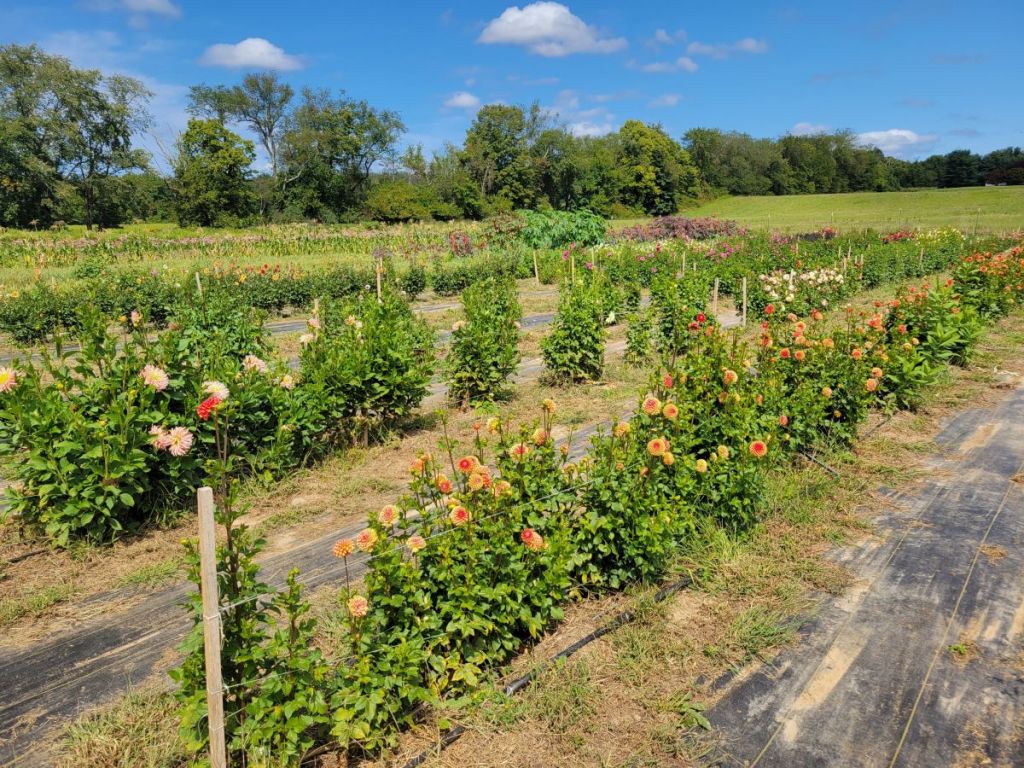
One of the cut-flower beds at Treadlight Farm (looking west from #6)
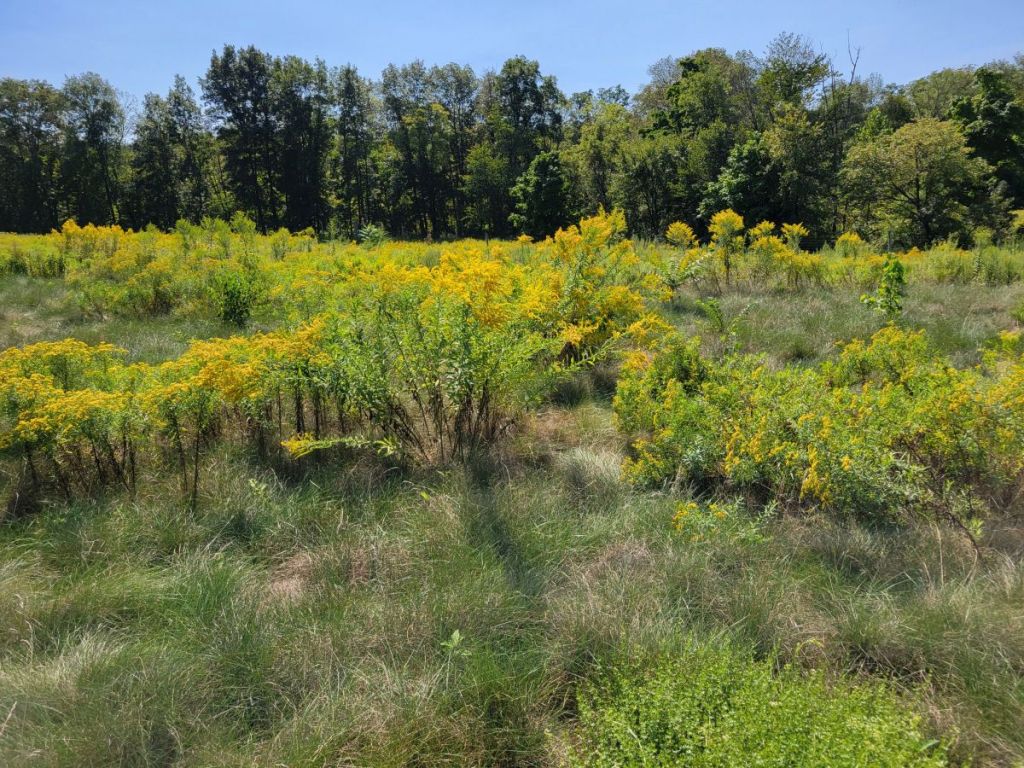
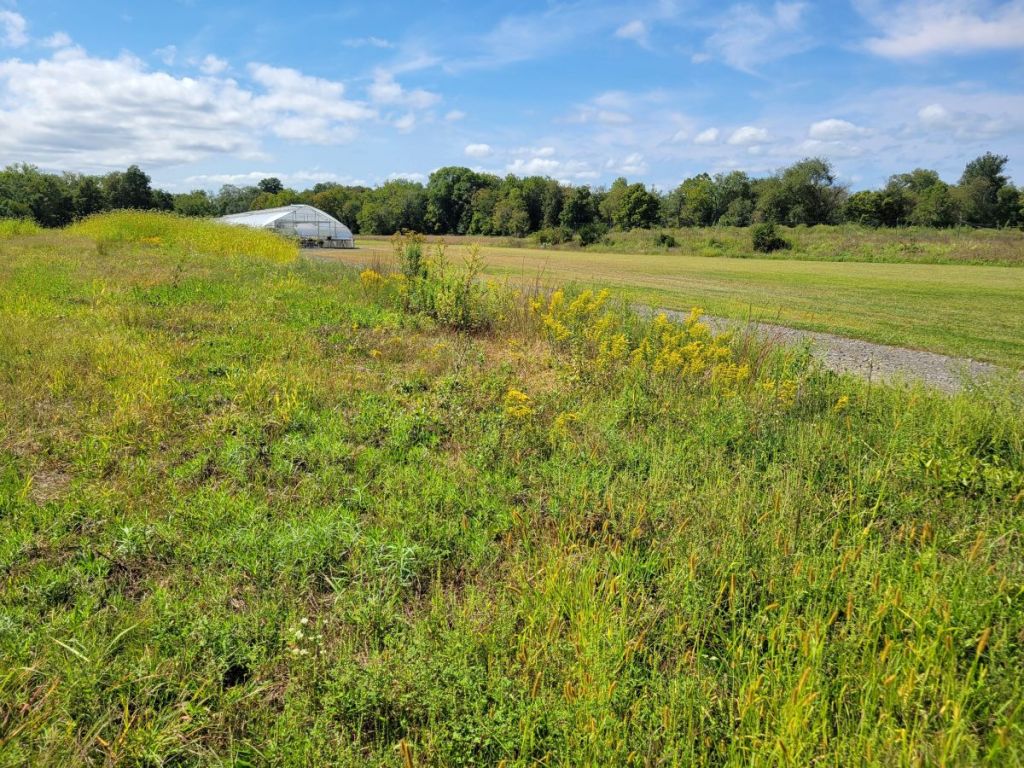
At the west and east end of the farmland are old fields, largely composed of perennial species, both native and non-native. Those old fields harbored at least five species of goldenrods and seven species or varieties of asters, all native. The “grassy” matrix at the west end (#1) was dominated in late summer by the non-native grass Hard Fescue (Festuca trachyphylla), but also included the native Path and Soft Rushes (Juncea tenuis and J. effusus).
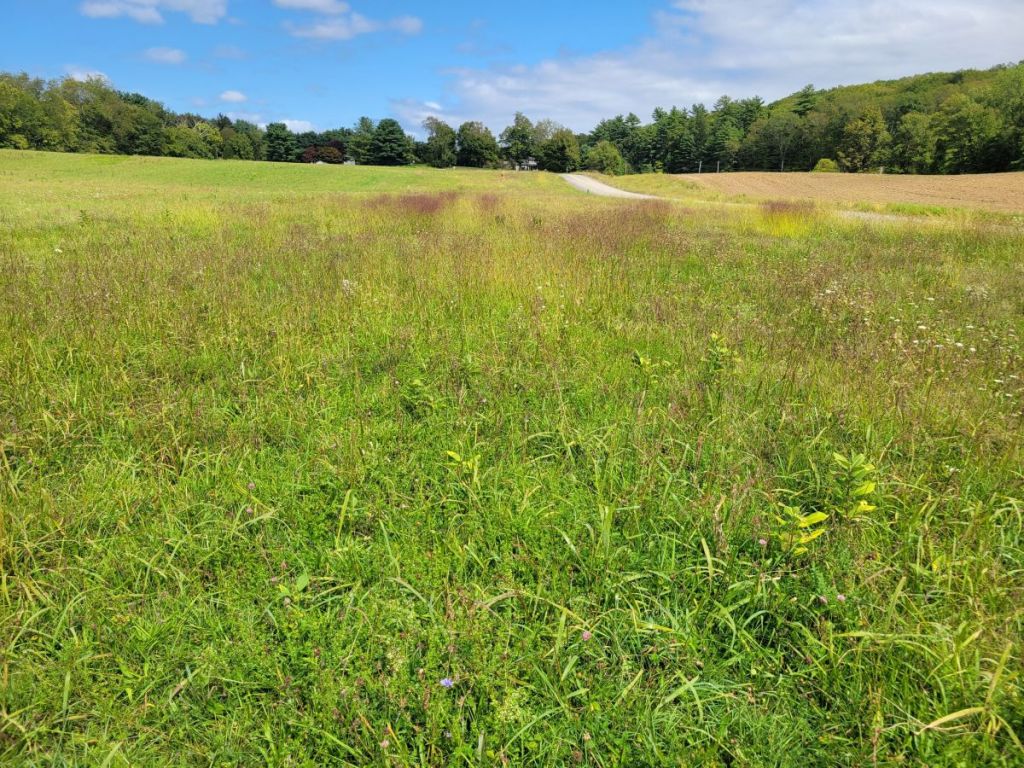
Old field vegetation at the west end of the farm (#1)
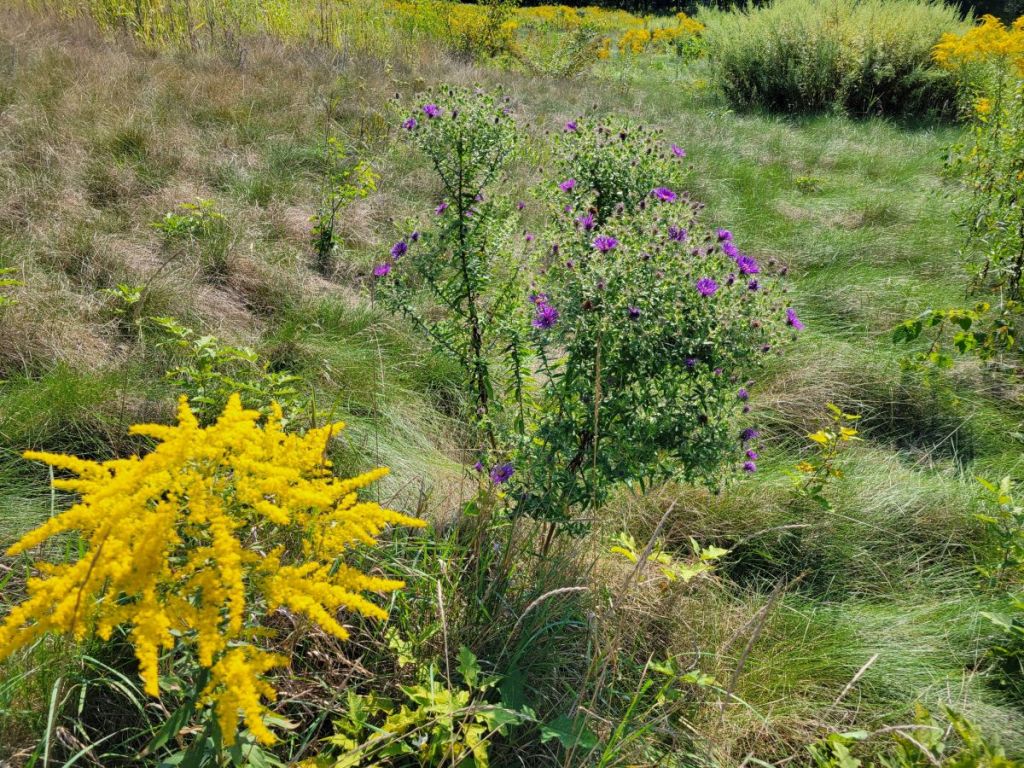
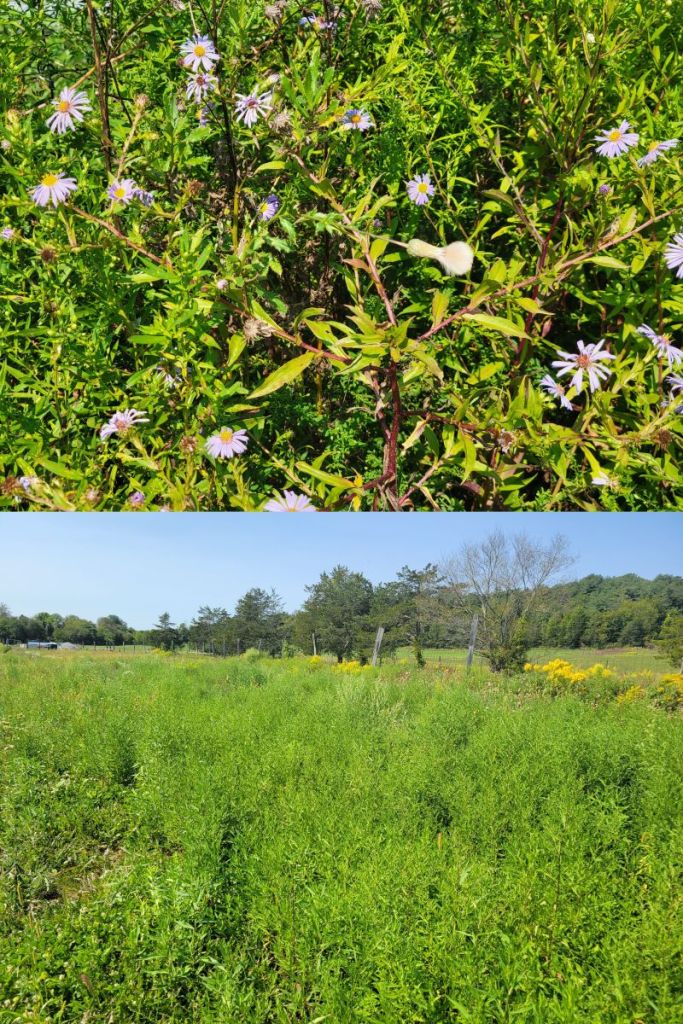
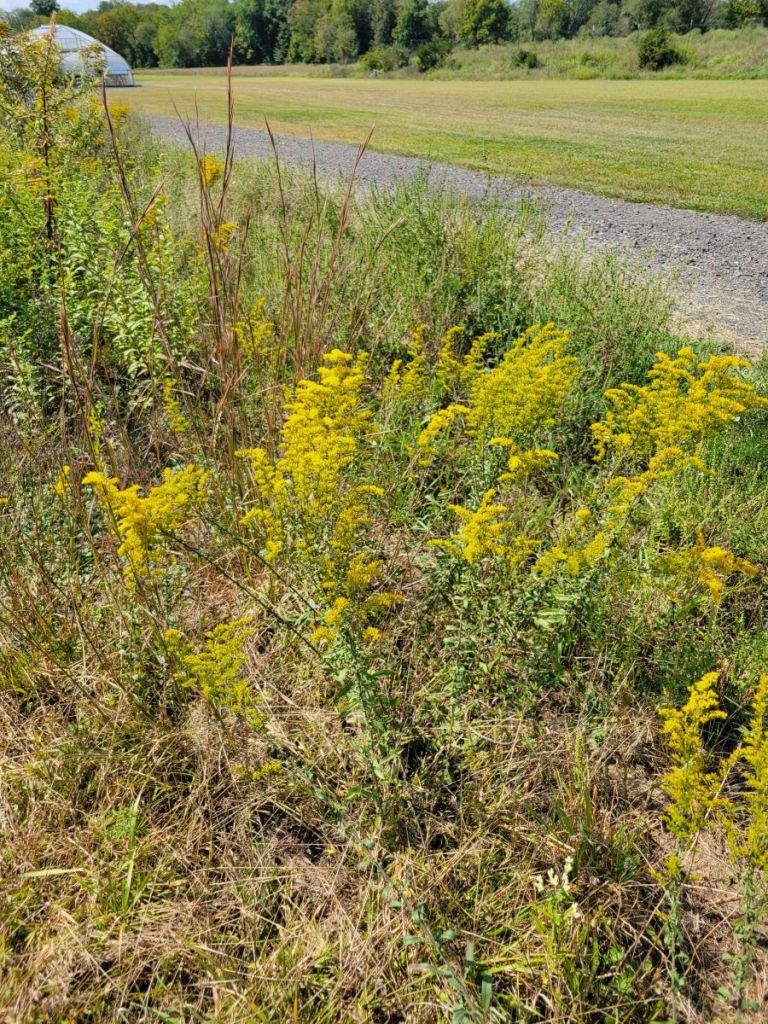
At the time of my visit (4th Sept.), the asters were just starting to flower, but the goldenrods were already in full bloom. In the image below, the golden yellow flowers of Tall Goldenrod (Solidago altissima) contrast beautifully with the purple flowers of New England Aster (Symphyotrichum novae-angliae). Tall Goldenrod (also often referred to as Canada Goldenrod) is one of four very common, rhizome-forming, old field goldenrods in our region. We know of 11 other goldenrod species in our area, all less common than the four old field species, and associated with other habitats, such as dry meadows, wetlands, and even forests. All our goldenrods are native species and—as a group—provide resources to a dazzling variety of insects, who visit the flowers for nectar and pollen, eat the leaves, bore in stems and roots, form galls, or wait for prey in the flowers.
Tall Goldenrod (Solidago altissima) and New England Aster (Symphyotrichum novae-angliae)
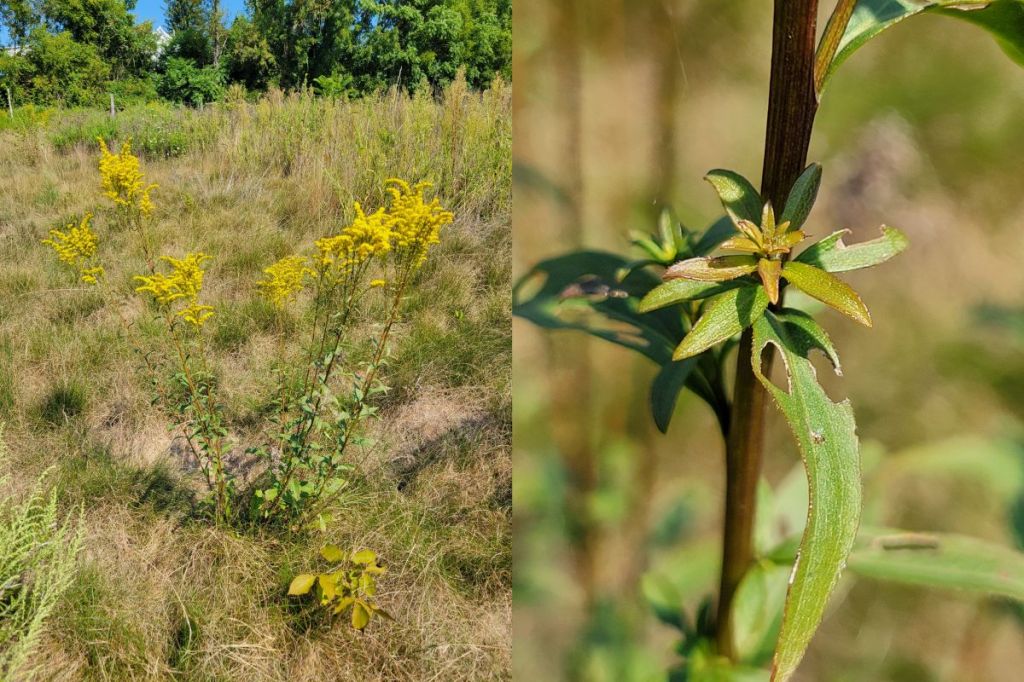
Nearby, Early Goldenrod (Solidago juncea) was still in bloom. This is a species that does not form rhizomes and does not grow in dense colonies. In fact, it does not compete well with the more aggressive goldenrods on fertile and moist soils. Therefore, it is usually found on somewhat dryer, less nutrient-rich soils. This is one of the earliest-flowering goldenrods, it usually has a basal rosette of leaves, as well as small clusters of leaves in the axils of the stem leaves.
Early Goldenrod (Solidago juncea)
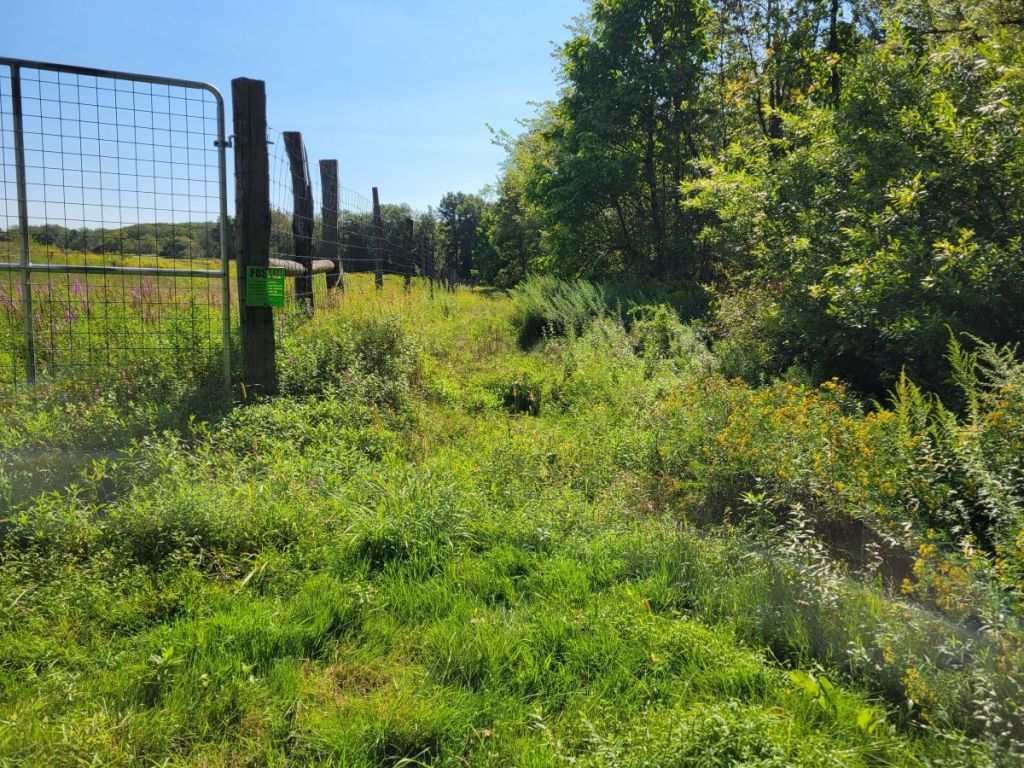
A strip of herbaceous vegetation has been maintained along the outside of the deer fence (#2), forming the edge between farmland and wooded riparian corridor along the Roundout Creek. This strip harbors some of the same species as the old field, but also some species associated with the riparian corridor, such as Sensitive Fern (Onoclea sensibilis), Deer-tongue Rosette Grass (Dichanthelium clandestinum), and a species of native sunflowers described below. Unfortunately, invasive plant species, including abundant Mugwort (Artemisia vulgaris) and Japanese Stilt Grass (Microstegium vimineum) also thrive in this occasionally mowed strip.
Strip of herbaceous vegetation outside of the deer fence (#2)
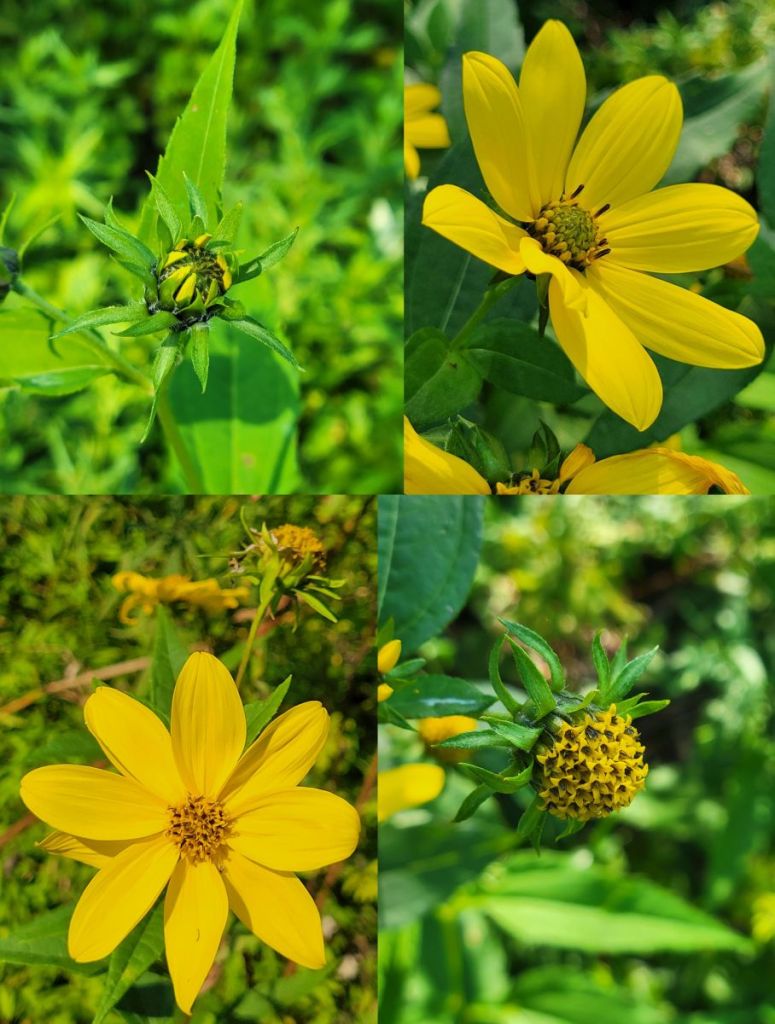
I was excited to find several patches of Thin-leaved Sunflower (Helianthus decapetalus) on both sides of the deer fence along the southern edge of the farm fields (#3). This beautiful native wildflower tends to grow in semi-shaded riparian areas and occasionally along roadsides. I would think that it could also find its place in native plant gardens and seeded wildflower meadows, but its seeds are still hard to find in seed catalogues. Would this be a candidate for the production of eco-type seeds and plugs?
Thin-leaved Sunflower (Helianthus decapetalus)
The next image shows a flower head of a Thin-leaved Sunflower in its prime. Note how this flower head is composed of two types of flowers: the large, petal-like ray flowers visually attract pollinators, while the small, star-shaped disk flowers at the center focus their energy on pollen, nectar, and—eventually—seed production. Note how the disk flowers mature first around the outside of the disk. The dark columns emerging from the open disk flowers bear the pollen. The flowers at the center of the disk are still green flower buds.
Thin-leaved Sunflower (Helianthus decapetalus)
The following collage illustrates a sequence of flower heads at different stages of development (clockwise from top left): (1) the young flower head is mostly defined by its green bracts, the disk and ray flowers are still developing; (2) a flower head just coming into bloom, with some—but not all—disk flowers spreading and receiving pollen; (3) a flower head at or just past the peak of its blooming period seems to have spent all its pollen, but might still be receptive for pollen brought in from other plants; (4) this flower head has dropped its ray flowers and is now ripening its seeds, one per star-shaped disk flower.
Thin-leaved Sunflower (Helianthus decapetalus)
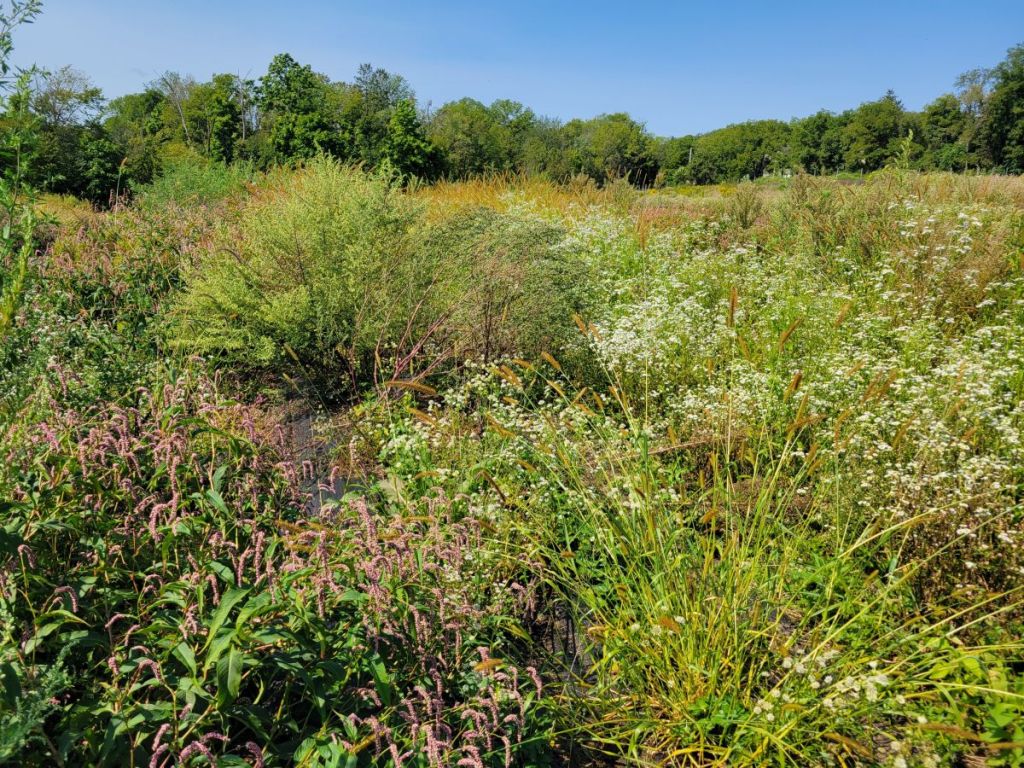
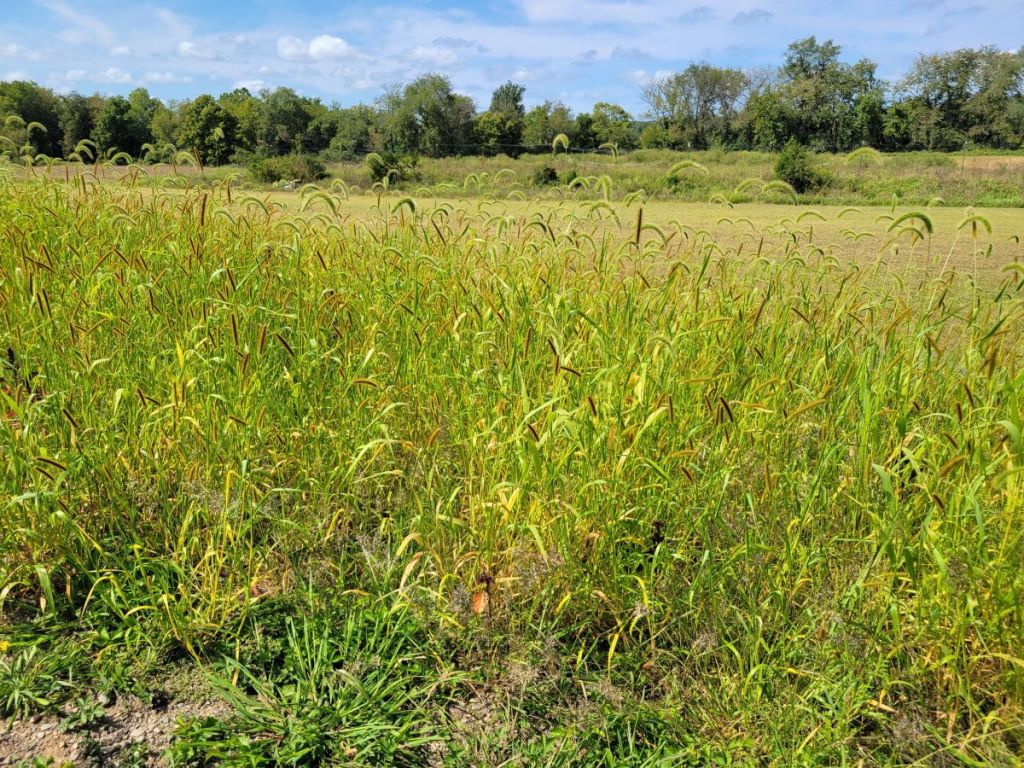
Returning from the riparian corridor back towards the center of the farm, a fallow field (#4) sports a riot of weeds, including the native Daisy Fleabane (Erigeron annuus; white flowers), and the non-native grass Yellow Foxtail (Setaria pumila; orange, upright spikes) and an unusually large smartweed (probably Persicarialongiseta; drooping, pink spikes).
A weedy fallow (#4)
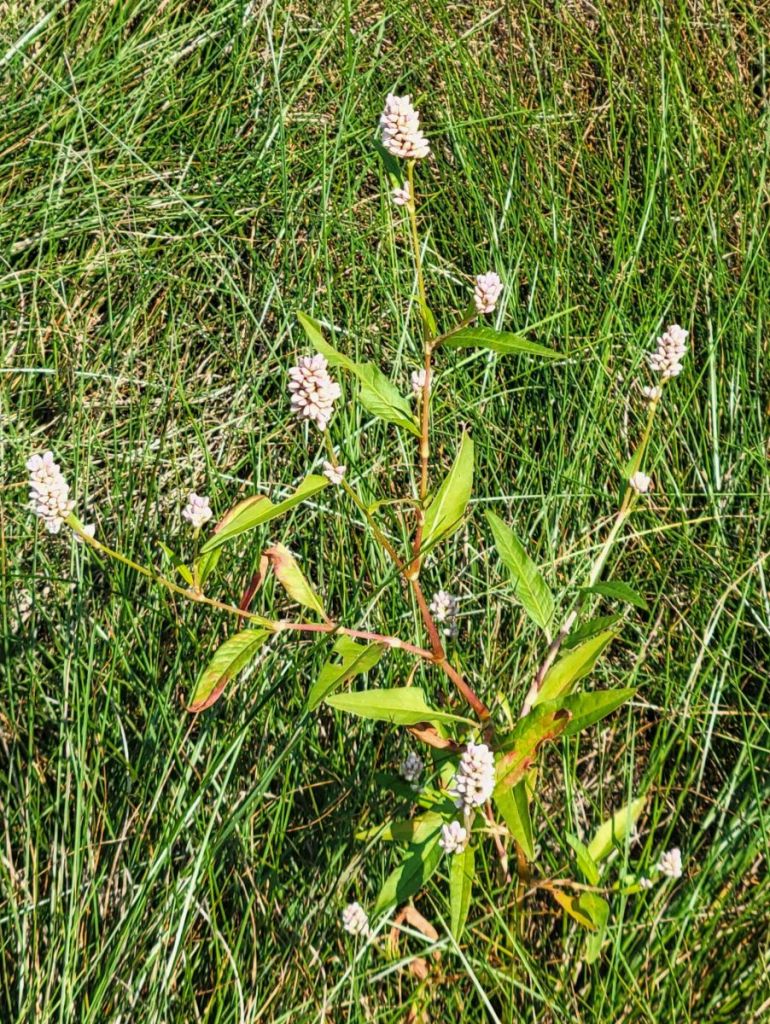
Nearby, I found another smartweed, the non-native Lady’s Thumb (Persicaria maculata), which also seemed particularly robust.
Lady’s Thumb (Persicaria maculata)
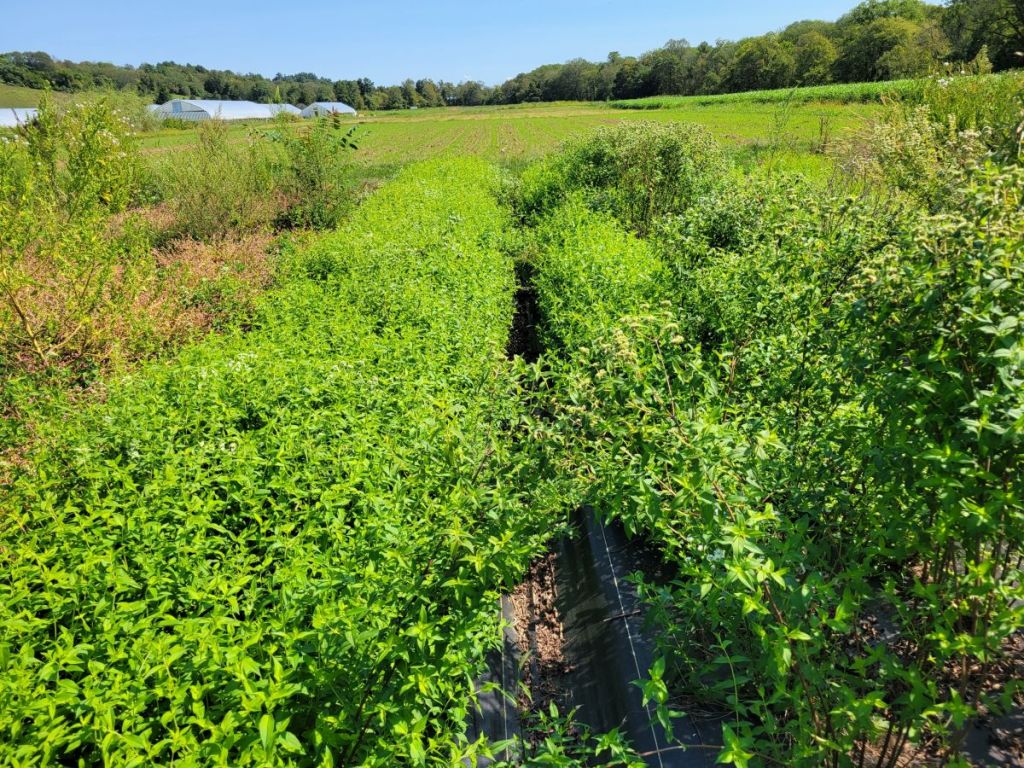
In these beds (#5), a variety of native wildflower species were cultivated. They included several mountain-mints (Pycnanthemum spp.), asters (incl. Symphyotrichum laeve), and Joe-Pye-weed (Eutrochium sp.). However, I did not attempt a complete inventory of these cultivated flowers.
Beds of cultivated native wildflowers (#5)
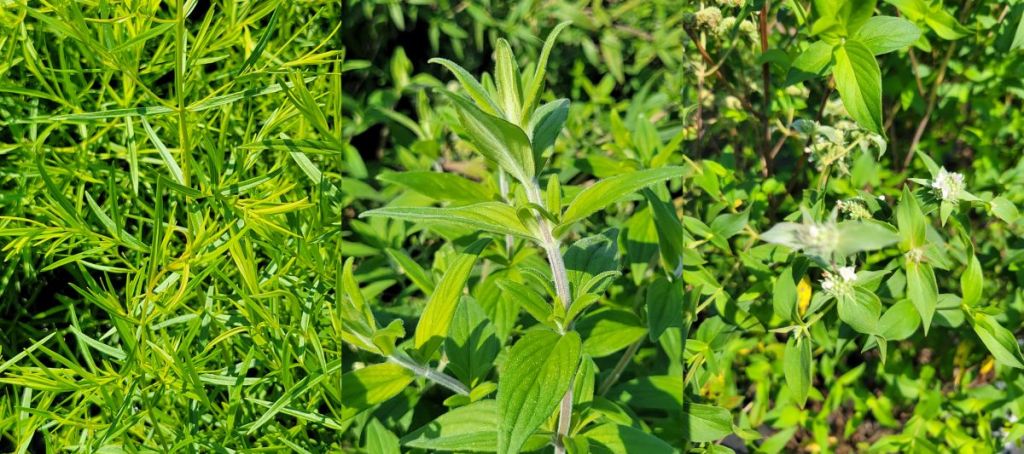
The following collage shows three different species of mountain-mints cultivated at Treadlight Farm (from left to right): Narrow-leaved Mountain-mint (Pycnanthemum tenuifolium), possibly Hairy Mountain-mint (P. cf. verticillatum), and possibly Blunt-leaved Mountain-mint (P. cf. muticum).
Examples of cultivated native mountain-mints
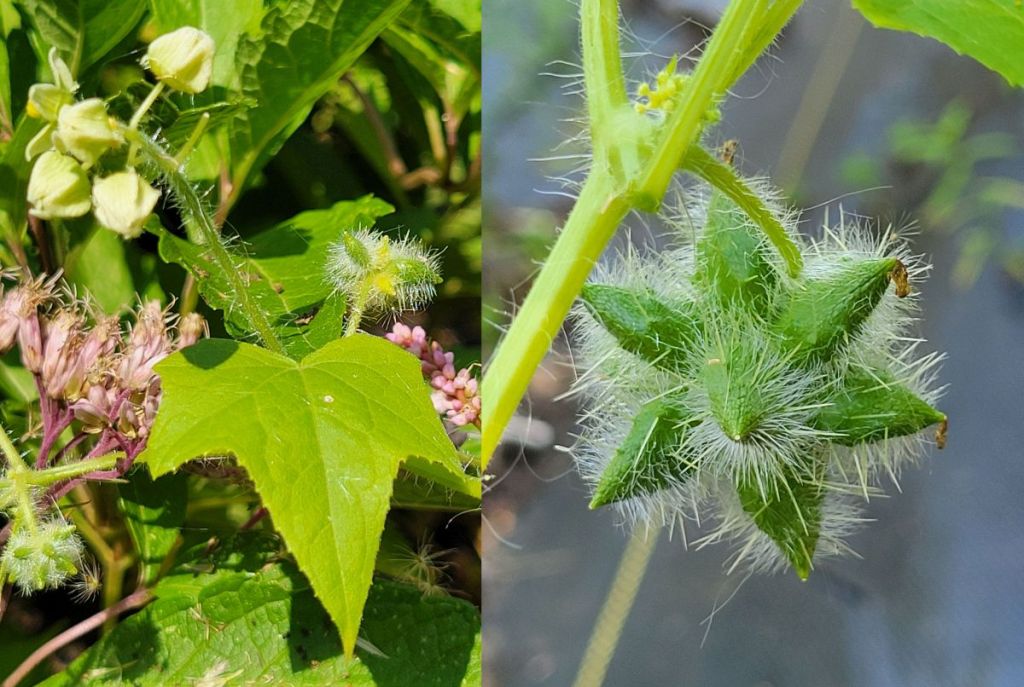
The native One-seeded Bur-cucumber (Sicyos angulatus), a wild cucurbit, was mingling with the Joe-Pye-weed.
One-seeded Bur-cucumber (Sicyos angulatus)
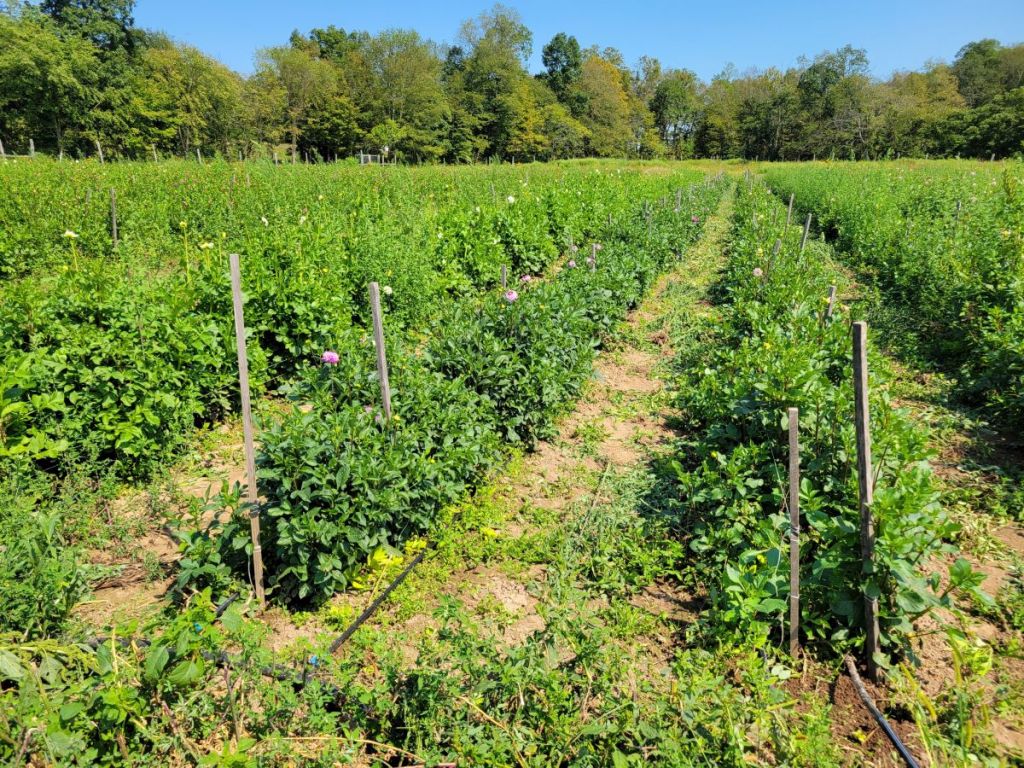
Not many native plans were thriving in the rows of dahlias (#6).
Rows of dahlias (#6)
At the northeastern corner of the farm fields, I found a small strip of old field/wet meadow (#7), which harbored some Purplestem Asters (Symphyotrichum puniceum), not seen anywhere else at TFreadlight Farm and possibly quite a few Willow-leaved Asters (S. praealtum). The latter species was not yet in bloom, so I am not 100% certain of its identity.
A strip of old field/wet meadow vegetation (#7; below) and Purplestem Aster (Symphyotrichum puniceum; above)
A pink (more typical would be lavender) flower head of Purplestem Aster in lovely contrast with the yellow flowers of Flat-topped (a.k.a. Grass-leaved) Goldenrod (Euthamia graminifolia).
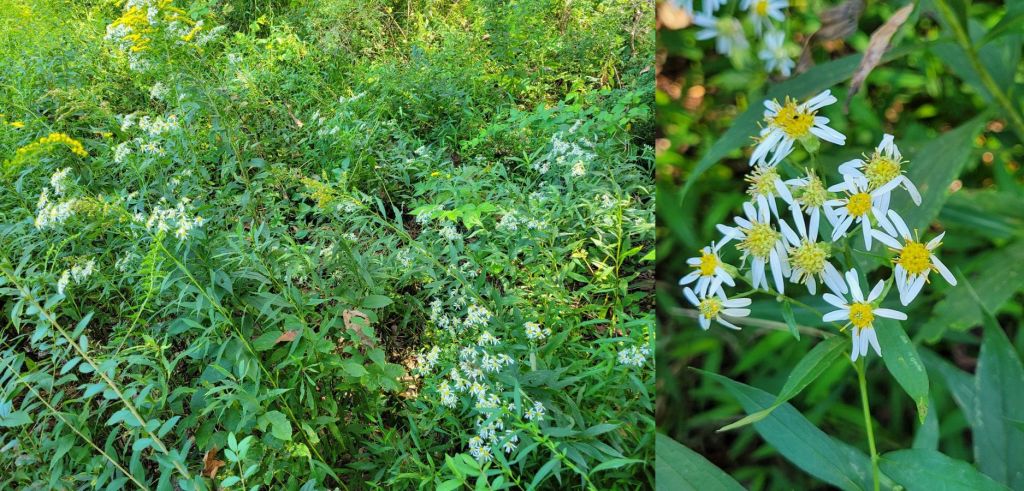
Three different native asters were common in the old field in the east corner of the farm (#8). These small-leaved, white-flowering species are notoriously hard to identify, but I suspect them to represent (from left to right): Calico Aster (Symphyotrichum lateriflorum), Pringle’s Aster (S. pilosum var. pringlei), and Awl Aster (S. pilosum var. pilosum).
Examples of three native asters, most likely (from left to right): Calico Aster (Symphyotrichum lateriflorum), Pringle’s Aster (S. pilosum var. pringlei), and Awl Aster (S. pilosum var. pilosum)
I did not find many unique native plants at Treadlight Farm—a fact easily explained by the relative homogeneity of habitats within the farm’s fences: there were no waterbodies, no substantial wetlands, no rock outcrops, and basically no woody vegetation. Therefore, the Farm supported mostly habitat generalists, which were also found at some of the other farms.
However, the old field patches at the west and east end of the farm, as well as the fence line did support more species of native asters than I had found at any of the other farms this summer. In addition to the species already mentioned above, Lance-leaved Aster (Symphyotrichum lanceolatum) was probably the most common of all asters in many places along the fence line and in unmowed interior areas, and Heart-leaved Aster (S. cordifolium) occurred mostly along the southern fence line.
The old field patch on the west side of the farm (#1)
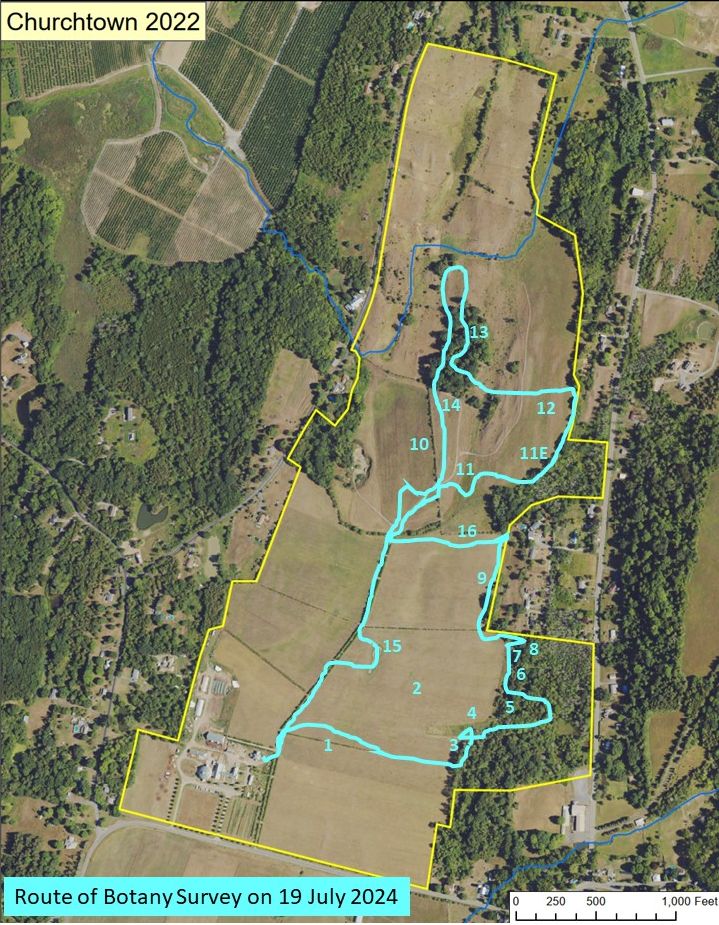
This blog shares some of the botanical observations from Churchtown Dairy on 19 July 2024. Will had visited the farm separately and written about the “Birds of the prairie” at this farm in his blog posted on 13 October 2024.
The following map shows the approximate route walked for the botany survey. The numbers (referenced throughout this blog) indicate places where botanical observations were made or pictures were taken.
Map of the approximate plant survey route (in sky blue). The numbers (referenced throughout this blog) indicate places where botanical observations were made or pictures were taken.
Let us begin by sharing some habitat images from the farm:
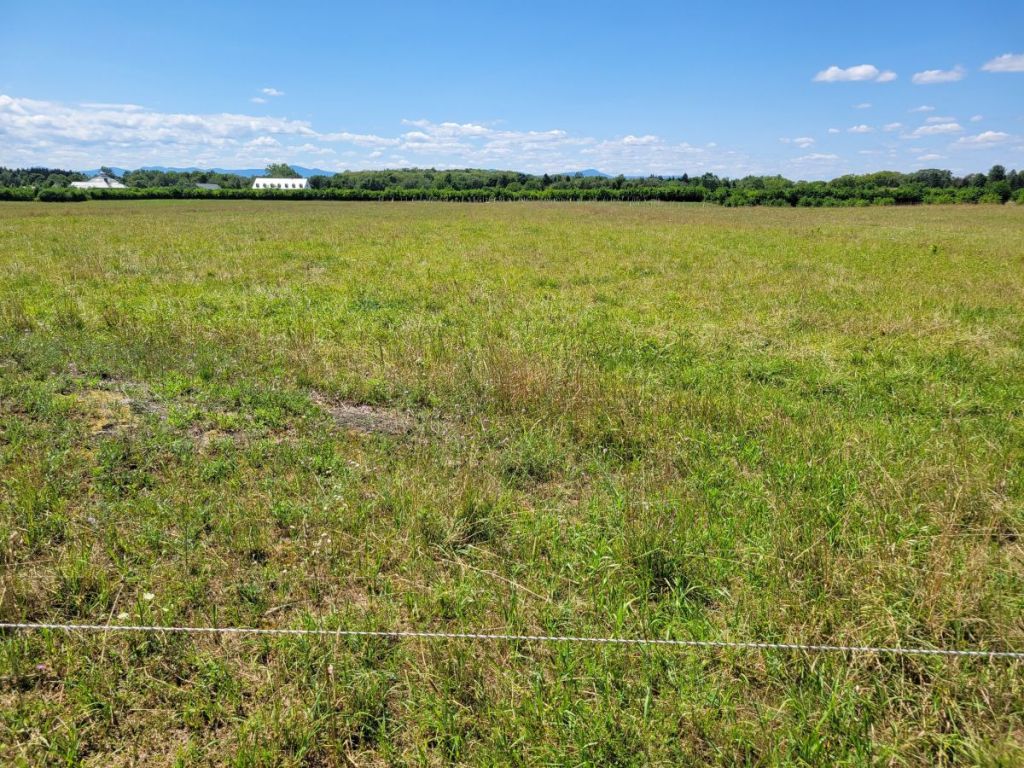
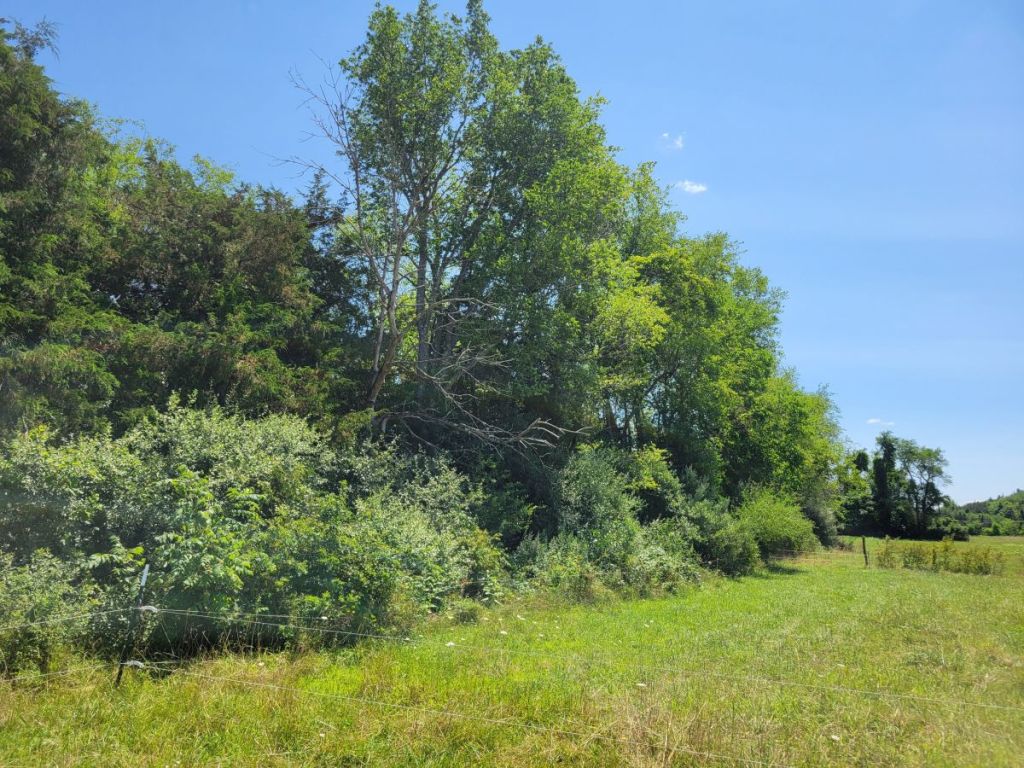
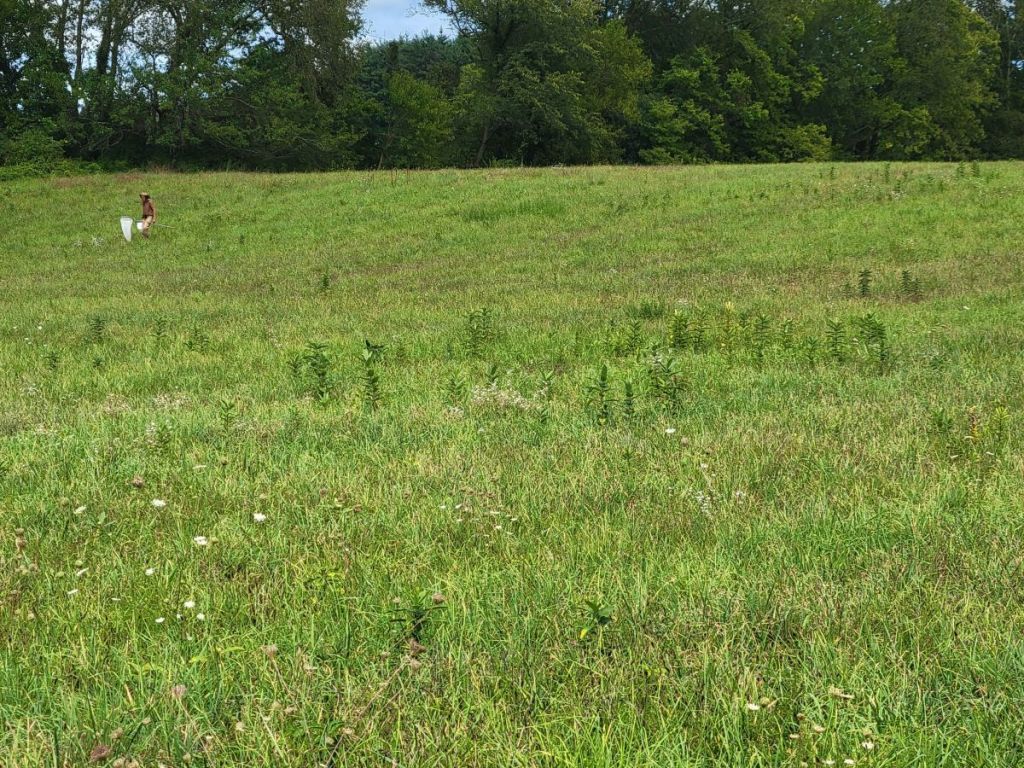
By far the largest amount of the farmland north of Route 12 is currently dedicated to pasture (view from #7 looking west).On the east, the pastures border mostly young forest and have a shrubby edge (#3).There are also pockets of wetlands along the eastern boundary (#4).Throughout the farm there are some long-established hedgerows dividing the fields (this is the view from #16). More recently planted hedges flank the main farm road.
The northern part of the farm is hilly (view north from #13)
There are also a couple of ponds. This smaller one (#15) is surrounded by a recent tree planting for silvopasture.
After this brief visual introduction to the farmland at Churchtown Dairy, we’ll go into more botanical detail.
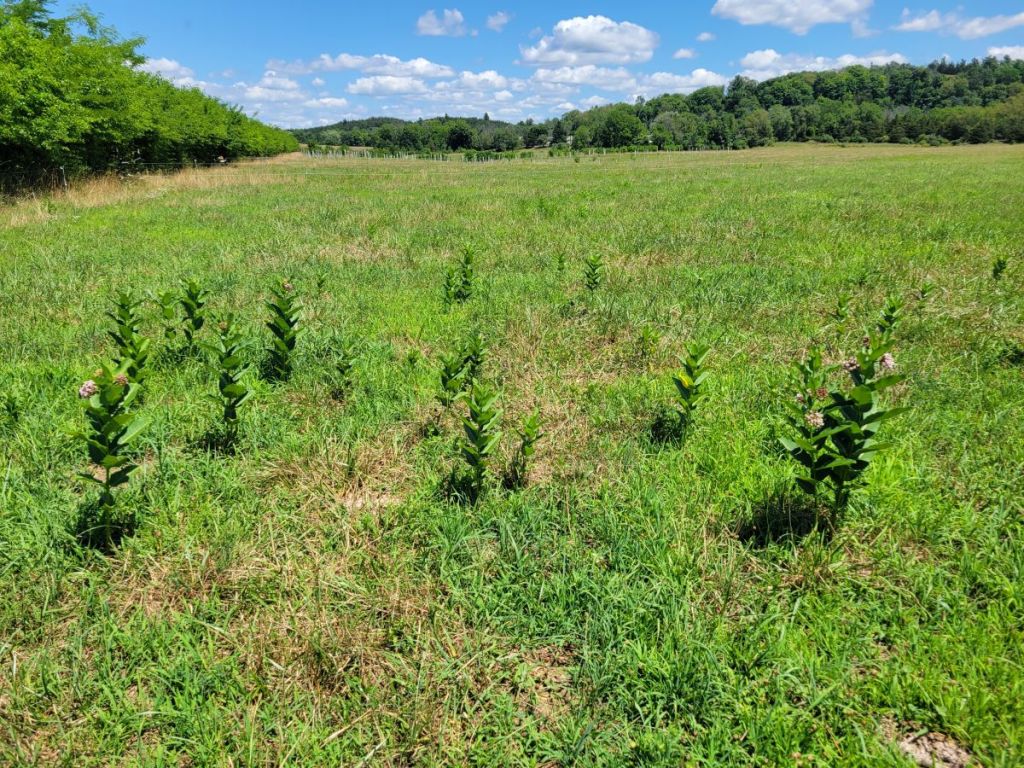
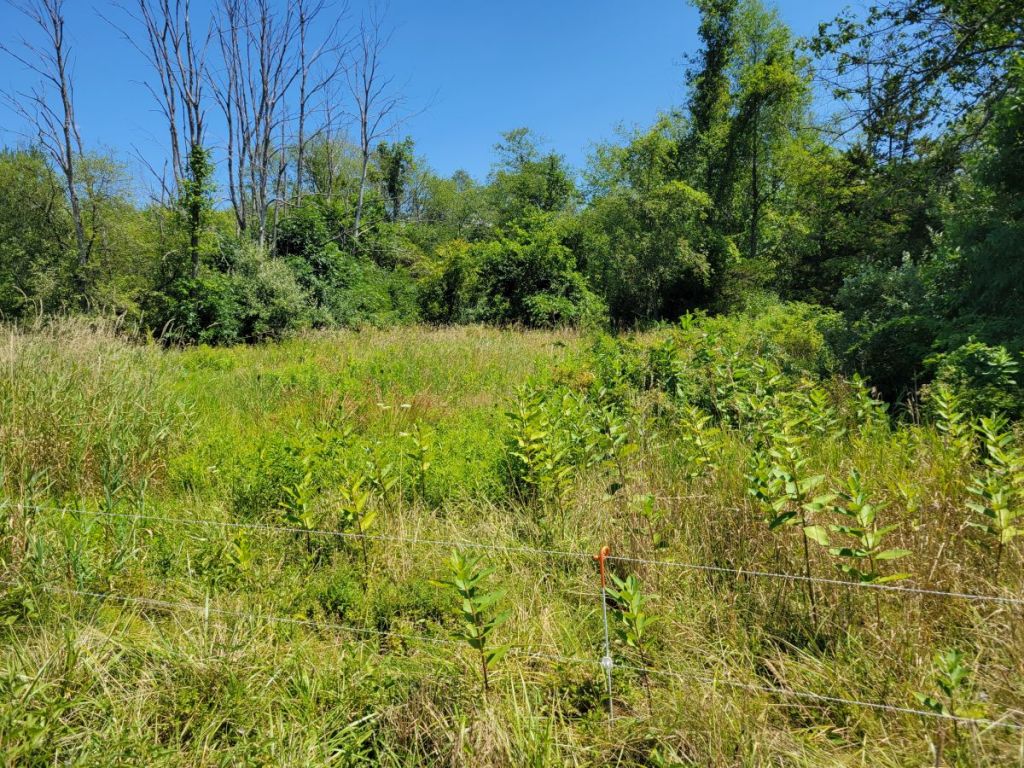
Most of the pastures were closely-grazed at this point. As typical for pastures and hayfields in our region, most of the plants in the pastures themselves were European species of grasses, legumes, and other common plants of perennial agricultural meadows. One exception stuck out immediately: many of the pastures had patches of Common Milkweed, a wildflower native to North America and one of the host species for Monarch caterpillars, as well as a number of other native milkweed-specialists. It was nice to see that the milkweed plants across the farm were at different stages of development, some going to seed, some in mid-bloom, and some just beginning to put out new leaves after having been grazed or clipped. Maintaining such diversity of developmental stages throughout the growing season is beneficial for the insect community, because it ensures the availability of a variety of resources (ranging from tender leaves for young caterpillars to nectar for adult butterflies and many other insects) for an extended time period (compared to the scenario were all plants of a species mature and go to seed at the same time).
Common Milkweed plants in a pasture (#2)
The hedgerows and forest edges bordering the pastures were composed of a variety of native and non-native woody plants. The hedgerows bordering the central laneway and separating some pastures had been planted relatively recently (10-20 years ago) with a small selection of species, including Osage Orange and Honey-locust (both considered native to areas south of here), and hawthorn and hazel (species and native status uncertain). However, the longer-established hedges and field edges supported wild-growing, native Staghorn Sumac…
One of the long-established hedgerows, including Staghorn Sumac
… Red Cedar …
Another one of the long-established hedgerows, including Red Cedar
… and even an occasional stately oak (pictured here is a Red Oak, whose leaves were partly eaten by Spongy Moth caterpillars)…
A field edge with a big Red Oak
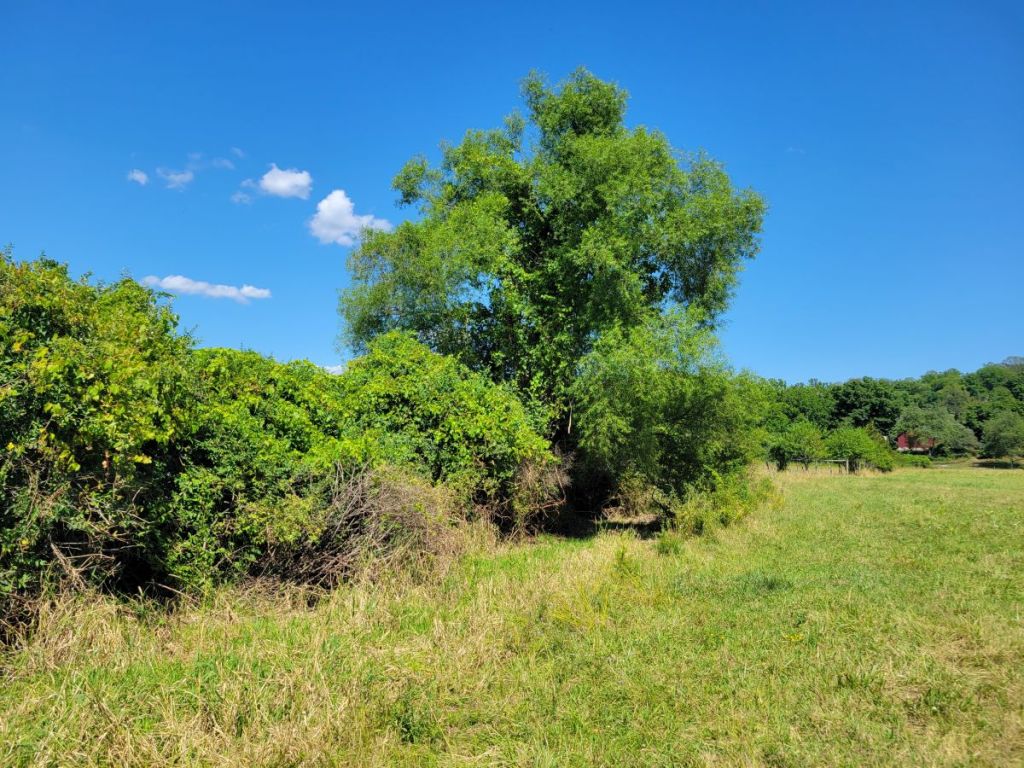
… and a willow, probably the native Black Willow (Salix nigra).
A long-established hedgerow with a big willow tree
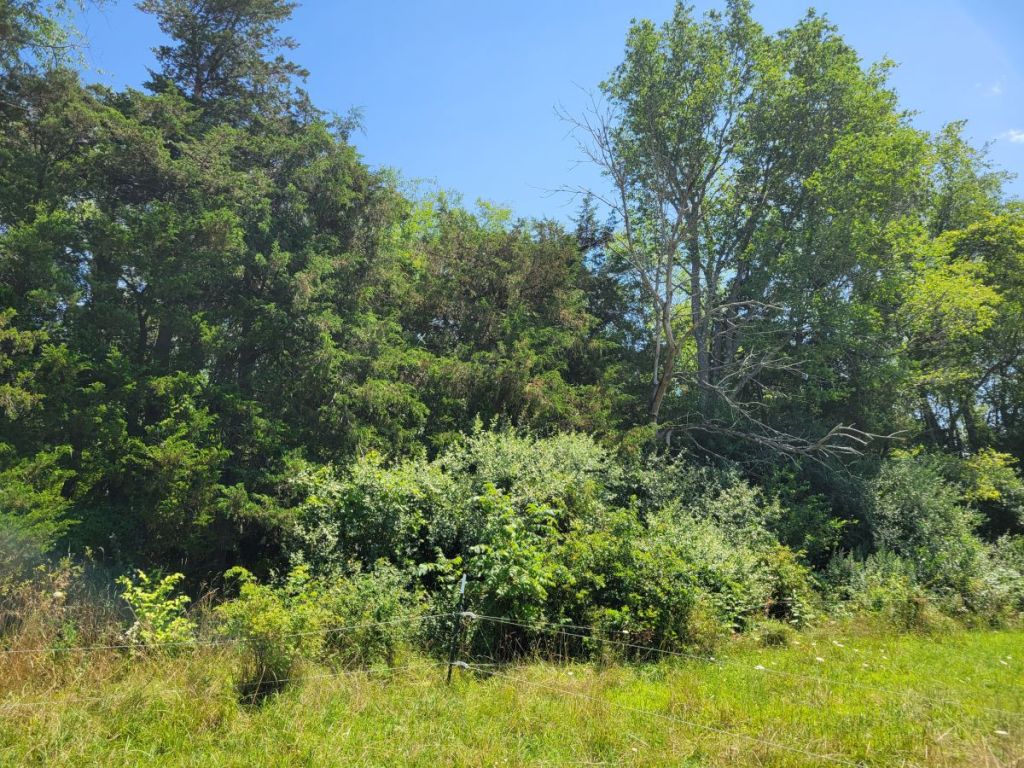
Non-native, invasive shrubs, such as Eurasian shrub honeysuckle (Lonicera morrowii or L. x bella), Multiflora Rose, Common Buckthorn, Autumn Olive, and Oriental Bittersweet were also quite common in many of the hedges and field edges.
A field edge with a variety of invasive shrubs
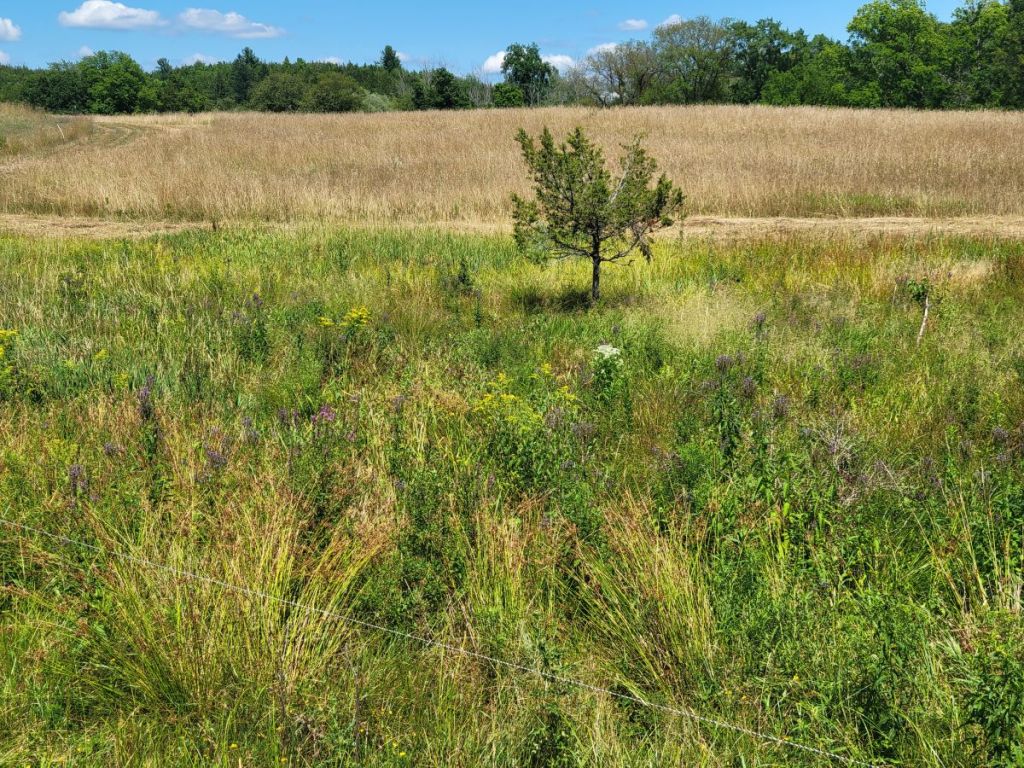
There were a few small wet meadow areas at Churchtown Dairy, such as the one in the next picture at the east end of D6 (#4 on the aerial photograph). These wet meadows support vegetation very different from that in the adjacent upland pastures. European species are also a component of these wet meadows and some, such as the invasive Reed Canary Grass, seen on the left in this image, can be quite common. However, these wet meadows are also important reservoirs of native biodiversity, because they harbor a number of native wildflowers, grasses, sedges, and ferns, which are not found anywhere else on the farm.
Wet meadow (#4)
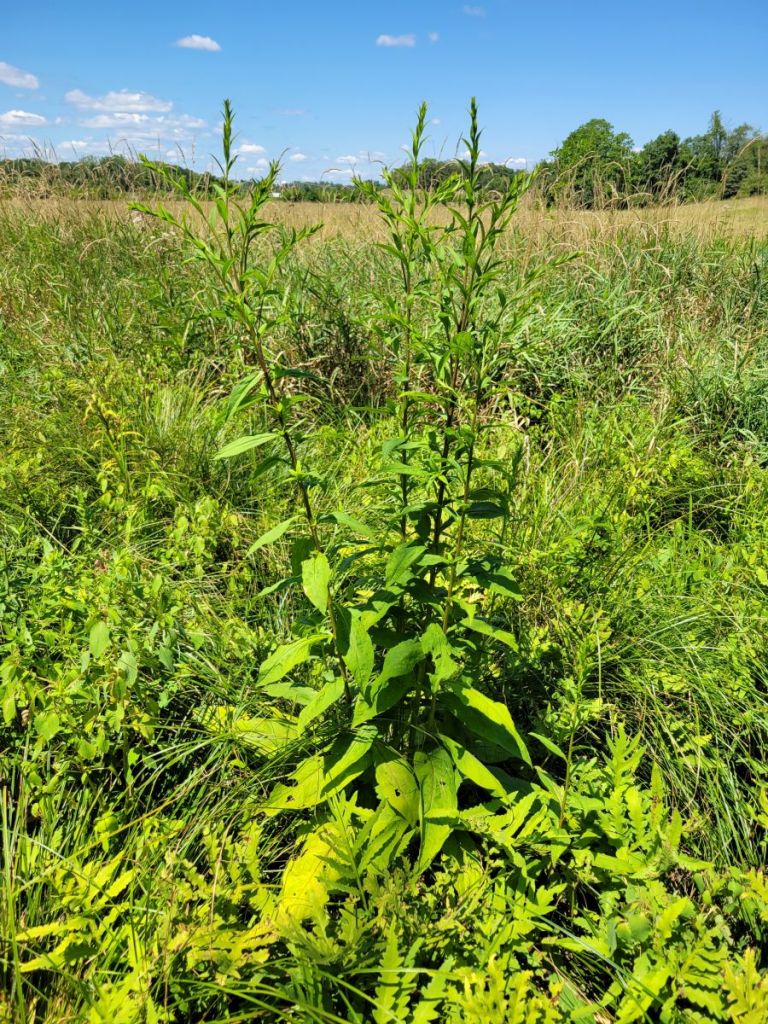
Rough-leaved Goldenrod (Solidago patula) is one example of a regionally uncommon native species I stumbled across in the wet meadow east of D6. This goldenrod, which typically occurs in calcium-rich wetlands, does not grow in dense, rhizomatous colonies like its more common cousins typical of old fields. Instead, a few (eventually) flowering stalks emerge from a cluster of large basal leaves that have the texture of sandpaper.
Rough-leaved Goldenrod (Solidago patula)
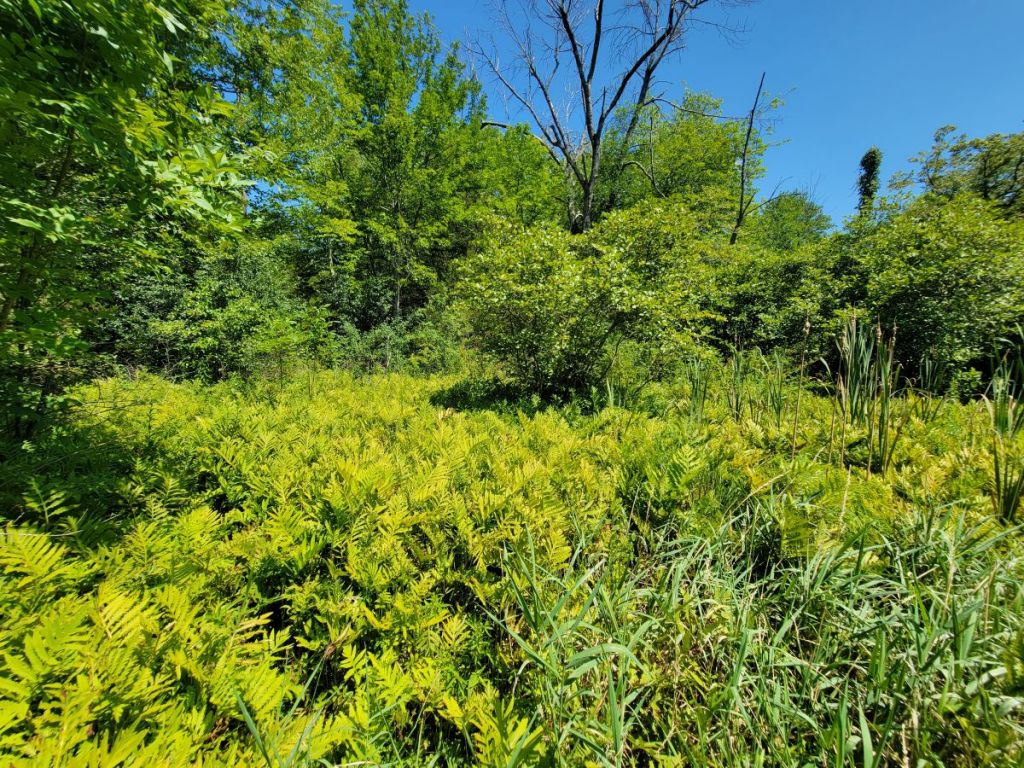
One part of the wet meadow east of D6 supported a colony of Sensitive Fern and cattails (both native species), in addition to a patch of the invasive Reed Canary Grass visible in the front right of the image.
Wet meadow (#4)
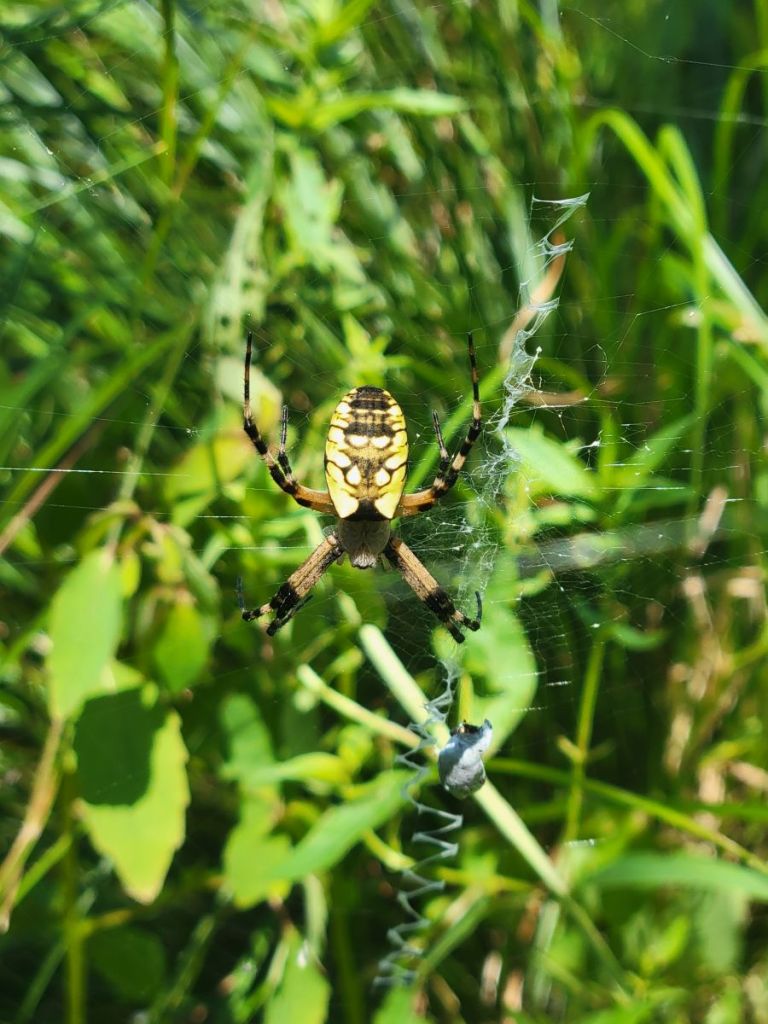
The Black-and-Yellow Gardenspider (Argiope aurantia) builds its net in tall, undisturbed vegetation, and the wet meadow provided ideal habitat for this gorgeous hunter.
Black-and-Yellow Gardenspider (Argiope aurantia)
Another beautiful small example of a species-rich wet meadow was found in the drainage southwest of the Bobolink Field (#11). Note the diverse textures and colors in this habitat!
A small wet meadow (#11)
A closer look reveals the native species Woolgrass (Scirpus cyperinus; in front left), Smooth Goldenrod (Solidago gigantea; yellow flowers), Common Boneset (Eupatorium perfoliatum; white flowers), Blue Vervain (Verbena hastata; purple flowers), and Tussock Sedge (Carex stricta; in front right).
A closer look at a small wet meadow (#11)
Back at the east edge of D6-11, I entered the forest and found small areas of swamp forest (#5) where the canopy was dominated by Red Maple trees.
Swamp forest (#5)
Rough-leaved Goldenrod grew here and there in the understory.
Rough-leaved Goldenrod (Solidago patula)
Unfortunately, the invasive Japanese Stiltgrass had also established itself in this forest (as well as in the “grove”). This grass is currently one of the most rapidly spreading non-native species in our region and there don’t seem to be any “silver bullets” for its control. It is an annual grass with wiry stems and relatively broad (and short!) leaves, which often have a broad white line along their midrib.
Japanese Stiltgrass (Microstegium vimineum)
Black Swallowwort (Vincetoxicum nigrum) is an invasive vine with opposite, shiny oval leaves, small, dark purple flowers, and seed pods reminiscent of milkweeds. It was found only in small numbers at Churchtown Dairy. Scattered plants were spotted in the swamp forest and wet meadow east of D6-11, as well as in the “grove.” This might be an invasive species still rare enough on the farm that its spread could be curtailed by systematically pulling it out, whenever it is encountered.
Black Swallowwort (Vincetoxicum nigrum)
Another potentially troublesome species is this pretty ornamental shrub, Jetbead (Rhodotypos scandens), which probably had jumped the fence onto the young forest on the farm’s land from one of the neighboring yards. I had never seen it growing wild in Columbia County, but was told that it had spread throughout Central Park and might become more assertive in our region, in the future… This might be another species to discourage early on wherever it shows up on the farm.
Jetbead (Rhodotypos scandens)
Tree-of-Heaven is the last invasive species I want to mention. It currently occurs at a low enough density at Churchtown Dairy, that its further spread might be avoided by removing the seed-producing trees, like this one next to the “grove.” Unfortunately, if a Tree-of-Heaven is felled, its roots tend to produce sprouts which—if unchecked—can result in an entire colony of new trees. Therefore, it is important to continue to annually monitor and—if needed—manage the site where an adult tree has been felled or girdled.
Tree-of-Heaven (Ailanthus altissima); this specimen was found between #12 and #13
Returning to the east edge of D6-11, after emerging from the swamp forest, I entered a small stand of Red Cedar trees (#6), which seemed to serve as an occasional forest pasture. I made no exciting native plant discoveries in this habitat.
Red Cedar forest (#6)
Emerging out of the Red Cedar forest, I found myself on the hilly, eastern section of pasture D11 (#7). Although dry pastures like this sometimes harbor uncommon native plants, I did not observe any noteworthy native species here, either.
Dry pasture (#7)
Eventually, I found myself in the “Bobolink Field,” (#12) a hay meadow cut late in the season to give ground-nesting Bobolinks enough time to raise their young. Like in the pastures, the vegetation in this field was mostly composed of European grasses and—to a lesser extent—legumes.
Late-cut hayfield (#12) which is managed to accommodate ground-nesting birds.
Another wetland, this one dominated by shrubs and trees, including Swamp White Oak, Green Ash (many dying), and Red Maples, borders the “Bobolink Field” on the east. Native shrubs, such as Winterberry, Arrowwood, Silky Dogwood, and Wild Raisin, occur side-by-side with the common invasive shrubs that dominate the understory.
Wetland (#11E)
Spotted Joe-Pye-weed grew along the herbaceous edge of this wetland and also in some of the other wet meadows along the eastern edge of the farm.
Spotted Joe-Pye-weed (Eutrochium maculatum)
The “grove” (#13) is the only forest at Churchtown Dairy (at least north of County Route 12) that grows on land that seems to have never been completely cleared. It harbors some exceptionally large specimens of Hop-hornbeam trees and some beautiful White Oaks. At the north end, there are several Common Pear trees and Pignut Hickories. Although hardly an “old-growth” forest, this woodland fits our definition of an “ancient forest,” whose soils have not been homogenized by the plow. Therefore, they might have the potential to support soil life and understory plants that are slow to recolonize post-agricultural forests. However, its current understory vegetation is mostly composed of invasive species and European plants typical of nutrient-enriched barn yards. This is likely due to the recent use of this woodland as a pig pasture.
The “grove” (#13) might be an example of an ancient forest.
On the way back to the barns, I took a quick detour to this small, marshy pond (#15), which had very little open water. Cattails (tall green vegetation at the center) were growing in a wide band around the shore and were flanked by patches of Reed Canary Grass (tall tan vegetation left and right of the cattails). Closer inspection revealed several native wetland plants we had not noted in the other areas surveyed for plants at Churchtown Dairy that day. They included the regionally common: Water Purslane, Nodding Bur-marigold, and Soft Bulrush.
A small, marshy pond (#15) harboring some unique wetland plants
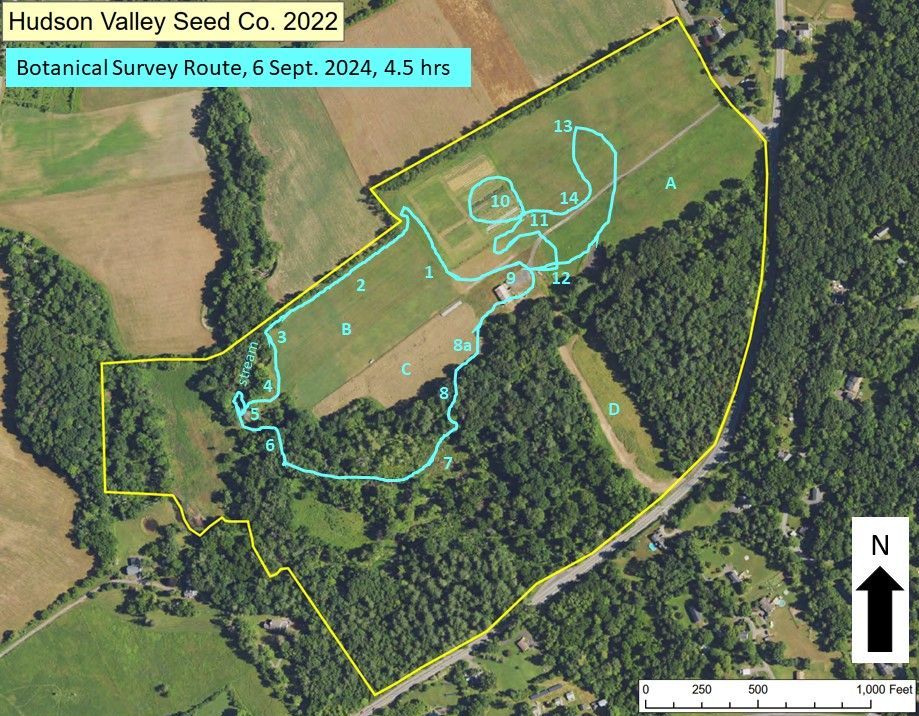
On 6 September 2024, we spent ~ 4.5 hours documenting the wild-growing plants of a cross-section of habitats at the new site of the Hudson Valley Seed Company on Airport Road in Accord. The following image highlights the approximate route taken and numbers observation points we will refer to throughout the blog.
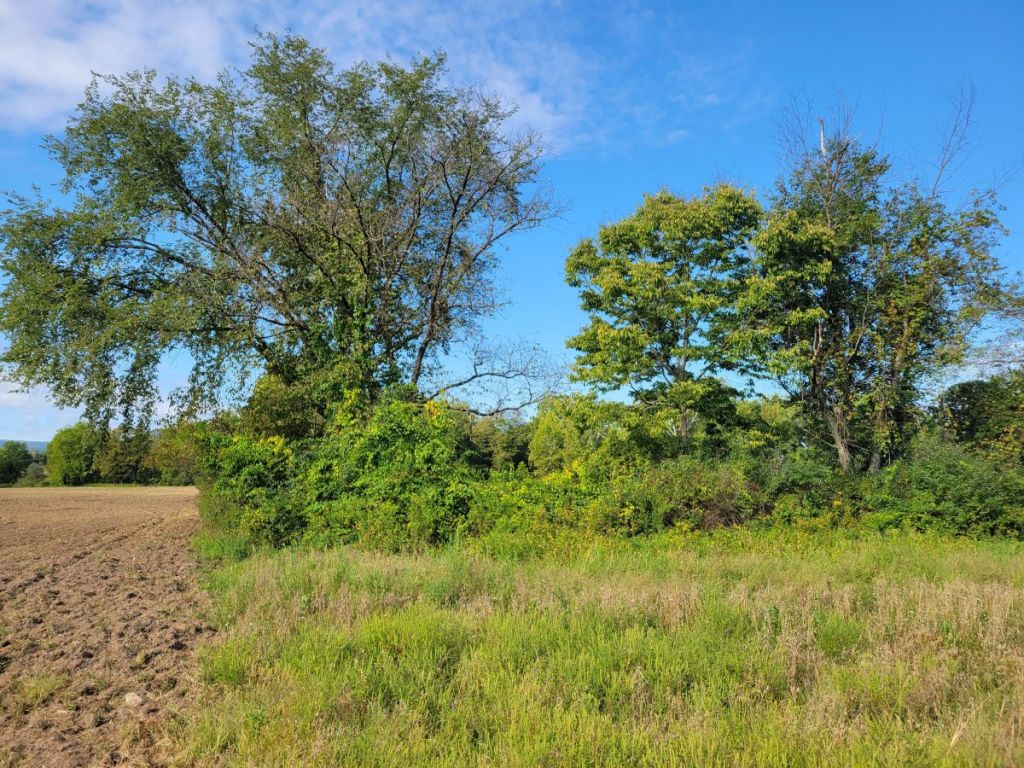
We began our survey along the west and north edges (#1 & #2) of a large tilled field. We found the usual field edge/hedgerow mix of common native and non-native plants. Half of the 20 invasive species recorded on the property were also represented in this area: Oriental Bittersweet (Celastrus orbiculatus), Eurasian shrub honeysuckle (Lonicera morrowii or L. bella), autumn-olive (Elaeagnus umbellata), Japanese Barberry (Berberis thunbergii), privet (Ligustrum sp.), Winged Burningbush (Euonymus alatus), Black Locust (Robinia pseudoacacia), Japanese Stiltgrass (Microstegium vimineum), Mugwort (Artemisia vulgaris), and Canada Thistle (Cirsium arvense).
Hedgerow and unmowed field along northern boundary (#2 on map)
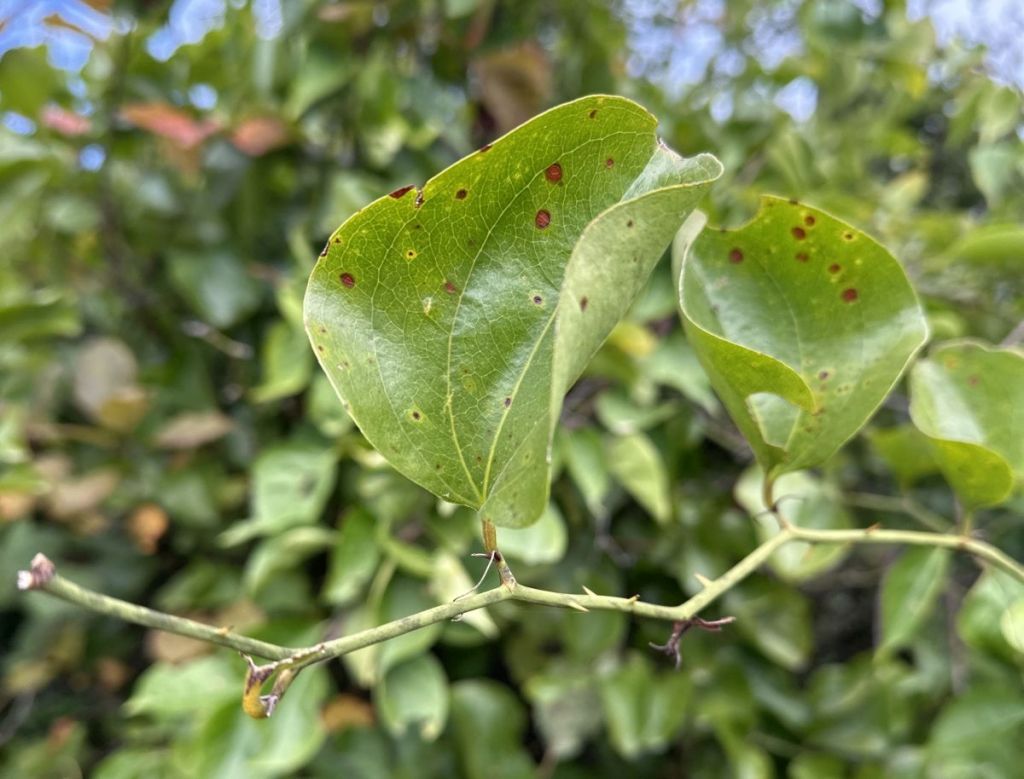
We also found an abundance of the native (but sometimes over-enthusiastic) spiny vine, Common Greenbrier (Smilax rotundifolia). Its fruits ripen in the autumn and somewhat resemble grapes, and some people consider them edible (I have never tried them). However, there are amply references on the internet of people eating the tender shoots in spring, and also using the dried roots to make a starchy powder used in a variety of ways.
Common Greenbrier (Smilax rotundifolia)
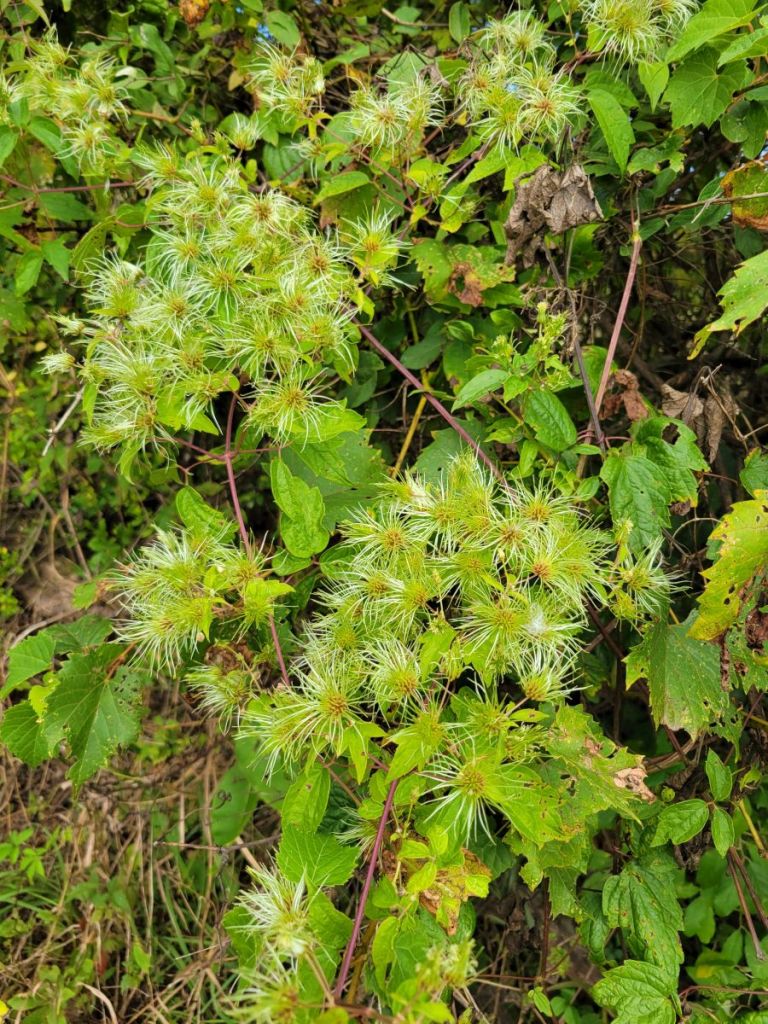
These fuzzy little seed heads belong to another native vine, Virgin’s Bower (Clematis virginiana). It is related to buttercups and, like many plants in that family, has secondary compounds that are poisonous/medicinal (depending on dosage).
Virgin’s Bower (Clematis virginiana)
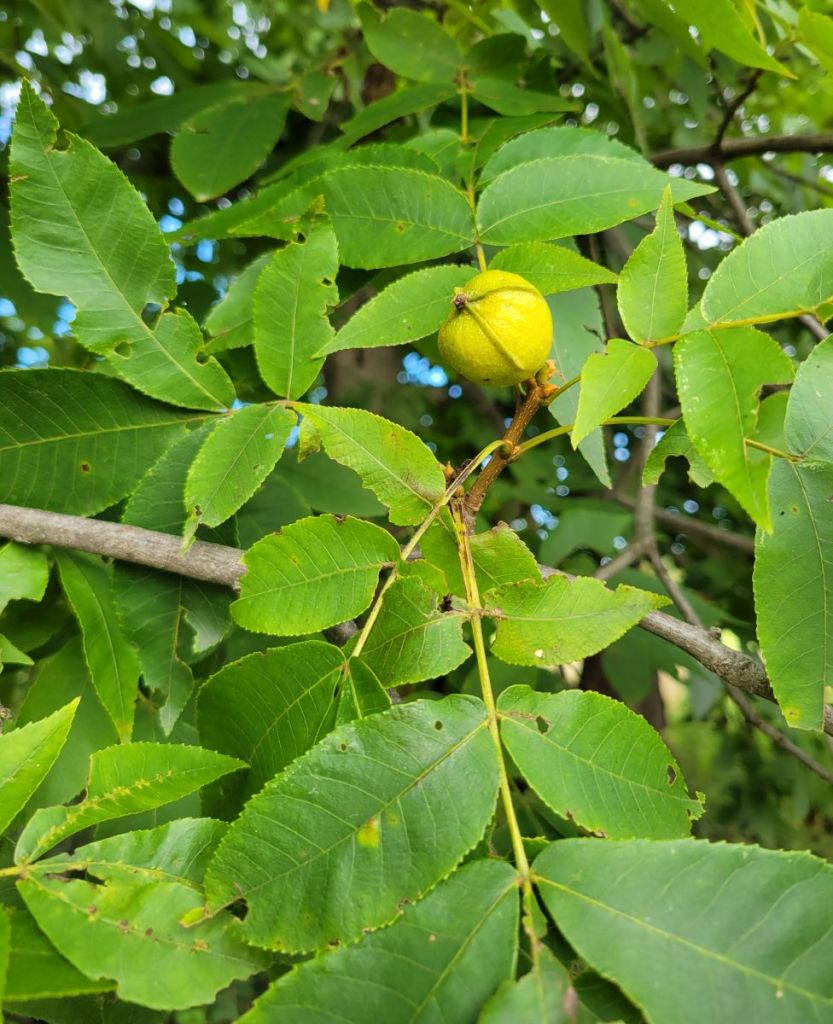
Several tall Bitternut Hickory (Carya cordiformis) trees could easily be identified by their thin-husked fruit with four “seams.” The related Shagbark Hickory (C. ovata) has a much thicker husk and Pignut Hickory (C. glabra) does not have the pronounced “seams.”
Bitternut Hickory (Carya cordiformis)
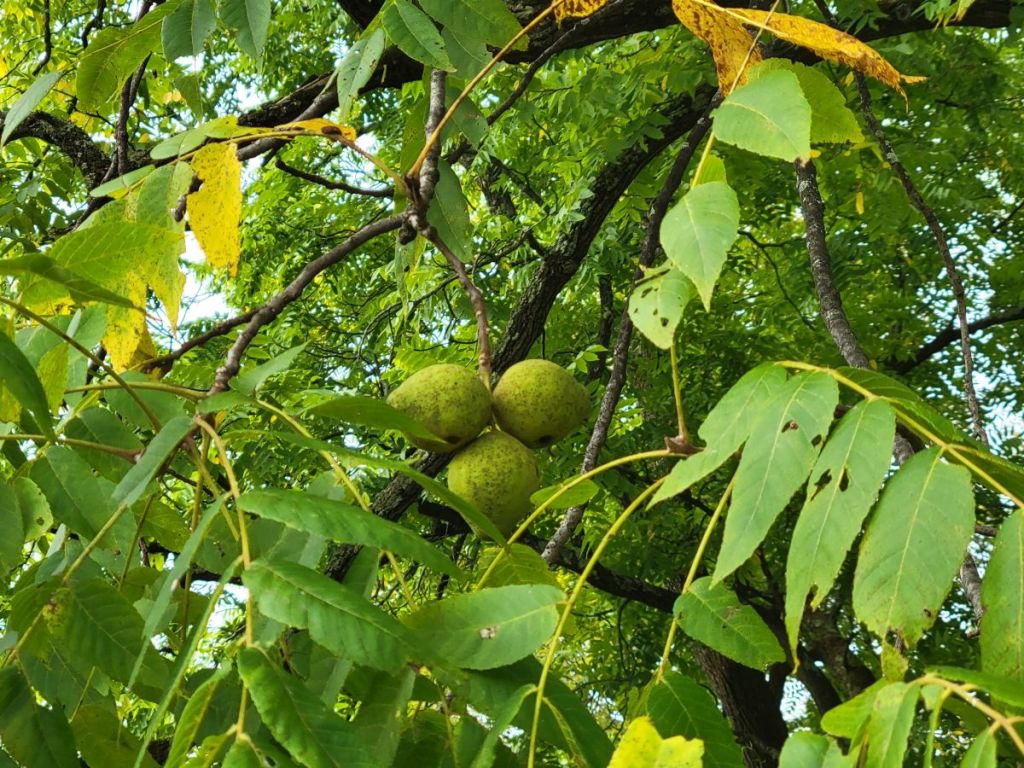
Black Walnut (Juglans nigra) was also present in the field margin (#3) and down near the stream. In the southern field margin (#8a), we also found Butternut (Juglans cinerea). These two, closely-related native species of walnuts are easily distinguished when fruits are present: the fruits of Black Walnut are almost round, while those of Butternut are more elongated (think of a stick of butter!).
Black Walnut (Juglans nigra)
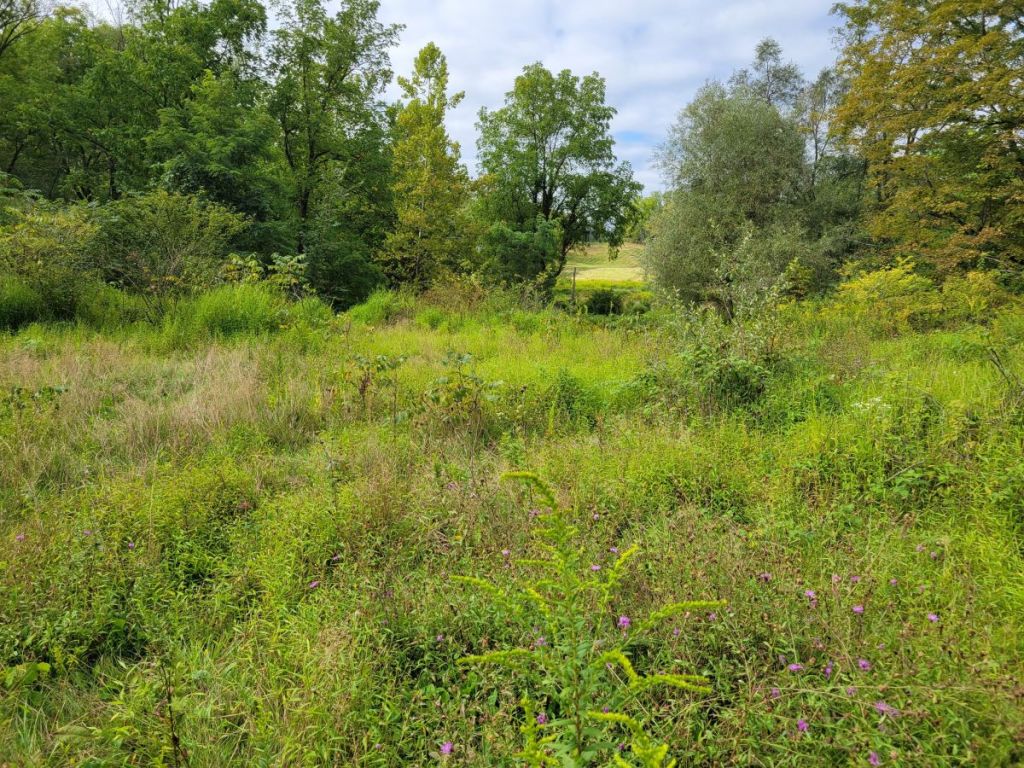
At the west end of the big field, we found an unmowed meadow sloping down to the stream. The dry part of this meadow (#4) was dominated by two invasive species, Japanese Stiltgrass (Microstegium vimineum) and Brown Knapweed (Centaurea jacea; purple, thistle-like flowers visible on the bottom right in the image).
Unmowed meadow (#4 on map) on west end of farm, above stream
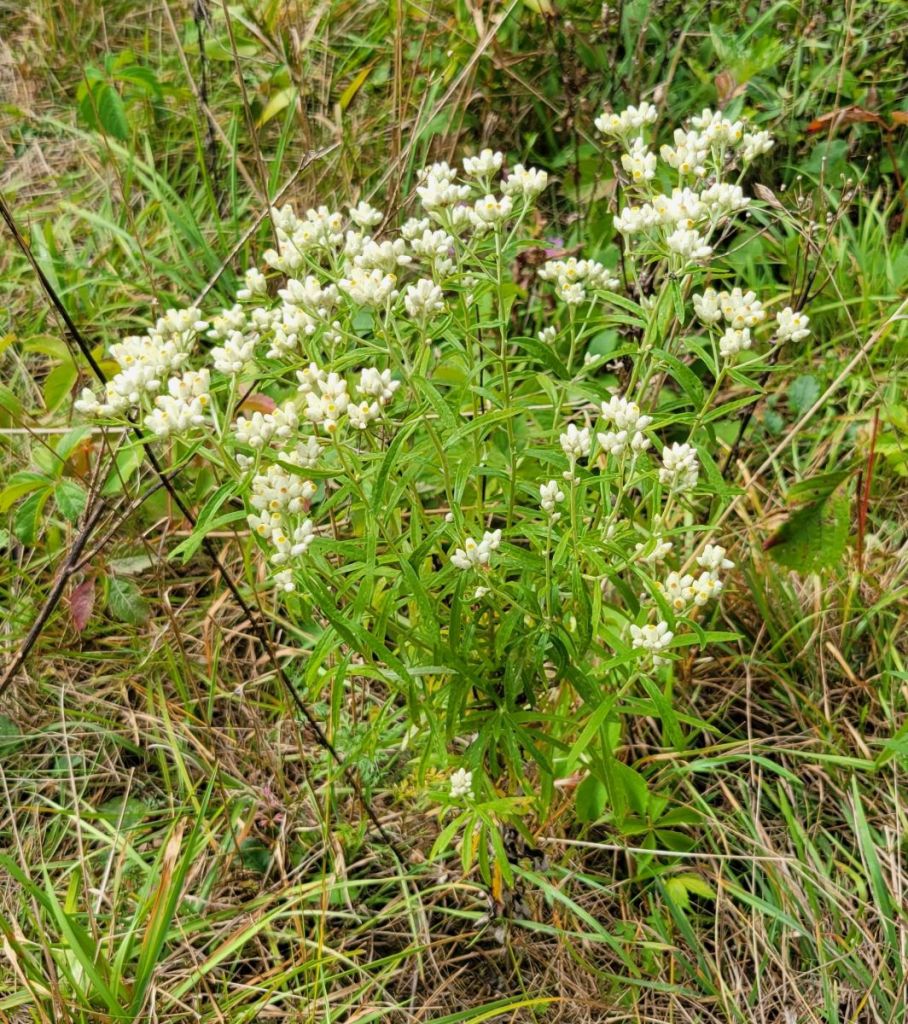
However, there was also a nice clump of the Fragrant Rabbit-tobacco (Pseudognaphalium obtusifolium), as well as a smattering of other native species, including Wild Bergamot (Monarda fistulosa) and one of the common oldfield asters, possibly Pringle’s Aster (Symphyotrichum pilosum var. pringlei).
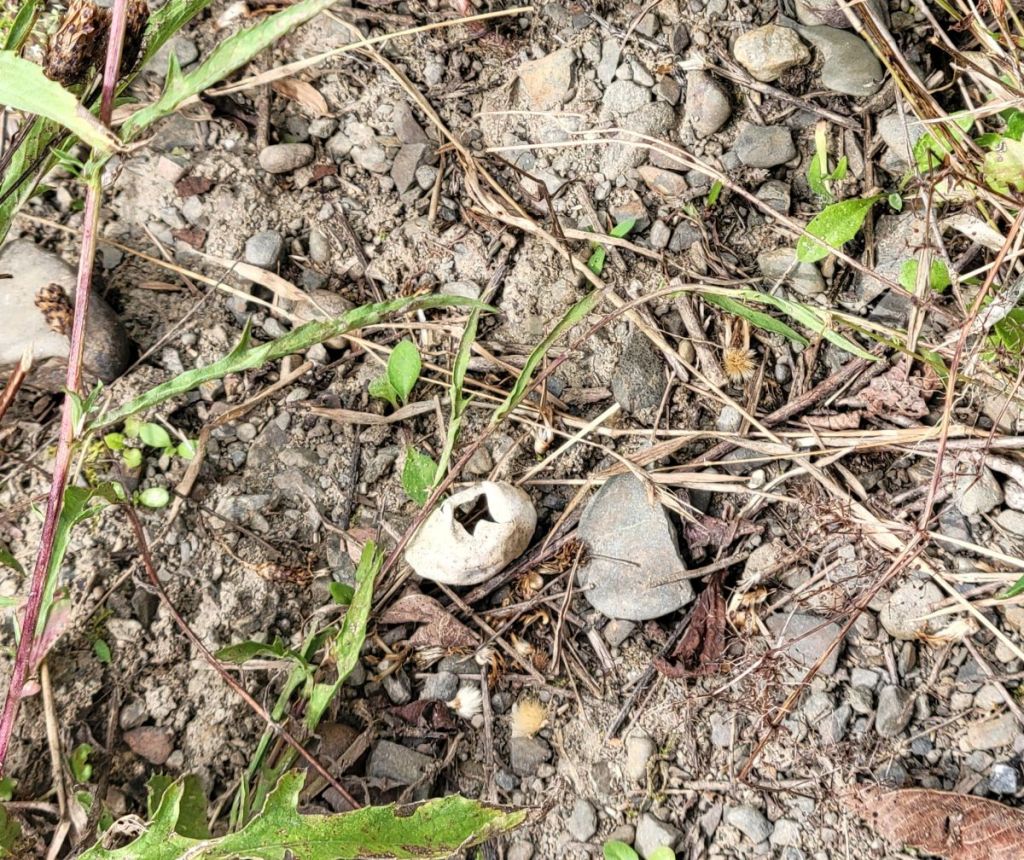
On the dry slope leading down to the stream, we also discovered a turtle egg that had been dug out of its underground nest and been preyed upon. We don’t know which turtle species had made the nest here, but the stream and adjacent floodplain forest might be home to the rare Wood Turtle.
Remnants of a turtle egg that had been preyed upon
Further down the slope and closer to the stream, the vegetation was taller and indicative of a wet meadow (#5), including Broad-leaved Cattail (Typha latifolia), Woolgrass (Scirpus cyperinus), and Tall Goldenrod (Solidago altissima). There were also large patches of the invasive Mugwort (Artemisia vulgaris),visible in the foreground of this image.
Wet meadow (#5 on map) near stream
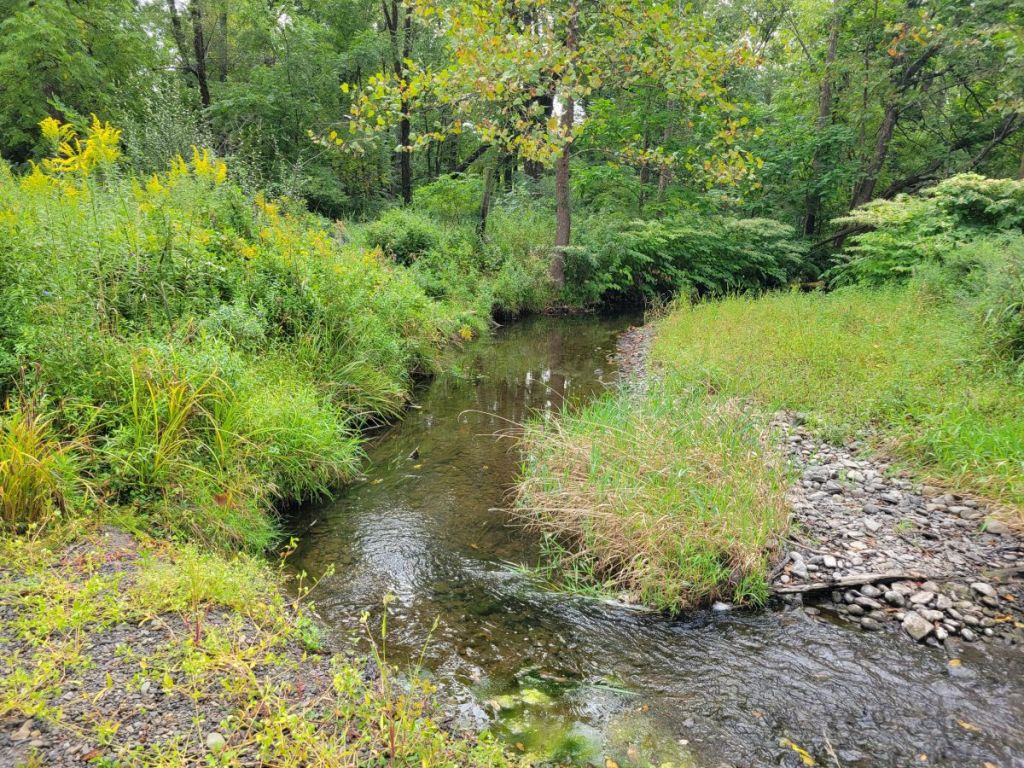
The stream had small gravel bars with a mix of native and non-native plants, including Japanese Knotweed (Reynoutria japonica), visible in the background of this image.
Stream with gravel bars
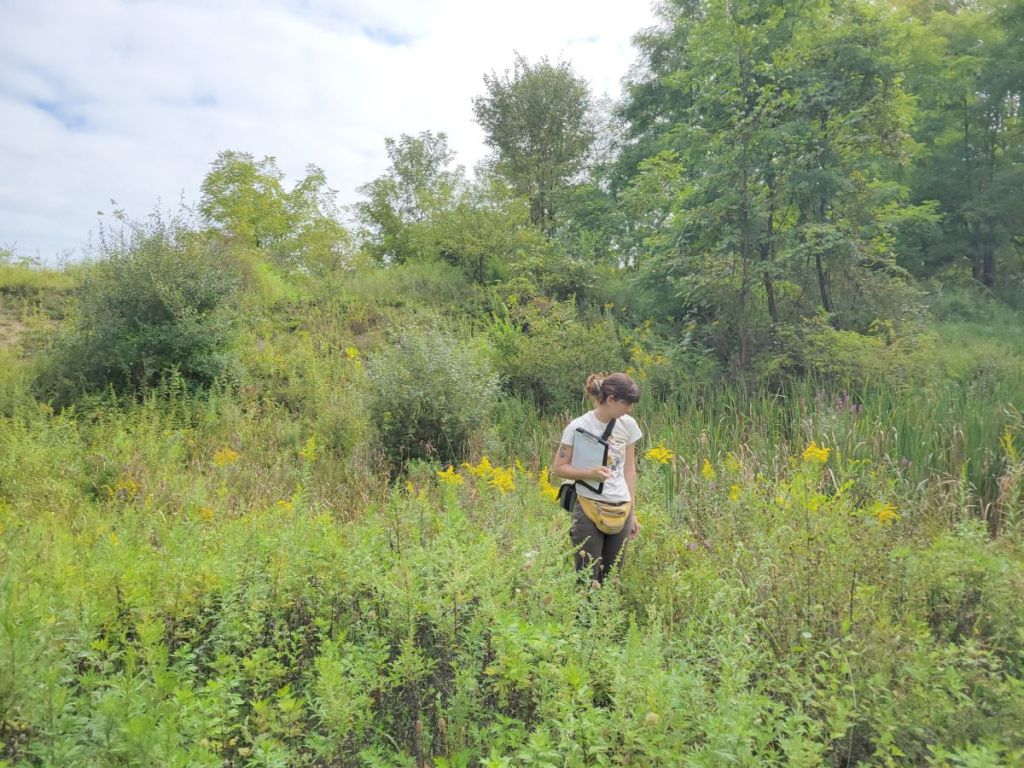
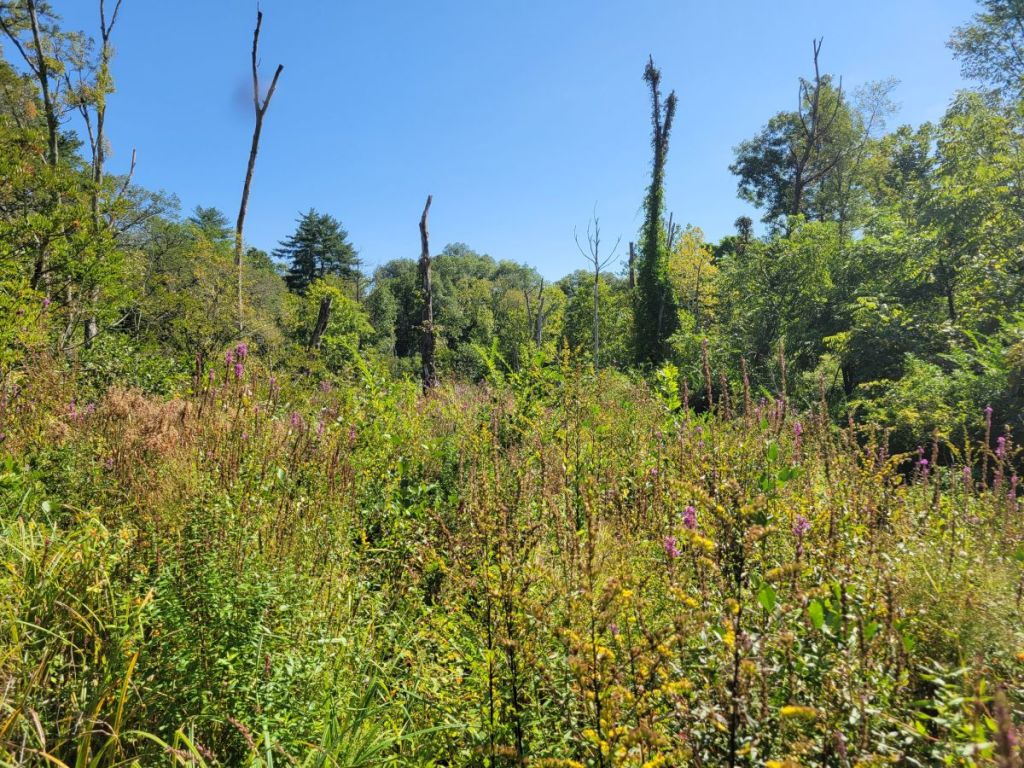
This wetland (#7), which had a mosaic of shrub swamp and wet meadow, was a bit difficult to move through, but harbored some botanical treats, including many plants of Rough-leaved Goldenrod (Solidago patula), visible in the foreground, one of our less-common goldenrods, which seems to be a good indicator for calcium-rich wetlands.
Wetland (#7 on map)
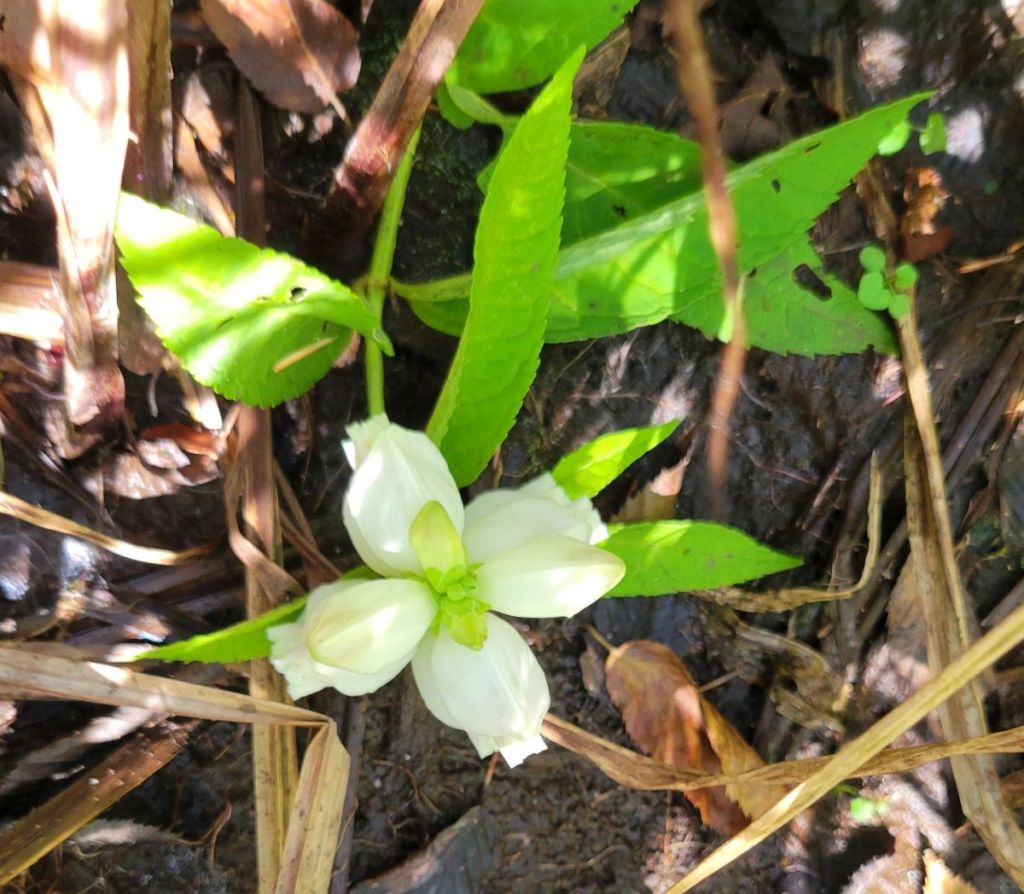
We also stumbled across the Turtlehead (Chelone glabra) in full bloom. The leaves of this species are the preferred caterpillar food of Baltimore Checkerspot butterflies.
Turtlehead (Chelone glabra)
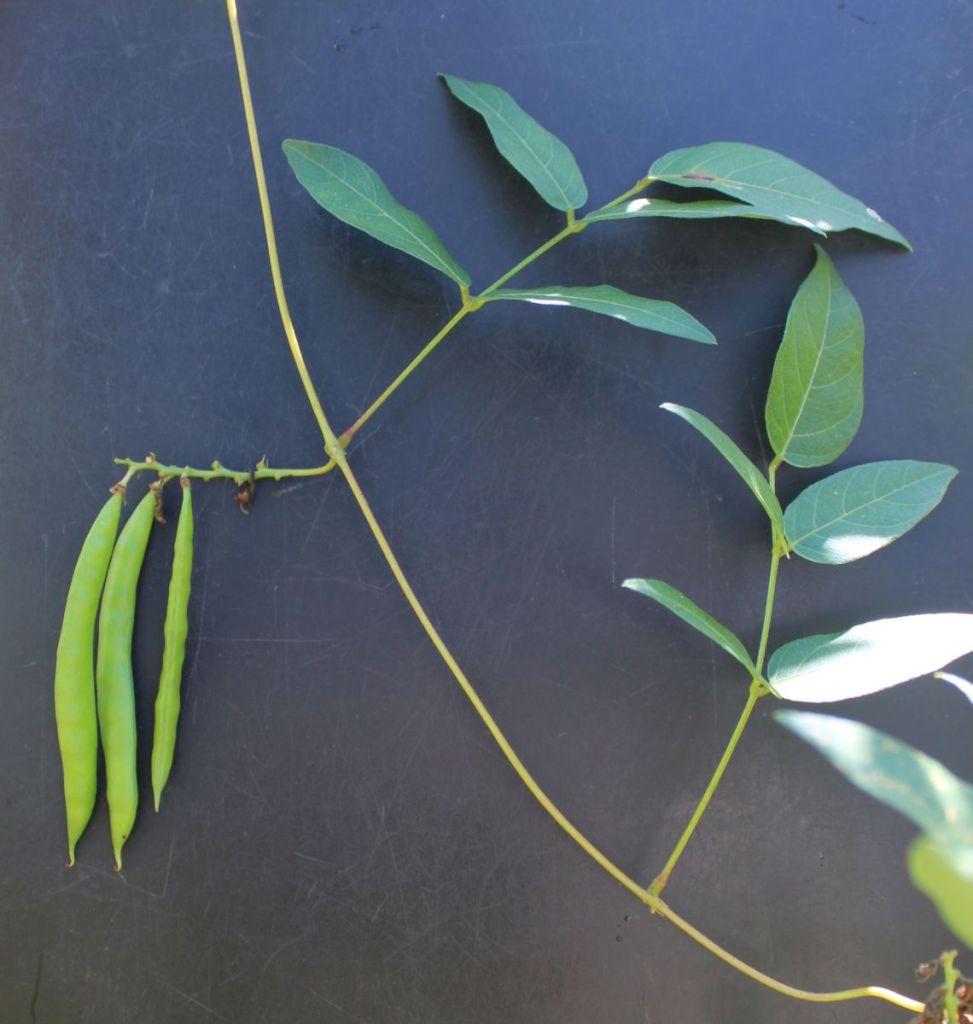
Another exciting find in the wetland was this Groundnut (Apios americana) with fruits. While we occasionally see flowers of this uncommon wetland plant in the Hudson Valley (see blog about the plants at Rose Hill Farm posted on 17 November 2024) it seems to rarely produce seeds in our region. According to Wikipedia, this species has diploid and triploid plants, with seemingly no big difference in their appearance. Only diploid plants (which tend to be more common south of our region) can produce viable seeds, while triploid plants (more common in our region and north of here) rely on vegetative reproduction.
The potato-like tubers of Groundnut are edible and have a long history of use (and likely cultivation) by native Americans.
Groundnut (Apios americana)
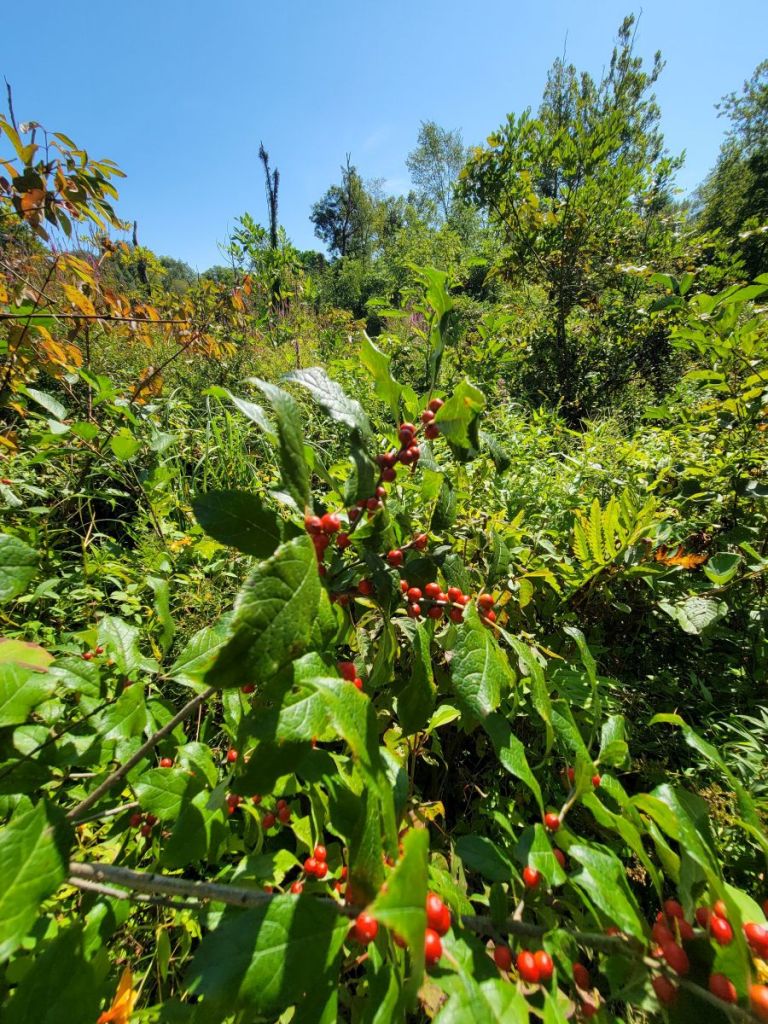
This is a more shrubby part of the wetland with a Common Winterberry (Ilex verticillata) in the foreground.
Common Winterberry (Ilex verticillata)
Quite common among the shrubs was Poison Sumac (Toxicodendron vernix), which is an upright-growing plant closely related to Poison Ivy (T. radicans) and has the same rash-inducing urushiol resin. In contrast to our other sumacs (Rhus spp.), which have red berries, the berries of Poison Sumac are white like those of Poison Ivy.
Like the Rough-leaved Goldenrod mentioned earlier, Poison Sumac is considered a good indicator for calcium-rich wetlands.
Poison Sumac (Toxicodendron vernix)
The northern edge of the wetland supported patches of Cinnamon Fern (Osmundastrum cinnamomeum), seen here as yellowish clumps, mixed with a tall, rhizomatous (non-clumping!) native sedge, Lake Sedge (Carex lacustris), and the ubiquitous, invasive Purple Loosestrife (Lythrum salicaria).
Northern edge of wetland (#7 on map)
The edge between the upland forest (#8) and the wetland (#7) is not a straight line. In this picture, a “finger” of low ground with wetland vegetation reaches between two areas of upland forest on higher ground.
Edge between the upland forest (#8 on map) and the wetland (#7 on map)
In the edge to the field (#8a) we found the before-mentioned Butternut tree.
Field edge (# 8a on map)
This field edge also had a small patch of an interesting native plant not seen anywhere else at the Hudson Valley Seed Company, nor at any of the other farms we have surveyed this summer. Flat-topped White Aster (Doellingeria umbellata) is a northern species, common in the Adirondacks and in northern New England, but we rarely see it in the Hudson Valley south of Troy.
Flat-topped White Aster (Doellingeria umbellata)
Near the buildings (#9), we noticed a small “island” of native plants in the vegetation that was otherwise dominated by common European plants.
Small “island” of native plants near buildings (#9 on map)
Early Goldenrod (Solidago juncea), Gray Goldenrod (Solidago nemoralis), and Little Bluestem (Schizachyrium scoparium) might have been seeded here or might have come in on their own. These three species often are found growing together on dry soil.
Early Goldenrod (Solidago juncea), Gray Goldenrod (S. nemoralis), and Little Bluestem (Schizachyrium scoparium)
Yellow and Giant Foxtail (Setaria pumila and S. faberi) were very common in the recently disturbed soil around the new building. Yellow Foxtail has upright, yellow-brown spikes of seeds; Giant Foxtail has light green, nodding spikes.
Yellow and Giant Foxtail (Setaria pumila and S. faberi)The seed production garden (# 10) of the Hudson Valley Seed Company.
Common Milkweed (Asclepias syriaca; big leaves in picture below) and Indian-hemp (Apocynum cannabinum; small leaves in picture below) were two native plants growing between the cultivated rows (#10). They both belong to the same plant family and have white latex. Both produce flowers that are visited by many pollinators.
Common Milkweed (Asclepias syriaca) and Indian-hemp (Apocynum cannabinum)
The strip of meadow along the north edge of the driveway (#11) had a lot of the native warm-season grass Purple-top (Tridens flavus), while the large hayfield (#13) beyond was dominated by the European cold-season grass Orchard Grass (Dactylis glomerata).
Meadows of different plant composition north of the driveway (#11 and #13 on the map)
It was nice to see that the Orchard Grass-dominated meadow (#13) had some Common Milkweed mixed in. The fields A, B, and C were all recently-tilled and bare ground during our visit. Field D was an unmowed old field dominated by goldenrods, interspersed by Purple Loosestrife.
Plenty of Common Milkweed was found in one of the meadows (#13 on the map)
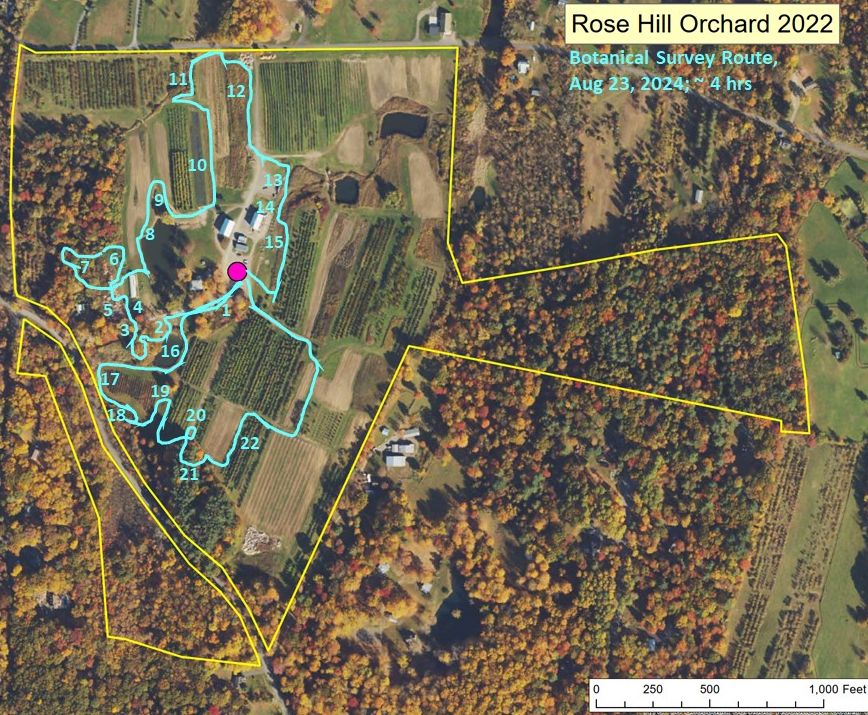
This blog shares some of the botanical observations made at Rose Hill Farm on 23 August 2024 during a 4 hour survey along the route indicated in sky blue in the aerial image below. The numbers indicate locations referenced throughout this blog posting. (Note that we shared habitat images from Rose Hill Farm in a blog posted 21 June 2024; Conrad posted about insects on 12 July 2024 and Will about birds on 16 November 2024.
Route of botanical survey on 23 August 2024
I started my walk-around from the parking area along the driveway back towards the entry gate.
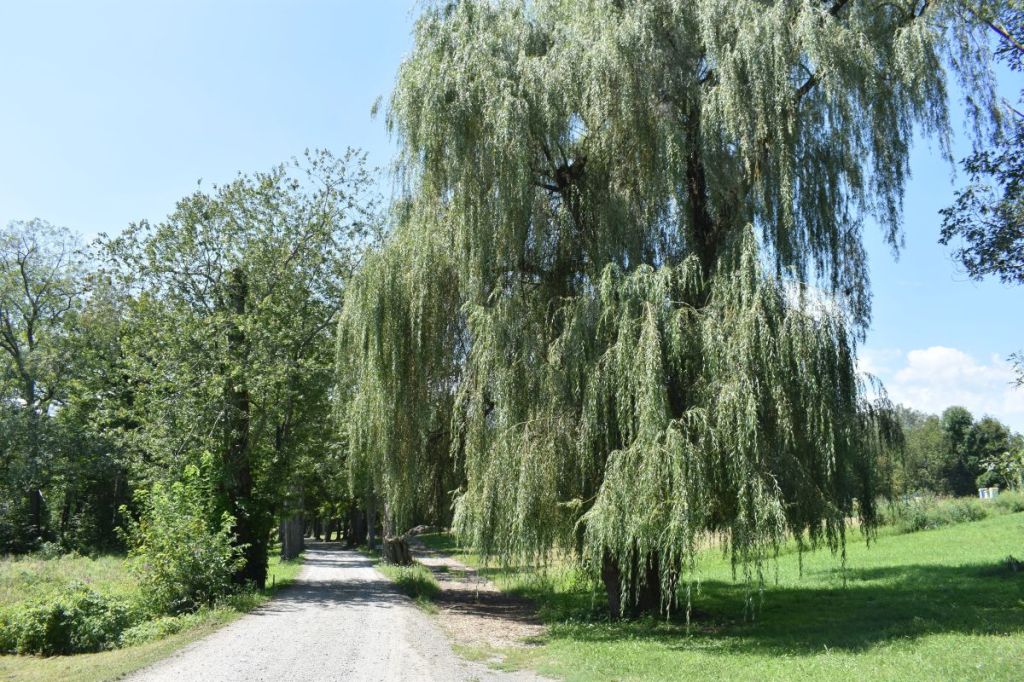
Entry ally to Rose Hill Farm with a weeping willow (Salix cf. babylonica x alba) and Red and Sugar Maples (Acer rubrum and A. saccharum) beyond (seen from #1).
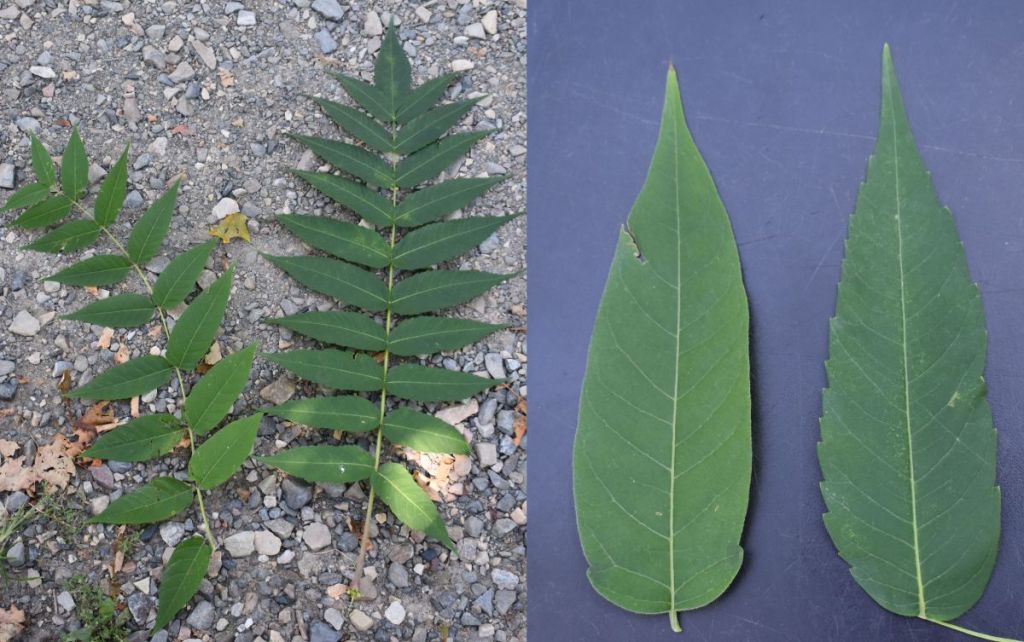
Along the driveway is a shrubland that contains both Tree-of-Heaven (Ailanthus altissima; left on both images below) and Staghorn Sumac (Rhus typhina; right on both images below). Both have pinnate, “feather-like” leaves, composed of a midrib with leaflets arranged opposite each other along both sides. However, the margin of the leaflets is toothed like a saw blade in the Sumac, while the margin of the Tree-of-Heaven leaflets is almost smooth, with just a couple of blunt teeth at the very base. Furthermore, the two species have very different smells: the Sumac has a (to me) very agreeable, aromatic, resinous smell, while the smell of Tree-of-Heaven reminds many people of rancid peanut butter.
Tree-of-Heaven (Ailanthus altissima; left on both images) and Staghorn Sumac (Rhus typhina; right on both images)
South of the driveway is a small wet meadow (#2) that supports a diverse plant community, composed of native and non-native species, such as Smooth Goldenrod (Solidago gigantea; yellow flowers) and Purple Loosestrife (Lythrum salicaria; deep pink flowers), respectively. I quickly tallied a total of 40 (!) species in this very small meadow.
Species-rich wet meadow south of the driveway (#2)
Just west of this wet meadow, I found a very small patch of forest on and surrounding a rock outcrop (#3). At the forest edge, there were several individuals of two native shrub species not seen anywhere else during my survey at Rose Hill (or any of the other eight farms surveyed this summer). This image shows Prickly Ash (Zanthoxylum americanum), which has pinnate leaves and thorny branches. Prickly Ash is one of the host plants for the caterpillars of Giant Swallowtail butterflies. Conrad shared a picture of a Giant Swallowtail he had seen at Rose Hill in his blog from 12 July 2024, but we don’t know yet, if they are actually successfully reproducing here or if an occasional individual flies in from further south.
Prickly Ash (Zanthoxylum americanum; #3)
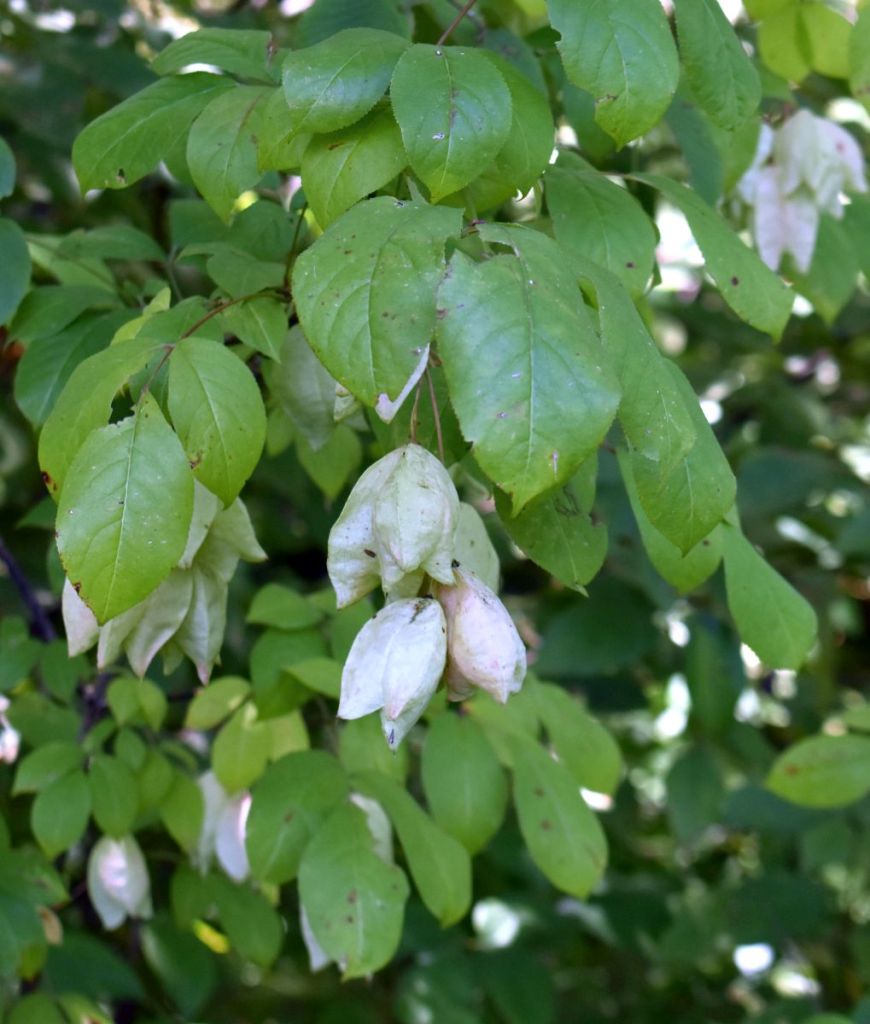
Bladdernut (Staphylea trifolia), which grew right next to the Prickly Ash, has leaves composed of three leaflets (similar to clovers) and unique, three-chambered, bladder-like fruits. Both of these species tend to occur in calcium-rich soils.
Bladdernut (Staphylea trifolia; #3)
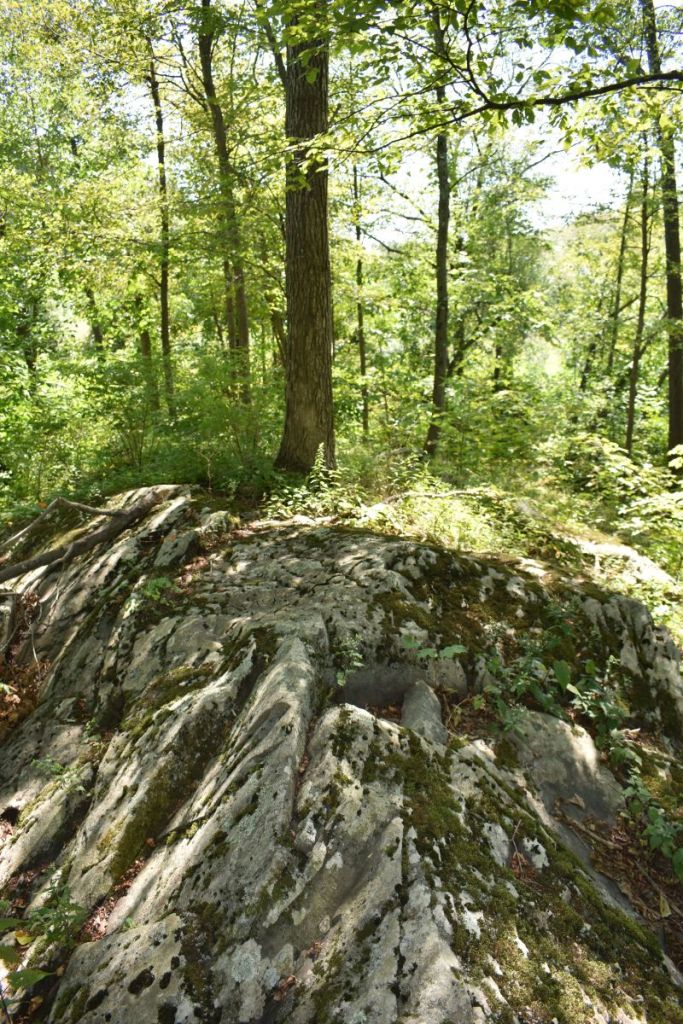
I am no geologist, but the outcrop (#3) might well be some sort of limestone or related rock that is rich in calcium.
Suspected limestone (or other calcium-rich rock) outcrop (#3)
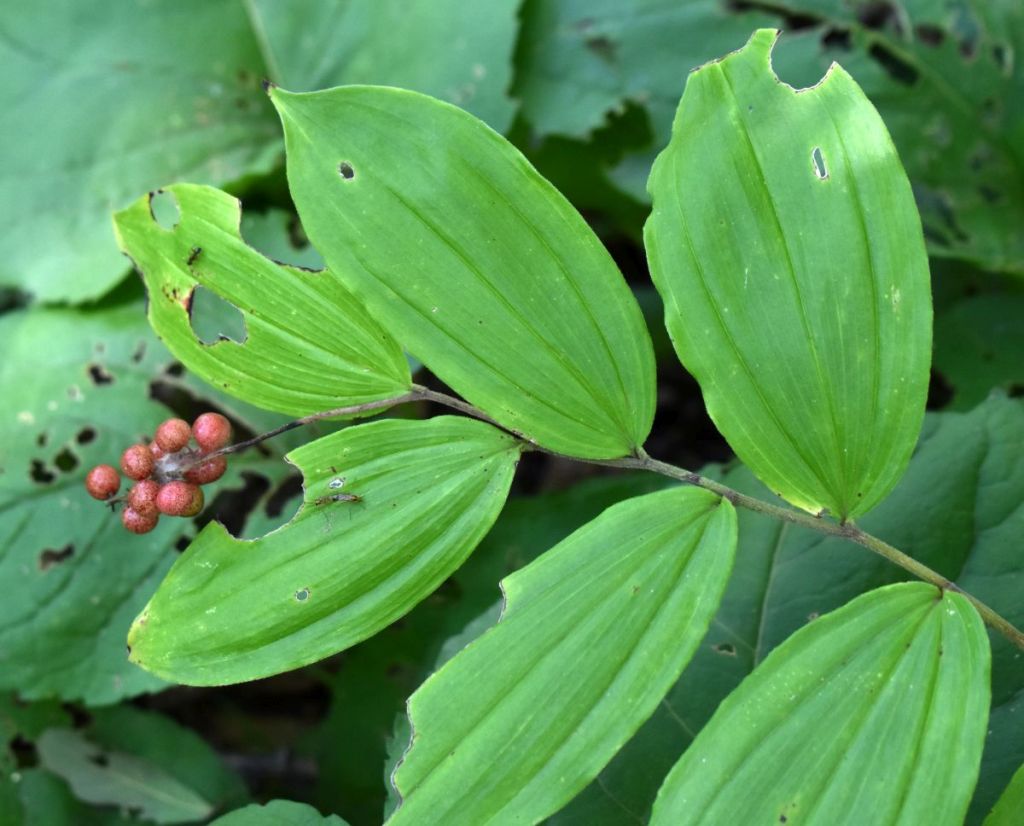
False Solomon’s-seal (Maianthemum racemosum) also grew at the base of the rock, which was surrounded by large trees, including Sugar Maple, American Basswood, Red Oak, and American Elm.
False Solomon’s-seal (Maianthemum racemosum; #3)
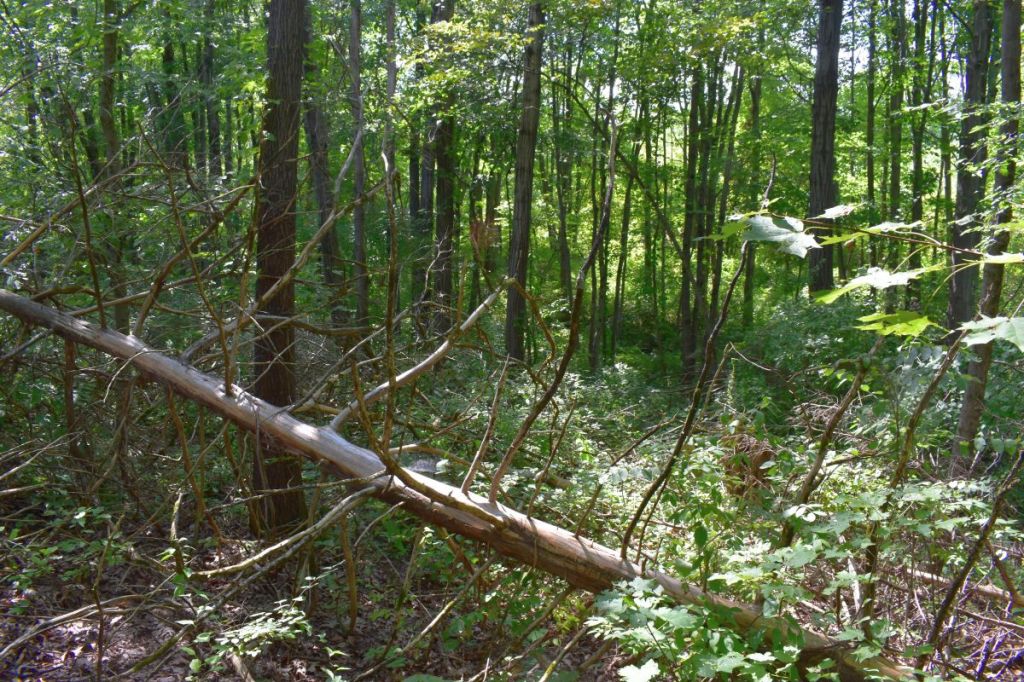
I found a very different, much younger forest north of the wood chip piles (#7). It still had the remnants of Red Cedar (Juniperus virginiana), which are early-successional trees that often grow on abandoned farm fields or pastures. As the historical aerial photo in Conrad’s blog from 12 July 2024 shows, this area used to be orchard 80 years ago.
Red Cedars tend to die naturally as they get shaded out by taller trees. However, the Red Cedars in this forest might have been intentionally cut, presumably to avoid serving as hosts for the Cedar-Apple Rust (Gymnosporangium juniperi-virginianae), a fungal pathogen of apples, that needs two hosts to complete its life cycle, a Red Cedar and an apple or hawthorn.
Fallen or felled Red Cedar in young forest (#7)
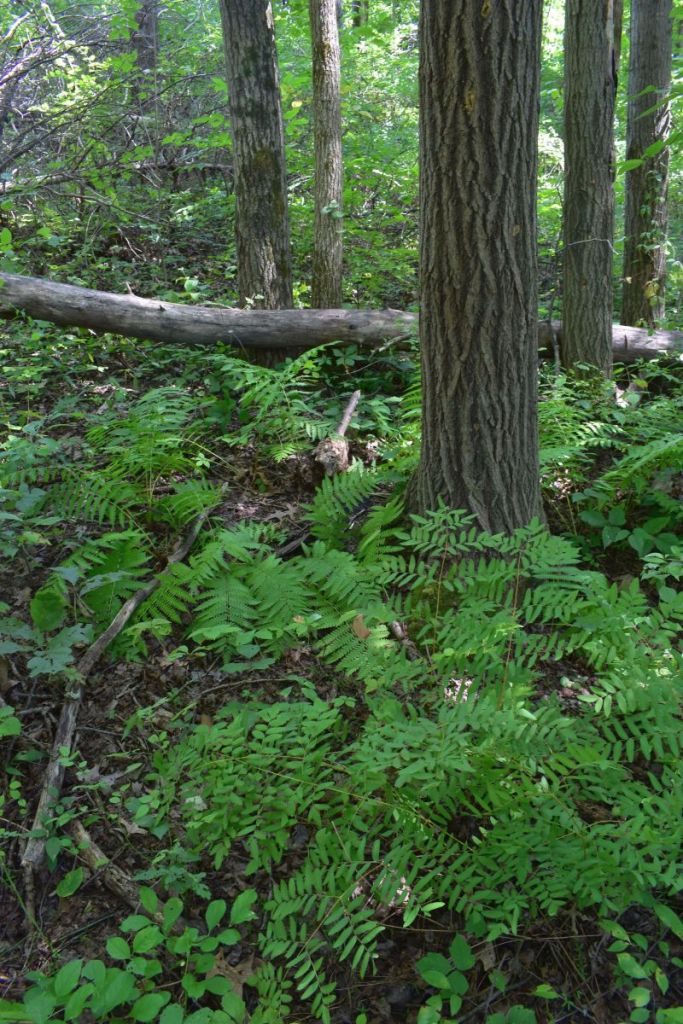
Lower down in the forest along a small stream, ferns such as Royal Fern (Osmunda regalis; bottom right in the image) and Cinnamon Fern (Osmundastrum cinnamomeum; center of image) grew lush in the moist soil.
Royal Fern (Osmunda regalis) and Cinnamon Fern (Osmundastrum cinnamomeum) in young forest (#7) by stream
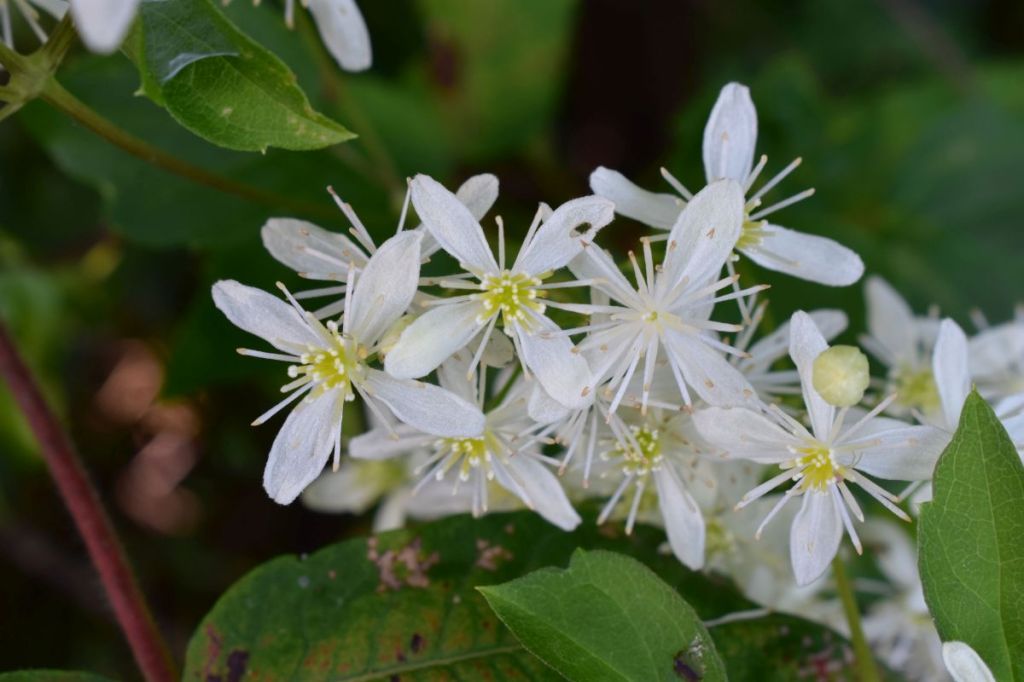
Back up along the forest edge (# 6), Virgin’s-bower (Clematis virginiana), which is a native vine whose stems are not woody and die back each winter, were in full bloom.
Virgin’s-bower (Clematis virginiana; #6)
The pond by the farm house (#8) had a narrow band of unmowed vegetation, which harbored some native plant species not seen anywhere else on the farm during our survey.
Pond (#8) with narrow band of unmowed vegetation
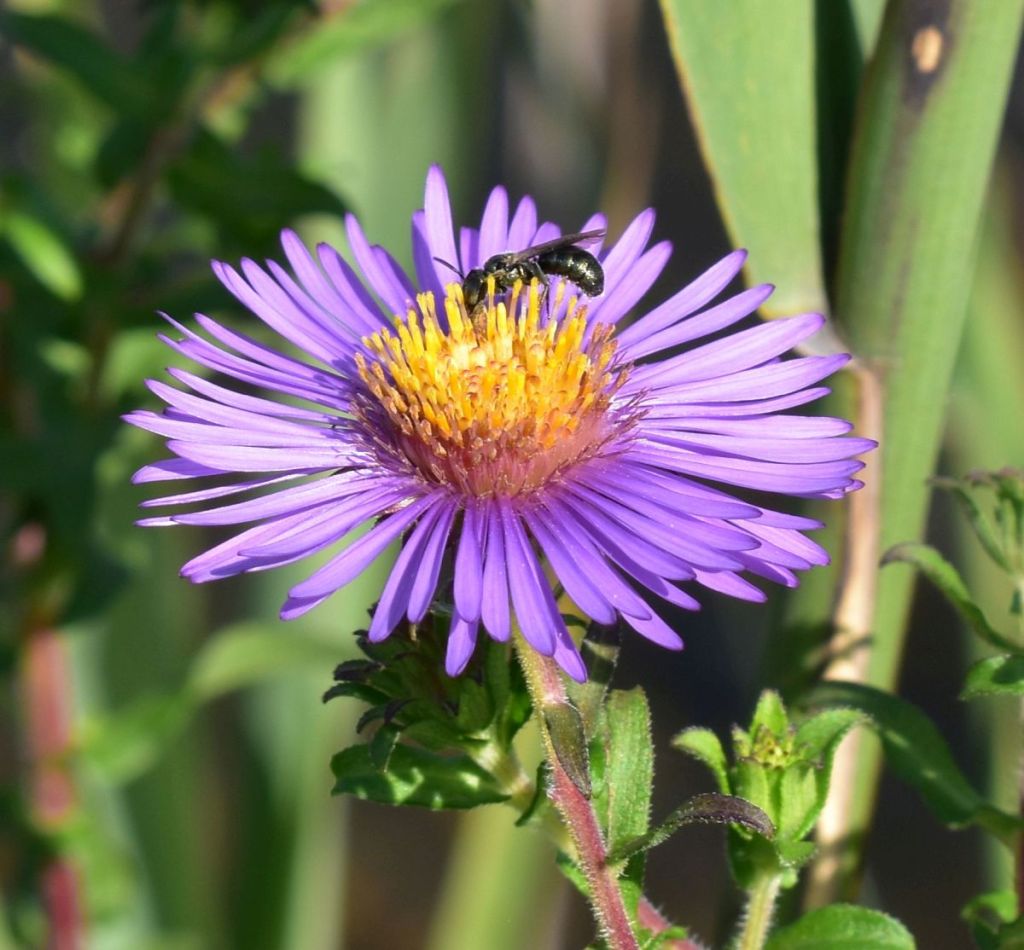
During my walk around Rose Hill Farm, I noticed New England Aster (Symphyotrichum novae-angliae) only at the shore of this pond. It was visited by a native bee.
New England Aster (Symphyotrichum novae-angliae; #8)
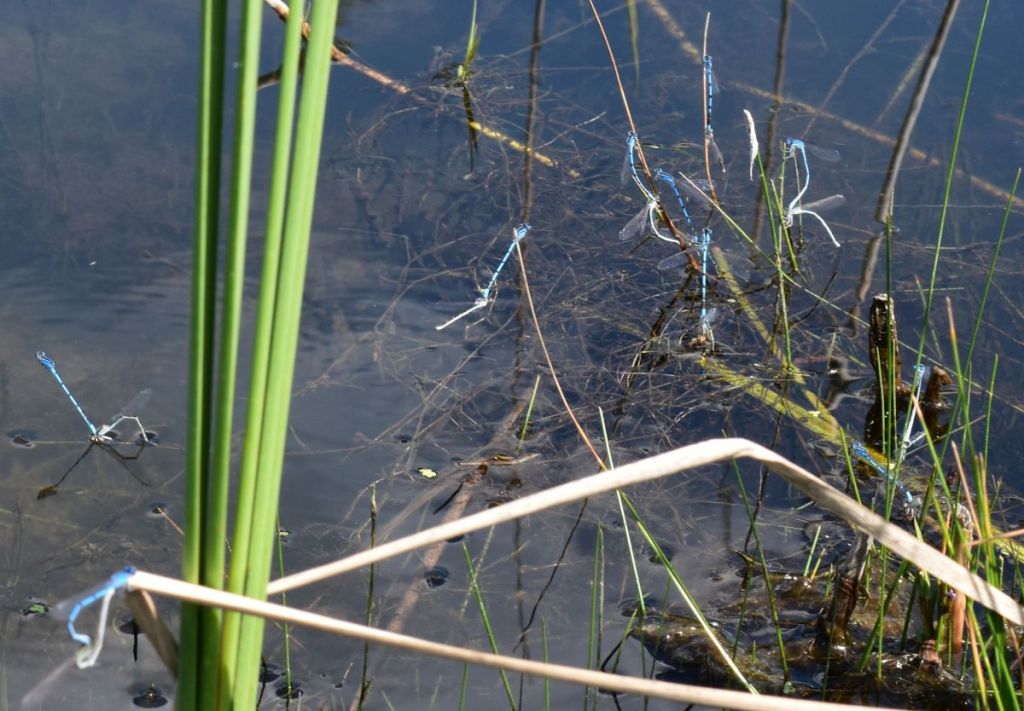
The damselflies were mating and laying their eggs in the pond. These little guys greatly benefit from the emergent vegetation which provides perches. They also benefit from aquatic vegetation in the pond, because it provides habitat for their aquatic larvae. Aquatic vegetation is especially important for dragonfly and damselfly larvae, when predatory fish or amphibians also live in the pond.
Mating damselflies (#8)
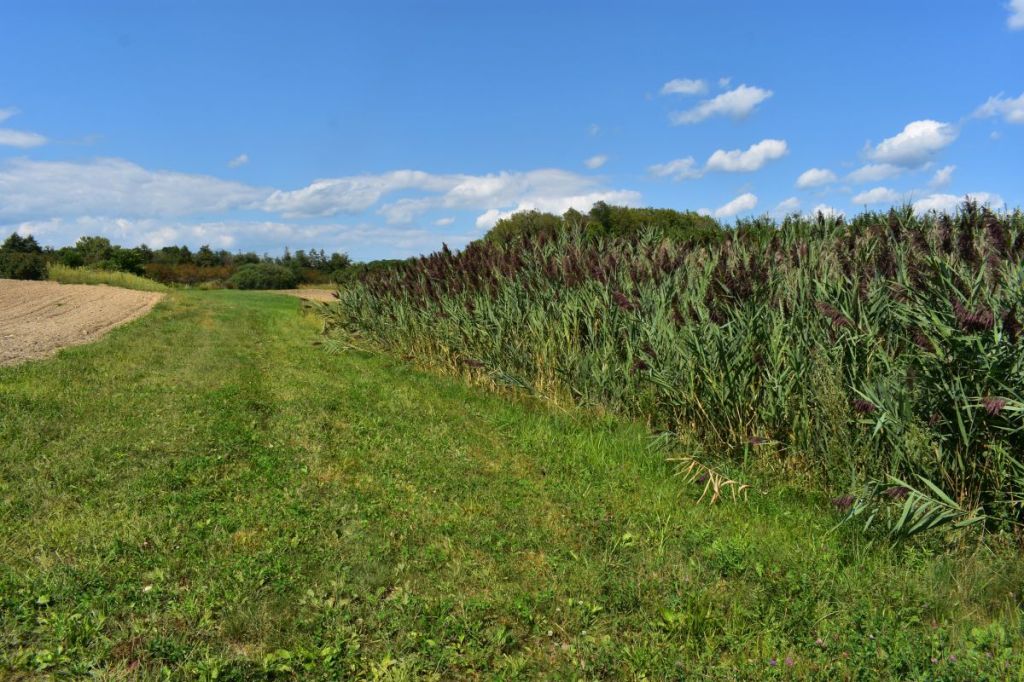
A big patch of the invasive Common Reed (Phragmites australis) grew in a swale (#9) draining into the pond.
Common Reed (Phragmites australis) in a swale (#9)
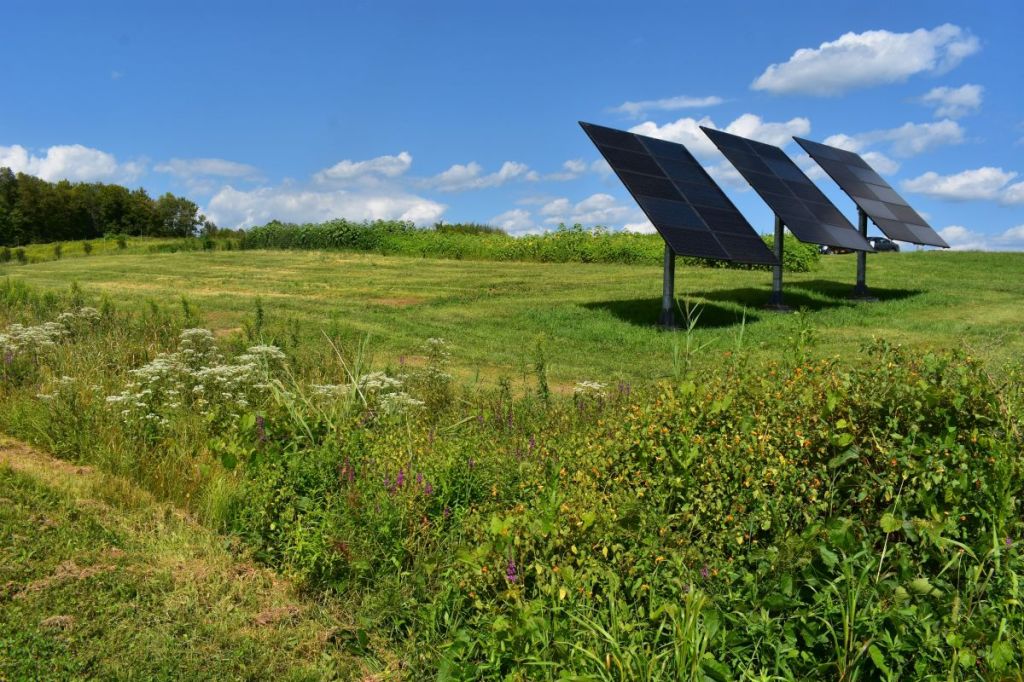
Another swale (#10) near the solar panels had unmowed wet meadow vegetation composed of many native species, including Common Boneset (Eupatorium perfoliatum; white flowers) and Spotted Jewelweed (Impatiens capensis; orange flowers), which were buzzing with insects.
Unmowed wet meadow in swale (#10)
The upper end of the same swale (#10) had a more diverse plant community, including native cattails (Typha sp.), Early Goldenrod (Solidago juncea), Awl Aster (Symphyotrichum pilosum var. pilosum), and Black-eyed Susan (Rudbeckia hirta).
Upper part of wet meadow in swale (#10)
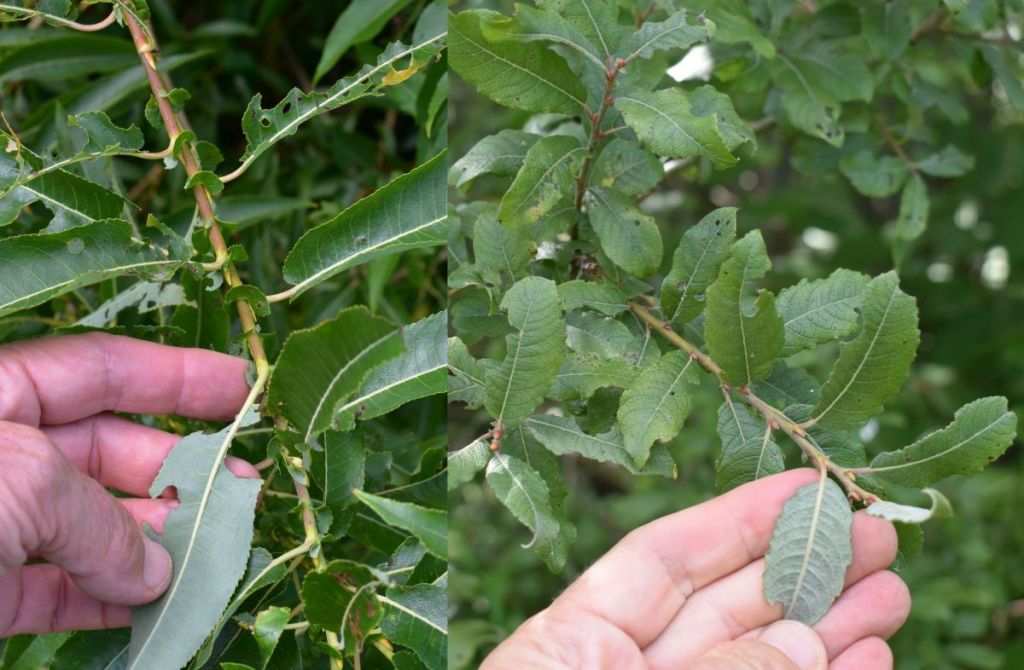
Near the fenceline, I encountered a shrub thicket (#11) with two different species of willow, Heart-leaved Willow (Salix eriocephala; left) and Bebb’s Willow (Salix bebbiana; right). Both of these willows have catkins that serve as important early season pollen sources for bees.
Heart-leaved Willow (Salix eriocephala; left) and Bebb’s Willow (Salix bebbiana; right) in shrub swamp (#11)
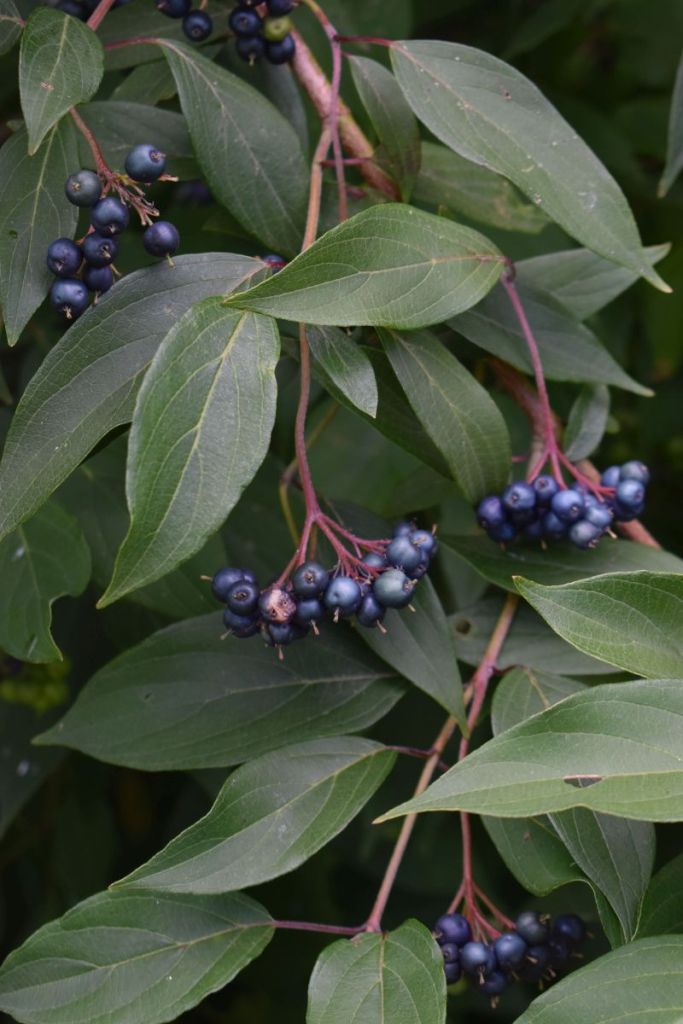
The thicket also had a Silky Dogwood (Cornus amomum), with its metallic-blue fruits displayed on reddish branches.
Silky Dogwood (Cornus amomum; #11)
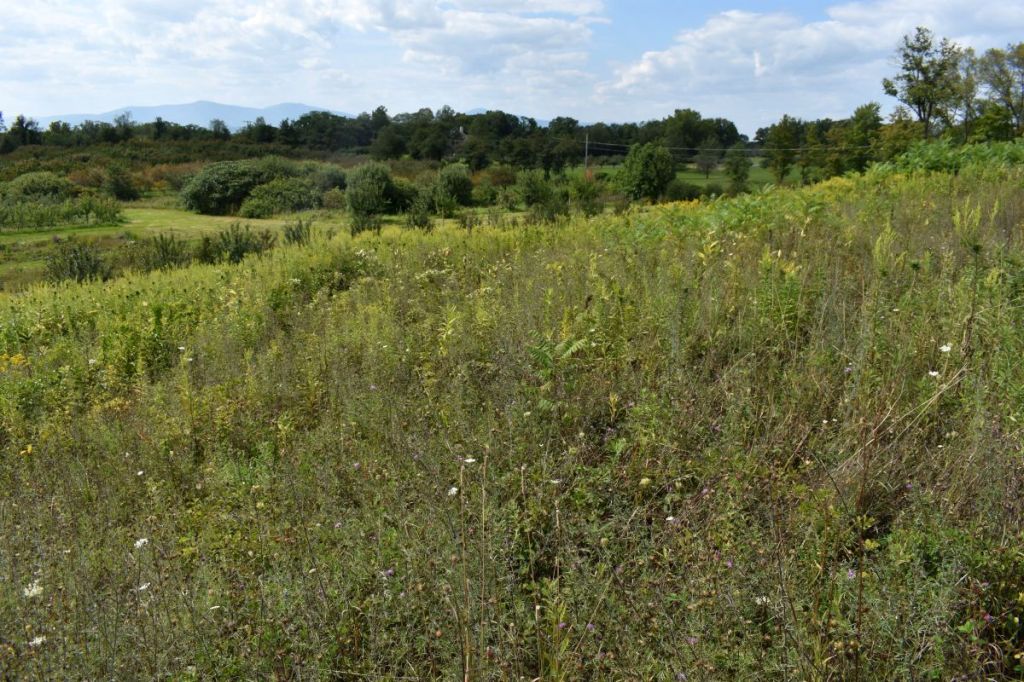
Circling back towards the buildings, I passed by a dry hillside which had been left unmowed (#12). The vegetation was a mix of common native species, including several goldenrods (Smooth, Tall, and Early) and Common Milkweed (Asclepias syriaca), with non-native species, including Spotted Knapweed (Centaurea jacea) and Wild Carrot (Daucus carota).
Unmowed dry hillside (#12)with a mix of common native and non-native wildflowers
Another unmowed, dry slope east of the parking lot (#15) had several less common native plants, including Purpletop (Tridens flavus), Purple Love Grass (Eragrostis spectabilis), and Whorled Milkwort (Polygala verticillata). I did not see any of these species anywhere else at Rose Hill Farm.
Another unmowed dry hillside (#15)with some unusual native plant species
The shore of the pond (# 16) south of the driveway had a broad band of unmowed, diverse vegetation including the uncommon native Swamp Rose (Rosa palustris), which we didn’t observe anywhere else on Rose Hill or at any of the other farms surveyed this season. Note also some “blonde” clumps of the native warm-season grass Little Bluestem (Schizachyrium scoparium), usually found in dry soils.
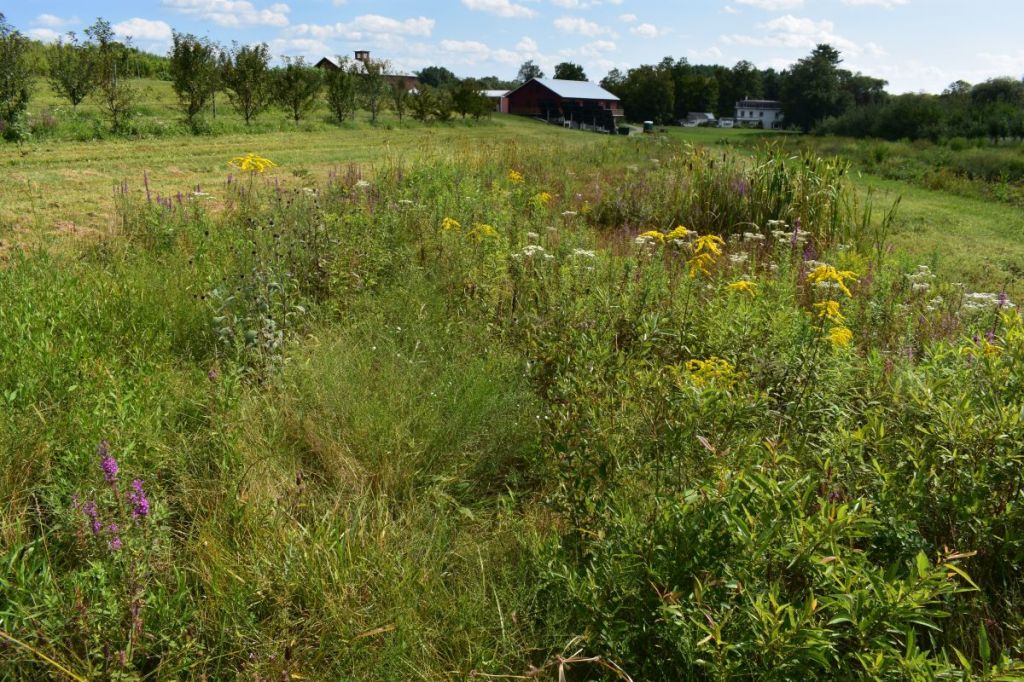
Band of unmowed shoreline of a pond (#16)
Along the south fence, south of the Blueberries, I was excited to find a beautiful and diverse wet meadow (# 18). Here, you see the native Spotted Joe-Pye-weed (Eutrochium maculatum; light pink) mix with the invasive Purple Loosestrife (Lythrum salicaria; dark pink). However, a closer look revealed many less conspicuous native wetland plants that we did not see anywhere else at Rose Hill. For example, Conrad included images of Yellow Stargrass (Hypoxis hirsuta) and Square-stemmed Monkeyflower (Mimulus ringens) from this wet meadow in his insect post on 12 July 2024
Diverse, unmowed wet meadow (# 18)
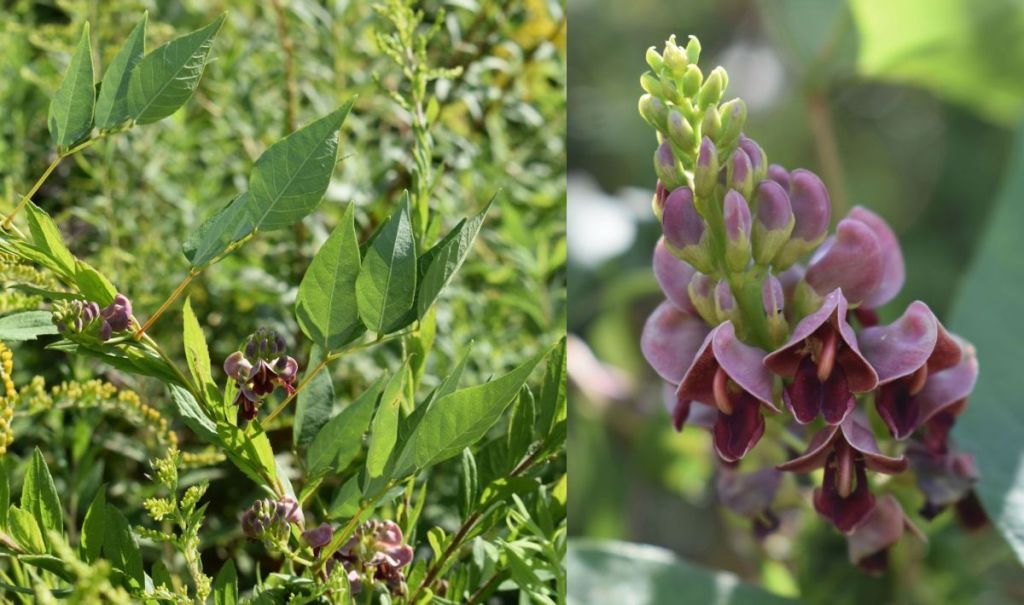
Another plant unique to this area was Groundnut (Apios americana), a native vine in the pea family which is occasionally found in wet, open areas. It has pinnate leaves with five leaflets and dense conical clusters of pea-shaped flowers of a very unusual, pink/purple/red-brown color. Most plants of this species in our region never produce fruits (but see our blog on the Hudson Valley Seed Company for an exception and explanation). The tubers of this species are edible and Native Americans seem to have sometimes cultivated Groundnut.
Groundnut (Apios americana; #18)
Another was Virginia Mountain-mint (Pycnanthemum virginianum), which is an uncommon native mint much visited by a large variety of pollinators.
Virginia Mountain-mint (Pycnanthemum virginianum; #18)
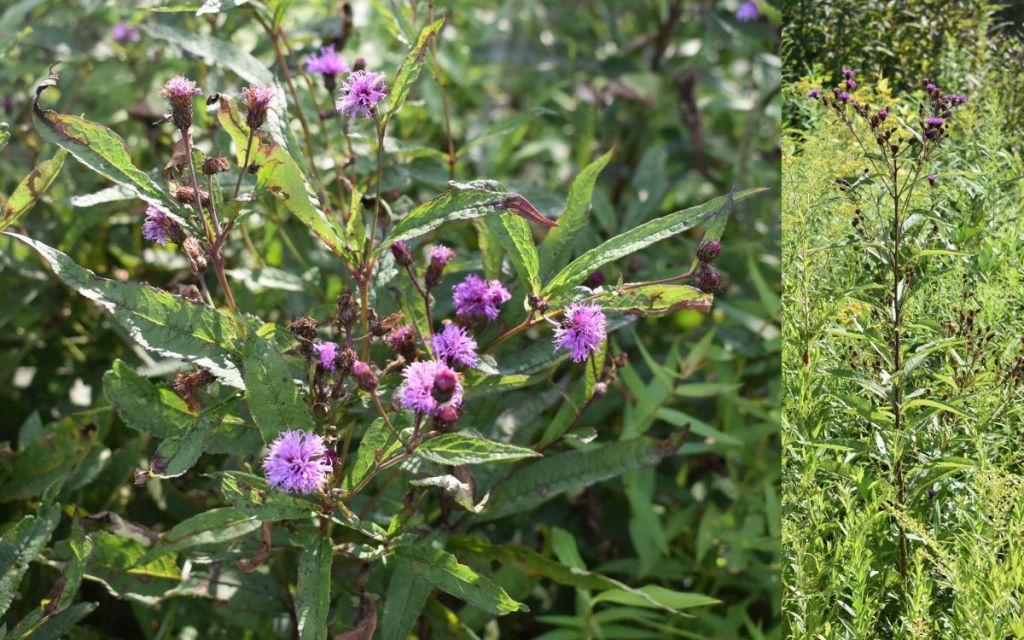
Finally, New York Ironweed (Vernonia noveboracensis) was also unique to this wet meadow. It is a member of the aster family, which seems to be more common further south in the Hudson Valley and is rarely found growing wild in our region.
New York Ironweed (Vernonia noveboracensis; #18)
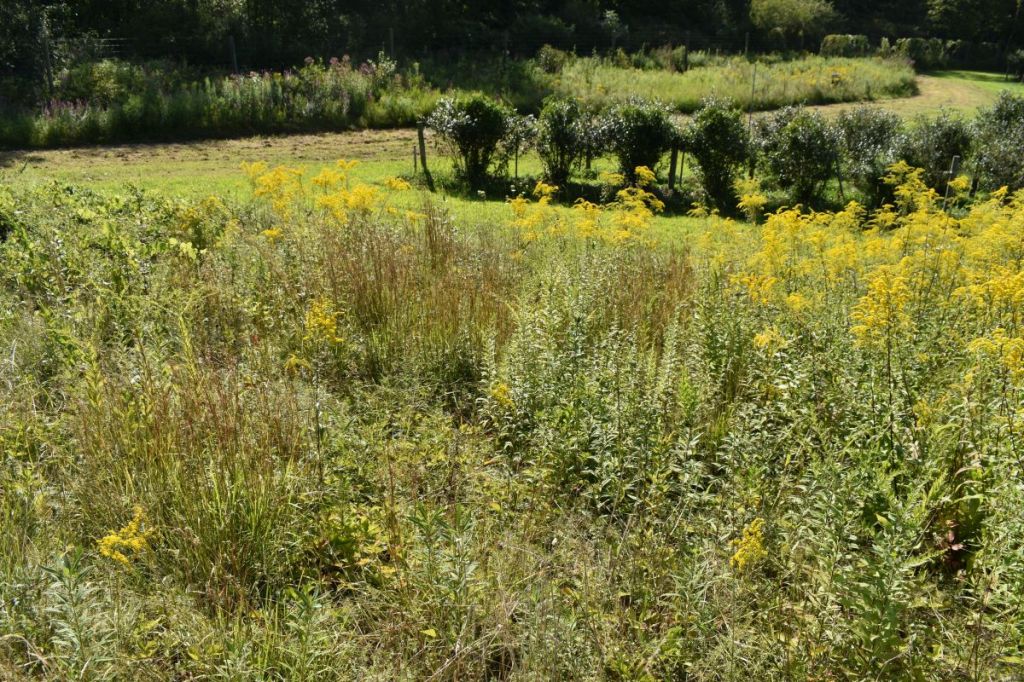
East of the Blueberries was another dry slope (# 19) with unmowed vegetation. It was fun to see how each of these unmowed slopes supported a slightly different vegetation. This one had a lot of Little Bluestem (Schizachyrium scoparium) and Early Goldenrod (Solidago juncea), but also a variety of other native and non-native plant species.
Another example of an unmowed dry slope (#19) with its own unique plant composition
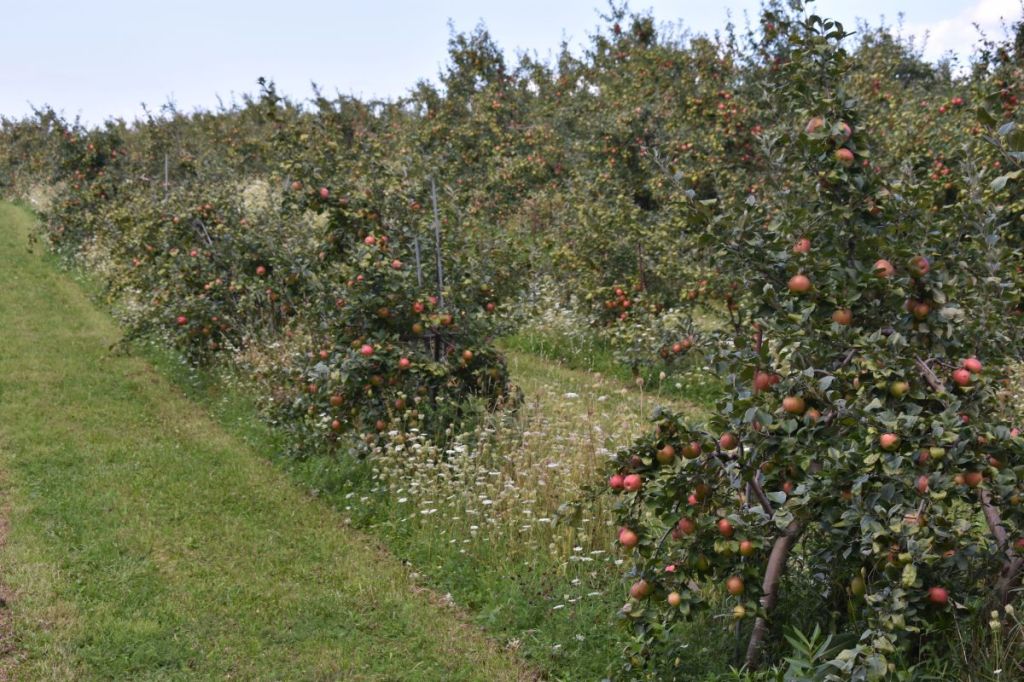
The apples nearby (# 20) were getting ripe and the unmowed strips of vegetation in the tree rows were still alive with flowers, here mostly Wild Carrot (Daucus carota).
Unmowed and flower-rich strips of vegetation within the rows of orchard trees(#20)
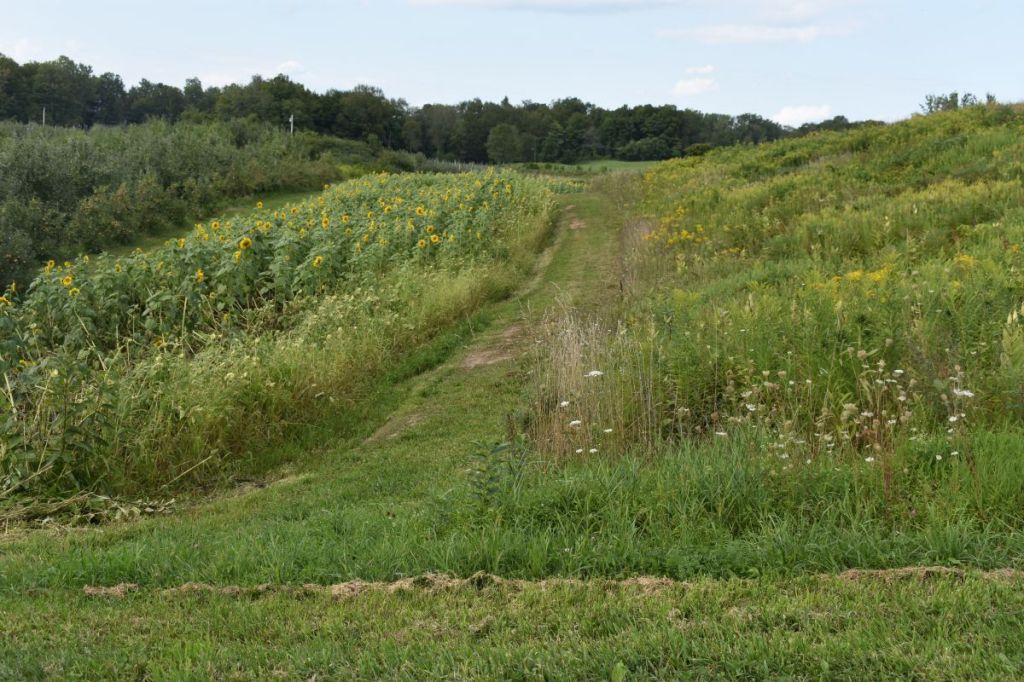
Finally, another unmowed slope with plenty of native goldenrods and European weeds in bloom, next to a field of seeded Sunflowers. With several large areas throughout the orchard left unmowed and some annual flower plantings, floral resources for pollinators (the Honey Bees kept on site, as well as wild native bees), as well as other insects, should be available throughout the season. And Will reminds us in his post on the birds of Rose Hill Farm (16 November 2024) just how important these scruffy-looking, “feral” areas throughout the farm are for our feathered friends.
A last example of a flower-rich, unmowed dry slope (#21)


















 Farmer-Ecologist Research Circle