Plants of Treadlight Farm

by Claudia

I visited Treadlight Farm in Kerhonkson on 4th Sept. 2024 to survey the wild-growing plants inside the fenced area outlined in yellow on the aerial photo below. The sky blue line indicates the approximate route of my four-hour walk-around. Numbers refer to locations mentioned below.
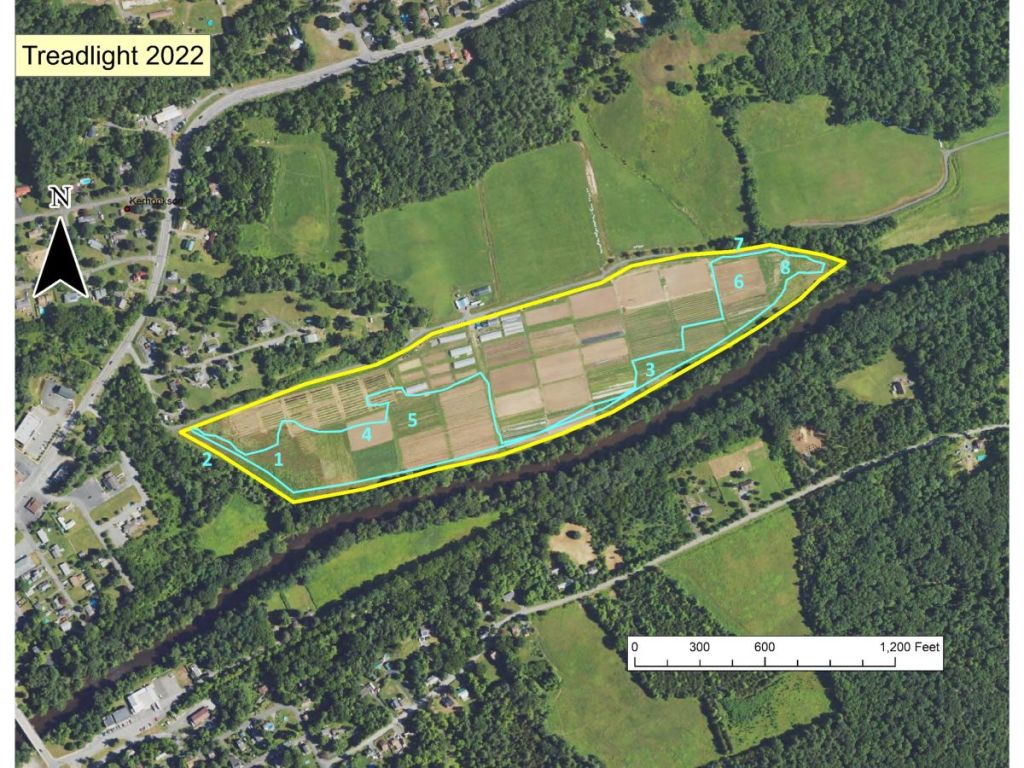
Aerial photo of Treadlight Farm (surrounded by deer fence indicated in yellow); the sky blue line is the approximate route taken during the botany survey, numbers refer to locations mentioned below

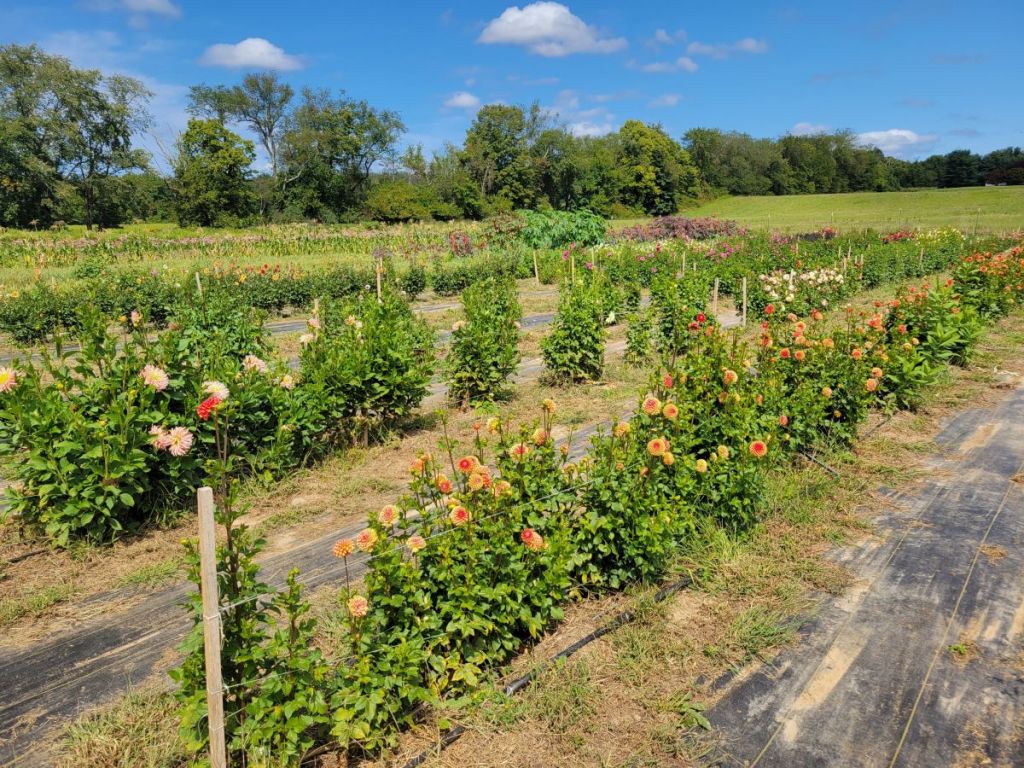
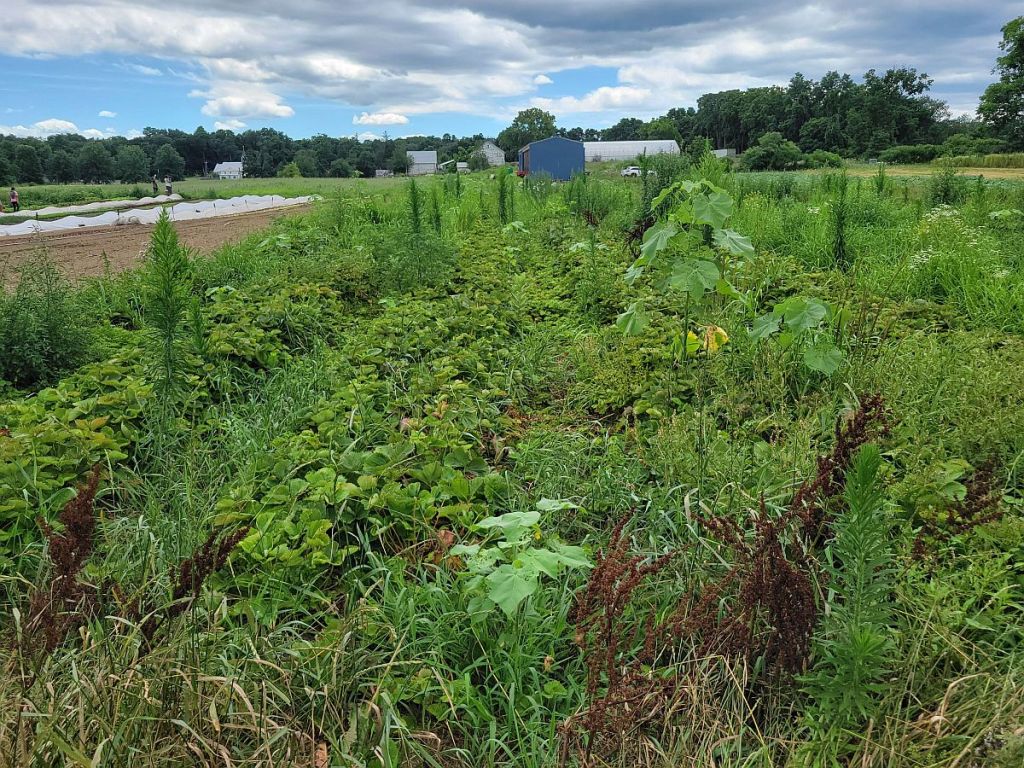
As Conrad has already described in the last posting, Treadlight Farm mainly grows cut-flowers and also produces plugs (mostly of native wildflowers). The farm operates on leased land that has a long history of farming and few semi-wild habitats are found within the farm’s fence. Not surprisingly, the wild-growing plants in the flower beds were largely the usual cast of regionally-common, annual, tilled-field weeds, including Common Ragweed, Daisy Fleabane, Horseweed, Lamb’s-quarters, Crabgrass, and foxtails.

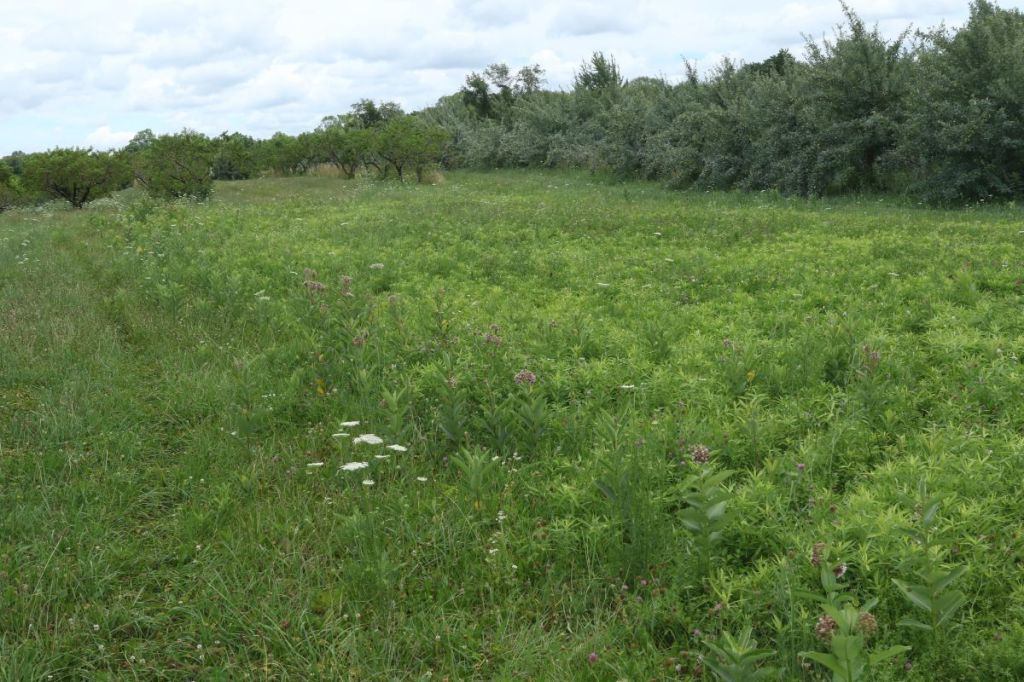
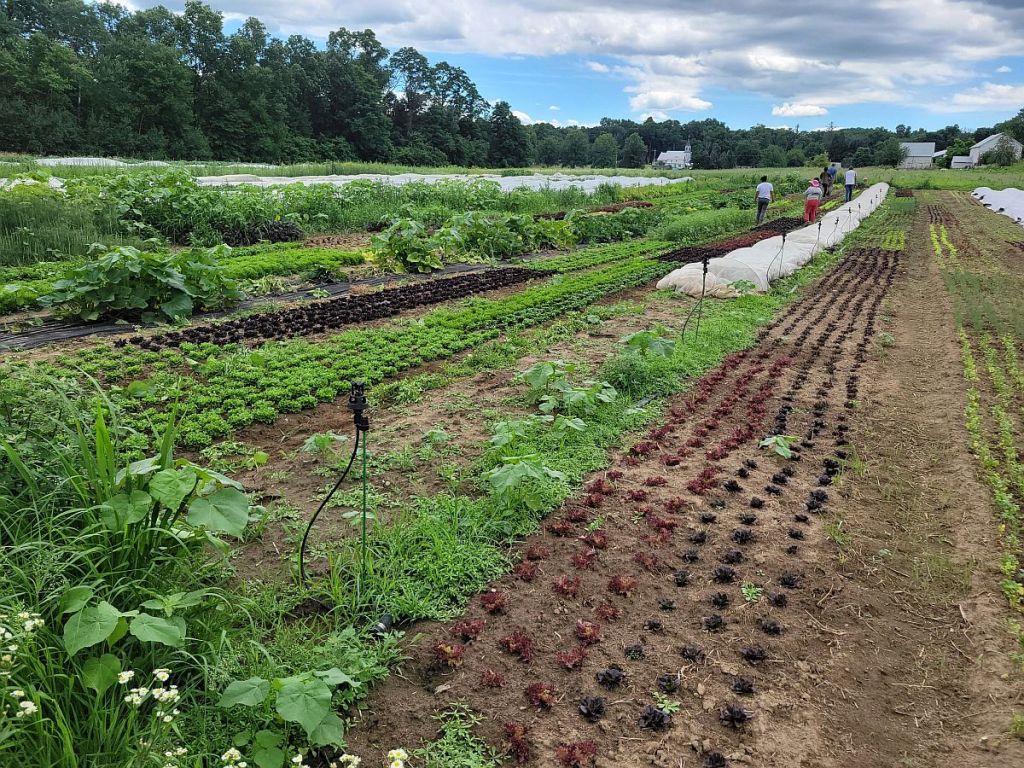
One of the cut-flower beds at Treadlight Farm (looking west from #6)

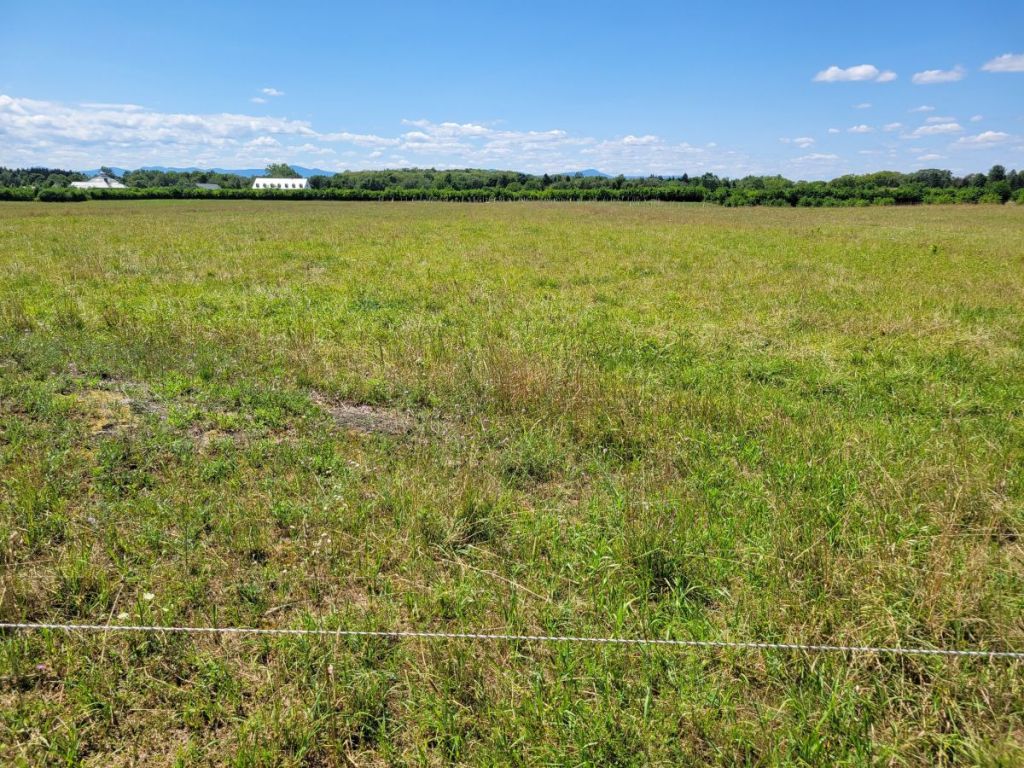
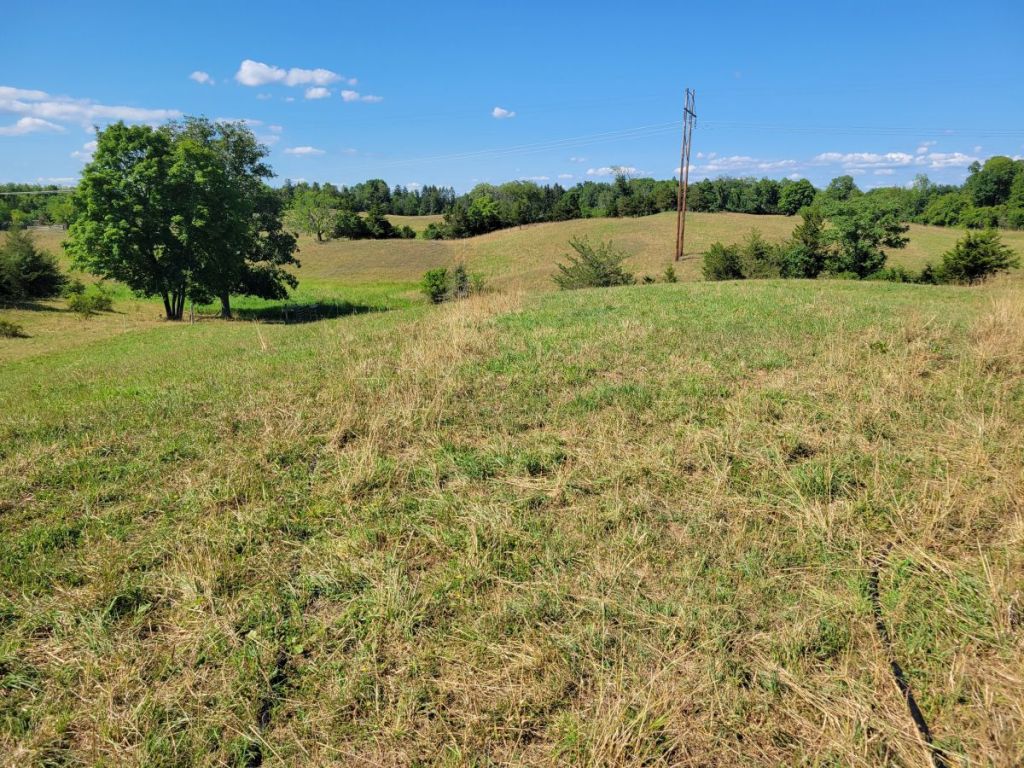
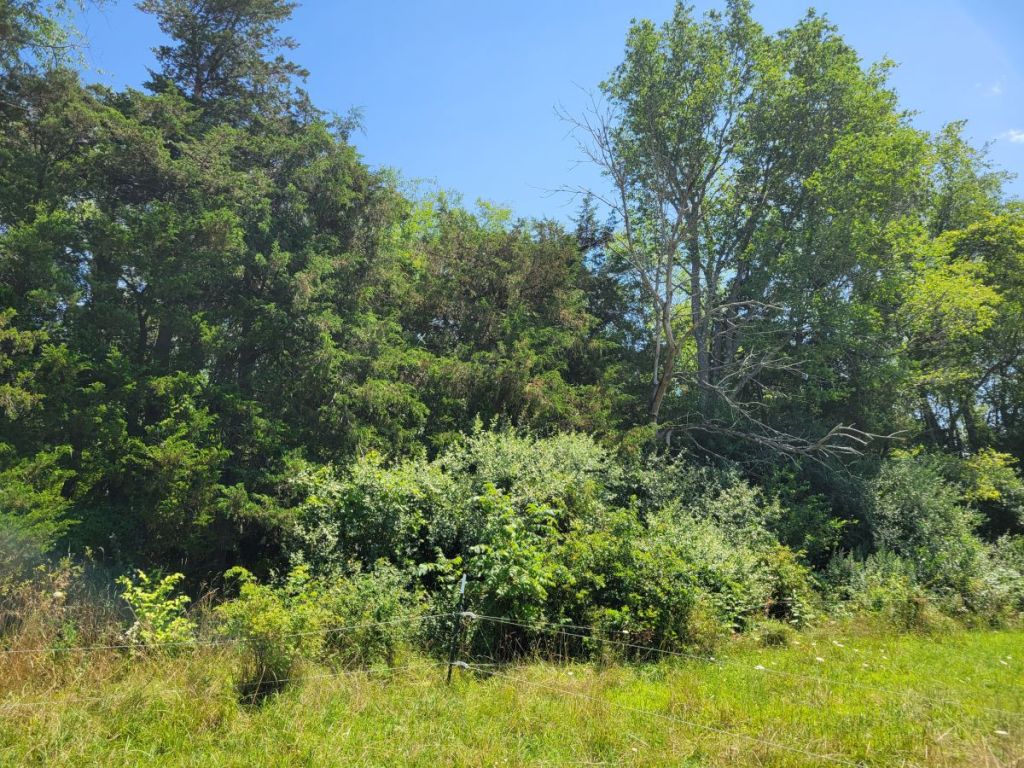
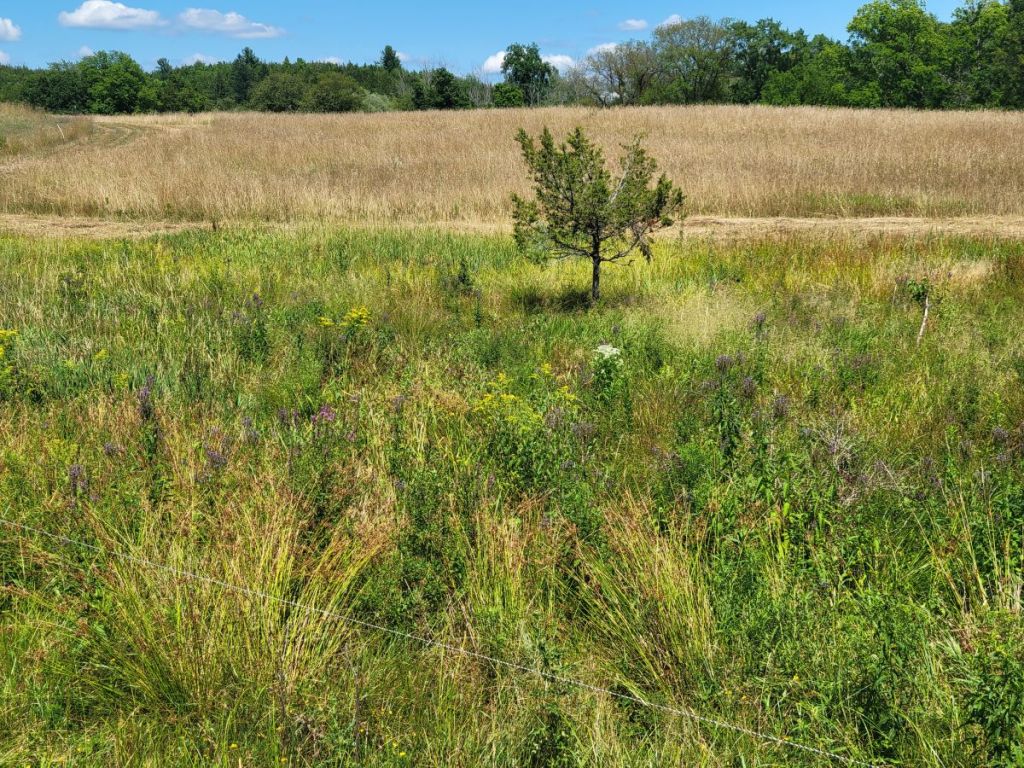
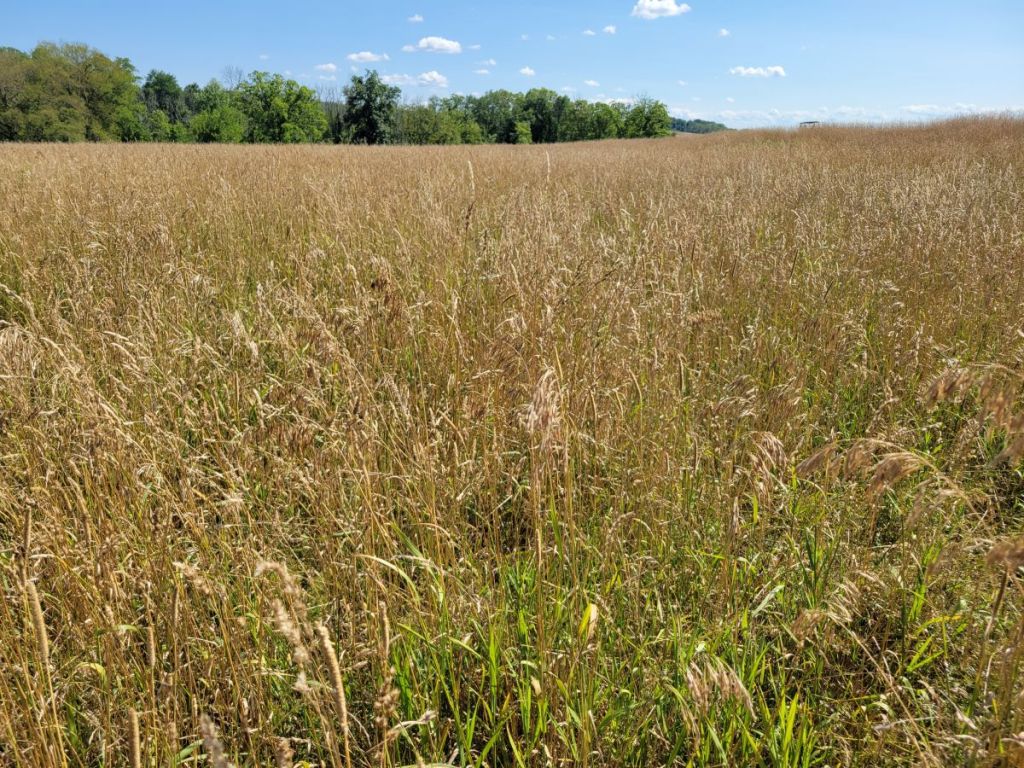
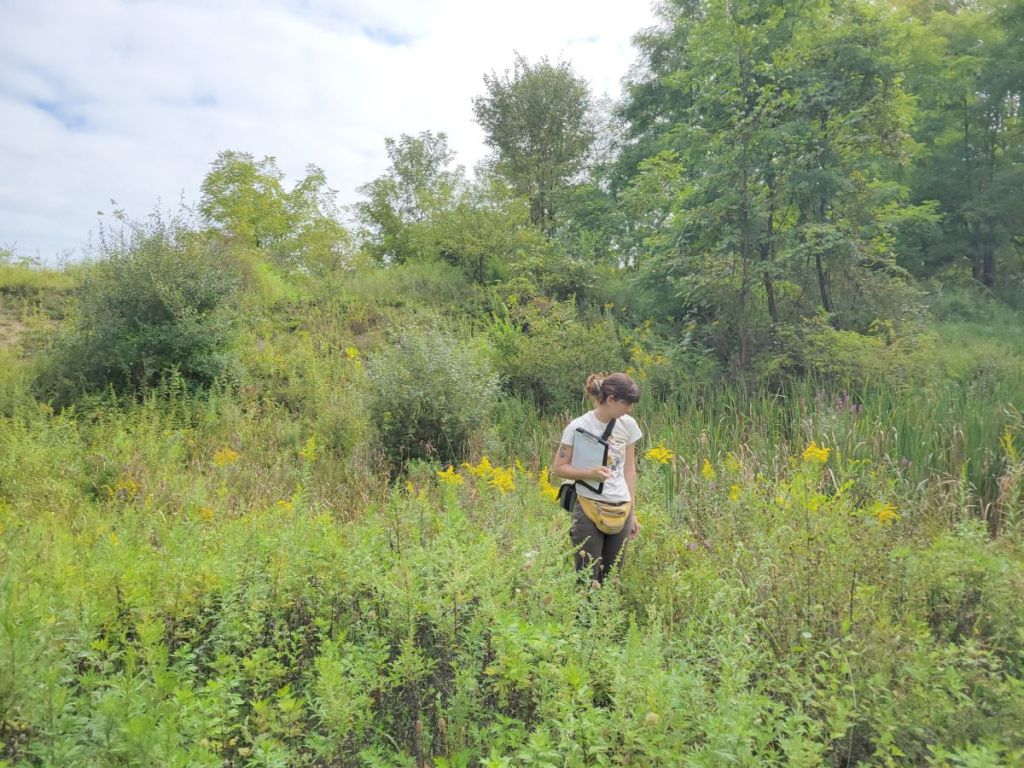
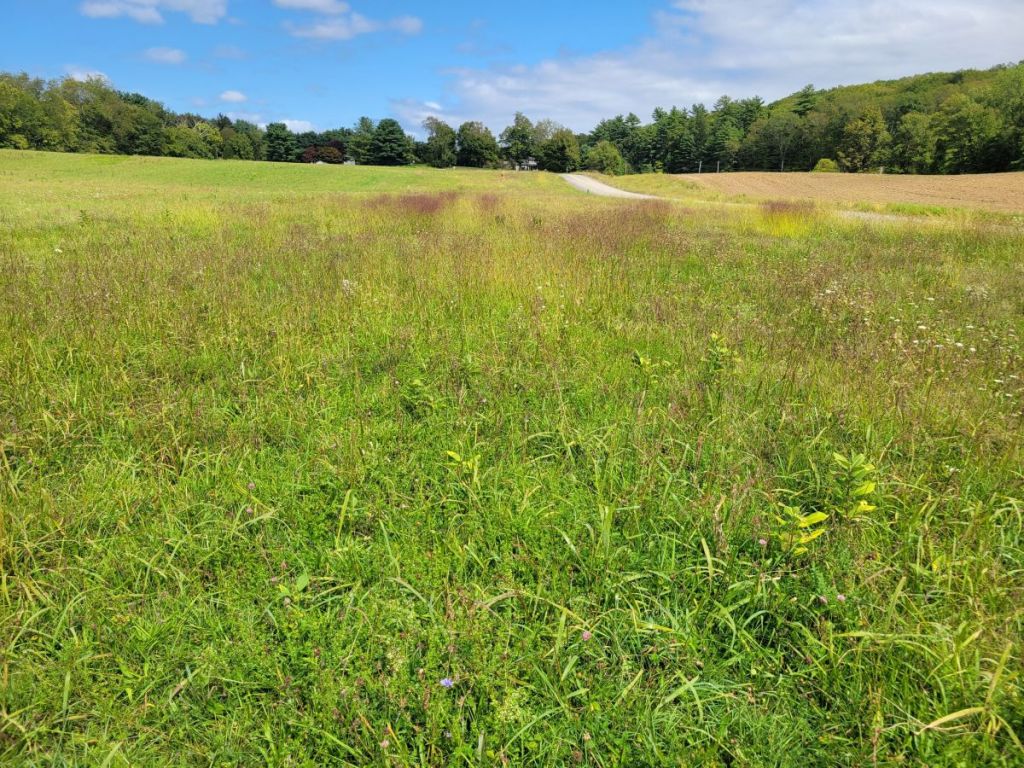
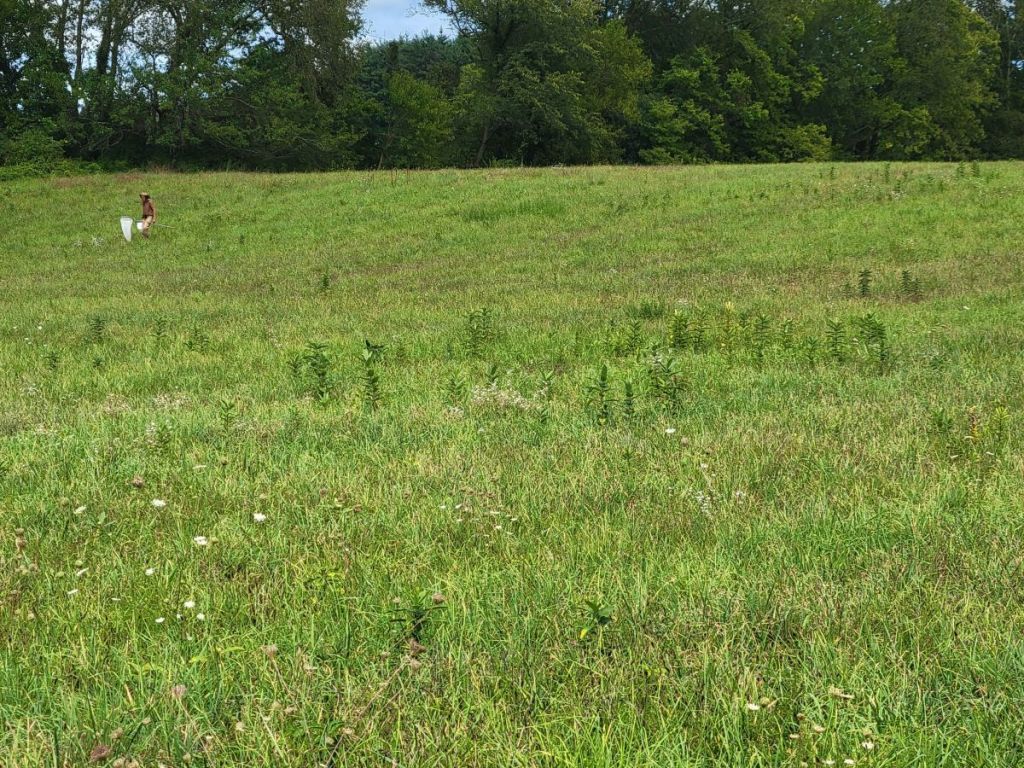
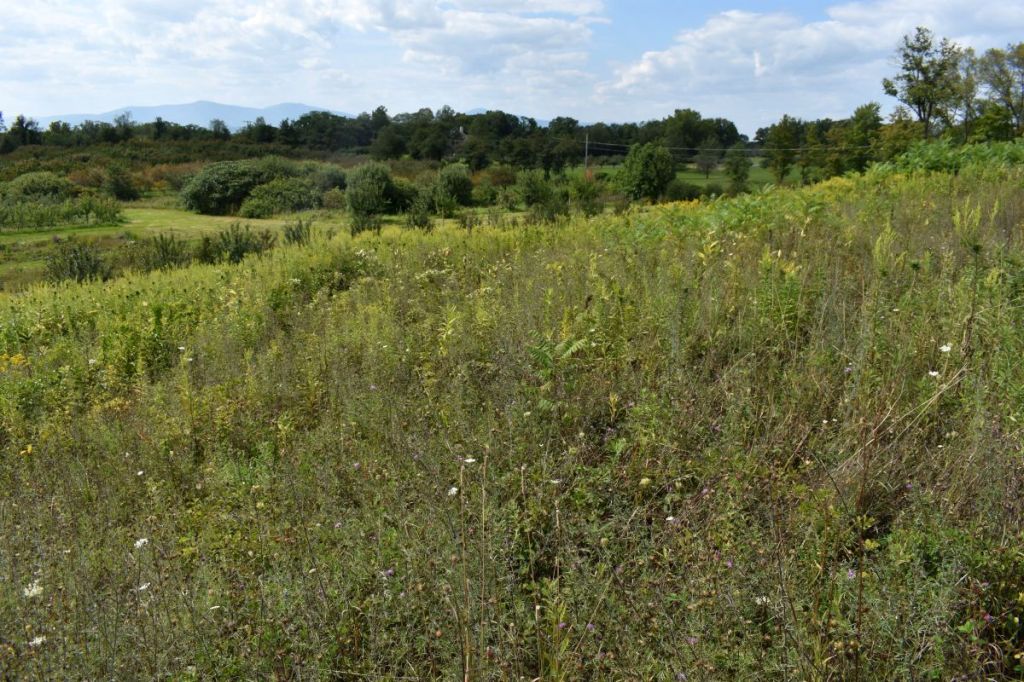
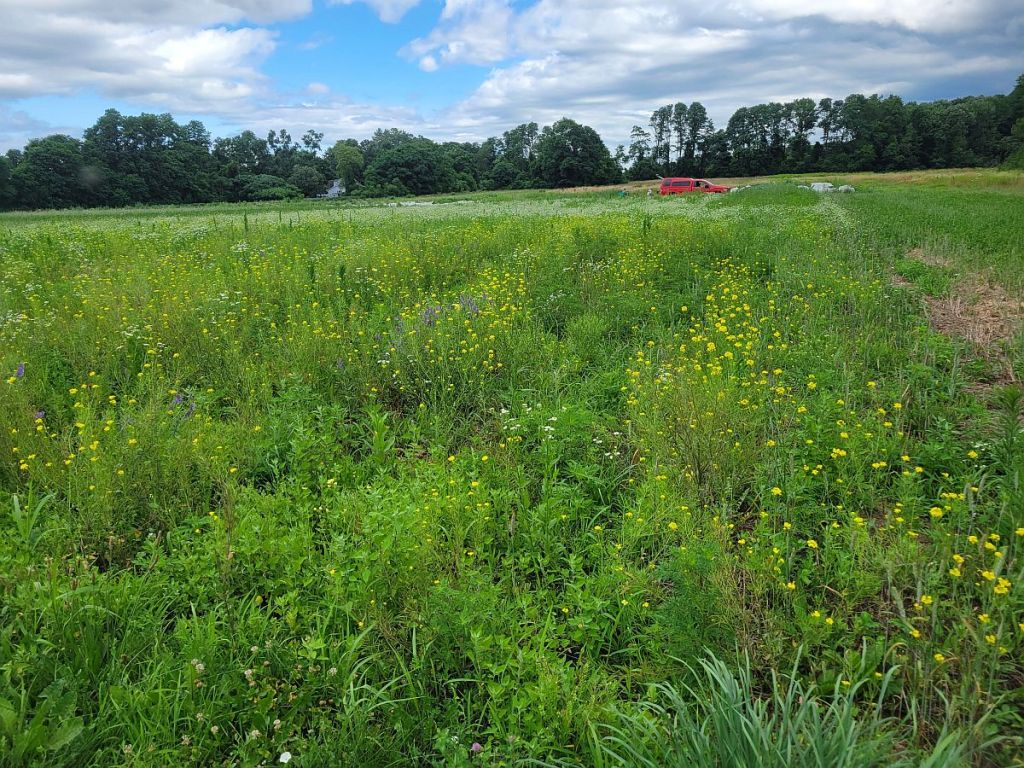
At the west and east end of the farmland are old fields, largely composed of perennial species, both native and non-native. Those old fields harbored at least five species of goldenrods and seven species or varieties of asters, all native. The “grassy” matrix at the west end (#1) was dominated in late summer by the non-native grass Hard Fescue (Festuca trachyphylla), but also included the native Path and Soft Rushes (Juncea tenuis and J. effusus).
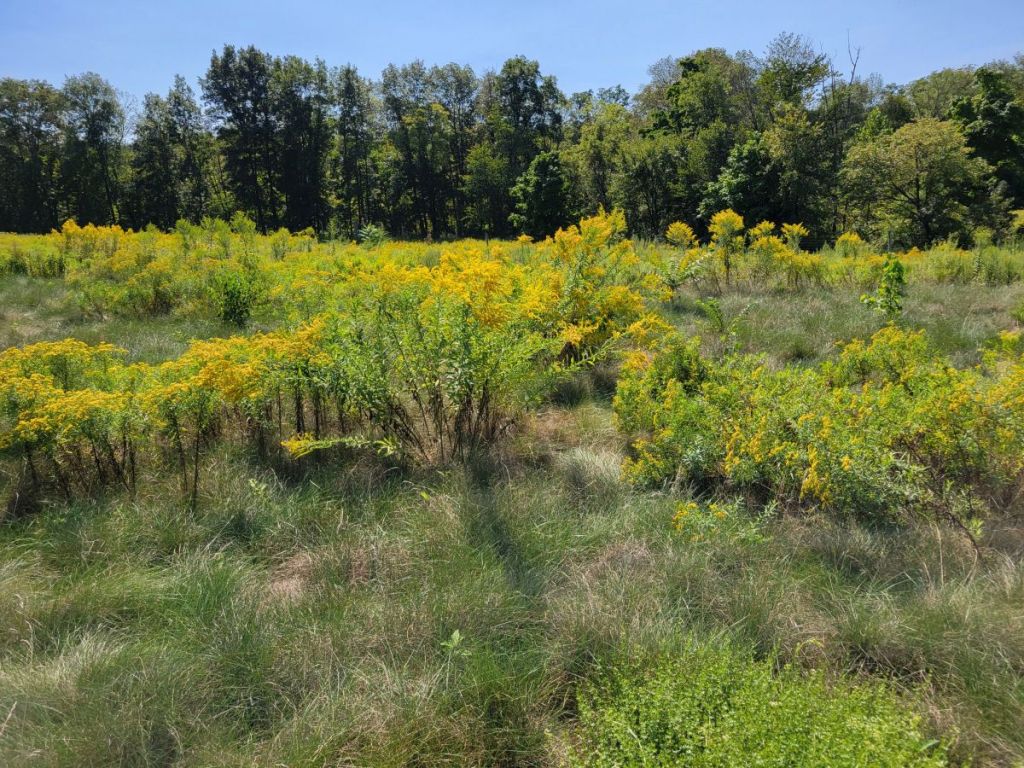
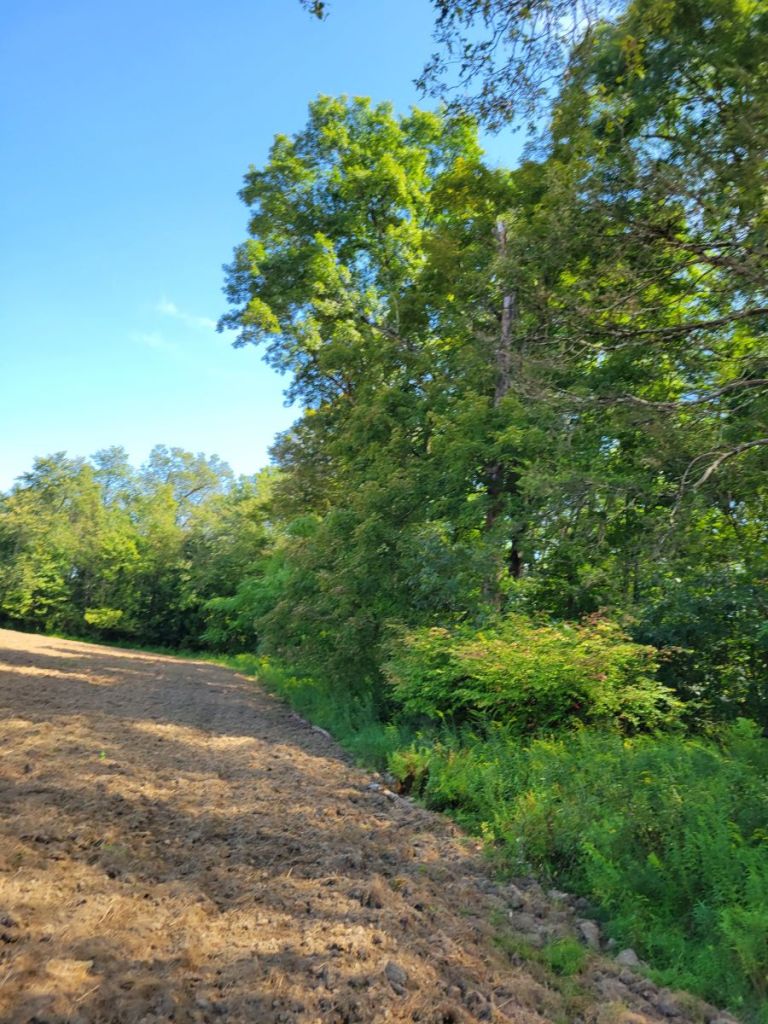
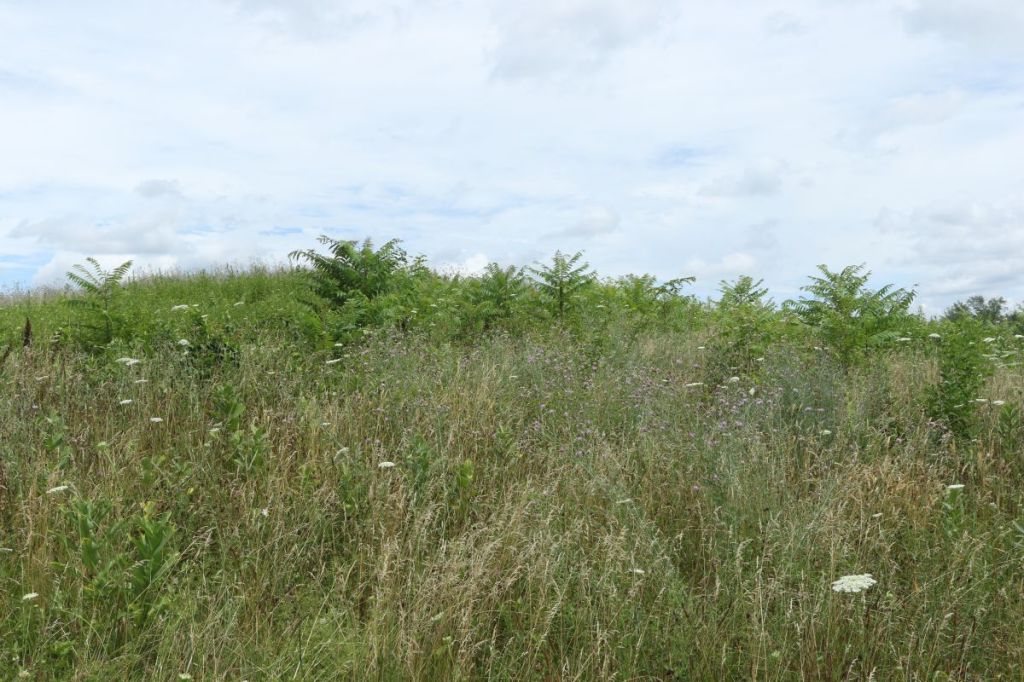
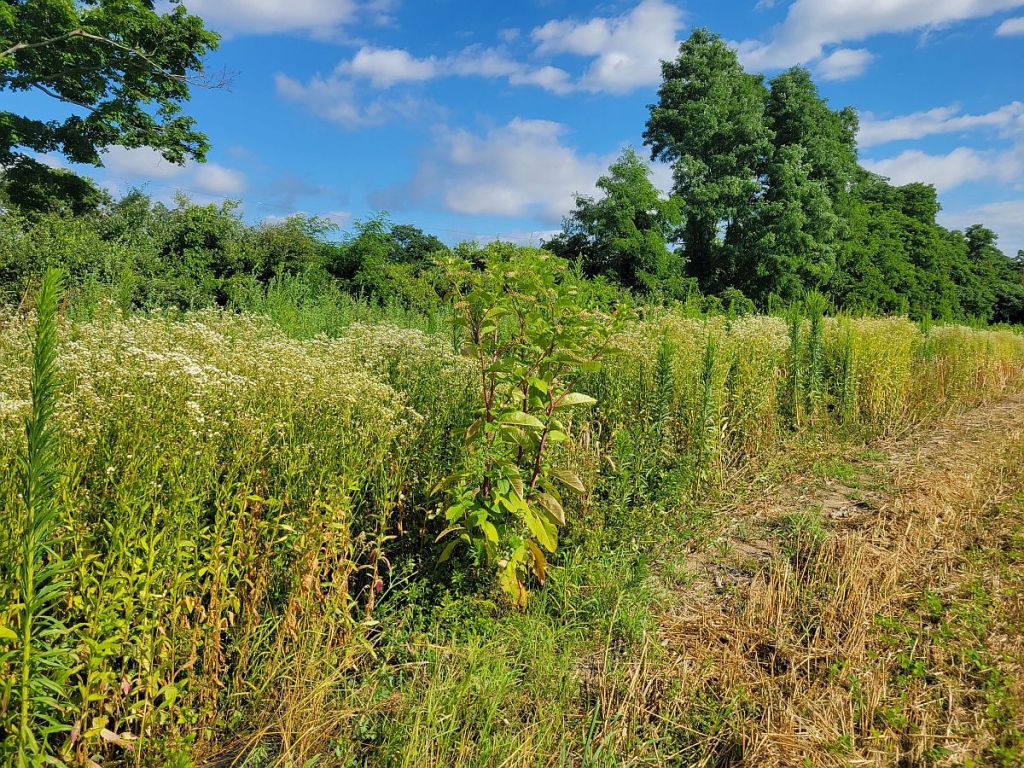
Old field vegetation at the west end of the farm (#1)

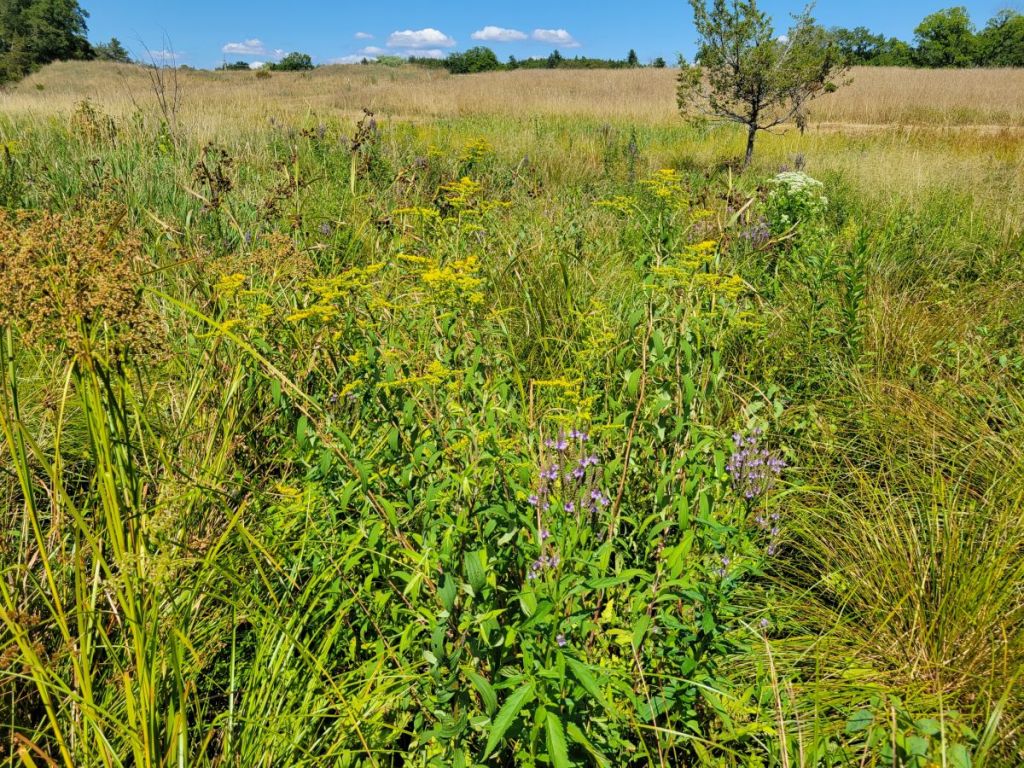
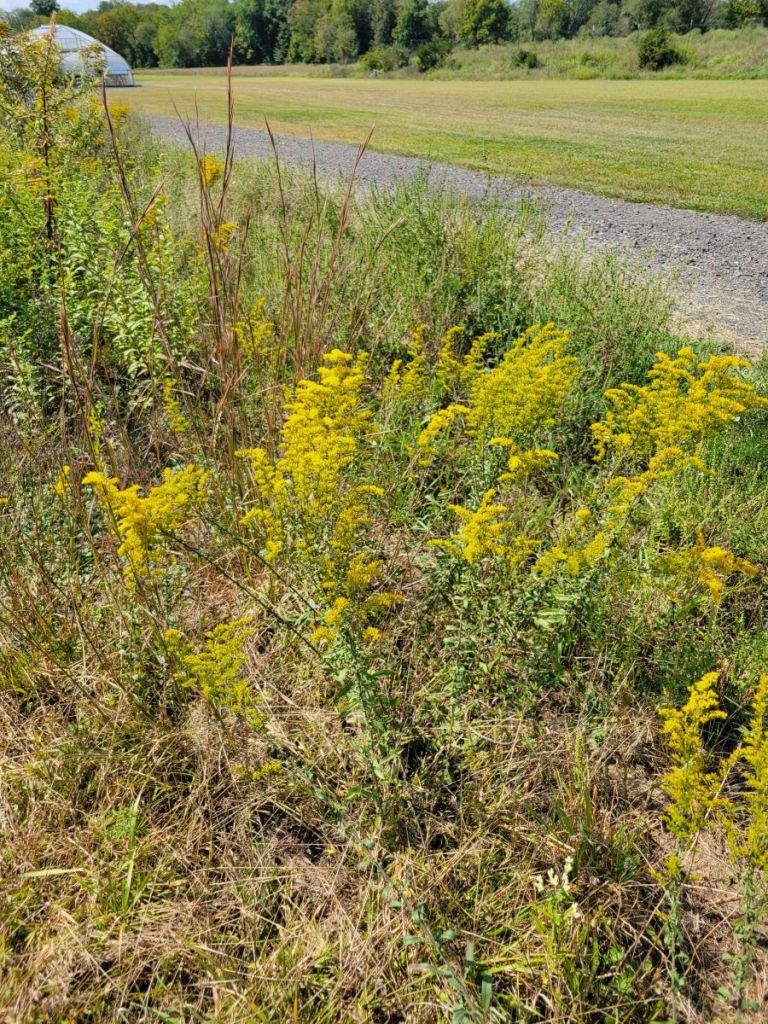
At the time of my visit (4th Sept.), the asters were just starting to flower, but the goldenrods were already in full bloom. In the image below, the golden yellow flowers of Tall Goldenrod (Solidago altissima) contrast beautifully with the purple flowers of New England Aster (Symphyotrichum novae-angliae). Tall Goldenrod (also often referred to as Canada Goldenrod) is one of four very common, rhizome-forming, old field goldenrods in our region. We know of 11 other goldenrod species in our area, all less common than the four old field species, and associated with other habitats, such as dry meadows, wetlands, and even forests. All our goldenrods are native species and—as a group—provide resources to a dazzling variety of insects, who visit the flowers for nectar and pollen, eat the leaves, bore in stems and roots, form galls, or wait for prey in the flowers.
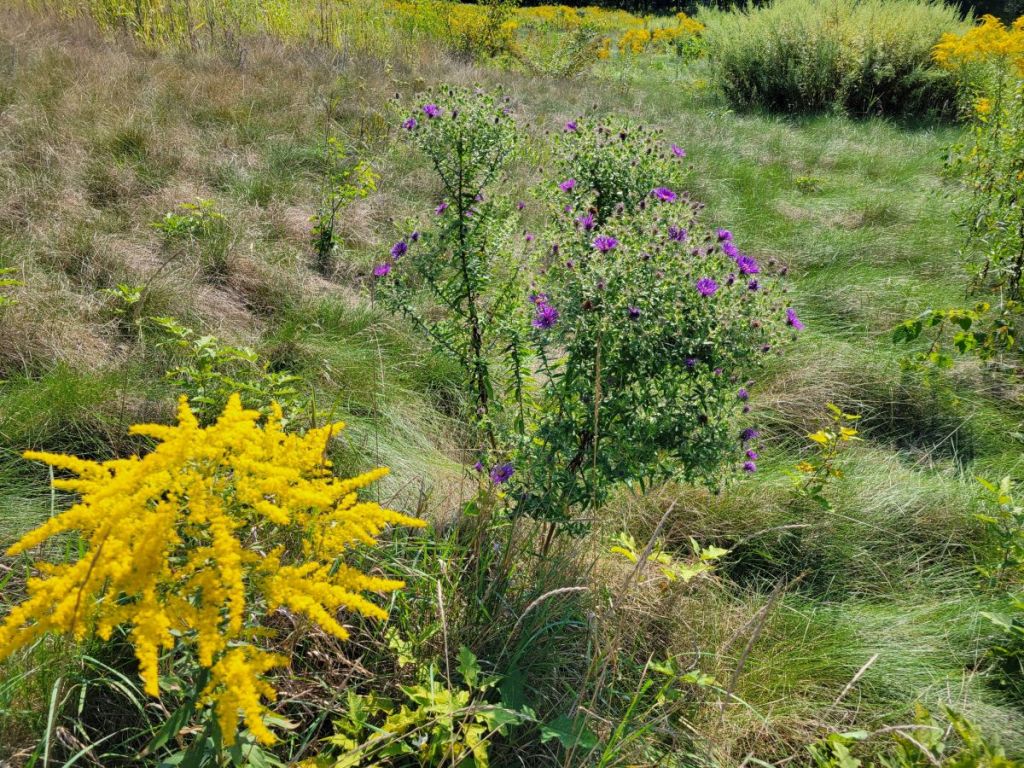
Tall Goldenrod (Solidago altissima) and New England Aster (Symphyotrichum novae-angliae)

Nearby, Early Goldenrod (Solidago juncea) was still in bloom. This is a species that does not form rhizomes and does not grow in dense colonies. In fact, it does not compete well with the more aggressive goldenrods on fertile and moist soils. Therefore, it is usually found on somewhat dryer, less nutrient-rich soils. This is one of the earliest-flowering goldenrods, it usually has a basal rosette of leaves, as well as small clusters of leaves in the axils of the stem leaves.
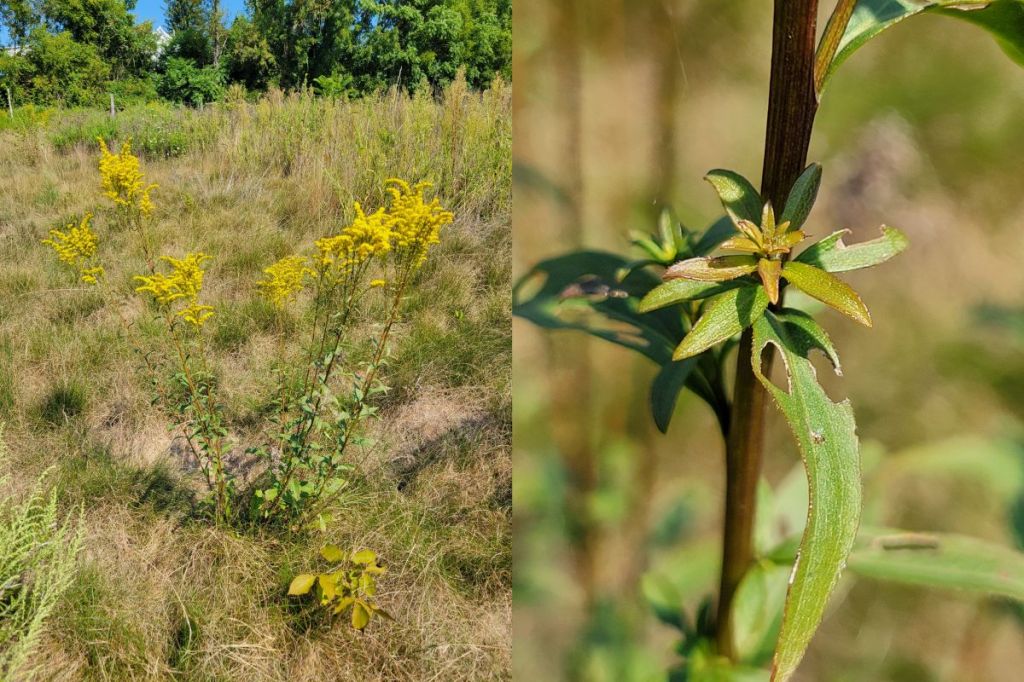
Early Goldenrod (Solidago juncea)

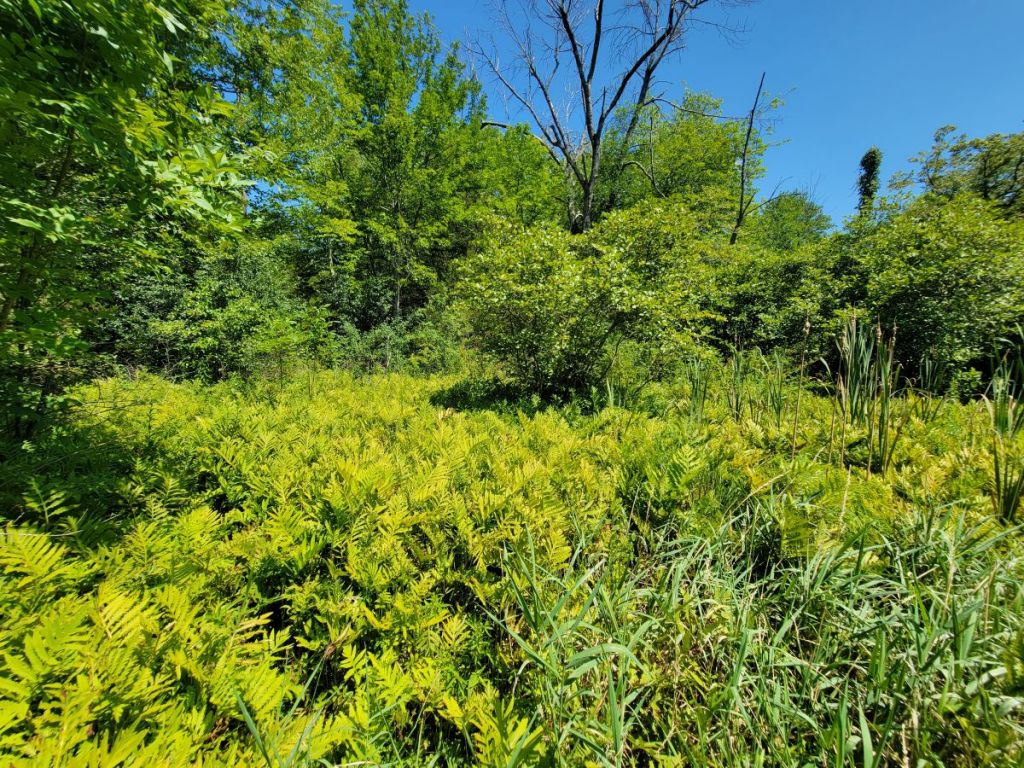
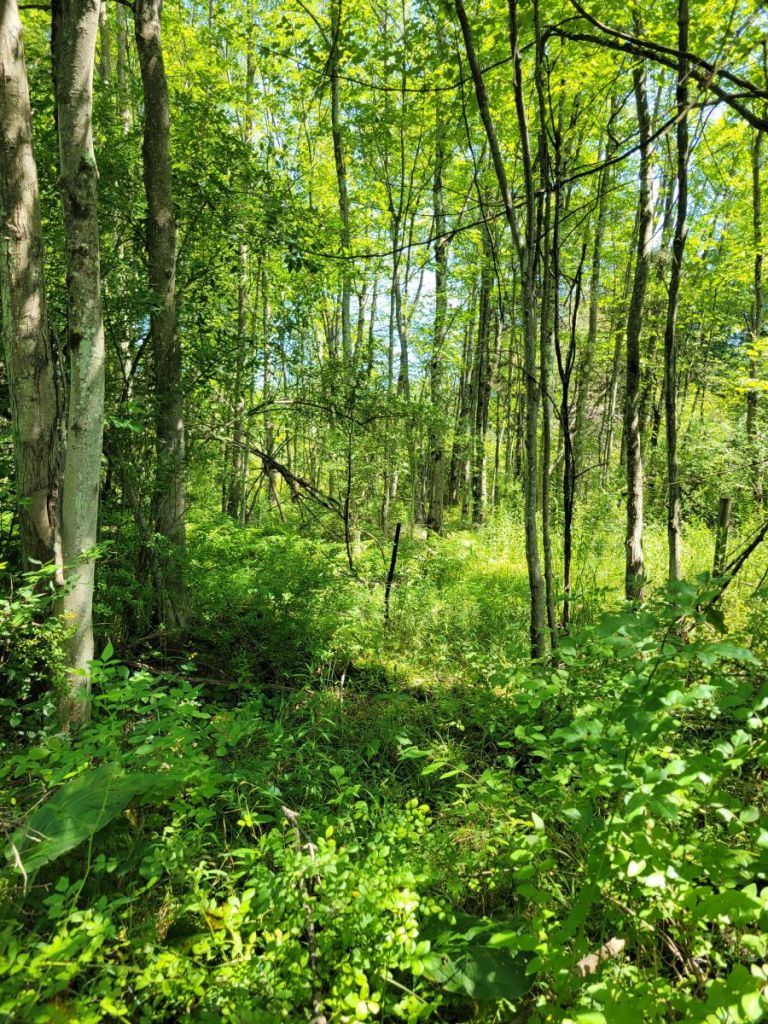
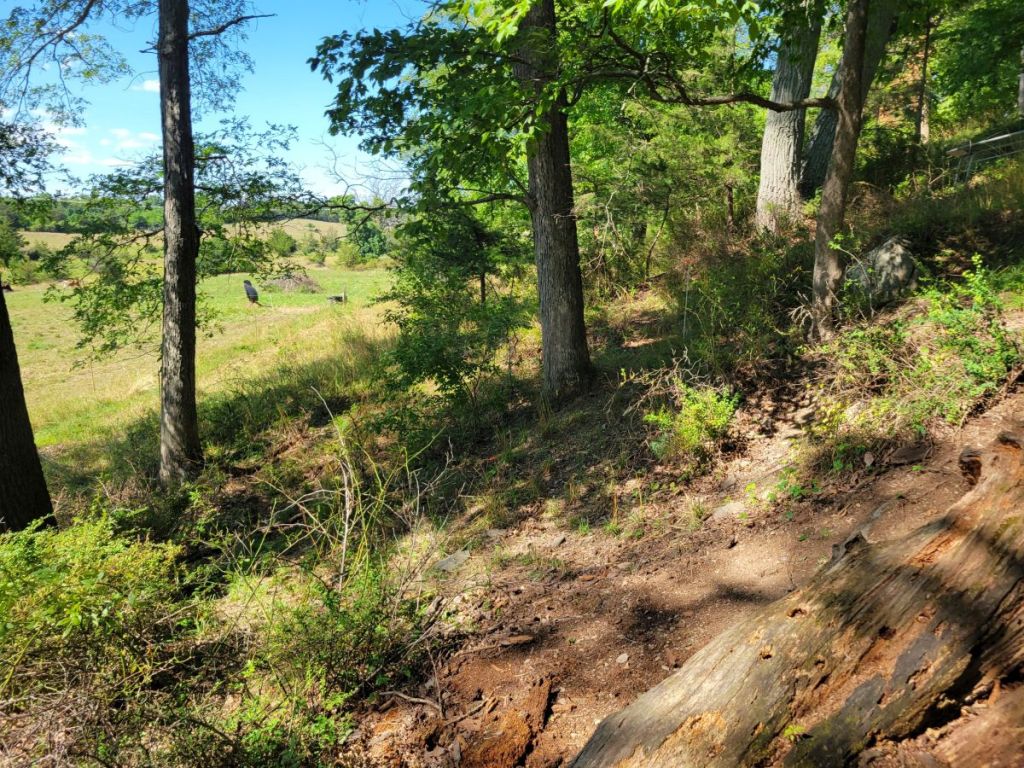
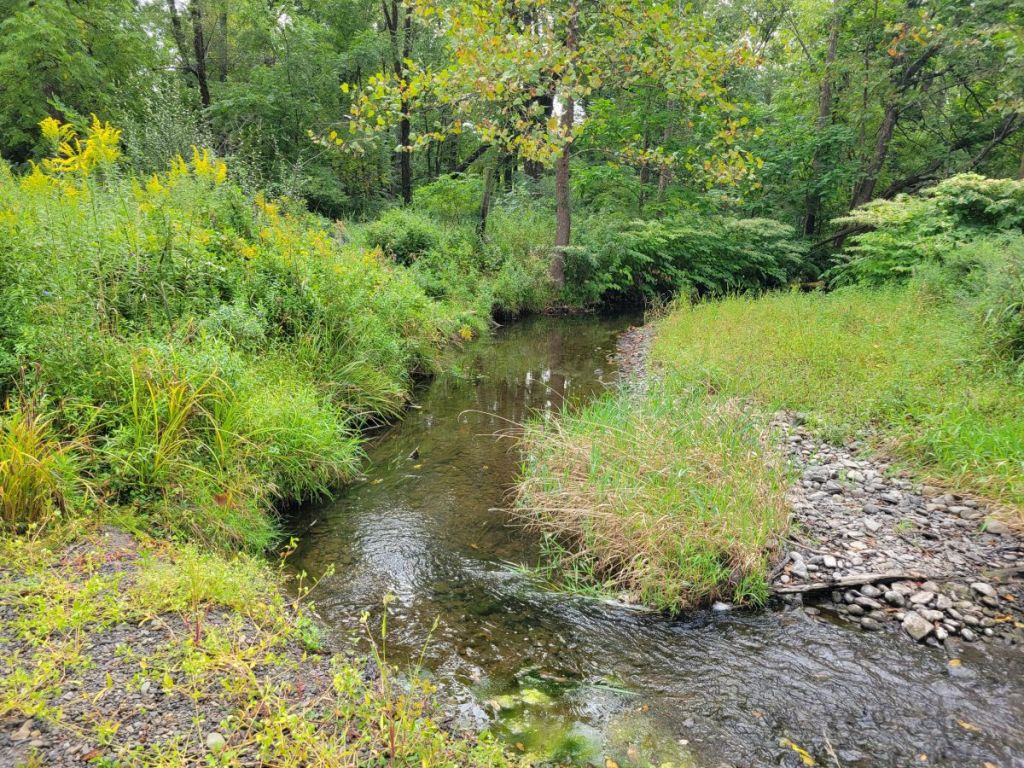
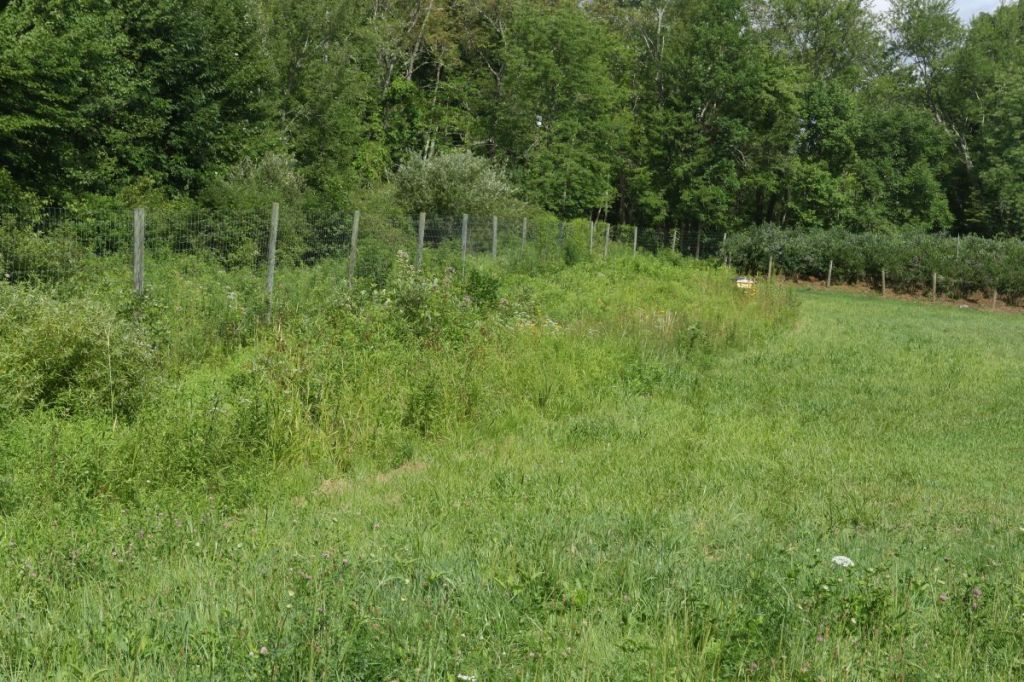
A strip of herbaceous vegetation has been maintained along the outside of the deer fence (#2), forming the edge between farmland and wooded riparian corridor along the Roundout Creek. This strip harbors some of the same species as the old field, but also some species associated with the riparian corridor, such as Sensitive Fern (Onoclea sensibilis), Deer-tongue Rosette Grass (Dichanthelium clandestinum), and a species of native sunflowers described below. Unfortunately, invasive plant species, including abundant Mugwort (Artemisia vulgaris) and Japanese Stilt Grass (Microstegium vimineum) also thrive in this occasionally mowed strip.
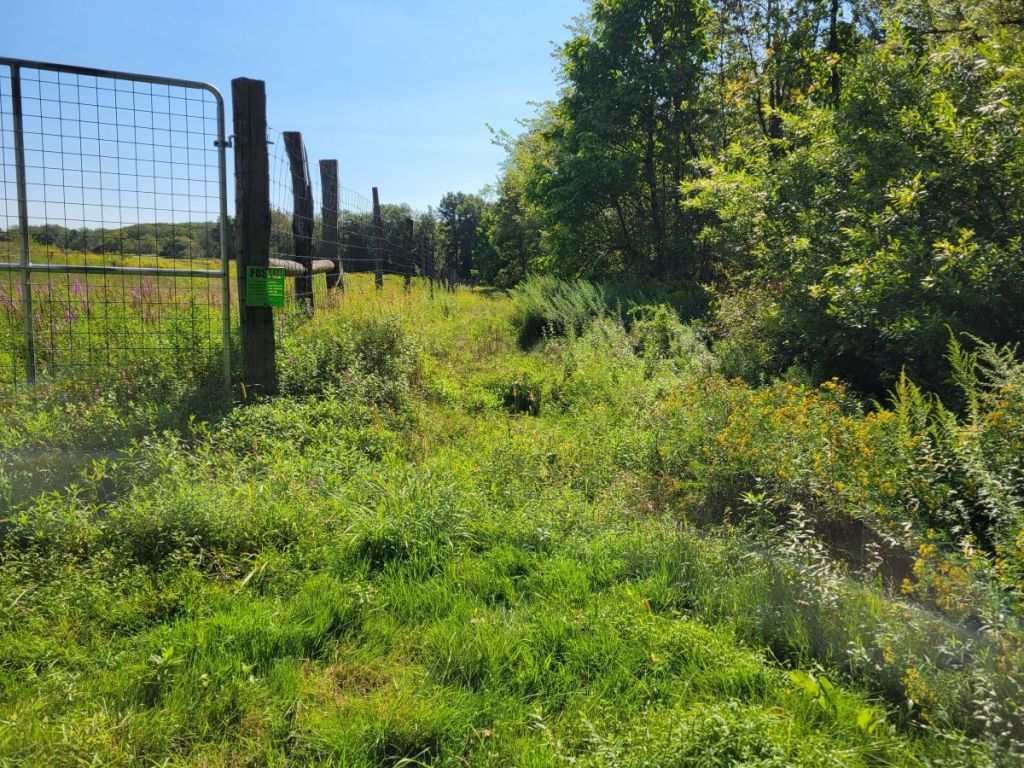
Strip of herbaceous vegetation outside of the deer fence (#2)

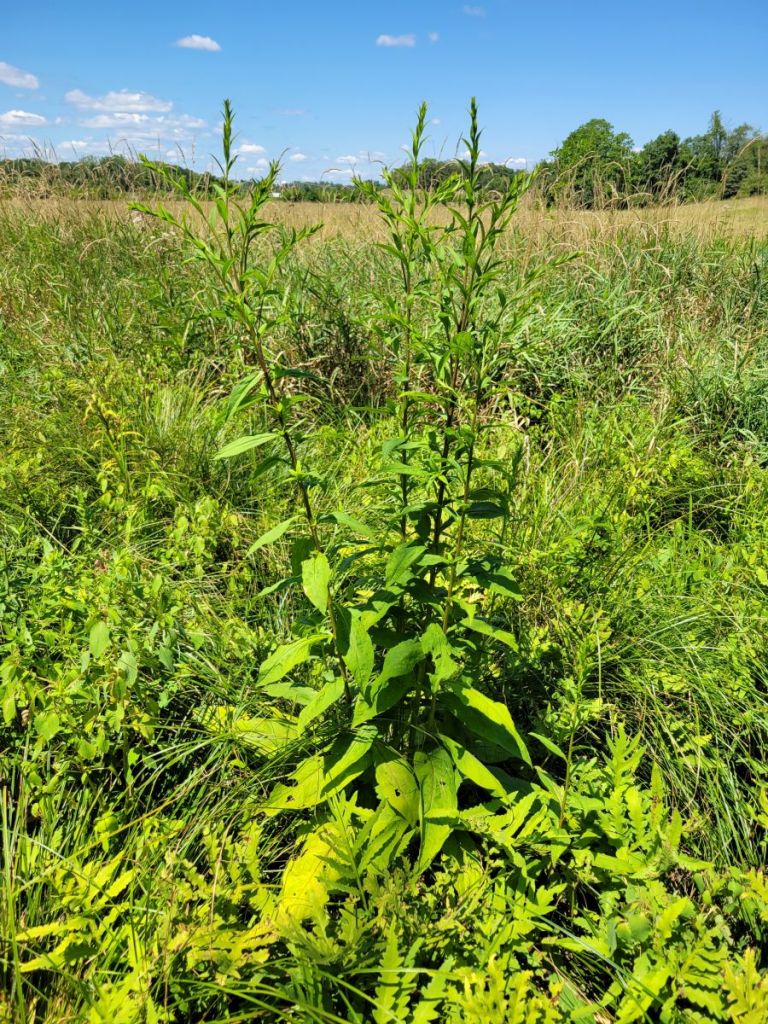
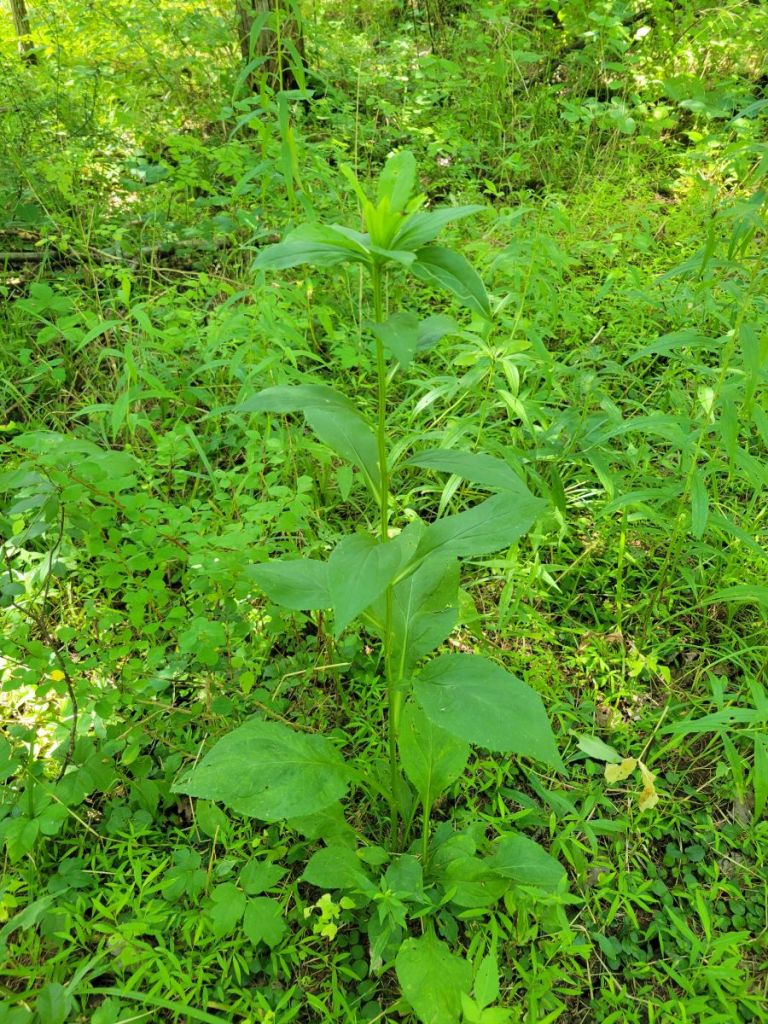
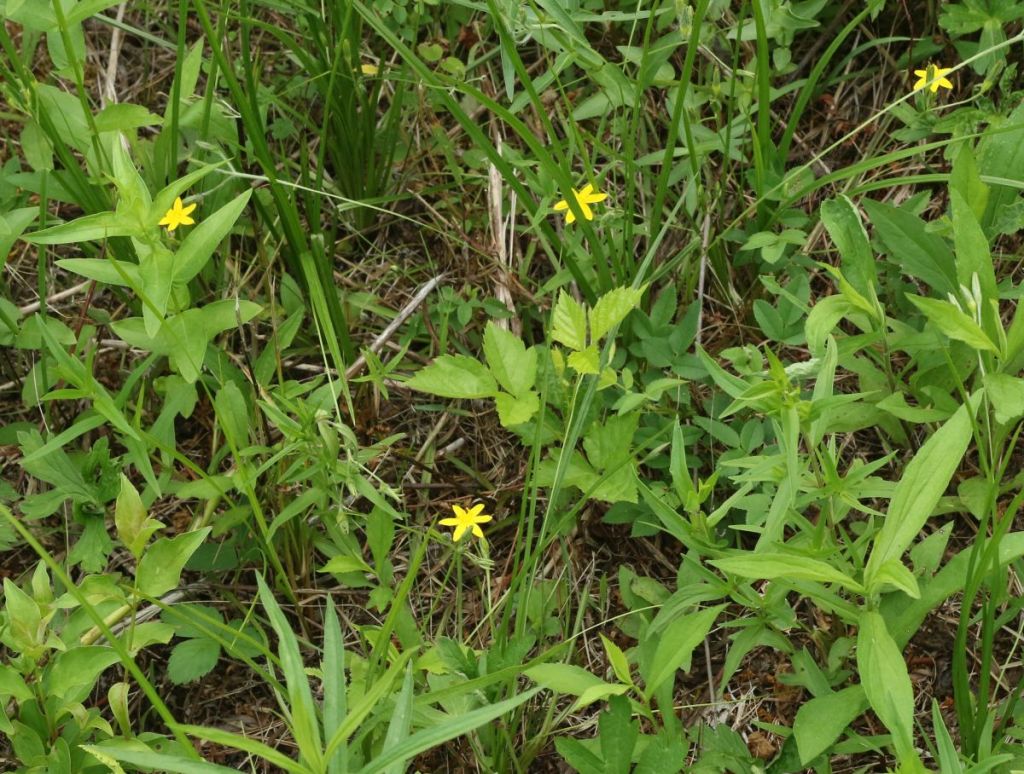
I was excited to find several patches of Thin-leaved Sunflower (Helianthus decapetalus) on both sides of the deer fence along the southern edge of the farm fields (#3). This beautiful native wildflower tends to grow in semi-shaded riparian areas and occasionally along roadsides. I would think that it could also find its place in native plant gardens and seeded wildflower meadows, but its seeds are still hard to find in seed catalogues. Would this be a candidate for the production of eco-type seeds and plugs?

Thin-leaved Sunflower (Helianthus decapetalus)

The next image shows a flower head of a Thin-leaved Sunflower in its prime. Note how this flower head is composed of two types of flowers: the large, petal-like ray flowers visually attract pollinators, while the small, star-shaped disk flowers at the center focus their energy on pollen, nectar, and—eventually—seed production. Note how the disk flowers mature first around the outside of the disk. The dark columns emerging from the open disk flowers bear the pollen. The flowers at the center of the disk are still green flower buds.

Thin-leaved Sunflower (Helianthus decapetalus)

The following collage illustrates a sequence of flower heads at different stages of development (clockwise from top left): (1) the young flower head is mostly defined by its green bracts, the disk and ray flowers are still developing; (2) a flower head just coming into bloom, with some—but not all—disk flowers spreading and receiving pollen; (3) a flower head at or just past the peak of its blooming period seems to have spent all its pollen, but might still be receptive for pollen brought in from other plants; (4) this flower head has dropped its ray flowers and is now ripening its seeds, one per star-shaped disk flower.
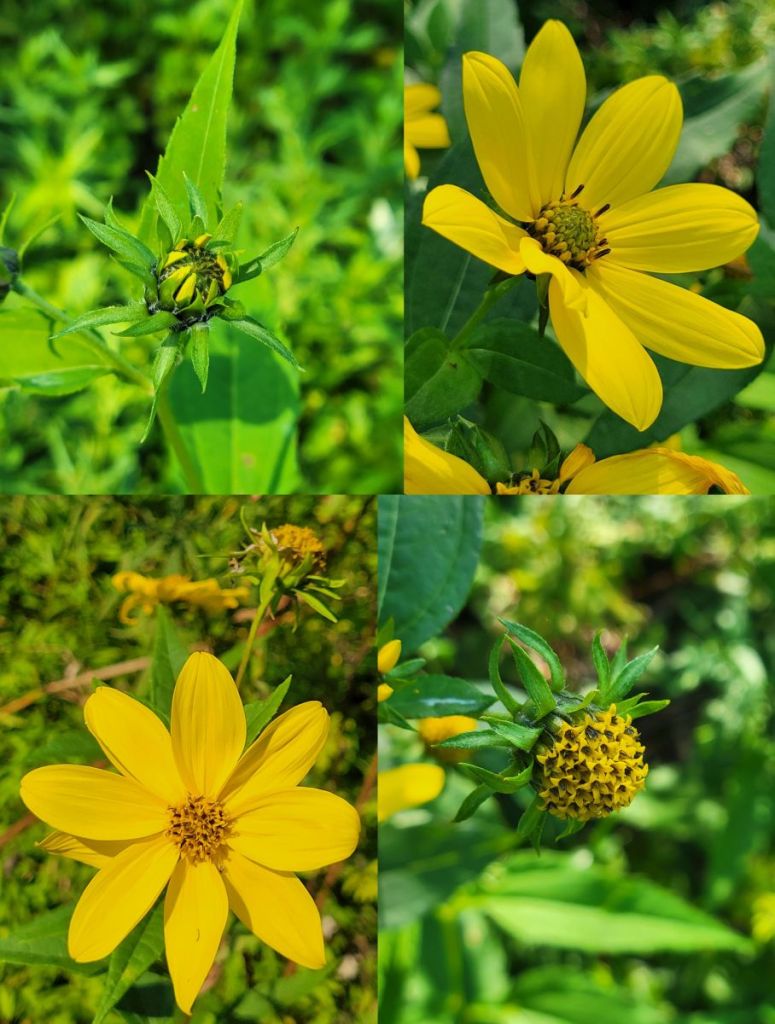
Thin-leaved Sunflower (Helianthus decapetalus)

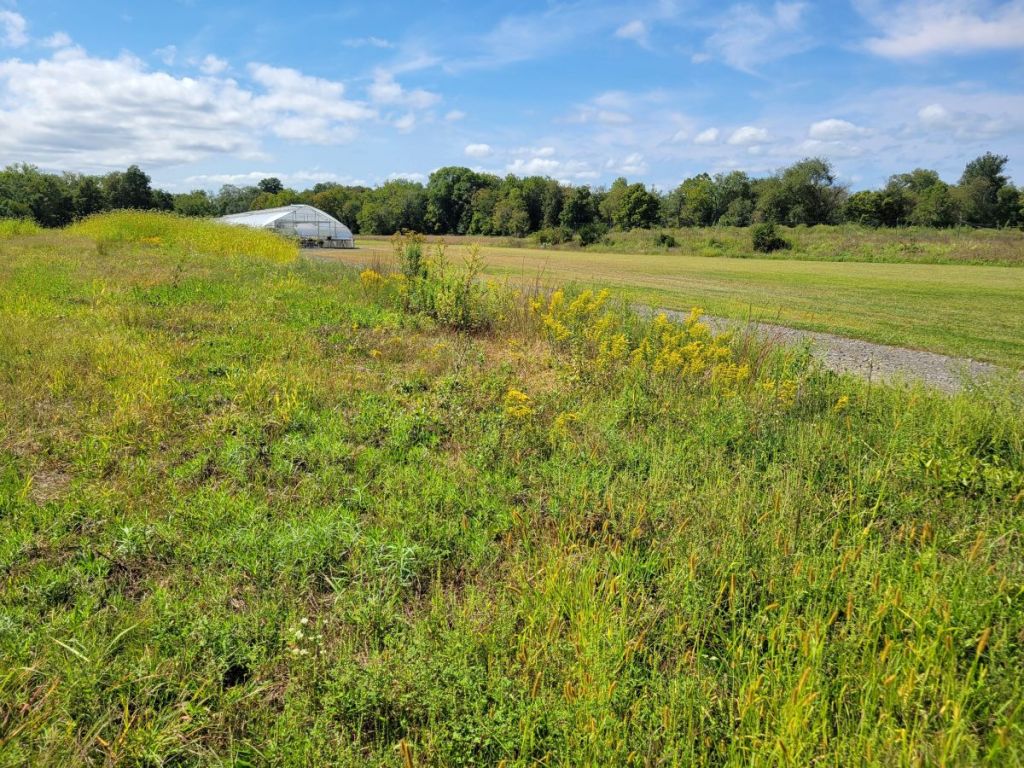
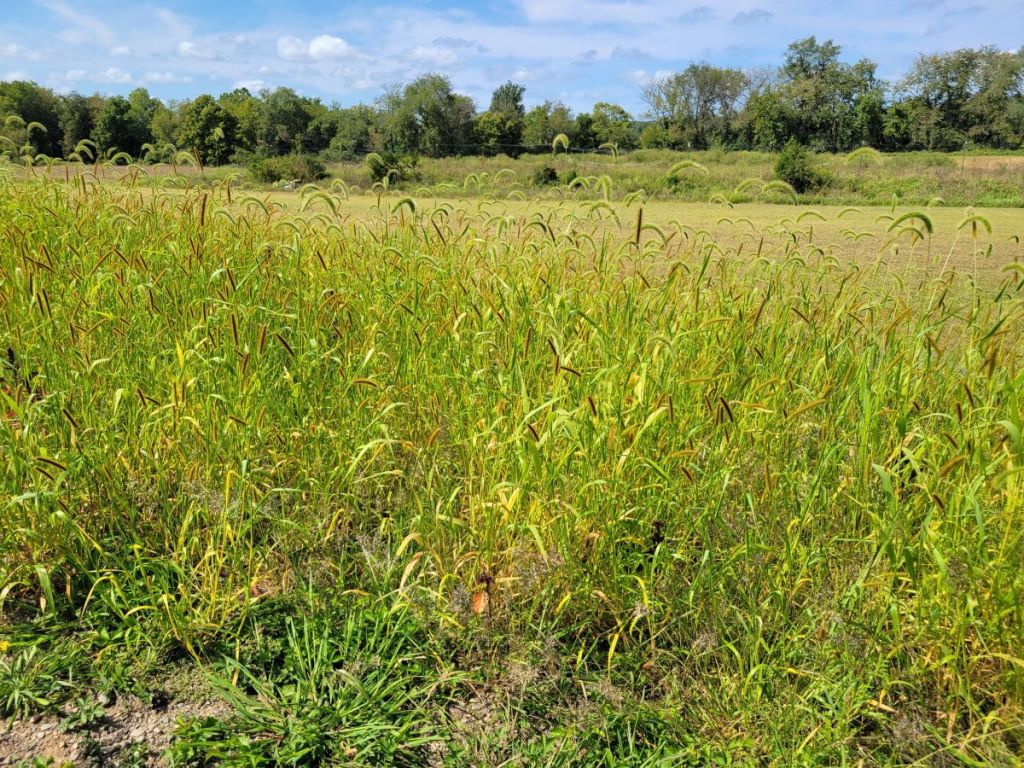
Returning from the riparian corridor back towards the center of the farm, a fallow field (#4) sports a riot of weeds, including the native Daisy Fleabane (Erigeron annuus; white flowers), and the non-native grass Yellow Foxtail (Setaria pumila; orange, upright spikes) and an unusually large smartweed (probably Persicaria longiseta; drooping, pink spikes).
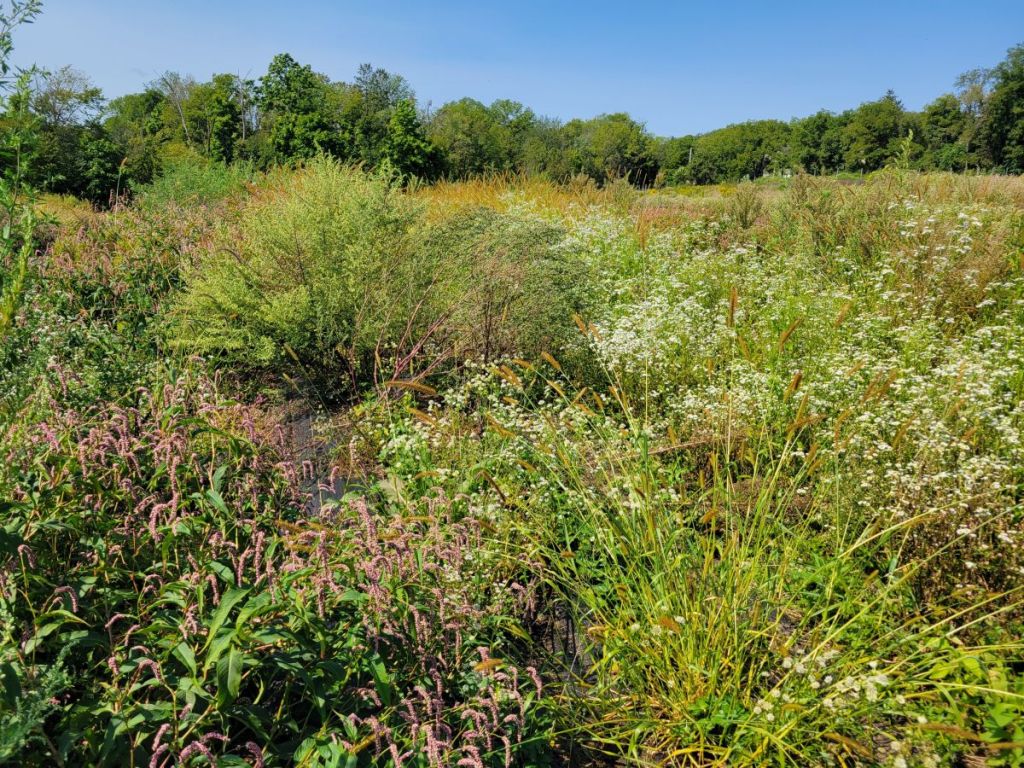
A weedy fallow (#4)

Nearby, I found another smartweed, the non-native Lady’s Thumb (Persicaria maculata), which also seemed particularly robust.
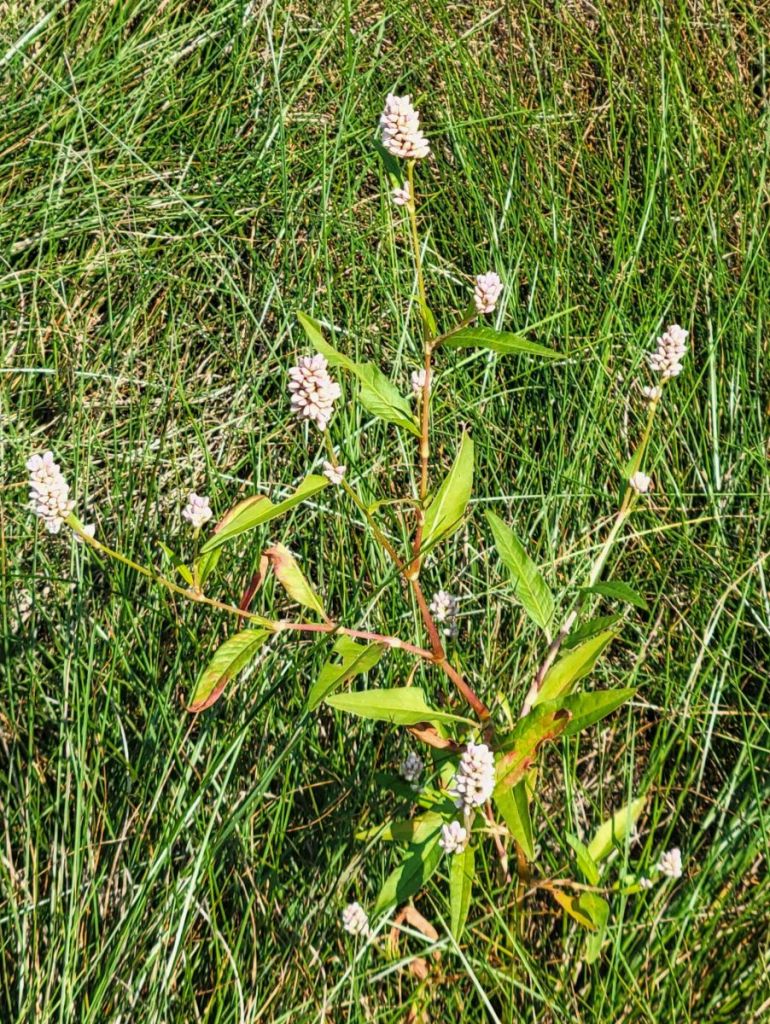
Lady’s Thumb (Persicaria maculata)

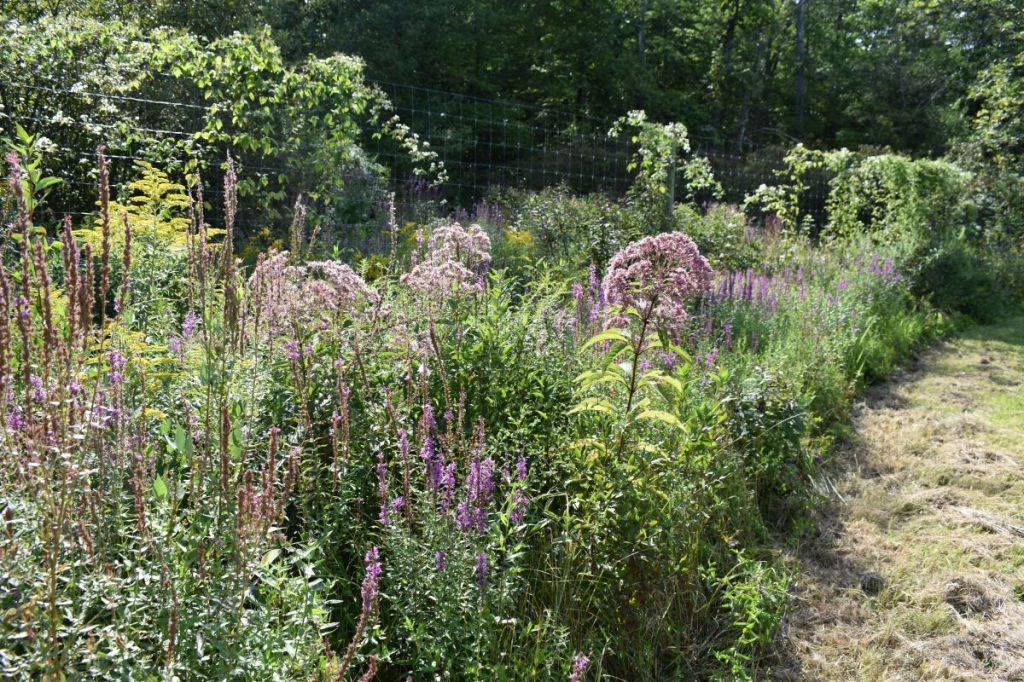
In these beds (#5), a variety of native wildflower species were cultivated. They included several mountain-mints (Pycnanthemum spp.), asters (incl. Symphyotrichum laeve), and Joe-Pye-weed (Eutrochium sp.). However, I did not attempt a complete inventory of these cultivated flowers.
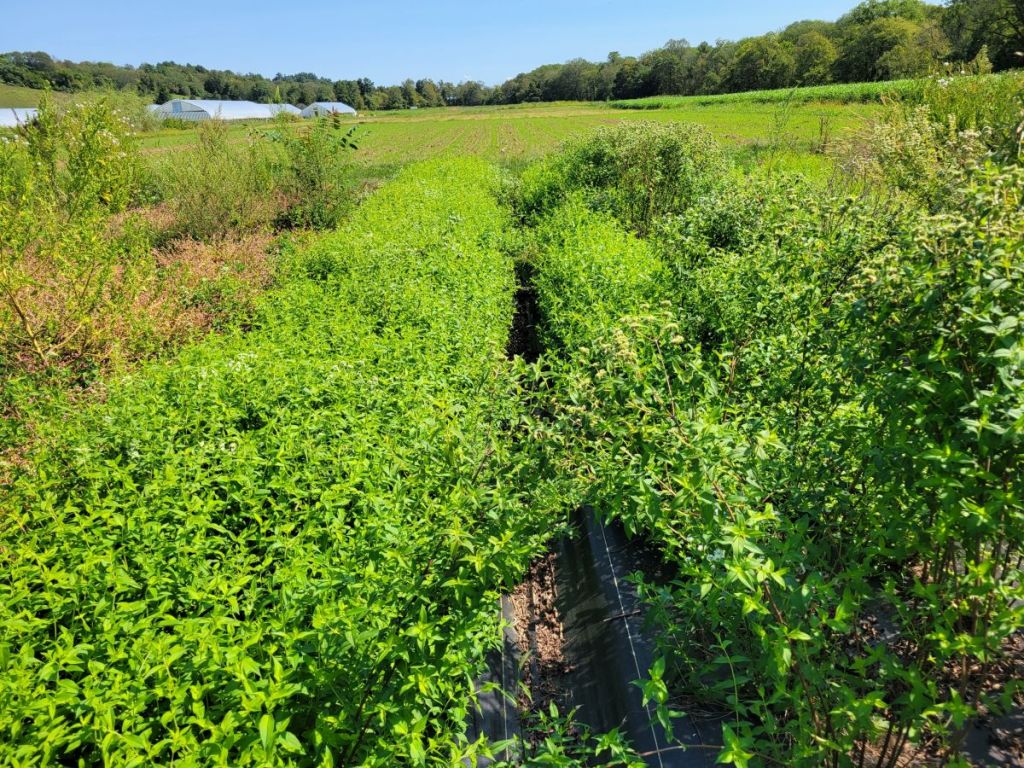
Beds of cultivated native wildflowers (#5)

The following collage shows three different species of mountain-mints cultivated at Treadlight Farm (from left to right): Narrow-leaved Mountain-mint (Pycnanthemum tenuifolium), possibly Hairy Mountain-mint (P. cf. verticillatum), and possibly Blunt-leaved Mountain-mint (P. cf. muticum).
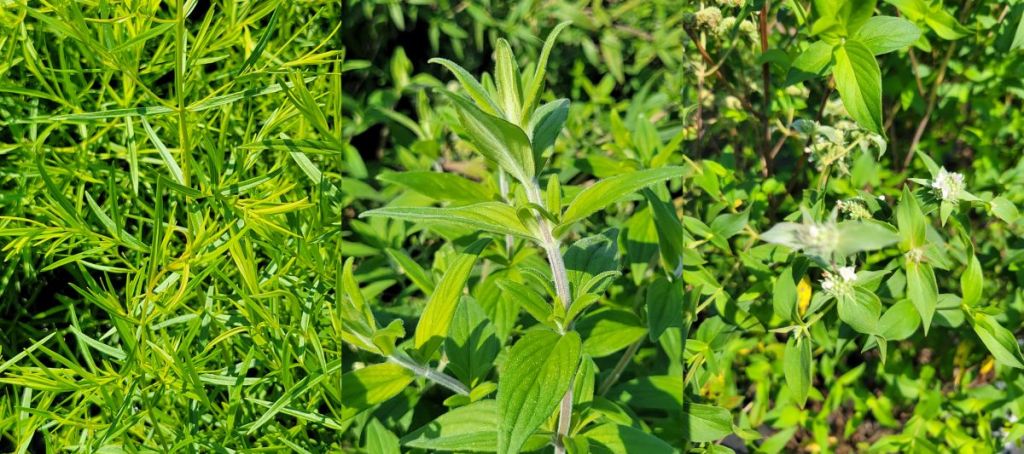
Examples of cultivated native mountain-mints

The native One-seeded Bur-cucumber (Sicyos angulatus), a wild cucurbit, was mingling with the Joe-Pye-weed.
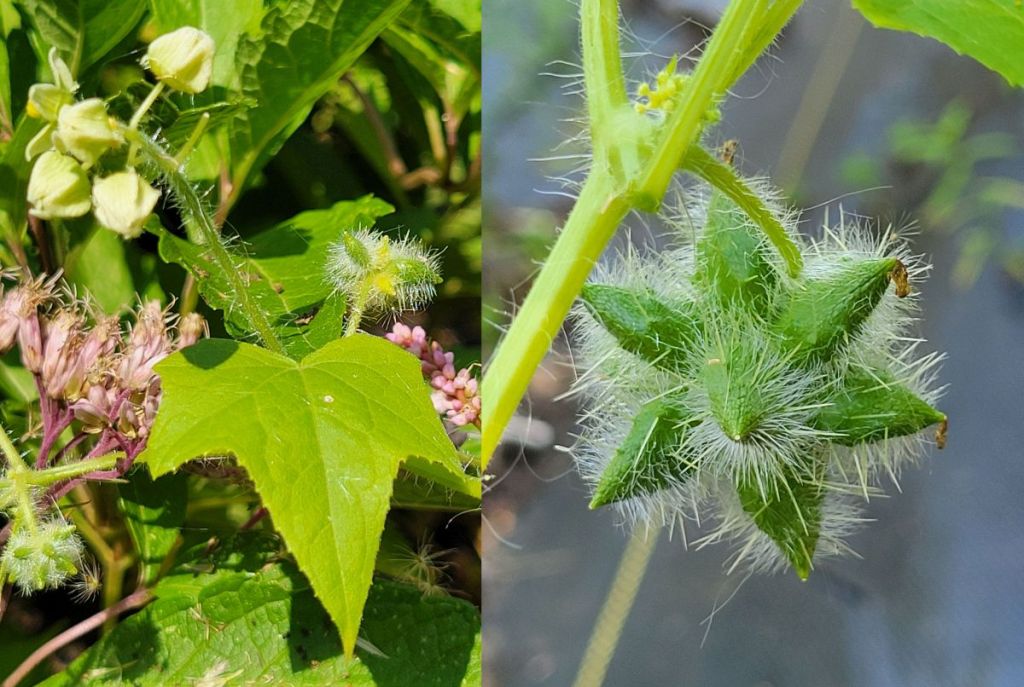
One-seeded Bur-cucumber (Sicyos angulatus)

Not many native plans were thriving in the rows of dahlias (#6).
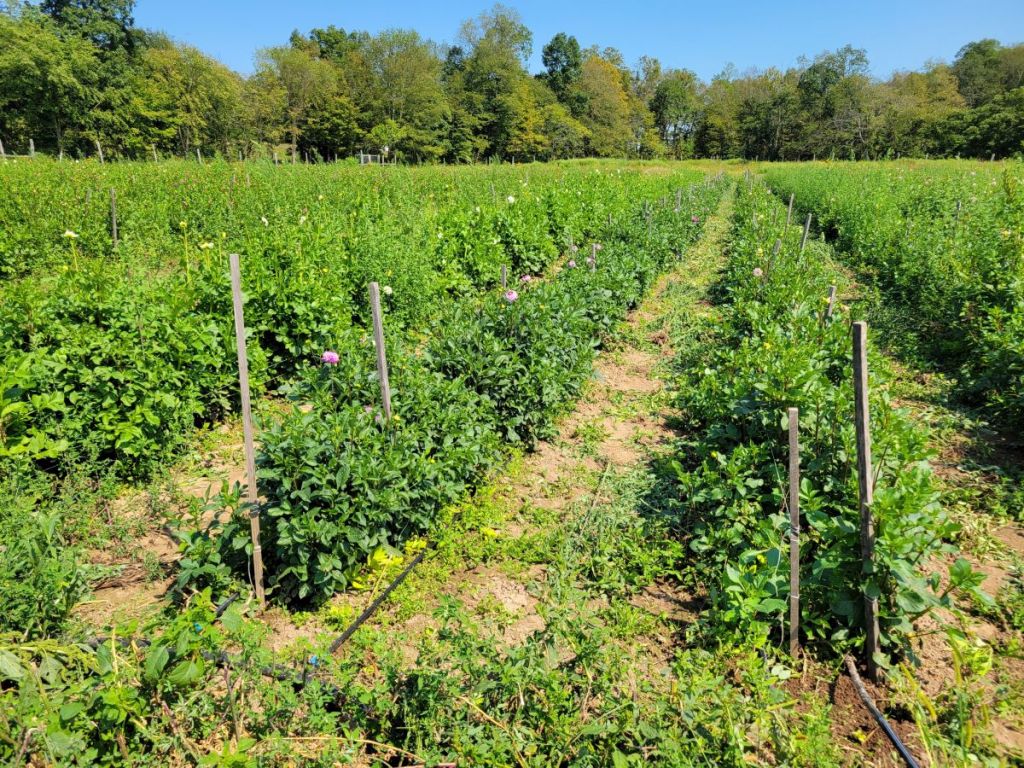
Rows of dahlias (#6)

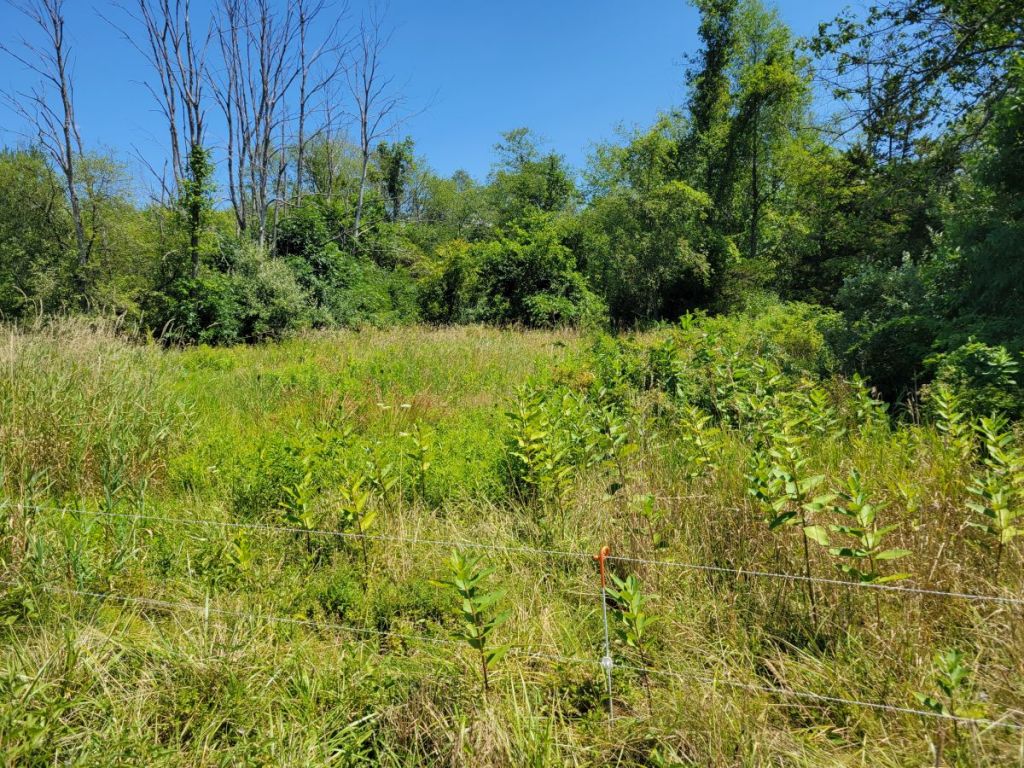
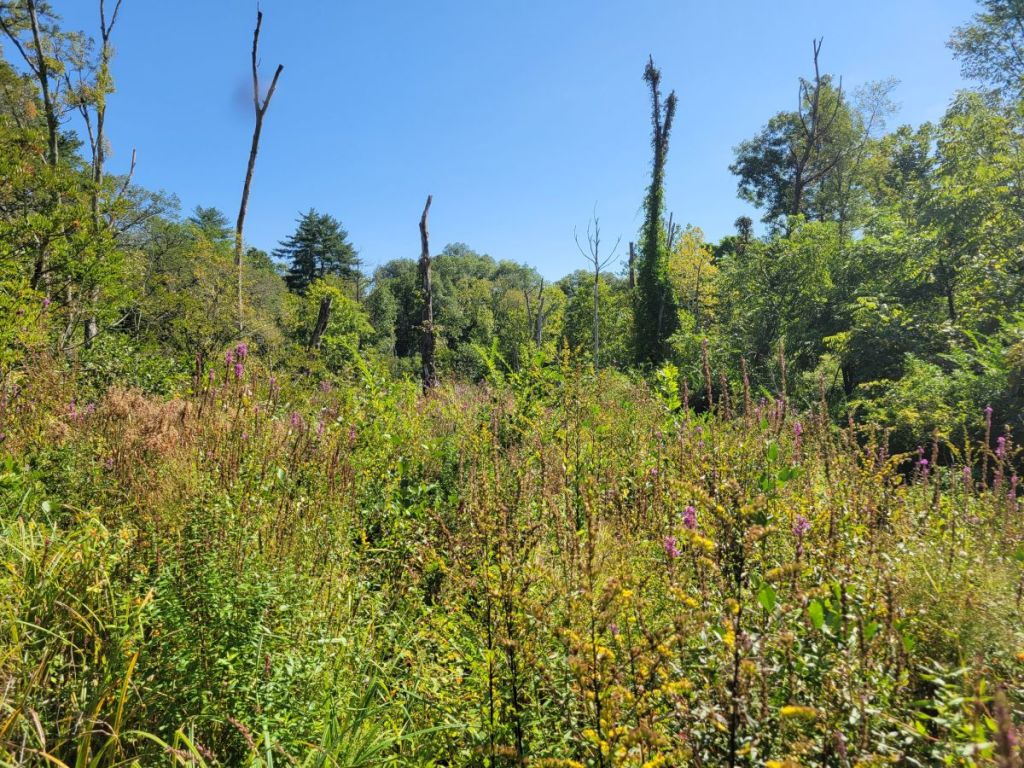
At the northeastern corner of the farm fields, I found a small strip of old field/wet meadow (#7), which harbored some Purplestem Asters (Symphyotrichum puniceum), not seen anywhere else at TFreadlight Farm and possibly quite a few Willow-leaved Asters (S. praealtum). The latter species was not yet in bloom, so I am not 100% certain of its identity.  
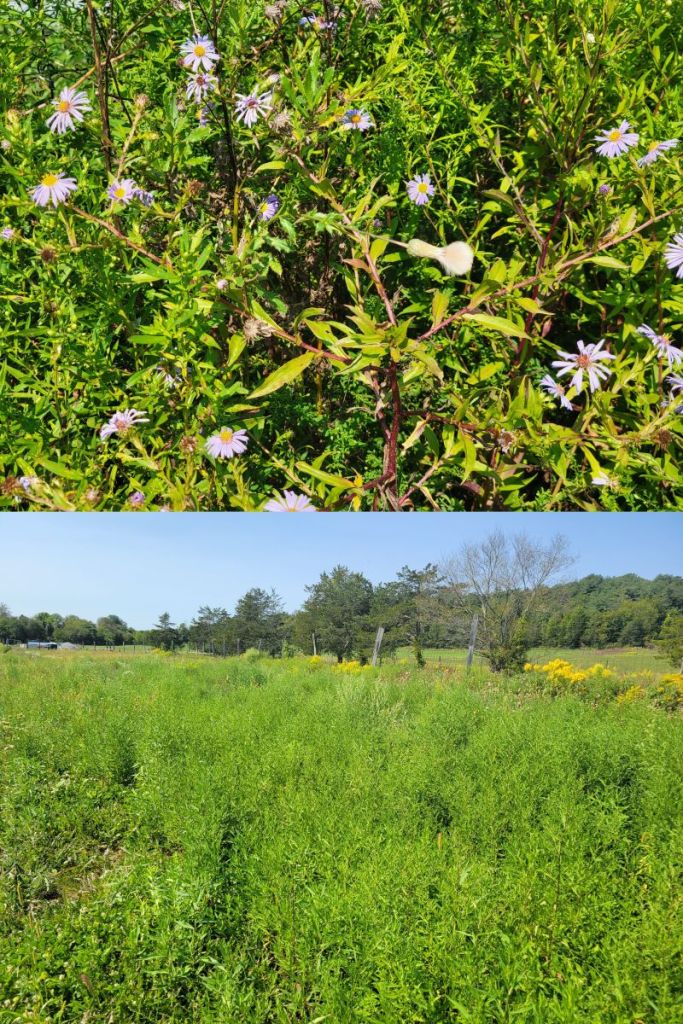
A strip of old field/wet meadow vegetation (#7; below) and Purplestem Aster (Symphyotrichum puniceum; above)

A pink (more typical would be lavender) flower head of Purplestem Aster in lovely contrast with the yellow flowers of Flat-topped (a.k.a. Grass-leaved) Goldenrod (Euthamia graminifolia).

Purplestem Aster (Symphyotrichum puniceum) and Flat-topped (a.k.a. Grass-leaved) Goldenrod (Euthamia graminifolia)

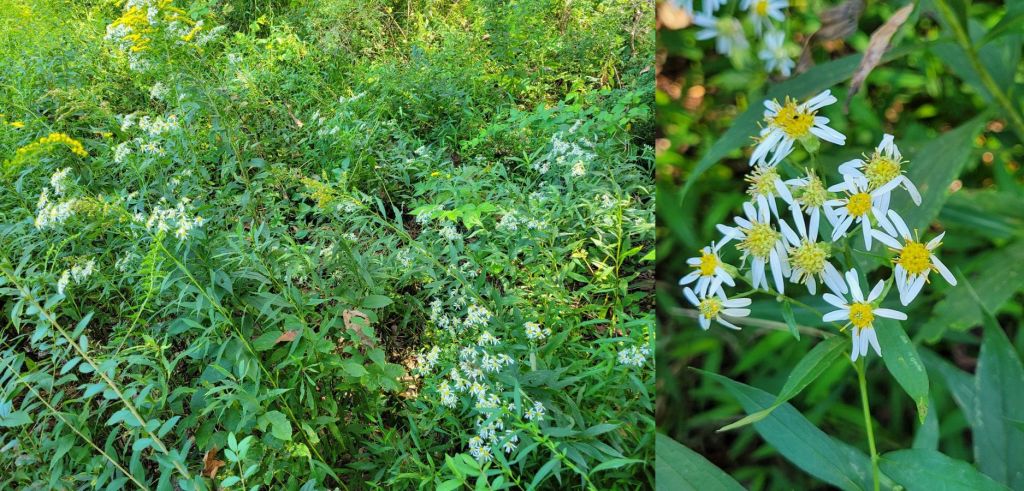
Three different native asters were common in the old field in the east corner of the farm (#8). These small-leaved, white-flowering species are notoriously hard to identify, but I suspect them to represent (from left to right): Calico Aster (Symphyotrichum lateriflorum), Pringle’s Aster (S. pilosum var. pringlei), and Awl Aster (S. pilosum var. pilosum).

Examples of three native asters, most likely (from left to right): Calico Aster (Symphyotrichum lateriflorum), Pringle’s Aster (S. pilosum var. pringlei), and Awl Aster (S. pilosum var. pilosum)

I did not find many unique native plants at Treadlight Farm—a fact easily explained by the relative homogeneity of habitats within the farm’s fences: there were no waterbodies, no substantial wetlands, no rock outcrops, and basically no woody vegetation. Therefore, the Farm supported mostly habitat generalists, which were also found at some of the other farms.

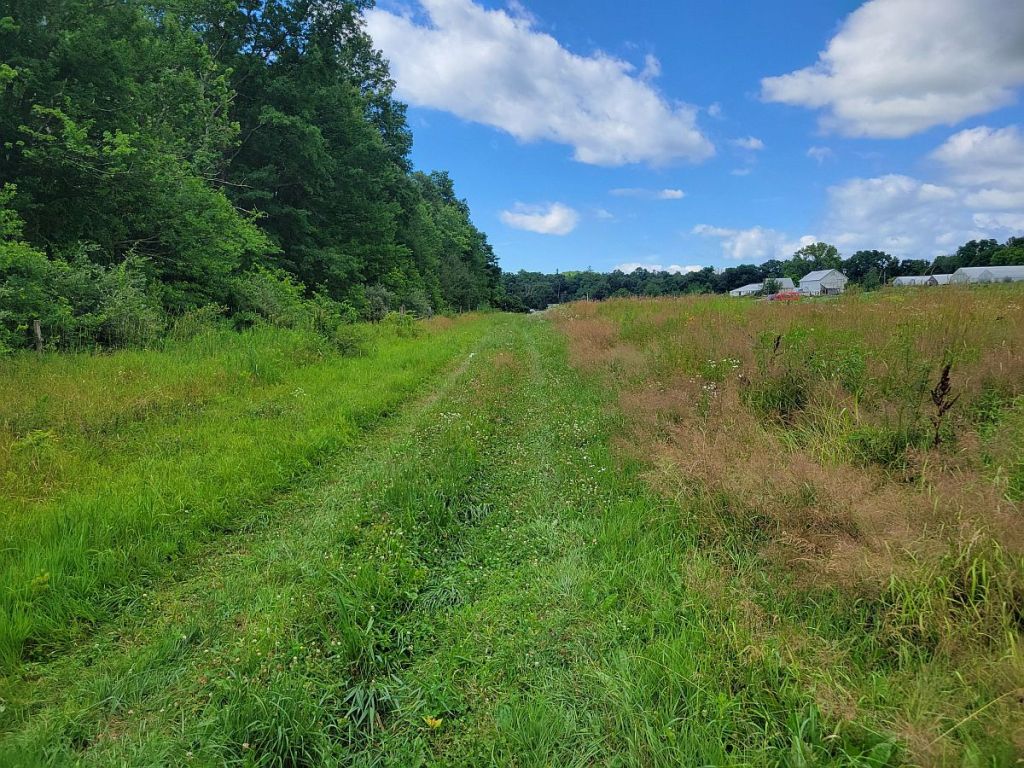
However, the old field patches at the west and east end of the farm, as well as the fence line did support more species of native asters than I had found at any of the other farms this summer. In addition to the species already mentioned above, Lance-leaved Aster (Symphyotrichum lanceolatum) was probably the most common of all asters in many places along the fence line and in unmowed interior areas, and Heart-leaved Aster (S. cordifolium) occurred mostly along the southern fence line.

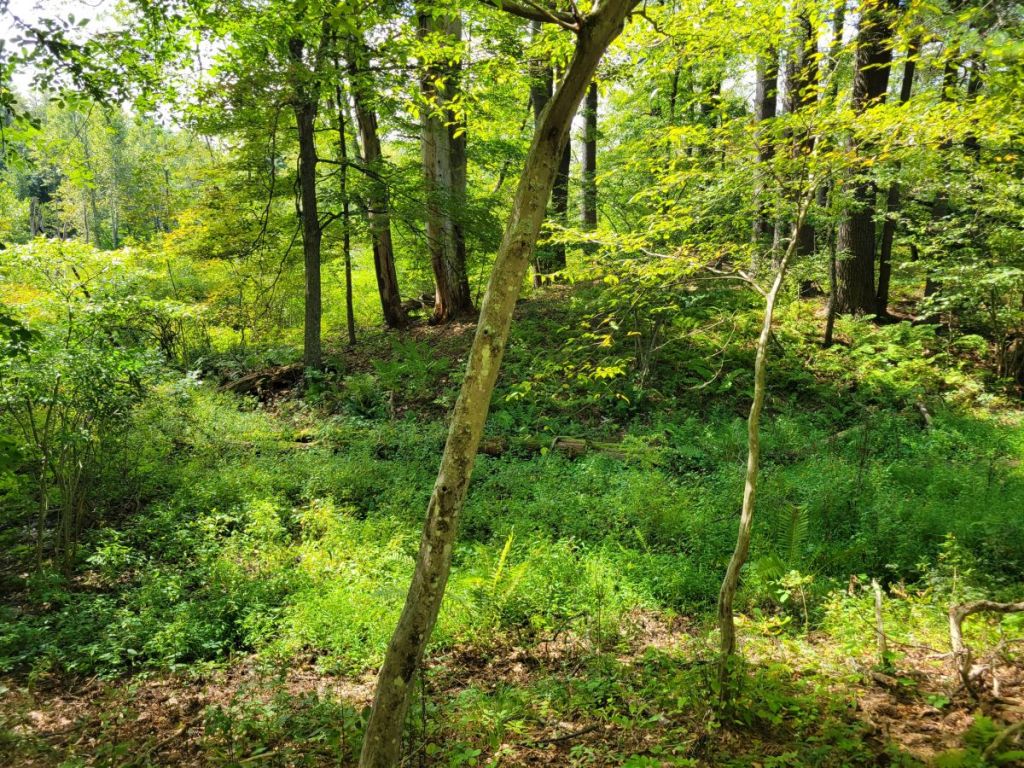
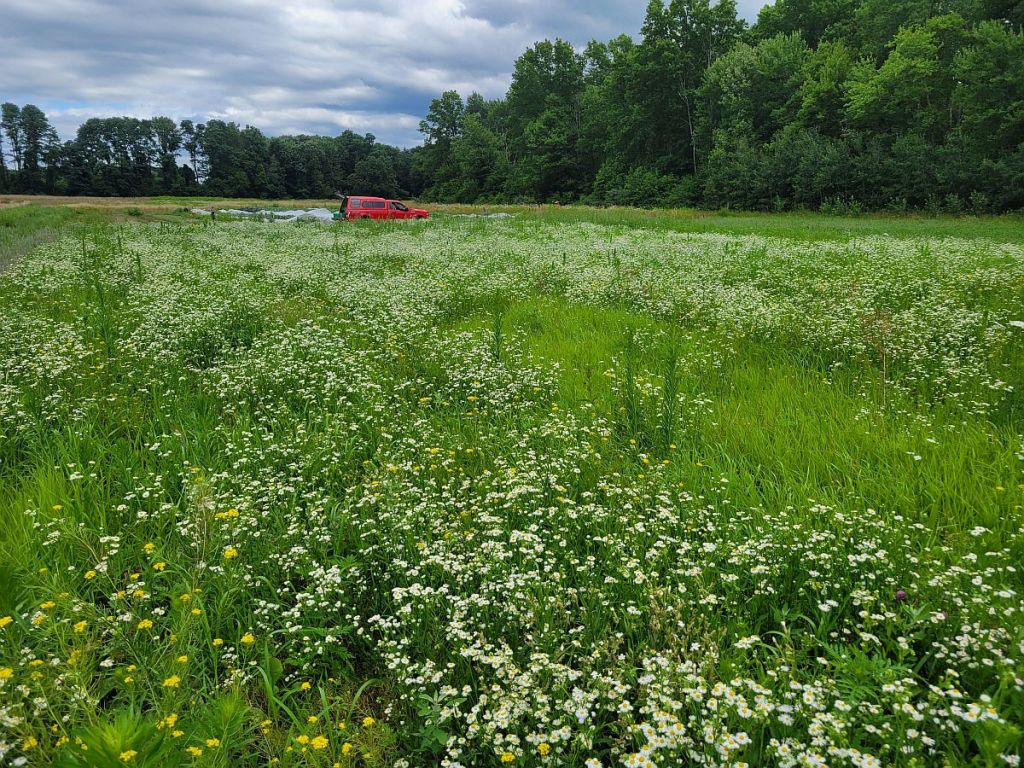
The old field patch on the west side of the farm (#1)

Plants at Churchtown Dairy

by Claudia

This blog shares some of the botanical observations from Churchtown Dairy on 19 July 2024. Will had visited the farm separately and written about the “Birds of the prairie” at this farm in his blog posted on 13 October 2024.

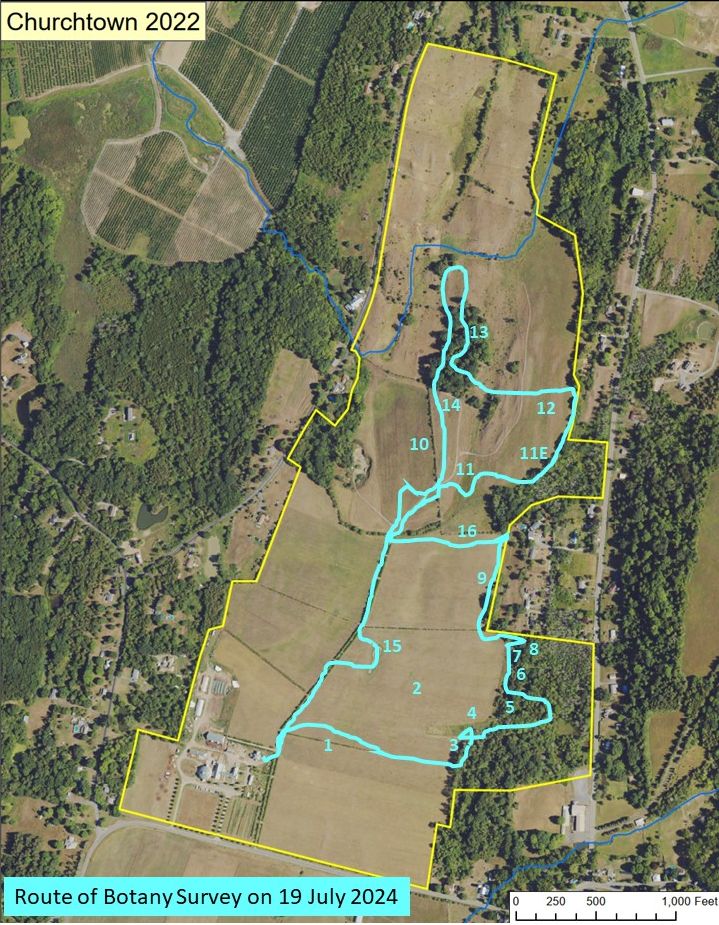
The following map shows the approximate route walked for the botany survey. The numbers (referenced throughout this blog) indicate places where botanical observations were made or pictures were taken.

Map of the approximate plant survey route (in sky blue). The numbers (referenced throughout this blog) indicate places where botanical observations were made or pictures were taken.

Let us begin by sharing some habitat images from the farm:

By far the largest amount of the farmland north of Route 12 is currently dedicated to pasture (view from #7 looking west).
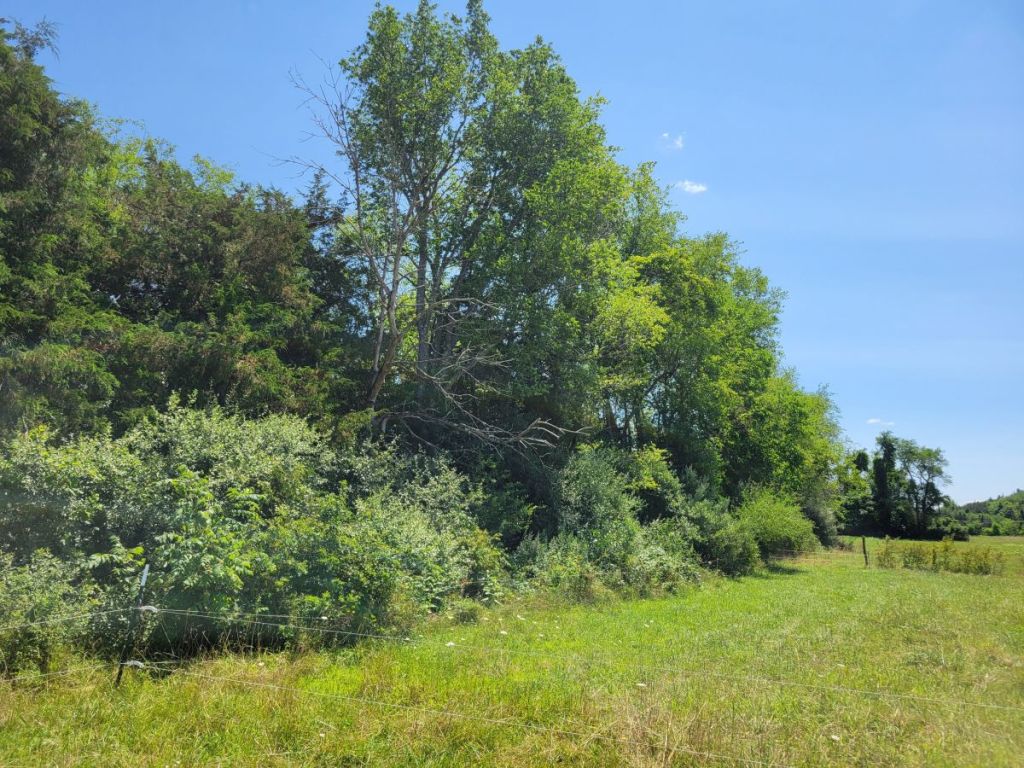
On the east, the pastures border mostly young forest and have a shrubby edge (#3).
There are also pockets of wetlands along the eastern boundary (#4).
Throughout the farm there are some long-established hedgerows dividing the fields (this is the view from #16). More recently planted hedges flank the main farm road.
The northern part of the farm is hilly (view north from #13)
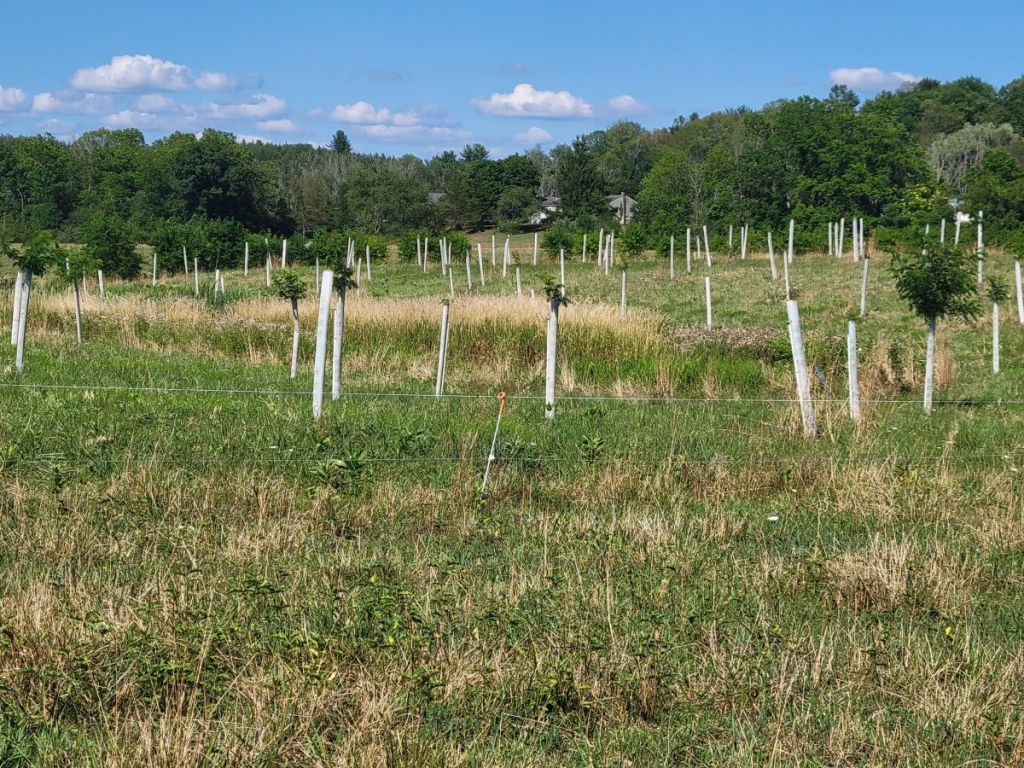
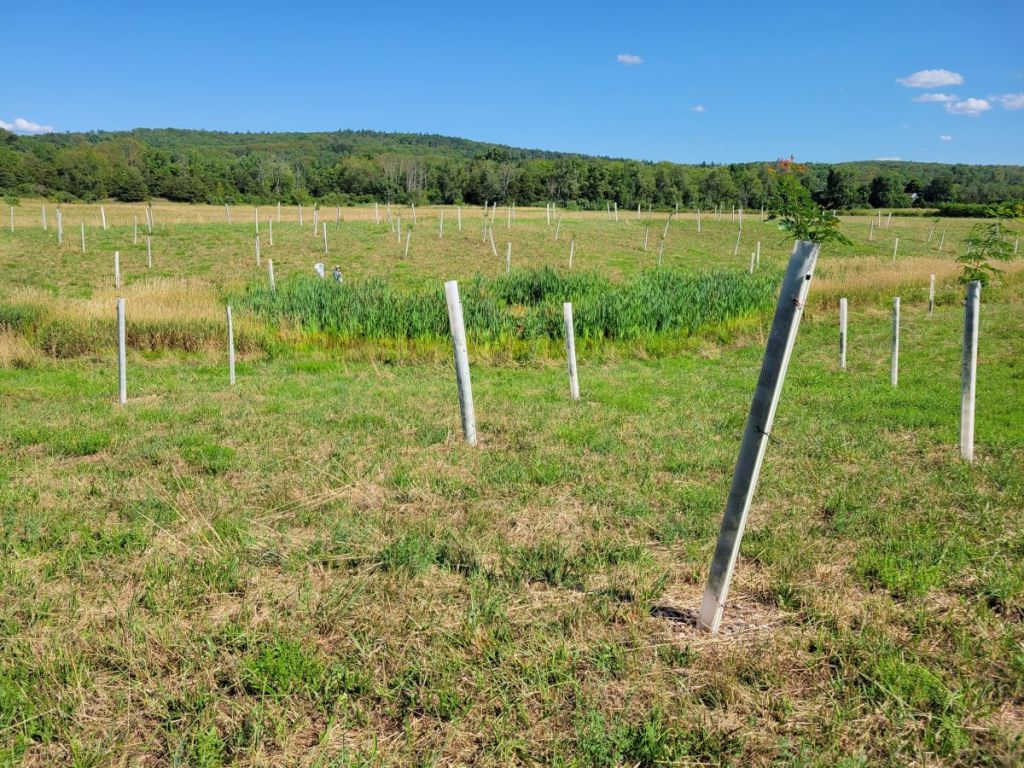
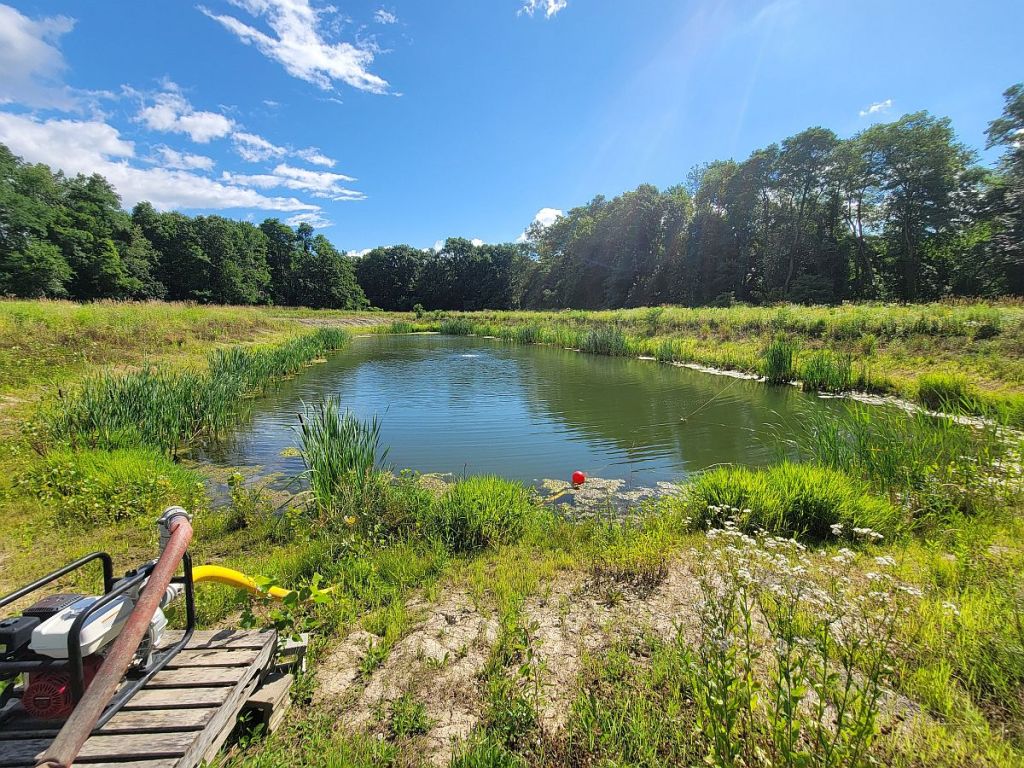
There are also a couple of ponds. This smaller one (#15) is surrounded by a recent tree planting for silvopasture.

After this brief visual introduction to the farmland at Churchtown Dairy, we’ll go into more botanical detail.

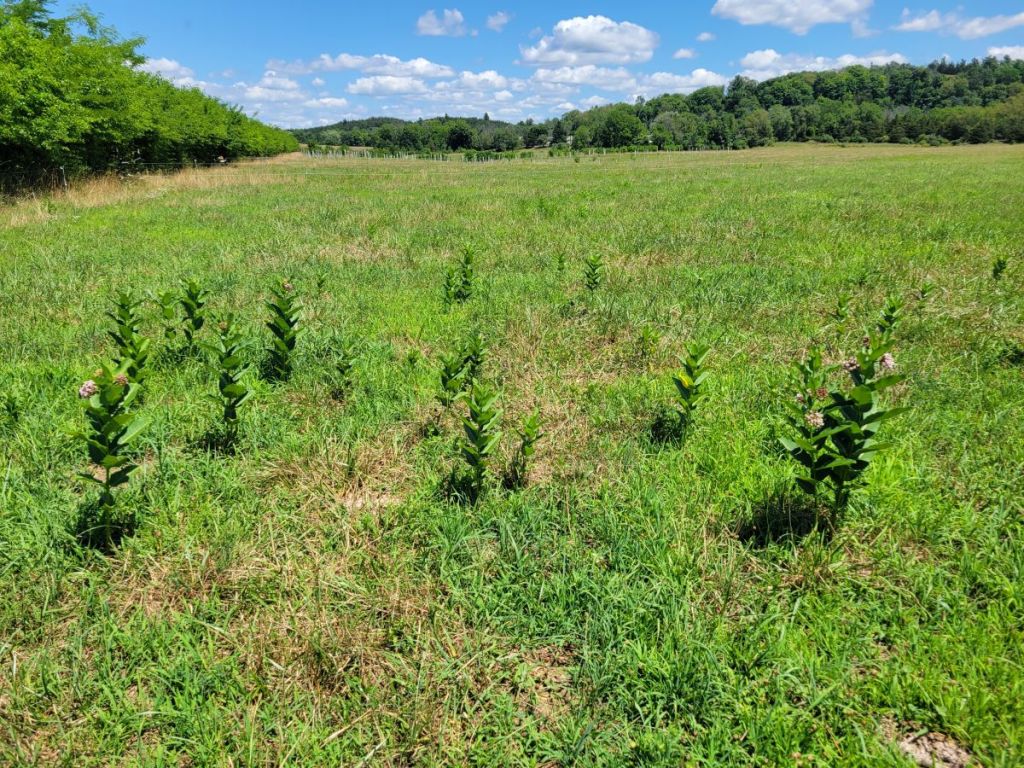
Most of the pastures were closely-grazed at this point. As typical for pastures and hayfields in our region, most of the plants in the pastures themselves were European species of grasses, legumes, and other common plants of perennial agricultural meadows. One exception stuck out immediately: many of the pastures had patches of Common Milkweed, a wildflower native to North America and one of the host species for Monarch caterpillars, as well as a number of other native milkweed-specialists. It was nice to see that the milkweed plants across the farm were at different stages of development, some going to seed, some in mid-bloom, and some just beginning to put out new leaves after having been grazed or clipped. Maintaining such diversity of developmental stages throughout the growing season is beneficial for the insect community, because it ensures the availability of a variety of resources (ranging from tender leaves for young caterpillars to nectar for adult butterflies and many other insects) for an extended time period (compared to the scenario were all plants of a species mature and go to seed at the same time).

Common Milkweed plants in a pasture (#2)

The hedgerows and forest edges bordering the pastures were composed of a variety of native and non-native woody plants. The hedgerows bordering the central laneway and separating some pastures had been planted relatively recently (10-20 years ago) with a small selection of species, including Osage Orange and Honey-locust (both considered native to areas south of here), and hawthorn and hazel (species and native status uncertain). However, the longer-established hedges and field edges supported wild-growing, native Staghorn Sumac…

One of the long-established hedgerows, including Staghorn Sumac

… Red Cedar …

Another one of the long-established hedgerows, including Red Cedar

… and even an occasional stately oak (pictured here is a Red Oak, whose leaves were partly eaten by Spongy Moth caterpillars)…

A field edge with a big Red Oak

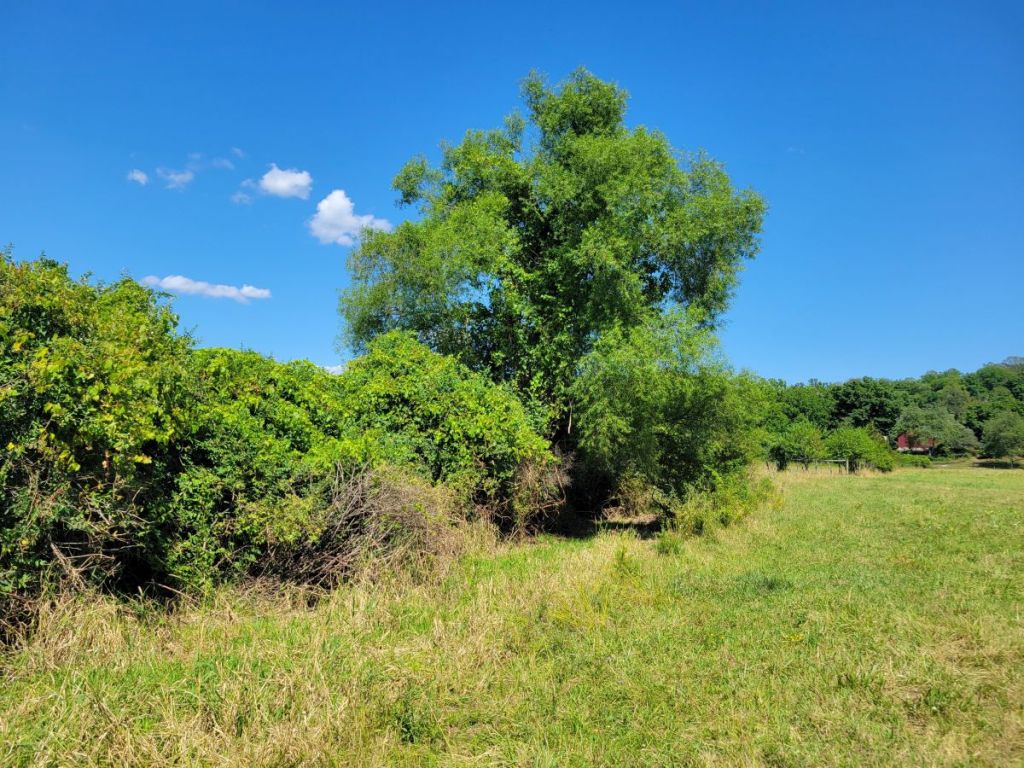
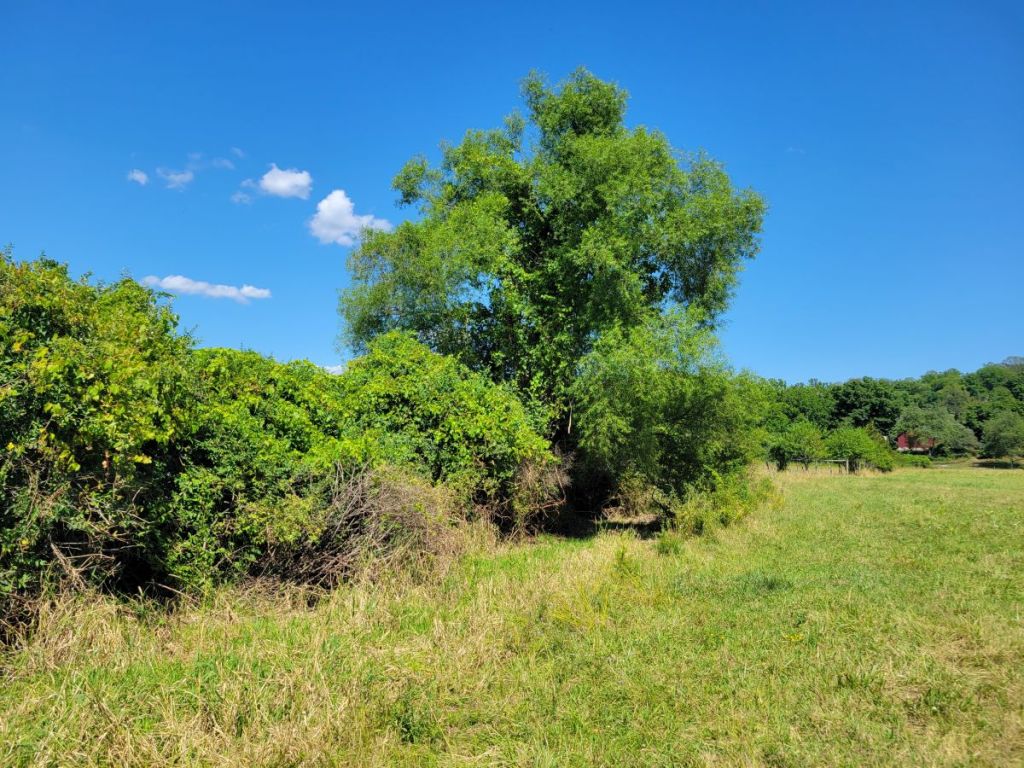
… and a willow, probably the native Black Willow (Salix nigra).

A long-established hedgerow with a big willow tree

Non-native, invasive shrubs, such as Eurasian shrub honeysuckle (Lonicera morrowii or L. x bella), Multiflora Rose, Common Buckthorn, Autumn Olive, and Oriental Bittersweet were also quite common in many of the hedges and field edges.

A field edge with a variety of invasive shrubs

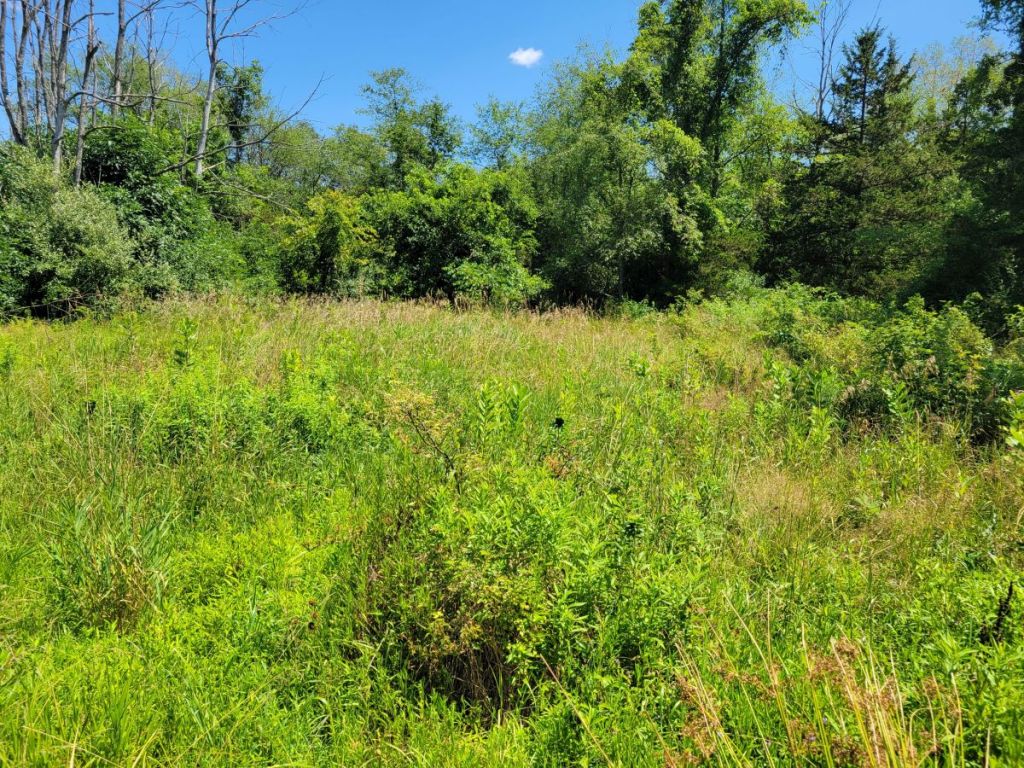
There were a few small wet meadow areas at Churchtown Dairy, such as the one in the next picture at the east end of D6 (#4 on the aerial photograph). These wet meadows support vegetation very different from that in the adjacent upland pastures. European species are also a component of these wet meadows and some, such as the invasive Reed Canary Grass, seen on the left in this image, can be quite common. However, these wet meadows are also important reservoirs of native biodiversity, because they harbor a number of native wildflowers, grasses, sedges, and ferns, which are not found anywhere else on the farm.

Wet meadow (#4)

Rough-leaved Goldenrod (Solidago patula) is one example of a regionally uncommon native species I stumbled across in the wet meadow east of D6. This goldenrod, which typically occurs in calcium-rich wetlands, does not grow in dense, rhizomatous colonies like its more common cousins typical of old fields. Instead, a few (eventually) flowering stalks emerge from a cluster of large basal leaves that have the texture of sandpaper.

Rough-leaved Goldenrod (Solidago patula)

One part of the wet meadow east of D6 supported a colony of Sensitive Fern and cattails (both native species), in addition to a patch of the invasive Reed Canary Grass visible in the front right of the image.

Wet meadow (#4)

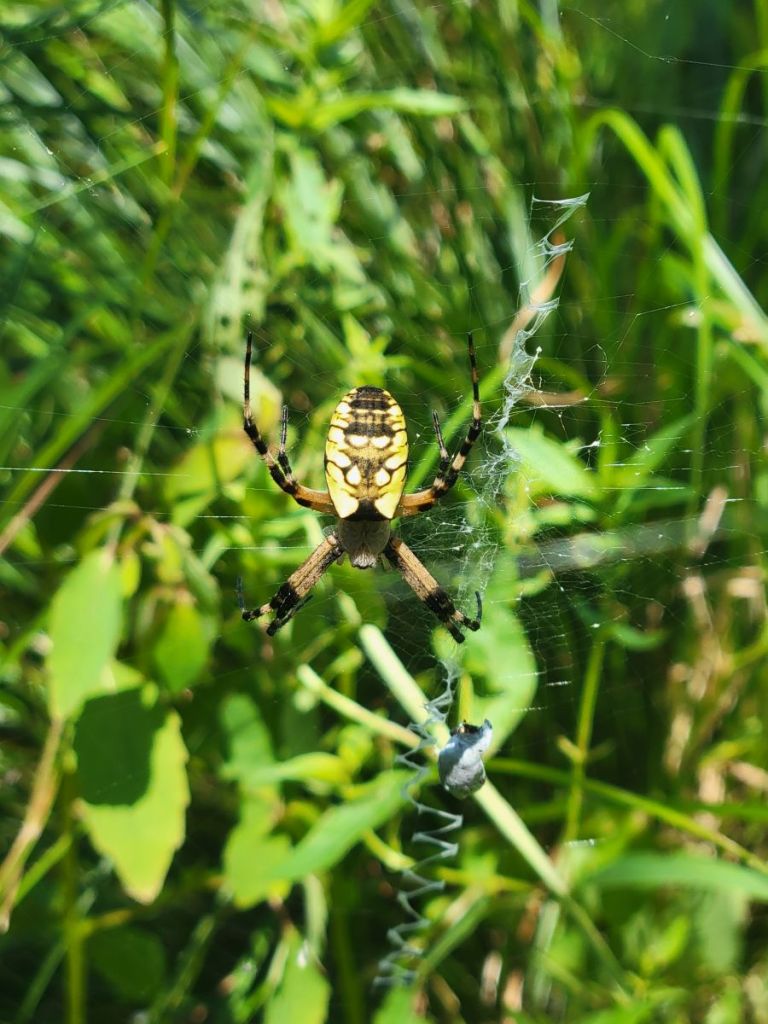
The Black-and-Yellow Gardenspider (Argiope aurantia) builds its net in tall, undisturbed vegetation, and the wet meadow provided ideal habitat for this gorgeous hunter.

Black-and-Yellow Gardenspider (Argiope aurantia)

Another beautiful small example of a species-rich wet meadow was found in the drainage southwest of the Bobolink Field (#11). Note the diverse textures and colors in this habitat!

A small wet meadow (#11)

A closer look reveals the native species Woolgrass (Scirpus cyperinus; in front left), Smooth Goldenrod (Solidago gigantea; yellow flowers), Common Boneset (Eupatorium perfoliatum; white flowers), Blue Vervain (Verbena hastata; purple flowers), and Tussock Sedge (Carex stricta; in front right).

A closer look at a small wet meadow (#11)

Back at the east edge of D6-11, I entered the forest and found small areas of swamp forest (#5) where the canopy was dominated by Red Maple trees.

Swamp forest (#5)

Rough-leaved Goldenrod grew here and there in the understory. 

Rough-leaved Goldenrod (Solidago patula)

Unfortunately, the invasive Japanese Stiltgrass had also established itself in this forest (as well as in the “grove”). This grass is currently one of the most rapidly spreading non-native species in our region and there don’t seem to be any “silver bullets” for its control. It is an annual grass with wiry stems and relatively broad (and short!) leaves, which often have a broad white line along their midrib.

Japanese Stiltgrass (Microstegium vimineum)

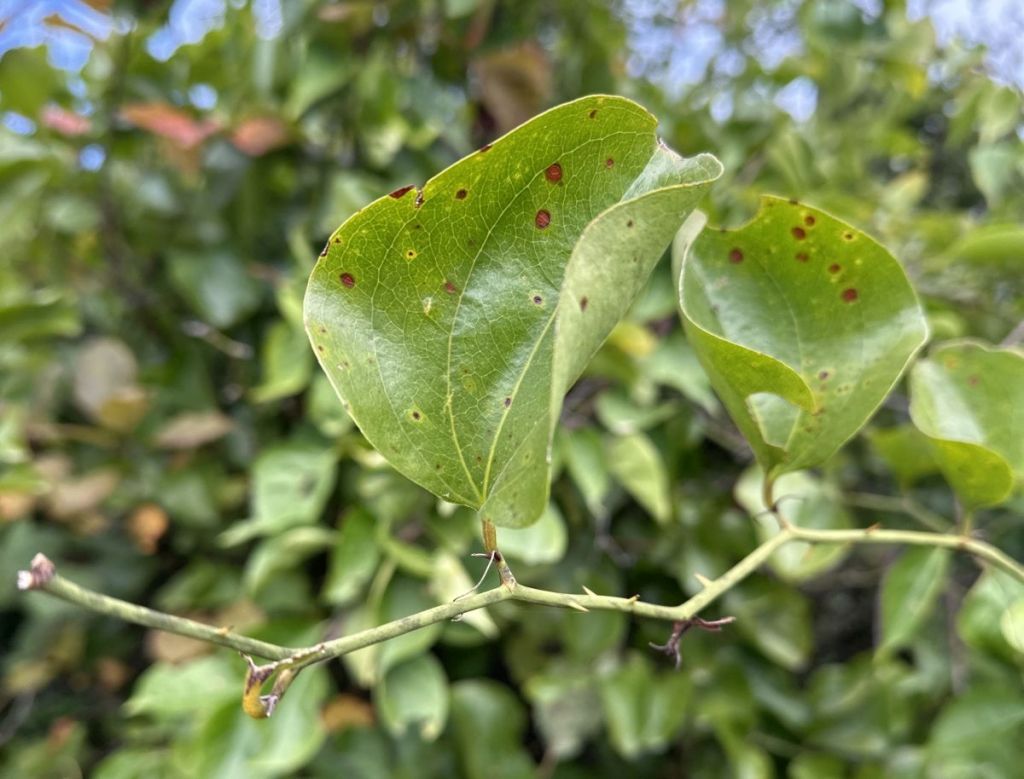
Black Swallowwort (Vincetoxicum nigrum) is an invasive vine with opposite, shiny oval leaves, small, dark purple flowers, and seed pods reminiscent of milkweeds. It was found only in small numbers at Churchtown Dairy. Scattered plants were spotted in the swamp forest and wet meadow east of D6-11, as well as in the “grove.” This might be an invasive species still rare enough on the farm that its spread could be curtailed by systematically pulling it out, whenever it is encountered.

Black Swallowwort (Vincetoxicum nigrum)

Another potentially troublesome species is this pretty ornamental shrub, Jetbead (Rhodotypos scandens), which probably had jumped the fence onto the young forest on the farm’s land from one of the neighboring yards. I had never seen it growing wild in Columbia County, but was told that it had spread throughout Central Park and might become more assertive in our region, in the future… This might be another species to discourage early on wherever it shows up on the farm.

Jetbead (Rhodotypos scandens)

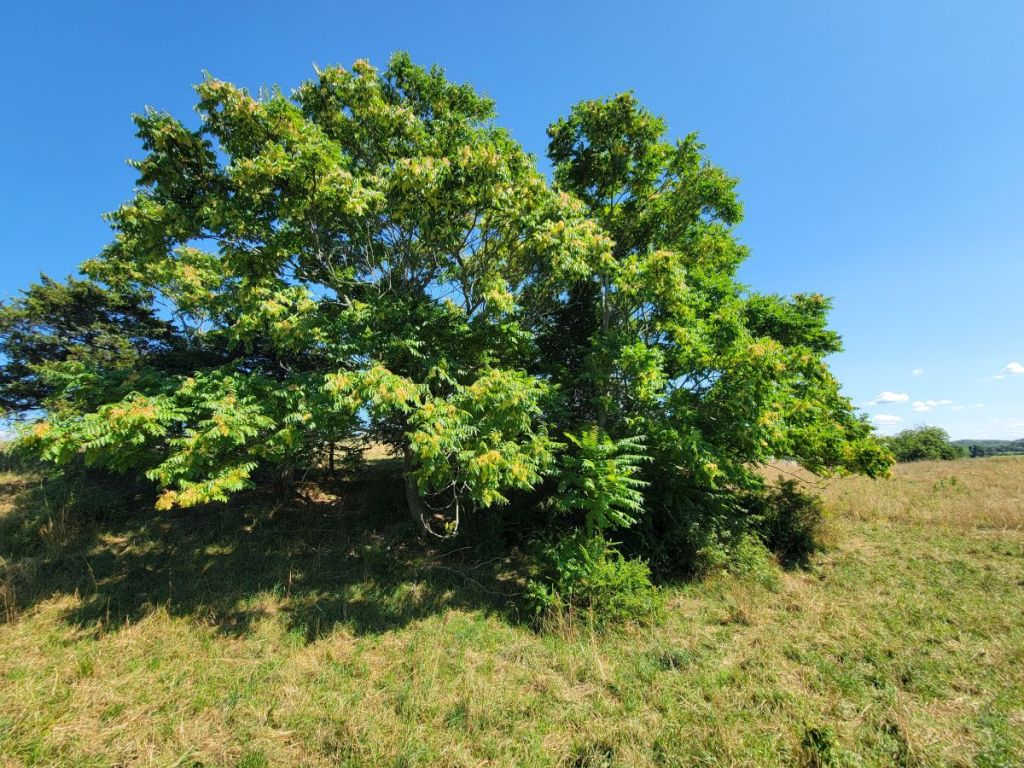
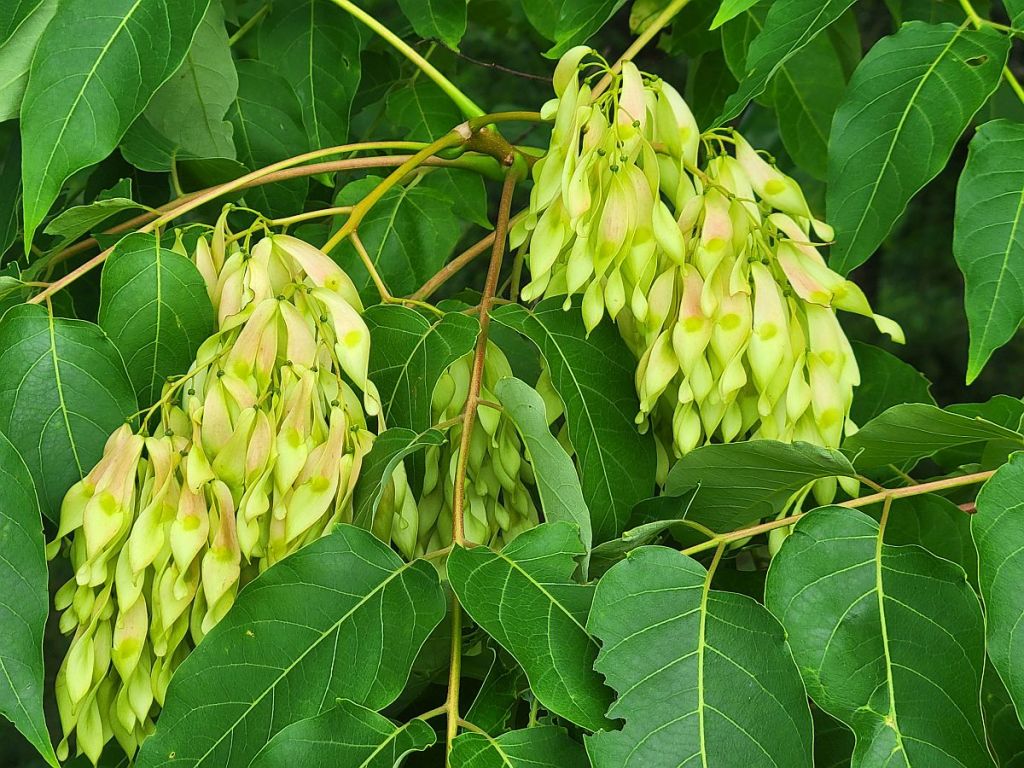
Tree-of-Heaven is the last invasive species I want to mention. It currently occurs at a low enough density at Churchtown Dairy, that its further spread might be avoided by removing the seed-producing trees, like this one next to the “grove.” Unfortunately, if a Tree-of-Heaven is felled, its roots tend to produce sprouts which—if unchecked—can result in an entire colony of new trees. Therefore, it is important to continue to annually monitor and—if needed—manage the site where an adult tree has been felled or girdled.

Tree-of-Heaven (Ailanthus altissima); this specimen was found between #12 and #13

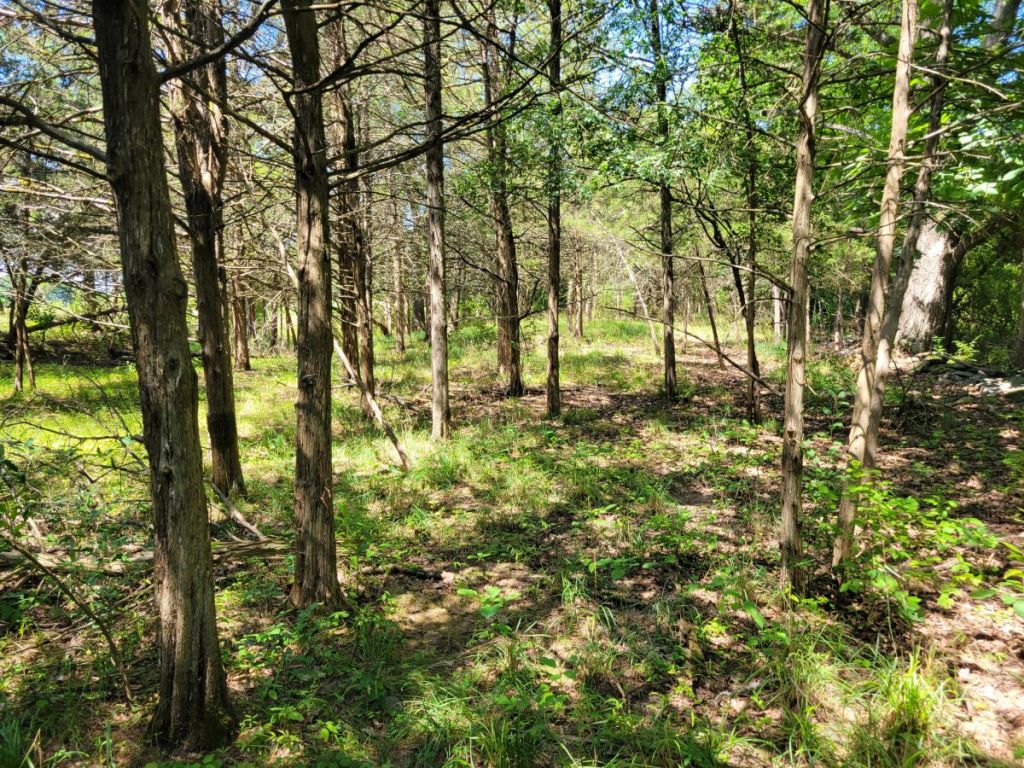
Returning to the east edge of D6-11, after emerging from the swamp forest, I entered a small stand of Red Cedar trees (#6), which seemed to serve as an occasional forest pasture. I made no exciting native plant discoveries in this habitat.

Red Cedar forest (#6)

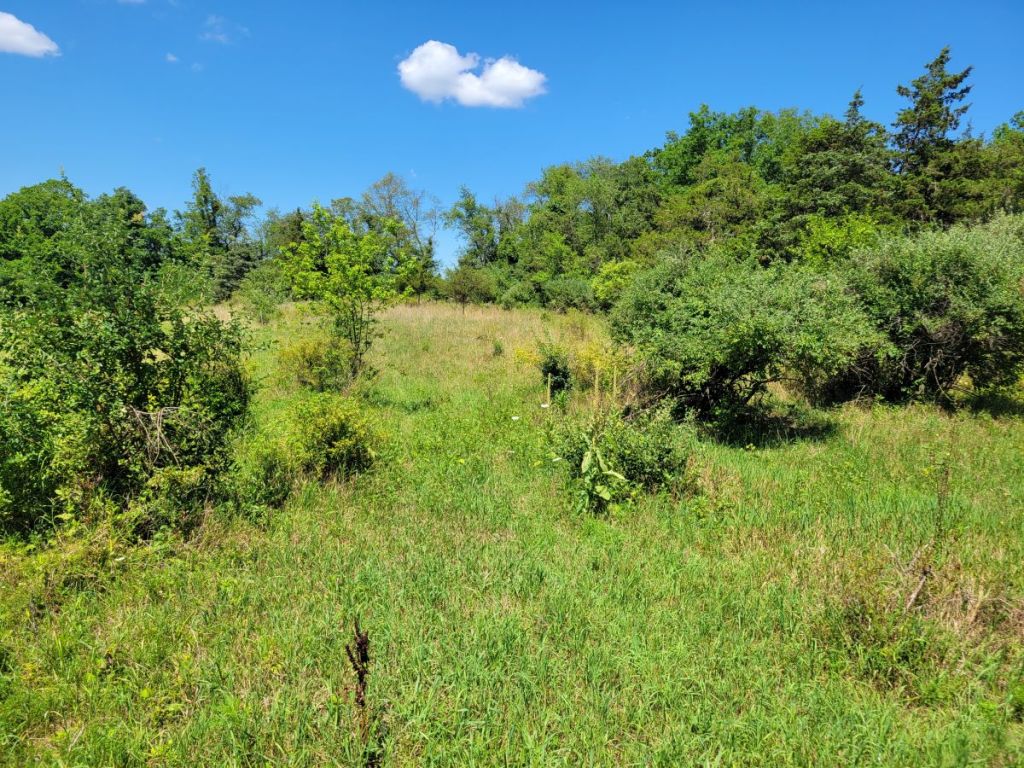
Emerging out of the Red Cedar forest, I found myself on the hilly, eastern section of pasture D11 (#7). Although dry pastures like this sometimes harbor uncommon native plants, I did not observe any noteworthy native species here, either.

Dry pasture (#7)

Eventually, I found myself in the “Bobolink Field,” (#12) a hay meadow cut late in the season to give ground-nesting Bobolinks enough time to raise their young. Like in the pastures, the vegetation in this field was mostly composed of European grasses and—to a lesser extent—legumes.

Late-cut hayfield (#12) which is managed to accommodate ground-nesting birds.

Another wetland, this one dominated by shrubs and trees, including Swamp White Oak, Green Ash (many dying), and Red Maples, borders the “Bobolink Field” on the east. Native shrubs, such as Winterberry, Arrowwood, Silky Dogwood, and Wild Raisin, occur side-by-side with the common invasive shrubs that dominate the understory.

Wetland (#11E)

Spotted Joe-Pye-weed grew along the herbaceous edge of this wetland and also in some of the other wet meadows along the eastern edge of the farm.

Spotted Joe-Pye-weed (Eutrochium maculatum)

The “grove” (#13) is the only forest at Churchtown Dairy (at least north of County Route 12) that grows on land that seems to have never been completely cleared. It harbors some exceptionally large specimens of Hop-hornbeam trees and some beautiful White Oaks. At the north end, there are several Common Pear trees and Pignut Hickories. Although hardly an “old-growth” forest, this woodland fits our definition of an “ancient forest,” whose soils have not been homogenized by the plow. Therefore, they might have the potential to support soil life and understory plants that are slow to recolonize post-agricultural forests. However, its current understory vegetation is mostly composed of invasive species and European plants typical of nutrient-enriched barn yards. This is likely due to the recent use of this woodland as a pig pasture.

The “grove” (#13) might be an example of an ancient forest.

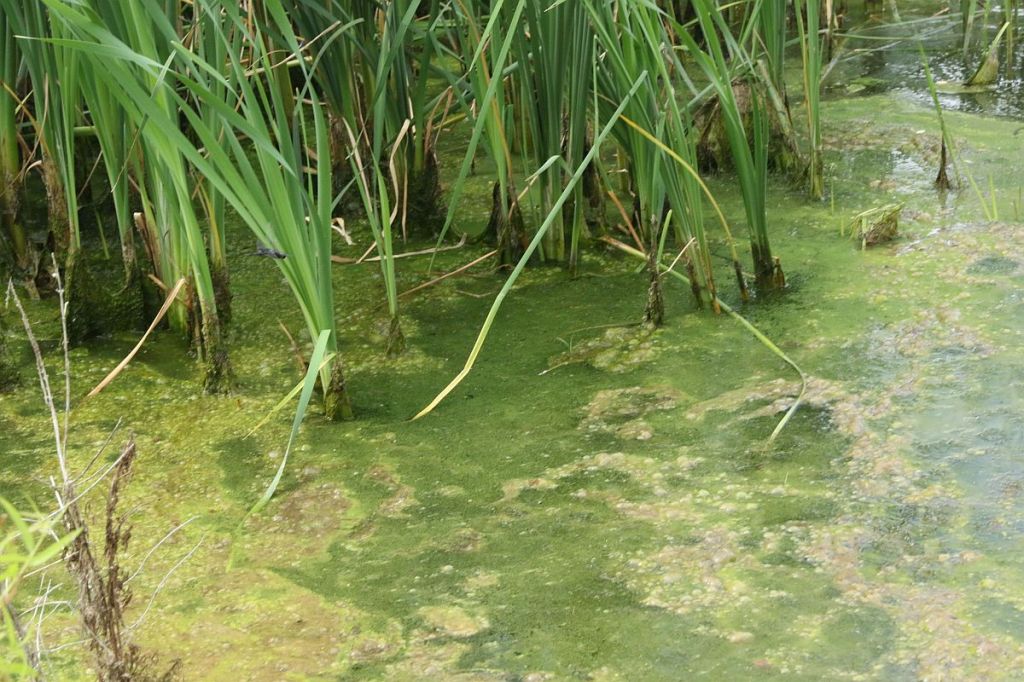
On the way back to the barns, I took a quick detour to this small, marshy pond (#15), which had very little open water. Cattails (tall green vegetation at the center) were growing in a wide band around the shore and were flanked by patches of Reed Canary Grass (tall tan vegetation left and right of the cattails). Closer inspection revealed several native wetland plants we had not noted in the other areas surveyed for plants at Churchtown Dairy that day. They included the regionally common: Water Purslane, Nodding Bur-marigold, and Soft Bulrush.

A small, marshy pond (#15) harboring some unique wetland plants

Botanical Survey of Wild-growing Plants at the Hudson Valley Seed Company

by Claudia (with Josie)

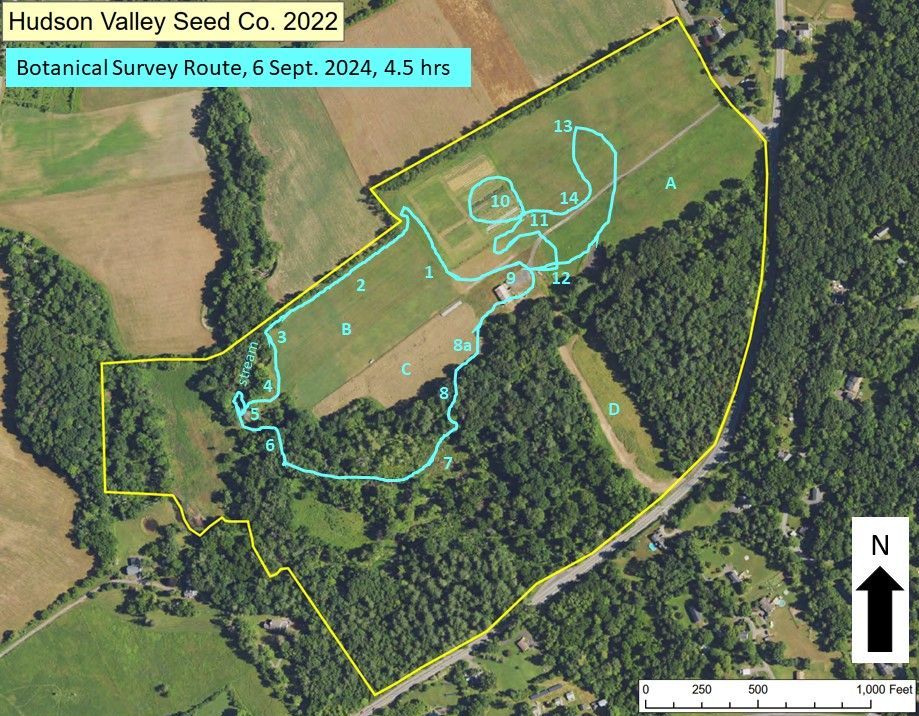
On 6 September 2024, we spent ~ 4.5 hours documenting the wild-growing plants of a cross-section of habitats at the new site of the Hudson Valley Seed Company on Airport Road in Accord. The following image highlights the approximate route taken and numbers observation points we will refer to throughout the blog.

We began our survey along the west and north edges (#1 & #2) of a large tilled field.  We found the usual field edge/hedgerow mix of common native and non-native plants. Half of the 20 invasive species recorded on the property were also represented in this area: Oriental Bittersweet (Celastrus orbiculatus), Eurasian shrub honeysuckle (Lonicera morrowii or L. bella), autumn-olive (Elaeagnus umbellata), Japanese Barberry (Berberis thunbergii), privet (Ligustrum sp.), Winged Burningbush (Euonymus alatus), Black Locust (Robinia pseudoacacia), Japanese Stiltgrass (Microstegium vimineum), Mugwort (Artemisia vulgaris), and Canada Thistle (Cirsium arvense).

Hedgerow and unmowed field along northern boundary (#2 on map)

We also found an abundance of the native (but sometimes over-enthusiastic) spiny vine, Common Greenbrier (Smilax rotundifolia). Its fruits ripen in the autumn and somewhat resemble grapes, and some people consider them edible (I have never tried them). However, there are amply references on the internet of people eating the tender shoots in spring, and also using the dried roots to make a starchy powder used in a variety of ways.

Common Greenbrier (Smilax rotundifolia)

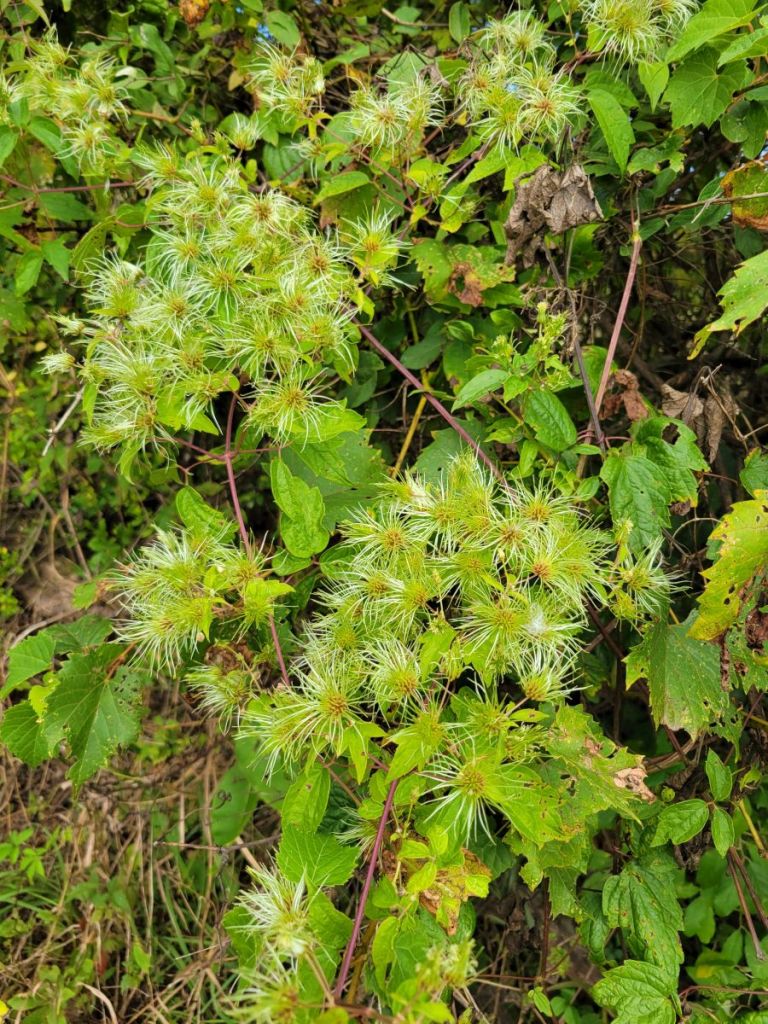
These fuzzy little seed heads belong to another native vine, Virgin’s Bower (Clematis virginiana). It is related to buttercups and, like many plants in that family, has secondary compounds that are poisonous/medicinal (depending on dosage).

Virgin’s Bower (Clematis virginiana)

Several tall Bitternut Hickory (Carya cordiformis) trees could easily be identified by their thin-husked fruit with four “seams.” The related Shagbark Hickory (C. ovata) has a much thicker husk and Pignut Hickory (C. glabra) does not have the pronounced “seams.”

Bitternut Hickory (Carya cordiformis)

Black Walnut (Juglans nigra) was also present in the field margin (#3) and down near the stream. In the southern field margin (#8a), we also found Butternut (Juglans cinerea). These two, closely-related native species of walnuts are easily distinguished when fruits are present: the fruits of Black Walnut are almost round, while those of Butternut are more elongated (think of a stick of butter!).

Black Walnut (Juglans nigra)

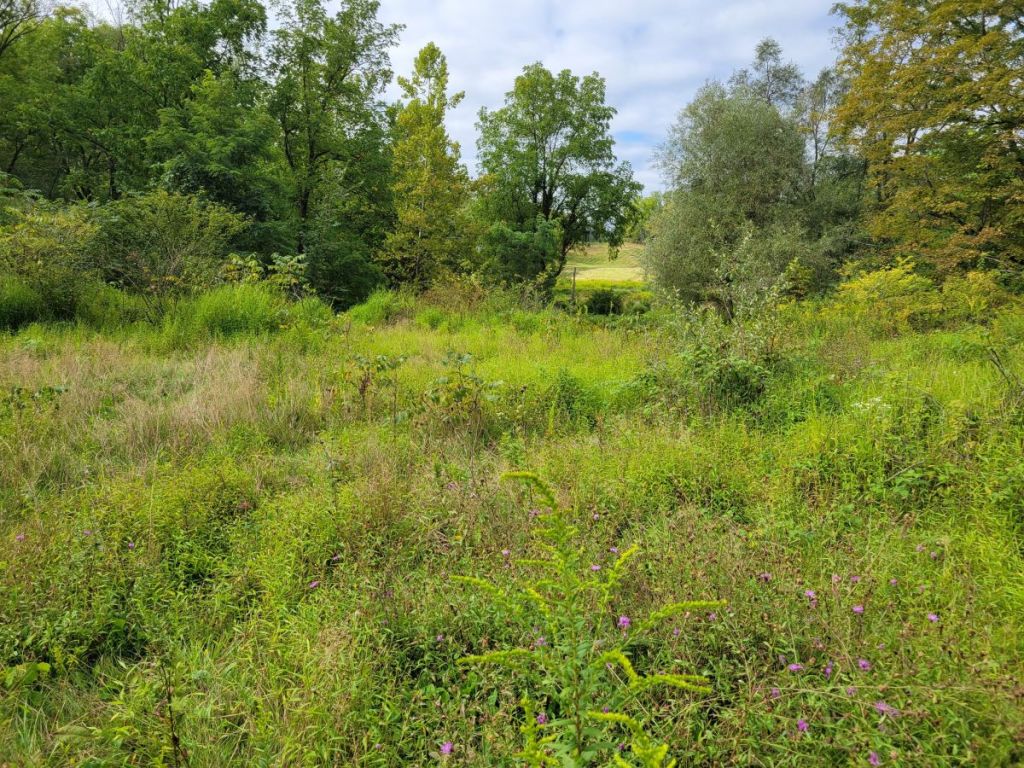
At the west end of the big field, we found an unmowed meadow sloping down to the stream. The dry part of this meadow (#4) was dominated by two invasive species, Japanese Stiltgrass (Microstegium vimineum) and Brown Knapweed (Centaurea jacea; purple, thistle-like flowers visible on the bottom right in the image).

Unmowed meadow (#4 on map) on west end of farm, above stream

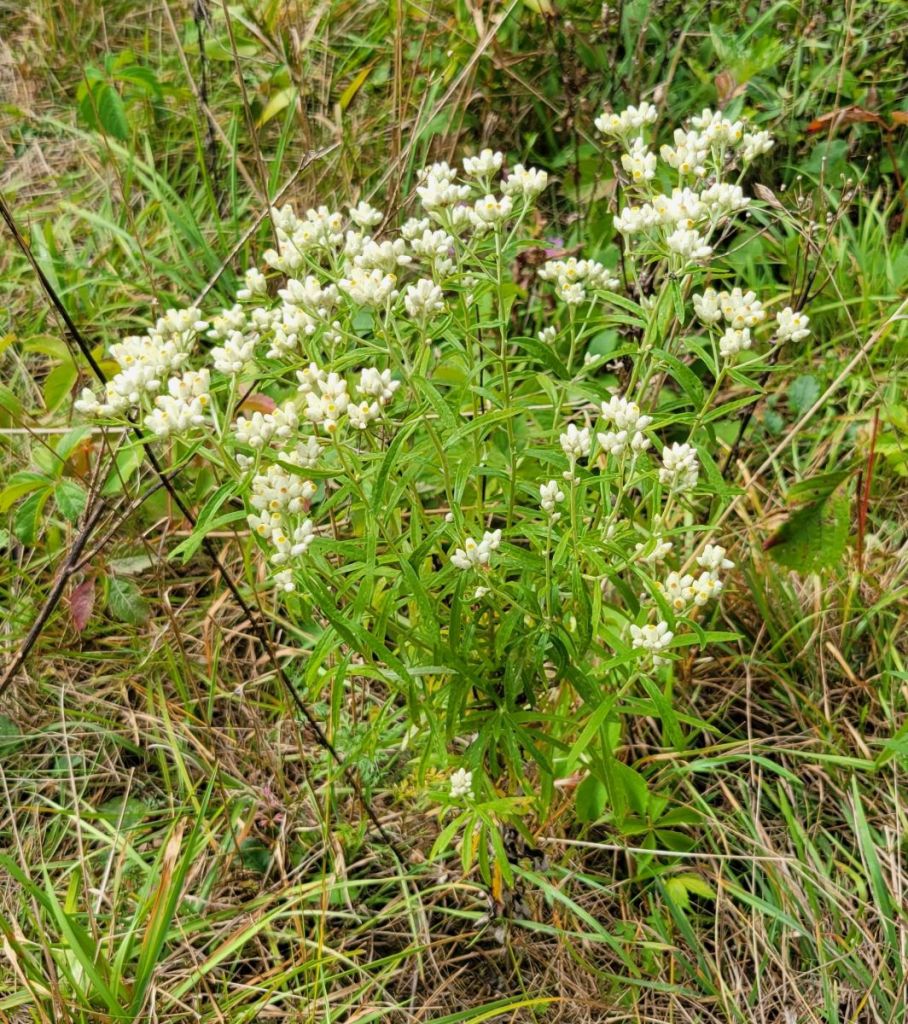
However, there was also a nice clump of the Fragrant Rabbit-tobacco (Pseudognaphalium obtusifolium), as well as a smattering of other native species, including Wild Bergamot (Monarda fistulosa) and one of the common oldfield asters, possibly Pringle’s Aster (Symphyotrichum pilosum var. pringlei).

Fragrant Rabbit-tobacco (Pseudognaphalium obtusifolium)

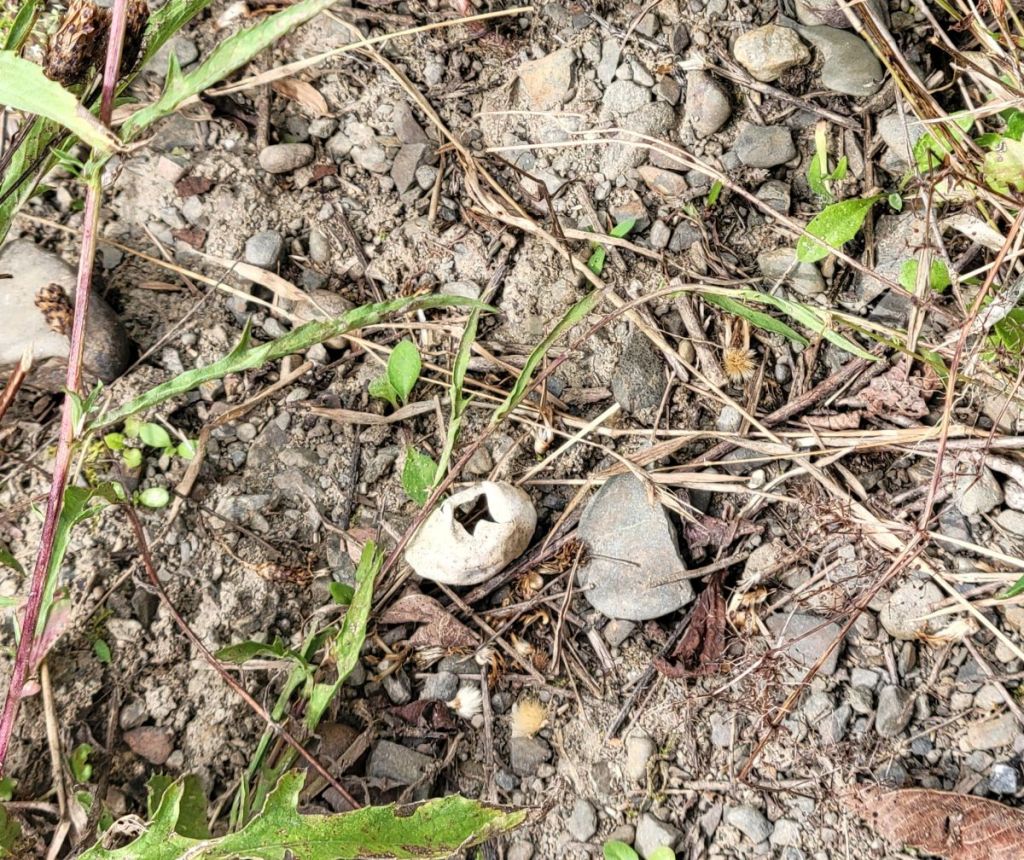
On the dry slope leading down to the stream, we also discovered a turtle egg that had been dug out of its underground nest and been preyed upon. We don’t know which turtle species had made the nest here, but the stream and adjacent floodplain forest might be home to the rare Wood Turtle.

Remnants of a turtle egg that had been preyed upon

Further down the slope and closer to the stream, the vegetation was taller and indicative of a wet meadow (#5), including Broad-leaved Cattail (Typha latifolia), Woolgrass (Scirpus cyperinus), and Tall Goldenrod (Solidago altissima). There were also large patches of the invasive Mugwort (Artemisia vulgaris),visible in the foreground of this image.

Wet meadow (#5 on map) near stream

The stream had small gravel bars with a mix of native and non-native plants, including Japanese Knotweed (Reynoutria japonica), visible in the background of this image.

Stream with gravel bars

This wetland (#7), which had a mosaic of shrub swamp and wet meadow, was a bit difficult to move through, but harbored some botanical treats, including many plants of Rough-leaved Goldenrod (Solidago patula), visible in the foreground, one of our less-common goldenrods, which seems to be a good indicator for calcium-rich wetlands.

Wetland (#7 on map)

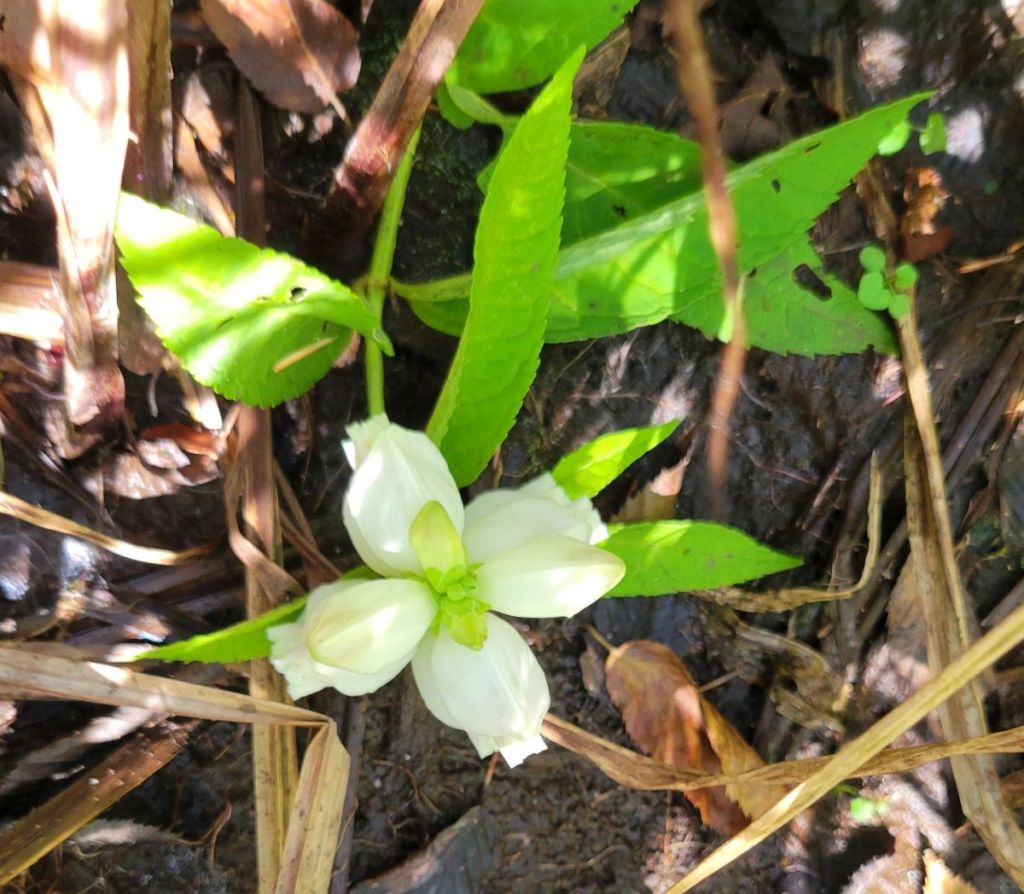
We also stumbled across the Turtlehead (Chelone glabra) in full bloom. The leaves of this species are the preferred caterpillar food of Baltimore Checkerspot butterflies.

Turtlehead (Chelone glabra)

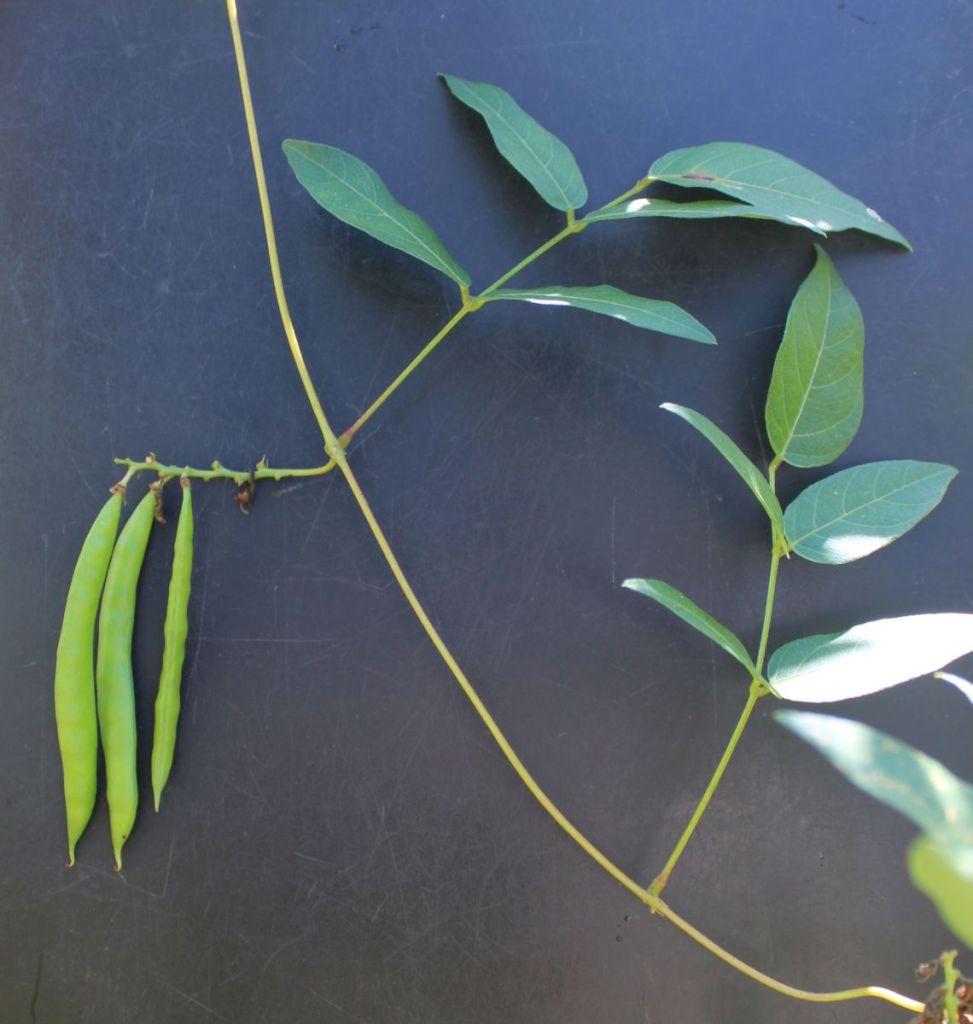
Another exciting find in the wetland was this Groundnut (Apios americana) with fruits. While we occasionally see flowers of this uncommon wetland plant in the Hudson Valley (see blog about the plants at Rose Hill Farm posted on 17 November 2024) it seems to rarely produce seeds in our region. According to Wikipedia, this species has diploid and triploid plants, with seemingly no big difference in their appearance. Only diploid plants (which tend to be more common south of our region) can produce viable seeds, while triploid plants (more common in our region and north of here) rely on vegetative reproduction.

The potato-like tubers of Groundnut are edible and have a long history of use (and likely cultivation) by native Americans.

Groundnut (Apios americana)

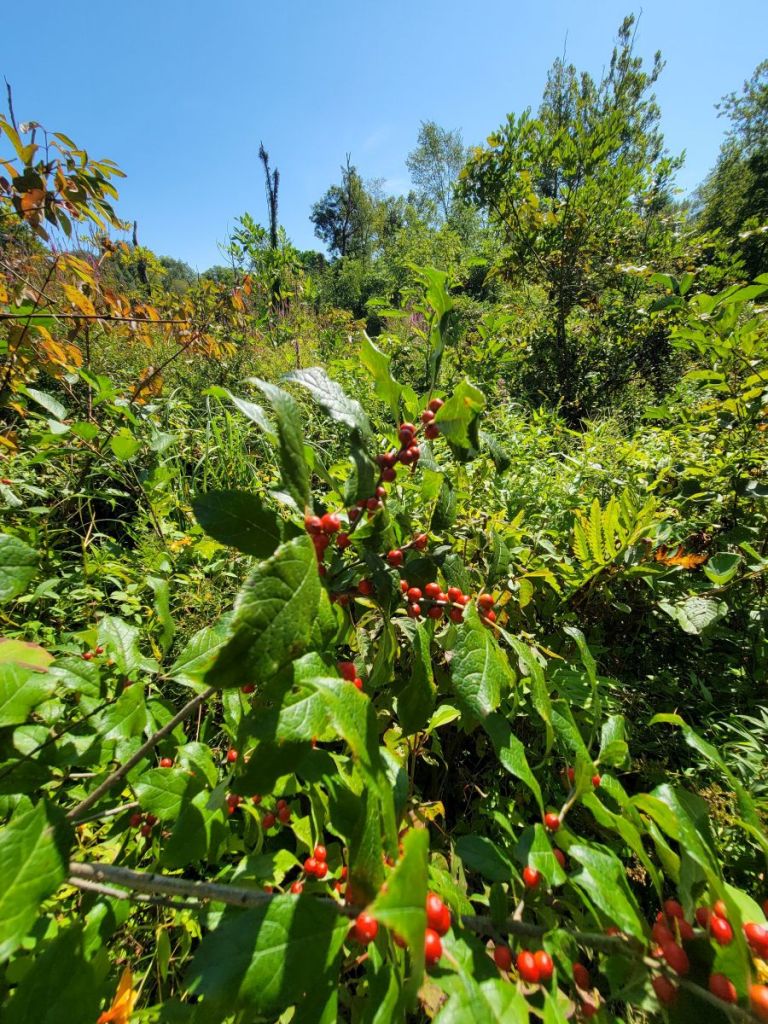
This is a more shrubby part of the wetland with a Common Winterberry (Ilex verticillata) in the foreground.

Common Winterberry (Ilex verticillata)

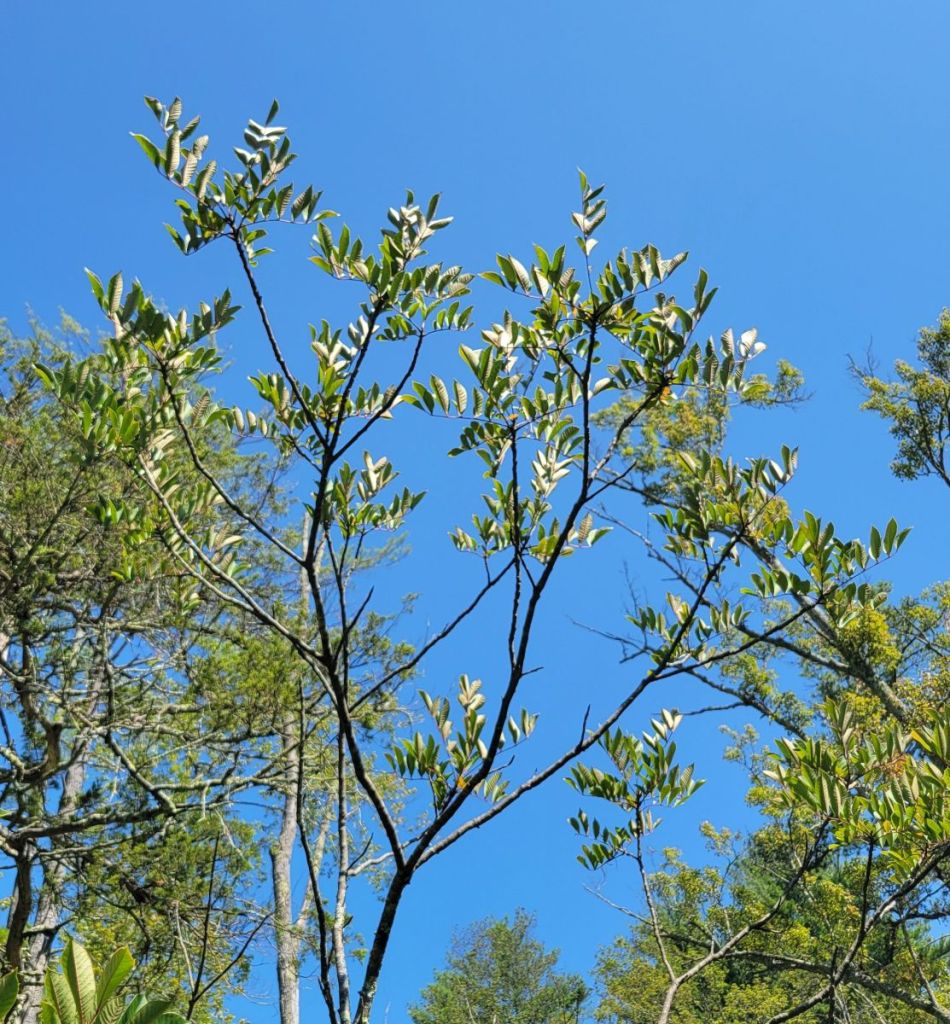
Quite common among the shrubs was Poison Sumac (Toxicodendron vernix), which is an upright-growing plant closely related to Poison Ivy (T. radicans) and has the same rash-inducing urushiol resin. In contrast to our other sumacs (Rhus spp.), which have red berries, the berries of Poison Sumac are white like those of Poison Ivy.

Like the Rough-leaved Goldenrod mentioned earlier, Poison Sumac is considered a good indicator for calcium-rich wetlands.

Poison Sumac (Toxicodendron vernix)

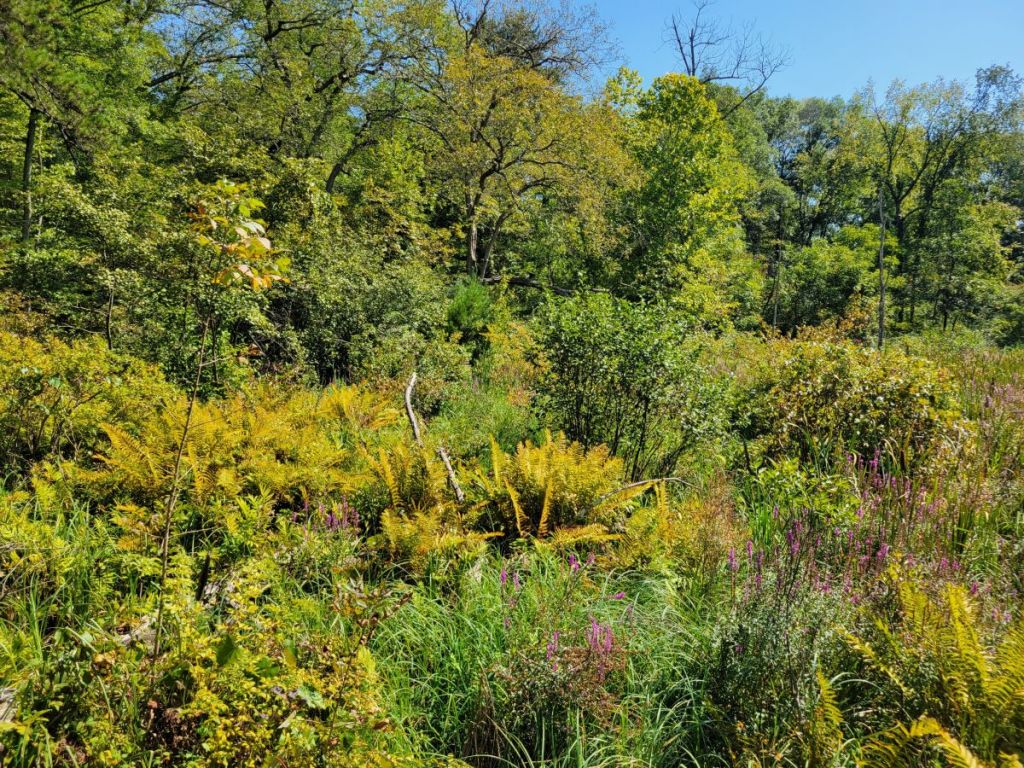
The northern edge of the wetland supported patches of Cinnamon Fern (Osmundastrum cinnamomeum), seen here as yellowish clumps, mixed with a tall, rhizomatous (non-clumping!) native sedge, Lake Sedge (Carex lacustris), and the ubiquitous, invasive Purple Loosestrife (Lythrum salicaria).

Northern edge of wetland (#7 on map)

The edge between the upland forest (#8) and the wetland (#7) is not a straight line. In this picture, a “finger” of low ground with wetland vegetation reaches between two areas of upland forest on higher ground.
Edge between the upland forest (#8 on map) and the wetland (#7 on map)

In the edge to the field (#8a) we found the before-mentioned Butternut tree.

Field edge (# 8a on map)

This field edge also had a small patch of an interesting native plant not seen anywhere else at the Hudson Valley Seed Company, nor at any of the other farms we have surveyed this summer. Flat-topped White Aster (Doellingeria umbellata) is a northern species, common in the Adirondacks and in northern New England, but we rarely see it in the Hudson Valley south of Troy.

Flat-topped White Aster (Doellingeria umbellata)

Near the buildings (#9), we noticed a small “island” of native plants in the vegetation that was otherwise dominated by common European plants.

Small “island” of native plants near buildings (#9 on map)

Early Goldenrod (Solidago juncea), Gray Goldenrod (Solidago nemoralis), and Little Bluestem (Schizachyrium scoparium) might have been seeded here or might have come in on their own. These three species often are found growing together on dry soil.

Early Goldenrod (Solidago juncea), Gray Goldenrod (S. nemoralis), and Little Bluestem (Schizachyrium scoparium)

Yellow and Giant Foxtail (Setaria pumila and S. faberi) were very common in the recently disturbed soil around the new building. Yellow Foxtail has upright, yellow-brown spikes of seeds; Giant Foxtail has light green, nodding spikes.

Yellow and Giant Foxtail (Setaria pumila and S. faberi)
The seed production garden (# 10) of the Hudson Valley Seed Company.

Common Milkweed (Asclepias syriaca; big leaves in picture below) and Indian-hemp (Apocynum cannabinum; small leaves in picture below) were two native plants growing between the cultivated rows (#10). They both belong to the same plant family and have white latex. Both produce flowers that are visited by many pollinators.

Common Milkweed (Asclepias syriaca) and Indian-hemp (Apocynum cannabinum)

The strip of meadow along the north edge of the driveway (#11) had a lot of the native warm-season grass Purple-top (Tridens flavus), while the large hayfield (#13) beyond was dominated by the European cold-season grass Orchard Grass (Dactylis glomerata).

Meadows of different plant composition north of the driveway (#11 and #13 on the map)

 It was nice to see that the Orchard Grass-dominated meadow (#13) had some Common Milkweed mixed in. The fields A, B, and C were all recently-tilled and bare ground during our visit. Field D was an unmowed old field dominated by goldenrods, interspersed by Purple Loosestrife.

Plenty of Common Milkweed was found in one of the meadows (#13 on the map)

Botanical Observations from Rose Hill Farm

by Claudia

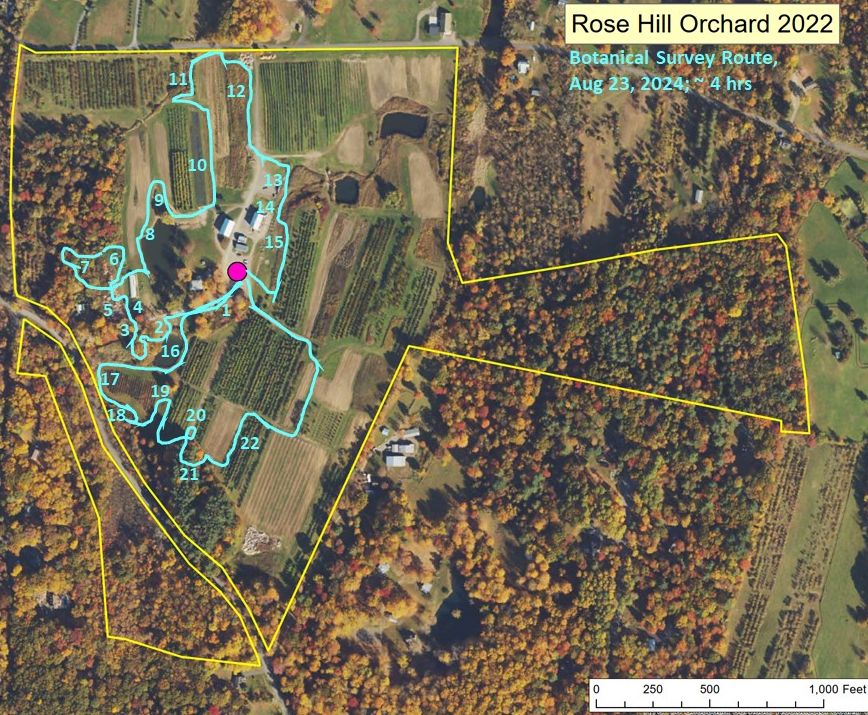
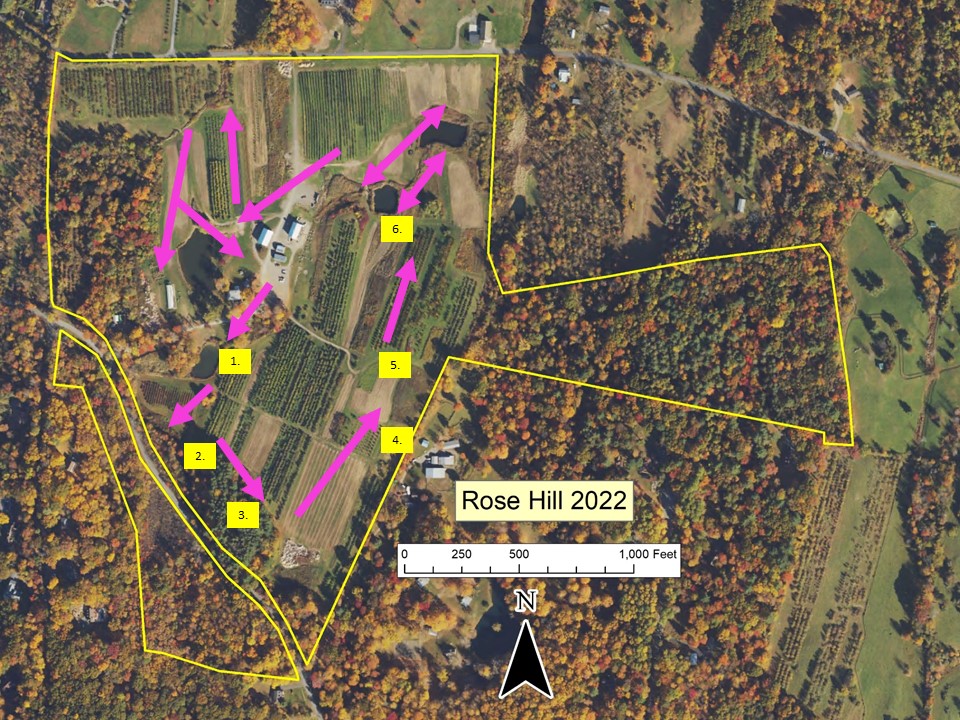
This blog shares some of the botanical observations made at Rose Hill Farm on 23 August 2024 during a 4 hour survey along the route indicated in sky blue in the aerial image below. The numbers indicate locations referenced throughout this blog posting. (Note that we shared habitat images from Rose Hill Farm in a blog posted 21 June 2024; Conrad posted about insects on 12 July 2024 and Will about birds on 16 November 2024.

Route of botanical survey on 23 August 2024

I started my walk-around from the parking area along the driveway back towards the entry gate.

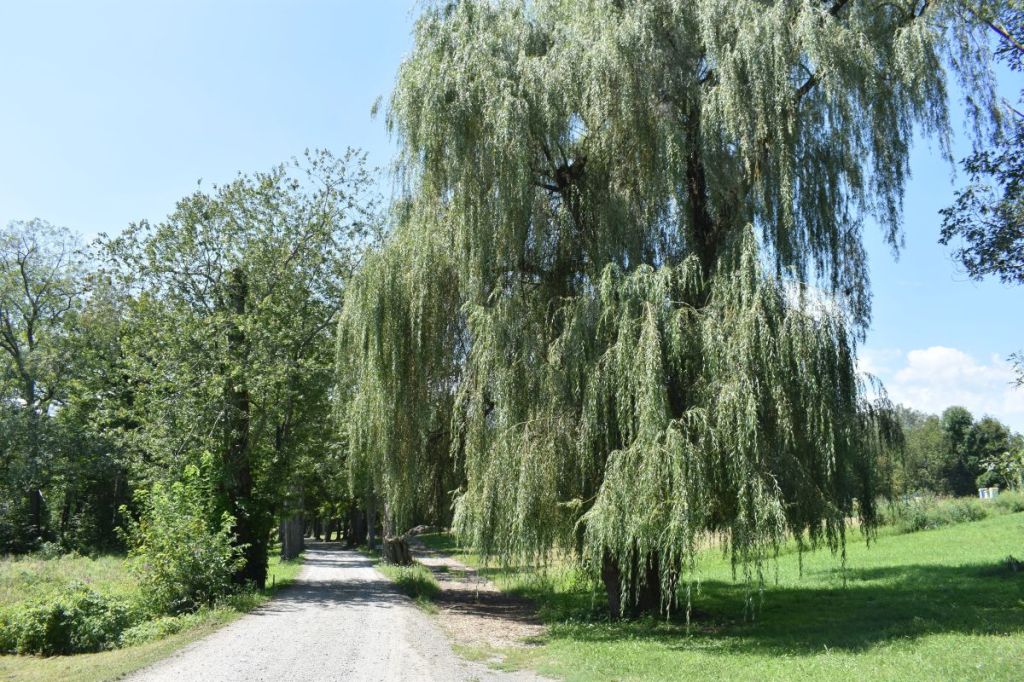
Entry ally to Rose Hill Farm with a weeping willow (Salix cf. babylonica x alba) and Red and Sugar Maples (Acer rubrum and A. saccharum) beyond (seen from #1).

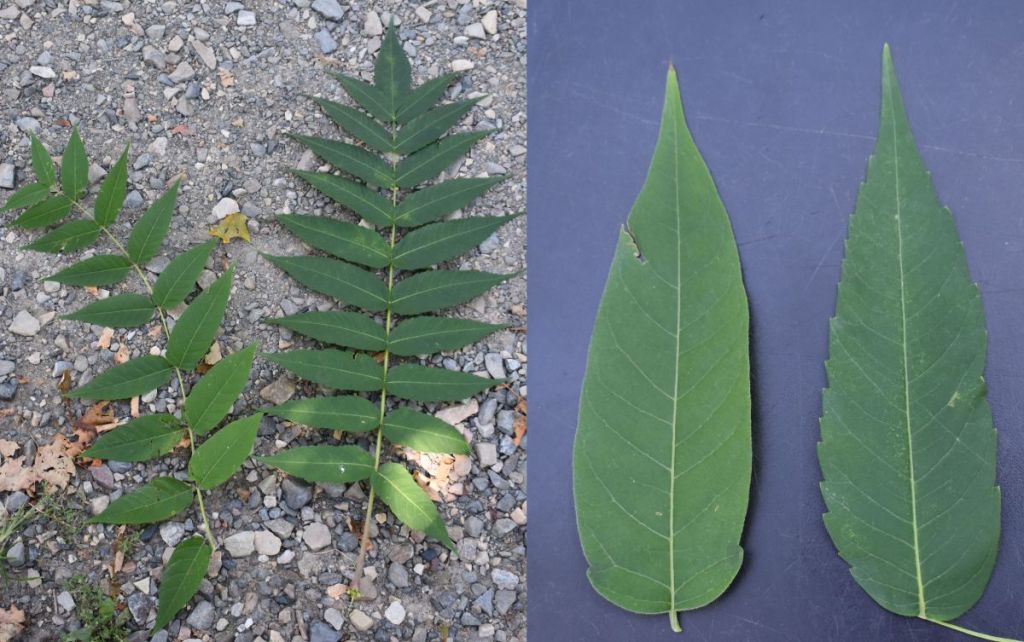
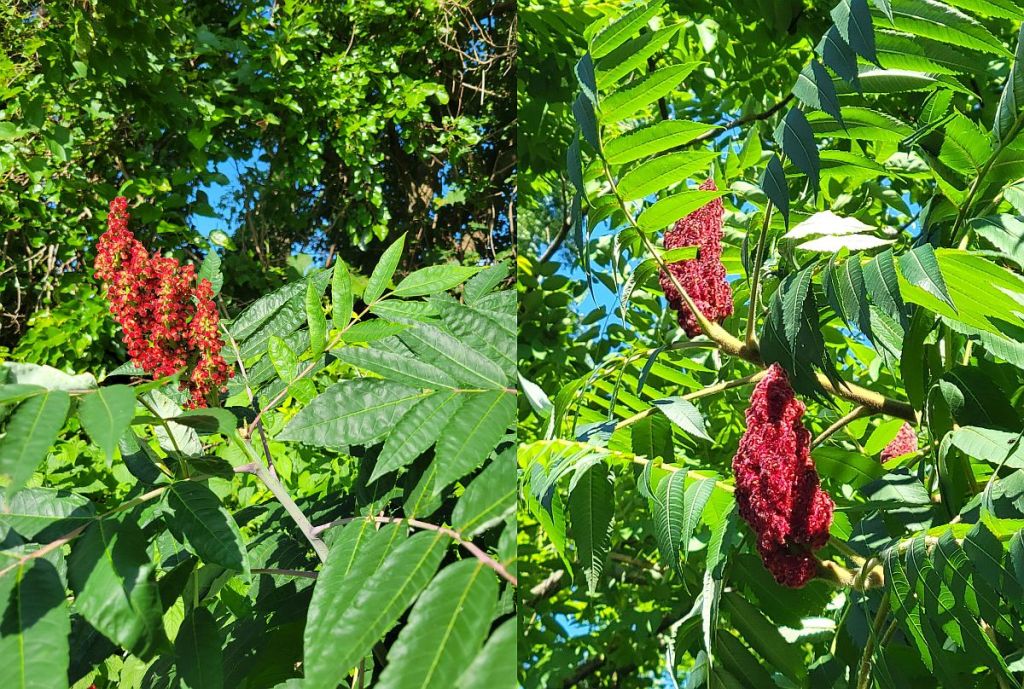
Along the driveway is a shrubland that contains both Tree-of-Heaven (Ailanthus altissima; left on both images below) and Staghorn Sumac (Rhus typhina; right on both images below). Both have pinnate, “feather-like” leaves, composed of a midrib with leaflets arranged opposite each other along both sides. However, the margin of the leaflets is toothed like a saw blade in the Sumac, while the margin of the Tree-of-Heaven leaflets is almost smooth, with just a couple of blunt teeth at the very base. Furthermore, the two species have very different smells: the Sumac has a (to me) very agreeable, aromatic, resinous smell, while the smell of Tree-of-Heaven reminds many people of rancid peanut butter.

Tree-of-Heaven (Ailanthus altissima; left on both images) and Staghorn Sumac (Rhus typhina; right on both images)

South of the driveway is a small wet meadow (#2) that supports a diverse plant community, composed of native and non-native species, such as Smooth Goldenrod (Solidago gigantea; yellow flowers) and Purple Loosestrife (Lythrum salicaria; deep pink flowers), respectively. I quickly tallied a total of 40 (!) species in this very small meadow.

Species-rich wet meadow south of the driveway (#2)

Just west of this wet meadow, I found a very small patch of forest on and surrounding a rock outcrop (#3). At the forest edge, there were several individuals of two native shrub species not seen anywhere else during my survey at Rose Hill (or any of the other eight farms surveyed this summer). This image shows Prickly Ash (Zanthoxylum americanum), which has pinnate leaves and thorny branches. Prickly Ash is one of the host plants for the caterpillars of Giant Swallowtail butterflies. Conrad shared a picture of a Giant Swallowtail he had seen at Rose Hill in his blog from 12 July 2024, but we don’t know yet, if they are actually successfully reproducing here or if an occasional individual flies in from further south.

Prickly Ash (Zanthoxylum americanum; #3)

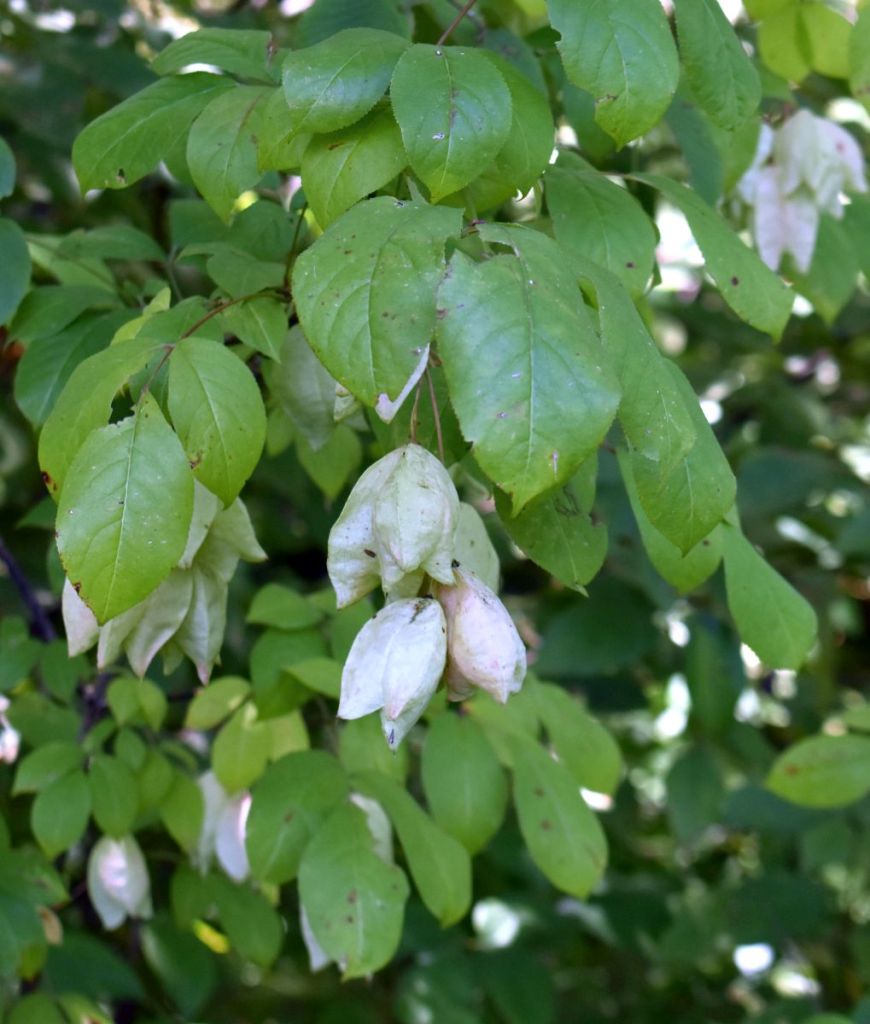
Bladdernut (Staphylea trifolia), which grew right next to the Prickly Ash, has leaves composed of three leaflets (similar to clovers) and unique, three-chambered, bladder-like fruits. Both of these species tend to occur in calcium-rich soils.

Bladdernut (Staphylea trifolia; #3)

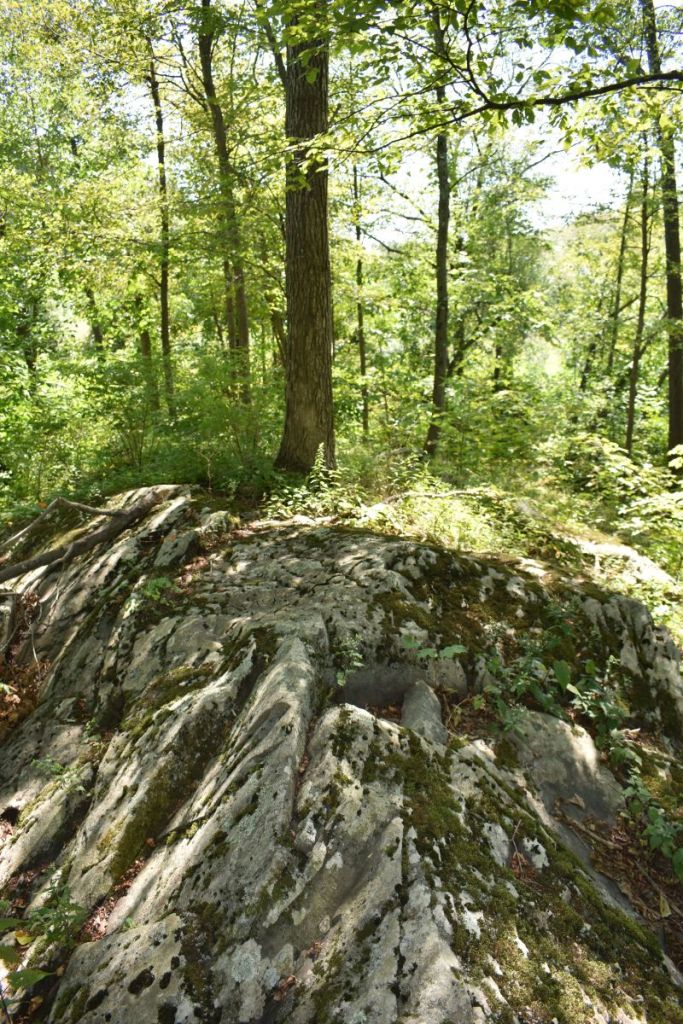
I am no geologist, but the outcrop (#3) might well be some sort of limestone or related rock that is rich in calcium.

Suspected limestone (or other calcium-rich rock) outcrop (#3)

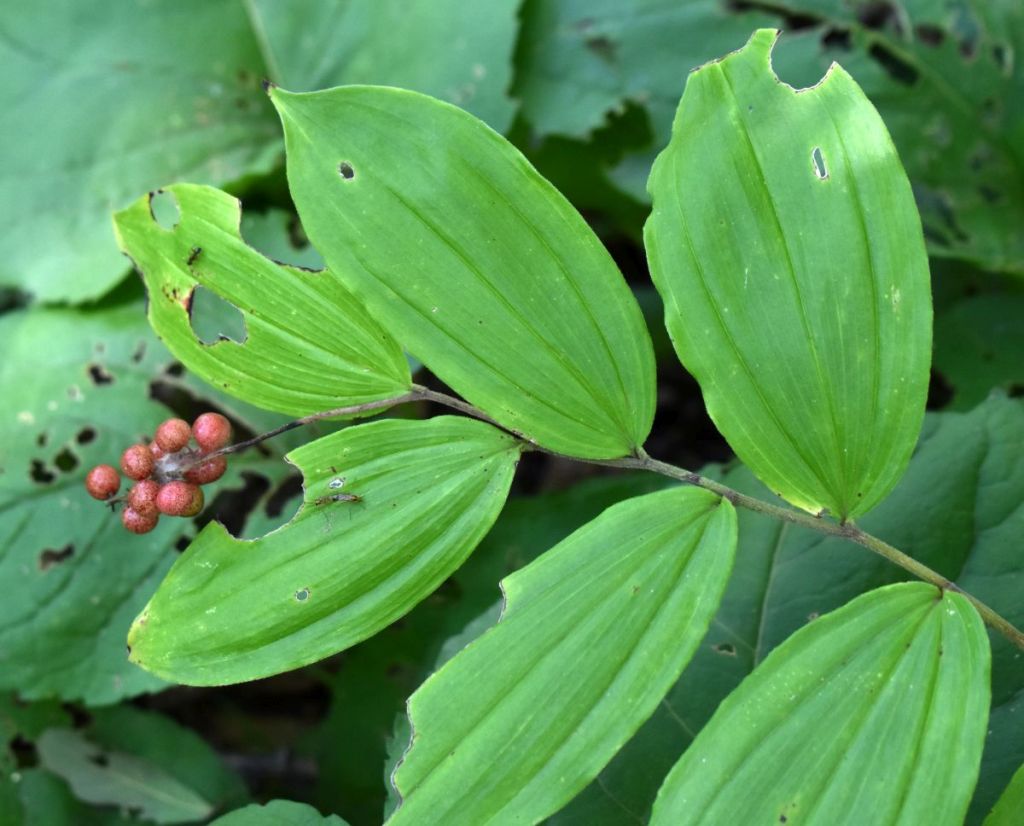
False Solomon’s-seal (Maianthemum racemosum) also grew at the base of the rock, which was surrounded by large trees, including Sugar Maple, American Basswood, Red Oak, and American Elm.

False Solomon’s-seal (Maianthemum racemosum; #3)

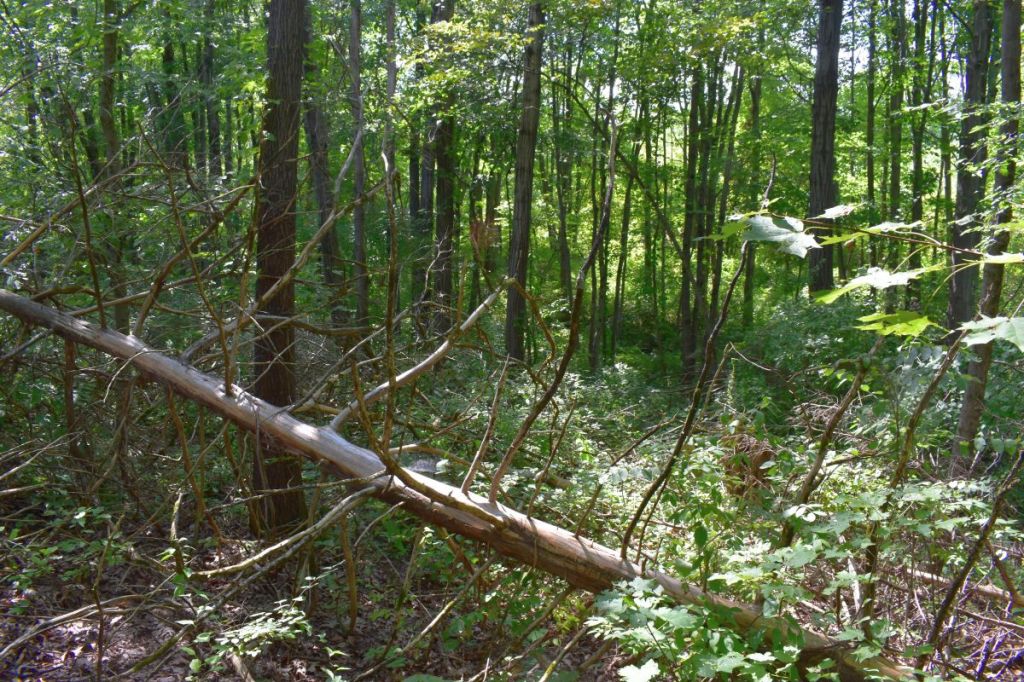
I found a very different, much younger forest north of the wood chip piles (#7). It still had the remnants of Red Cedar (Juniperus virginiana), which are early-successional trees that often grow on abandoned farm fields or pastures. As the historical aerial photo in Conrad’s blog from 12 July 2024 shows, this area used to be orchard 80 years ago.

Red Cedars tend to die naturally as they get shaded out by taller trees. However, the Red Cedars in this forest might have been intentionally cut, presumably to avoid serving as hosts for the Cedar-Apple Rust (Gymnosporangium juniperi-virginianae), a fungal pathogen of apples, that needs two hosts to complete its life cycle, a Red Cedar and an apple or hawthorn.

Fallen or felled Red Cedar in young forest (#7)

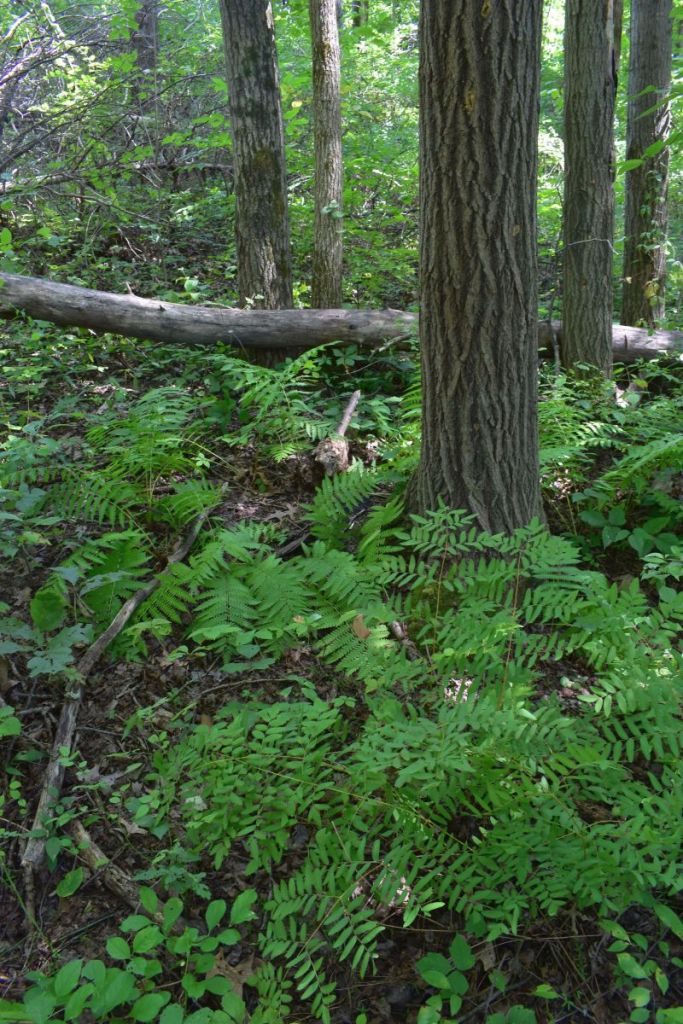
Lower down in the forest along a small stream, ferns such as Royal Fern (Osmunda regalis; bottom right in the image) and Cinnamon Fern (Osmundastrum cinnamomeum; center of image) grew lush in the moist soil.

Royal Fern (Osmunda regalis) and Cinnamon Fern (Osmundastrum cinnamomeum) in young forest (#7) by stream

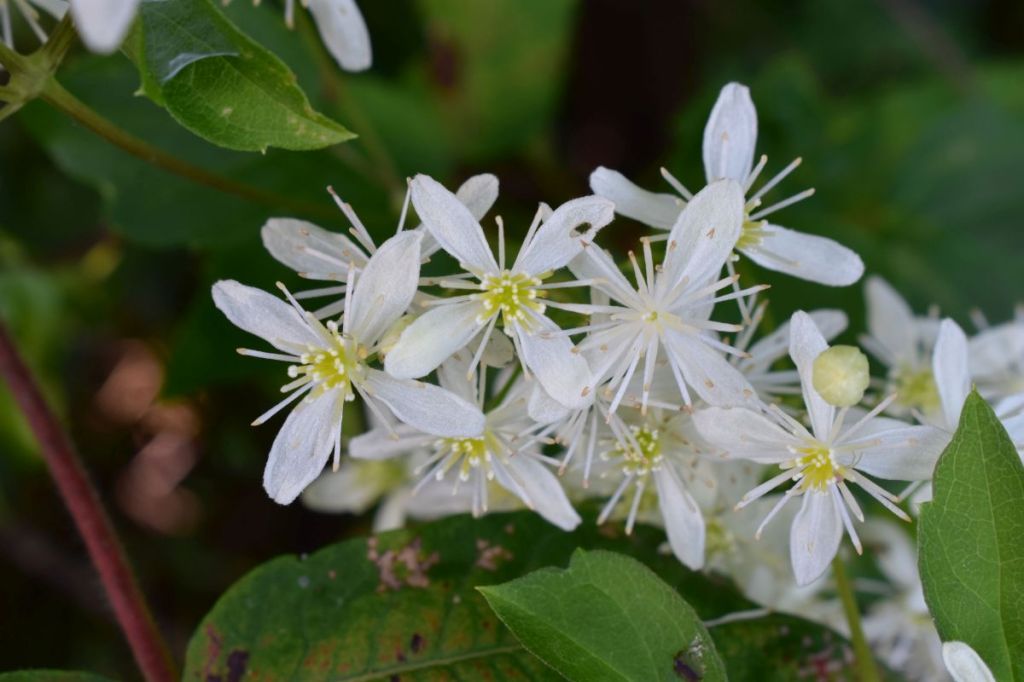
Back up along the forest edge (# 6), Virgin’s-bower (Clematis virginiana), which is a native vine whose stems are not woody and die back each winter, were in full bloom.

Virgin’s-bower (Clematis virginiana; #6)

The pond by the farm house (#8) had a narrow band of unmowed vegetation, which harbored some native plant species not seen anywhere else on the farm during our survey.

Pond (#8) with narrow band of unmowed vegetation

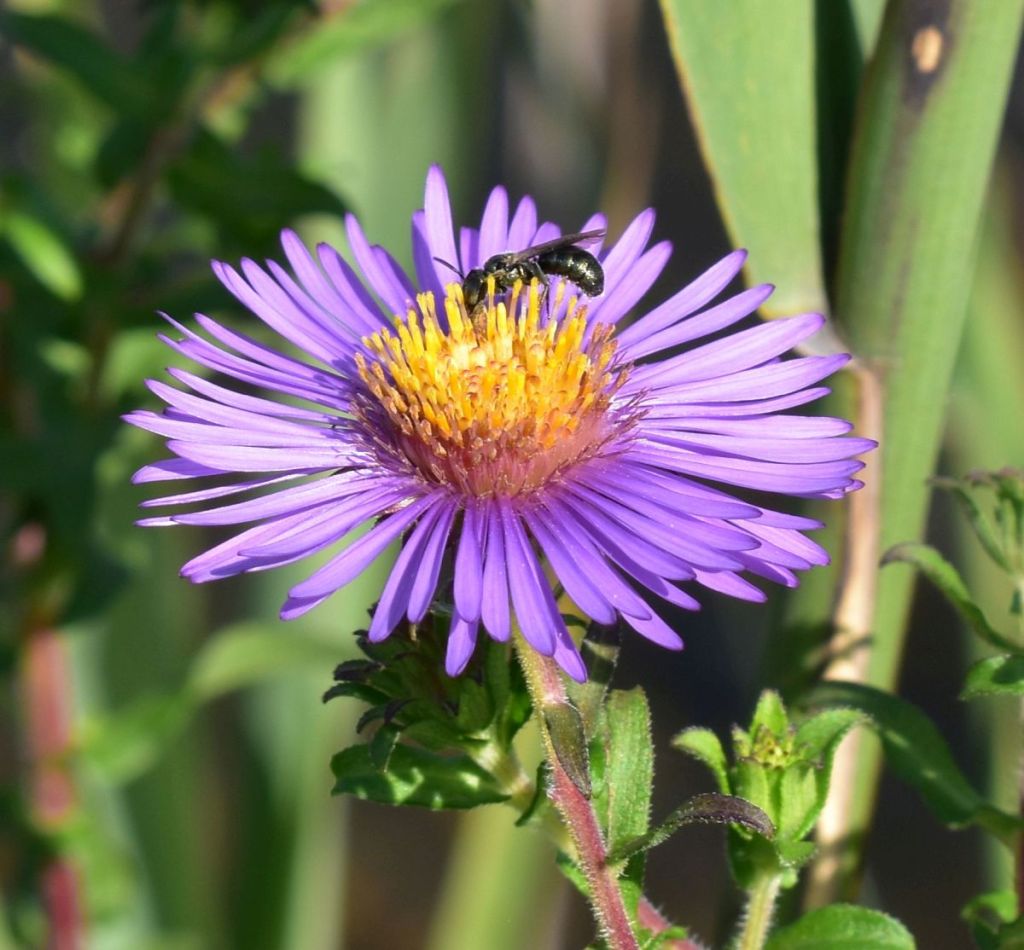
During my walk around Rose Hill Farm, I noticed New England Aster (Symphyotrichum novae-angliae) only at the shore of this pond. It was visited by a native bee.

New England Aster (Symphyotrichum novae-angliae; #8)

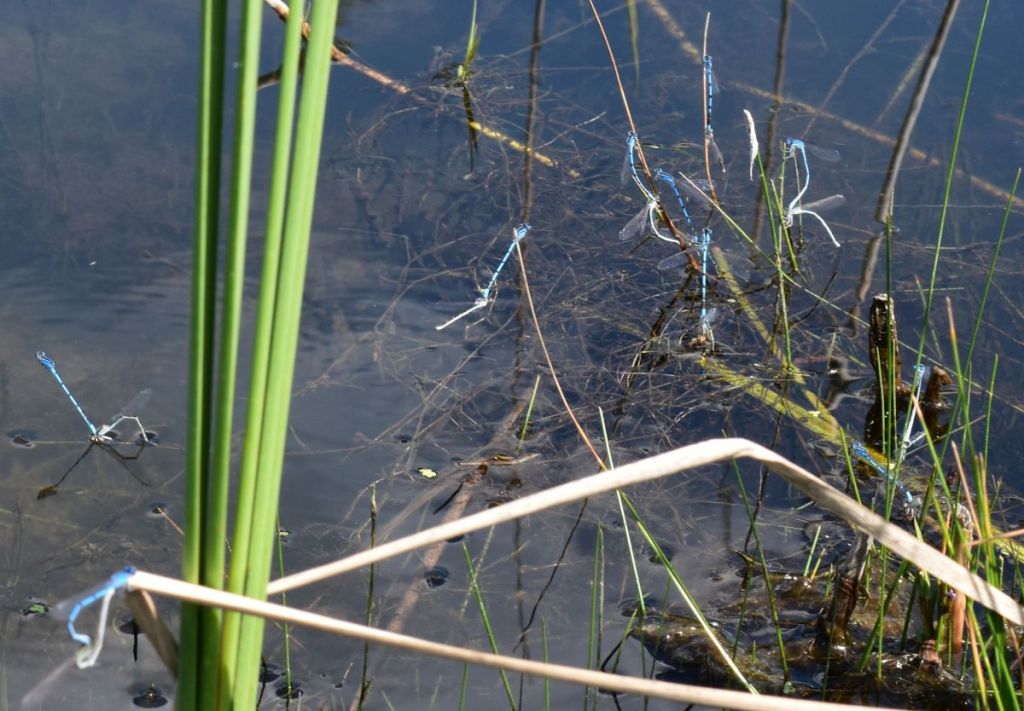
The damselflies were mating and laying their eggs in the pond. These little guys greatly benefit from the emergent vegetation which provides perches. They also benefit from aquatic vegetation in the pond, because it provides habitat for their aquatic larvae. Aquatic vegetation is especially important for dragonfly and damselfly larvae, when predatory fish or amphibians also live in the pond.

Mating damselflies (#8)

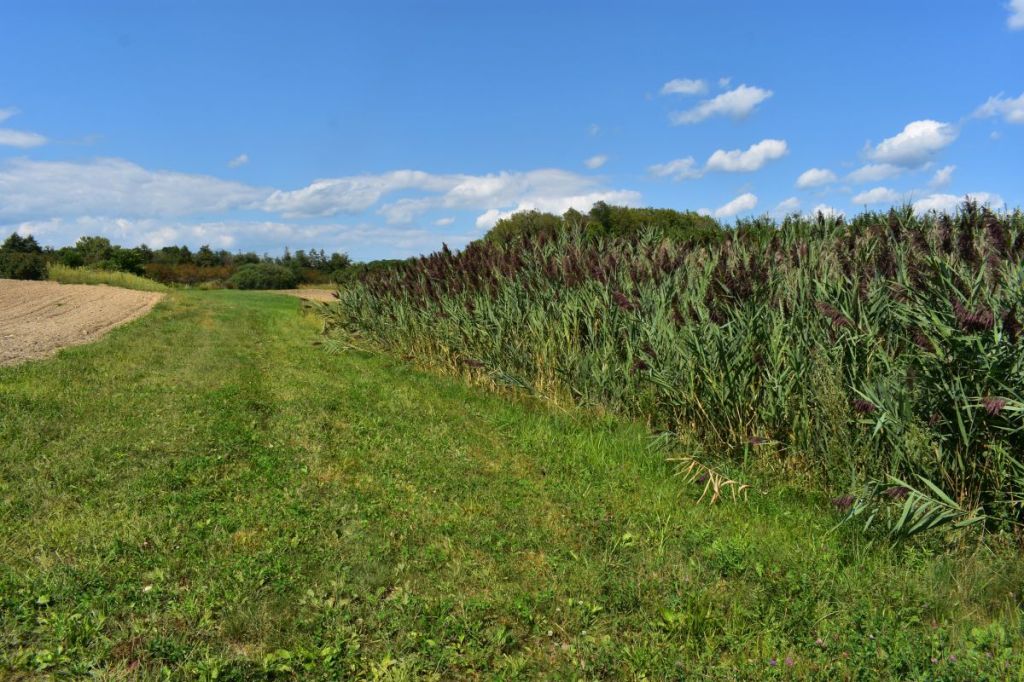
A big patch of the invasive Common Reed (Phragmites australis) grew in a swale (#9) draining into the pond.

Common Reed (Phragmites australis) in a swale (#9)

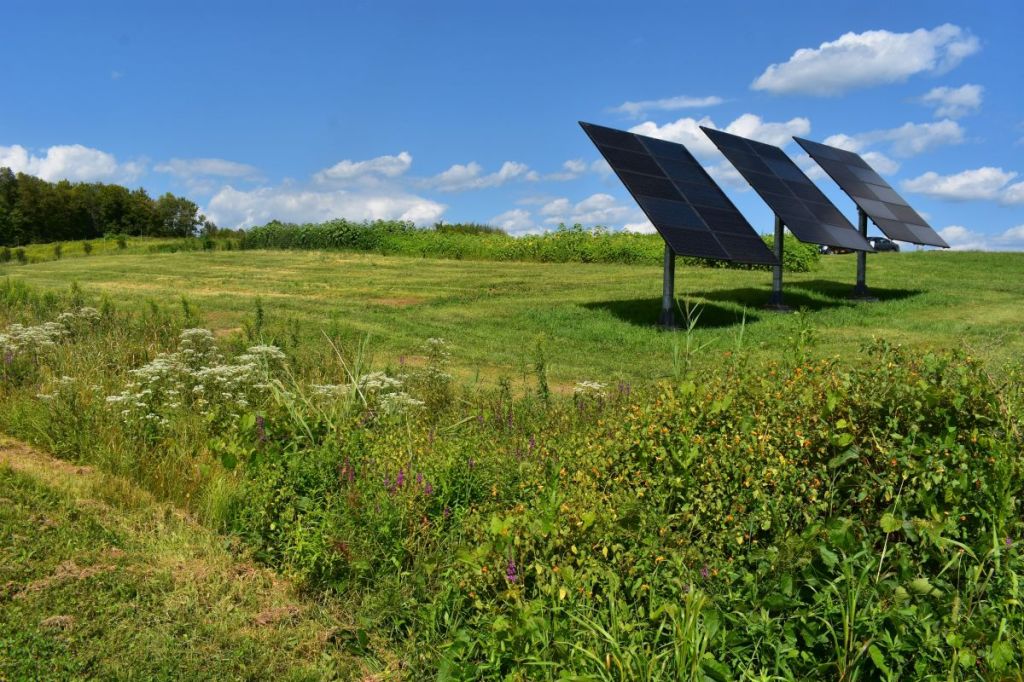
Another swale (#10) near the solar panels had unmowed wet meadow vegetation composed of many native species, including Common Boneset (Eupatorium perfoliatum; white flowers) and Spotted Jewelweed (Impatiens capensis; orange flowers), which were buzzing with insects.

Unmowed wet meadow in swale (#10)

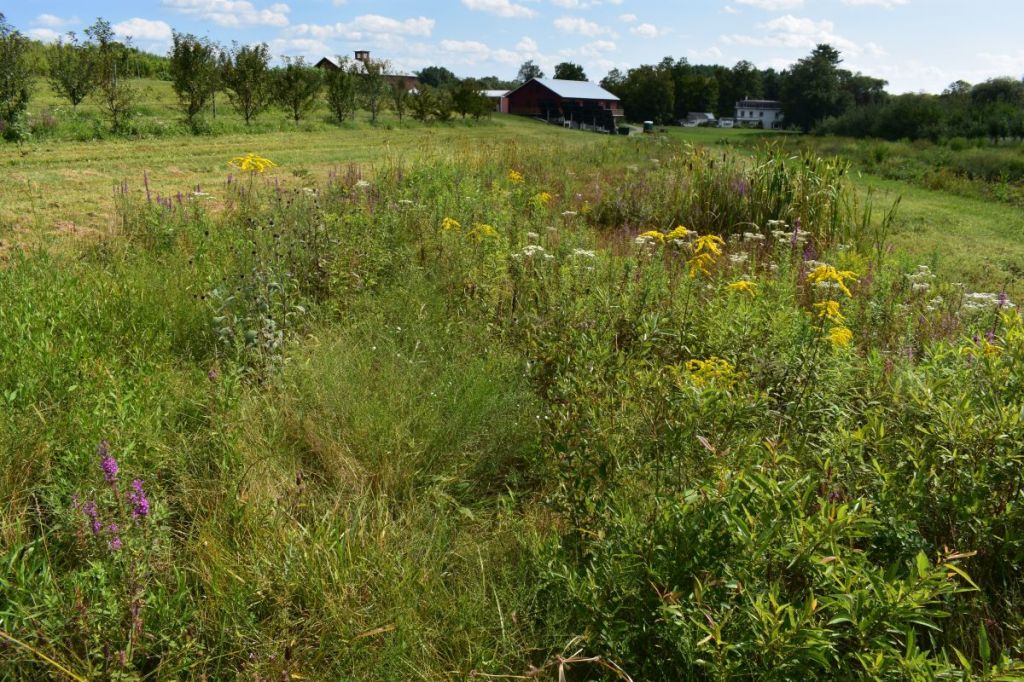
The upper end of the same swale (#10) had a more diverse plant community, including native cattails (Typha sp.), Early Goldenrod (Solidago juncea), Awl Aster (Symphyotrichum pilosum var. pilosum), and Black-eyed Susan (Rudbeckia hirta).

Upper part of wet meadow in swale (#10)

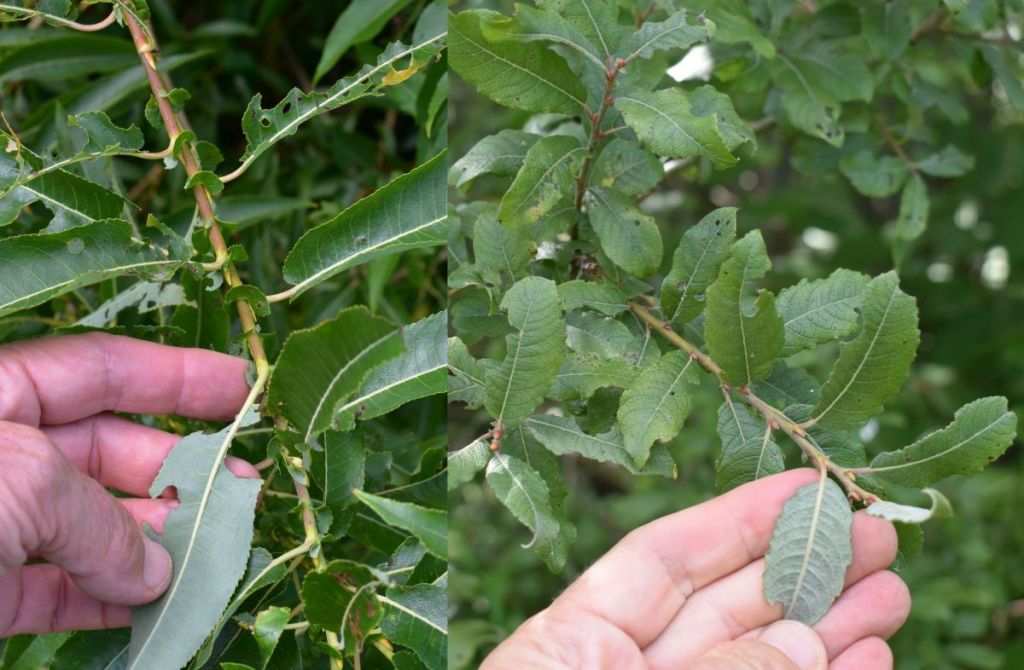
Near the fenceline, I encountered a shrub thicket (#11) with two different species of willow, Heart-leaved Willow (Salix eriocephala; left) and Bebb’s Willow (Salix bebbiana; right). Both of these willows have catkins that serve as important early season pollen sources for bees.

Heart-leaved Willow (Salix eriocephala; left) and Bebb’s Willow (Salix bebbiana; right) in shrub swamp (#11)

The thicket also had a Silky Dogwood (Cornus amomum), with its metallic-blue fruits displayed on reddish branches.

Silky Dogwood (Cornus amomum; #11)

Circling back towards the buildings, I passed by a dry hillside which had been left unmowed (#12). The vegetation was a mix of common native species, including several goldenrods (Smooth, Tall, and Early) and Common Milkweed (Asclepias syriaca), with non-native species, including Spotted Knapweed (Centaurea jacea) and Wild Carrot (Daucus carota).

Unmowed dry hillside (#12) with a mix of common native and non-native wildflowers

Another unmowed, dry slope east of the parking lot (#15) had several less common native plants, including Purpletop (Tridens flavus), Purple Love Grass (Eragrostis spectabilis), and Whorled Milkwort (Polygala verticillata). I did not see any of these species anywhere else at Rose Hill Farm.

Another unmowed dry hillside (#15) with some unusual native plant species

The shore of the pond (# 16) south of the driveway had a broad band of unmowed, diverse vegetation including the uncommon native Swamp Rose (Rosa palustris), which we didn’t observe anywhere else on Rose Hill or at any of the other farms surveyed this season. Note also some “blonde” clumps of the native warm-season grass Little Bluestem (Schizachyrium scoparium), usually found in dry soils.

Band of unmowed shoreline of a pond (#16)

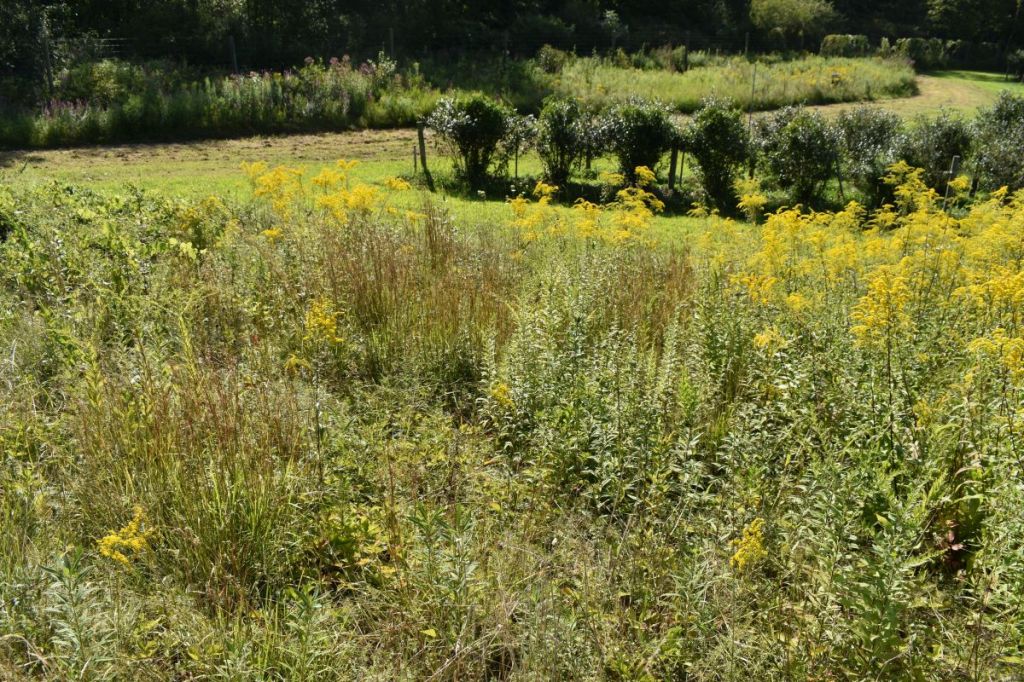
Along the south fence, south of the Blueberries, I was excited to find a beautiful and diverse wet meadow (# 18). Here, you see the native Spotted Joe-Pye-weed (Eutrochium maculatum; light pink) mix with the invasive Purple Loosestrife (Lythrum salicaria; dark pink). However, a closer look revealed many less conspicuous native wetland plants that we did not see anywhere else at Rose Hill. For example, Conrad included images of Yellow Stargrass (Hypoxis hirsuta) and Square-stemmed Monkeyflower (Mimulus ringens) from this wet meadow in his insect post on 12 July 2024

Diverse, unmowed wet meadow (# 18)

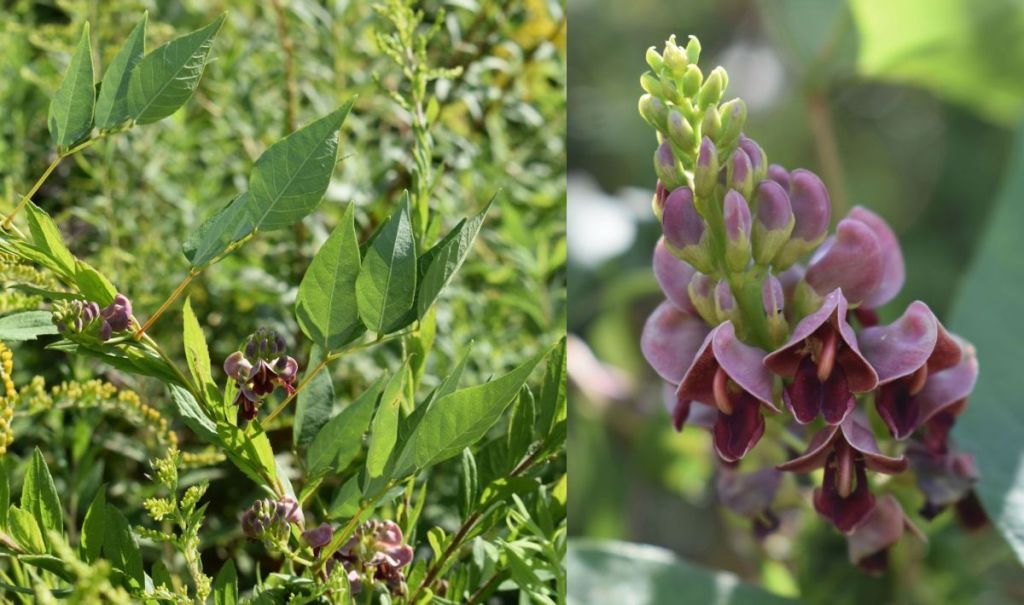
Another plant unique to this area was Groundnut (Apios americana), a native vine in the pea family which is occasionally found in wet, open areas. It has pinnate leaves with five leaflets and dense conical clusters of pea-shaped flowers of a very unusual, pink/purple/red-brown color. Most plants of this species in our region never produce fruits (but see our blog on the Hudson Valley Seed Company for an exception and explanation). The tubers of this species are edible and Native Americans seem to have sometimes cultivated Groundnut.

Groundnut (Apios americana; #18)

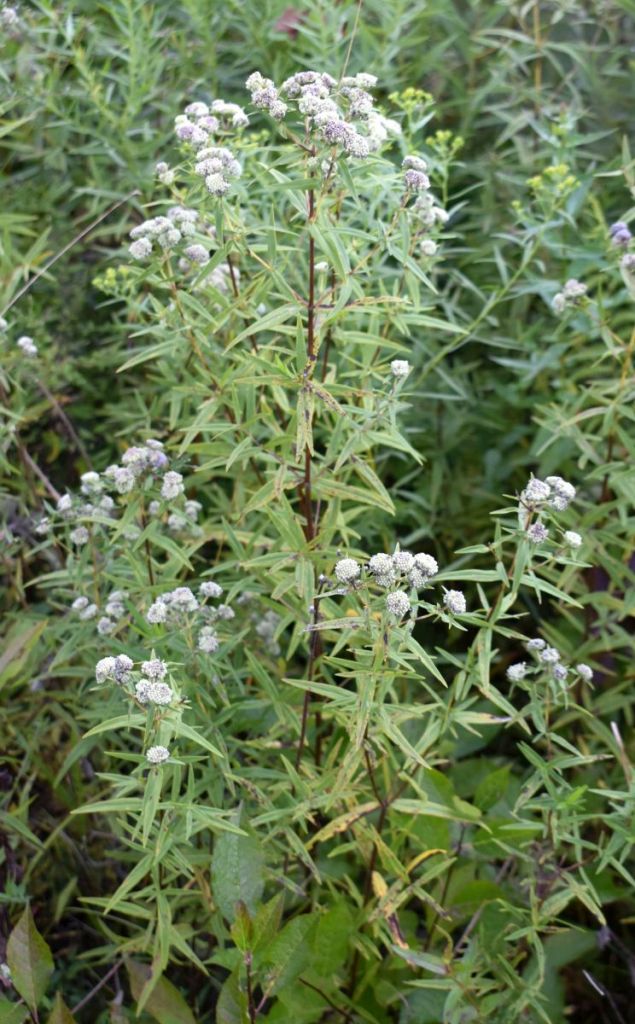
Another was Virginia Mountain-mint (Pycnanthemum virginianum), which is an uncommon native mint much visited by a large variety of pollinators.

Virginia Mountain-mint (Pycnanthemum virginianum; #18)

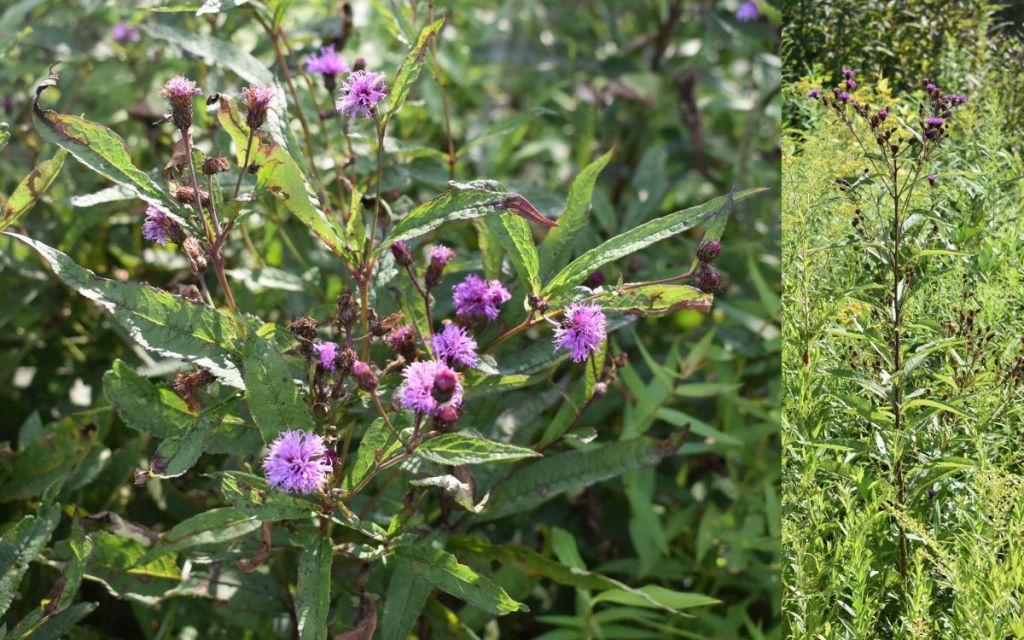
Finally, New York Ironweed (Vernonia noveboracensis) was also unique to this wet meadow. It is a member of the aster family, which seems to be more common further south in the Hudson Valley and is rarely found growing wild in our region.

New York Ironweed (Vernonia noveboracensis; #18)

East of the Blueberries was another dry slope (# 19) with unmowed vegetation. It was fun to see how each of these unmowed slopes supported a slightly different vegetation. This one had a lot of Little Bluestem (Schizachyrium scoparium) and Early Goldenrod (Solidago juncea), but also a variety of other native and non-native plant species.

Another example of an unmowed dry slope (#19) with its own unique plant composition

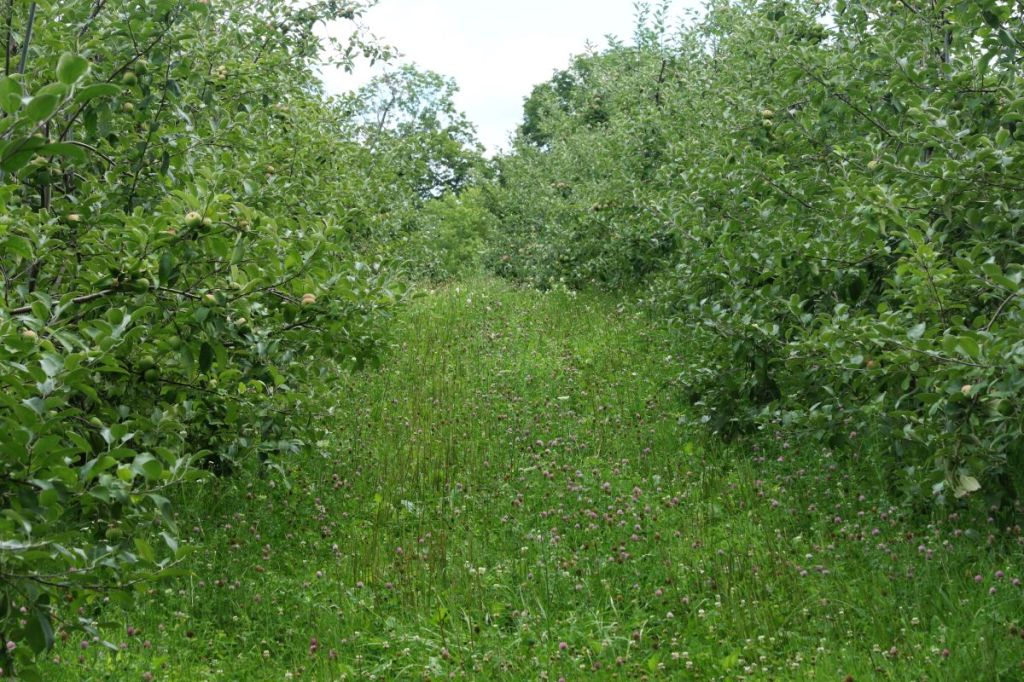
The apples nearby (# 20) were getting ripe and the unmowed strips of vegetation in the tree rows were still alive with flowers, here mostly Wild Carrot (Daucus carota).

Unmowed and flower-rich strips of vegetation within the rows of orchard trees (#20)

Finally, another unmowed slope with plenty of native goldenrods and European weeds in bloom, next to a field of seeded Sunflowers. With several large areas throughout the orchard left unmowed and some annual flower plantings, floral resources for pollinators (the Honey Bees kept on site, as well as wild native bees), as well as other insects, should be available throughout the season. And Will reminds us in his post on the birds of Rose Hill Farm (16 November 2024) just how important these scruffy-looking, “feral” areas throughout the farm are for our feathered friends.

A last example of a flower-rich, unmowed dry slope (#21)

The Birds of Rose Hill

By Will

Peruse any aerial photograph of the Hudson Valley from the 1960s and you will see field after field dotted with fruit trees, their neat rows show up as pointillist parcels in even the most blurry photos. There used to be a lot of commercial orchards in the Hudson Valley. Several successful commercial orchards still remain in what is today a very difficult and competitive agro-economy, but New York is no longer the Big Apple and much of its market share has been overtaken by the irrigated apples of Washington state, New Zealand, and other far-flung places. The regional commercial orchards that persist today are either ruthlessly efficient or creative in their direct marketing to tourists and visitors.

This photo (Livingston, Columbia County) shows the extent to which orchards once dominated “hedgerow to hedgerow” on many farms. 1965.

To be truthful, most commercial orchards in the Hudson Valley do not rise to the top of my list as places to see birds, which is why the bird diversity of Rose Hill was a refreshing surprise.

For birds to survive they need places to roost and rest, insects in May to replenish their exhausted bodies after typically long migrations, places to build nests free from disturbance, and still more insects in June and July to feed their rapidly developing offspring. Most commercial orchards are some of the most intensively managed farmscapes in the Hudson Valley. Many pesticides (both organic and conventional) are necessary to raise the high-quality fruit that consumers demand. It’s been over 50 years since Joni Mitchell proudly sang that she can live with “spots on her apples” but we have a long way to go to convince most American consumers that the tradeoff is worth it for a healthier ecosystem. Our changing regional climate, with its warmer springs still punctuated with snap freezes, and new invasive pests in the pipeline (Brown-Marmorated Stinkbug the newest arrival and Spotted Lanternfly at our doorstep) don’t make things any easier.

I’ll let Rose Hill speak for themselves on their growing practices and philosophy, but as a visiting farmer and ornithologist, a few key features stood out:

  1. Mechanical (rather than chemical) removal of weeds under trees at a reduced rate that provide a lot of structural plant diversity within orchard rows.
  2. Reduced spray schedule and use of non- or less-toxic spray alternatives
  3. Retention of landforms in orchard blocks (vegetated shale ridges, for example)
  4. Adjacent blocks of native vegetation.

The vegetated strips between trees that cannot be reached by mowers provides spaces for pollinators, and for insect prey that birds depend upon. This structural heterogeneity is closer to the appearance of Hudson Valley orchards in the 19th and early 20th Centuries.

Rather than bulldozing and infilling shale ridges, Rose Hill has left them in place providing important micro shelters and feeding zones for birds.

The savannah-like structure of orchards actually attract a few species of birds who preferentially nest in the grassy matrix of trees.

I find that one of the most common orchard birds, which nests directly in fruit trees, can thrive when spray programs are kept to a minimum. The Eastern Kingbird is a type of flycatcher that builds a grassy cup in the fork of a tree branch that looks like a Disney cartoon of a nest. They are famously aggressive towards other birds and mammals (but oddly, not humans). On a spring day when you look up and see some smaller songbird attacking and chasing a Red-tailed Hawk and think, wow, that bird has chutzpah, chances are that it’s an Eastern Kingbird.

Chris Franks shared this image of a local Eastern Kingbird. These birds perch conspicuously on wires and the tops of trees sallying forth for large flying insects. They have a white band on their tails that identifies the bird in flight even from a distance without binoculars.

Cedar Waxwings often nest in orchards as well. On my farm, I typically see them nesting in plums and early peaches, constructing their nests just as the harvest is winding down. They rarely bother to eat peaches and large fruit but can be considered a management challenge in cherry and small-berry crops. There are plenty of native species of fruit that these birds frequent, and yes, as the name implies, they eat Eastern Red Cedar (juniper) berries, as well as serviceberries, wild grape, hawthorn, and winter berry. Many fruit-eating birds separate the flesh and seeds in their crops and regurgitate the seeds, but waxwing digestion shunts both the pulp and seeds through their bodies and they are a key species for spreading many fruiting trees and shrubs (they can also spread less desirable invasive species such as Japanese Honeysuckle and Multiflora Rose). Sometimes in the fall when fruits such as wild grape partially ferment and produce alcohol the birds can become intoxicated and fly awkwardly.

The “waxy” red tips on the wings, yellow tail band and raccoon mask of the Cedar Waxwing are unmistakable. Their song, if you can call it much of one, is an almost an inaudible high pitched trill. Photo: Chris Franks

The aptly named Orchard Oriole, seen in the apricot orchard at Rose Hill, has a brick-red chest (unlike the tangerine orange of the far more common Baltimore Oriole). They feed on fruit, flowers, nectar, and insects and unusual for orioles, sometimes nest communally in appropriate habitat. The 60-plus-year-old records of the Alan Devoe Bird Club has shown this species increasing in our area for unknown reasons. It may be due to the current successional sweet spot in the Hudson Valley with many young forests and abandoned orchards that provide the structure this species favors without the intensive pesticide use. I never find them in modern commercial orchards and its presence at Rose Hill was a surprise, although my visit in mid July is at the end of their breeding cycle and this individual could have been a migrant on its way back to Central America.

Marian Sole shared this image of a local male Orchard Oriole. Like all orioles, it has a rich lilting complex song.

This lightly managed section of the orchard edge (with native vegetation on the opposite side of the fence) was a “birdy” section of the farm and contained a Common Yellowthroat nest with young.

This female Common Yellowthroat foraged for insects in a young planting of plums. Close enough for my iPhone!

Common Yellowthroats are small yellow-olive warblers that nest in brushy tangles and like to be near water. They are a common bird in our area the summer and their ‘whitchity-whitchity-whitchity’ song is a familiar sound if you train your ear to recognize it. They frequently struggle with brood parasitism from another native species, the Brown-headed Cowbirds. Cowbirds do not construct their own nests, but rather like Eurasian Cuckoos, they lay a single egg in the nests of other birds and abandon them for the host bird to raise. Their hatching offspring grow at a fast rate and therefore elbow the lion’s share of the incoming insect food from parents which seem instinctually inclined to shove food into any open mouth regardless of species.

This is a two-way evolutionary race, however, and some populations of Common Yellowthroat have learned to recognize the cowbird’s egg and will build a layer of grass overtop it to isolate it. If that fails, they may abandon the nest and attempt to renest completely at a great cost of energy. The North American Breeding Bird Survey has documented a 26 percent loss of Common Yellowthroats in North America since 1966, probably due to habitat loss. Farms can be essential places for these birds since the unmowed edges, unused fields or the vegetation around irrigation ponds can be more than enough habitat for this species to successfully raise young. A few have learned to use more heavily vegetated suburban yards. You don’t need a lot of land to attract and retain this species, but they can’t eke out a living on mowed lawns dotted with ornamental shrubs–they need a patch of rank growth.

Rose Hill has a wonderful planting of blueberries as part of their U-Pick offerings. The mature plants were heavy with berries on the July morning I visited and although they were not open for customers, more than 30 birds helped themselves to the berries in the patch. American Robins, Gray Catbirds, and Baltimore Orioles dominated the flock, with a smattering of Eastern Towhees, Northern Mockingbird, and a Brown Thrasher. I’ve talked to growers with divergent views on netting berries to prevent birds, some swear it’s essential and others feel there is plenty to go around. I’ve found that birds can nearly wipe out small plantings of a 50 bushes or less, but larger blocks seem to satiate the robbers and leave plenty for us.

This planting of blueberries hosted 5-6 species of birds attracted to the free fruit

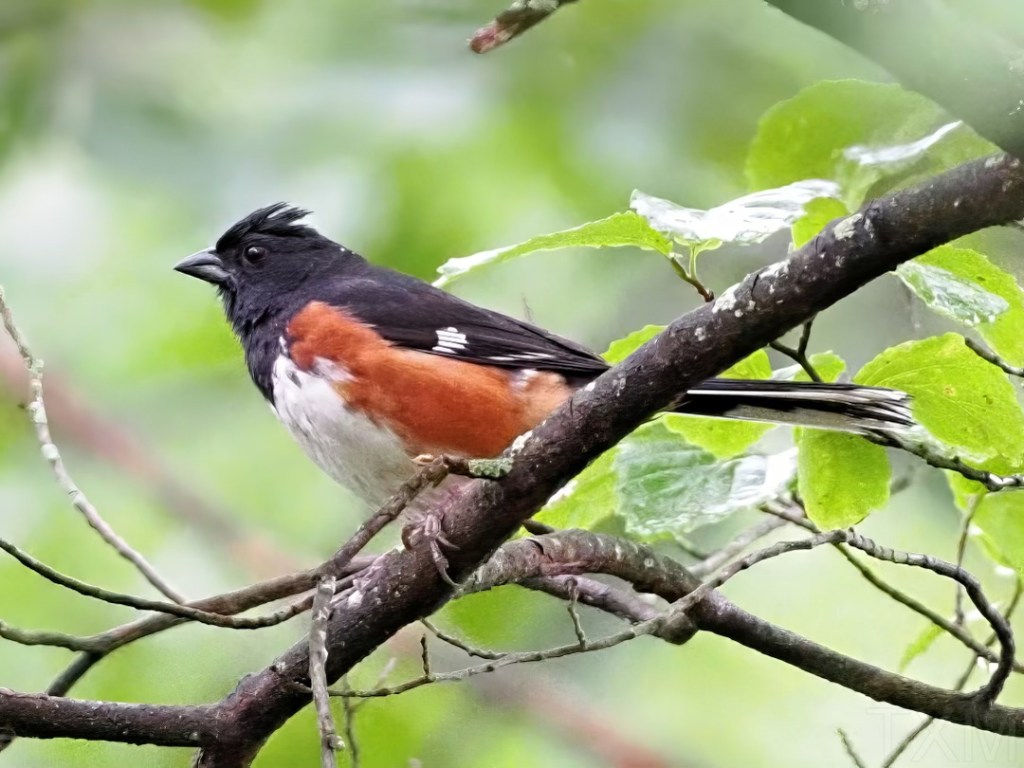
The former name of the Eastern Towhee is the aptly named Rufous-Sided Towhee. Related to sparrows, this is a common bird of scrublands and early successional forests. They scratch through leaf litter with a two foot hop, pouncing on exposed insects. They commonly add fruit to their diet as well

In a month these sunflowers will attract pollinators and if left to go to seed, a calorie-rich seed for a variety of birds

So many of the fruits that we expect and enjoy at commercial orchards — from peaches to apricots, apples to pears, are eurasian imports to North America, non-natives that require a lot of skill and work to bring to fruitfulness and profit. That Rose Hill has managed to do all of this and still leave patches on their farm to attract native birds and other organisms is deliberate proof that this complex relationship of native and non-native, cultivated and fallow, management and benign neglect, can yield positive ecological relationships. All of us who farm and care about wildlife are searching for our own models to achieve something akin to a balance of what we take from nature and what we leave.

The Birds of Blue Star

By Will

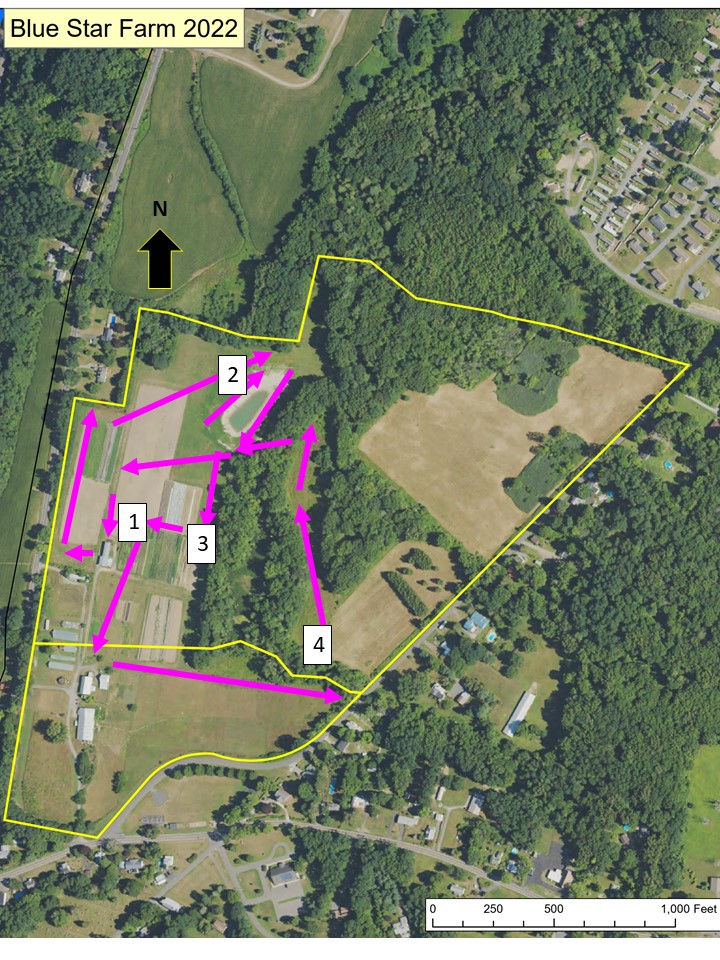
On June 12 I visited Blue Star Farm and documented breeding evidence for the following birds:

  • American Robin (Feeding Young)
  • Carolina Wren (Territorial Singing)
  • Chipping Sparrow (Nest with Young)
  • Common Yellowthroat (Territorial Singing)
  • Gray Catbird (Feeding Young)
  • Indigo Bunting (Feeding Young)
  • Killdeer (Fledgling)
  • Pileated Woodpecker (Territorial drumming)
  • Red-eyed Vireo (Territorial Singing)
  • Red-winged Blackbird (Feeding Young)
  • Song Sparrow (Nest with Young)
  • Warbling Vireo (Feeding Young)
  • Wood Thrush (Feeding Young)
  • Yellow Warbler (Feeding Young)

Each section of Blue Star Farm contained unique habitats that hosted a variety of farm and edge-loving species of birds.

Native shrubs such as Staghorn Sumac and large legacy Sugar Maples planted long ago shared space with common non-natives such as Buckthorn, Autumn Olive, and Japanese Honeysuckle (all fruiting shrubs that attract birds) between the farm’s vegetable fields and the main road. Northern Cardinals and Gray Catbirds fed on berries as a Northern Flicker, a yellow-spotted medium woodpecker, investigated nesting cavities in the mature Sugar Maples.

Weediness is a given in most vegetable production systems and they are often the top management challenge. My farm, despite my best efforts to cultivate and hand weed, is often a riot of weeds and I’m slowly learning to make peace with that. Weeds, that catch-all term for an uninvited variety of herbaceous surprises in crop zones, can and often do rob crops of critical moisture and nutrients, but they often include many seed-bearing grasses and forbs that attract insect prey for birds, serve as cover for nesting sites, and feed many ground-feeding sparrows, particularly in fall and winter.

Weeds can be a particular problem for organic farmers because there are limited options available to chemically control them. ‘An ounce of prevention is worth a pound of care,’ is old country advice for dealing with weeds, advising farmers to stay on top of weeds early or else suffer the consequences. A farming manual I have from 1915 has slightly more bellicose advice: “Man must wage continual warfare against weeds should he wish to prevail.”

Just how much weediness a farm can endure depends on the tolerance of the crop and a lot on the time, resources, and philosophy of the grower. I find weeds are most prevalent during dry years (those fast-growing annual weeds seem to thrive in conditions when cultivated crops struggle to keep up). I find that most crops can handle some weediness once they are established and if mowed out shortly after harvest, the weed seed load is mitigated. Like so many things in life, timing is everything.

At Blue Star, A Song Sparrow built a nest in a weedy tangle at the edge of black plastic mulch. An adult foraged for small beetles along the edge of the mulch and noticing me it paused on a spray of Lambsquarter. I stayed motionless until its instinct to feed its young overcame its instinct to be wary of this large mammal. Red-winged Blackbirds perched on the tomato stakes nearby and Chipping Sparrows foraged in the Clover-Wheat cover crops adjacent to the vegetable patch.

I heard a familiar rollicking whistle overhead and noticed a pair of Ospreys flying overhead

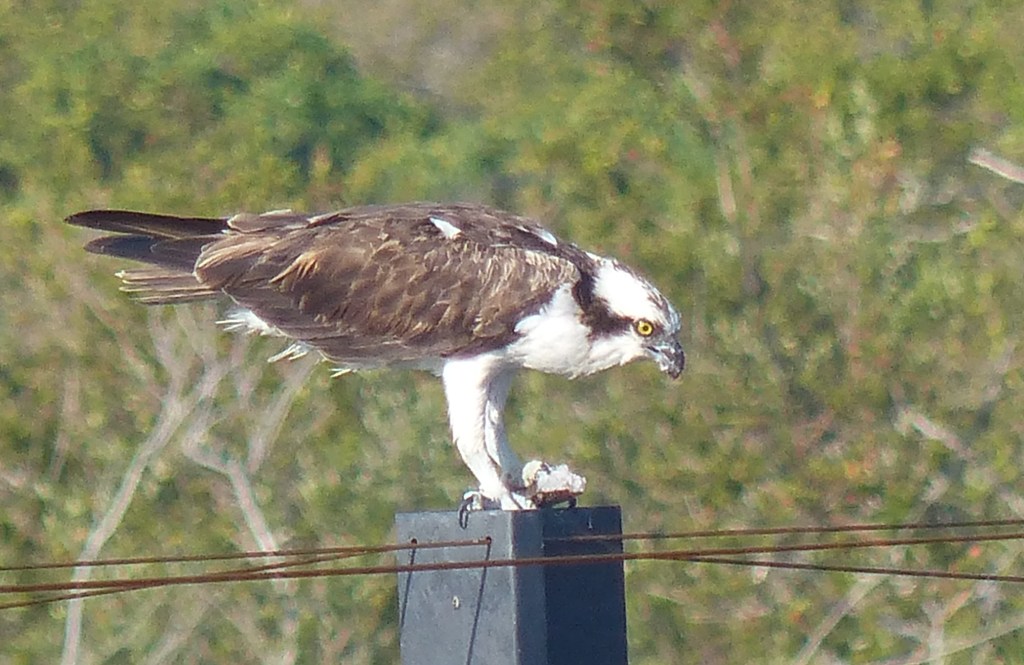
The Osprey or Fish Hawk have rough scaled feet perfect for grabbing and holding onto fish plucked from the water

The two fish-eating raptors seemed out of place on a farm, but here in Stuyvesant the Hudson River is a short distance away. Osprey are just starting to nest again in the middle stretches of the Hudson River Valley. They commonly breed downstate and on Long Island and populations nest on lakes at the foothills of the Adirondacks, but for decades they were not present as breeders in the Hudson Valley even as Peregrine Falcons and Bald Eagles (other raptors recovering from DDT poisoning) repopulated historic ranges.

Their absence was long a local ornithological mystery. In the 1980s students from Columbia-Greene Community College erected nesting platforms on the Hudson River to entice them to settle here, but Ospreys are famously uncritical about where they build nests, and lack of nesting sites was probably not the limiting factor. In Florida, they commonly appropriate power line posts, commercial signs, and even flat roofs in developed areas. Perhaps the population just needed to build up over time to infill suitable habitats. Few things authenticate a large body of water better than an Osprey and its dramatic hover and dive to catch fish. I’m always amazed at how quickly local bird populations can wax and wane within the span of a human life.

A single Wild Turkey launched out and flew noisily from a cover crop patch of rye and wheat into the distant woodlot. Turkeys are another great success story in our area, benefiting both from regrowing forests and reintroduction programs. Victims of habitat loss and overhunting in the early 20th Century, they are now common throughout the Hudson Valley and have even adapted to suburban yards. They are one of two native North American birds that have been domesticated (the other is the Muscovy Duck of Mexico). Spanish explorers sent the Turkey back to Europe in the 1500s where they were further domesticated and spread throughout Europe. English colonists a century later brought them back “home” to North America. Wild Turkeys are found in all states except Alaska (yes, there are even wild introduced populations in the upper elevations of Hawaii!).

I hear the gulping distinctive “KOWP KOWP KOWP” song of a Yellow-billed Cuckoo just to the north of the farm in the old woodlot. 2024 has been a banner year for our two native species of Cuckoo, the Black-billed and Yellow-billed as their regional populations follow outbreaks of hairy caterpillars. The large outbreak of Spongy Moth caterpillars in Columbia County and Duchess County has attracted migrating cuckoos to our area and provided an abundance of easy prey. Cuckoos are some of the only birds able to digest Spongy Moth caterpillars and they can eat more than 100 of them at a time, so many in fact, that the caterpillar hairs become matted into a digestive felt inside the cuckoo’s stomach inhibiting its ability to absorb nutrients. Cuckoos are among the few birds in North America able to feed heavily on hairy caterpillars and have evolved the ability to regurgitate their entire stomach lining and grow a fresh one anew. Although the cuckoos barely put a dent in the spongy moth populations, the spongy moths are a boon for the cuckoos which gain the extra nutrition to lay multiple clutches of eggs.

Cuckoos can be incredibly difficult to see when perched. They are masters at remaining perfectly still and they keep their wings tucked tight when foraging. Mike Birmingham captured this wonderful image of a Yellow-billed Cuckoo on an exposed perch.

The edge between the unmoved pastures and adjacent woodlot hosted several species of forest and edge-adapted species including American Crow, American Goldfinch, Common Yellowthroat, Eastern Wood Pewee, Gray Catbird, Great-crested Flycatcher, Pileated Woodpecker, Red-bellied Woodpecker, Red-eyed Vireo, Rose-breasted Grosbeak, Song Sparrow, Warbling Vireo, White-breasted Nuthatch, and Wood Thrush

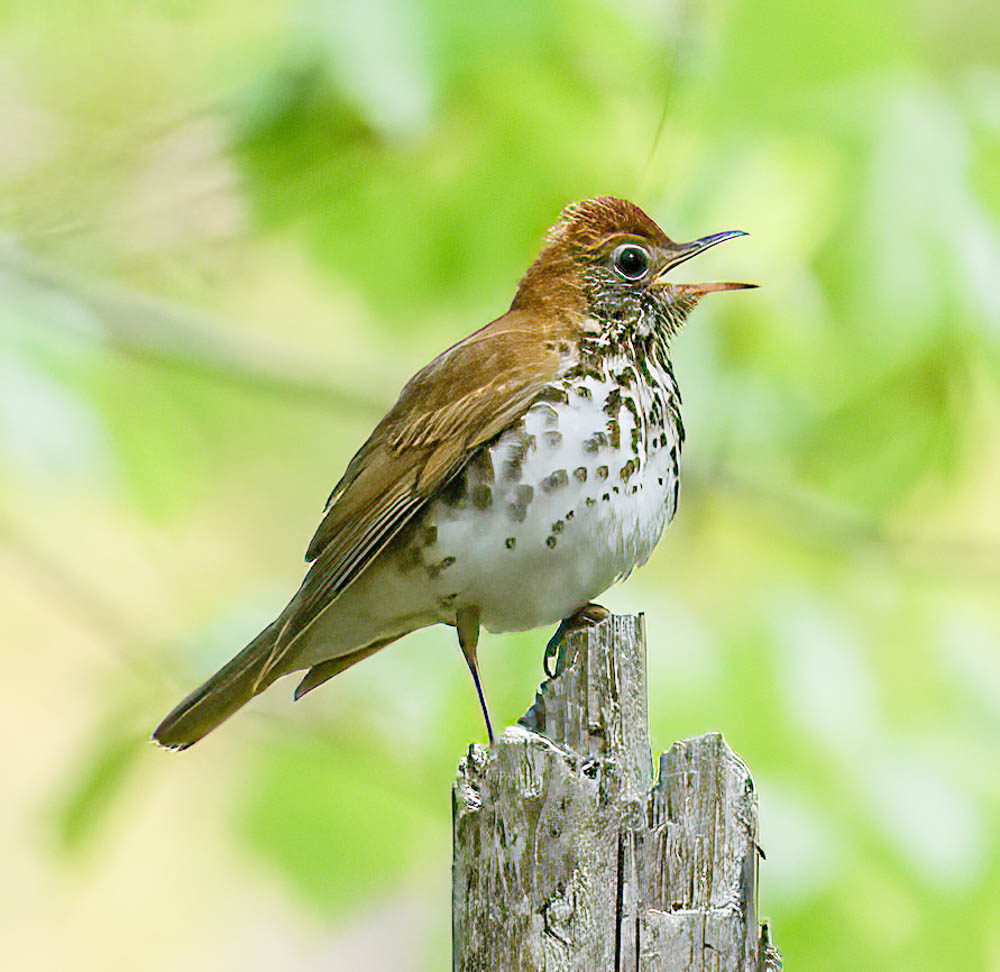
This stunning image of a local Wood Thrush was captured by Chris Franks. Wood Thrushes require at least some undisturbed woodland. Although they have survived forest fragmentation better than other woodland thrushes, their numbers have still declined by half in the last fifty years in New York State.

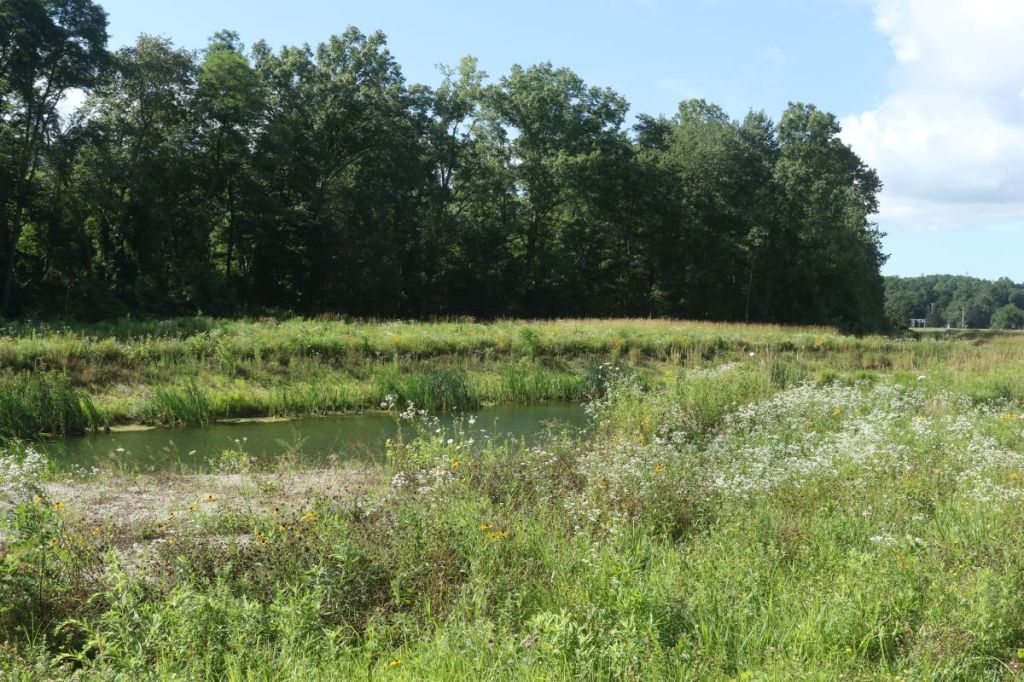
One hotspot of bird activity at Blue Star is the farm pond that lies to the north of their vegetable plots. Many farms in our region build fewer ponds these days as soil and water district grants have dried up, the importance of ponds for watering livestock has declined with the overall decline in animal agriculture, and many vegetable operations now opt for wells and drip irrigation. Homeowners still build ponds for aesthetic reasons, but new pond construction on farms is now rare. Nevertheless, a multitude of legacy ponds dot the Hudson Valley and can serve as oases for birds.

Blue Star’s pond hosted two territories of Song Sparrow, a pair of Red-winged Blackbirds, Barn Swallows, and several Yellow Warblers that caught some unidentified beetles at the waters edge to feed their young in adjacent willows. A small clan of Killdeer, black-and-white inland shorebirds, foraged along the pond’s muddy edge. While the nearby Hudson River is ancient, natural ponds are recent landscape features and quite rare because the fate of most ponds are to fill in quickly over time. The intentional disturbance created by pond construction in the last two centuries has provided a wealth of habitat value for our area. Are there ponds on your farm or property? If so, how long has it been there and what sorts of organisms does it host?

Not all disturbances are net negative events for wildlife. The sad looking oaks defoliated by Spongy Moths throughout the Hudson Valley this June have generated the highest populations of cuckoos I’ve ever seen and the oaks will surely rebound. The soil disturbances associated with Blue Star’s vegetable production created a flush of annual weed seeds now enjoyed by sparrows and their farm pond has produced the insects feeding a variety of native song birds. How to we measure ‘creative destruction’ and gauge how some disturbance is valuable or harmful? What values do we bring to that question and how does it affect the management decisions we make?

The Birds of Little Seed

The diversity of habitats in such a compact area, including a stream and riparian zone, upland pasture, hedgerows, weedy field margins, and vegetated crop zones permit many species of birds to coexist with the farming practices of Little Seed.

On a bright sunny morning on 17 June I was able to document breeding evidence for the following species at Little Seed

  • American Redstart (Feeding Young)
  • Bank Swallow (Used Nest)
  • Belted Kingfisher (Used Nest)
  • Chestnut-sided Warbler (Fledgling)
  • Common Grackle (Fledgling)
  • Common Yellowthroat (Singing territorially)
  • Eastern Kingbird (Feeding Young)
  • Field Sparrow (Fledgling)
  • Gray Catbird (Carrying Food for Young)
  • Indigo Bunting (Singing territorially)
  • Killdeer (Fledgling)
  • Northern Rough-winged Swallow (Fledgling)
  • Red-eyed Vireo (Carrying Food for Young)
  • Red-winged Blackbird (Fledgling)
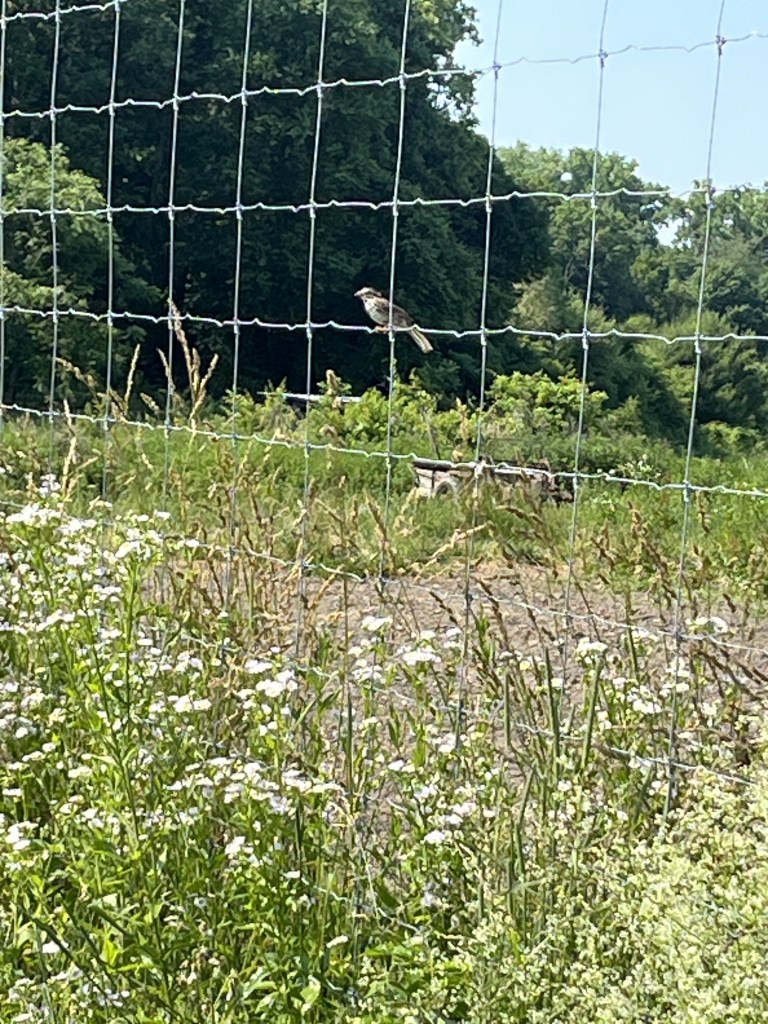
  • Savannah Sparrow (Singing territorially)
  • Spotted Sandpiper (Singing territorially)
  • Song Sparrow (Fledgling and Nest with Eggs)
  • Warbling Vireo (Singing territorially).
  • Wood Duck (Fledgling)

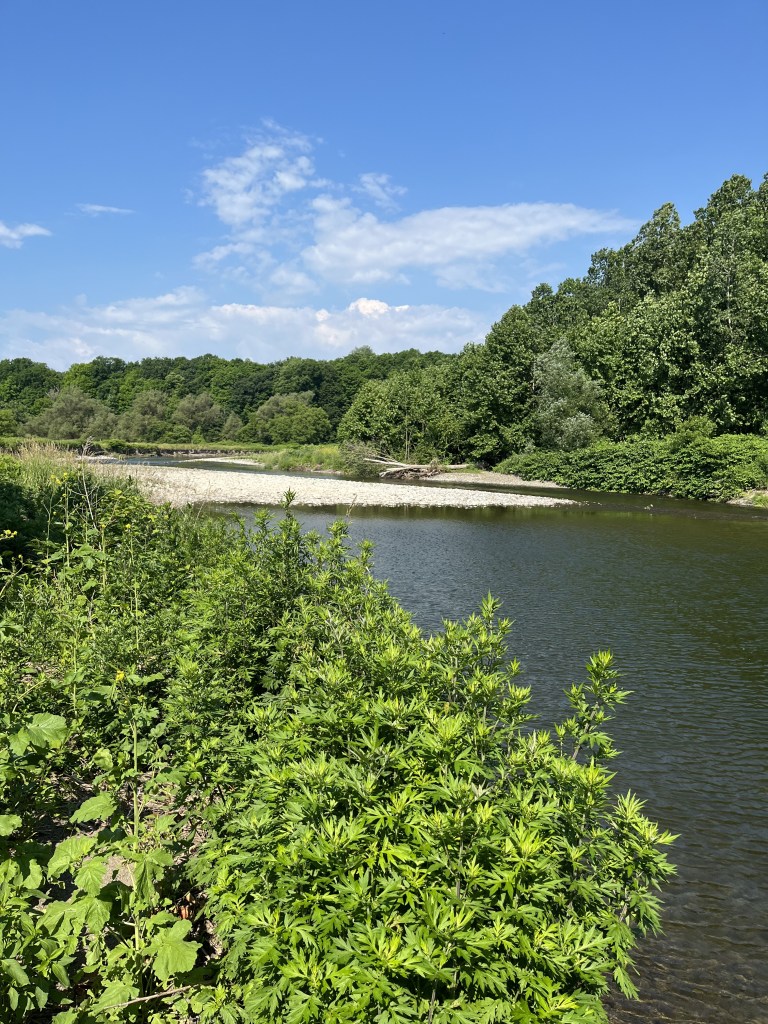
As Conrad and Cladia described in their post, one of the most ecologically interesting and unique features of this farm is the stream and riparian edge that runs adjacent to the farm’s pastures. In addition to looking like a well-used and marvelous swimming hole, the stream and shorelines hosted a variety of interesting birds.

The pebble beach and distant exposed stream banks hosted several range-restricted riparian species of birds

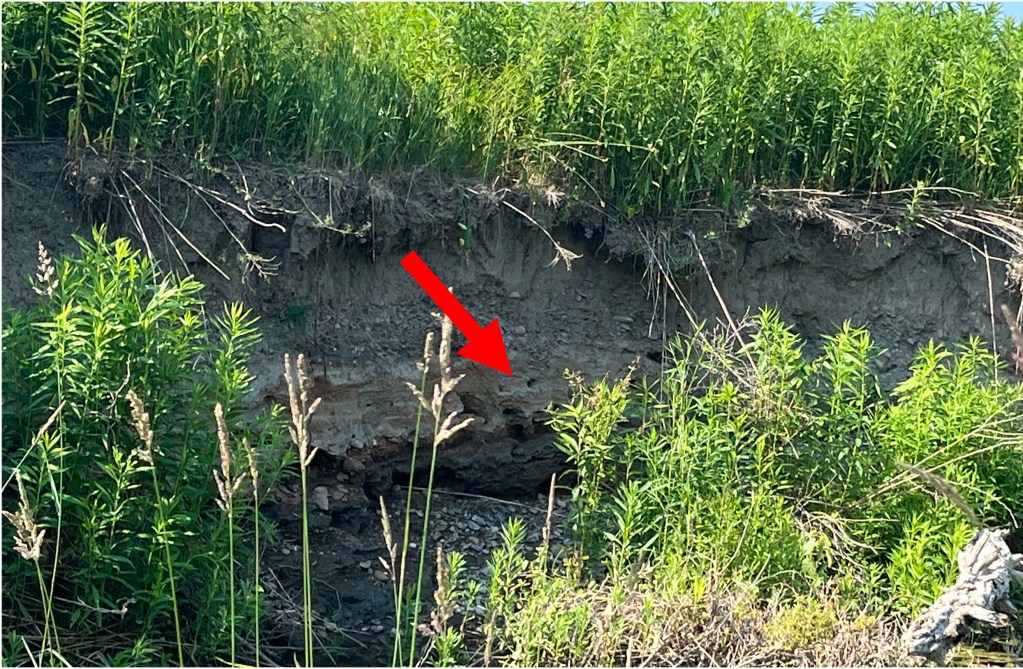
The silt embankment of the stream provided nesting sites for three species of birds that take advantage of this specialized habitat. Bank Swallows, aptly named for their tendency to dig into the soft silt/sand edges of watercourses to form communal nesting cavities were present. Northern Rough-winged Swallows (that often nest as single pairs rather than in groups) also called this section of the stream home.

The red arrow points to one of the excavated cavities of a Bank Swallow nest. Bank Swallows were present flying over the creek, but this particular nest is likely abandoned, perhaps picked up by another cavity nester such as the Northern Rough-Winged Swallow. Bank Swallow colonies are inherently ephemeral, taking advantage of recently exposed banks due to flooding or erosion. Bank Swallows have been documented nesting in human-altered gravel banks and sand mines when natural habitat is unavailable.

This Bank Swallow was photographed by Mike Birmingham in the Hudson Valley. Like all swallows, its long wings allow it the great aerial performance necessary to chase and catch flying insects. Bank Swallows arrive to the Hudson Valley in May and depart to Central America in late August and September when flying insect biomass begins to decreases here locally.

The larger cavity to the left was recently used by a Belted Kingfisher, a much larger fish-eating crested bird that also nests in exposed embankments. This nest looks like it was also used in a previous season. Fresh nests show two clean groves where the adult kingfisher drags its feet as it enters and exits. A variety of mammals will renovate and inhabit this kind of valuable real estate when the breeding season ends.

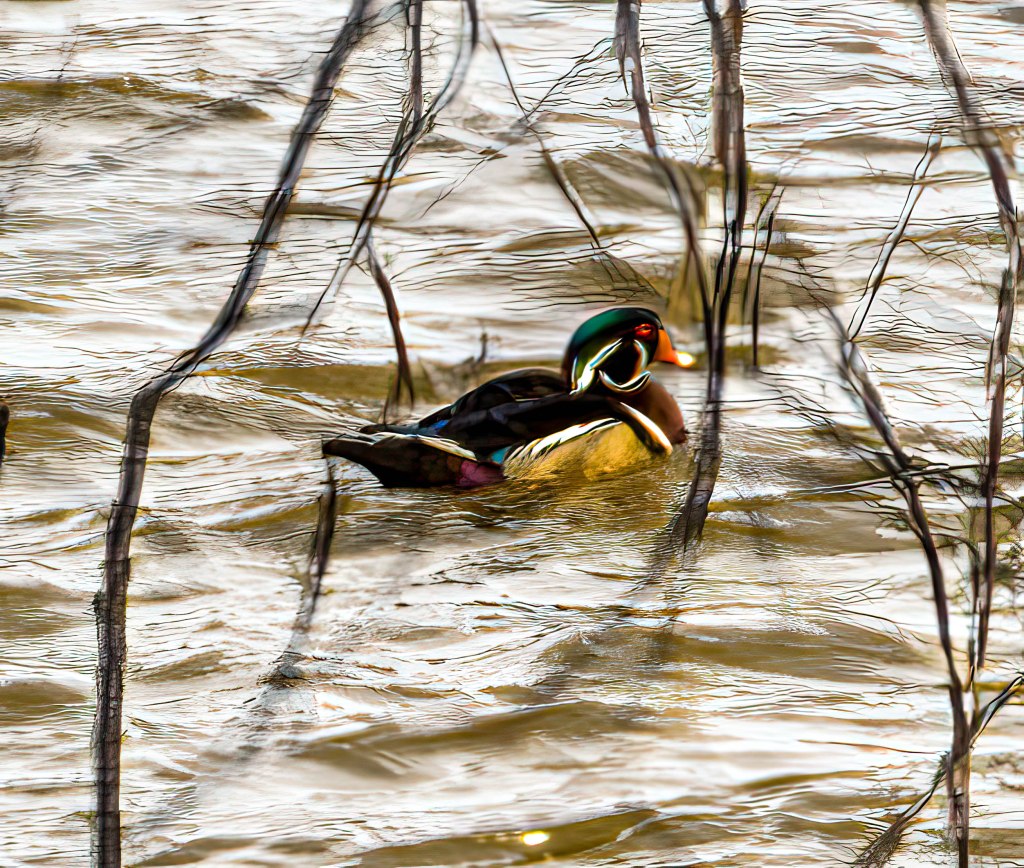
An adult Wood Duck, another cavity nester, swam past on the creek with seven recently fledged ducklings in tow. Ducklings are a classic example of precocial young, meaning that shortly after they hatch they are mobile and able to explore and feed. Contrast these young swimmers with the pink, blind and helpless young of an American Robin (which are altricial young) that must be fed and kept warm to survive. Wood Ducks nest in cavities, but as their name implies, inside the cavities of trees rather than soil embankments. Sometimes suitable nesting holes can be so scarce that multiple females will lay in the same cavity creating super clutches of forty or more young. As soon as the birds are hatched and mobile they exit the cavity (sometimes falling 20 or 30 feet to the ground). Wood Duck chicks have a layer of fat that cushions the fall as they don’t always drop into the water from their nesting trees!

A drake (male) Wood Duck photographed by Mike Birmingham. Wood Ducks are examples of short-distant migrants. They typically leave the Hudson Valley in December but don’t go too far, finding open water in the Mid-Atlantic States. They return earlier than most migrants as well, typically showing up in the Hudson Valley in March. More than 100 years of data have shown us that as the climate warms, Wood Ducks linger here longer in the fall and arrive earlier in spring, often returning in February now, 2-3 weeks earlier than average.

In the pasture adjacent to the stream, three species of early breeding birds are already wrapping up the year’s nesting cycle. Red-winged Blackbirds fly in mixed age flocks in the pasture. They alight and drop back down into the grasses like rain. Common Grackles and their recently fledged soft gray young join them. These small flocks begin as the association of a few dozen breeding pairs. As the summer draws to a close these local flocks aggregate, joining others of their own species and and perhaps too by European Starlings and Brown-headed Cowbirds, sometimes reaching numbers in the tens of thousands. Birds of a Feather Flock Together, so the proverb goes, but in this literal sense the ecological needs of these bird change. In the summer, males aggressively defend individual territories. The proud red flash of a Red-winged Blackbird is designed in part to keep others away from their nesting territories. As breeding season ends, however, and their sexual hormones diminish, the value of so many neighbors becomes an essential survival tool. Many eyes can quickly spot predators and the dodge and weave of a large flock of blackbirds confuses their assailants. There is safety in numbers.

Some of the more experienced Red-Wing Blackbirds will raise a second clutch, but the bulk of breeding is already over just as the summer solstice arrives. Other species of birds, like the pair of American Goldfinch that fly over the pasture, are just forming their pair bonds and attracting mates, not yet ready to lay eggs. They will gather together nests of spider webs and milkweed silk embroidered with lichens as the first apples of the Hudson Valley are picked. Each species of bird has its own season and rhythm.

Tree Swallows, a third early breeder also flies over the stream near the pasture. These iridescent blue-green, white-bellied swallows nest in tree cavities just like Wood Ducks. Placing a bluebird box next to a water course is almost certain to attract them. They are the first swallows to arrive to the Hudson Valley each year, typically in March, and the last to leave. Unusual for migrants, they have a long season locally after their breeding cycle. In early July they perch crowded on local power lines and those flocks always remind me of the pivotal moment when summer has peaked and we begin the long slow walk to winter. They seem to be able to eke out a living when other species of swallows have long departed and it’s not impossible to see them in our area as late as October.

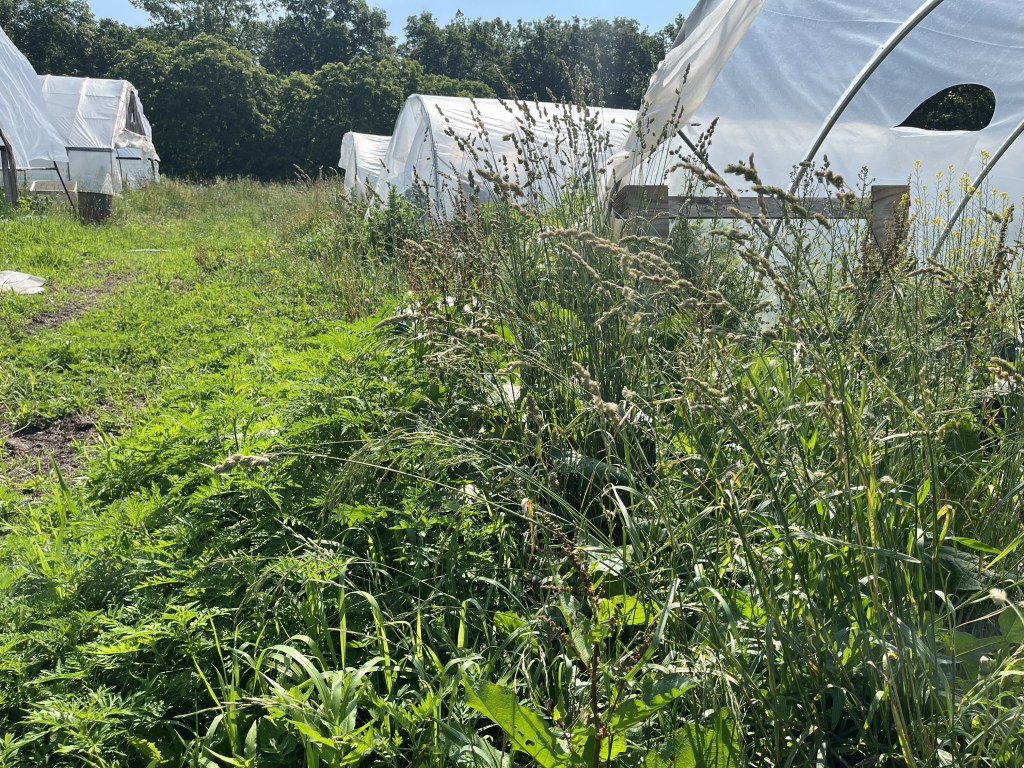
On many conventional farms, active cropping areas typically have low bird diversity, but the unmanaged edges at Little Seed provide habitat for birds even in places that are heavily travelled and used for production.

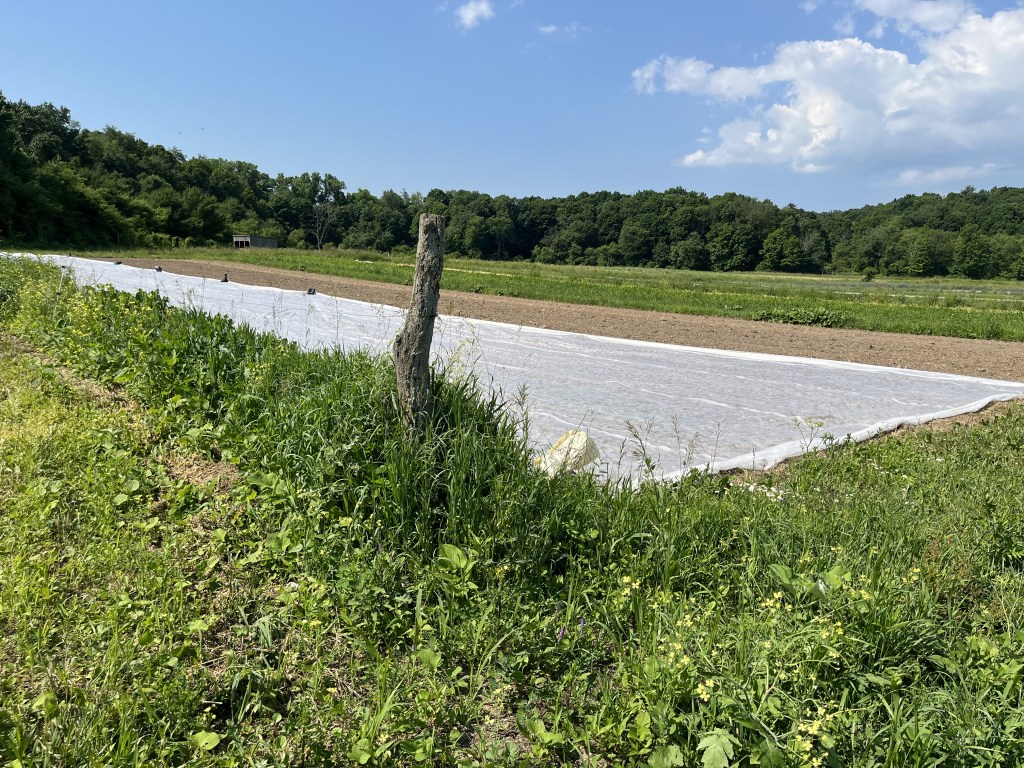
The seeding grasses in and around these plastic tunnel greenhouses provide enough habitat for sparrows to nest and feed.

Song Sparrows are particularly good at finding small breeding niches in weedy field margins and hedgerows when given the chance. They are true omnivores feeding on a variety of insect prey, seeds, and fruits.

As their name implies, Song Sparrows have complex — and to our ears, pleasant — songs that they sing over and over to define and defend their territories.

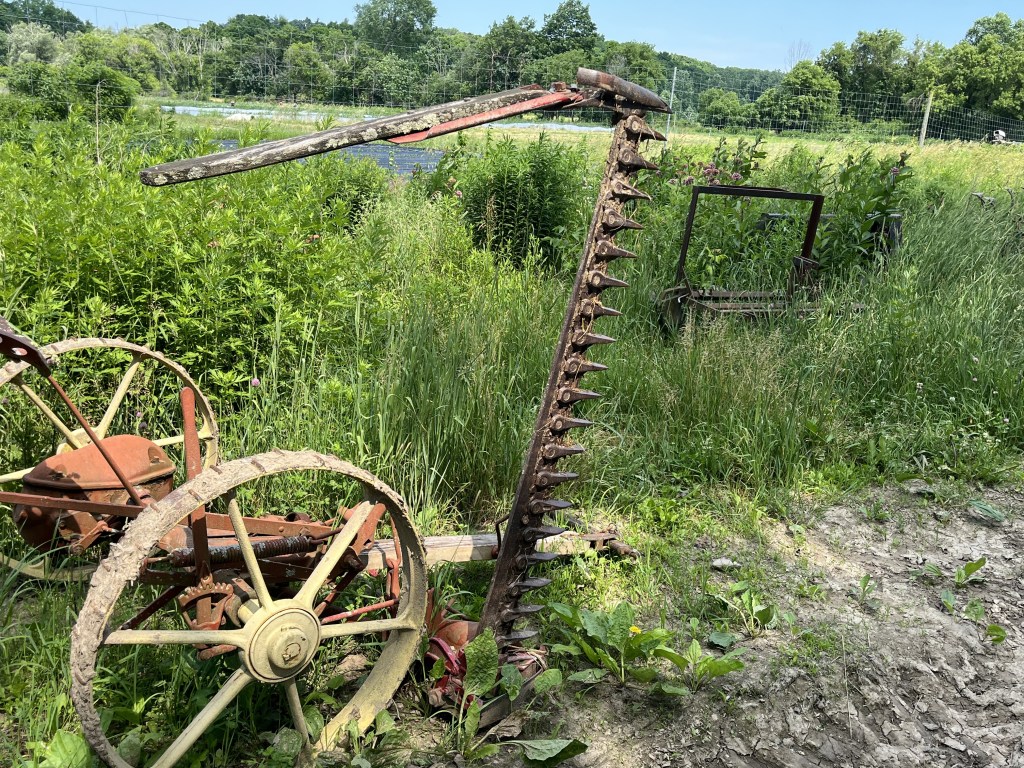
Even the seasonal weeds that grow up around equipment storage sties can be an oasis for sparrows and other birds

Fenceposts can be important feeding sites for birds. An Eastern Bluebird (that just dived out of view of my camera!) used this post to ambush and pounce down onto insects below.

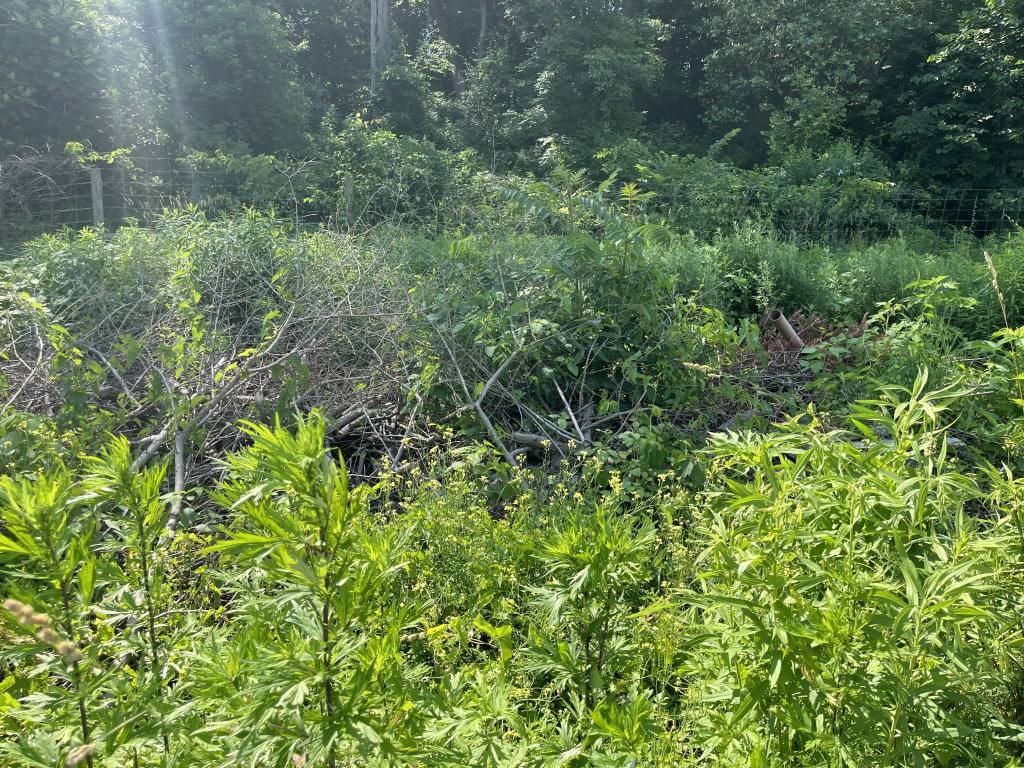
Brush piles can be essential cover for sparrows and other birds, particularly in the winter when the lack of leaves makes many small birds easy targets for aerial predators.

As an ecologically minded farmer, I often ask myself the question: Is it better to provide wildlife habitat on my farm by encouraging more undisturbed and fallow land, or should I work harder to integrate spaces for wildlife in and among my cropping areas? Little Seed clearly demonstrated both solutions. And although, I’m not sure there is ever a firm answer to this question, or if I have even framed it correctly, I left the farm thinking more and more about these two approaches.

12 July 2024: Insects of Rose Hill

by Conrad (with some photos and field assistance from Laura & Meg).

First of all, I’m not trying to ‘back date my check’ by associating this with a date of 9 days ago – that is when we visited Rose Hill, not the date on which this was written. Because phenology changes rapidly, it seems important to use the date we were actually on the ground.

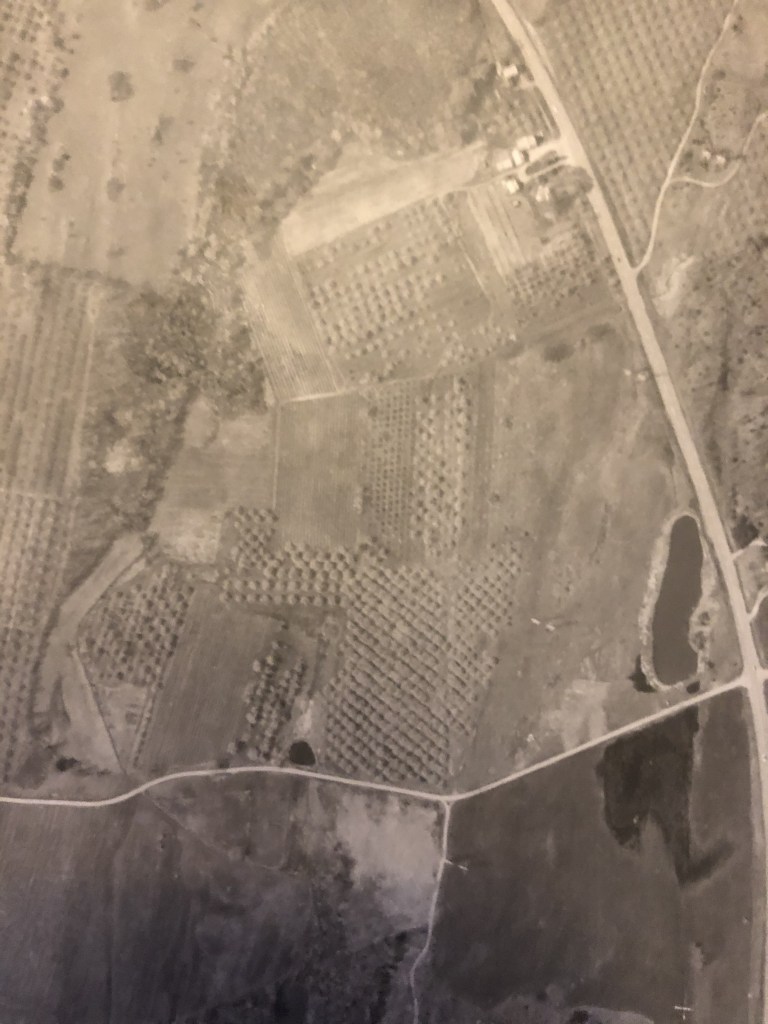
In 1936, on the current land of Rose Hill Farm only the northwest corner appeared to be in orchard.

Today, orchards of various sorts fill much of Rose Hill. Surprisingly, one of the areas reverting to forest is that northwest area which appeared to be orchard in the earlier image. The pink line refers to our approximate path, and yellow-boxed numbers indicated the approximate locations of some of the below landscape shots.

Several ponds are scattered across Rose Hill. This photograph was taken looking southwest from roughly point 1 on the above map. All ponds probably had predatory fish, possibly reducing their ecological value for some dragonflies.

One of the ecologically most interesting areas was the wet meadow shown in this photo, taken looking west-northwest along the fence from near point 2. There is wetland beyond the fence here and that wetland has snuck into Rose Hill.

Among the fun plants spotted in this area were Yellow Star Grass (a somewhat unusual plant found in both wetlands and dry forests) and…

Square-stemmed Monkey Flower, a moist-meadow plant.

Some of the strips between trees had been left unmowed, leaving a welcome abundance of clover. This picture was taken near point 2, looking north.

Mowing had occurred between the rows of some smaller trees, although taller vegetation, including Common Milkweed and Indian Hemp, was growing up within rows but between the trees. This photo was taken looking northeast from around point 3.

There were also larger patches of uncut vegetation, including this dry hillock north of point 4 and capped by sumach and knapweed.

This moister, unmowed block was located roughly north of point 5. Flowers included Queen Anne’s Lace (aka Wild Carrot) and Common Milkweed. The Rose Hill bioblock, where they are experimenting with organic production, is located just beyond this meadow, but we did not enter because it had recently been sprayed with organic pesticides.

This photo was taken looking north from point 6; a pond is hidden behind the bushes and surrounded by this wetter meadow.

We split up and circled around these ponds before rejoining for a quick lunch near the main parking lot and heading out for a final loop through the northwest section of the Farm.

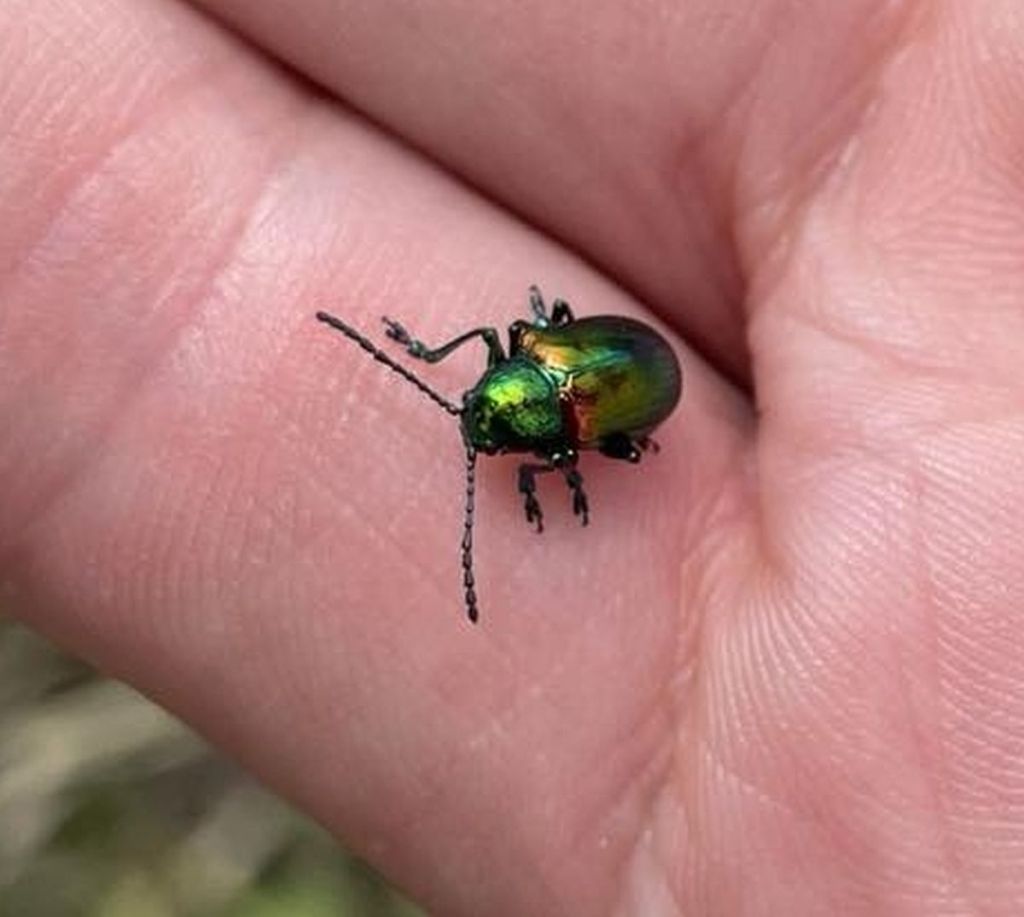
We’ll begin our ‘insect hodge-podge’ section with this species, the elegant, iridescent Dogbane Beetle, which we found hanging out in the Indian Hemp (a species of Dogbane).

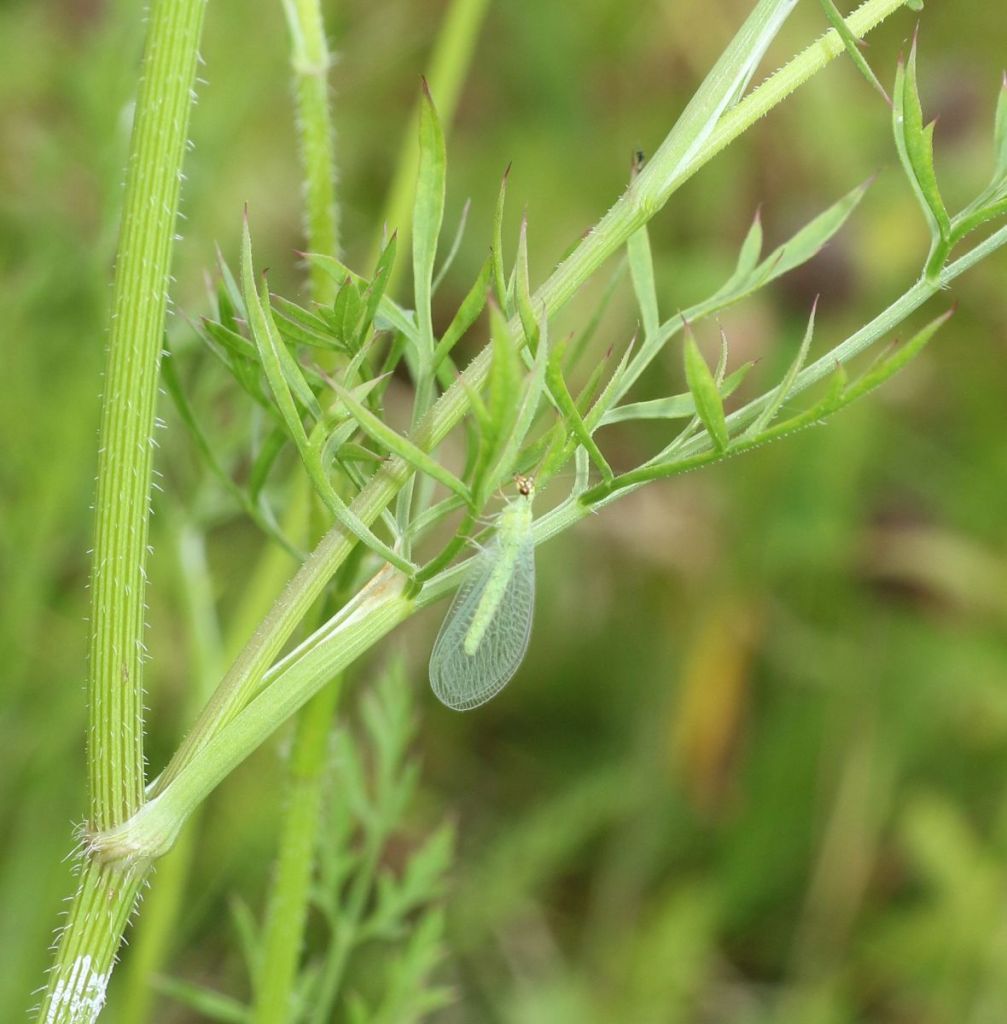
Lacewings are described as beneficials, largely because of their predatory larvae. One can even buy them commercially. However, we see their adults and larvae so rarely that it’s hard to believe that, in our region at least, they are usually having much of a demographic impact on pests. If you have observed otherwise, please let us know!

Crops aren’t the only plants afflicted by aphids – here Common Milkweed flowers appear to sag under their aphid load.

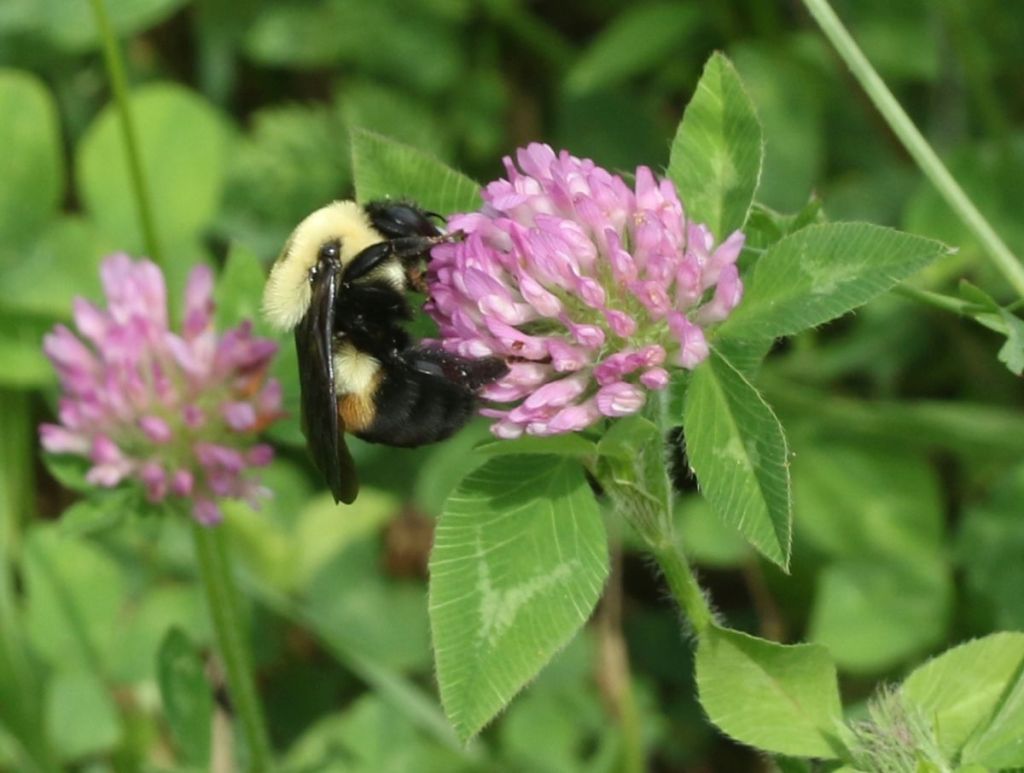
Honey Bees were the most common bee we observed (not surprising, given the on-farm bee hives), however we did observe some other bees including this Brown-belted Bumble Bee (Bombus griseocollis) and this…

This is a Giant (or “Sculptured”) Resin Bee. I was rather baffled by this bee, and do not recall having seen it before. This is an Asian bee that was apparently accidentally introduced to the US in the early 1990s; it now occurs throughout most of the East Coast. It is solitary and makes its solo nests in wood cavities. It apparently doesn’t make its own excavations, and so sometimes uses the holes pre-drilled by our native carpenter bees.

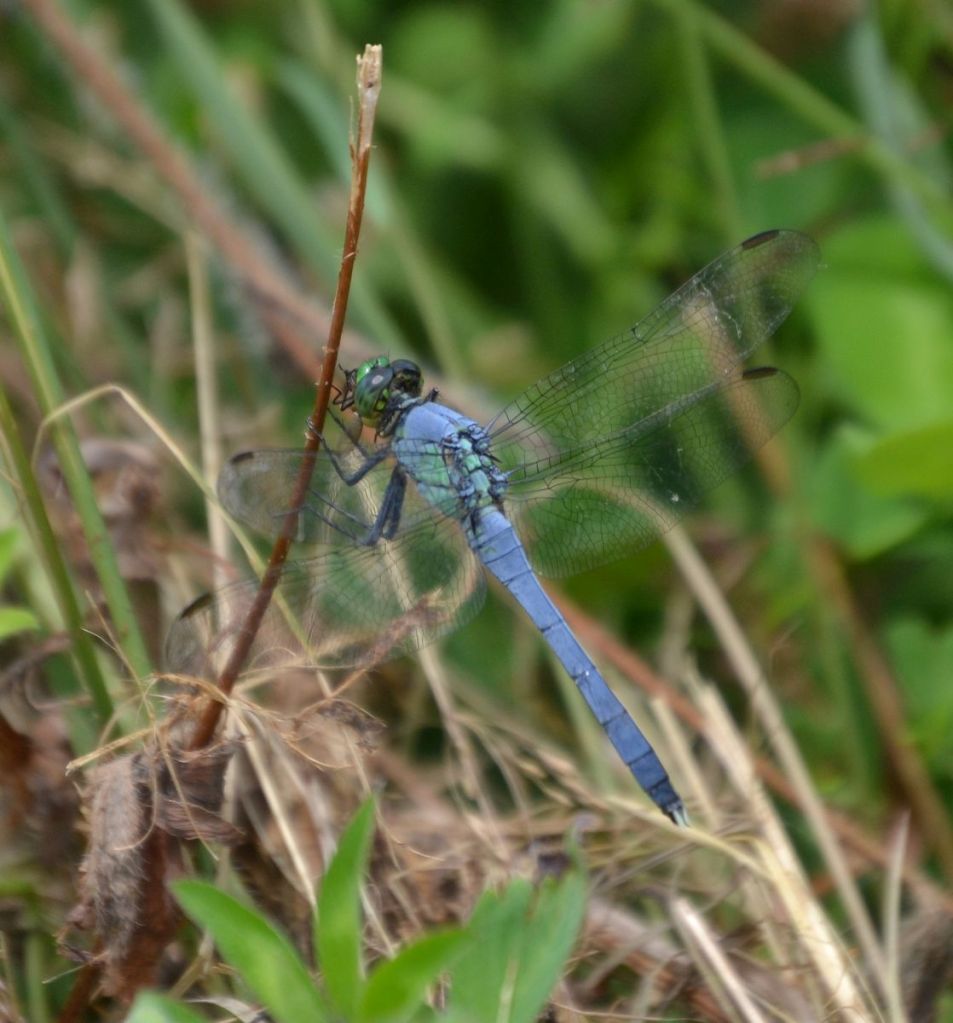
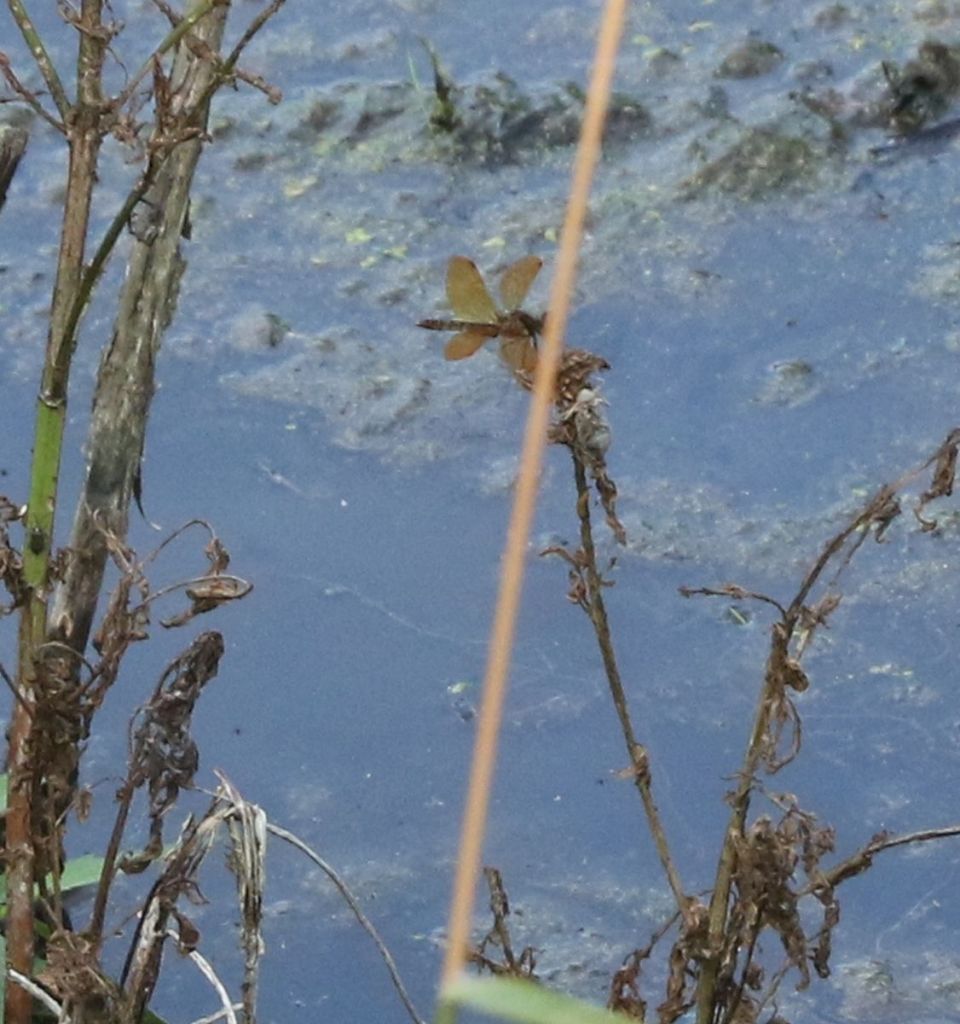
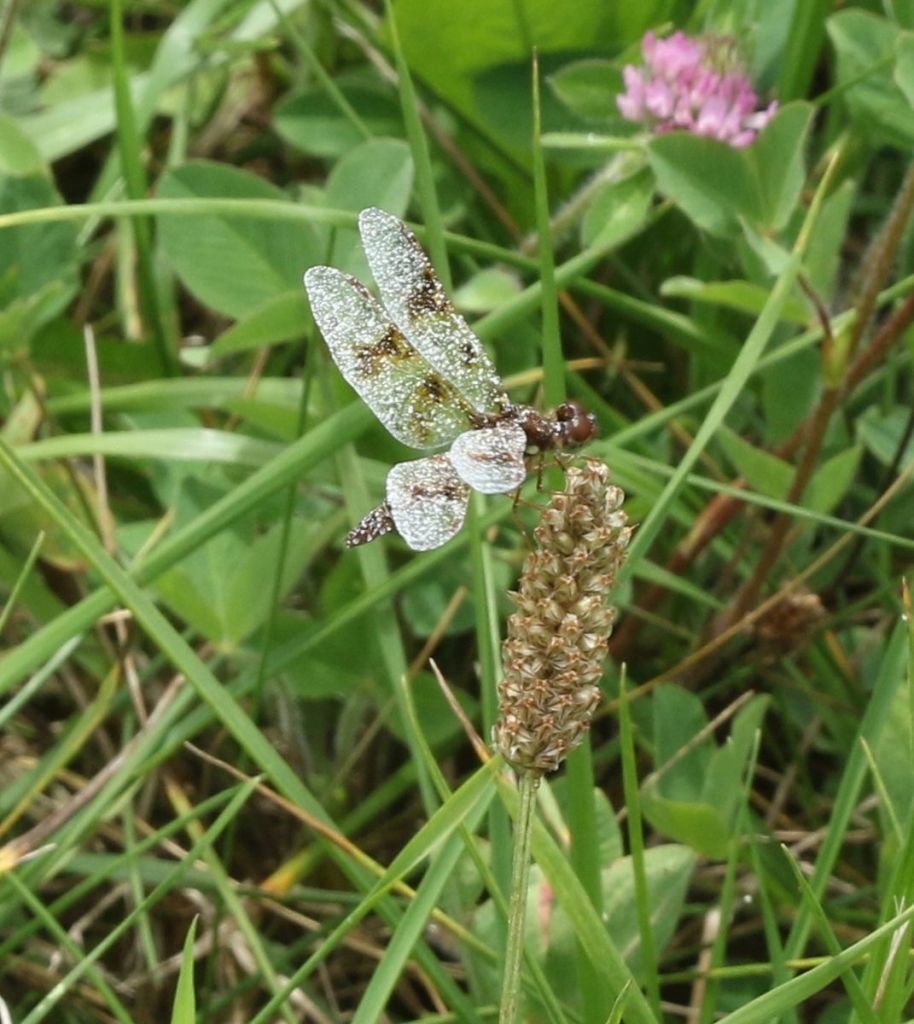
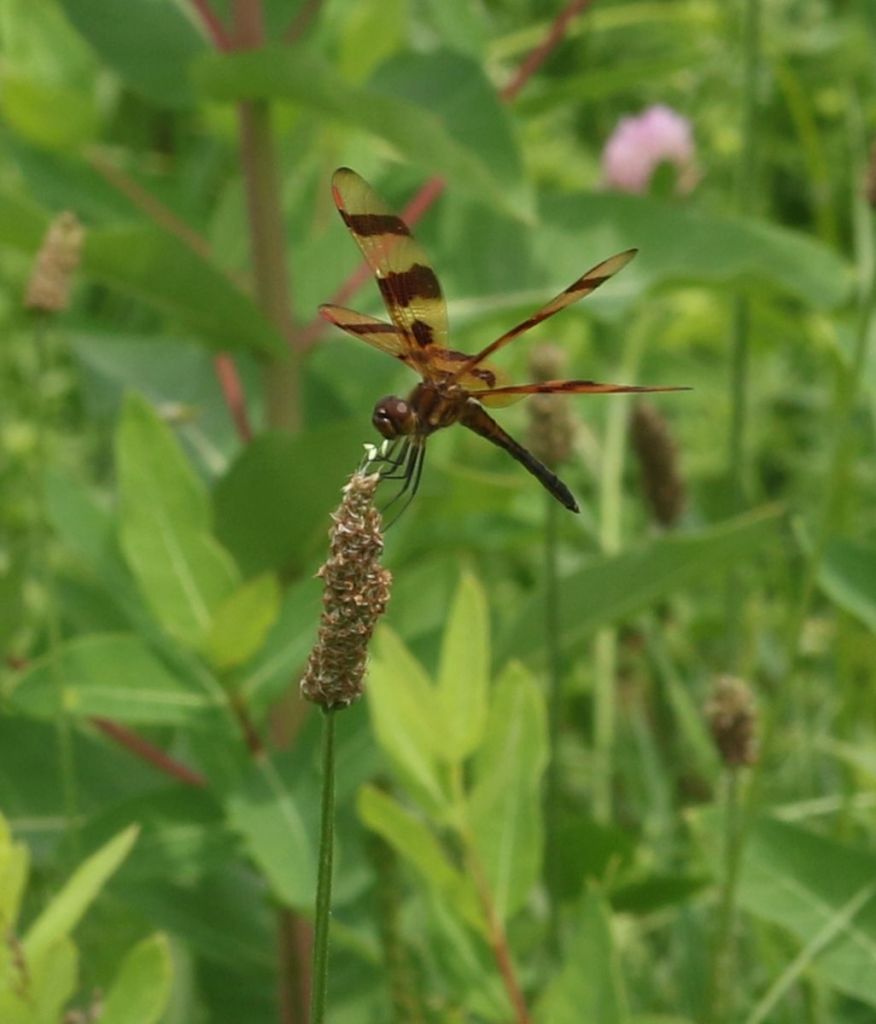
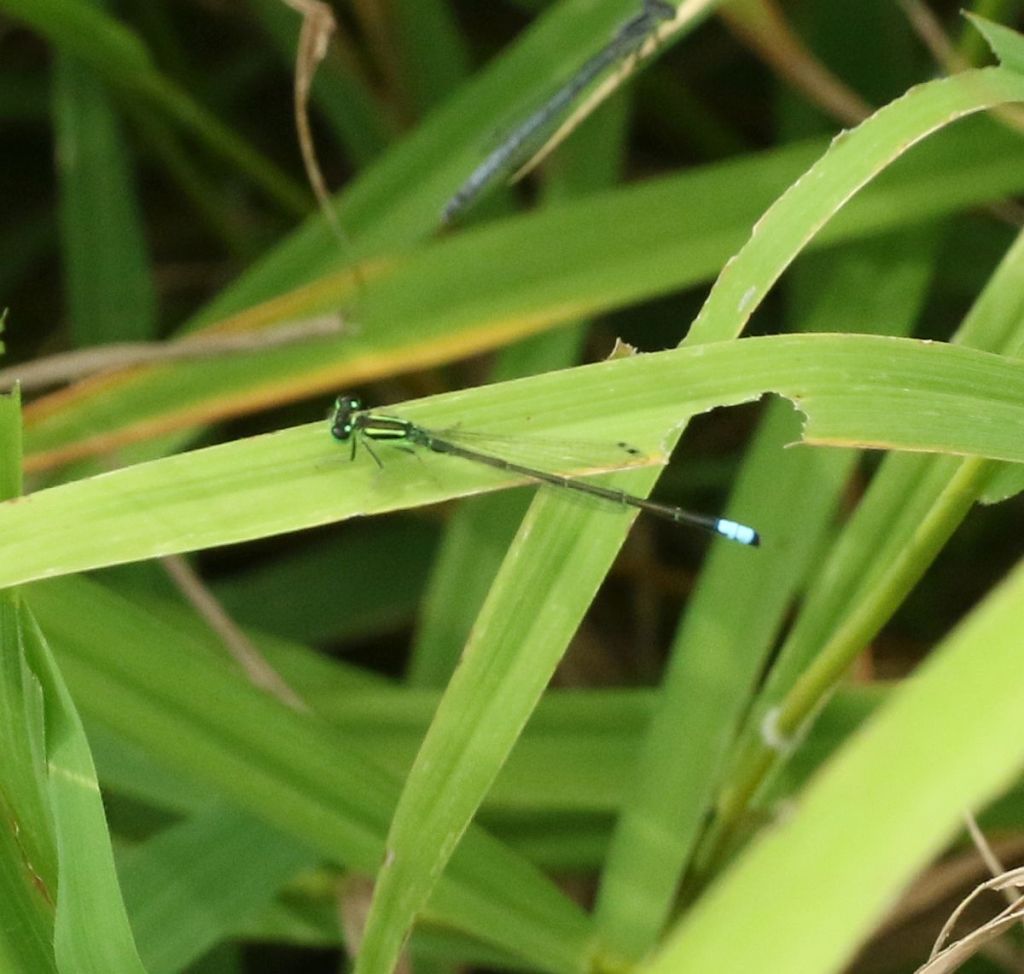
Dragonfly and damselfly diversity was not particularly high, perhaps because of the presence of fish. Among the species we noted were the following:

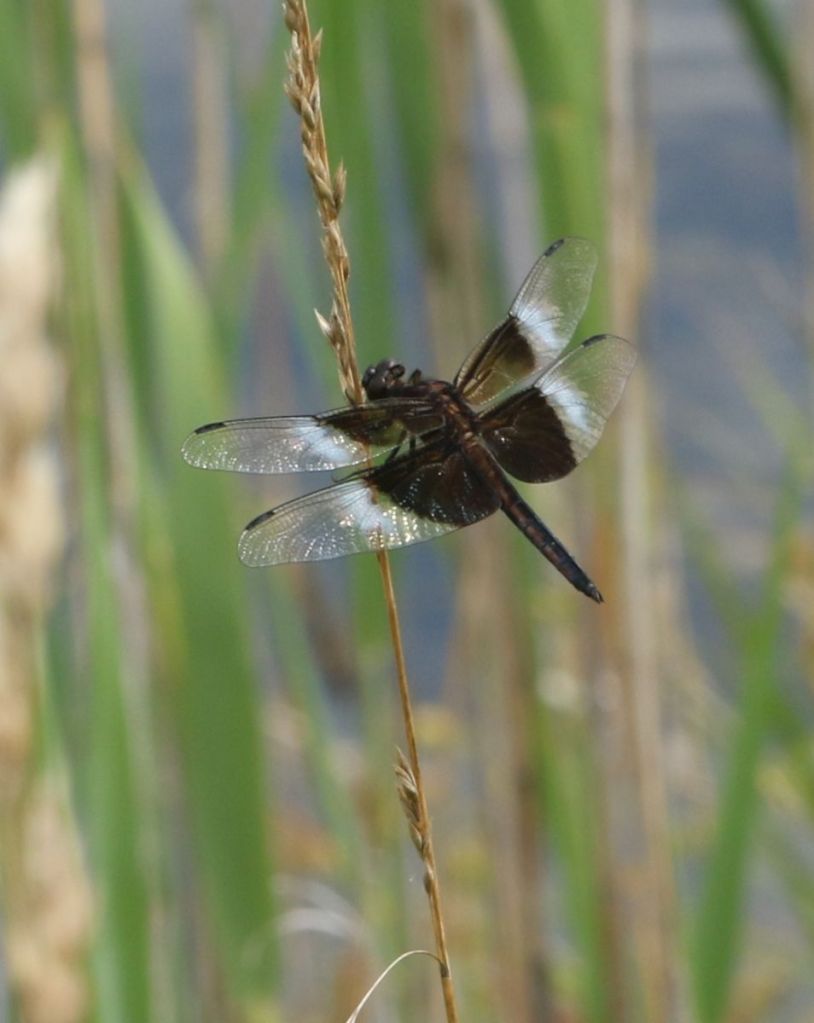
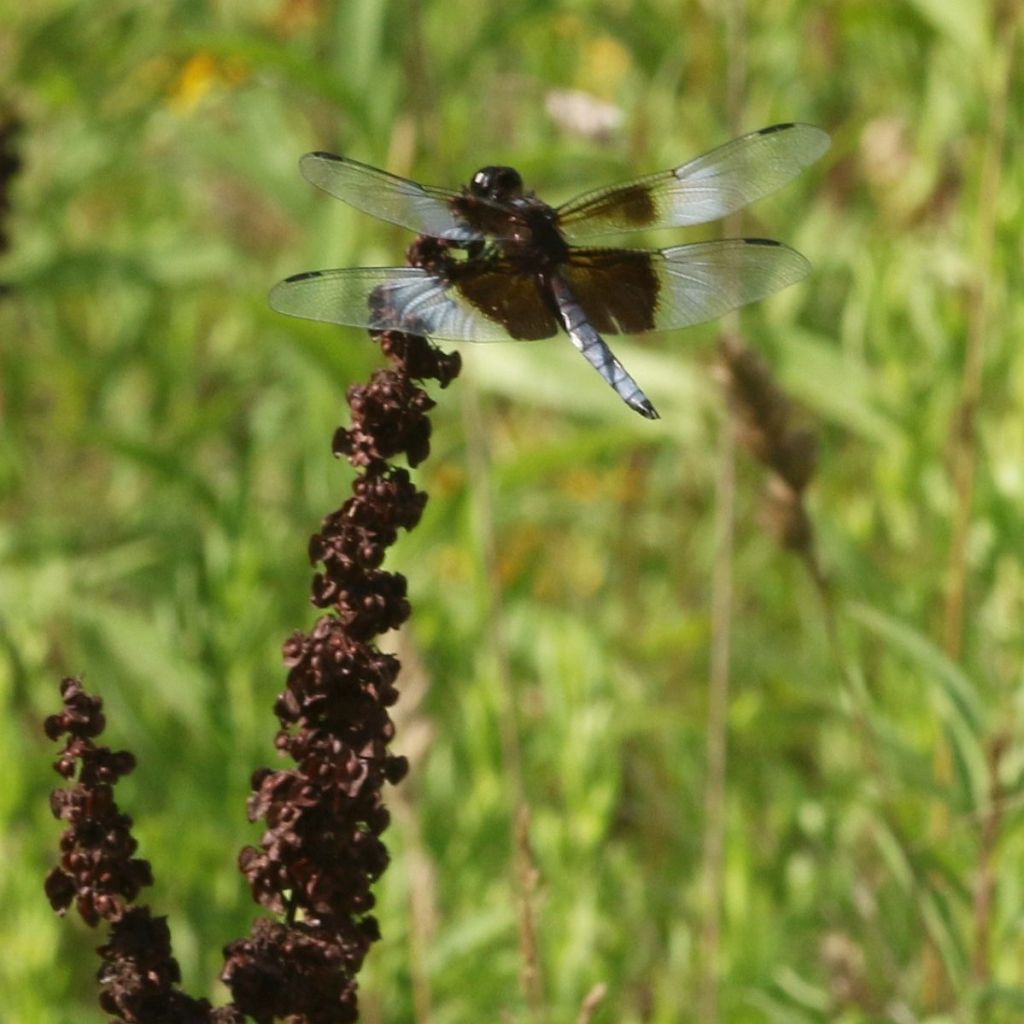
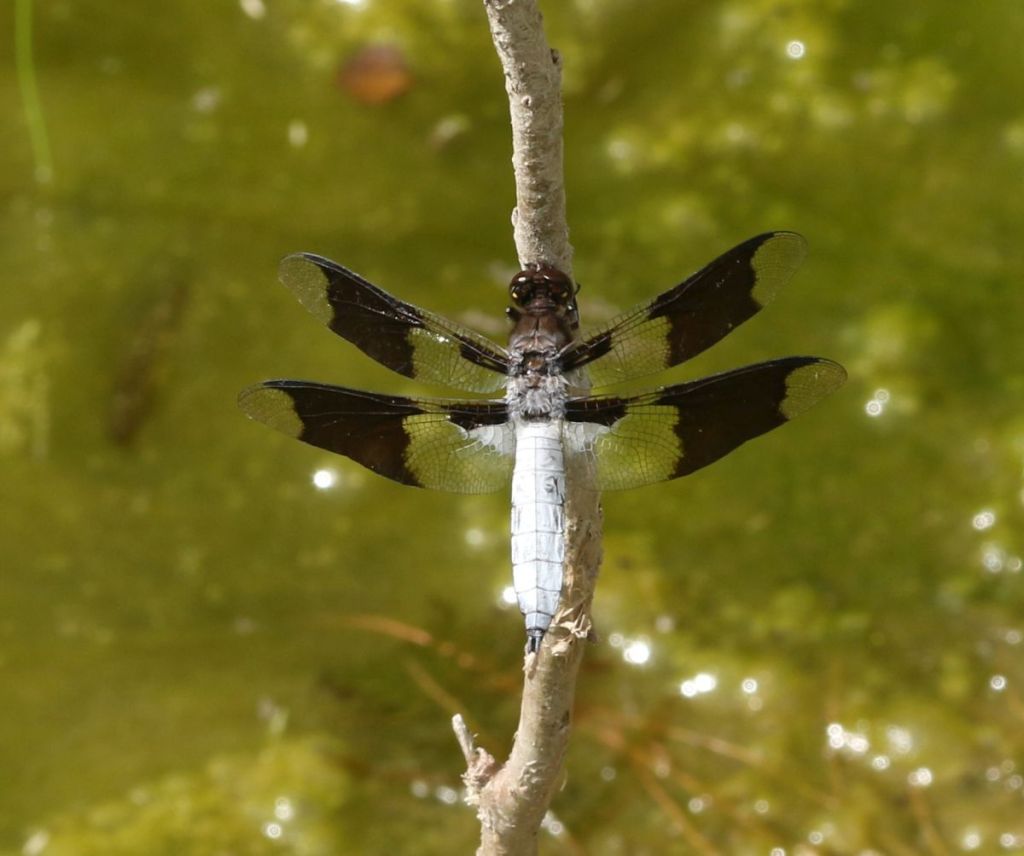
The common, widespread Widow Skimmer; this mature male shows the characteristic black wing bases fringed with white frosting.

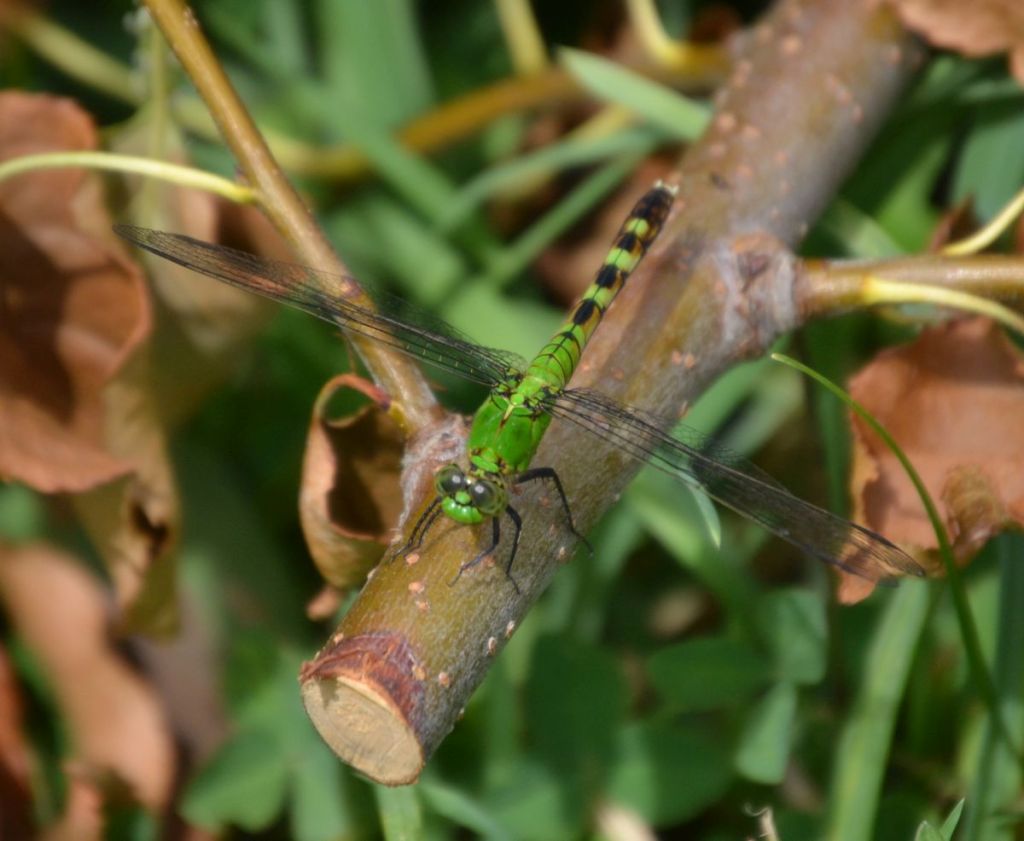
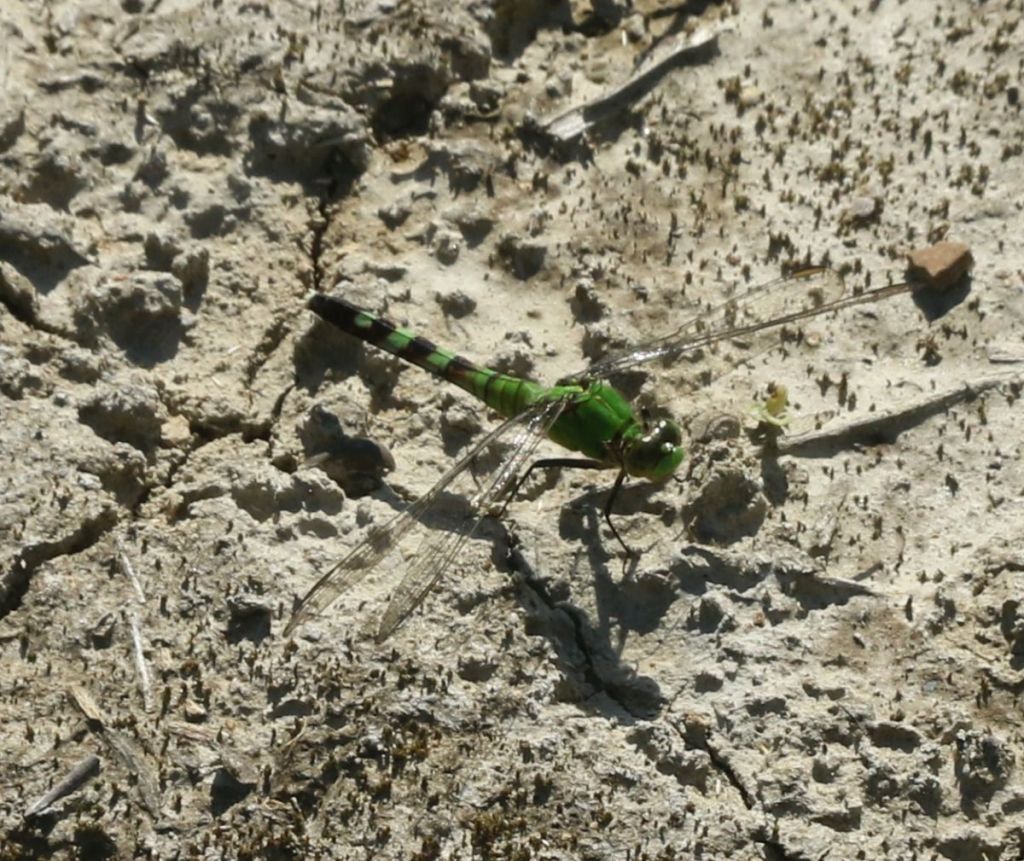
This bright green beast is a female Eastern Pondhawk; she’s really our only dragonfly with such a vibrant green coloration.

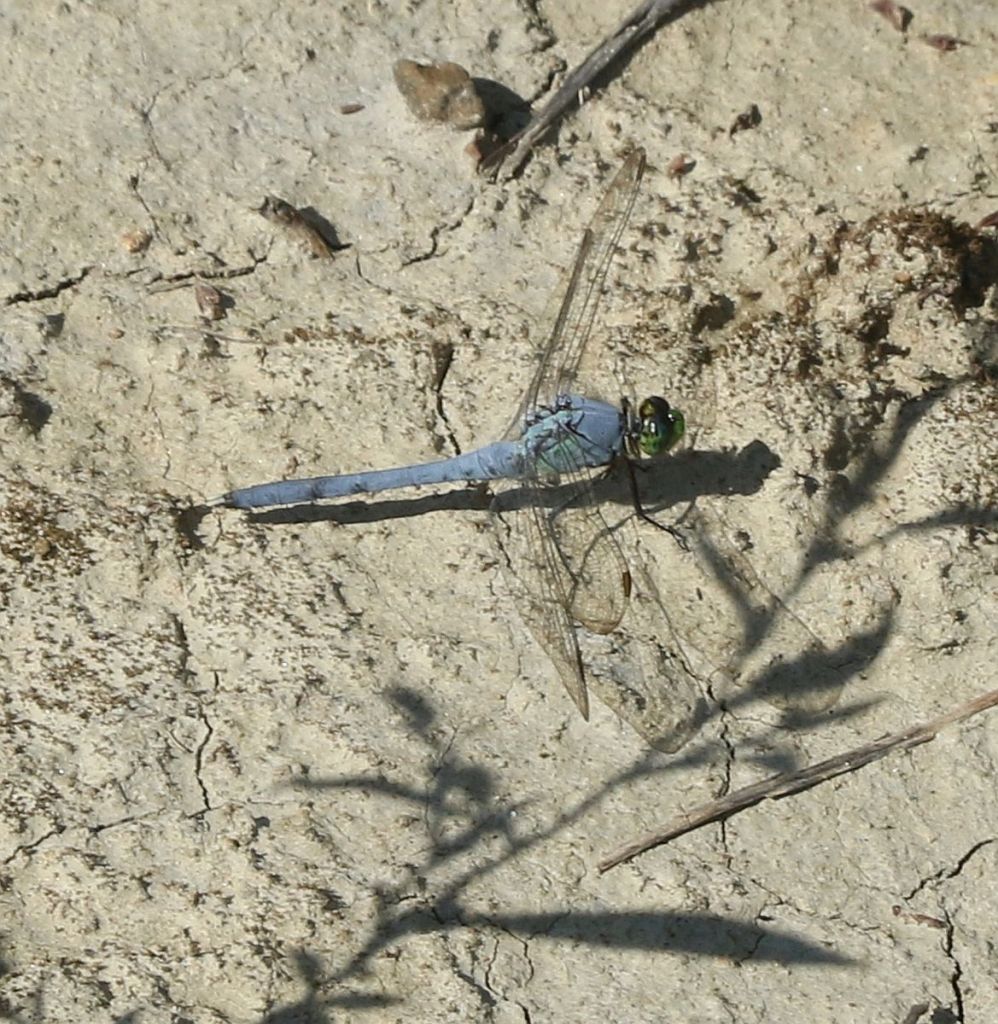
The maturing blue male of the Eastern Pondhawk, both sexes have that white tail tip.

Sorry for the ‘headless’ photograph, but at least this image shows the distinctive orange wings of the male Eastern Amberwing.

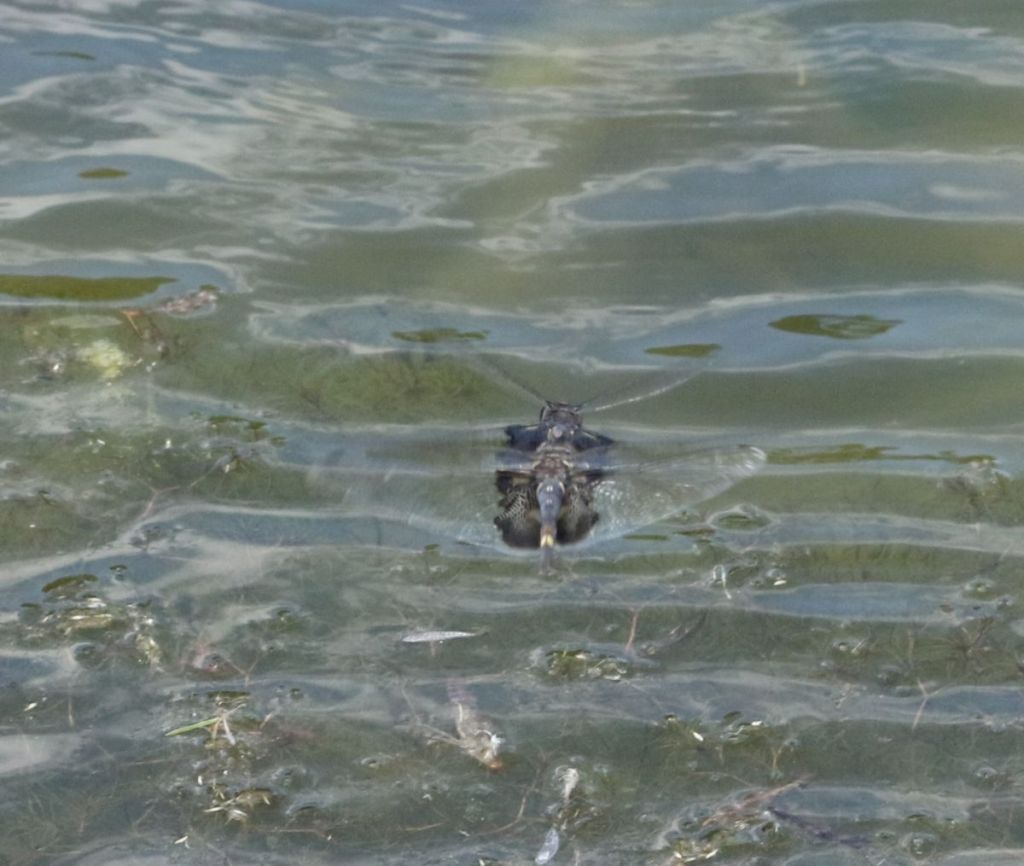
It appears that this female Eastern Amberwing may have flown too close to the clay sprayer. In organic orcharding, a clay compound is used to coat fruit with a protective clay layer.

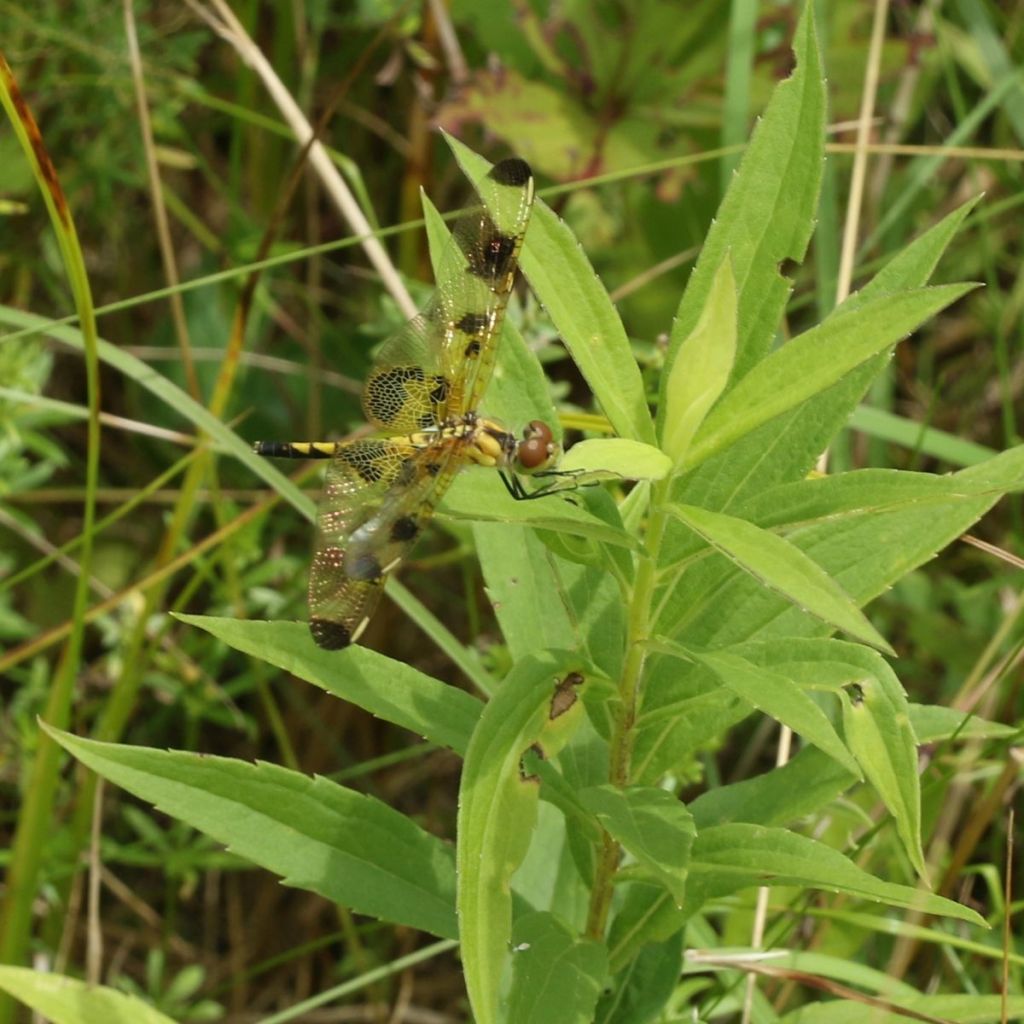
The colorful Halloween Pennant is common in our fields at this time of year.

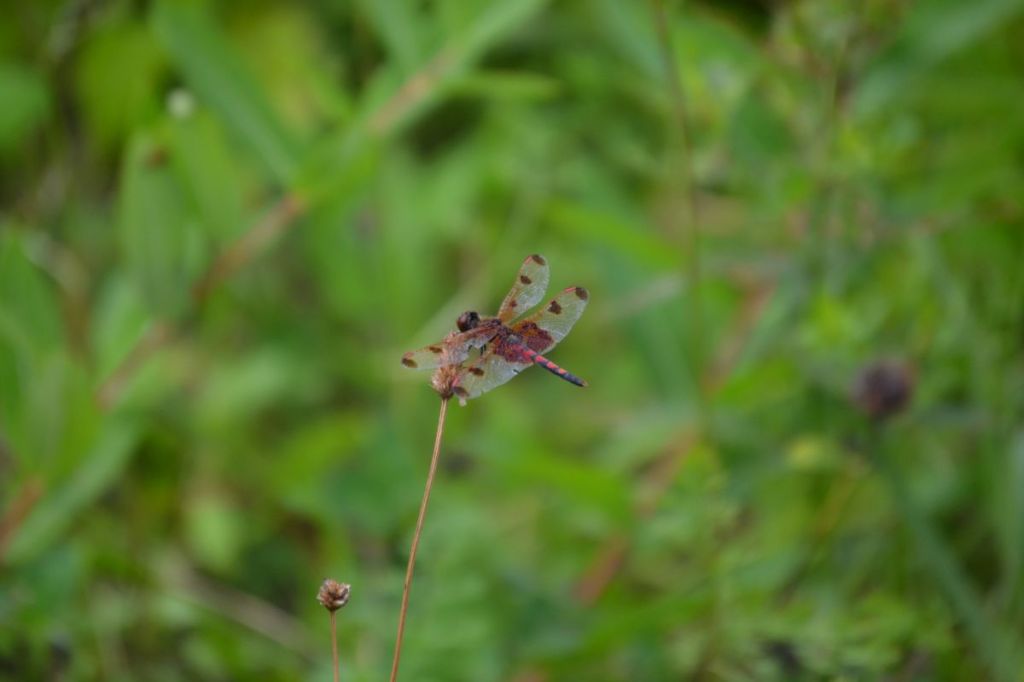
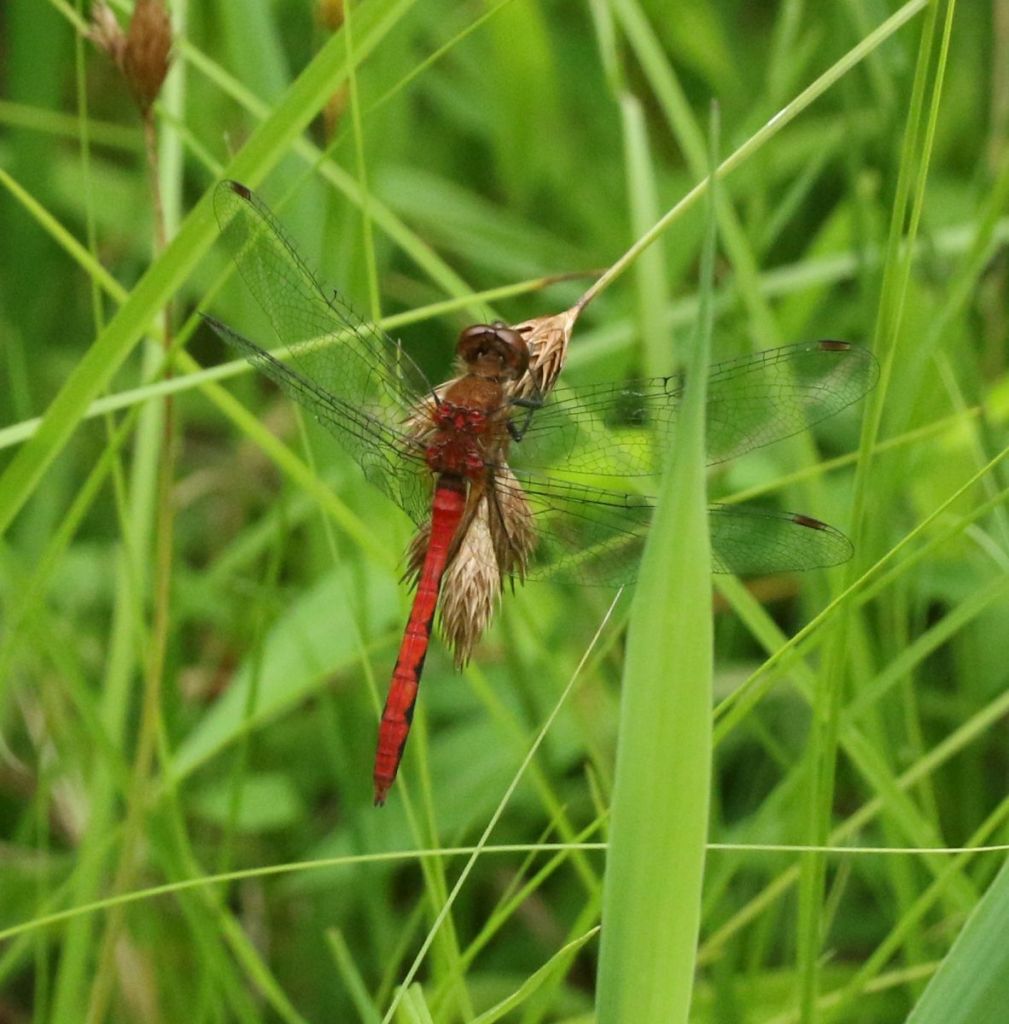
For longer than I should have, I mistook this for the preceding species because of its similar size, behaviour,and orange-yellow coloration. However, note the different patterning of the dark dots on the wings. This is a Calico Pennant, whose females and young males look like this. Mature males are…

a distinct red (but don’t mistake them for Meadowhawks!).

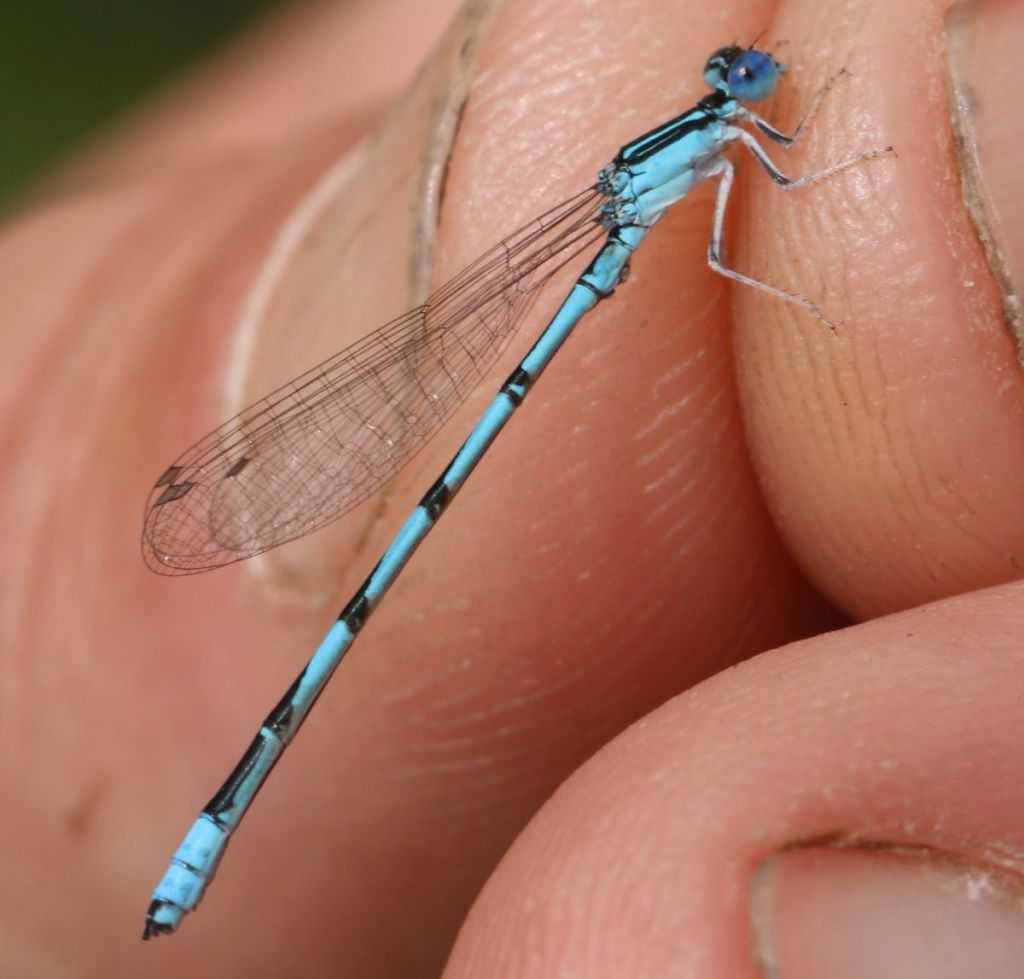
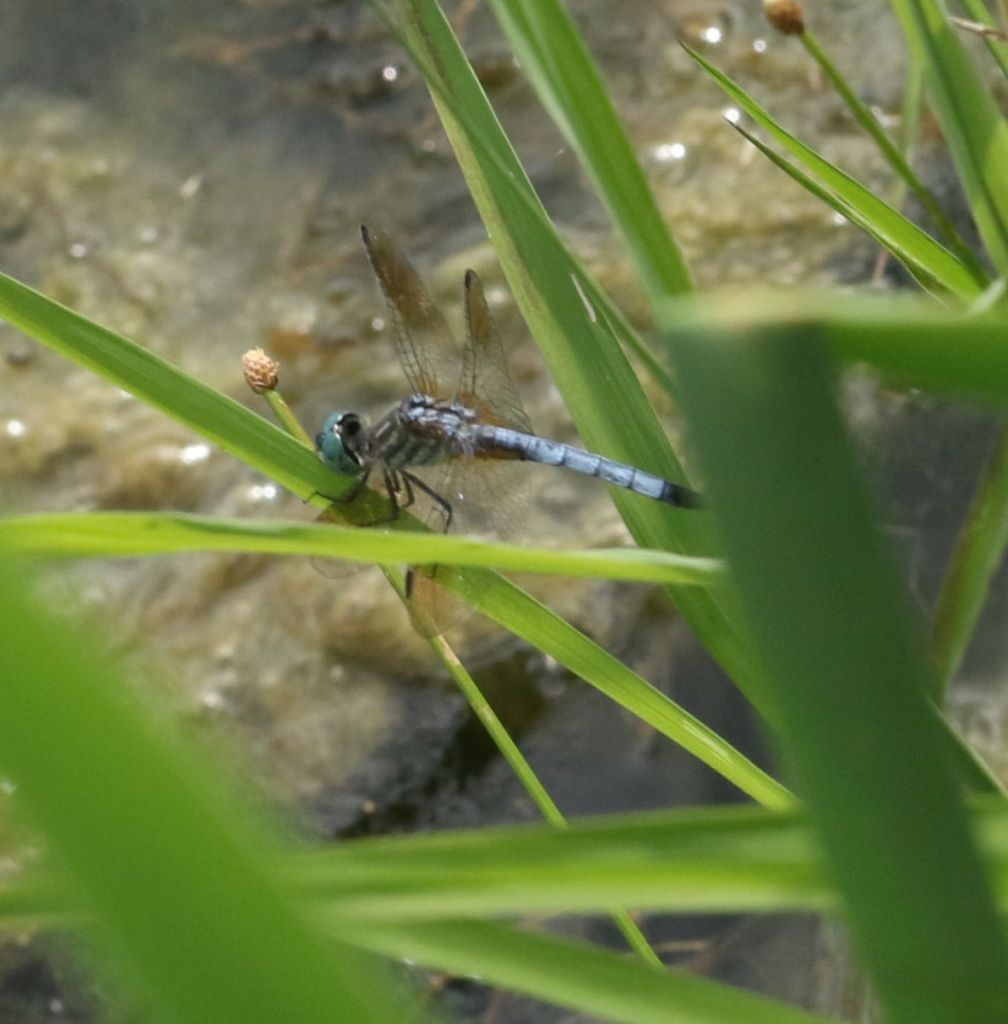
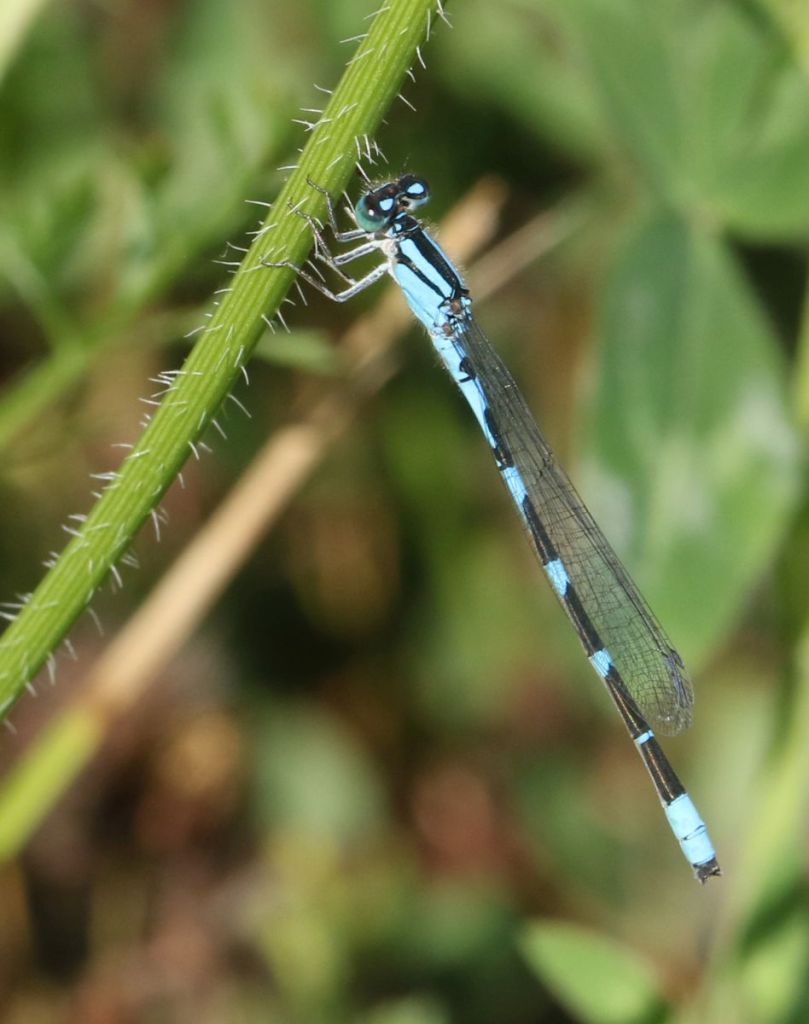
Damselflies, such as this bluet, tend to be smaller and thinner.

One of the key characteristics for identifying these insects is the shape of the so-called claspers – the structures that the males use to grasp the females behind the head. Because that physical pairing is a integral part of the mate bonding, clasper structure tends to be unique, perhaps creating something like a lock-and-key with the architecture of the female. The shape of these claspers (together with features of its coloration) suggest that this is a Familiar Bluet. As the name suggests, this is a common species; it found throughout almost the entire continental US.

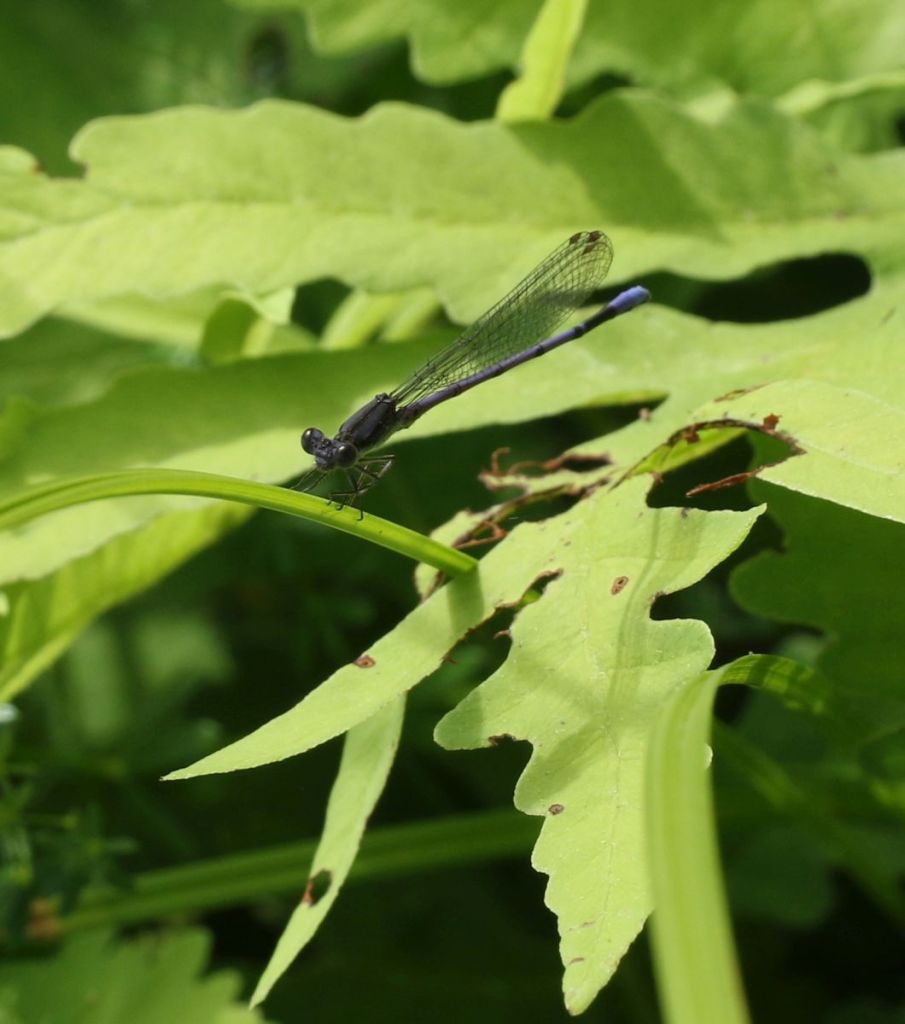
The purplish hue of this damselfly earmark it as a Variable Dancer. This another relatively common species, with the core of its distribution in the eastern US.

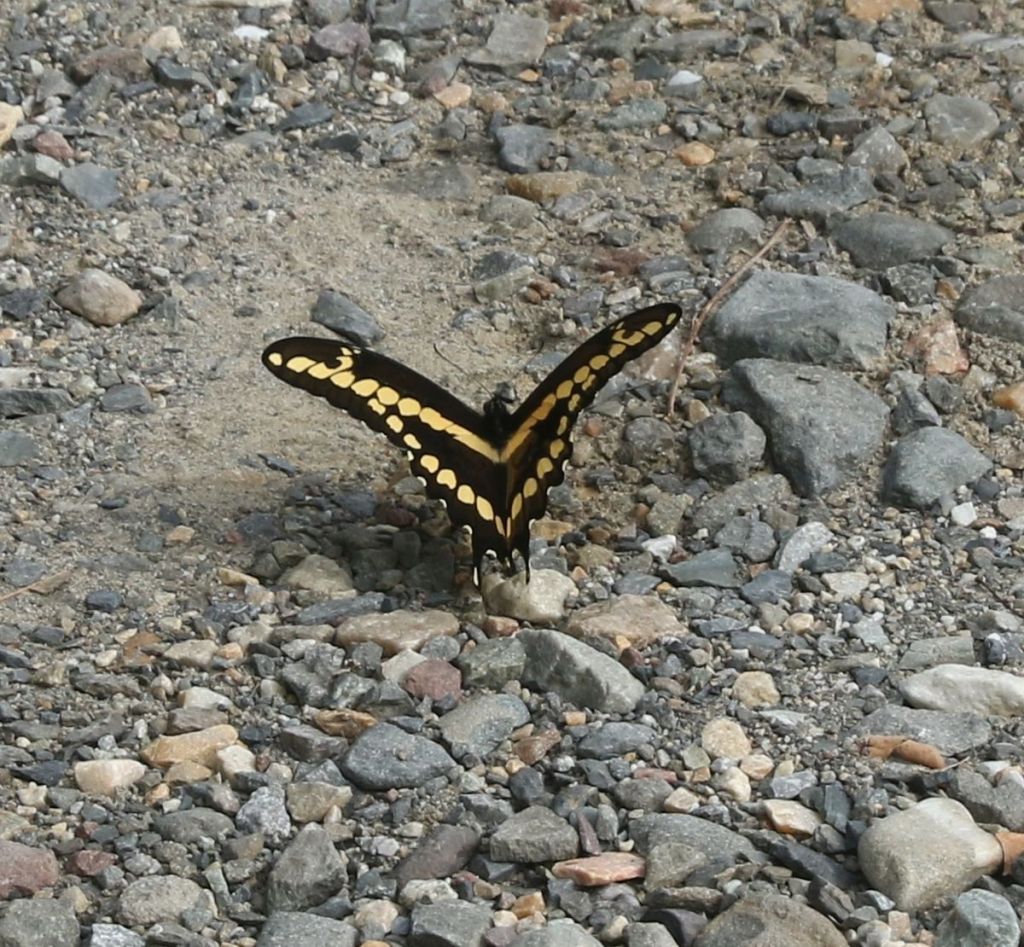
Turning to the butterflies, we were welcomed to the parking lot by a Giant Swallowtail. As the name implies, this is our largest swallowtail species. Unique among our species, it appears to be yellow with black markings below and black with yellow markings above. This is a southern species that occasionally comes north in greater or lesser numbers. This years seems to be a relatively good one for it, as we have noted it at various locations. Its only regional caterpillar foodplant (outside of some garden exotics) is probably Northern Prickly Ash, a sparsely distributed species in our region.

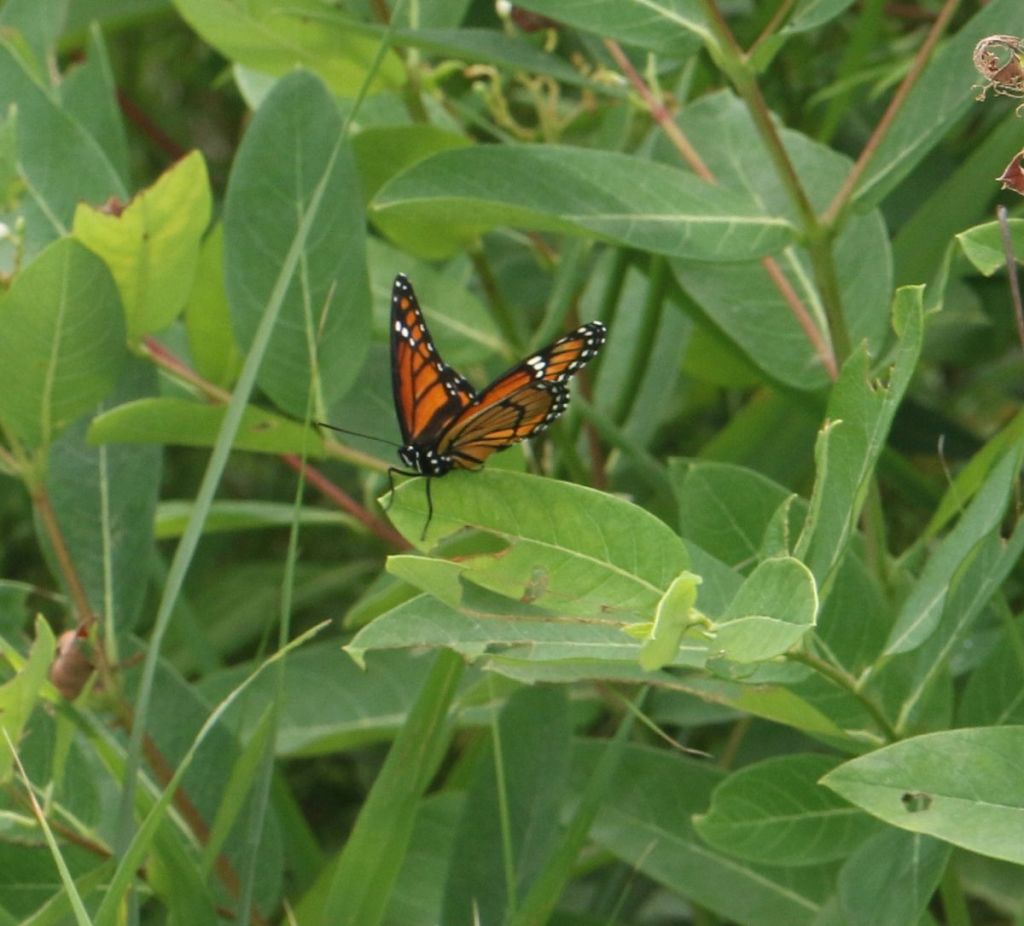
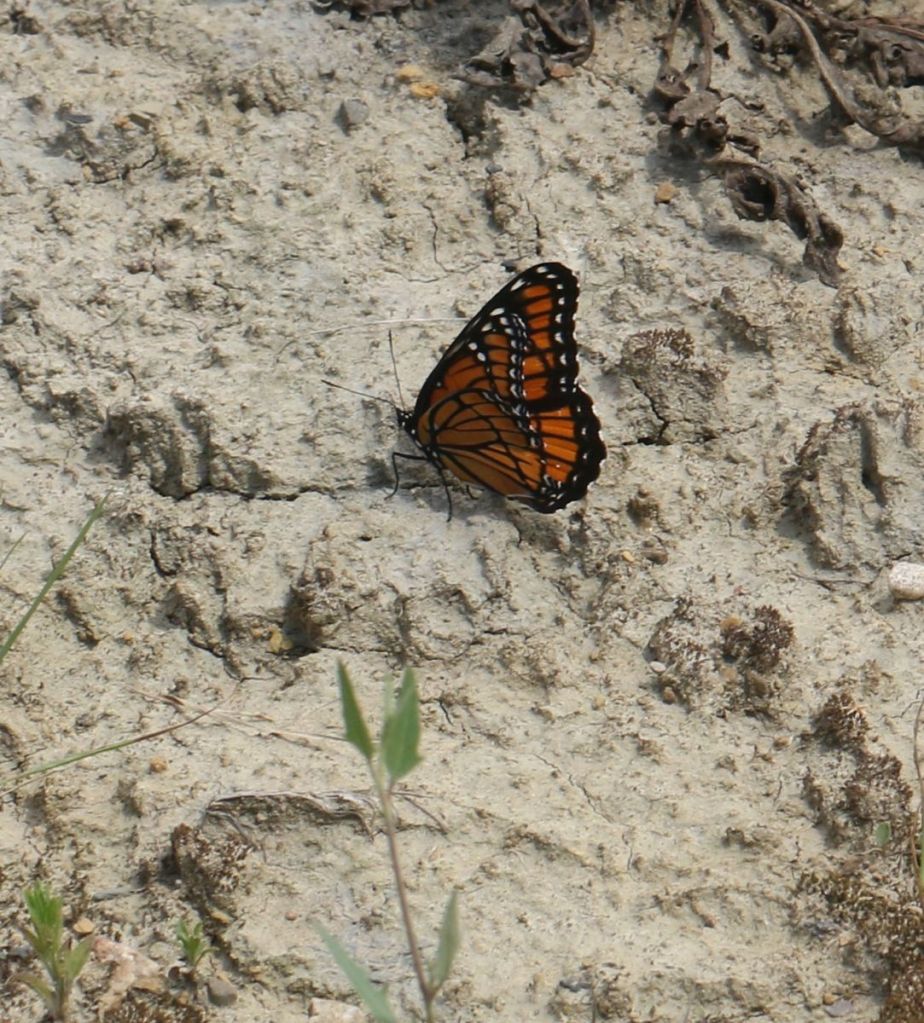
A Viceroy hanging out on Indian Hemp, as documented below…

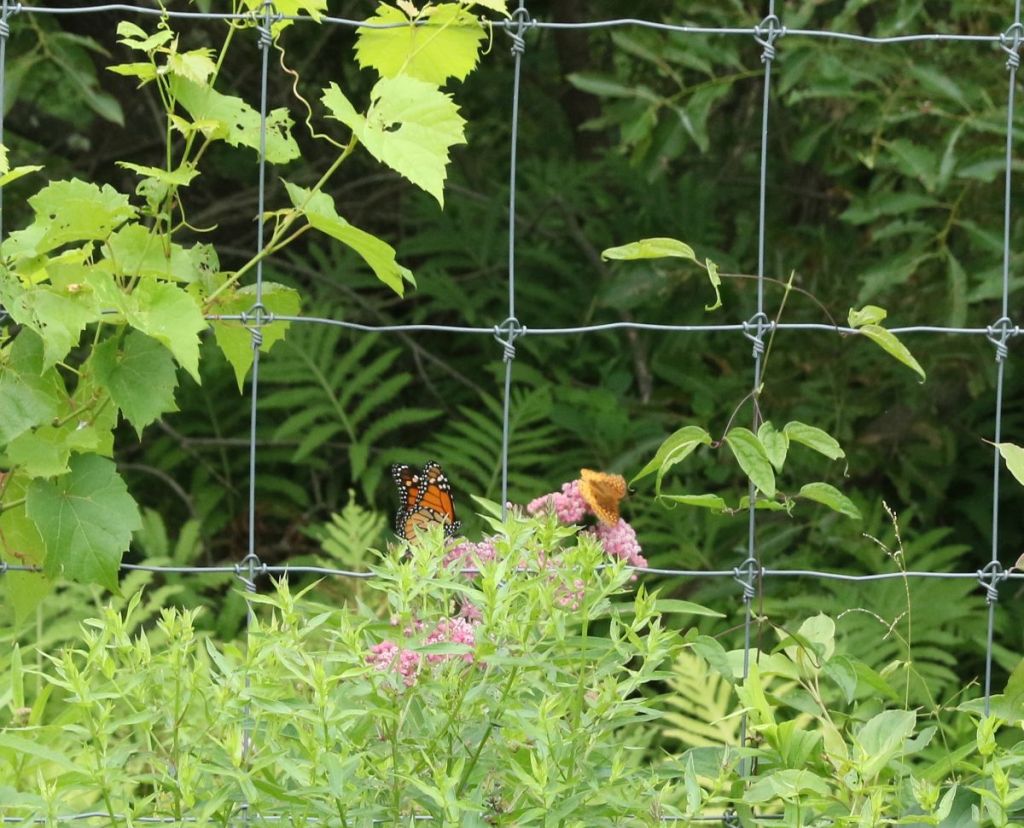
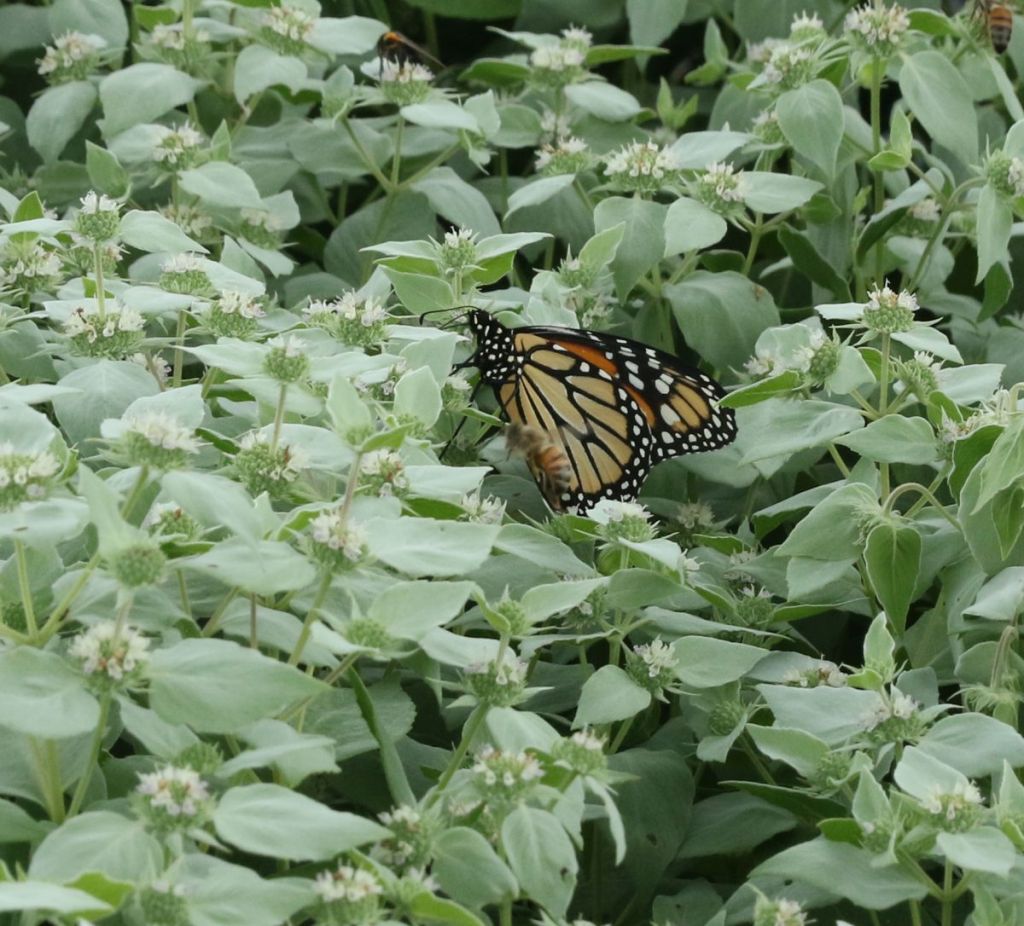
its look-alike, the Monarch, was also present. It was once thought that the palatable Viceroy mimicked the distasteful Monarch. It is now believed that both are distasteful and so reinforce each other’s warning coloration. Here, a Monarch visits milkweed in the wet meadow of the southwest corner. Also present in this photo is..

what appears to be a Great Spangled Fritillary. Last year was a banner year for this species, they seem noticeably less abundant this year. Because their caterpillars eat violets, they tend to be associated with forest edges. Although we didn’t get a good photograph of it, we also saw one individual of the Great Spangled’s smaller cousin, the Meadow Fritillary.

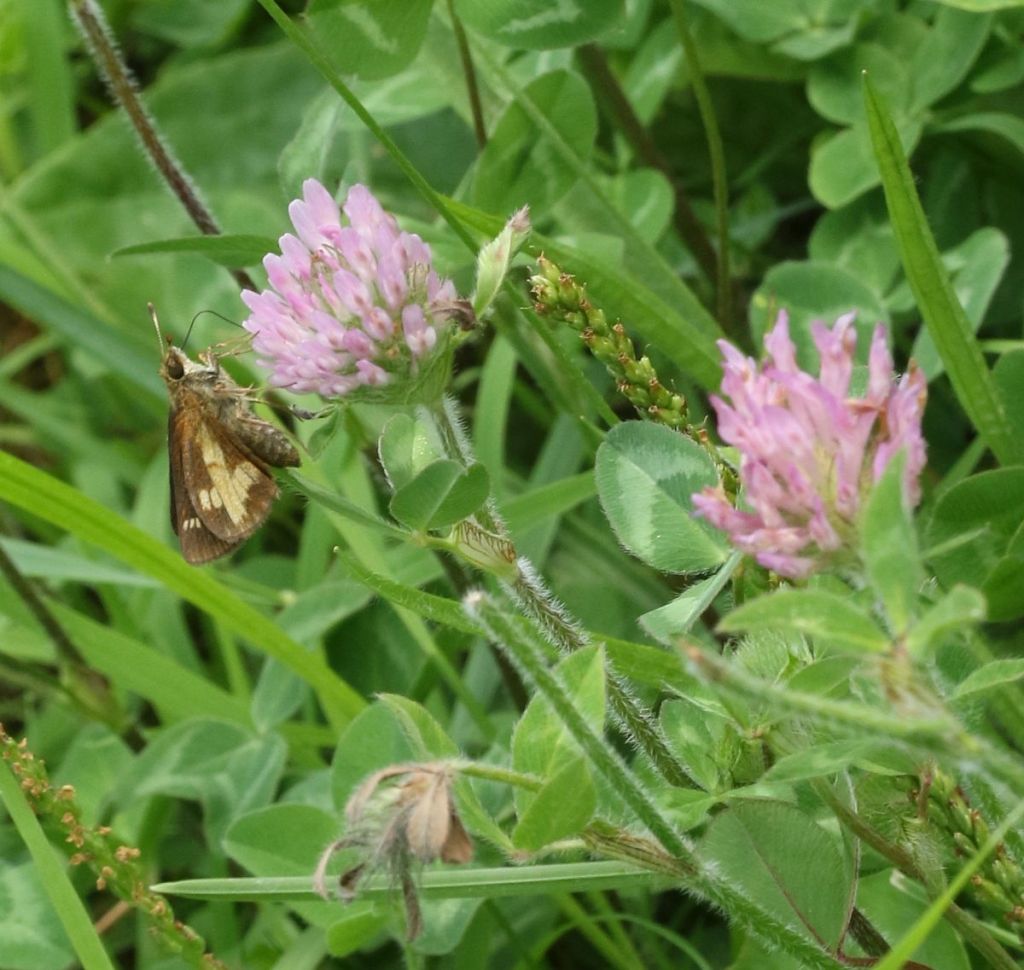
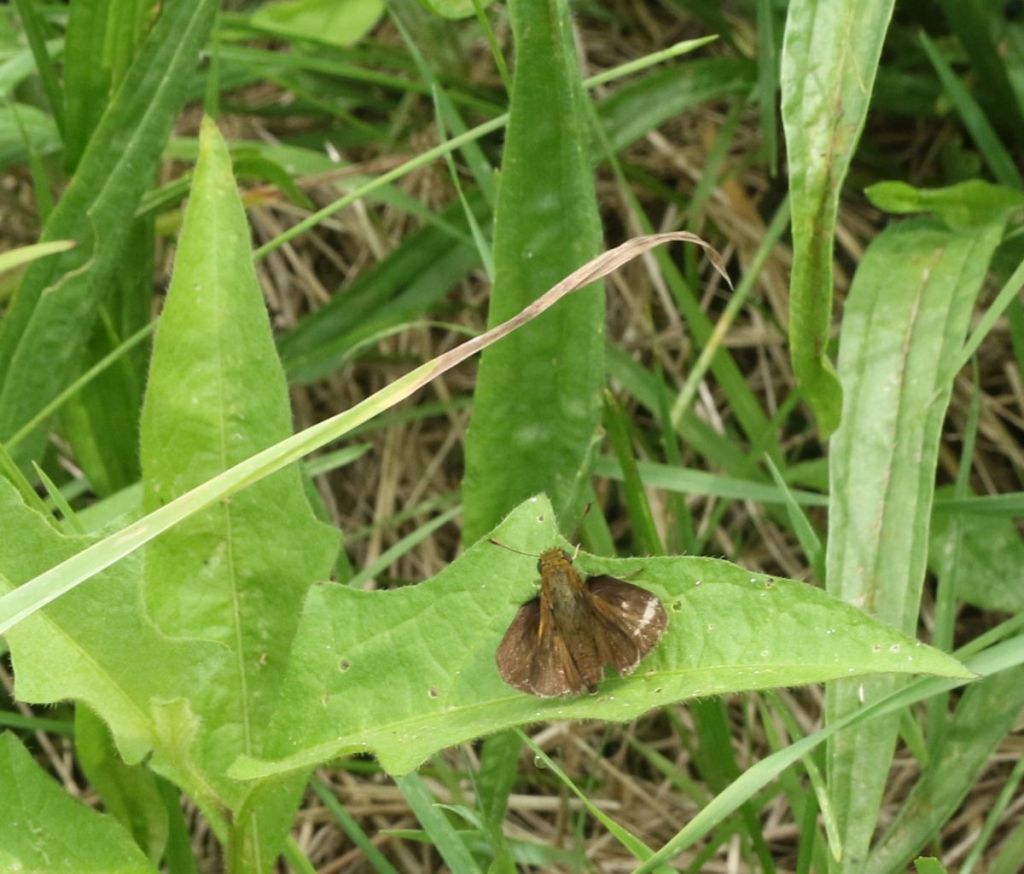
This sharply marked little skipper was found relatively near that same wet meadow. This is a Mulberry Wing (so named because some fresh individuals have a distinctly purplish hue). Its caterpillars feed on sedges and we generally associate it with well-developed, older wetlands, and we consider it somewhat unusual.

Dun Skippers were more common. This individual has an atypical white wing marking on one side, perhaps associated with some developmental quirk or a post-metamorphosis run-in. Its caterpillars are also sedge feeders, but it doesn’t seem to be a tightly associated with wetlands.

To finish with the skippers, this large species was relatively common both here and at other farms – which butterfly is it?

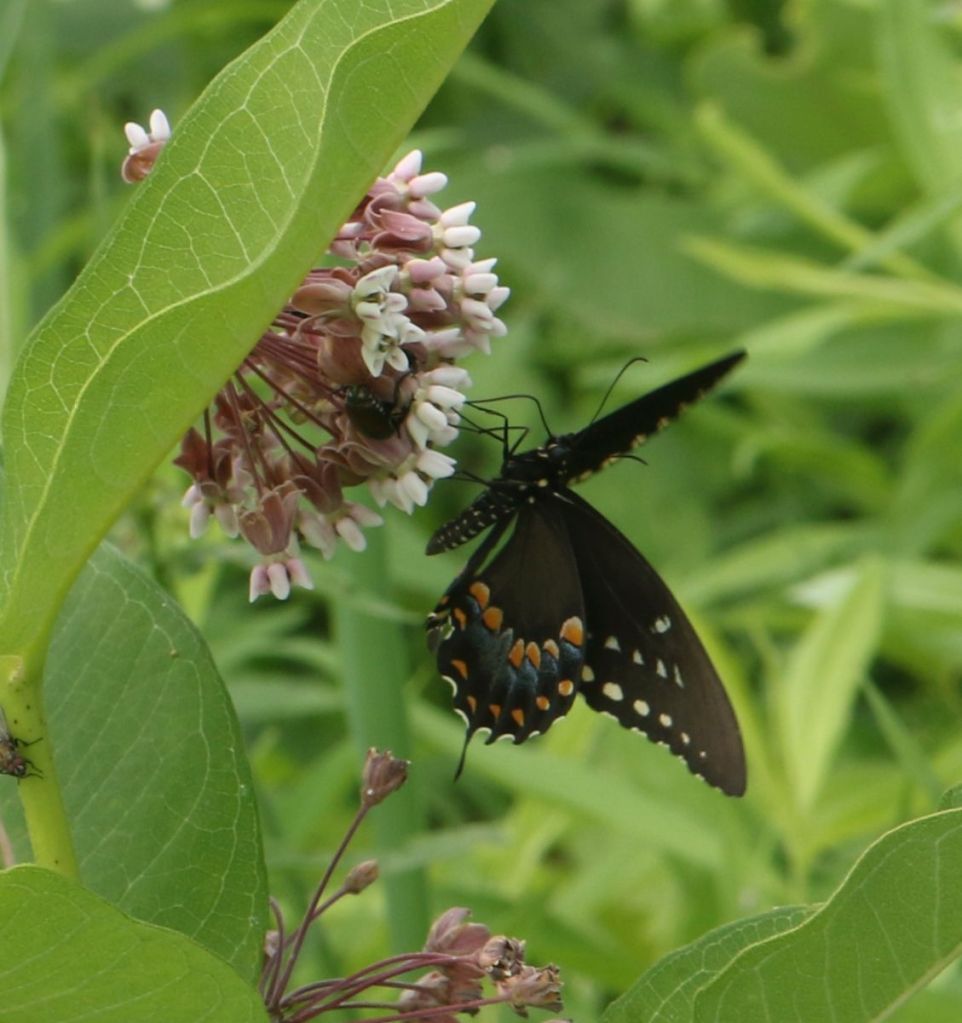
At first glance, one might think that both of these are Black Swallowtails, but actually only the top photograph is that species. The bottom is a Spicebush Swallowtail (so identified by the one missing orange spot along the inner row of orange spots on the underside of the hind wing); as the name implies, its caterpillars feed on Spicebush, a shrub of wet areas.

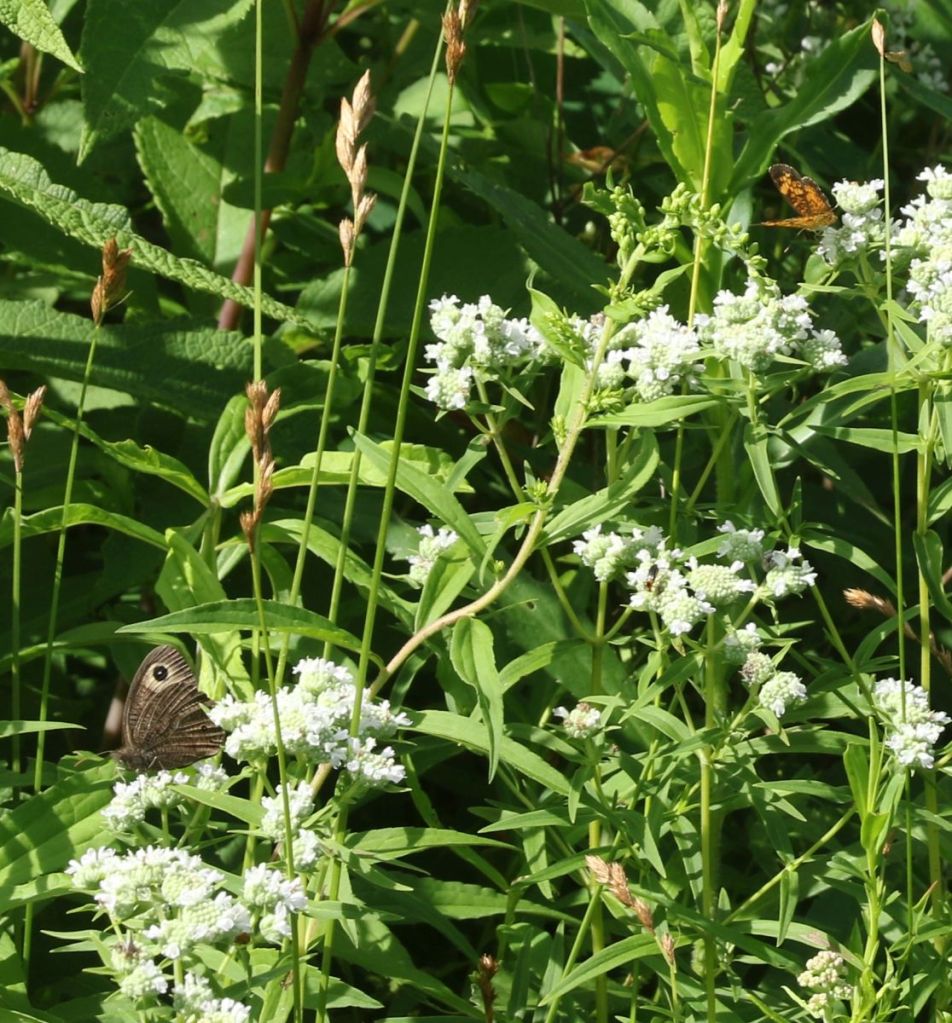
Common Ringlet, a butterfly that should already be familiar if you have read previous blogs; it is regularly found bouncing across old fields at this time of year.

Two more welcome ‘regulars’ during this time of year, a Common Woodnymph (lower left) and Pearl Crescent (upper right).

Eastern Tailed-blues tend to be most common (or at least visible!) in short, grassy areas. Sooty grey means this is a female.

This beauty is a good butterfly shot to end with – our only truly green regional butterfly, the Juniper Hairstreak, is widespread but sparsely distributed in our area. Its caterpillars feed on Red Cedar (actually a juniper), and it is usually found near stands of that tree. Its presence at Rose Hill surprised us because we hadn’t come across many Red Cedar on the farm. However, Kevin assured us they are nearby. Some orchardists aren’t fond of Red Cedar, because it is the alternate host of Apple-Cedar Rust.

As listed above, we saw about 21 butterfly species at Rose Hill, the core group of widespread openland butterflies was spiced by a few species associated with damper areas (indicated in blue hues above). While some of these (fainter blue) seem to range more widely, Mulberry Wing and Spicebush Swallowtail (brighter blue) have tighter wetland associations. Also augmenting the diversity were a couple of species that, while not rare, we only see occasionally: Juniper Hairstreak and Giant Swallowtail. The ample flowers left along edges, around ponds, and in ‘roughs’ retained within the orchards helped attract and support this diversity.

As noted, the dragonfly community was primarily composed of relatively common (nothing wrong with that!) pond dragonflies and damselflies.

Three Familiar Bluets have a tête-à-tête.

15 July 2024: Blue Star Farm’s Wild-growing Plants

Blue Star Farm produces a variety of vegetables and the core of the farm is composed of a mosaic of intensively-managed beds, cover crops, fallow fields, and mowed drive strips. Towards the surrounding tree lines and forest patches, there are also less frequently-mowed meadow areas and narrow bands of “soft edges”, where low woody plants provide a transition from field to forest. For my exploration of the wild-growing plants on the farm, I spent around four hours on July 11, 2024 mostly in the less-intensively managed areas of the farm. This included brief visits to two adjacent patches of swamp forest, one ancient (probably not cleared for agriculture for centuries, if ever, and visible as a triangle in the historical aerial photo from the 1940s in Conrad’s blog from yesterday) and the other, just east of the current fields, recently reforested from a formerly cleared area. I also spent some time recording the plants in and around the recently dug irrigation pond. The inventory resulted in a list of 200 plant species, half of which considered native to this region. In this blog, I’ll try to provide a glimpse of the wild-growing plant life on the farm.

This first picture gives an impression of Blue Star Farm looking south from the approximate center of the fields, with the edge of the young swamp forest on the east side in the background.

A fallow field (it produced kale last year, but had not been worked this season) along the western edge features some of the most common wild-growing plants in the actively-farmed area: Daisy Fleabane (Erigeron annuus; sea of white flowers) and Horseweed (Erigeron canadensis; slender, tall plants, not yet in bloom). Both species are native to Northeastern North America and can become quite common in 1st year fallows of formerly tilled fields. Their shallow flowers provide nectar to small insects, including parasitoid wasps. The picture also shows a single individual of Pokeweed (Phytolacca americana).

Another fallow field along the eastern edge supports a similar plant community.

A closer look at the daisy-like flower heads of Daisy Fleabane. This species can be seen in bloom from May to October and has smaller flower heads than Oxeye Daisy (Leucanthemum vulgare), which also blooms in early summer. It has more white ray flowers (arranged like petals around the yellow disk flowers) than the many similar-looking aster species, which will open their flowers in August/September.

Another common wild-growing plant in 1st year fallow fields was the yellow-flowering Tall Hedge-mustard (Sisymbrium loeselii). It is a European plant that has been spreading relatively recently and rapidly across North America and is not included in my favorite field guide. Therefore, I suspect that I might have been mis-identifying it for a few years as one of the more established, and better-known species in the same genus.

This former strawberry field has a good representation of the most common weeds at Blue Star Farm, including Velvetleaf (Abutilon theophrasti), which is easily recognized by its large, heart-shaped (and velvety) leaves. Reportedly, it has been intentionally introduced to America as a source of fiber. In Asia, where this species originated, it is also used for medicinal and veterinary purposes. In a quick internet search, I could not find any reference about what an abundance of this plant might tell us about the soil conditions (this was a question Sue brought up during our visit–sorry, no new insights).

Here and there in the fallow fields and unmowed areas of the farm, one finds examples of (I think) two very similar-looking vetch species: Cow, Bird, or Tufted Vetch (Vicia cracca; left) and Hairy or Winter Vetch (V. villosa) on the right. Tufted Vetch has a larger upper petal (“flag”) and upper calyx lobes that are broadly triangular, while Hairy Vetch has a shorter flag and upper calyx lobes that are narrowly triangular. I might not be getting this right, yet, but both species are reportedly common on farms in our area. A third species, Slender Vetch (V. tetrasperma) is a very delicate plant with much smaller and fewer pink (instead of purple) flowers, and also grows at Blue Star Farm. All three are originally from Europe.

The reddish hue in the fallow field on the right is from Redtop (Agrostis gigantea), a European grass.

Two species of sumac grow along the western field edge: Smooth Sumac (Rhus glabra; left) and Staghorn Sumac (Rhus typhina; right). Note the difference in the surface texture of their shoots: that of Smooth Sumac is glaucous, with a waxy layer that can be rubbed off, while that of Staghorn Sumac is velvety hairy, like the growing antlers of a deer. Both images show female plants, which are producing berries. Their male counterparts had yellow flowers in the spring, which spread their pollen and are now wilted.

These two species are very different from Poison Sumac (Toxicodendron vernix), which is more closely related to Poison Ivy (T. radicans) and is a shrub with white berries that grows in wetlands. It is not usually found on farms or along roadsides.

The very invasive, non-native Tree-of-Heaven (Ailanthus altissimus) has leaves similar to those of the native Smooth and Staghorn Sumacs and—like them—forms clonal colonies with a joint root system.

However, the female Tree-of-Heaven plants produce wind-dispersed, propeller-shaped fruits that are very different from the red Sumac berries. If you haven’t tried it, the smell of their leaves is also a good way to distinguish the Sumacs and Tree-of-Heaven. To me, the crushed leaves of Sumacs have a pleasant, aromatic, resinous scent, while crushed Tree-of-Heaven leaves have a rank smell reminiscent of rancid peanut butter.

Now, let’s explore a bit the plant life in and around the newly dug irrigation pond. The tall plants right along the water’s edge are two species of native cattails. Although most of the water is clear, you can see some “greenery” floating on the surface around the shoreline.
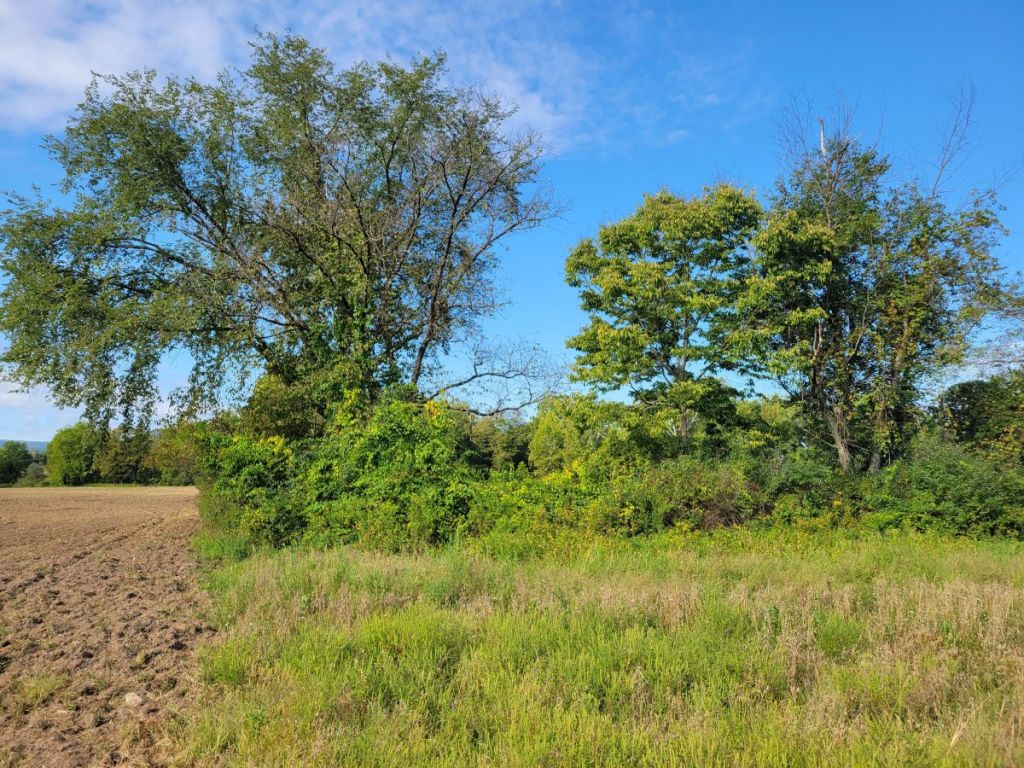
This “pond scum” is most likely composed of filamentous green algae (not to be confused with the sometimes toxic cyanobacteria, which are often referred to as “blue-green algae”). Ecologically, the filamentous green algae are nothing to worry about if they occur in small amounts. They indicate that there are some nutrients in the water, which is not surprising, if a pond is dug in an area that has long been farmed.

In shallow water, just underneath the surface grows a native aquatic plant, aptly called Eutrophic Water Nymph (Najas minor), another indicator of nutrient-rich water.

In the shallow water along the shore, there were also some small plants of the invasive, non-native Curly Pondweed (Potamogeton crispus). As the pond matures, it remains to be seen how this species behaves… Some amount of aquatic plants is a very good thing to provide shelter and food for aquatic insects (including dragonfly larvae) and amphibians. Should the aquatic plants ever become too much, please consider mechanical removal (which has the added advantage that the nutrients stored in them get removed from the waterbody) and DO NOT introduce grass carp to control the vegetation! In our experience, these plant-eating fish turn ponds into a turbid soup without any plant life and little habitat value for aquatic insects and amphibians.

On the east side of the pond is a well-established meadow composed of at least 50 (probably many more) different grasses, sedges, wildflowers, as well as some shrubs and vines. This was one of the most flower-rich and botanically-diverse areas of the farm and is a perfect example of a “soft edge” to the neighboring forest.

Common Boneset (Eupatorium perfoliatum) is an example of a native wildflower only seen in this meadow during the botanical survey.

East of the pond is a narrow band of recently reforested swamp forest. We did not take the time for a complete tree inventory, but noted the presence of Pin Oak, Red Maple, Black Cherry, Black Locust, White Mulberry, and Trembling Aspen. This area also harbors some invasive shrubs and seems to be the epicenter of the invasive Japanese Stiltgrass (Microstegium vimineum; not pictured) on the Farm.

Nonetheless, there were also some native botanical treasures in this young swamp forest, such as the Spotted St. John’s-wort (Hypericum punctatum). This is one of three St. John’s-worts found at Blue Star Farm. The other two are the native Dwarf St. John’s-wort (H. mutilum), spotted on the shore of the irrigation pond, and the non-native Common St. John’s-wort (H. perforatum) which was seen here and there in the unmowed areas.

Ragged Robin (Lychnis flos-cuculi) is a European plant, related to chickweeds and carnations. It grew in the young swamp forest and was also found in the meadows east of it.

Finally, we reach the patch of ancient swamp forest further east (indicated by the triangular area of forest at the center of the historical aerial photo in Conrad’s post from 13 July). This forest is characterized by very few invasive species and by the presence of some unique tree species, seemingly not found anywhere else on the Farm. The patches without vegetation indicate seasonally flooded areas, which might serve as breeding grounds for vernal pool amphibians, if they hold water long enough in the spring to allow tadpoles of Spotted Salamanders and Wood Frogs to develop. However, the presence of these amphibians on the Farm was not confirmed during our brief survey!

Yellow Birch (Betula alleghaniensis) is easily recognized by its shiny, peeling bark and the often octopus-like, superficial roots. It is one of the two “sweet birches”, whose twigs smell of wintergreen (= root beer). In our experience, this species does not readily establish in post-agricultural forests and—at least in our area—is a good indicator of “ancient forest” (a forest that has not been cleared for agriculture during European colonization.)

At the center of this image, you see the uniquely-divided leaves of Royal Fern (Osmunda regalis), an uncommon native wetland fern. It is surrounded by Spotted Jewelweed (Impatiens capensis), which made up the bulk of the ground cover in this forest.

There are two species of native Jewelweeds at Blue Star Farm. Spotted Jewelweed (I. capensis) has orange, spotted flowers and usually no more than nine teeth along the margin of each side of its leaf. As we have seen, it grows abundantly in the ancient swamp forest. Its yellow-flowering cousin is Pale Jewelweed (I. pallida), which was found along the southern edge of the young swamp forest. Note how its leaf margins have more than nine teeth. Fortunately, the invasive, pink-flowering (and much taller!) Himalayan Jewelweed (I. glandulifera) is still quite rare in Columbia County and was not found at Blue Star Farm.

This, admittedly somewhat tattered, plant is Mad Dog Skullcap (Scutellaria lateriflora), a native member of the mint family, which reportedly is used in herbal medicine as a mild sedative and anti-anxiety treatment. In the 18th century, there was a belief that this plant could cure rabies (hence the name “Mad Dog”), but this has been disproven.

Another nice find in the ancient swamp forest was Ditch Stonecrop (Penthorum sedoides), a native wetland plant not seen anywhere else at Blue Star Farm.

Finally, this parting shot shows a Blackgum (Nyssa sylvatica) seedling, growing next to the luxuriant fronds of Interrupted Fern (Osmunda claytoniana). Blackgum is an uncommon tree in Columbia County, usually found in swamp forests and around vernal pools. Cinnamon Fern (Osmundastrum cinnamomeum) which looks similar to Interrupted Fern, but is not pictured here, was also abundant in the ancient swamp forest.

11 July 2024: Blue Star Farm & Surroundings.

by Conrad.

As this LiDAR image shows, the western portion of Blue Star Farm, run by Sue Decker, is located in Stuyvesant NY on terrace land above the Hudson River (seen on the left). A seasonal waterway drains north out of this farm, joining up with Mill Creek shortly before entering the Hudson. Sue’s “home farm” is slightly farther east along route 26A.

We parked just southwest of the “1” on the map and then headed north along veggie and cover crop beds, before cutting northeast to the new pond (near “2”) and then following the forest edge south, before cutting west through veggie plots to flower beds of Damsel Garden, run by land owner Denise Pizzini. We then moved south before turning east along the pastures, and finally bearing north into a finger of wettish meadow. The forested sections in the center of the land are wetland, sporting some interesting trees that Claudia will describe in a subsequent plant post.

In the 1940s, much of the now-forested area was cleared, although a patch of mature swamp forest existed near the center of the parcel. As was typical of this era, orchards were extensive, although they only nudged into the edges of the current farmland

This photograph looks north from near the point marked “1” on the earlier image.
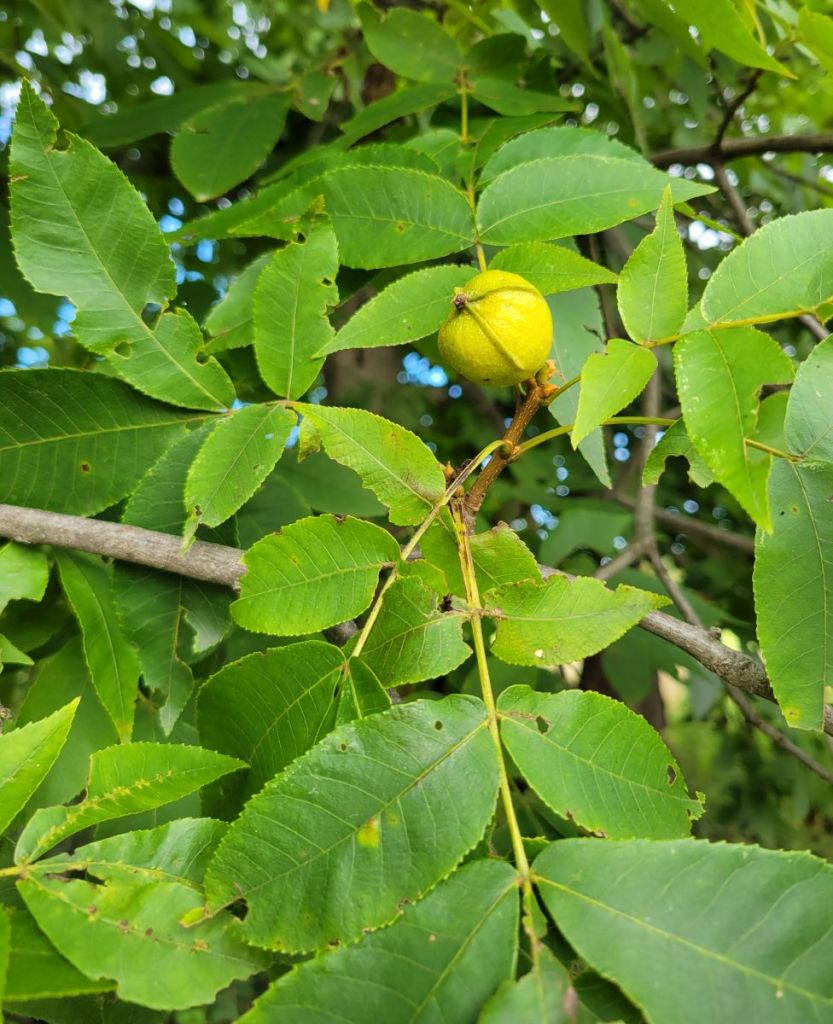
This photograph was taken from near point “2” and looks south, across a pond constructed around 2022. This was a dragonfly hot bed, as we’ll see later.
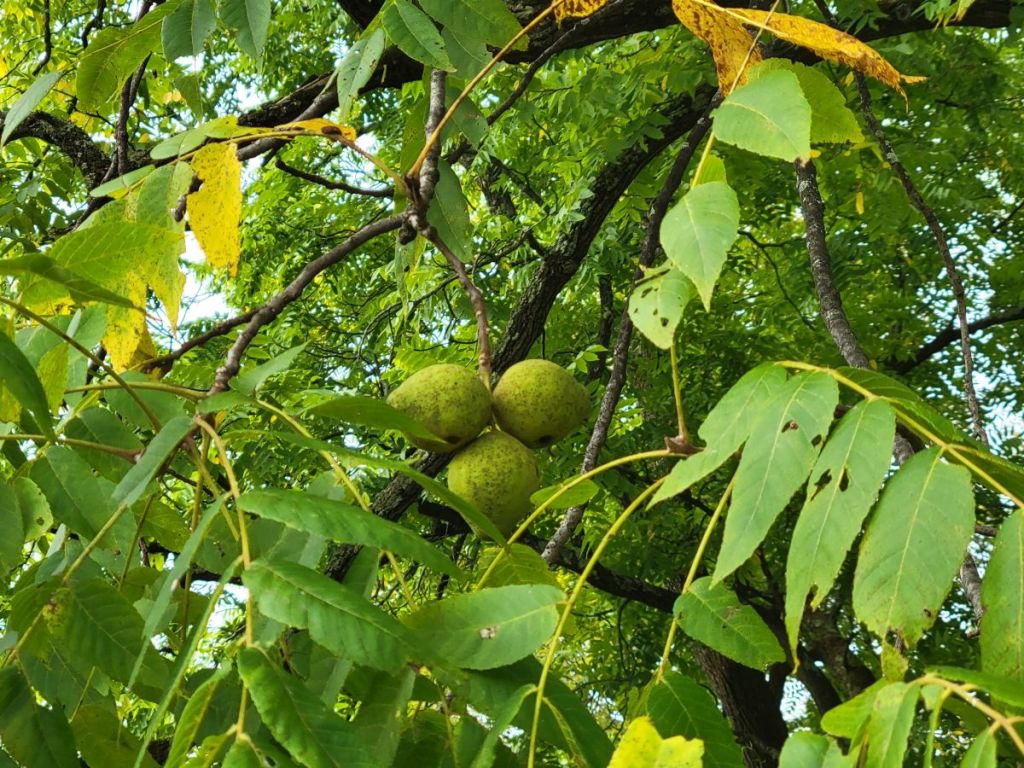
This picture, taken looking south from a bit north of point “3”, shows the welcoming (at least to insects!) soft edge with the forest.

This photograph was taken around point “3” and looks southwest across Blue Star veggie beds towards the buildings and beds of Damsel Gardens.

This wet meadow was photographed looking north from around point “4”. The mature swamp forest mentioned earlier is on the right.

One characteristic of this farm is its sandy soils, as evidenced here. These are remnants of Glacial Lake Albany beaches (or shallow, submerged sand flats). Making a cameo is one of the numerous grasshoppers we encountered. Most of the time they flushed hurriedly from in front of us, their large wings sometimes fooling us into mistaking them for short-flighted butterflies.
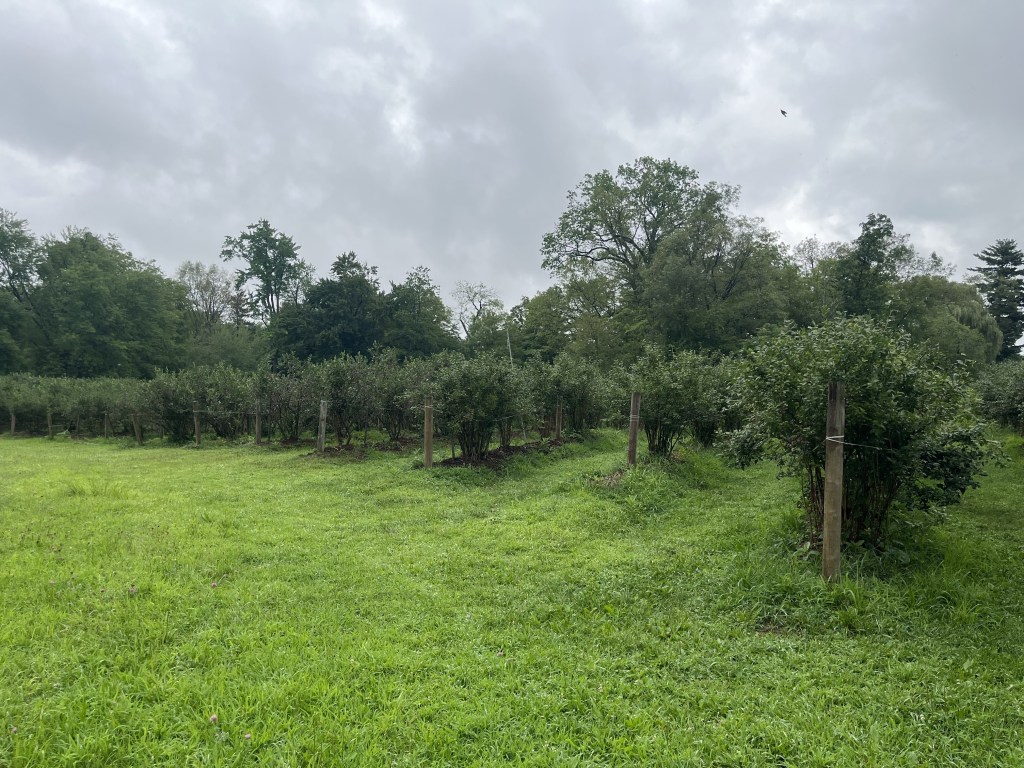
One consequence of the sandy soils seems to be ample habitat for native, ground-nesting bees, such as this Eastern Miner Bee (or close relative).

This graph illustrates data we collected from 19 Columbia County farms back in 2010. In and around tomato beds, we indexed flower abundance (much of which was unplanted “weeds”) and surveyed bees using bowl traps. This graphic shows that, relative to all other farms and especially for those with such low flower abundance, bees were very abundant at the current Blue Star site. Our guess was that this was because the sandy soil made excellent habitat for ground nesting bees. Bee diversity also appeared to be relatively high, ranking fourth in a quick and dirty assessment of diversity. We did not assess flower abundance during our current visit and it may well now be higher.

This native bee may be another species of mining bee.

Many bumble bees are also ground nesters.

The most common bee species observed was the Honey Bee, likely originating from…

these hives along the forest edge. While many of us appreciate the honey, and Honey Bees can definitely be a boon to crop pollination, there is evidence that, at least under certain conditions, they can out compete native bees, thereby reducing the habitat quality for some species. Where native bees are abundant, additional pollinators are usually not needed.

Open sand or clay patches are also favored by tiger beetles. This happens to be a “Punctured Tiger Beetle”, named for the row of point-like indentations along its back.

Speaking of beetles, this is a Green June Beetle, an elegant beetle with a wide-ranging diet, who is sometimes considered a minor agricultural pest.

Most of our attention was focused on dragonflies (& damselflies) and butterflies. We’ll start with the former.

This large dragonfly was seen flying over the aforementioned pond. While the green body and reddish tail could suggest a female Common Green Darner (a species that was also present), the brightness of the red, coupled with an evident white patch below the hind wings (not so evident in this photo, but clearer in others), suggests Comet Darner. Comet Darners are the biggest dragonflies regionally, and they are generally considered rare. We know them from only two other sites in the County.

The vegetation around the pond edge sported numerous darner exuvia – the hollow, dry skins left behind when the aquatic nymph clambers out of the water, unzips its diving suit, and flies away. These appear to be exuvia of the Common Green Darner.

Widow Skimmers are common pond dragonflies that range widely in search of prey.

The Eastern Pond Hawk is another relatively common pond dragonfly. This bright green individual is the female, who has a much more verdant coloration than…

the blueish male shown above. One wonders if she is also more apt to hang out in green vegetation. As the traces of green suggest, the coloration of younger males resembles that of the female in many dragonfly species .

The name “Common Whitetail” almost says it all, but only the males have such white abdomens.

This slightly tattered Blue Dasher female also seems to carry its habitat’s design onto its thorax.

The Blue Dasher male tends to have a blue tail with a black tip.

OK, I admit this is an odd angle. It shows a pair of flying Black Saddlebags from the back. The male is in front and is clasping the female behind the head with his aptly named “claspers”. Unlike Widow Skimmers, Pondhawks, and Blue Dashers, Black Saddlebags rarely perch. Rather than ‘hawking’ after prey from stationary resting points, this species does most of its hunting on the wing. This mated pair is probably not hunting, but rather looking for a place where their eggs can be deposited.

A mature male of one of our red-colored Meadowhawks. We have a trio of similar species and, not having tried to catch and inspect this individual more closely, I won’t guess at a species name.

Damselflies are close relatives of the dragonflies, but are generally smaller, slimmer and hold their wings above their backs when perched. This damselfly is an Eastern Forktail, a common if somewhat inconspicuous species.

A Familiar Bluet. The defining characteristic for many damselflies and dragonflies is often those male claspers mentioned earlier; they are found at the very tip of the tail. Probably because they are an important component of the pairing process, their shape tends to be species-specific.

Damselflies can have exuvia too!

Moving on to butterflies, this is the iconic Monarch. We have seen a scattering of them so far this year.

This is the Viceroy, a Monarch look-alike. It is usually smaller than a Monarch and has that distinctive black line paralleling the trailing edge of the hindwing.

Cabbage Whites were abundant at the farm. As hinted at here, their caterpillars (aka cabbageworms) feed on brassicas and can sometimes be crop pests. Cabbage White are not native, and were first noticed around the ports of Quebec City and New York in the 1860s, probably having hitched a ride on imported cabbages.

Their medium size and bright white wings is almost distinctive. Just to keep things interesting however…

some female sulphur butterflies are white, and so a definitive ID can require a close look. When their wings are closed, sulphurs have a small, brown-outlined eye on their hindwings; Cabbage Whites have no such mark. The tops of the wings are also distinctive but are less commonly seen.

“Skippers” are moth-like butterflies with comparatively large bodies. Their flight is usually hurried, with minimal apparent gliding. This is our largest skipper, the Silver-spotted Skipper. It is a common resident on farms, where its caterpillars feed on various, usually non-commercial legumes.

Butterflies do age. Their wings do not grow back and they progressively lose their scales, hence the tattered, almost translucent wings of this Silver-spotted Skipper.

Another Silver-spotted Skipper, this time in the relatively rare open-wing posture.

We have a host of tiny skippers that often go relatively unnoticed. They can be tricky to ID, so much so that butterfly aficionados call this and two other darkish skipper species the “Three Witches”. This is a male Little Glassywing, or at least so I have convinced myself!

My guess is that this is a female of the same species. These smaller skippers often perch with their wings in a ‘jet-fighter’ position – the hindwing flat and the forewing at an angle.

I believe this slightly drabber-colored species is a Dun Skipper, another one of the witches. Unlike the other two witches, the Dun is a sedge feeder; correspondingly, it tends to be most common around wetter areas.

The bronzy head of this fresh individual is a subtle but useful characteristic for recognizing the Dun Skipper.

Some skipper do, however, perch with their wings flat. In fact, one rarely sees these particular species with their wings closed. This is a Wild Indigo Duskywing, a native butterfly whose caterpillars feed on Wild Indigo. This would currently seem to be a losing strategy in our region – how many times have you seen Wild Indigo? However, species aren’t stupid evolutionarily, and the Wild Indigo Duskwing could now be more aptly named the Vetch Duskywing, having accepted introduced vetches into its diet.

This was the first time I have seen a Common Checkered Skipper for at least a couple of years. We are on the northern edge of this southerly species’ range, and they have not been common locally. It may not overwinter with us and might need to recolonize each summer from farther south. Its caterpillars feed on Velvet Leaf, a farm weed that Sue assured us she has plenty of.

This little beauty is a Pearl Crescent – a small, sometimes common butterfly whose caterpillars feed on asters. They were most common in the flowers between the pond and the forest, but were found throughout the farm.

A mated pair of Pearl Crescents, the larger, more darkly marked female has her wings open.

Crescent taxonomy harbors some confusion. There are probably at least two Crescent species in the County, the widespread Pearl Crescent and the less common Northern Crescent. The distinguishing characteristic is said to be the lack of black dividing lines in the central, orange field of the Northern’s hindwing. So perhaps this is a Northern Crescent, or maybe it’s just a particularly ‘blond’ Pearl Crescent.

Only slightly bigger than a large, female Pearl Crescent, the Meadow Fritillary seems to be declining regionally for reasons unknown. In the 19th century, for example, its range extended throughout Massachusetts, but now it is mainly found in the western part of the State. It has similarly retracted from the surroundings of NYC. One hopes it will not go the way of the Regal Fritillary – a once relatively widely distributed species, now nearly extinct on the East Coast.

The Meadow Frit’s underwing is well camouflaged.

The underwing of this butterfly is also subtle, but, wait a bit and…

the Red Admiral may flash its more dramatic wing tops. Like the Monarch (and a few other of our species), the Red Admiral is migratory.

Do you see the butterfly hiding in this picture?

What about now? This is an Eastern Comma. It is thought that such contrasting coloration of the two sides of the wings might play a role in a startle strategy – come too close and a potential predator gets a surprising flash of orange as its intended prey flies away. Alternatively, perhaps the coloration plays a role in inter-species communication but is best kept under wraps much of the time.

As suggested by the fact we have already seen this hairstreak in our Little Seed Gardens posting, the Grey Hairstreak is probably are most common hairstreak.

A sooty Eastern Tailed-blue female.

Common Ringlets flash their brick orange while flying. Somewhat counterintuitively, this is a northern species which has come south over the past 30 years or so.

This reclusive butterfly was found hugging the edge of the swamp forest. The Appalachian Brown is largely confined to wetlands, where its caterpillars’ food plants – sedges – are found. Unlike some other wetland butterflies, one rarely sees it on field flowers, perhaps because tree sap and animal dung are its more favored adult foods.

A male Black Swallowtail decked with ample ‘scrambled eggs’.

The female has less yellow. This is a native butterfly, but is sometimes considered an agricultural pest on carrots, dill, parsley and other cultivated relatives. Caterpillars also feed on Queen Anne’s Lace.

Butterflies aren’t the only ‘Lepidoptera’ out during the day – several of our moths are also day fliers. These Yellow-collared Scape Moths seem especially common this year. Their caterpillars are reportedly grass and sedge feeders, but the adults seem to love nectaring on a range of flowers.

None of the butterflies we saw at this farm were particularly rare, but their abundance and diversity (18 species) were encouraging. This was probably due in part to the diversity of habitats on the farm, from wet meadow to swamp forest to pasture to pond edge, combined with the ecological farming practices used and the ample space for wild-growing flowers.

The dragonflies and damselflies around the new pond were fairly abundant, especially for a pond that is only a couple of year old. One of the key factors that encourages the diversity of these insects is a lack of fish, and we would discourage their introduction. If it does not completely dry out, there might be additional species of dragonflies in the swamp forest, but we did not venture in during this visit.

Stay tuned for Claudia’s plant contribution.