by Conrad.
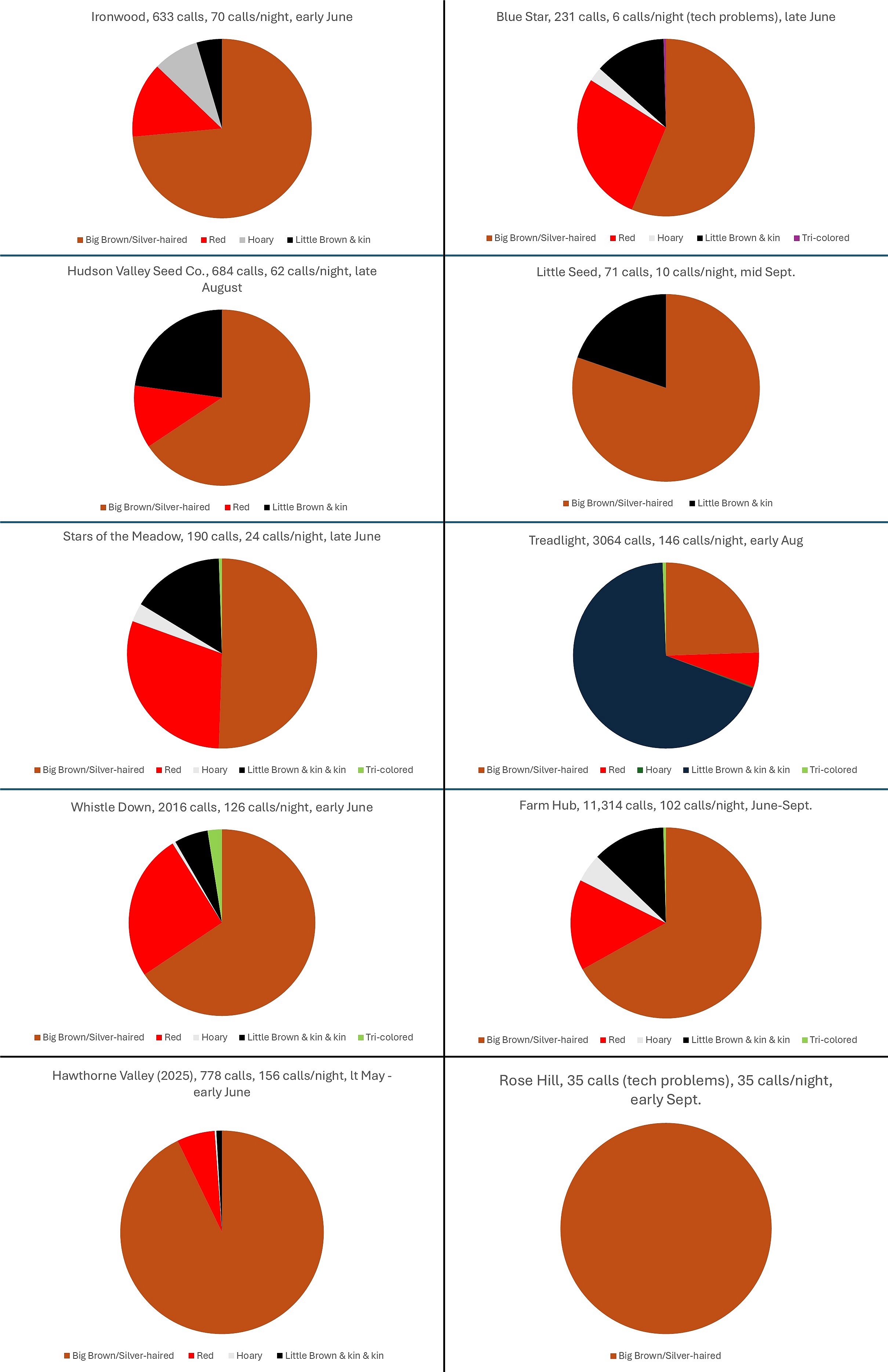
Admittedly, bats were something of an afterthought this year. I had a couple of extra detectors, and so scattered them around the participating farms when I got a chance. We had some technical difficulties and some late set ups, so I won’t aspire to any grand conclusions, just some snapshots. Pie charts showing the proportions of different bat calls found at the ten mid-Hudson Valley farms associated with the Research Circle appear at the end of this posting.
The easy headline is that bats were detected on all farms. Not surprising, but worth remembering given how inconspicuous bats can be.
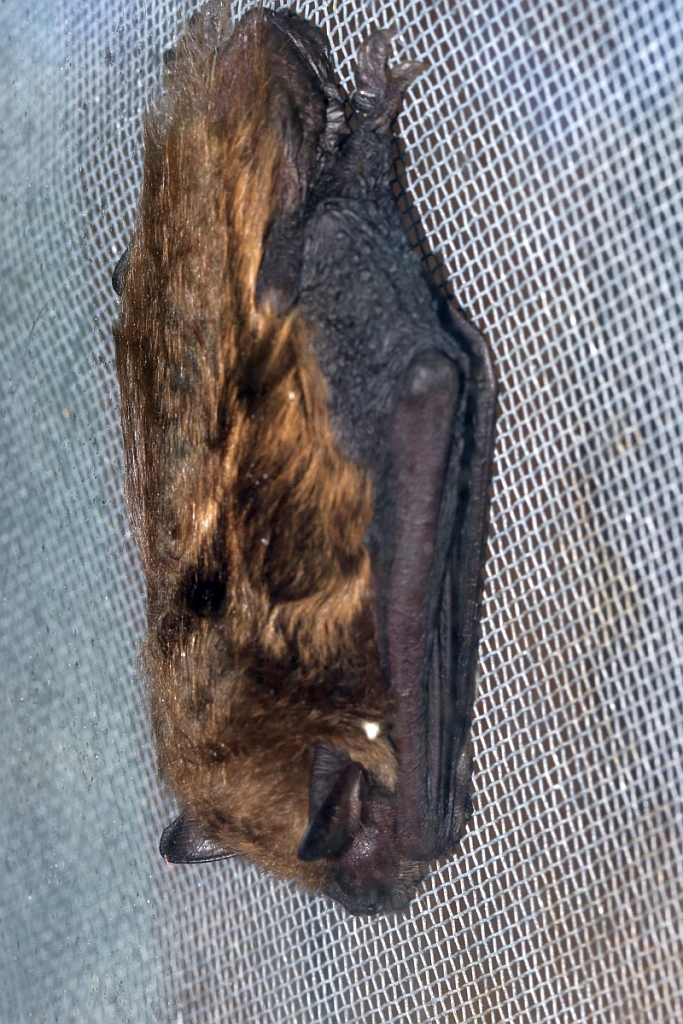
The Big Brown Bat, was found on all farms. “Big” is a relative term distinguishing this bat from the “Little Brown Bat”. It is still a tiny creature, reportedly weighing about 15-26g, or little more than the weight of 3-5 US nickels. As with all of our regional bats, this species is an insectivore. It is said to favor beetles and moths. The Big Brown Bat takes advantage of human structures, able to overwinter and breed in attics and barns, although, of course, natural cavities also work.
The recorded calls of these bats are difficult for me to tell apart from those of the Silver-haired Bat, so I have lumped them together. More detailed analysis from some farms suggests that Silver-haireds probably made up 10% or less of the calls in this category. Nonetheless, this species is also generally considered common.
Red Bats and Hoary Bats are our largest bats, and these cousins both show annual north/south migration, as the Silver-haireds may also do to some degree. Migration makes these bat species particularly vulnerable to fatal encounters with wind turbines.
Little Brown Bats and their kin (the genus Myotis) are amongst our smaller bats. They return to regional caves for their Winter hibernation. Cave hibernation made these bats and the following species especially susceptible to mortality from White-Nose Syndrome, which caused a 90+% decline in their populations starting in the early 2000s. There are, thankfully, now some signs of rebound.
Aside from the Little Brown Bat, there may be three other local species in the genus Myotis, but distinguishing their recorded calls is tricky, so they’re lumped here. All of these bats are now considered to be of high conservation concern, and the Indiana Bat (also found in NYS) is a national endangered species.
Finally, the Tri-colored Bat, averaging about 2-3 pennies in weight, is a tiny, cave hibernator currently being considered for endangered species status.
Probably the most important thing you can do as a farmer to promote bat conservation is to support local insect populations by avoiding the use of pesticides and maintaining natural habitats as much as possible. In landscapes with ample forests, roosting locations might not be limiting, and so erecting bat houses is probably not necessary for their conservation. That said, if you know of existing roosts in farm buildings or elsewhere, please do protect them. Any caves where bats are known to hibernate should not be disturbed, especially during the winter-roosting season which stretches from late Autumn through early Spring.
The pie graphs below offer a quick and dirty profile of the bat communities on your farms. These numbers were primarily derived by running automatic call identification on recordings made by the detectors. This was supplemented by some visual inspection of sonograms, but should be taken with a dose of salt. Nonetheless, I think these graphs do reflect some real differences and commonalities among the bat communities of Research Circle farms. Remember that these are call counts, not population censuses, and so they reflect relative activity, not necessarily relative populations sizes.
Some quick points:
- On all farms except Treadlight, the Big Brown/Silver-haired group made up more than 50% of all calls. At Rose Hill, it was the only bat heard, but technical difficulties meant we had very little data from that farm.
- The Red Bat and the Little Brown Bat (& kin) seemed to vie for second place, except at Treadlight, where the Little Brown & kin was unusually common.
- Comfortably in fourth place, in terms of activity, was the Hoary Bat, although it was not present on all farms
- While its absolute call numbers were relatively small, the Tri-colored Bat was present to a surprising degree at Treadlight, Whistle Down and the Farm Hub.
- Finally, I have included information on average calls per night at each farm. In some cases, the variation reflects the varying sensitivity of the detectors; in others, it may have been related to date. These are interesting statistics, but would definitely need some standardization before being given much weight.
We have begun gathering a little bit of information regarding on-farm bat diets by collecting bat poop (aka guano) and submitting it for DNA analyses. Very preliminary data suggests that one bat, a Little Brown, was eating flies and mayflies, while a Big Brown favored an undetermined type (or types) of beetle, potentially including weevils. Getting a better idea of bat diets, combined with information regarding who is actually flying over your fields during the growing season, could suggest what potential exists for bats to be helping with pest control. If you know of any bat roosts near your farm, please let me know – that would let us collect guano for analysis. In any case, it’s clear that your farms do seem to be supporting regional bats.
Glad to field questions and hear observations.