
Bees 2026, Part I
by Conrad.
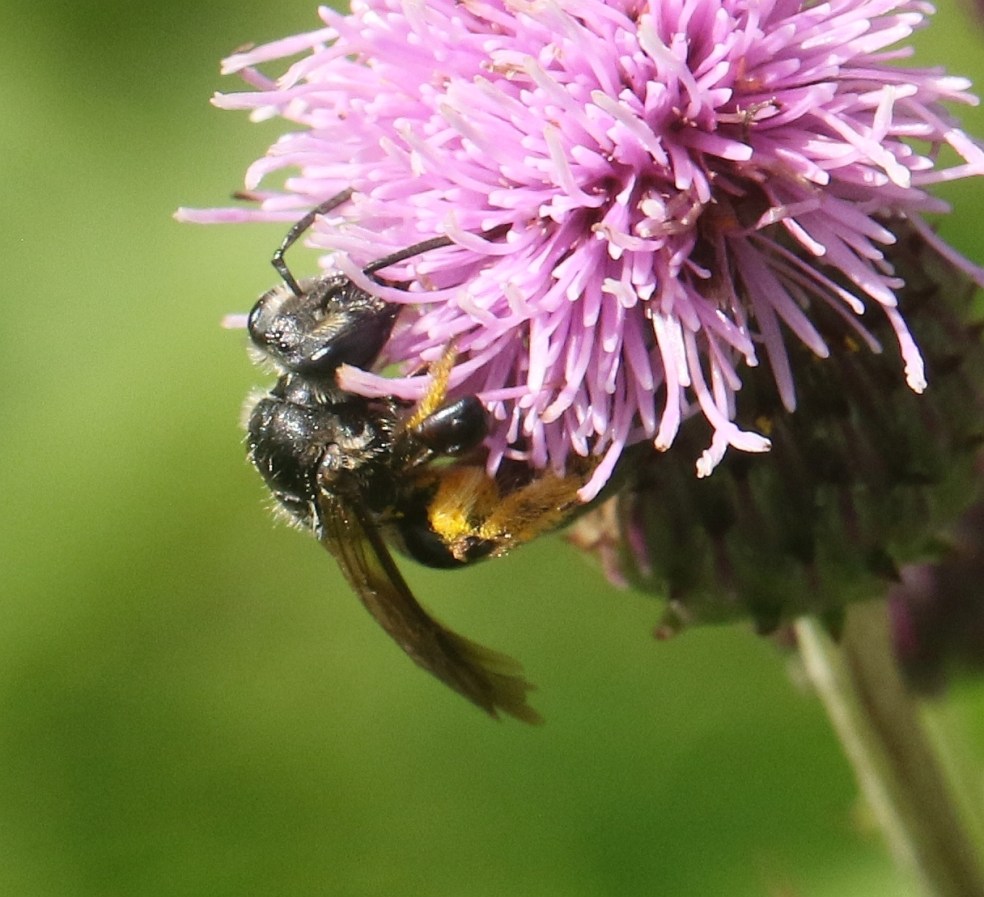
What’s Ahead (jump to what you want to read):
A Pre-ramble explaining a bit about what we did
An Aside regarding what our data say about interactions between Honey Bees and non-Honey Bees.
An Introduction to mining bees.
Profiles of the mining bees we found on participating farms.
Thoughts about management for mining bees
‘Pre-ramble’ (explains a bit about what we did and didn’t do; can be ignored if you just want to know about your bees)
Welcome to our first posting of the calendar year. While we’ve been silent, we have not been still, and so there is plenty of data to report.
In my bee postings from last year, I profiled the ecology of some of our bee genera and got into some of the nitty gritty of bee/flower interactions on the farms we visited.
So far this year, I have spent quite a bit of time going through our photos and getting expert IDs. As I said in a posting last year, I only did visual surveys and did no collecting. While that makes for efficient, if generalized, bee surveys (across the two years, we have more than 70 hours of bee/flower observations) and avoids killing bees, it was only through photos that I was able to dive a little bit into bee diversity and hence conservation. Collecting would have allowed for the close inspection and then identification of some bee species that are hard, if not impossible, to ID from photos of free-living individuals. But, at the same time, some bees do not come readily to traps and are rarely seen in samples so that, if they are distinct enough for photo IDs, then hunting them with a camera can work relatively well.
Please be aware that our list from your farms is far from complete: I have tallied something like 65 distinct bee species during visual/photographic surveys, while a summary of Columbia County bees based largely on past collecting tallied around 160 species. Some bees require microscopic inspection to identify: for example, while our photos only documented a couple of species groups of the tiny Lasioglossum sweat bees, our collections had almost 40 species. We had plenty of ‘Lasioglossum species’ photos, but this is a tricky genus to identify even from specimens. On the other hand, for conspicuous creatures like bumble bees, our observations agreed relatively well with our collection: seven species observed in the field, ten or eleven in our collection. Finally, our observations appeared to document around 20 species not yet identified in our collection including in some generally rare genera (for example, Macropis, Protandrena, and Triepeolus).
Six of the species we’ve found are non-native – the Honey Bee is not our only newcomer! Almost half of the native bees we found are considered ‘vulnerable’ or worse, and at least eight are ranked as “Imperiled” or “Critically Imperiled”. Native bees are having a rough time for a variety of reasons, including habitat loss, competition from non-native species (see below), pesticides, and climate change.
Honey Bees & Wild Bees (a potentially useful aside on how Honey Bees may be affecting our native bees)
I have been struck by how the flowers of some farms at some times of year seem to mainly host Honey Bees, which, although well established and widely loved, are an introduced species. As others have proposed, do Honey Bees discourage wild bees by physical interaction and/or resource depletion? Our data might have something to say about this.
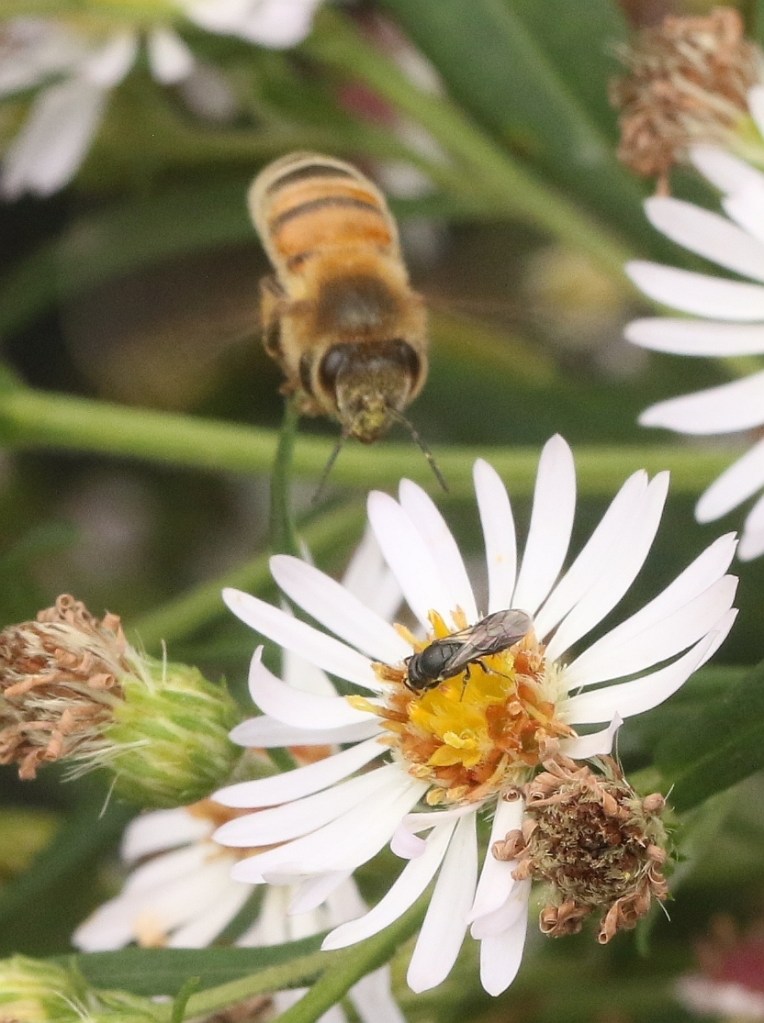
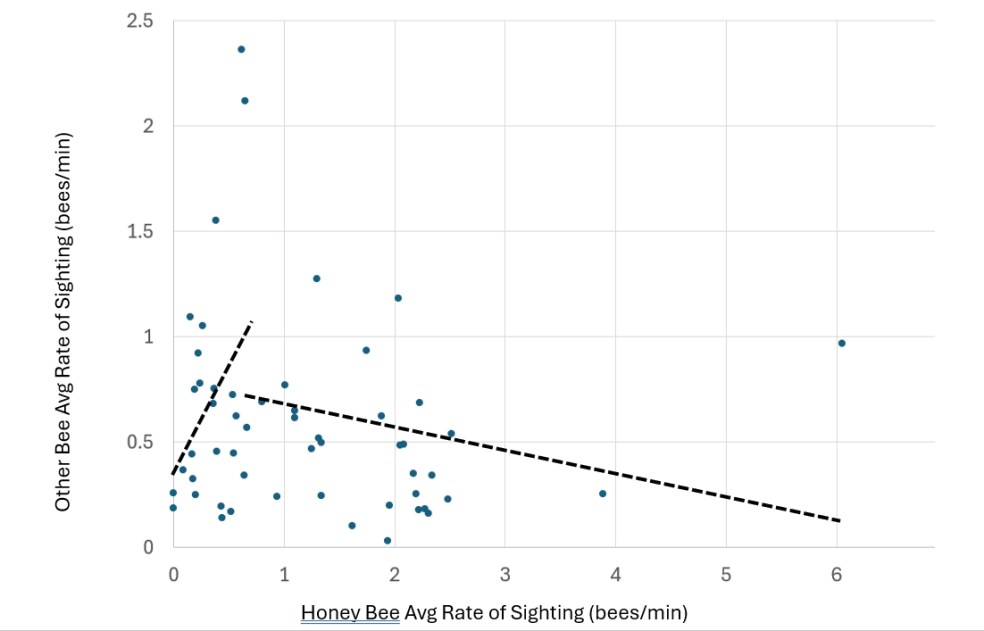
First, for each visit to each farm, I calculated the average rate of Honey Bee and “Other Bee” observation (where “Other Bee” refers all non-Honey Bees except bumble bees and Eastern Carpenter Bees, which I excluded because of their generally large size). I then asked – as the rate of Honey Bee observation increases, what happens to the rate of “Other Bee” observation? Fig. 1 suggests that while Honey Bee and “Other Bee” rates may initially increase in tandem (as one might expect if the general conditions were propitious for all bees), somewhere around .7 Honey Bee/min, the rate of “Other Bee” sightings begins to drop off. Indeed, below .7 Honey Bees/min, the average “Other Bee” sighting rate is, coincidentally, .7 bees/min; however, above .7 Honey Bees/min, the “Other Bee” sighting rate is only .49, or, in other words, about 30% less.
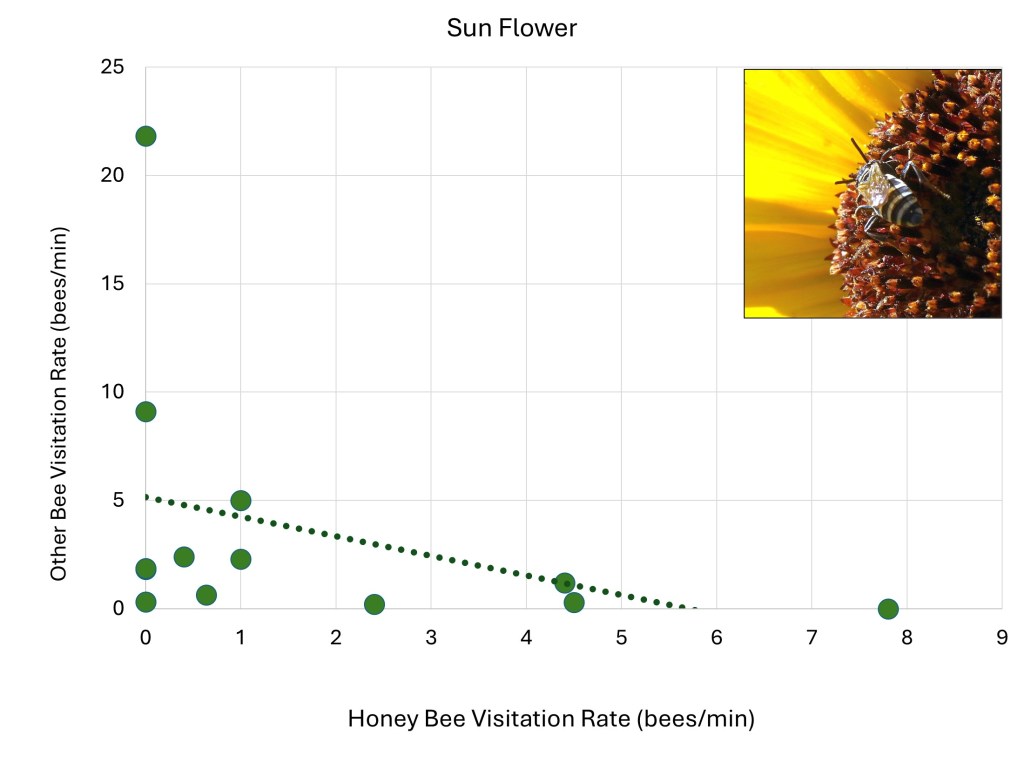
If one looks at particular flower groups to avoid the possibility that the above pattern is due solely to differences in flower composition across farm visits (i.e., because Honey Bees and “Other Bees” don’t always favor the same flowers and all farms do not support the same flowers), it seems that, at least for some flowers, increasing Honey Bee visits are associated with fewer “Other Bee” visits (see figures below). True, not all the flowers for which I had sufficient data showed this pattern – Common Milkweed and Purple Loosestrife were, for example, notable exceptions – but most flowers for which I had ample data did, including some of our most prevalent on-farm flowers such as the Solidago goldenrods, Autumn asters, sunflowers, the clovers, Marigolds and Zinnias.
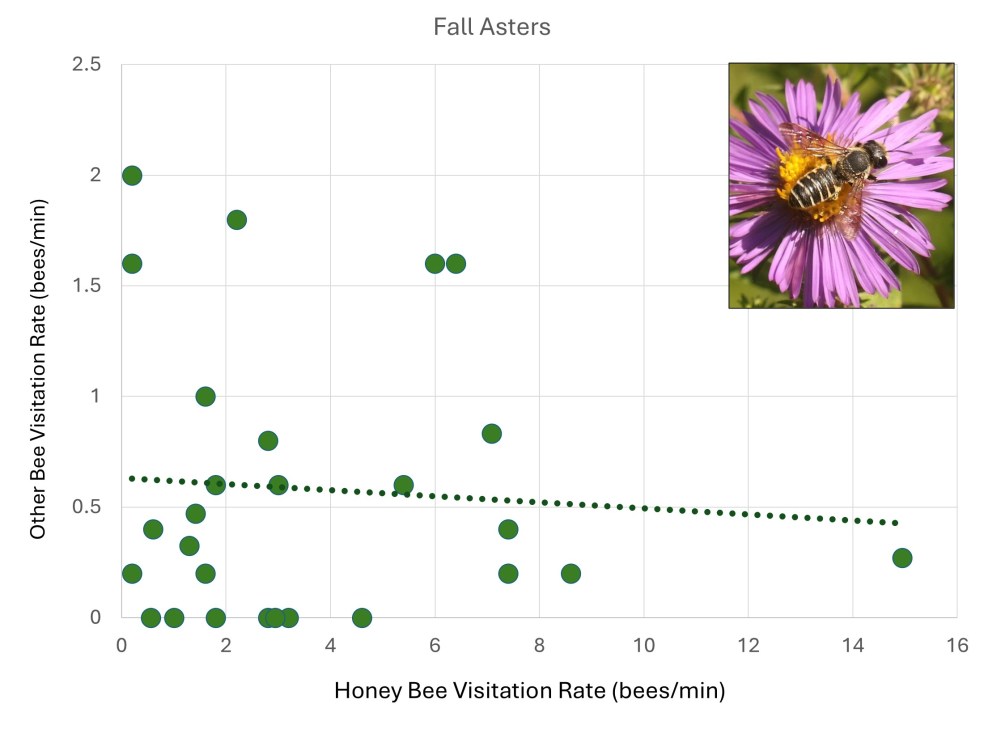
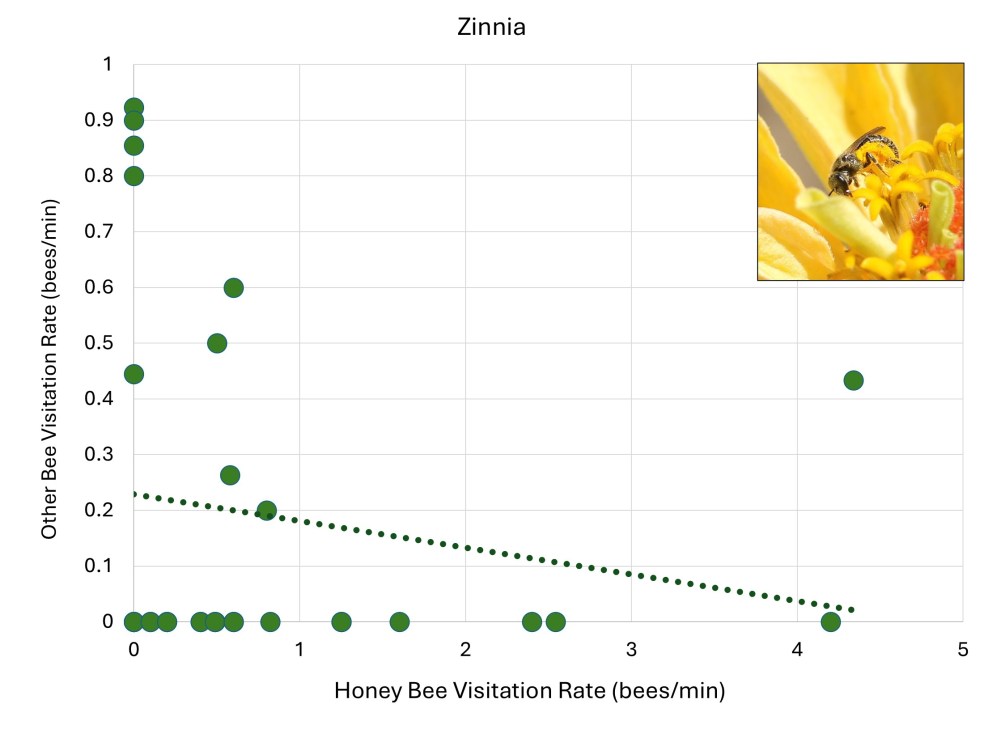
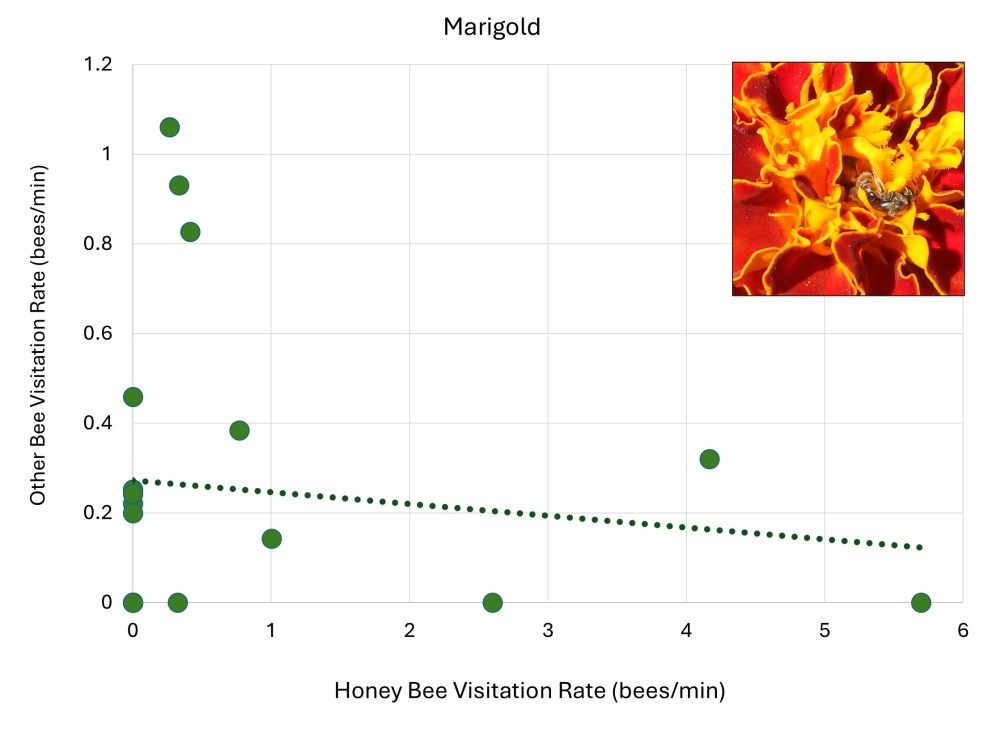
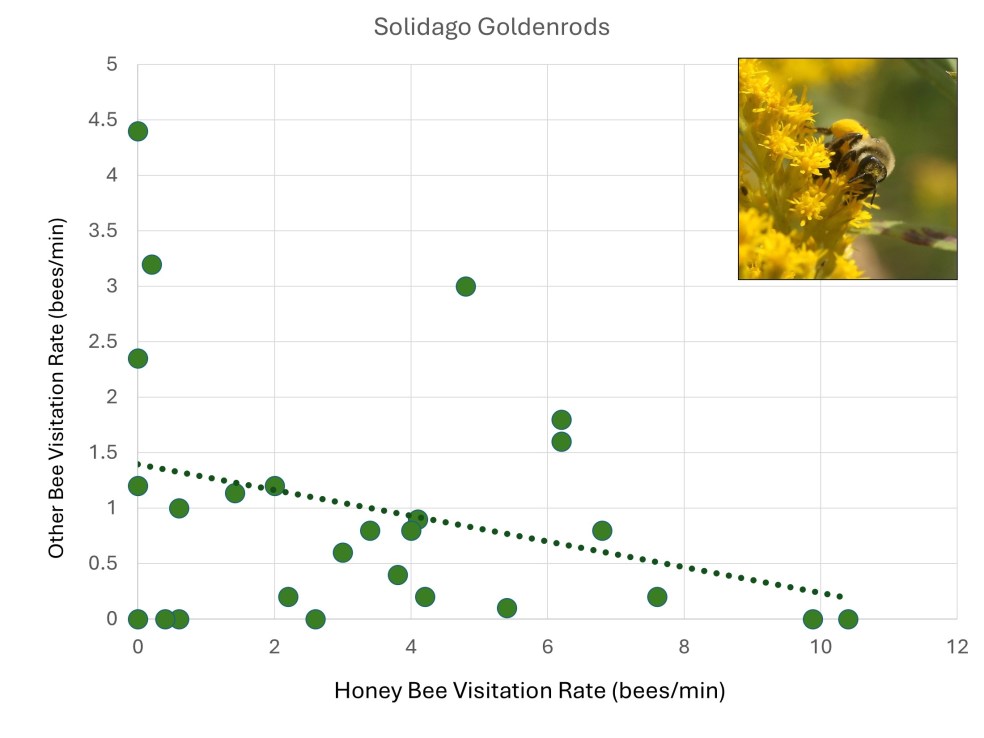
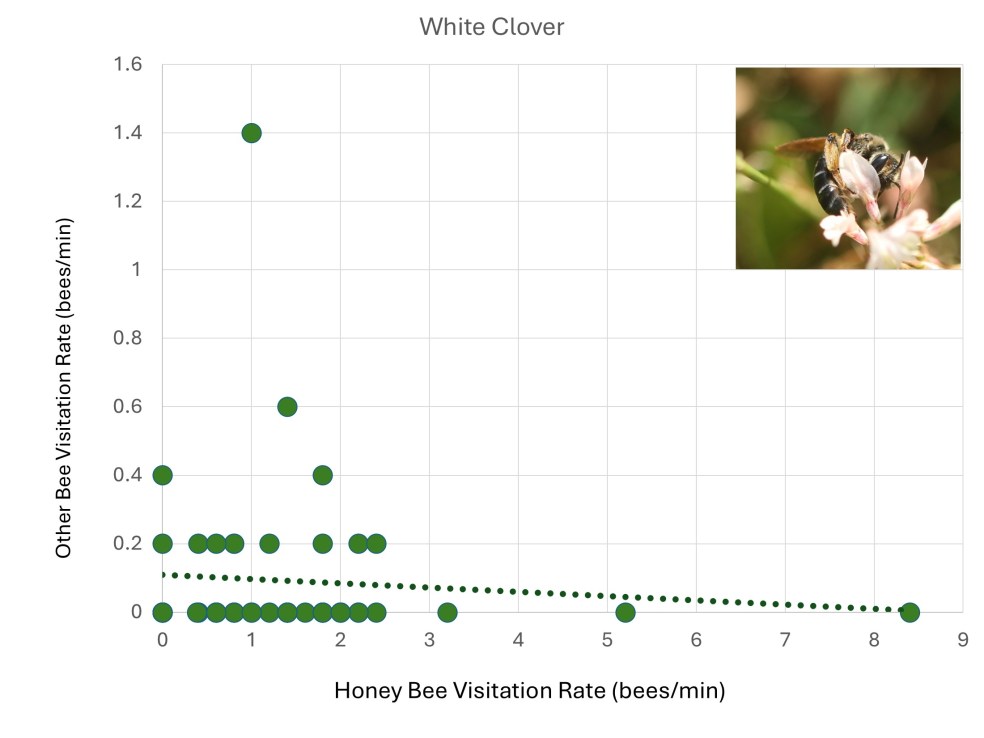
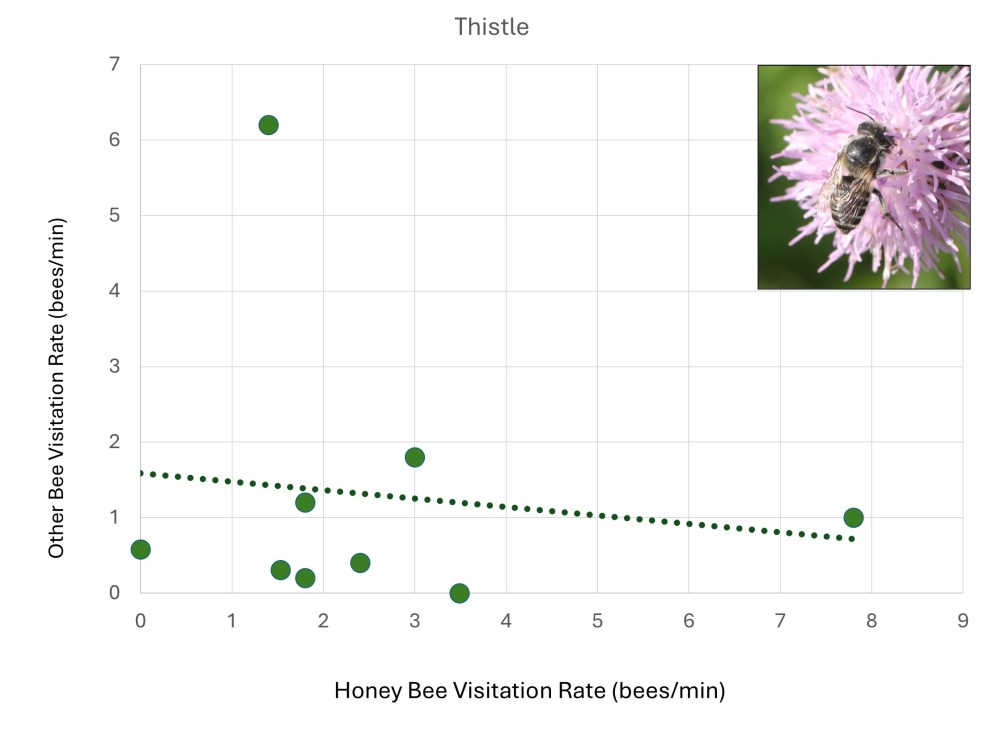
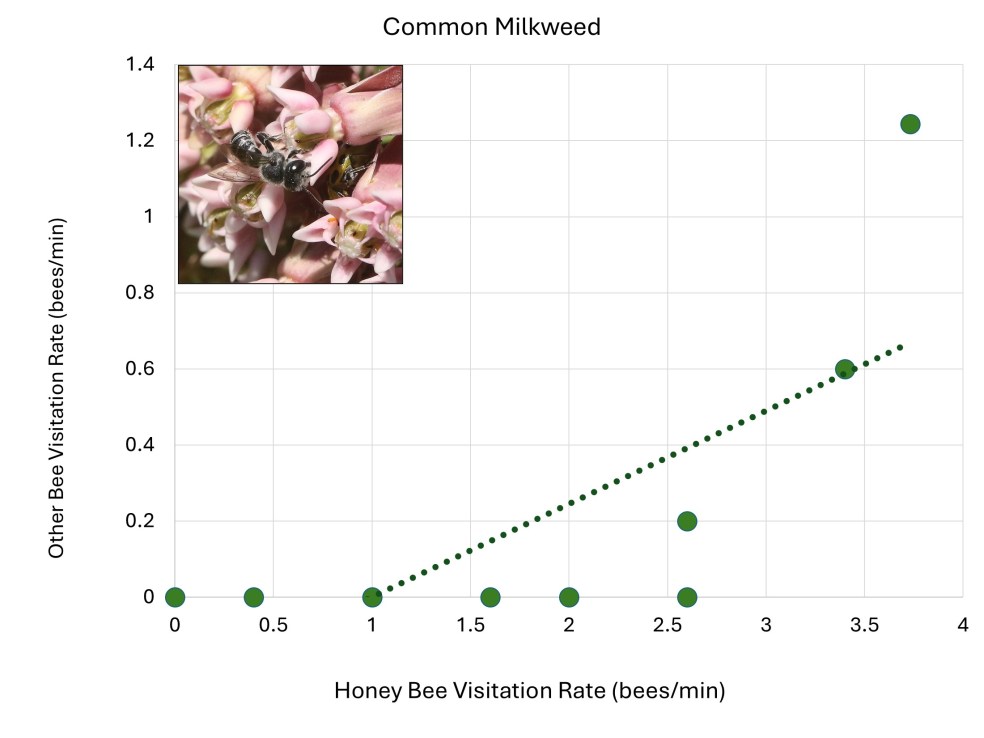
While these results might be somewhat arguable, taken together with the findings of others, I believe makes it difficult to avoid the conclusion that our support for Honey Bees is likely reducing wild bee populations at least locally. Farms are not representative of the entire landscape – they are particularly likely to host bee hives, however, they are also likely to host the open-field flowers that most bees love. Do farms have a responsibility to support wild bees and does that involve reducing Honey Bee hive numbers? How do we balance our appreciation of honey (which I share) with the conservation needs of our native bees? As suggested above by the apparent break point around .7 Honey Bees/min, can we find a ‘sweet spot’ which allows continued honey production but at lower local hive densities (offset perhaps by more sites)?
Diversity and Management of Mining Bees (genus Andrena) – Soil drillers of the Shoulder Seasons.
In the rest of this posting to keep things (relatively) simple, I’m going to focus on mining bees; I hope to describe some of the other bees in later postings. Below, the first section gives some general background on this group of bees, the second is a series of profiles of the mining bees found on your farms, and the last provides some management suggestions.
Some generalities about Mining Bees.
The mining bees (genus Andrena) are one of the most speciose genera of animals with more than 1700 species and over 90 in New York. Speciation is likely to still be occurring. The genus apparently originated some 40-50 million years ago, at a time when the continents were closer together than they are today.
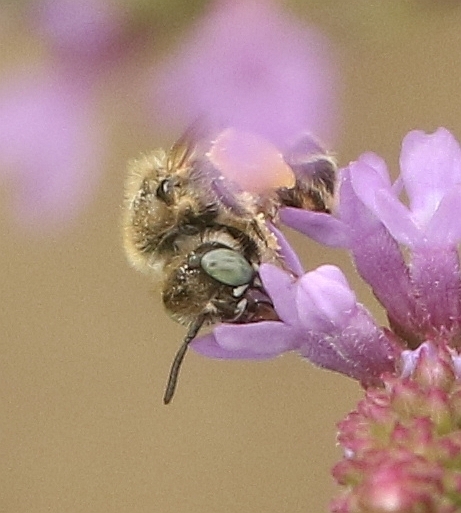
These are generally medium-sized, fuzzy yellowish bees. They can seem somewhat reminiscent of Honey Bees, but look for their distinct “facial foveae”, which some observers have described as vertical eyebrows. Most of our species are a faint yellow, but some are more silvery, a couple of species are pumpkin orange, and one is dark with striking gold epaulets.
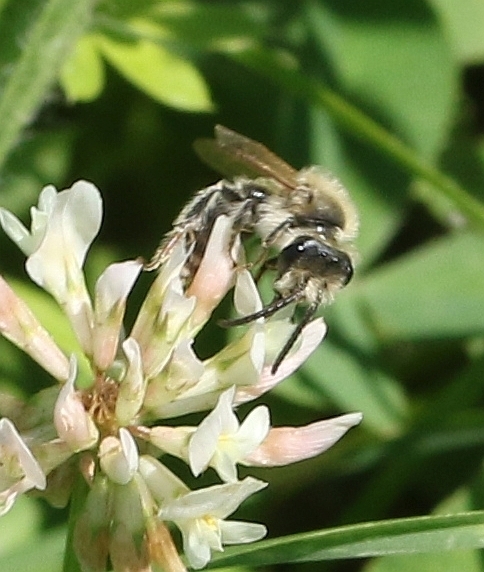
These are largely solitary, ground-nesting (hence “mining”) bees. This means that they look for friable soils into which they extend burrows at the ends of which they place pollen balls and lay an egg. A given burrow may have various side branches, each ending in a nursery. Some of these burrows may extend more than a couple of feet below ground, and some mining bee species seem particularly drawn to sandy soils. Many seem to appreciate patches of semi-open ground, although some reportedly make their burrows below the forest leaf litter.
The nests of many mining bee species are parasitized by other bee species. These so-called ‘cuckoo bees’ enter the nests of their host, often under the cover of host-mimicking pheromones, and then lay their eggs in the chambers with the pollen balls the mining bees have begun to form. When the cuckoo bee eggs hatch, they kill (and consume?) the egg or larva of the host bee and then feast on the host’s pollen ball. Some parasite-host relations can be quite specific. It is however very important to realize that we know painfully little about the nesting biology of most of our mining bees. Indeed, for some of our relatively common species, there is no published documentation of their nesting sites.
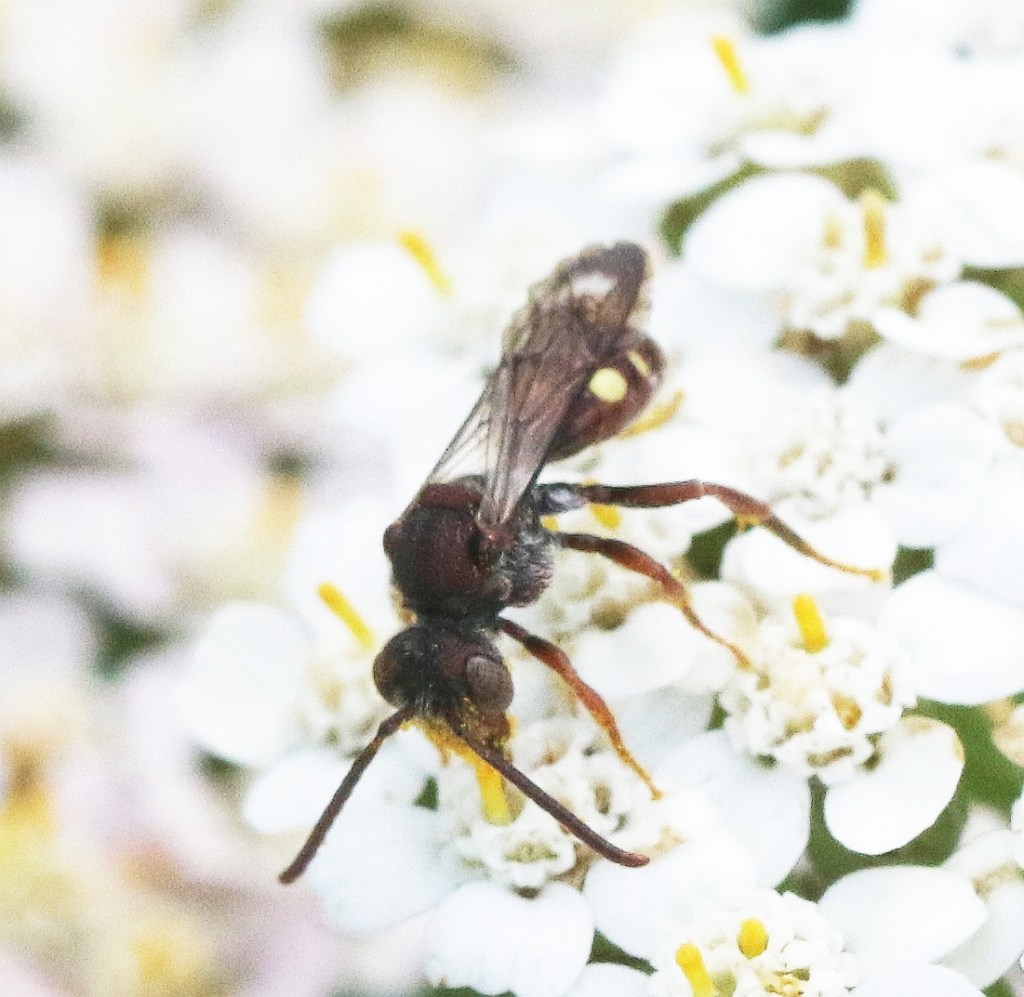
Mining bees are most commonly seen in Spring or late Summer, and some are pollen specialists on the flowers blooming at these particular times of year. Specializing means that, while these bees may be found nectaring at other flowers, they collect pollen for their nests from one or only a limited number of flower species. When those flowers are absent, then so are the bees. Examples of this group include mining bees who specialize on Spring Beauty, violets or Trout Lily (we did not find these species during our observations but did not look for them; we have found them at other times in regional on-farm floodplain forests.)
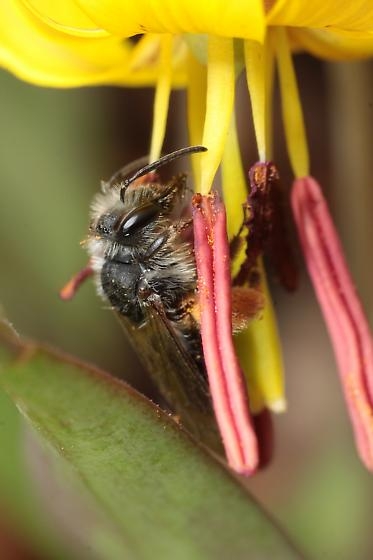
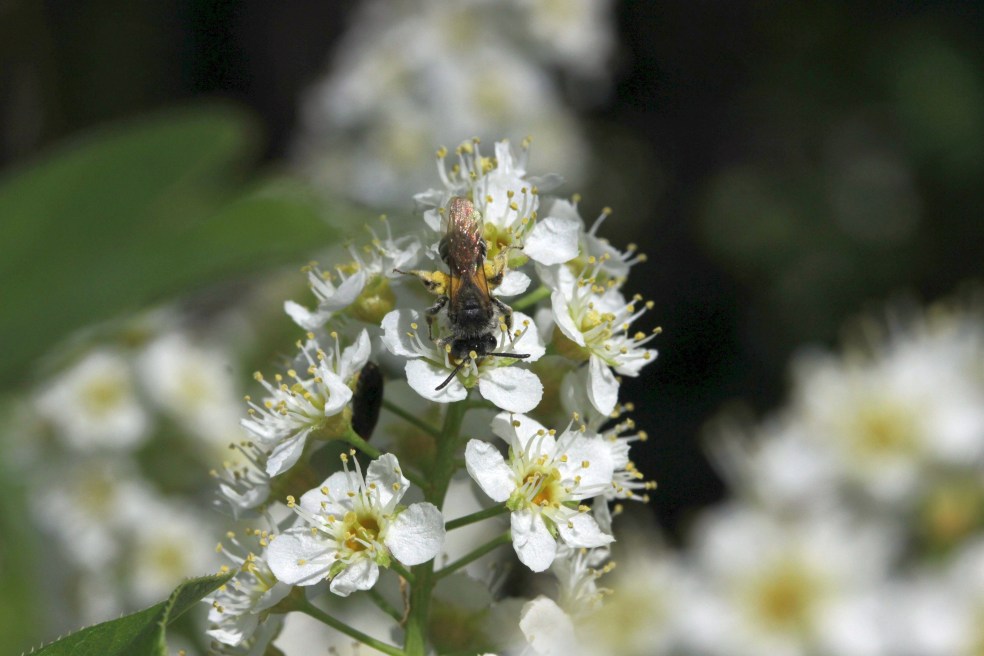
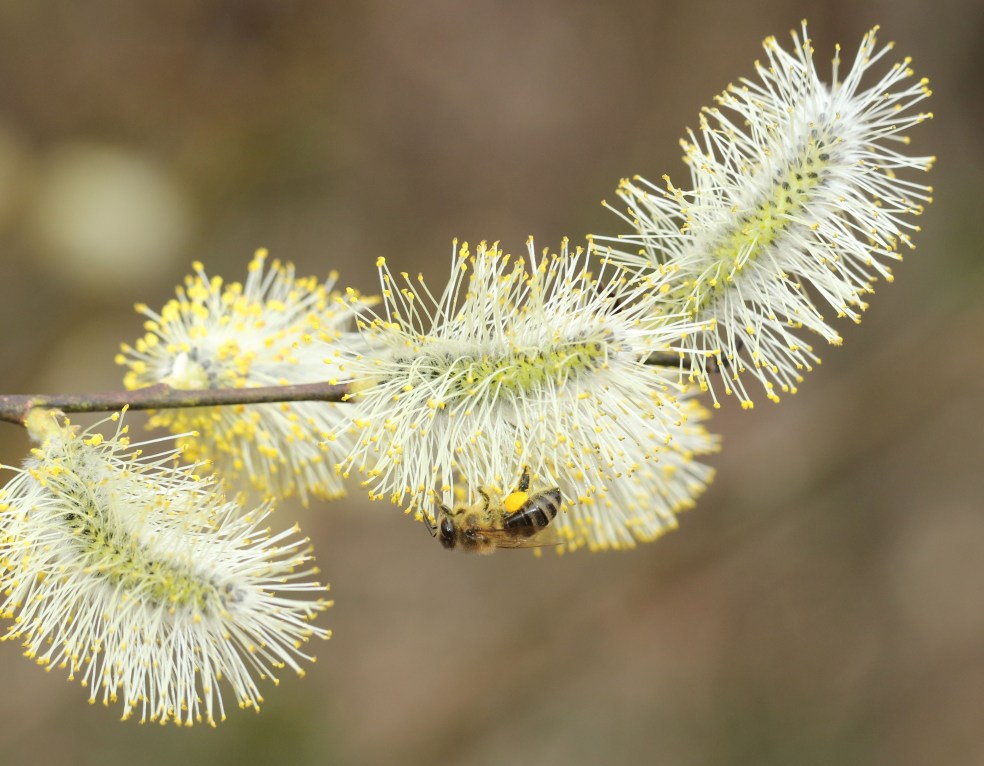
Many of our Research Circle surveys were too late in the season to record the Spring cohort, and most of the spring-time mining bees we did find seem to have relatively broad pollen tastes – a habit that’s likely an advantage when dealing with the vagaries of Spring which might frost nip one flower here, but leave another type of flower unscathed over there. As summarized below, woody plants in the rose family (including most fruit trees, hawthorns, cherries, and shadbush) did seem to be particularly appreciated by springtime mining bees, although willows and blueberries and their relatives also appear to be popular, and recent work by tree-scaling Kass Urban-Mead has shown the importance of tree flowers in the forest canopy.
Meanwhile, our late-flying mining bees seem to often specialize on the emblematic wild flowers of the Northeastern Autumn – goldenrods and asters, while one species specializes on sunflower. Watch these flowers for any length of time, and your likely to see one of our native mining bees amongst the crowd of visitors. Again, it is important to realize that bees with specialized pollen tastes might nonetheless sometimes seek nectar from other flowers and, conversely, that other bees may also visit the flowers favored by the ‘specialists’ bees.
Bee Profiles: The Mining Bees We Found on your Farms.
Common Name: Alleghany Mining Bee (but I also think of it as the “Epauletted Mining Bee”)
Scientific Name: Andrena alleghaniensis
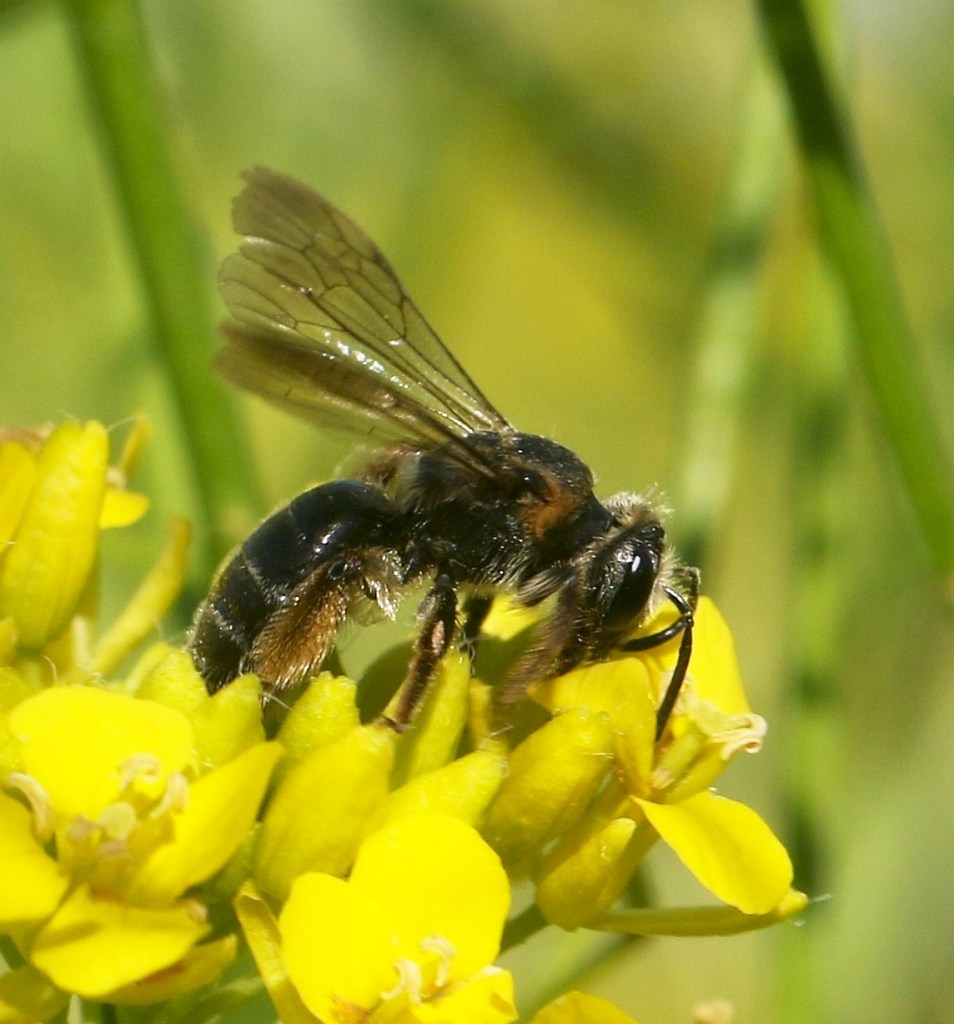
Recognition: One of the few mining bee that can be readily identified in field – dark and about the size of a small Honey Bee with patches of golden shoulder fuzz. It is a bee of late Spring and early Summer.
Ecology: Our single observation was on Hedge Mustard (but previously also recorded at Roxbury Farm). This bee is a generalist pollinators, and others have recorded it visiting such plants as willows, cherry, maple, viburnums, zinnias, dandelion, buttercups, blueberries, raspberries and cucurbits. Although considered solitiary, it is said to nest in large gatherings on fine sands; and is apparently unusual amongst our mining bees because it overwinters as an adult.
Abundance & Occurrence: Only recorded on one outing to Blue Star, the farm with some of the sandiest soils. This snappy bee seems to be most common in New England, but there are scattered records as far west as Utah and as far south as Florida and Texas.
Conservation Status & Farm Thoughts: Considered ‘Vulnerable’ (S3) in NY. Regionally, we only have one specimen in our collection and one visual record. iNaturalist lists 35 observations. There doesn’t seem to be a lot of work on the conservation of this particular species, but, of course, general on-farm bee conservation measures like avoiding pesticides and providing floral resources are relevant. This species seems to visit a wide variety of flowers, including some fruit crops, but might be too rare to regularly be important in crop pollination. It seems to be associated with open, sandy soils, and, if you know you have this bee, then creating a ‘bee beach’ or bank might help enhance their nesting.
Something to Ponder: You may have noticed that I said this bee was solitary and yet nests in large gatherings – doesn’t that make it a social, colonial bee? The terminology of bee sociality is somewhat complicated. A few of our bees, including Honey Bees and bumble bees, are considered “eusocial”, this means they nest in large colonies with a queen and a non-reproductive cast. On the ‘other end’ of the spectrum are the solitary nesters, whose nests may be scattered in isolated burrows across suitable habitats; females of these bees provision their nests on their own with no help from family. In between these two extremes are bees who form small family groups with mothers sometimes aiding daughters; bees who, essentially, share an apartment building, each mother creating her own nest cavities within a larger, interconnected burrow; and bees who, like the Alleghany Mining Bee, still have solitary nests but place them in close proximity to others of their kind. In part such behaviour might just reflect limited suitable nesting habitat and minimal need for ‘personal space’, but what do you think might be some of the benefits and costs of being social?
Common Name: Aster Mining Bee
Scientific Name: Andrena asteris
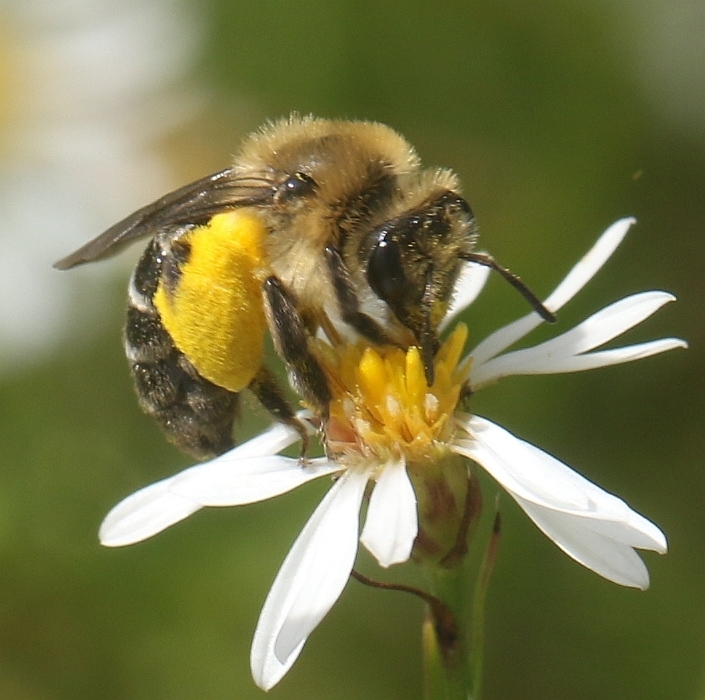
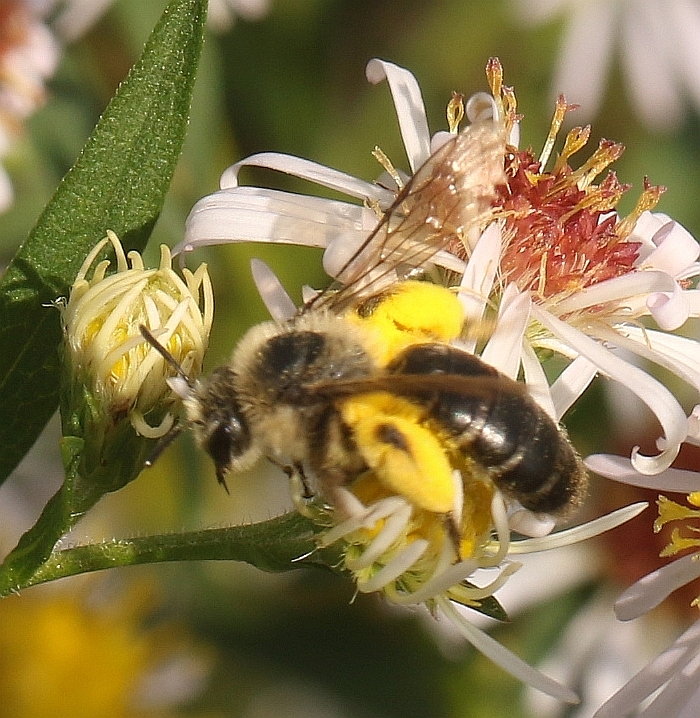
Recognition: This is a fall-flying bee whose size and shape make it easy to confuse with a Honey Bee. However, the color pattern of the abdomen is noticeably different, with marked white strips when fresh. Looked at face-on, you’ll also notice the facial foveae, and the lack of the Honey Bee’s distinctive hairy eyes.
Ecology: This is the paragon of Autumn Andrena (at least in terms of size). We have found it on goldenrod and asters, and this seems to be the norm, although it has also been reported from smartweed and sunflower, where it may be nectaring rather than gathering pollen. Like the Alleghany Mining Bee, this species is reported to favor very sandy (90%+) soils, in which it has been observed to make nest tunnels over 2′ deep.
Abundance & Occurrence: We’ve recorded it from Ironwood and Stars of the Meadow. Elsewhere, we have seen it on meadows at the Forge in Tagkhanic, Columbia County and found it on a large installed meadow in Connecticut. We have not yet identified any physical specimens in our Hudson Valley collection.
Conservation Status & Farm Thoughts: Regionally, this species is considered Vulnerable (S3) in NY, MA and Ontario, and Apparently Secure (S4) in Maine. Given its late flight period and favored flowers, its unlikely to play much, if any, role in crop pollination. As Espinoza and colleagues have pointed out, its focus on a reduced diversity of flowers (albeit ones still common in the Autumn), its single flight period, and its low reproductive potential may make it especially susceptible to habitat loss and other threats. We would recommend leaving ample habitat for food flowers and, where the bee has been observed, creating sand banks or, at least, exposing patches of sandy soil.
Something to Ponder: It is thought that some mining bees including this one may produce no more than 10 offspring in a lifetime. This is a very low reproductive rate relative to many insects (and even numerous mammals)! Such a low rate can, in turn, make it more difficult for such bees to re-establish themselves after population downturns. A small ‘turnout’ makes the provisioning and survival of each individual offspring especially important. Some species have a ‘flood the market’ approach to reproduction and survival, while others opt for ‘quality counts’. What environmental conditions do you think might favor each approach?
Common Name: Sunflower Mining Bee
Scientific Name: Andrena helianthi
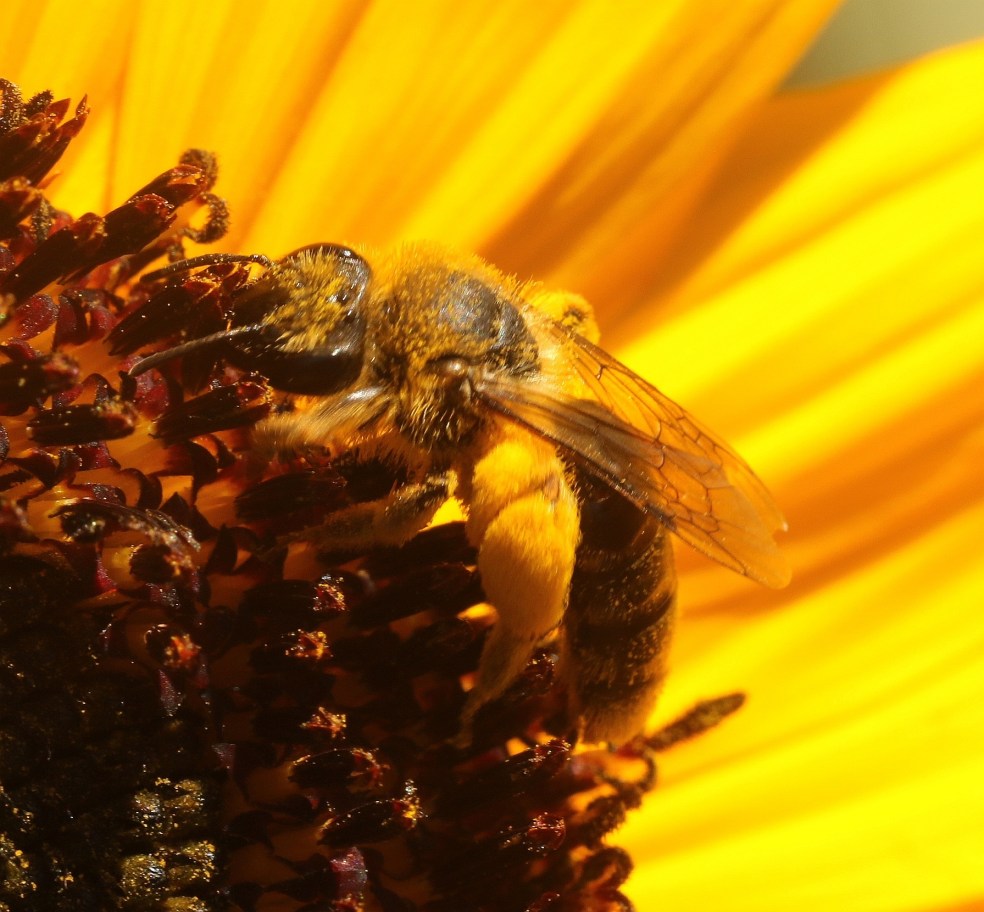
Recognition: This is another relatively large Autumn mining bee but, unlike the previous species, its shiny, abdomen is unstriped.
Ecology: A bit of an oddball amongst our mining bees in that it primarily visits sunflowers, rather than asters or goldenrods. It is a bee of later-Summer through mid-Autumn. Although considered a specialist, it has also been reported from a range of other fall-flowering plants, where it may only have been nectaring. Little seems to be known about its nesting behaviour, but it is probably a solitary ground nester like most of our mining bees.
Abundance & Occurrence: Our only regional record, alive or pinned, is our sighting this past Summer (aptly enough on a sunflower) at Little Seed Farm. It seems to be most prevalent in the Northeastern and Northcentral states, but extends into southern Canada and as far west as the Rockies.
Conservation Status & Farm Thoughts: In NY and CT, it is considered Critically Imperiled (S1); elsewhere regionally it is Vulnerable in Ontario and Apparently Secure in VT. The conservation status of this species seems to be primarily due to its apparent scarcity, rather than any long-term information on its population dynamics. For example, CT has only three post 1967 records, and during its 4 year pollinator survey, NY Natural Heritage caught no specimens (although there were at least a couple of recent partner reports). There are currently 14 iNaturalist records from NYS.
Other than perhaps assisting with sunflower pollination (although longhorn bees, bumble bees and Honey Bees were much more common on this flower), it is unlikely that this species has an impact on crops. Given its patchiness and uncertainty about its regional ecology, it is difficult to come with meaningful recommendations other than to continue planting sunflowers in locations where it has been observed. As a ‘mining bee’, suitable open ground is probably also necessary for its nesting, and so it might be expected to benefit from open ground or the earth piles described in the management section below.
Something to Ponder: Today, this bee is seen mainly on cultivated sunflowers. However, we also have wild sunflower varieties, and historically, some of those varieties may have been common on the Prairies. With the radical loss of Prairies, this bee, like some grassland birds, may have become more demographically dependent on lands outside of their original heartland. What responsibility do we in those regions now have for supporting such species?
Common Name: Hairy-banded Mining Bee
Scientific Name: Andrena hirticincta
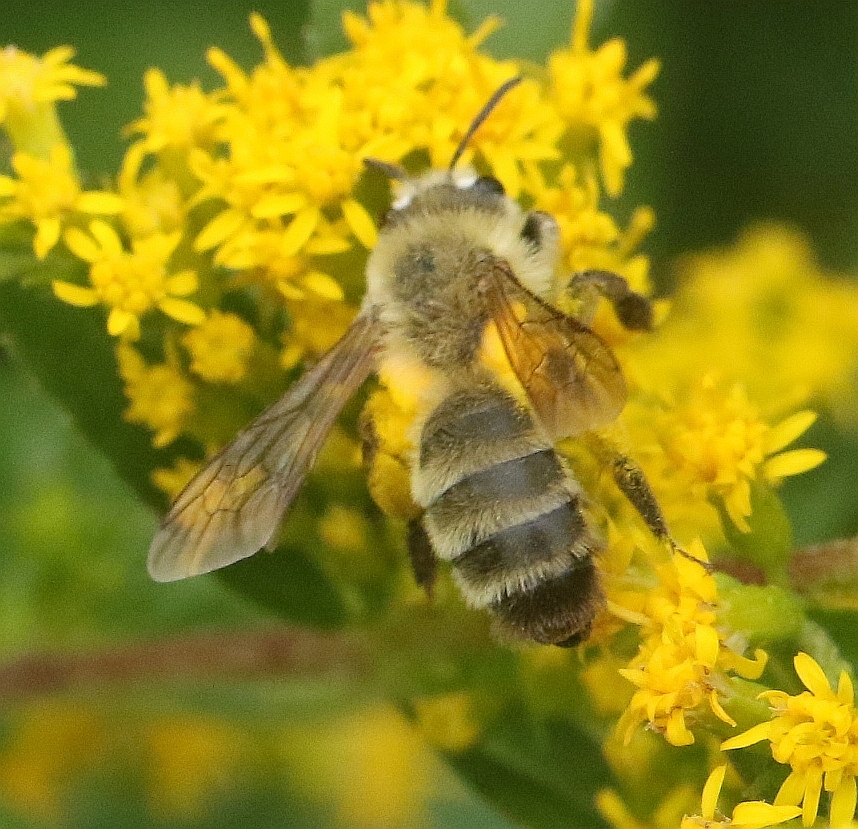
Recognition: The common name is apt – this late-Summer Mining bee has conspicuous bands of long hair on its abdomen.
Ecology: As with many other late-season mining bees, this species visits the asters and goldenrods that fill old fields and edges at this time of year. However, it is generally considered a ‘goldenrod specialist’. Both support for and caution against applying this generalization can be seen when one compares the flower visiting preferences of this species with the Aster Mining Bee noted above: according to data from the PiP iNaturalist project, almost 70% of the flowers upon which the Hairy-banded Mining Bee has been reported are goldenrods (Solidago or Euthamia species) with only about 12% of sightings being from asters (Symphyotrichum); while for the Aster Mining Bee mentioned above, more than 65% of sightings were from asters and only 23% were from goldenrods. While there seems to be a clear preference, it’s also worth noting that deeper inquiry into what the bees were actually doing on each flower type (e.g., gathering nectar and/or pollen?) would be useful, and, in both cases almost a third of all sightings were not on the flowers these bees are said to specialize on.
Little is known of its nesting ecology, but it’s assumed to be a solitary ground-nester like most of the other mining bees mentioned here.
Abundance & Occurrence: We had three observations of this species during our surveys, two at Rose Hill and one at Hawthorne Valley. Elsewhere, we also observed one at the Farm Hub and at an old-field site in New Lebanon (Columbia County). At a continental scale, reported sightings stretch along a band from New England WNW through the upper Midwest into southern Alberta, sprinkling down the Rockies to the SW US.
Conservation Status & Farm Thoughts: In NY (and Ontario and Illinois), this species is considered Vulnerable (S3); assessments in CT and VT suggest less risk. This species was relatively well represented during the Natural Heritage Program’s Empire State Pollinator Survey, and there are 177 NYS records in iNaturalist. In the Northeast, it seems to range widely both geographically and in terms of habitat use. As with most of these fall-flying mining bees, this species probably does not play a significant role in any crop pollination. Presumably, providing access to open, somewhat friable ground could help support nesting by this species, but that remains to be shown.
Something to Ponder: Why should a bee be ‘hairy’? There are clearly various evolutionary forces at work. The hairs on bees’ bodies certainly are pollen magnets and can help them gather pollen during their flower visits. When they then groom themselves, they can collect the gleanings. Visual cues might also be important – thoracic bands, colored hairs on the face, and other hirsute markings might help in intraspecific communication. Finally, don’t forget staying warm. While insects are often called ‘cold blooded’, this is not completely true. While they may not have a basal metabolic rate that generates much warmth, by vibrating their flight muscles and basking in the Sun, they can raise their body temperatures. Once that has been done, then having a fur coat does help keep you warm and productive.
Common Name: Cloudy-winged Mining Bee
Scientific Name: Andrena nubecula
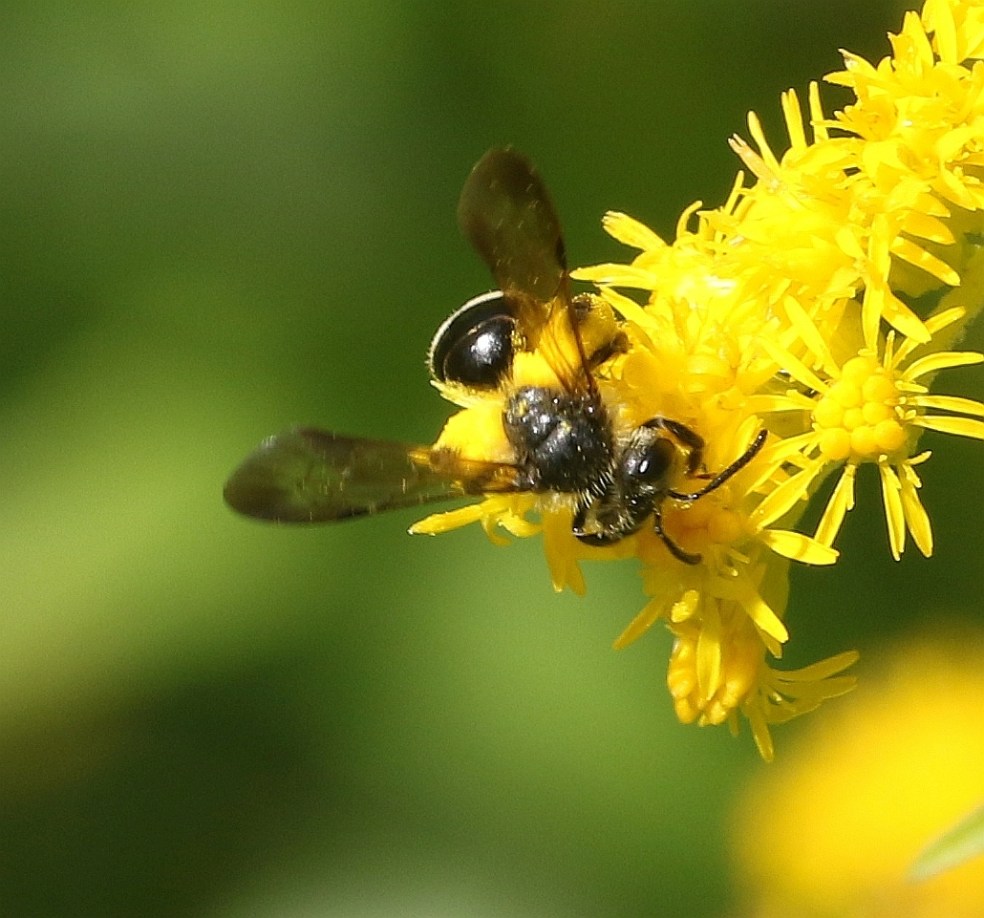
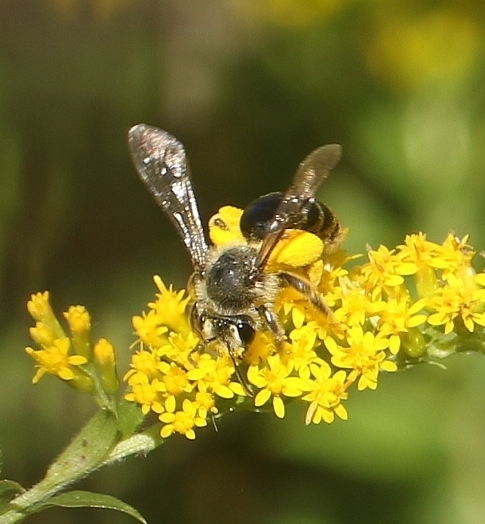
Recognition: This relatively small mining bee has a boldly striped abdomen and, when foraging, tends to hold its smoky wings at a wasp-like angle away from its body. Most of our other bees fold their wings over their backs when on flowers.
Ecology: Another late Summer-Autumn mining bee, despite the fact we saw them only on goldenrods, this species generally seems to show a preference for asters, having been observed on them about two thirds of the time. Little is known about its nesting ecology, but the assumption is that it’s a solitary ground nester.
Abundance & Occurrence: We have seen this bee, always on goldenrods, at Rose Hill, Whistle Down, and the Farm Hub. We have not yet identified it in our physical collection. This bee seems to be most commonly seen in the eastern US, as far south as Georgia.
Conservation Status & Farm Thoughts: This bee is considered vulnerable in NY, Ontario and IL, but more secure in CT and VT. It was recorded relatively often in the Empire State Pollinator Survey and has almost 200 NYS iNaturalist records… not common perhaps, but not rare either. It seems to range relatively widely across habitats.
Something to Ponder: Why have darkened wings and hold them away from the body when visiting a flower? One possibility is that it makes them look more wasp-like, and some predators may have learnt the hard way to avoid wasps. Mining bees can themselves sting, but perhaps trying to associate oneself with a widely recognized group of stingers, like wasps, brings some selective advantage in the long run. The boldly striped abdomen only adds to the effect.
Common Name: Carlin’s Mining Bee (but see below)
Scientific Name: Andrena carlini
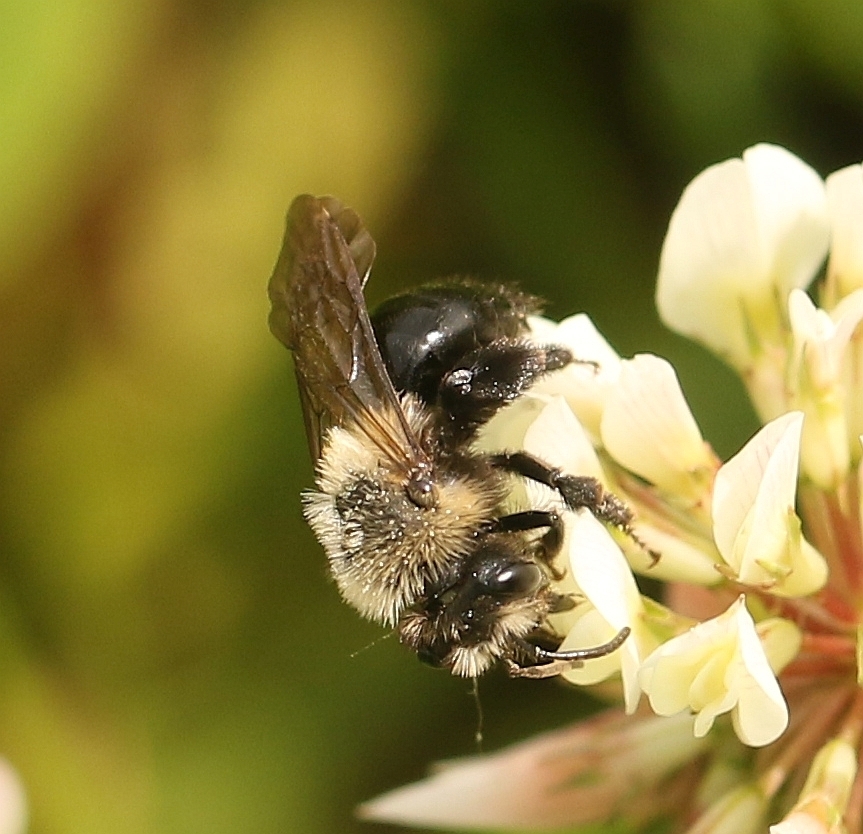
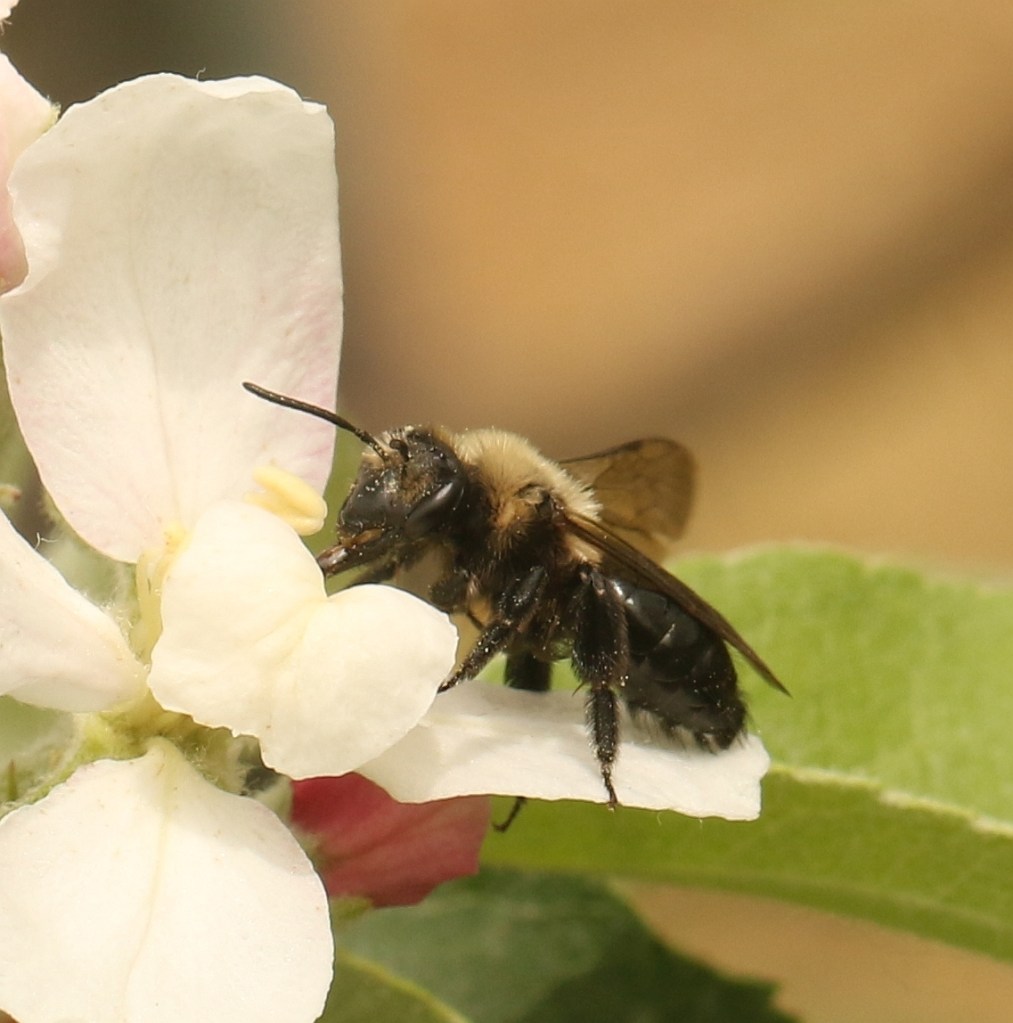
Recognition: This species is likely underrepresented in photographic databases because it is a somewhat nondescript bee and reportedly easily confused with at least one other species. While its fuzzy facial foveae (say that ten times fast!) mark it as a mining bee, and its unbanded abdomen and spring flight time narrows the field, definitive identification requires inspection of wing venation, which can only sometimes be seen in photographs .
Ecology: This is a springtime mining bee whose taste in flowers seems to range widely. We observed what we believe to be this species on yellow mustard, Apples, and White Clover; published records suggest it favors a wide variety of native and non-native Spring-flowering woody and herbaceous plants including willows, cherries, chokeberry, shadbush, strawberries, blueberries, raspberries, dogwoods, violets, bedstraw, Garlic Mustard, dandelion and various other species. It has been described by Colleen Smith and her colleagues, as a forest-associated bee that has benefited from the return of East Coast forests. In her study looking at how adjacent forests support pollination in Apple orchards, this was one of the more common mining bees that Kass Urban Mead found in both the forest canopies and the orchards. It is reportedly a solitary ground nester, but may not be as closely tied to sandy soil as some of the other species profiled here.
Abundance & Occurrence: During Research Circle work, we found what we believe to be this bee at Rose Hill, Little Seed, and Ironwood. It is also well-represented in our physical collection – we have capture records from the Farm Hub, Hawthorne Valley, and two other Columbia County farms. We have found it in both floodplain forests and farm fields. It is known mainly from the Eastern US, north of Georgia, but with scattered records to West Coast.
Conservation Status & Farm Thoughts: It is considered Secure (S5) or apparently secure (S4) wherever it has been officially assessed. The Empire State Pollinator Survey found numerous individuals. This seems to be one of the most important mining bees in terms of crop pollination, it has been reported on a range of Spring-flowering fruit crops, Apples to Blueberries (see, for example, the work of Nancy Adamson and the Danforth Lab at Cornell). The wide distribution of this species suggests its nesting requirements may not be very demanding, but ensuring there are ample, diverse, pesticide-free flower resources (even in years when frost nips the flower buds) during its March-June flight window is probably important.
Something to Ponder: What’s in a name? As the scientific name would suggest, iNaturalist calls this Carlin’s Mining Bee, which led me to wonder who Carlin was – some early bee biologist perhaps? Well, a bit more digging uncovered that it has also been called the ‘Carlinville Mining Bee’, and it was first described (in 1901) from a specimen collected in Carlinville, Illinois. Carlinville was, in turn, named in honor of Thomas Carlin, governor of Illinois from 1838 to 1842. Apparently, he was a ‘frontiersman’, participating in wars against the indigenous peoples and described in a book on Illinois governers as “intensely pro-slavery or, at least, negro-hating”. Recently, ornithologists have changed bird common names to remove references to individuals, largely because of stories like this. At the same time, removing such names hides some of the sadder aspects of early natural history study as well as the names of some of the individuals who made early contributions; indeed, it can make taxonomy seem ahistorical. In this case, a good compromise might be calling it the Carlinville Mining Bee. What do you think?
Common Name: Hawthorn Mining Bee
Scientific Name: Andrena crataegi
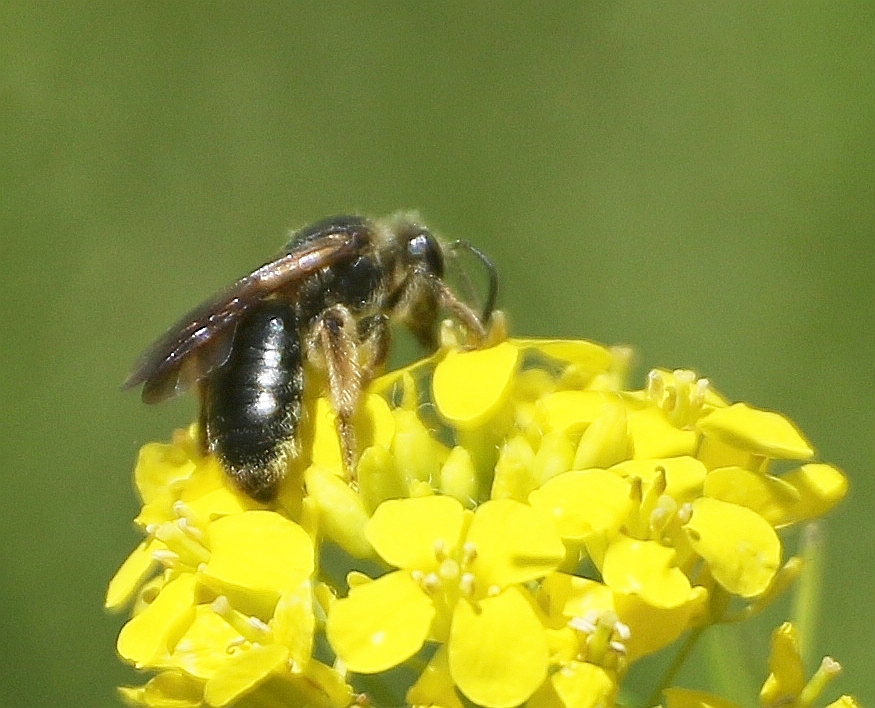
Recognition: A relatively distinctive and large springtime mining bee. It is a dark bee with a shiny black abdomen and a dark thorax that is relatively lightly haired. The wings are dark but, unlike in the later-flying Cloudy-winged Mining Bee, the abdomen is unstriped. Look for it in late May through early July.
Ecology: This Spring-flying generalist bee has been observed on a dizzying array of flowers (more than 140 genera by some counts) including, but hardly limited to, hawthorns. Unlike all the other mining bees so far mentioned, this species is known to nest communally, with multiple females sharing entrances to a labyrinthine set of tunnels. Unlike in Honey Bees and Bumble Bees, however, it seems that there are no ‘castes’, and all females are reproductive. The nests of this bee are reportedly parasitized by Nomada cressoni, a tiny little ‘cuckoo bee’, for which we may have one Farm Hub collection. Nest parasites stake out the nests of their hosts and then dart in to deposit their eggs on the pollen ball the host species is preparing for its own offspring. Once both the cuckoo and its host have hatched, the cuckoo kills and consumes its host’s larva. Reportedly, both males and females participate in locating host nests and in creating an olfactory cover by mimicking the host’s scent (of course, only the female actually lays an egg).
Abundance & Occurrence: During our surveys for this project, we noticed this species twice at Ironwood and once at Hawthorne Valley; all three of our apparent records were observed on Hedge Mustard. We have only two specimens in our collections, but both of those are from farms – Hawthorne Valley and Roxbury. This is generally a relatively common bee. It was widely reported during the Empire State Pollinator Survey and has almost 200 iNaturalist records from NYS. It is distributed across the entire US (although see ponderings below).
Conservation Status & Farm Thoughts: This bee is currently considered more or less secure throughout its range. This may be one of the most important mining bees pollinating spring fruits. In Finger-Lake Apple orchards, it was found more than twice as frequently as the next most common mining bee species (see supplemental data associated with this publication). Indeed, Mark Shlueter and his colleague Nicholas Stewart in Georgia suggested it as an alternative fruit pollinator to Honey Bees in some situations. It has also been mentioned as a blueberry pollinator. During his studies in Columbia County, this was one of the bees that Martin Holdgrege found in early Spring along floodplains but then later in the year in crop fields.
Something to Ponder: If one takes a closer look at the distribution pattern of the Hawthorn Mining Bee, which I previously described as ‘continent wide’, one notices there’s actually an apparent gap in the Central Plains. Based on the published comments of an ardent mining bee biologist, this seems to be real – he looked for this species specifically in this region and never found it. So, why the gap? Why are there two, apparently disjunct populations? One recently published study reminds us that bees have been around for a long time, and this species certainly coped with the last glacial period some 26,500 to 19,000 years ago. However, at that time much of its current range was uninhabitable. The study uses modelling of climate and this bee’s needs to propose that during the last glaciation, this species was actually broken into two distinct populations – one in the SE and the other in Central Mexico. As the climate warmed, these two populations were able to follow suitable conditions northward (and, indeed, relinquished southern habitats that became too hot for their liking), however a swathe of somewhat inhospitable habitat in the Central Plains has largely kept these two populations distinct. Genetic work on these two populations should be telling – does it suggest they have, in fact, been genetically unconnected for more than 25,000 years? Are they really still one species?
Common Name: Dunning’s Mining Bee
Scientific Name: Andrena dunningi
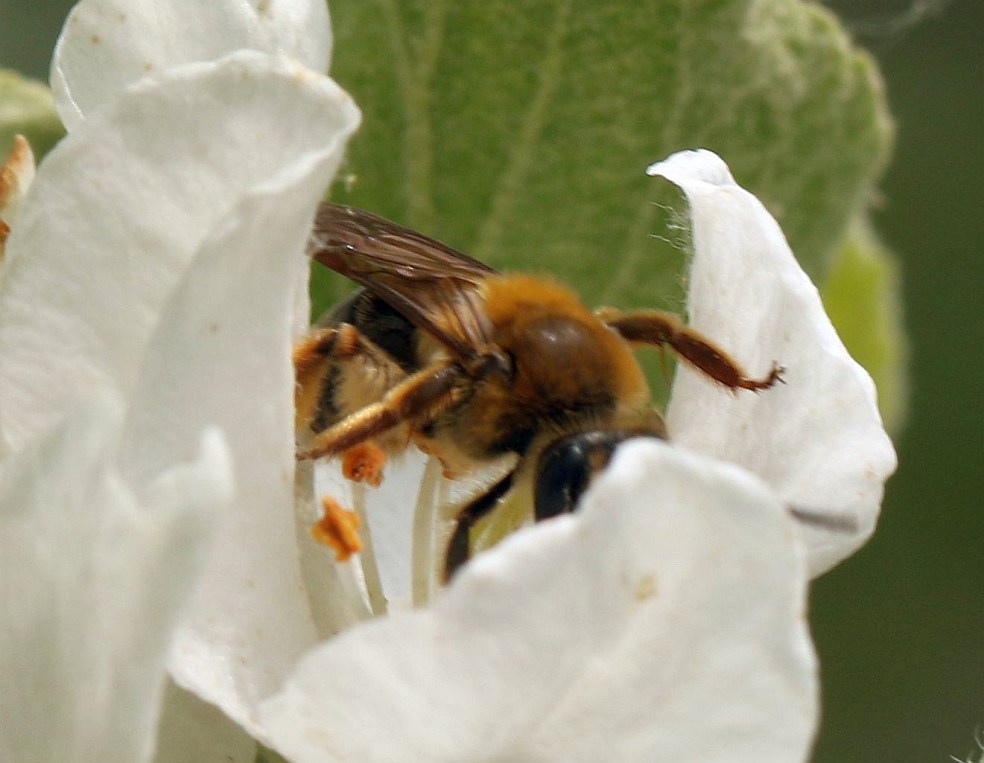
Recognition: This fuzzy Springtime bee looks something like a pumpkin-colored smallish bumble bee, although closer inspection reveals the tell-tale facial foveae of mining bees and its bare, black abdomen.
Ecology: This species seems to be a generalist – visiting an array of Spring flowers and nesting across a wide variety of soils and habitats. As Nick Dorian and Max McCarthy eloquently put it, “Dunning’s mining bee (Andrena dunningi) is fond of lazy gardeners: this spring-active species thrives in sunny, unkempt suburban lawns and gardens full of dandelions.” We and many others have observed it on Apple blossoms. It has also been reported from, amongst other plants, blueberries, blackberries, willows, hawthorns, and spring-flowering herbaceous wild flowers such as Dandelion, toothworts, liverworts, Strawberry, and Spring Beauty.
Abundance & Occurrence: During our travels for the Research Circle, we found it only once during Apple blossom at Rose Hill. Part of this apparent dearth may be due to the fact that most of our surveys occurred after the flight time of this species. In our collection, there’s a single sample from the Farm Hub. The NY Natural Heritage Program found a scattering of these bees during its statewide survey. In CT, it was described as “common”. Farther afield, it is found in a band across the Northcentral and Northeastern states through adjacent southern Canada.
Conservation Status & Farm Thoughts: Considered Vulnerable (S3) in NYS and Illinois, but more secure elsewhere. It doesn’t appear to be too picky in its choice of nesting sites, so managing for the nesting of other mining bees should also help this species. Ample woody spring flowering plants such as willows and cherries could be helpful, as would being lazy around the garden! While it doesn’t seem to get singled out, its ample documentation in orchards (including at Rose Hill) confirms it as one of a suite of bees that can help pollinate spring fruits.
Something to Ponder: Why the bright orange coloration? This deep orange does not seem to be reminiscent of some dangerous wasp, and I assume that potential predators are not afraid of falling pumpkins. Nor does it appear to be camouflage – this would seem more suitable as an Autumn rather than Spring coloration. I cannot immediately come up with any evolutionary ‘just-so’ story to explain it, but one should always remember the possibility that some traits are just selection-neutral byproducts of something more important. Perhaps an orange biochemical is, for example, a physiological byproduct of some important, internal physiological process, and storing that compound in one’s hairs is just an easy fix. Of course, it’s still helpful to look for evolutionary stories, because trying to prove them or disprove them can lead one to observe heartofore unknown aspects of a creature’s life – for example, who ever knew that these bees were fans of the Cincinnati Bengals?
Common Name: Nason’s Mining Bee
Scientific Name: Andrena nasonii
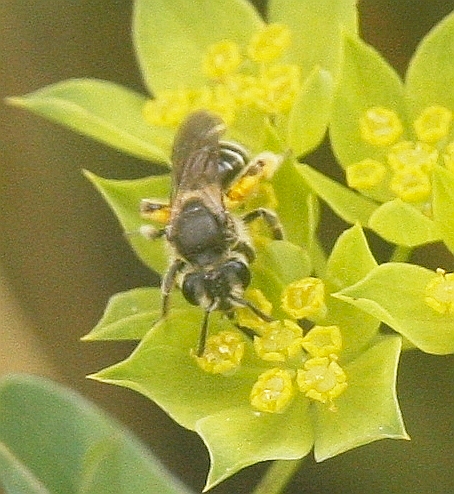
Recognition: A relatively small, yellow-fuzzy, nondescript bee characterized by wide facial foveae, prominent abdominal hair bands, and enlarged ‘shins’ on its hind legs.
Ecology: Apparently a consummate, springtime generalist, this bee has been observed on a wide variety of flowers and in a wide variety of habitats – it is found in both field and forest. This species has been reported from Apple, hawthorns, Blueberry, Strawberry, raspberries, Dandelion, Zinnia, violets, and wide range of other plants. I could find no published information about this bee’s nesting, but Henry Steig says that based on his observations, it’s a solitary.nester although it occurs in large, multi-species aggregations on suitable sites.
Abundance & Occurrence: Although we’ve only identified two sets of photos (one from Stars of the Meadow and one from Rose Hill) from our surveys that we think may show this species, that is doubtless due to the fact that this is a tricky bee to ID from photos and many of our surveys were conducted after this species’ flight season. It’s one of the most common bees in our collection with around 70 specimens, including from the floodplains of Hawthorne Valley, Triform, Miller’s Crossing, and the farmland of Thompson-Finch Farm, where it was netted off of blueberries and strawberries. It is widespread in the East, where it is regularly reported as common; there are a smattering of records from farther west.
Conservation Status & Farm Thoughts: It is considered Vulnerable (S3) in NY, although it is considered Secure (S5) elsewhere where it has been evaluated. Natural Heritage did find numerous records during the Empire State Pollinator Survey, and so the ranking is probably based mostly on the general ecology of mining bees, rather than anything specific to this species. This bee is reported from a variety of spring-flowering fruits, and, given its apparent abundance, is likely an effective part of the springtime wild bee pollinating contingent. As a generalist, it is likely that management intended to assist other mining bees (such as exposed patches of earth and ample spring flowers) will help this species too.
Something to Ponder: How does one know when a bee population is stressed? Obviously, population decline is one cue, but what else might be an indicator? Biologists at Cornell looked at the body size of this species in relation to the extent of agriculture in the surrounding landscape. They found that greater agricultural land cover within a kilometer of the bee sampling site was associated with smaller bees. They hypothesized that this was due to reduced access to food, although pesticide impacts were also possible. As the authors note, however, this smaller size could be indicative of adaptation rather than stress. For example, song birds have been reported to have lower body fat when food is plentiful and predictable – fat can be a drag on flight (and hence predator escape), so why stock up if you can be confident the pantry will be full when you return?
Common Name: Cherry Mining Bee
Scientific Name: Andrena pruni
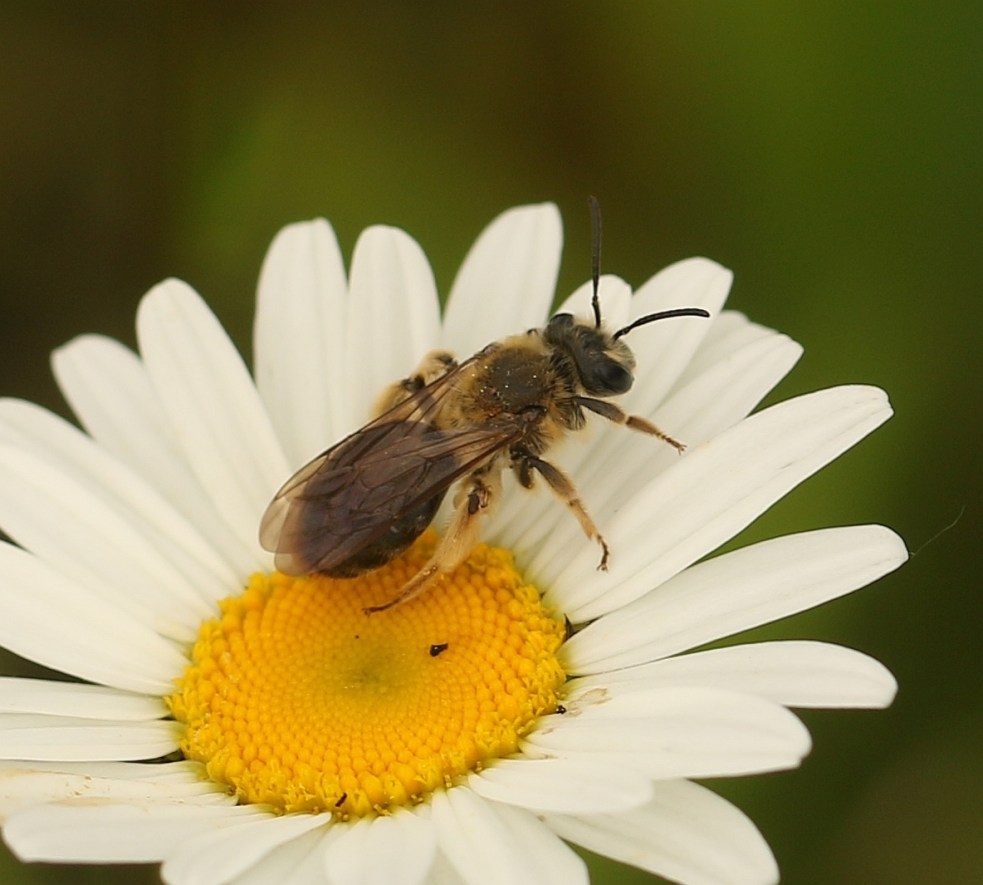
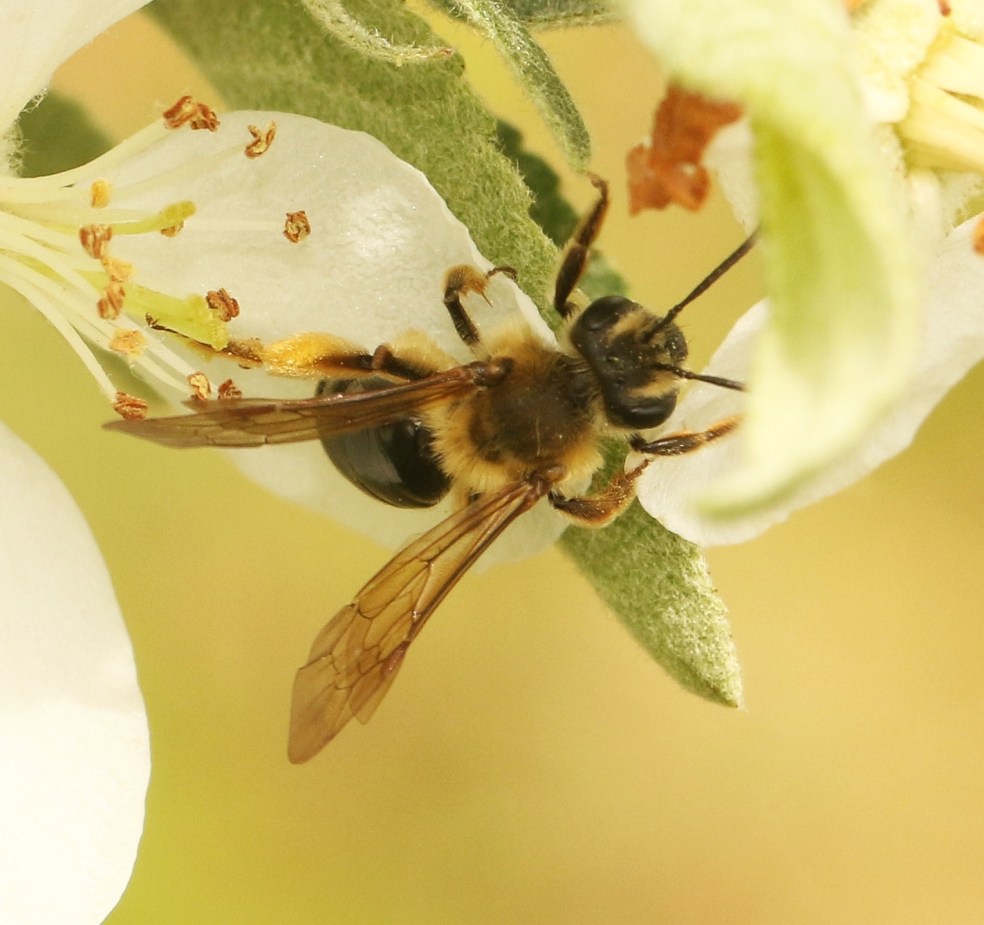
Recognition: This is not a very distinctive bee. It is Honey-Bee sized with pale yellow body fur and an unbanded abdomen. Its most telling features are its fuzzy, blond rear leg socks (or, to put that more scientifically, it has light colored scopal hairs on its hind tarsus).
Ecology: The flower menu of this bee seems to be a bit more restricted than that of some of the other springtime mining bees described here, although that may just be a result of its relative rarity. It may favor woody plants, especially in the Rose family, but is also recorded from various brassicas, including Garlic Mustard, and the Hedge Mustard and Oxeye Daisy upon which we observed it. It appears to favor forest or near-forest habitats, and is a ground-nesting, probably solitary bee.
Abundance & Occurrence: We observed it on three farms: Hawthorne Valley, Ironwood and Rose Hill, but we have no samples in our collection. In NY, a moderate number of specimens were collected by the Empire State Pollinator Survey, mainly along the Hudson and Mohawk River Valleys and south of the Great Lakes. It seems somewhat more confined to the Northeast than the other bees we have described here, with most records in southern New England and down the Appalachians, with a few records found NW of that line but almost none to the SE.
Conservation Status & Farm Thoughts: In Vermont and NY, this bee is considered Vulnerable (S3) while it is ranked as Apparently Secure (S4) in Illinois. Researchers in Vermont have suggested that this species is spreading northward as the climate warms. Although this bee has been reported from Apple and blueberries, it seems to be relatively scarce and so may not play much of a role in the pollination of commercial fruits. However, if its abundance really is increasing in the northern part of its range, it may become a more significant springtime agricultural pollinator in some areas. Not much seems to be known about the natural history of this species, and so specific habitat management recommendations are challenging. Presumably, ample springtime-flowering woody plants wouldn’t hurt.
Something to Ponder: Although there are hints that it might be increasing, as you might have gathered from reading over the above description, this is a somewhat rare species. Not super rare, just “somewhat” rare. Why so? To avoid any suspense, I will immediately say, ‘who knows!’, but the point is that such uncertainty helps illustrate how little we know about the life around us. In an age when we have probed the cellular depths and spent gazillions on AI, it is sobering to realize how much natural history we still don’t know. That is not a lack of knowledge that will be primarily solved by technology (although technologies like eDNA can help), instead it will take dogged, probably not very lucrative natural history study.
Management
Two important habitat components for any bee are a place to build their nest and flowers from which to gather the pollen and nectar they need for themselves and/or their offspring. A simplified approach to management thus focuses on providing these two ingredients. Be aware however that most bees probably need more than this including mating grounds and overwintering sites (which are sometimes, but not always, the natal nest).
Flowers
As the profiles above describe, different mining bee species have different flower preferences. This website lists the flower preferences of many of the specialist species, and generalist bees often choose from across these options as well. Management recommendations include leaving intact any sites where spring native wild flowers are blooming, such as Spring Beauty, Trout Lily, Violets, Wild Geranium, and Waterleaf. Of course, extending those areas would be beneficial, but likely also tricky. More broadly and perhaps more easily, expanding spring-flowering woody plants, especially Willows and members of the rose and blueberry families could help both pollen generalists and specialists. Basically, think of which native woody plants you have flowering around your farm (and thus already supporting the corresponding bees), and do what you can to augment them. As Kass Urban-Mead and her colleagues have reported, preserving established forest can also provide important springtime pollen sources like maple and oaks; for example, over 75% of the pollen consumed by the Dunning’s Mining Bees she studied came from maple. Leaving patches of unmowed Dandelions, clovers and other springtime lawn flowers would also not hurt, as these can be useful nectaring sources.
Nesting sites
I think this is the trickier of the two management components, in part because we know so little about the nesting requirements of most of these bees. For those mining species who favor sandy soils and on those farms that have such soils, providing undisturbed patches of more or less open soil could helpful. This means providing areas that are not regularly cultivated and where bare soil is encouraged.
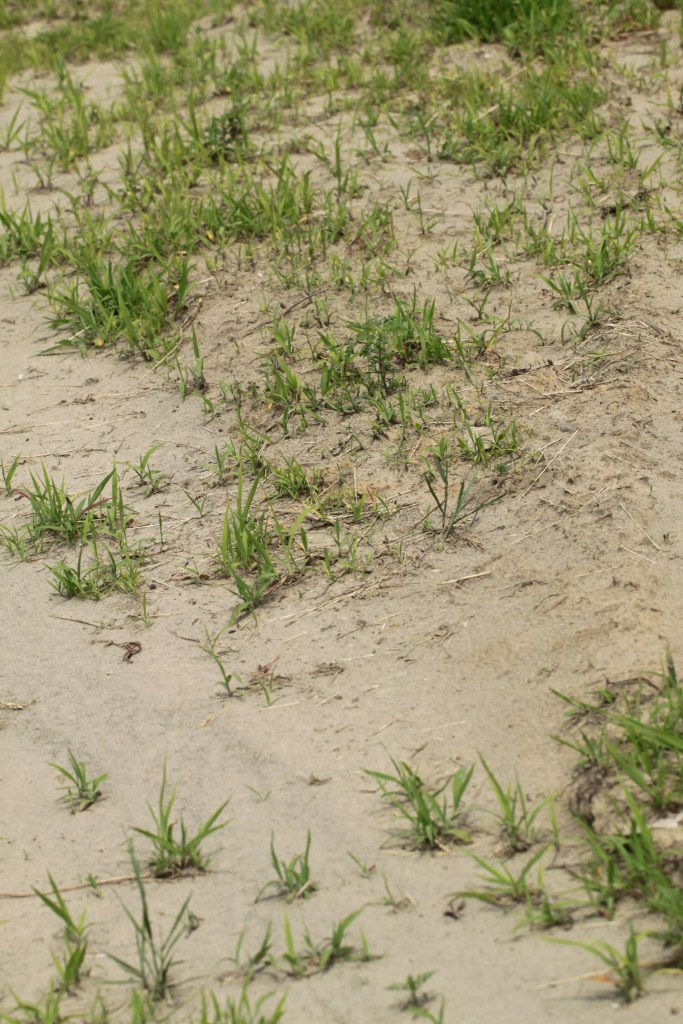
Mining bees often seem to like vertical faces, and Mark Schlueter and Nicholas Stewart, seeking to augment wild populations in Georgia orchards, created simple trenches 3-4’ long and about 2’ deep and a foot wide.Hawthorn Mining Bee readily nested in the bottoms and sides of these trenches. Although the excavated earth was placed adjacent to the trenches to provide increased nesting habitat, it was little used, and Mark emphasized the probable importance of stable, somewhat compacted soil. They also planted spring-flowering woodies (such as cherries) near the trenches. An alternative on-farm approach has been described by the German scientists Ulrich Neumuller and his colleagues. In exposed, sunny areas, they made earth piles roughly 9’ wide, 27’ long and 5’ high using local soils. Piles were tamped down and shaped to have steep faces and then maintained by periodic vegetation removal. They found extensive use of such piles (more than 100 ground nesting bee species!) and provided a handy (assuming you have access to a backhoe), illustrated how-to document (file S1 in this zipped file).
Three of words of caution: As Paul Westrich, a highly experienced German bee biologist, has pointed out (use the Google translate feature), it is almost impossible to predict which bees will settle in what created habitat, so be ready for the unexpected. Don’t be surprised to see wasps, tiger beetles and other creatures also celebrating your accomplishments. Additionally, you’ll notice that both of the above efforts used local soils. While importing sand could make sense if there were such sand elsewhere in the area, you’re mainly hoping to augment bee populations already existing around your farm and if you’re not on sandy soil, the bees around your farm probably won’t be interested in the sand you provide. By using local soils, you have the best chance of supporting local bees. Finally, I largely don’t know what I’m talking about and have no direct experience with either of these measures. One of these suggestions was field tested in the state of Georgia and the other in Germany, so some experimentation would definitely be in order if we’re really interested in exploring the regional value of these measures!
Finally, while I realize it is a very complex issue, I believe we need to consider the role that Honey Bee management could play in improving on-farm native bee conservation. It is clearly a situation involving both ecology (Do Honey Bees really reduce native bee populations in any significant way?) and farmer/public objectives (What are all the social and economic benefits of having Honey Bees in the landscape? Aren’t they somehow an inherent part of ecological farming?). I don’t have the answers but do think that serious wild bee conservation needs to consider the topic.
Up Next
Fate willing, there are many more bees still to tell you about. I probably won’t do such a deep dive into each group – few have as much depth as the mining bees. But there are some fun rarities yet to reveal, and I’m hoping to create another posting about some of them before the end of the year.
Useful Resources, which I used in making this blog.
https://www.discoverlife.org/mp/20q?search=Apoidea: The bee landing page at Discover Life, an amazing bee resource with much detailed identification informatino and images.
https://www.sharpeatmanguides.com: Tremendous photos of Hudson Valley bees supplemented by very useful ID tips by Paula Sharp and Ross Eatman.
https://watchingbees.com/: Nick Dorian and Max McCarthy’s extremely helpful site describing how to visually identify many of our regional bees.
https://val.vtecostudies.org/projects/vtbees/: The Vermont Wild Bee Survey, useful bee info. from next door.
https://www.nynhp.org/projects/pollinators/: The NYS Natural Heritage Program’s four-year project on the state’s bees and other pollinators.
https://www.inaturalist.org/observations?user_id=farmscape_ecology: iNaturalist is a very helpful site for identifying our local bee fauna and this link will lead you to the Farmscape Ecology Program’s observations of bees, mushrooms and other organisms. An especial shout out to their Pollinator Interactions on Plants project, https://www.inaturalist.org/projects/pollinator-interactions-on-plants-pip-of-the-ne-us, from which you can download summaries of the flowers upon which a given species of bee has been observed by iNat users.
https://cals.cornell.edu/pollinator-network/ny-bee-diversity: A page produced largely by Brian Danforth’s lab (see below) listing NYS bees
https://www.danforthlab.entomology.cornell.edu/; The web page for one of the most active bee labs in the State; lots of good information on diversity and agroecology.
https://hvfarmscape.org/research/biodiversity-columbia-county/native-bees/: Our bee page at the Farmscape Ecology Program, not as extensive as any of the above pages but there’s a Columbia County list and some links to our past regional bee work.
https://www.bugguide.net/: An oldie but a goody – this insect focused web site started before iNat. It’s interface is a bit clunkier, but it’s still active and has lots of useful info.
https://xerces.org/publications/endangered-species/native-bees: Xerces is the most active invertebrate conservation group in the US, and, as illustrated on this page, provides ample resources on native bee conservation.
https://illinoiswildflowers.info/flower_insects/index.htm: A handy index of which bees visit which flowers.
https://beewiki.org/: A data-rich, if dry, summary of what is known about US bees.
https://jarrodfowler.com/specialist_bees.html: A convenient list of the specialist bees of the Eastern US, with notes on their abundance, timing, and food plants.
Bees in your Backyard (2016) by Joseph Wilson and Olivia Messinger Carril, my favorite introductory book on our wild bees.
Common Bees of Eastern North America (2021) by Olivia Messinger Carril and Joseph Wilson. A useful field-guide type book, but I would read the previous one first.
The Solitary Bees: Biology, Evolution, Conservation (2019) by Brian Danforth, Robert Minckley and John Neff. A very nice summary of research on solitary bees. Unfortunately, I left my copy back in the States, and so could not incorporate much of this into this post.
Thanks: Much thanks to the following farmers for their hospitality – Kevin Clark (Rose Hill), Sue Decker (Blue Star) Matt Dell (Treadlight), Willy Denner and Claudia Kenny (Little Seed), Spencer Fenniman & Todd Newlin (Hawthorne Valley), Lauren Jones (Ironwood), Doug Muller (Hudson Valley Seed Co.), Nicholas Pandjiris & Eileen Wallding (Whistle Down), and Marybeth Wehrung (Stars of the Meadow). Identifying the bees in the photos I took on your farm involved the help of many on iNaturalist, and I would especially like to thank John Ascher, Nick Dorian, Frank Hogland, David Mantack, Max McCarthy, Michelle Orcutt, Henry Steig, and Sam Wilhelm; of course, all mistakes are my responsibility. Kass Urban-Mead at Xerces has enthusiastically fielded our bee questions, Claudia Knab-Vispo has been a key partner in crime, and my colleagues Kyle Bradford has shared his observations on regional bees. Mark Schlueter helped me better understand his work on trenching for bees.

