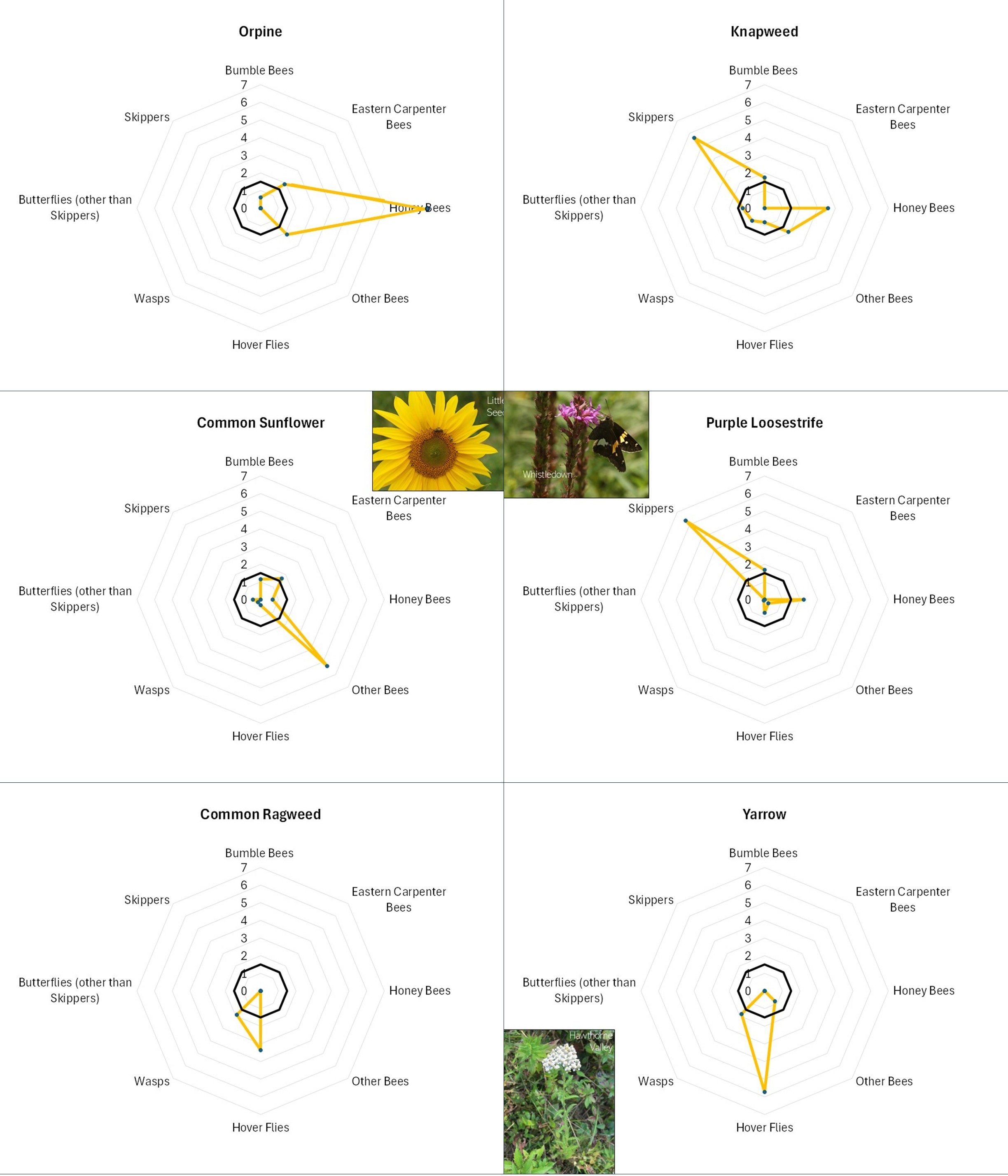
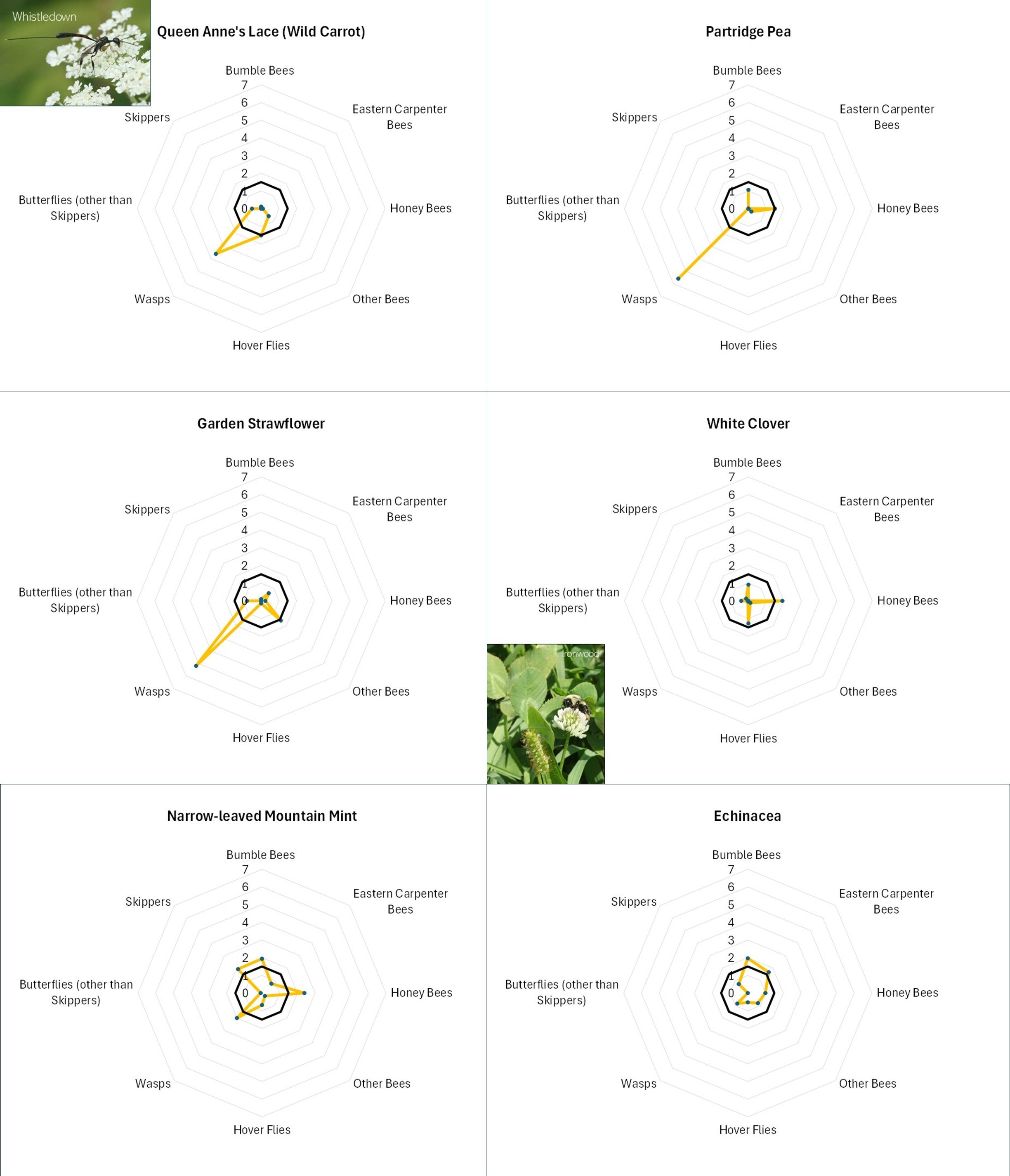
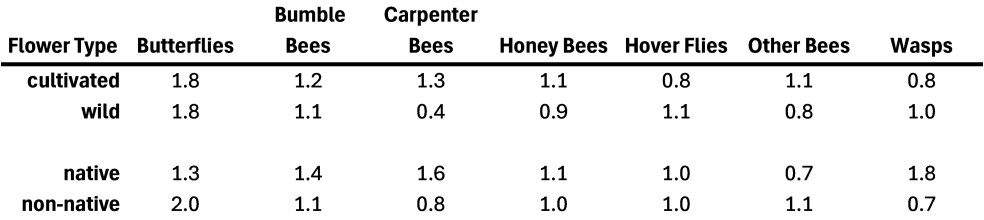
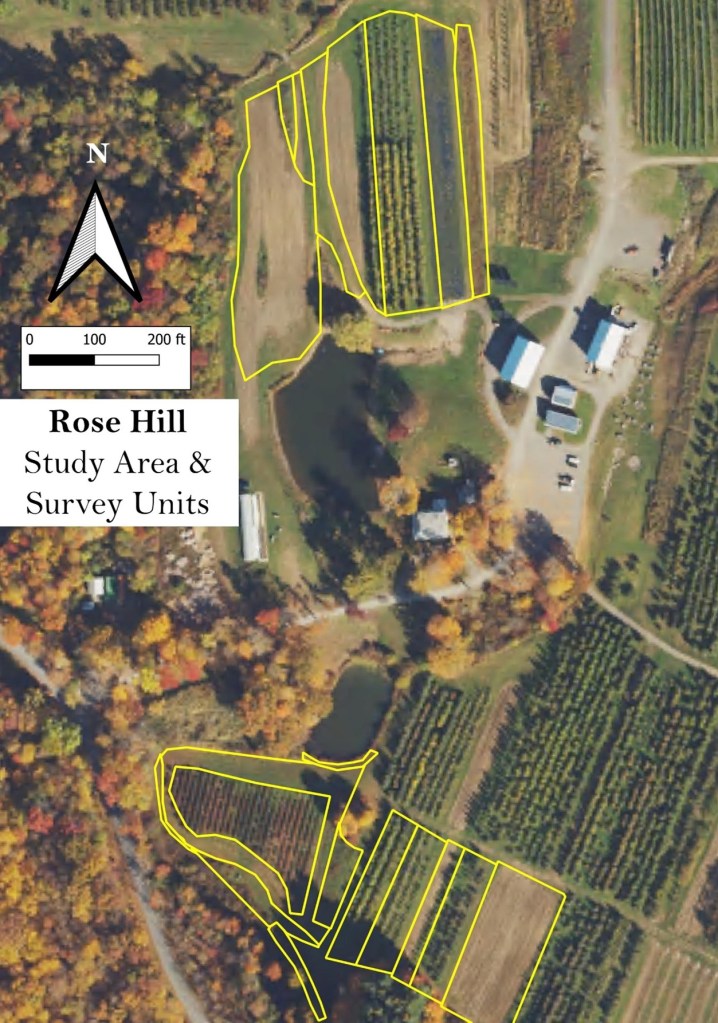
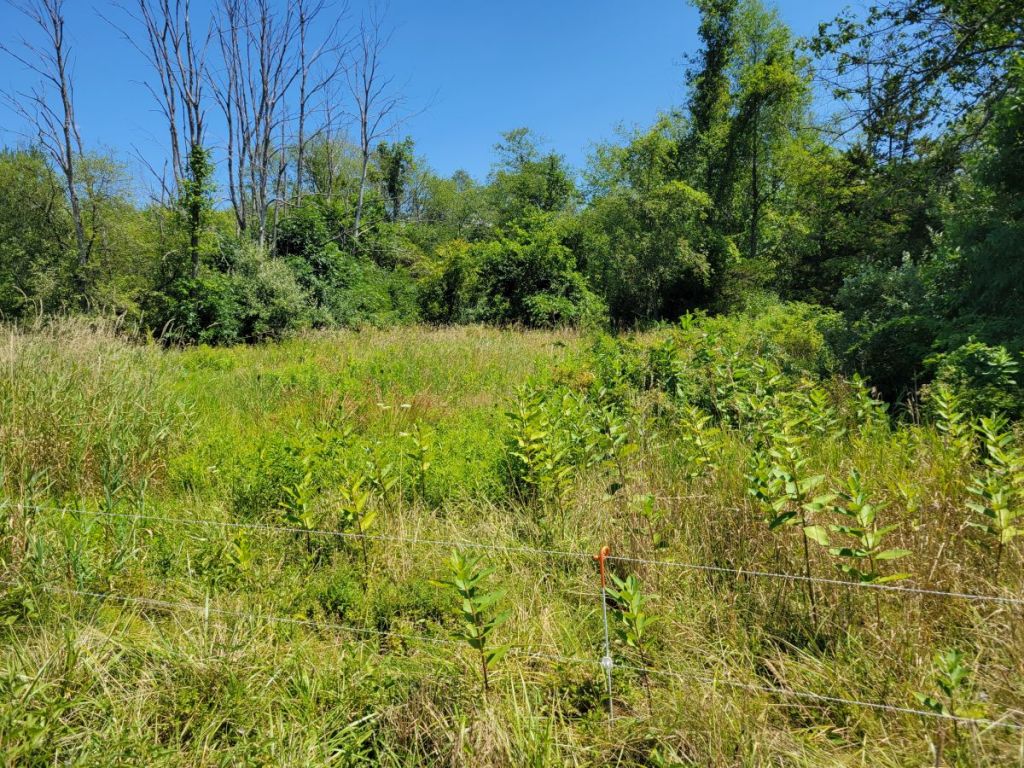
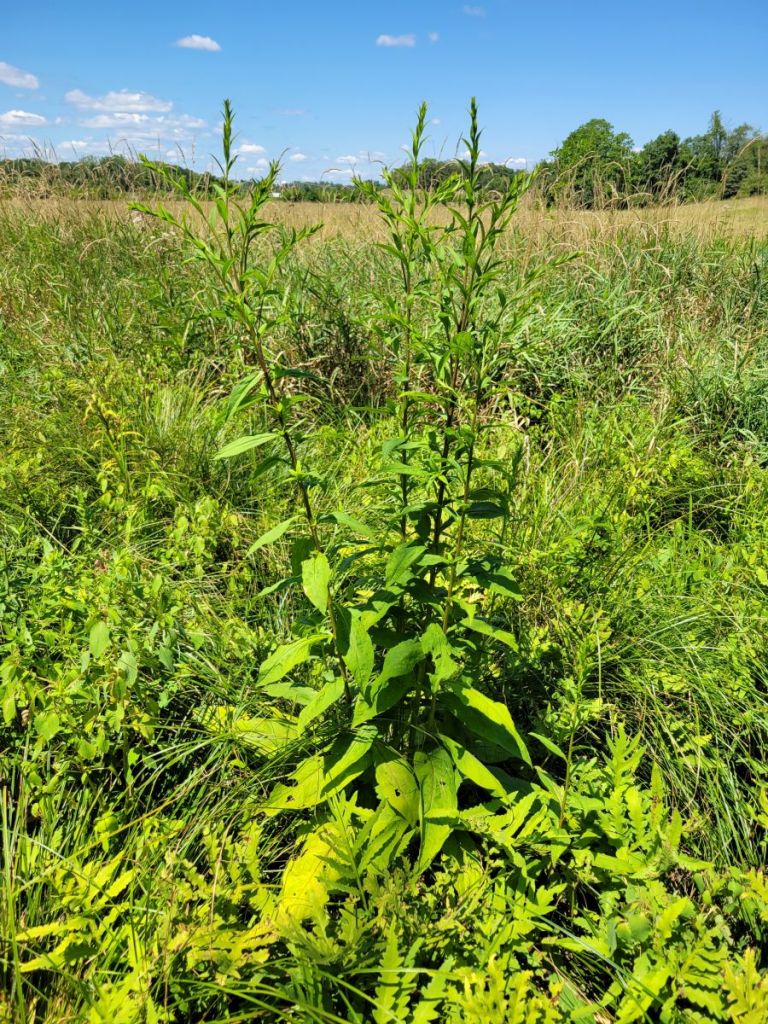
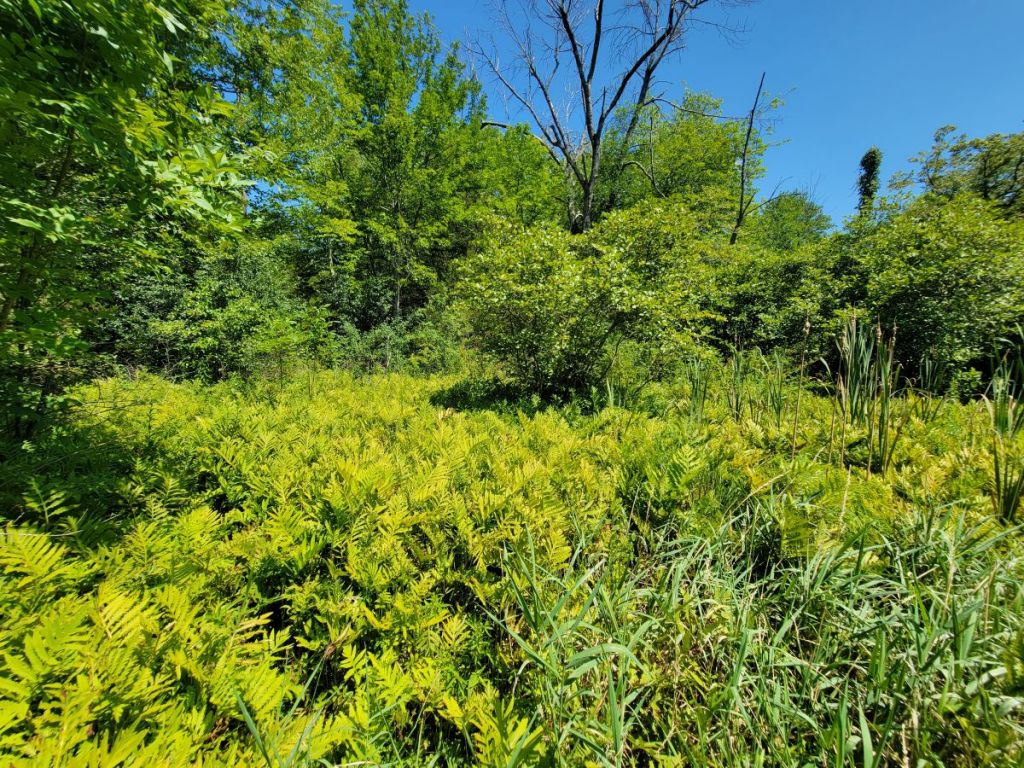
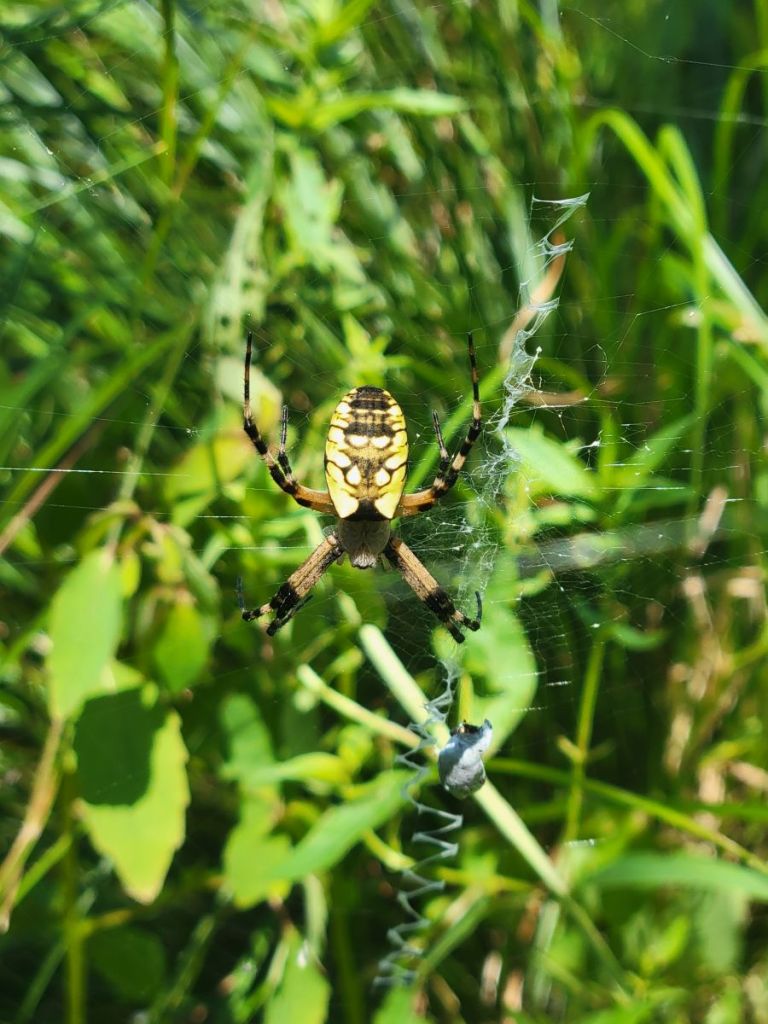
It can be useful to periodically restate what it is we’re trying to do. The following are a few words that were shared at the 17 Dec. 2025 meeting of the Research Circle. In part, they’re meant to help newcomers understand what we’re up to and to answers some questions we have received.
The Research Circle is not the project of any one person or organization. While we are fortunate to get funding from the Farm Hub and the Circle includes staff from Hawthorne Valley, it really derives from a shared desire to work together on topics of mutual interest. Some of us have been at this (on-farm ecological research, farming) for a while, and we are searching for ways to build a community of like-minded individuals to design, execute and act upon ecological research of the community’s own design.
That means that the Circle has no other existence than all of you, all of us. It exists for as long as we want it to and in the shape we choose for it. It is very much a work in progress. Some of us have tried to establish an initial framework in order to get it off the ground but this is intended as a starting point, not an end point.
Reflecting on our own strengths and weaknesses, we as the ecologist did establish one set of boundaries on our own work: There are many, many relevant research questions around farming. We cannot hope to answer them all, nor do we have the capacity to do so. While, to a certain degree, we can bring in the expertise of others, for now what we can offer as researchers is a focus on the role of on-farm habitats in supporting nature for its own sake and for its interaction with production.
In this context, the reports presented in the Fall are the research feedback from projects we all designed together the previous Spring and that were carried out during the growing season. The hope is that, over the course of the Winter, we can all consider these results and what they might mean for management and continued research. These are your results, please ask questions, be (constructively) critical – groan loudly, whoop audibly, share thoughts!
The Intentional and the Accidental: The Role of Cultivated and Uncultivated Flowers in Supporting Plant Diversity and Insect Abundance on Farms.
One project whose results we shared on 17 Dec involved studying the support that on-farm flowers provide to pollinators and other flower visitors. How big a contribution to plant biodiversity is provided by the uncultivated (aka “weedy”) flowers found in fallows, lawns, edges and wilder areas relative to flowers seeded for cut flowers, vegetable crops, or intentional pollinator habitat? What role do these same flower play in supporting flower visitors?
We plan a data-rich blog or two exploring these data in more detail. In the meantime, in this talkand these slides, Claudia and Conrad provide a preliminary description of the distribution of such flowers across the seasons and the farms, and summarize how popular the different flowers were with an array of flower visitors. (These links are also available from the Resources page.)
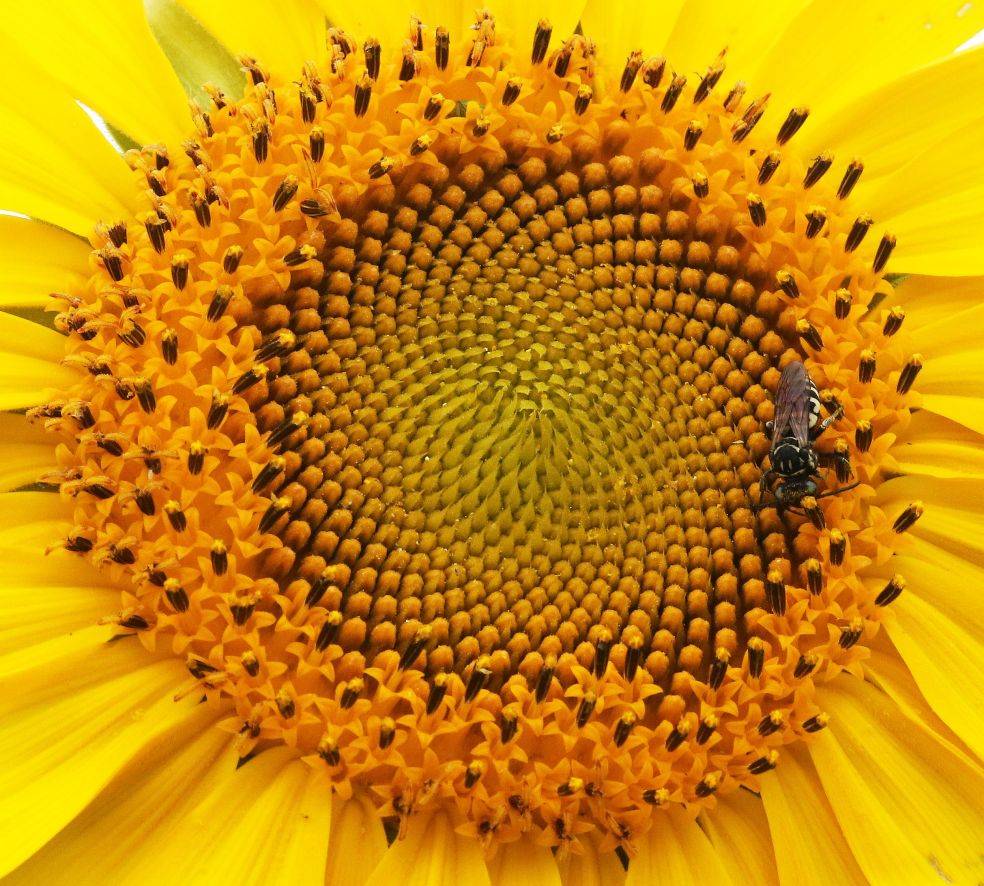
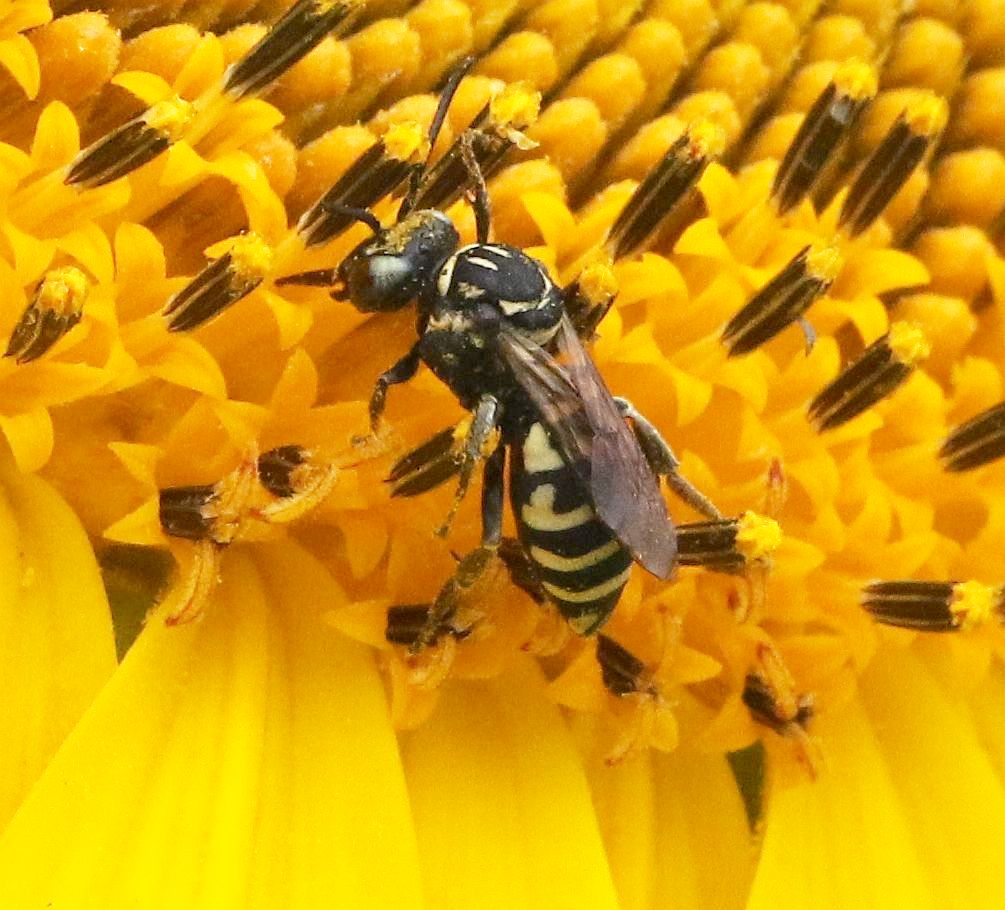
A Triepeolus bee about to get sucked into a Sunflower vortex (just kidding). These bees parasitize long-horned bees (see below).
INTRO
During the Summer, we collected data on the distribution and abundance of seeded and uncultivated flowers on and around nine different farms. We also gathered observations of bee visitation to those flowers. Future blog posts will explore this information in more mathematical detail in order to try to get a better understanding of the relative values of cultivated vs. uncultivated flowers in supporting bees. While the flower preferences of most of these bees are relatively well known, it is likely that such preferences are context dependent. In other words, like a person at a buffet, what is chosen depends on what else is available, so if our observations are useful, it is because they are derived from the actual context of regional farms and the flowers that are grown thereon, intentionally or incidentally.
A more skilled biologist than me could have conducted detailed visual surveys that gathered both behavioral data (that is, which flowers were visited?) and biodiversity data (that is, which bee species showed up?) However, I could not do both. Instead, I identified the relatively easy groups, such as Honey Bee, Bumble Bee and a couple of others, during the surveys. I took photos of the ‘unknowns’ when I could and then went back and tried to ID those bees from images. Most bees I saw were never photographed, and thus the collection of profiles that follow is in no way a complete list. In fact in Columbia County alone we have, summarizing across various years of work done by our program, found more than 150 species of bees; I registered less than 25 species during our observations this Summer. While some of this discrepancy may reflect the limited number of habitats and dates included in this project, it also reflects the shortcomings of my technique as a biodiversity study tool. Most biodiversity assessment studies use trapping of some form. Using photographs and visual tallies, I often can’t determine the species and below I’ll often talk at the broader scale of genera (genera are higher levels of biological organization than species; for example, wolves, coyotes and domestic dogs, while different species, are all members of the genus Canis).
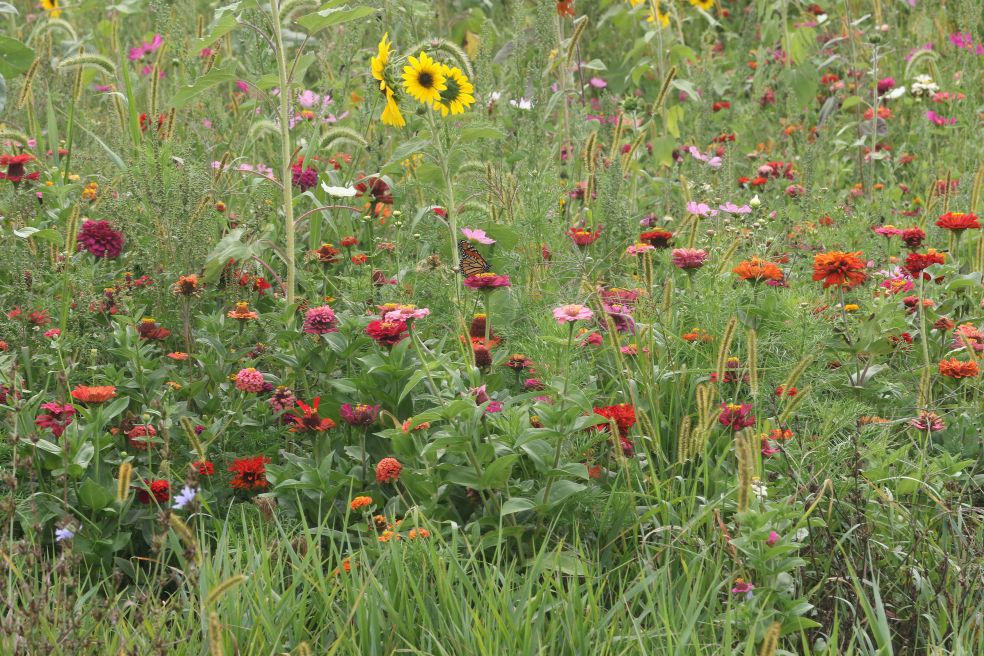
A seeded mix of Zinnia, Cosmos and Sunflowers with some true wild flowers to boot, in bloom at Rose Hill Farm.A variety of flower shapes and sizes can support a diversity of bees (and other flower visitors).
SOME BASICS
It’s important to remember that bees visit flowers for both nectar and pollen, with nectar generally being an energy source and pollen providing protein. Bees may be less picky about the flowers from which they collect nectar than those from which they gather pollen, but, when making observations, I did not try to distinguish pollen gathering and nectar slurping. While nectar and pollen can serve as food for the adults, they are often used to stock the nest (e.g., honey). To facilitate such brood provisioning, most female bees have special pollen-gathering hairs on their legs and/or the underside of their abdomens. Pollen gathering may be intentional (in order to stock the nest or to eat themselves) or unintentional (picked up incidentally when nectar sipping). The flower’s game is to lure bees with sweet nectar and/or appealing pollen and then encourage their pollen to hitch a ride to another, receptive female flower. Obviously, for flowers whose pollen is being gathered for juvenile or adult consumption, the flower’s ‘hope’ is that the bee will be somewhat messy, shedding at least a few pollen grains during its travels. Males do not gather pollen for the nest, and do not have the special, pollen gathering hairs of females. Nonetheless, fuzzy male bees do attract and share some pollen from the flowers they visit. Another set of bees – the pollen robbers (aka nest parasites) – don’t collect pollen for their own young. Instead, the females of these species count on usurping the nest of another bee species who has already done the work of pollen gathering.
One can think about flower visitors in various ways: as units of biodiversity to be tallied up to meet conservation goals, as winged workers pollinating diverse crops, as aesthetic elements adorning flowers, as nuisances ready to deliver a sharp sting to the unwary… During our project, we certainly tried to tackle the first two perspectives, albeit only partially: which flowers seem to support our native bees and thus benefit both insect conservation and crop (and other plant) pollination? Our tentative answers to this question will be forthcoming in our data analysis blog posting, but in this post I simply want to think of bees as other elements of life. How do they ‘solve’ that wondrous mystery of making a living and perpetuating their kind, largely regardless of what value we attach to them as currency of conservation or pollination? I’ll throw in a little bit of management and conservation speculation, but these profiles are primarily natural history snippets derived in good part from many of the publications and web sites listed at the end of the blog and contextualized by our own observations.
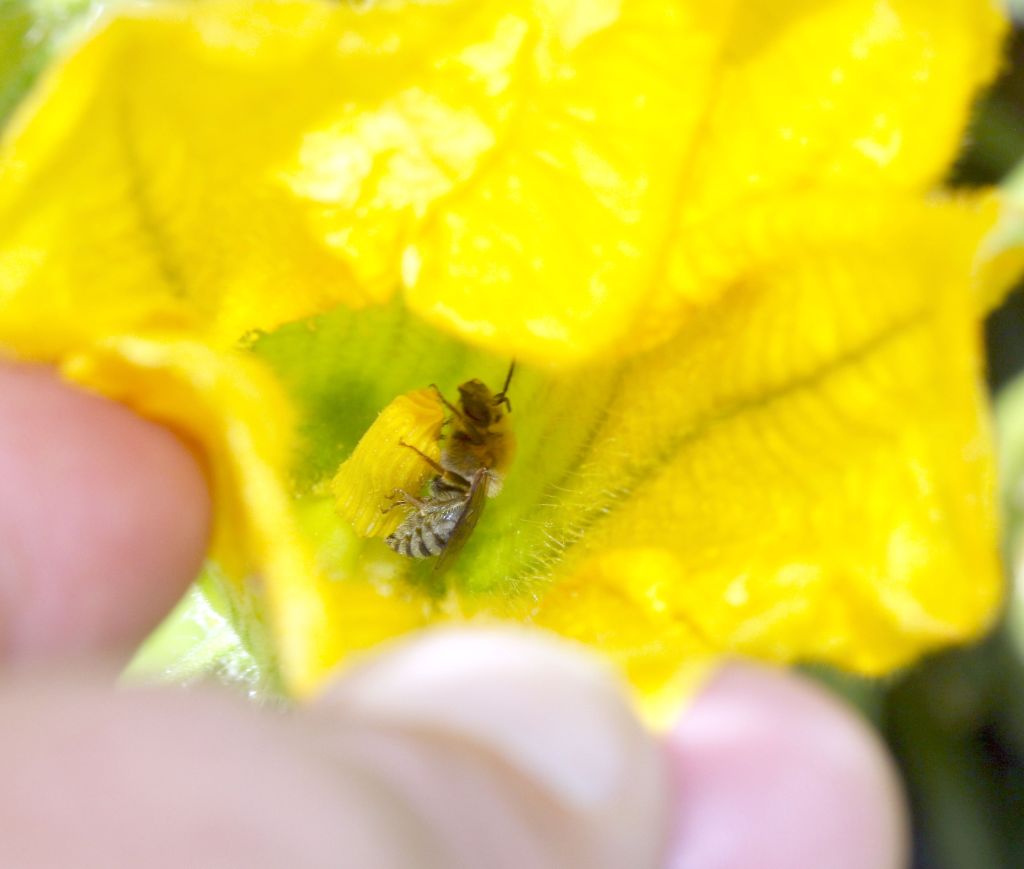
Squash Bee (top) and Not a Squash Bee (bottom, both at Blue Star Farm).
A FEW GENERALITIES FOR DESCRIBING BEES….
Bees have been categorized in different ways. One dimension is sociality. Most people’s first avatar of a bee is that of the Honey Bee. Relative to most of our other bees, the Honey Bee is, however, unusual. Specifically, its social system appears to be more complex and long-lasting than that of any of our other bees. The colony has distinct castes, can overwinter (and so must store up ample honey for the lean midwinter), and has complex communication amongst colony members, thereby focusing foraging and increasing its efficiency. Colonial life facilitates an effective nest defense and the protection of a large brood and food stores demands it, hence the origins of angry, stinging swarms to fend off possible nest destruction. Bumble bees and several other species also show some level of social organization, and as the profiles that follow may suggest, sociality happens in a variety of ways and to a range of degrees. Many bees do occupy the opposite social pole and nest solitarily – e.g., as single, isolate holes or cavities that only the mother bee provides for. Yet others fall somewhere in between in their sociality.
Another ‘dimension’ used to describe bee ecology is nest location. Some bees place their nests in holes in the ground, others use hollow plant stems, still others nest in rotting wood, and various others use natural or man-made cavities, or, even, clumps of grass. While not all species are 100% consistent in their choice of nesting substrate, generalizations are possible. As already mentioned, some bees don’t even make their own nests, instead parasitize the nests of other species.
Yet another descriptor commonly applied to bees is tongue length. This may seem a bit arcane and, aside from ant eaters and frogs, this trait might be relatively rarely considered elsewhere in the animal world. Its significance for bees is that it helps determine which bees can access the nectar of which flowers. A flower that buries its nectar deep down its ‘throat’ may only be usable by bees with long tongues. To an appreciable degree, certain flowers are evolutionarily designed for certain bees and deploy their nectar in ways that will encourage the passing bee to brush against pollen-bearing anthers and pollen-receiving stigmas. The depth of the flower is one aspect of flower architecture used to encourage this bee/pollen encounter. Although tongue length can vary dramatically amongst bees of the same size, it is also true that smaller bees tend to have shorter tongues. Admittedly, this is an overgeneralization – a small enough bee may be able to crawl down the flower tube to access deep nectar, while other bees short-circuit the system by slitting into the flower tube and so gaining more direct access to the nectar. While I report both tongue lengths and flower depths based on the literature, it should be noted that bee foraging is more complicated than an oil dip stick and measurements of the relevant lengths can be somewhat inconsistent, so don’t expect tongue length and flower depth to fully explain bee foraging, but it is a clue.
A Long-Horn (Melissodes) Bee displays its ample tongue while on a flower at Whistledown Farm.
SOME BEE PROFILES
I was going to gather all my profiles for one ‘glorious’ posting. However, creating these profiles has proved more time consuming than expected, my schedule has gotten more crowded than anticipated, and it dawned on me that sometimes a couple of shorter reads is more digestible than one long haul, so… I’m starting out with profiles of five relatively common bee groups: Halictus (a genus of sweat bee), Agapostemon virescens (a beautiful, easy-to-ID-on-the-wing species of sweat bee), Ceratina (a genus of little carpenter bees), Hylaeus (a genus of tiny, wasp-like bees) and Mellisodes/Eucera (a couple of closely related so-called ‘long-horn’ bees). Missing from this installment are Honey Bees, bumble bees, Lasioglossum sweat bees (i.e., those tiny critters who barely look like bees) plus a few rarer groups – meat for a second installment.
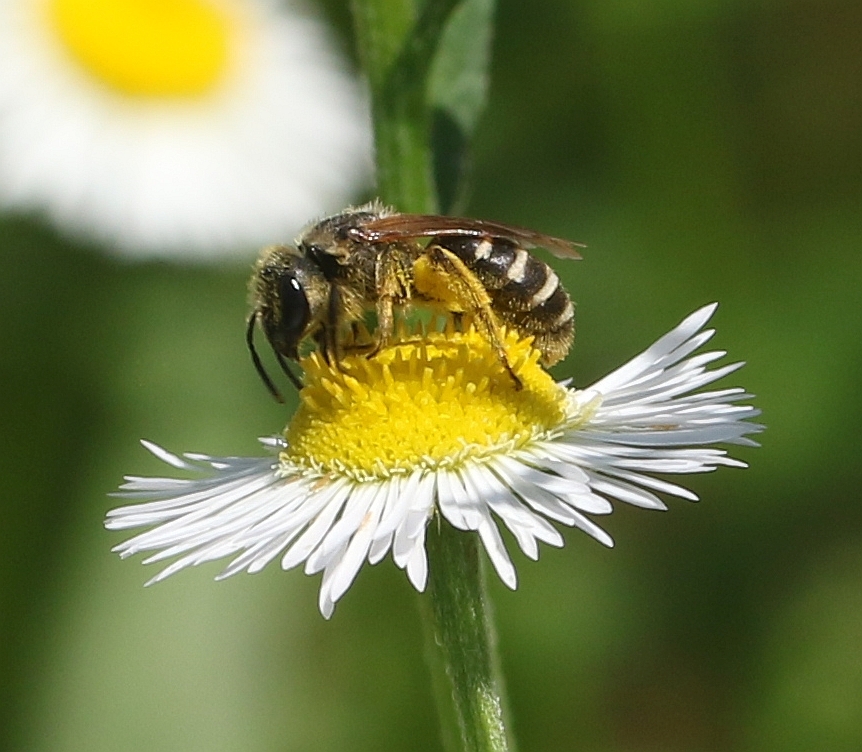
A Halictus bee pauses on a Daisy Fleabane at the Hudson Valley Seed Company.
Halictus– An Underappreciated Work Horse.
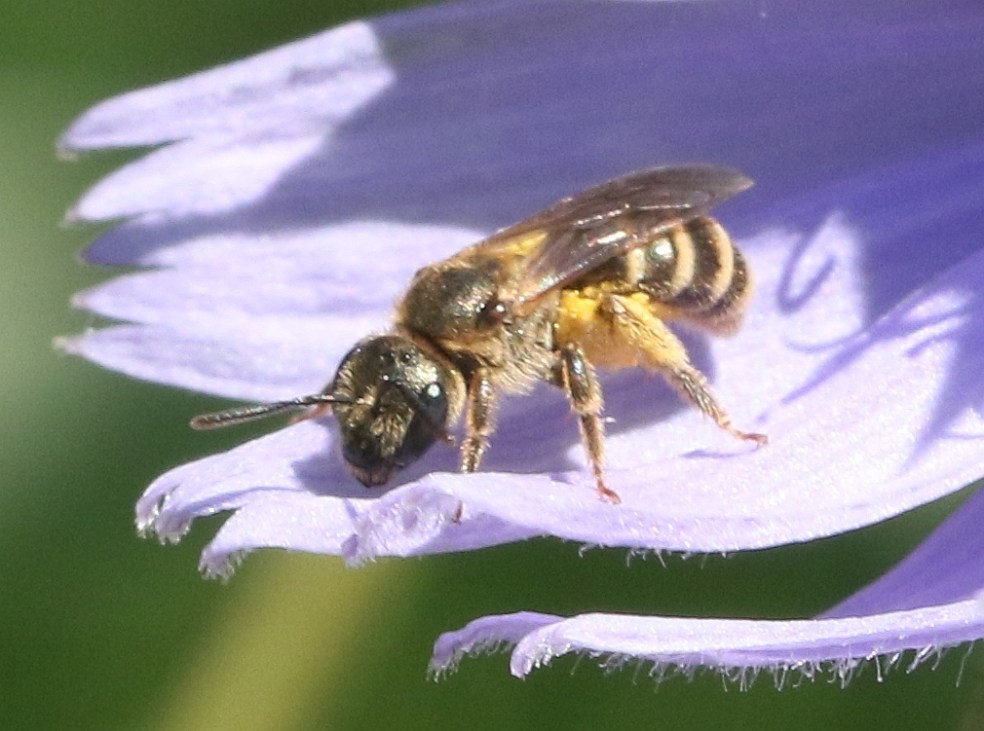
The most common species in this genus is Halictus ligatus and most, if not all, of our Halictus records may be of this species. This species is a darkish bee about the size of a large house fly with a hairy thorax and an abdomen banded by light hairs. It has oddly thick jowls. Somebody once said that these are markedly non-descript bees and that that, in and of itself, is a useful ID characteristic!
Halictus are common, geographically widespread bees who fly Spring through Autumn, and are reported to feed on a wide variety of flowers (as would be predicted by their long flight season). It seems to have long been common – when first described by pioneering entomologist Thomas Say in the 1830s, Halictus ligatus was stated to be “A very abundant species.” As befits their reported commonness and broad tastes, Halictus were found on eight of the nine farms we studied this year. In 2010, when we collected bees on 19 different farms around Columbia County, this genus was found at 13 sites, and it accounts for slightly over 5% of the bees in our regional bee collection.
It is a colonial or solitary ground nester. Colonies of up to ca. 200 individuals usually have a single queen bee, Halictus “worker” bees are able to reproduce and can replace the queen if she dies or can even fly off and establish their own colony if the mood strikes them. In other words, their sociality is facultative, meaning that if conditions suggest, a given species can either develop a colony or nest solitarily. Unpredictable weather and short growing seasons tend to favor solitary habits. As in bumble bees, the colony as a whole does not overwinter but the next year’s colony is founded by an overwintering female. Nests are described as drilled holes in relatively compact ground (such as along trails and road edges) and maybe re-used for various years. Some have said that Halictus also nest in rotting wood.
A Halictus bee on Chicory at Hawthorne Valley Farm.
This is considered to be a short-tongued species with a tongue length (ca. 3 mm) about half that of the Honey Bee. Our Halictus observations were spread more or less evenly across 16 different flower species. Amongst the seeded flowers, we found it on Bachelor Buttons, Black-eyed Susan, Cosmos, Feverfew, Oxeye Daisy, Strawflower, Sunflower, and Yarrow. Wild-growing flowers included Corn Chamomille, Daisy Fleabane, Field Bindweed, Grass-leaved Goldenrod, other goldenrods, Horseweed, knapweeds, and Sweet White Clover. Relative to average corolla length across all other flowers (ca.7.7 mm), the flowers visited by Halictus were short (ca. 4.0 mm). This genus of bee is reported to be an important pollinator of peppers, tomatoes, strawberry, turnip, apple, and watermelon, plus various cut flowers like marigolds and zinnias.
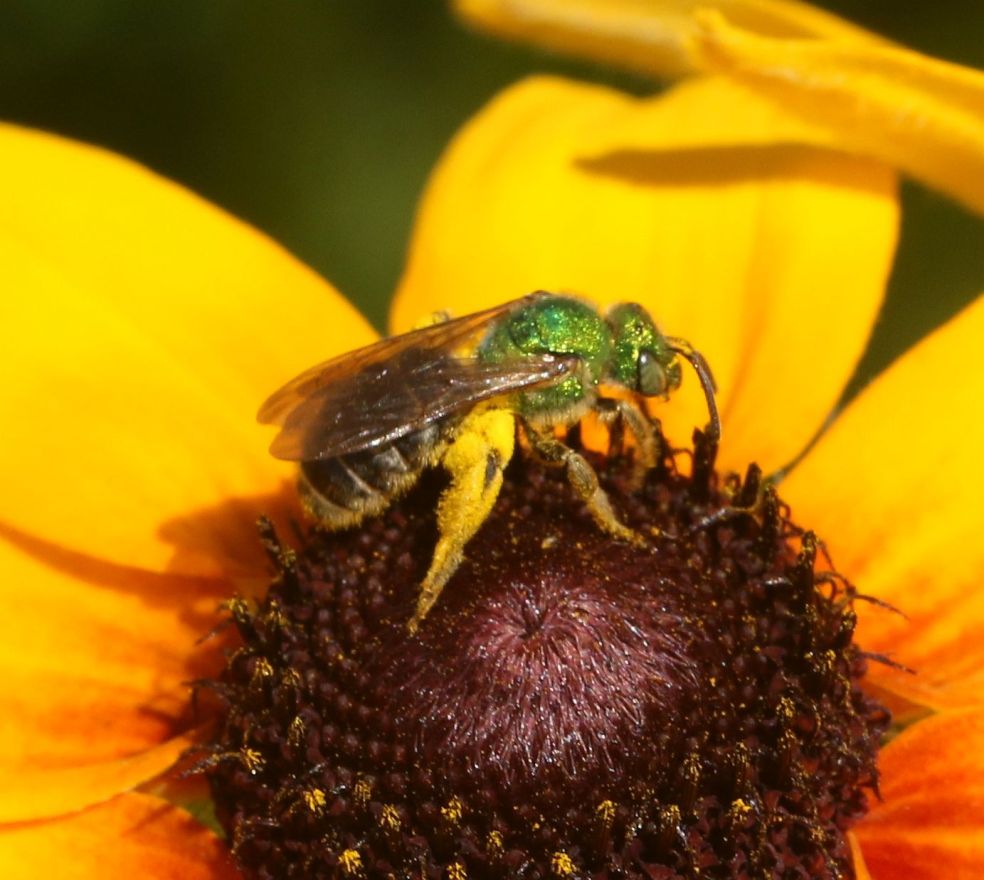
Agapostemon virescens on Black-eyed Susan at Hawthorne Valley Farm.
Agapostemon virescens – The Satisfying Sweat Bee.
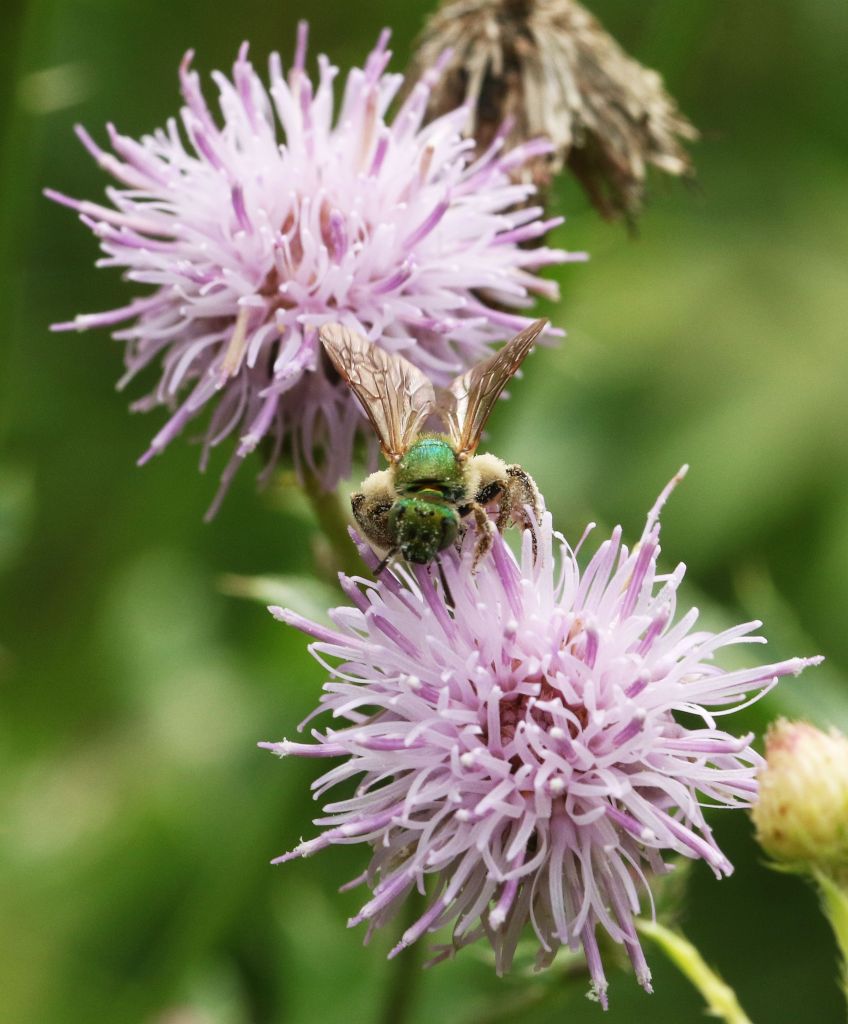
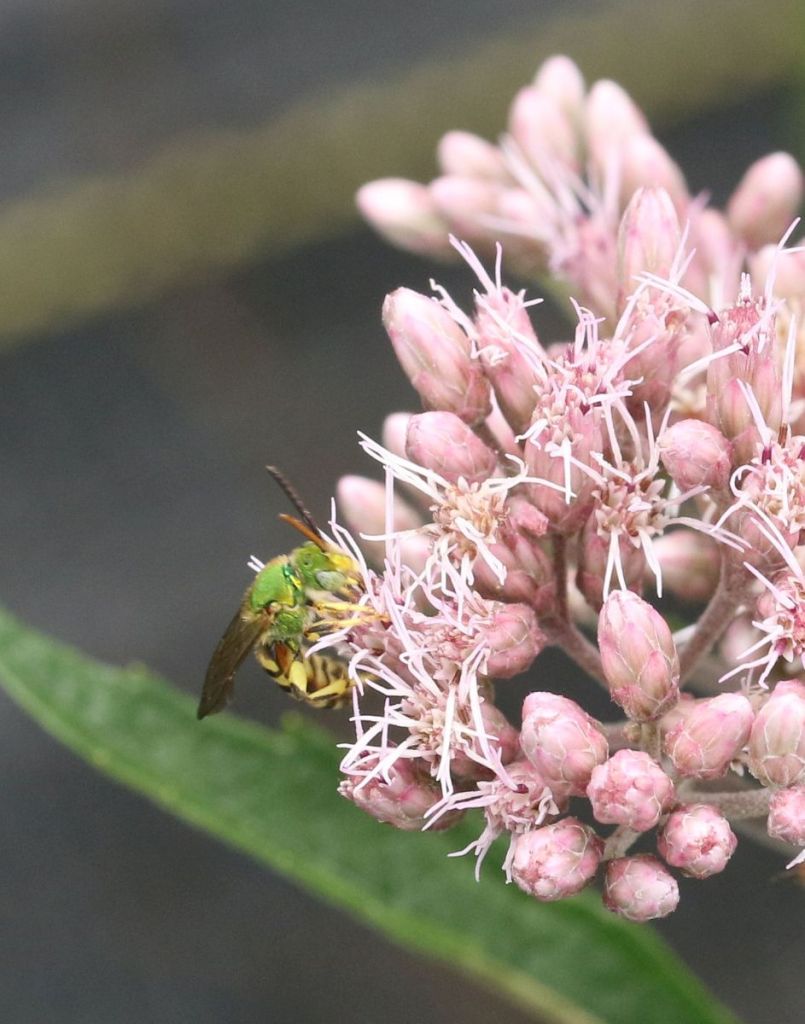
Agapostemon virescens is part of a family of bees called “Sweat Bees”, because of the propensity of some members of this family to seek the salts on sweaty skin; Agapostemon itself, however, is said not to share this taste. I call this species ‘satisfying’ because it is both conspicuous (the iridescent emerald green is hard to miss) and, with their striped abdomens, the females of this medium-sized bee are easy to identify.
This is another relatively widespread, long-flying, common species. We noted it at 6 of the 9 farms this year and at 9 of our 19 farms in 2010. This genus is the third most common in our collection, accounting for a bit more than 15% of all specimens.
Agapostemon virescens nests in the ground, apparently often where the surface is relatively open. These bees reportedly can (but don’t have to) nest in groups, but when they do so, each female makes and supplies her own brood. Think apartment building with only one or a few entrances but many individual families inside rather than the more complex sociality of Halictus, Honey Bees or Bumble Bees. For this reason, Agapostemon are sometimes described as gregarious, rather than communal. Nonetheless, when found together, it is said that bees will take turns watching for predators and parasitoids, and will collaborate in aspects of nest repair. There are reportedly two generations during the season, with the first being all-female. It is bred females of the second generation who apparently overwinter.
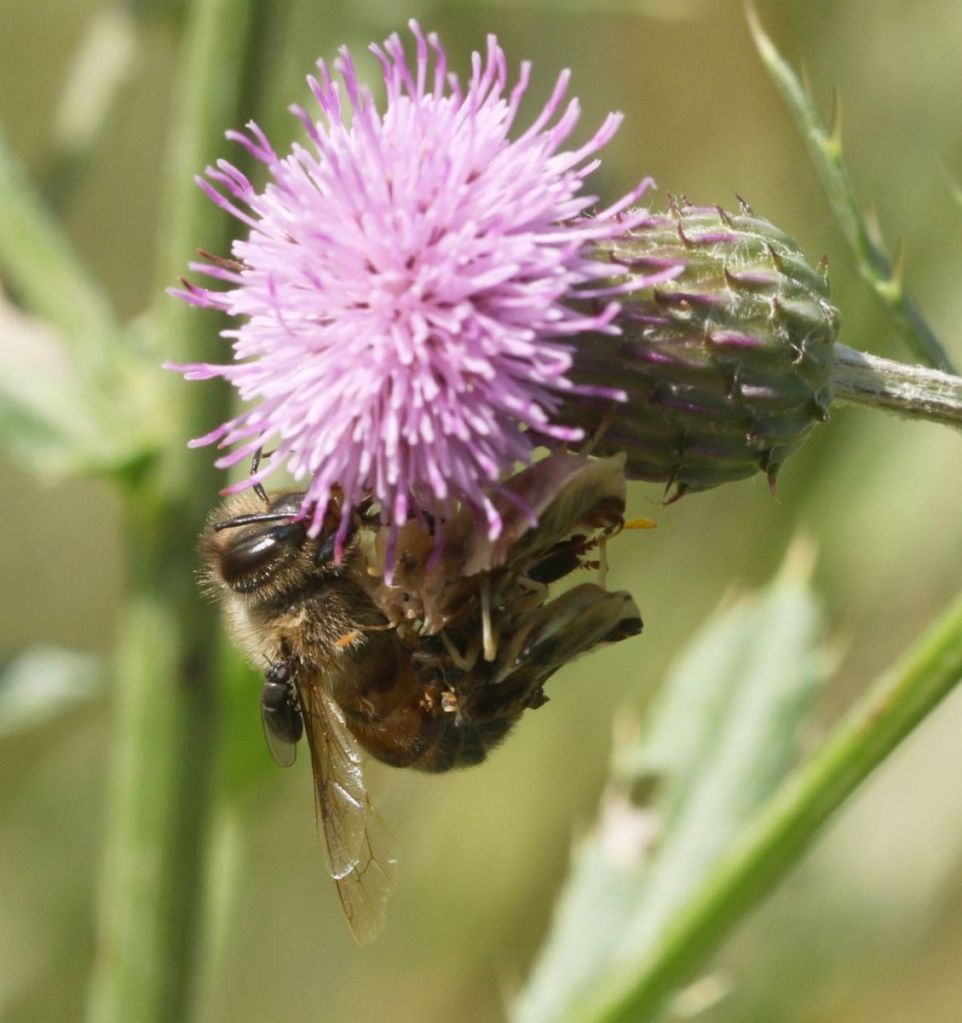
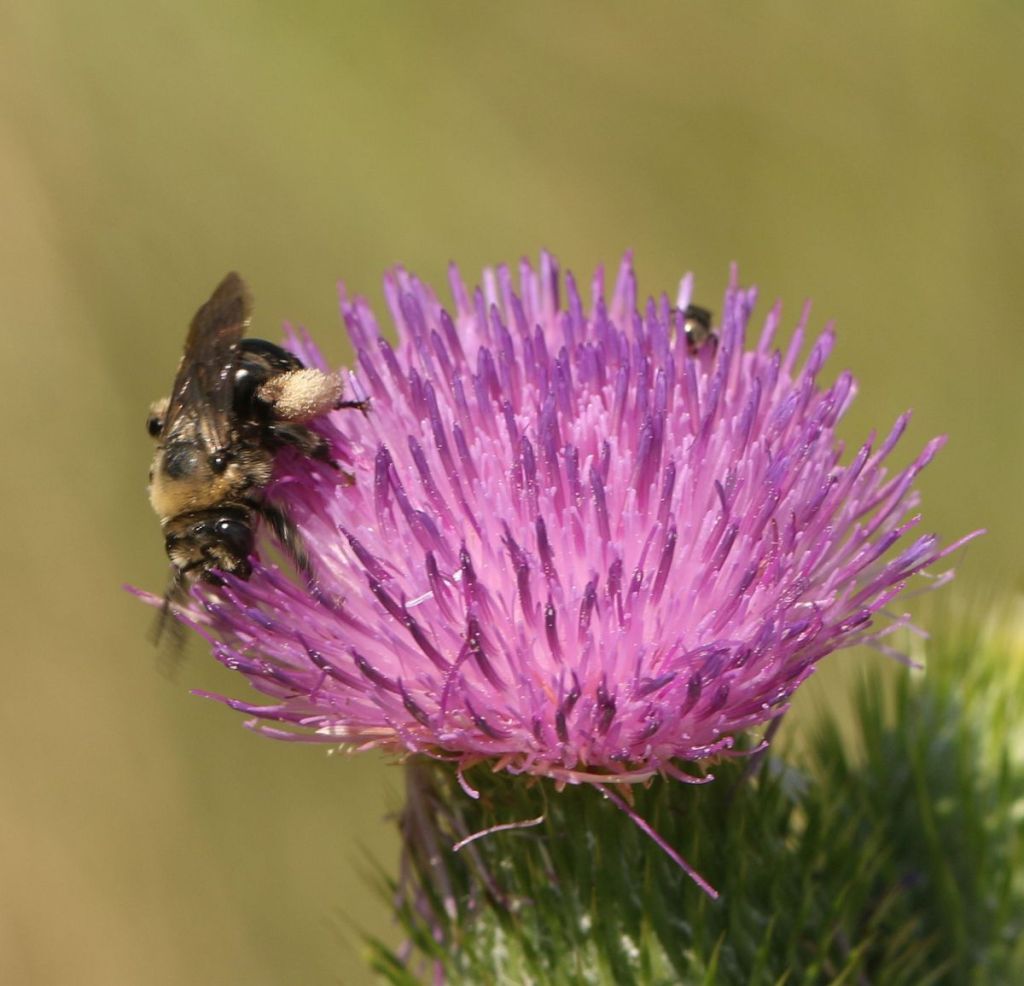
An Agapostemon visits Canada Thistle at Whistledown Farm. Its ‘saddlebags’ are full of what is probably thistle pollen. If you get a chance, study the color of pollen carried by bees on different flowers – the variation amongst types of flowers can be surprising. For example, who knew Asparagus has day-glow orange pollen?
Agapostemon virescens bees are reported to forage at a wide variety of flowers, and we observed them on nine different species. Amongst seeded flowers, we saw them at Bachelor Buttons, Black-eyed Susan, Echinacea, and Sunflower; among wild flowers, they were seen on Elderberry, English Plantain, Knapweed, thistle, and White Clover. These are a mix of shallower and deeper flowers (average depth of visited flowers = 5.7 mm vs 7.4 mm for remaining flowers). Nonetheless, with a tongue length of about 3.7 mm, this is considered a short-tongued bee. Interestingly, the Sharp-Eastman photographic study of bees at Stone Barn Farm in Putnam County, noted that this was one of the few bees seen pollinating White Water Lily; during our farm work, we did not have a chance to test this observation! In terms of crop pollination, they are said to be especially common on carrots and cut flowers being grown for seed, but, as noted, they pollinate a wide variety of plants.
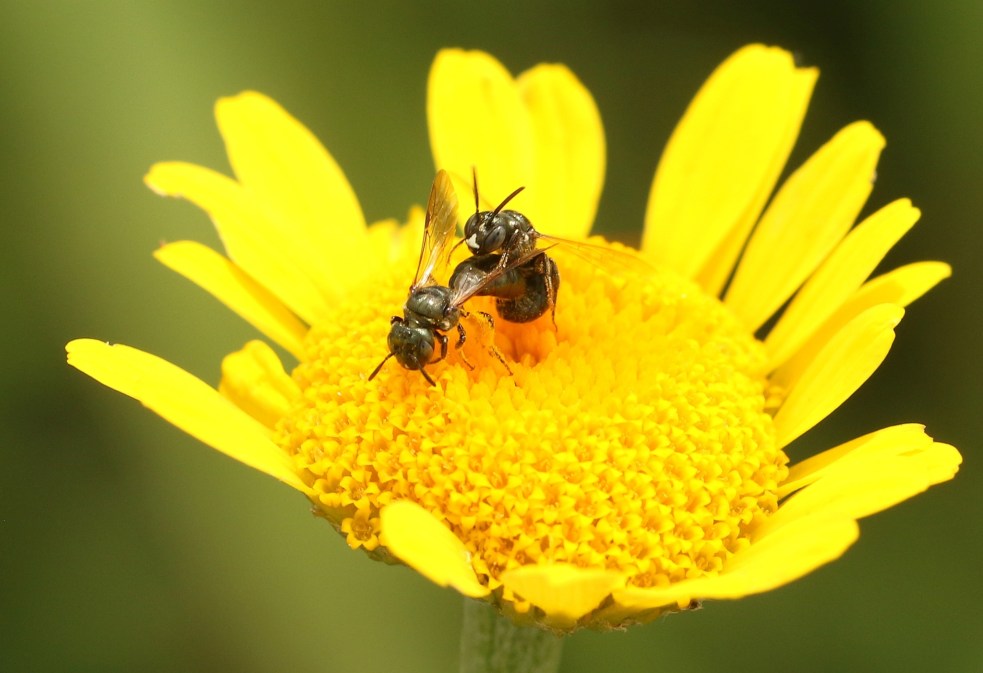
Ceratina feeding and mating on Feverfew at Stars of the Meadow Farm.
Ceratina – The Little, Motherly Carpenter Bee.
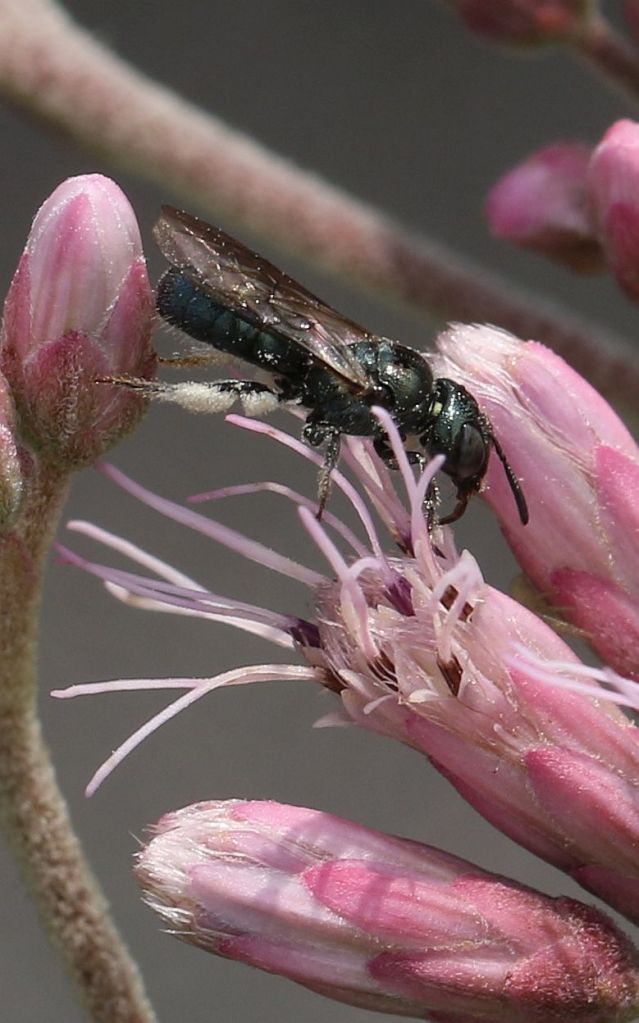
Ceratina are small bees with a blueish-green iridescence; they’re smaller than a small housefly but bigger than a gnat; perhaps think of them as a chubby long-grain rice kernels. While it’s hard to believe, their closest relative amongst our bees is apparently one of our largest bees – the Eastern Carpenter Bee, those massive, bumble bee-like creatures who drill into your outdoor woodwork. While Ceratina is somewhat inconspicuous, the teardrop shape of its tail end and the blue-green color mean that, with a little practice and good eyes, you can often ID it on the wing. The female (as well as the male) has a light patch on the ‘upper lip’. Ceratina also have relatively few pollen-collecting hairs on their legs or belly; some have suggested that they consume pollen on the flower and then regurgitate it in the nest, as Hylaeus (see below) is known to do.
We found this bee on seven of the nine farms we studied this year, and, in 2010, eight of the 19 farms visited. This genus accounts for 3% of the bees in our collection.
Ceratina bees apparently use their carpentorial skills to bore down the pith of stems such as those of raspberries, blackberries, roses and Queen Anne’s Lace (although stems have to be broken, so that there’s direct access to the pith). Despite often being considered solitary, they actually are reported to show some aspects of sociality – mothers tend young and sisters/daughters will help siblings and their mother. Rather than simply leave their eggs with provisions and ‘wish them luck’, mother Ceratina apparently not only guard the nest as the young develop but also help guard what then becomes the over-wintering hole (aka hibernaculum) of the emerged adult. Such a life history strategy, which depends on (or at least seems partially predicated on) an individual living for more than one year, is an unusual occurrence amongst bees.
Ceratina feeding on Daisy Fleabane at Little Seed Farm.
These are relatively common, widespread bees, who, like the preceding species, visit a variety of different flowers, indeed, we found this species to be widely distributed across 24 different kinds of flowers. Seeded plants included: Bachelor Buttons, Bird/Hairy Vetch, Black-eyed Susan, Butterfly Milkweed, Feverfew, marigold, Narrow-leaf Mountain Mint, Ox-eye Sunflower, Purple Coneflower, Snapdragon, Spotted Monarda, Garden Strawflower, White Coneflower, and White Gooseneck. Wild flowers visited by this species included Blackberry, Canada Thistle, Common St. Johnswort, Daisy Fleabane, Dandelion, Elderberry, English Plantain, knapweed, Sulphur Cinquefoil, and Viper’s Bugloss. They also visit roses and elderberry, both of which can be planted or wild. They are reported to be common pollinators of fruits, including apples, cranberries, blueberries, strawberries, and melons.
With a tongue length of about 3.7mm, Ceratina are considered ‘long-tongued’ bees (although on the short end of long!). The flowers they visited had the deepest average corollas of any of the bees so far considered: 7.5 mm vs. 7.2 mm for the depth of the remaining flowers. It seems ironic that the smallest bees so far considered should visit the deepest flowers, but, as mentioned, something else is also at play here – these bees are so small, that they sometimes crawl down into the ‘throats’ of large, deep-tubed flowers, i.e., they walk their tongues to the nectar.
Because they nest in old pithy stems, leaving standing stalks of goldenrod, raspberries, blackberries, elderberries, sumachs, and Queen Anne’s Lace can provide habitat. Cutting or breaking some of these at least a foot or so from the ground at the end of the first growing season will then ‘open the door’ and, assuming they are left undisturbed during the following growing season, these stalks could become valuable Ceratina nesting resources.
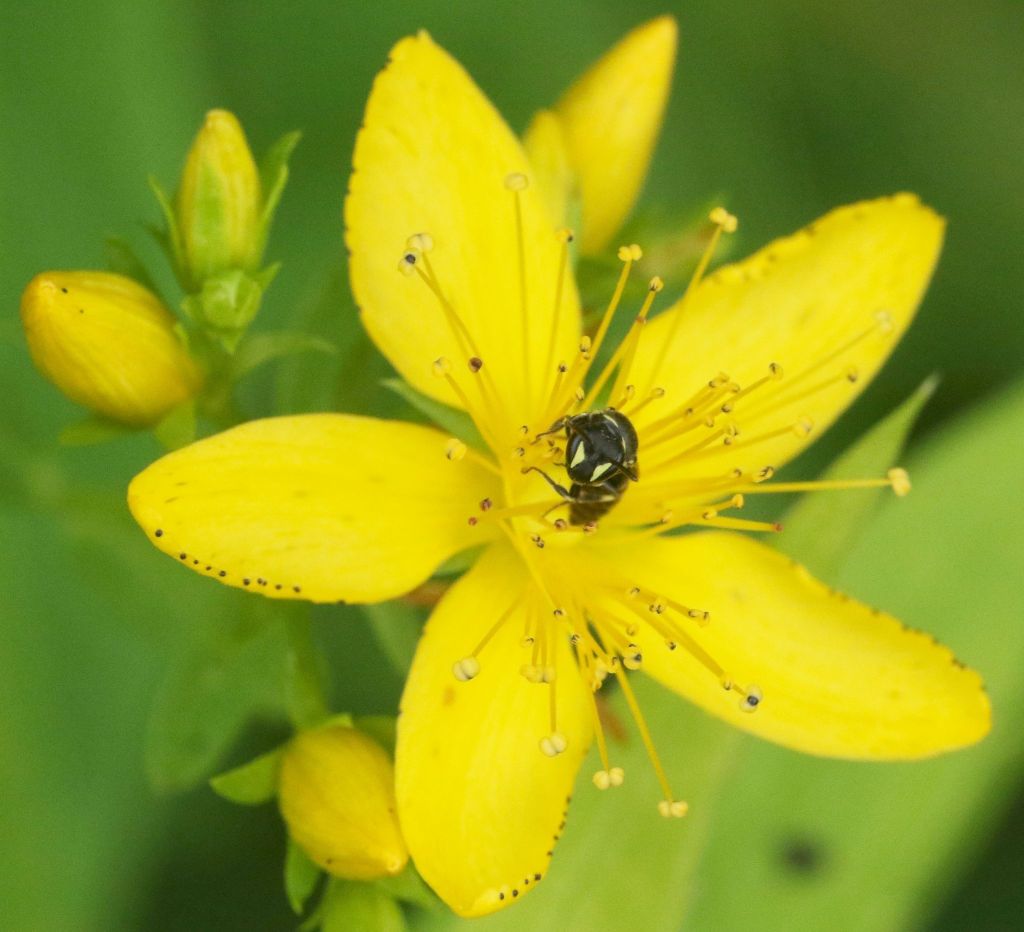
A Hylaeus bee on Common St. John’s-wort at Whistledown Farm.
Hylaeus – The Bee in Wasp’s Clothing.
Hylaeus are small, dark wasp-like bees. Their similarity to wasps is accentuated by their yellow-on-black markings, their elongated bodies, and their general lack of body fuzz. The yellow dashes along the inner side of the eyes on the female’s face look particularly waspish. These are part of a family of bees (Colletidae) who are popularly sometimes called “Cellophane bees”. This is not because they themselves are flimsy, but rather because they coat the inside of their nest capsules with a material somewhat like plastic wrap, which, as with sandwich wrap, seems to hold things together and deter fungus. This is all the more important given that the pollen-nectar mix that Hylaeus regurgitates to feed its young is a pretty soupy concoction (some authors talk about the larvae ‘swimming’ through it).
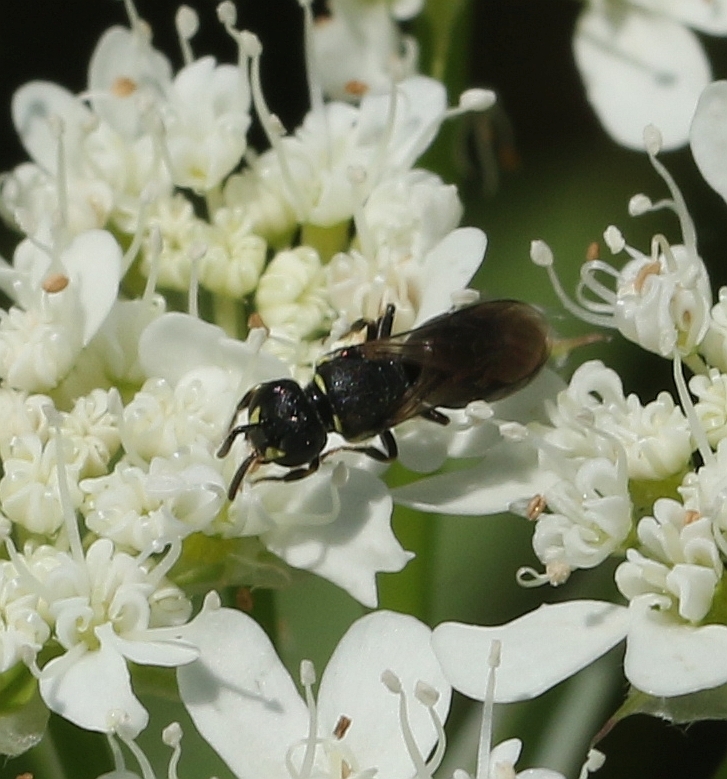
Hylaeus on White Lace Flower at Treadlight Farm.
We found this species on eight of nine farms we studied this year. In 2010, the genus was found during sampling on five of 19 farms. In our collections, it accounted for less than 2% of all specimens. Some bees are more readily counted visually than captured using netting or bee bowls, and these numbers may reflect that.
These are solitary nesters with no indication of sociality. Some say that they nest in the pith of plant stems (like Ceratina), although other sources just say that they nest in pre-existing holes (given their delicate jaws). Their nests are parasitized by Gasteruption wasps, which we recorded on the farm where we saw the most Hylaeus.
A Gasteruption wasp. This genus is said to parasitize the nests of Hylaeus bees. We consider it a good sign when we see native parasitic bees or wasps, because it indicates that the host population is robust enough to support them.
Hylaeus is considered a generalist in terms of the flowers it visits. During our work it was, far and away, seen most commonly on wild Queen Anne’s Lace, however we also observed it on seeded Anise Hyssop, Dill, Orpine, and White Lace Flower. Amongst wild flowers, it was seen on Common St. Johnswort, Galinsoga, Grass-leaved Goldenrod, Hedge Bedstraw, Horseweed, knapweed, Lady’s Thumb, Sulphur Cinquefoil, Tall Goldenrod (and close relatives), and a yellow Brassica. It was also seen on roses, which might be wild or planted. Hylaeus is a small bee with a short tongue (<1mm), so it’s not surprising that the average tube length of these flowers was short (4 mm) relative to that of the remaining flowers (7.7 mm). It is one of the bees for whom the wild, weedier, less showy flowers may provide an important resource.
Hylaeus may not be important crop pollinators, given that their habit of carrying pollen internally limits the likelihood that they’ll share pollen amongst flowers.
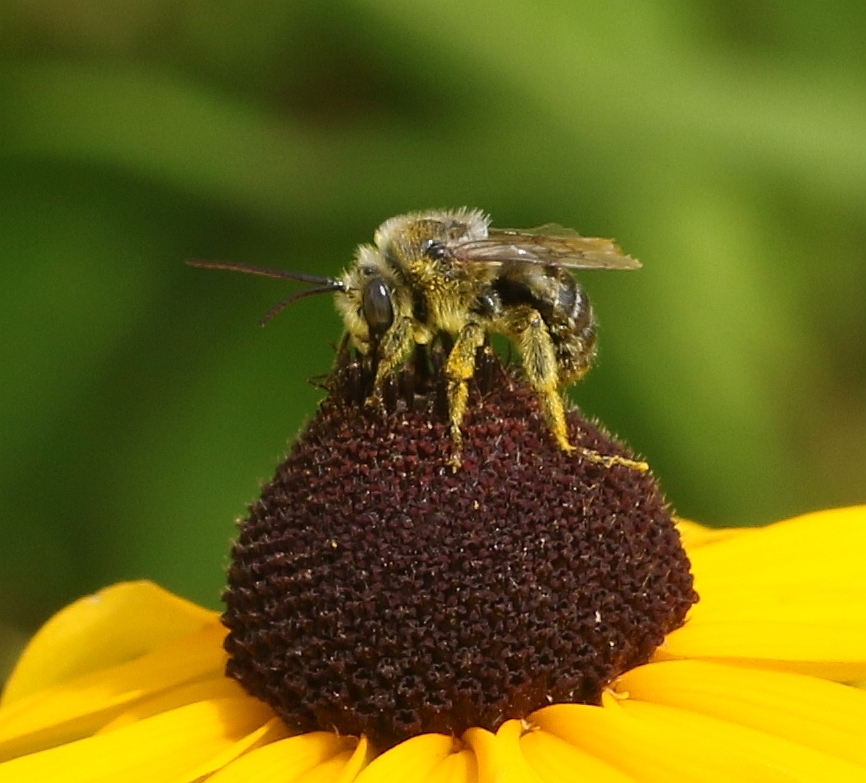
A Melissodes bee on Black-eyed Susan at Whistledown Farm. See also the earlier image of the bee displaying its tongue and of the Squash Bee (the closely related Eucera).
Melissodes and Eucera – Chunky, Funky, Long-horned Loners.
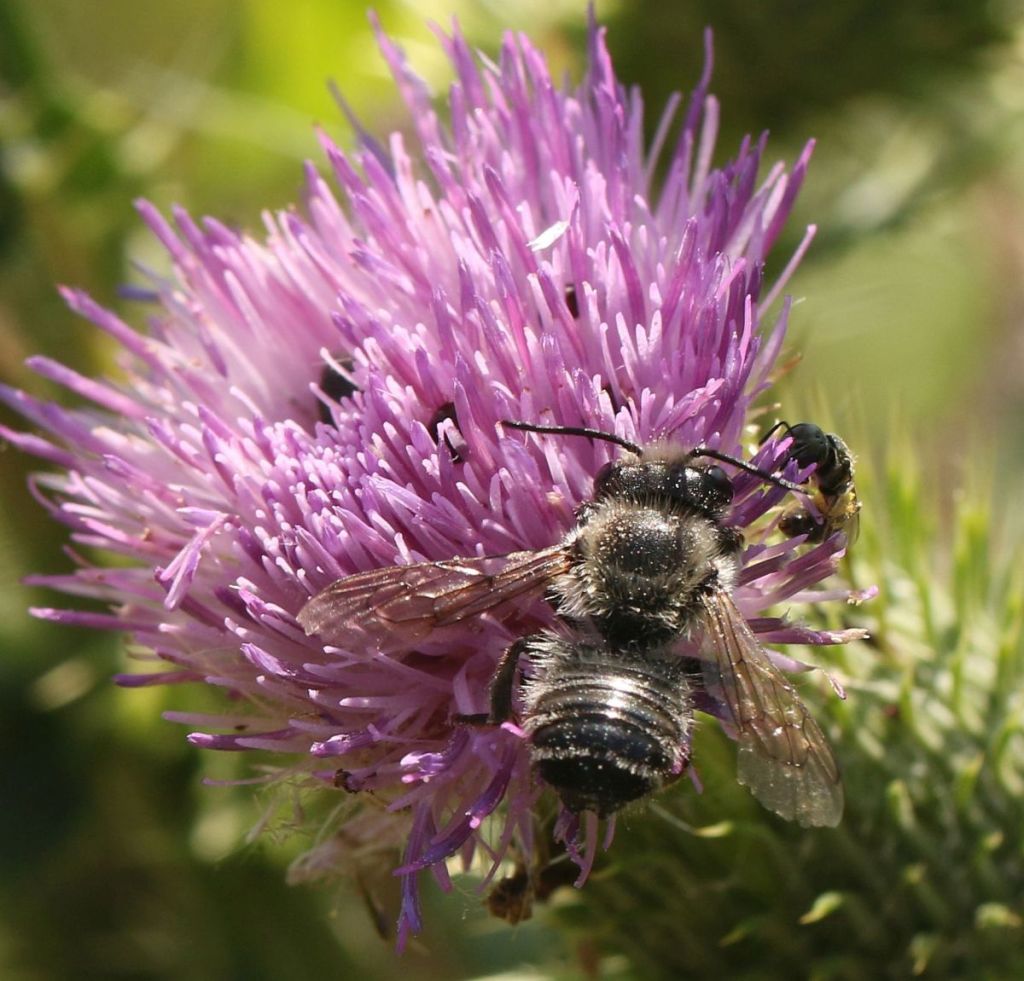
These two bee genera are closely related and considered together. This group includes several species, including the Squash Bee, our primary pollinator of squash plants. These are medium-sized (perhaps a bit smaller than a Honey Bee), generally fuzzy bees. The males in particular have long antennae (the “horns” of the common name). One description of bees stated that the males looked “a little like furry Chinese dragons” (which only really makes sense if you recall the long whiskers on the face of many such beasts). Many species have an orangish-yellowish hue, although one of our relatively common species is black with a pair of white butt spots.
The genus was found on five of the nine farms we visited this year. In 2010, our sampling on 19 different farms encountered it on five different farms. These genera account for nearly 6% of the bees in our regional collection.
A Two-spotted Melissodes (M. bimaculata) gathering pollen from Corn at Ironwood Farm.
Some Melissodes species can be especially common on Sunflowers late in the Summer. Indeed, some Sunflower beds we visited were almost swarming with these bees, sometimes with three or more to a flower. The Squash Bee is, of course, most common on… squashes.
Melissodes are considered solitary ground nesters given that a single female provisions a single nest hole, often in sandier soils. They will, however, sometimes nest in clusters, perhaps because of the limited availability of appropriate soils, and, occasionally, multiple females have reportedly been observed sharing a single nest opening, suggesting not a true colony but at least a shared front door. Melissodes diligently shut up their nests with packed soil. Nonetheless, the nests of these bees are parasitized by Triepeolus bees, a relatively large, distinctly marked creature, who follow a mother Melissodes back to the nest from a flower where they were foraging. They then descend the nest hole and lay their own egg by the pollen stash and egg of Melissodes. The resulting larva of Triepeolus then devours both host larva and its cache.
Melissodes tend to be late-season flyers and do seem to specialize somewhat by flower type, with our most common regional Melissodes seeming to favor Sunflowers. Our own observations supported this preference for Sunflowers, but they were also seen on a range of other flowers including, amongst seeded flowers, Bachelor Button, Black-eyed Susan, Blanket Flower, Brown-eyed Susan, Celosia, Coreopsis, Corn (!), Digitalis, Echinacea, Marigolds, Spearmint, Statice, and Zinnia. Among wild flowers, these bees were found on Chicory, Cosmos, Joe-Pye Weed and knapweeds. As this list suggests, many of these bees seem particularly fond of flowers in the Aster family, squash bees being an obvious exception.
Triepeolus on Sunflowers at Little Seed Gardens. A good place to get a nip of nectar and wait until your favorite host (Melissodes) happens by.
Melissodes and close relatives can be important crop pollinators for more than just squash and Sunflowers; they are also reported from cotton, alfalfa, muskmelons, watermelon, canola, and coffee, although given the relatively late-season flight times, they are not found regionally on spring-flowering fruits like apples.
Melissodes are considered ‘long-tongued’ bees, with a tongue length of 4-6 mm. The average depth of the flowers they visited (7.9 mm) was slightly larger than that of the flowers where they weren’t seen (7.2 mm).
CLOSING COMMENTS.
While we will develop these ideas further in later installments, even this small set of profiles illustrates some important points:
The bee community includes more than Honey Bees and bumble bees. That’s probably a pretty obvious statement, but it can be easy to overlook the diversity of less conspicuous native bees out there ‘doing their thing’. Indeed, prior to the late 20th century few entomologists even considered the role of the wild bees in crop pollination!
These are a diverse bunch, not only in terms of appearance but also in terms of behaviors – Are they social? Where do they nest? Which flowers do they favor?
A diversity of bees needs a diversity of flowers to support them. Above we have noted the aster-favoring tendencies of some Melissodes, and the shallow inconspicuous flowers favored by Hylaeus. Likewise, at least in a farm situation, some bees are more or less reliant on seeded plants, while others prosper on the weeds.
Importance to crops is variable and, of course, the agronomic utility of the bees depends, in part, on the crops one is trying to grow. It should be acknowledged that part of our goal is simply to conserve wild bees for their own sakes.
Nesting location also varies and suggests various management techniques including sand piles and high-cut herbaceous stubble.
In the next installment of this blog, I plan to profile a few other bee groups. Claudia and I will then join forces for a data summary posting. We’re out of the field and at the desk…
USEFUL REFERENCES
iNaturalist (https://www.inaturalist.org) – This web site was a big help in identifying my bee photos; not only does it make a trained guess at what a creature is, it helps one link into a community of bee aficionados and experts.
Bee Watching (https://watchingbees.com) – Created by a couple of young bee experts, this web site gives tips for on-the-wing bee identification.
Wild Bees of New York (https://www.sharpeatmanguides.com) – This beautifully illustrated bee guide was created for Stone Barn Farms in Putnam County, but it works pretty well for us too!
The Bees in your Backyard: A Guide to North American Bees (2015) by Joseph S. Wilson and Olivia Messinger Carril. A really nice and useful introduction to our wild bees.
Common Bees of Eastern North America by Olivia Messinger Carril and Joseph S. Wilson. Drier than the previous volume and a field guide rather than an overview, but a handy reference.
A green sweat bee visits a Black-eyed Susan at Hawthorne Valley Farm.
by Claudia & Conrad.
Background
Deriving from our conversations within the Farmer-Ecologist Research Circle during the winter and early spring of 2025, this season we are exploring a set of questions related to on-farm flowers and beneficial insects. Specifically, wild flower plantings are being promoted for a variety of reasons, including their support of insects. At the same time, the value of fallow and edge wild flowers is sometimes underappreciated. The Circle thus became interested in understanding what resources planted flowers might provide to insects relative to what wild-growing flowers are providing – are such plantings worth the extra effort? How might the seeded and the unseeded flowers best complement each other?
Specifically, our questions are the following:
Which flowers (cultivated and wild-growing, native and non-native, intentionally managed or growing spontaneously) occur on farms? Where on the farm do they occur and when in the season?
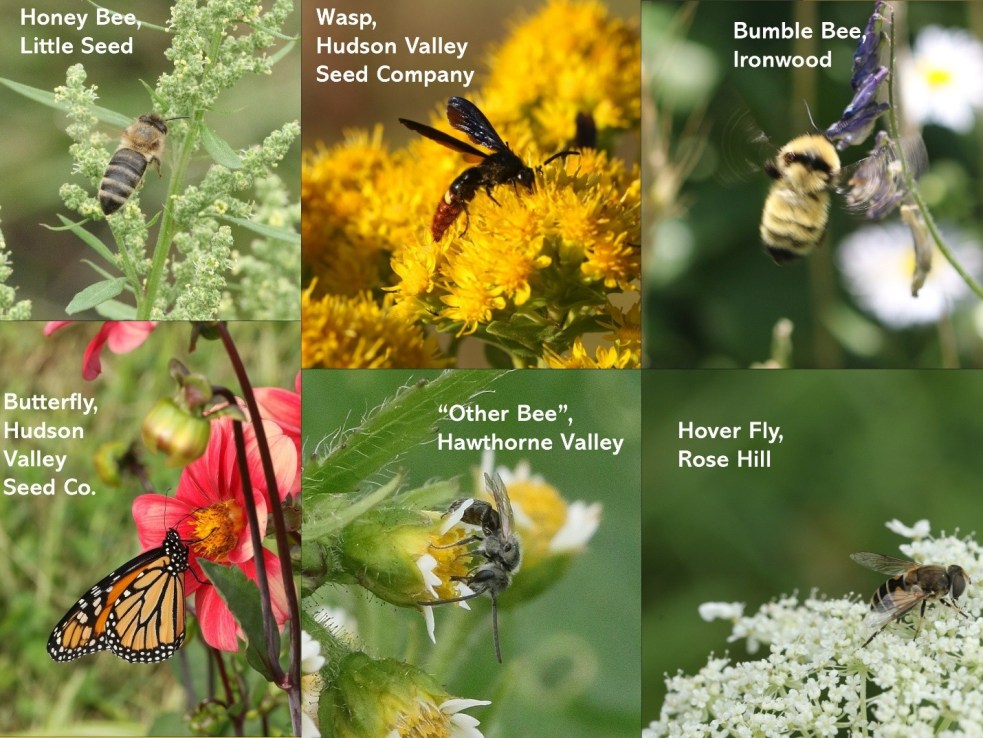
Which of the above flowers are most attractive to easily observable insect groups (such as Bumble Bees, Other Native Bees, Honey Bees, and Hoverflies)? Does one size fit all flower-wise, or is a diversity of floral shapes, sizes and colors important?
Based on the answer to the above two questions, which areas of each of the participating farms might be providng the most flower resources to each insect groups and how does that differ across the growing season?
There are various ways that one might approach answering these questions. The ‘Cadillac’ version (did we just date ourselves?) might be to do intensive surveys of flower diversity and abundance based on sampling plots and multiple counts coupled with some sort of standardized insect surveys such as with bee-bowl traps and netting. While potentially more rigorous, this would be a full-time job, plus it might not actually give much information on the value of individual types of flowers. So, instead, we decided to do something that is a bit more “quick-and-dirty,” but which, we hope, nonetheless allows us to get a good first glimpse of the answers to the above questions.
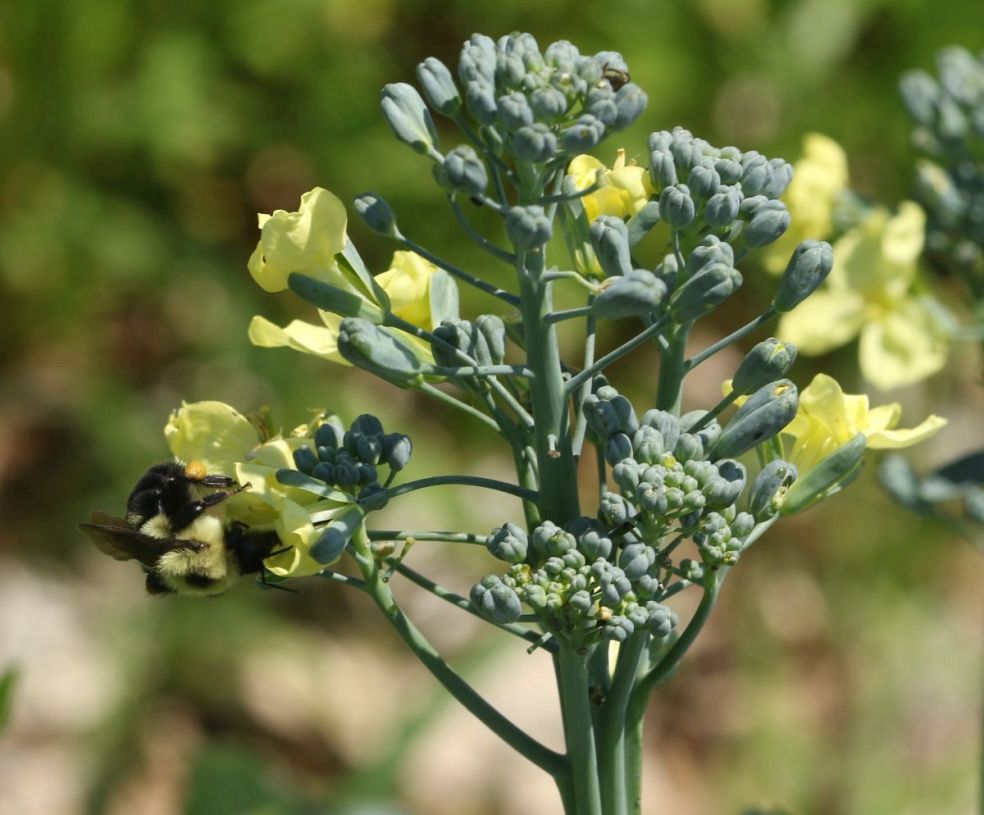
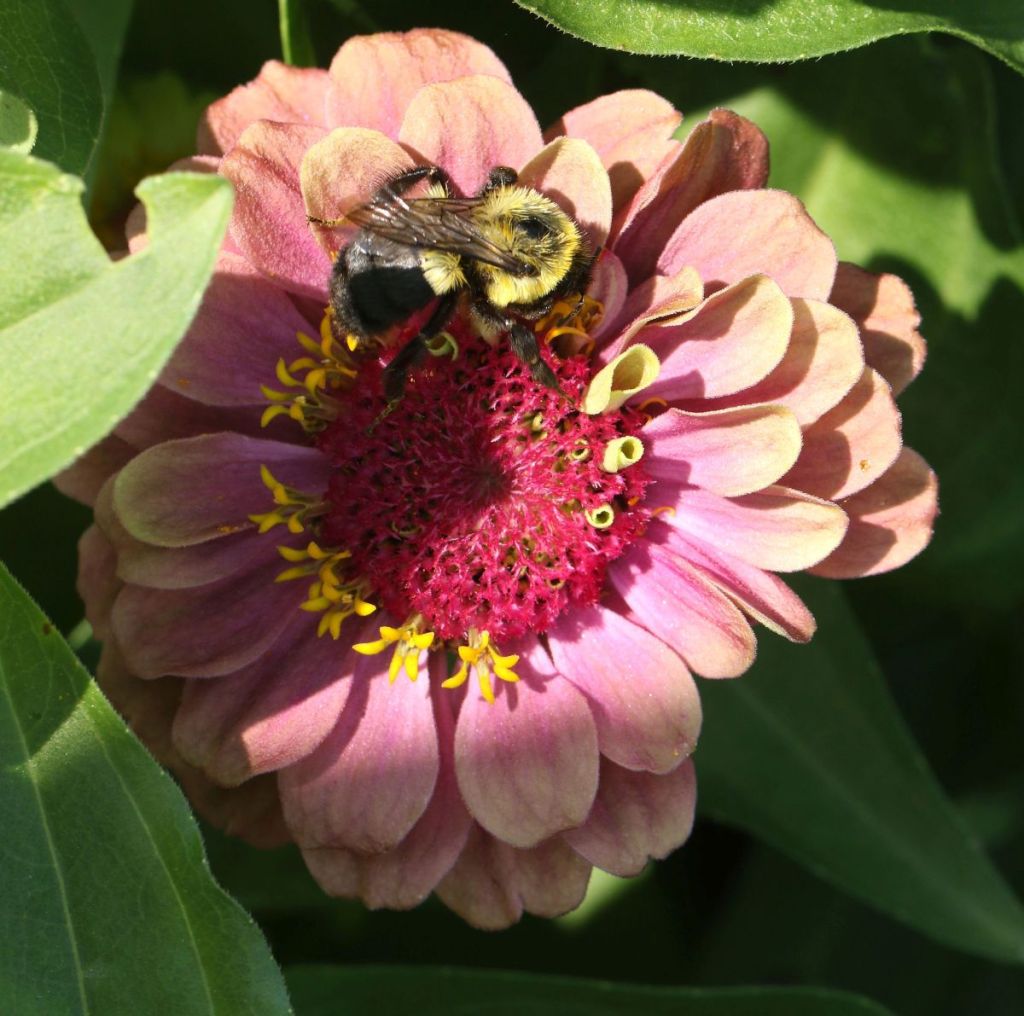
A bumble bee on Broccoli at Little Seed Farm.
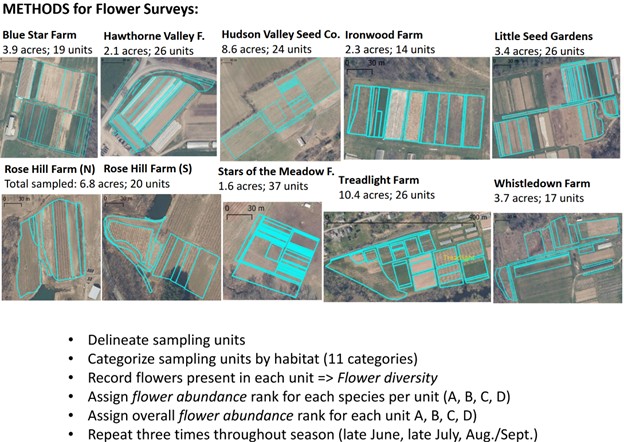
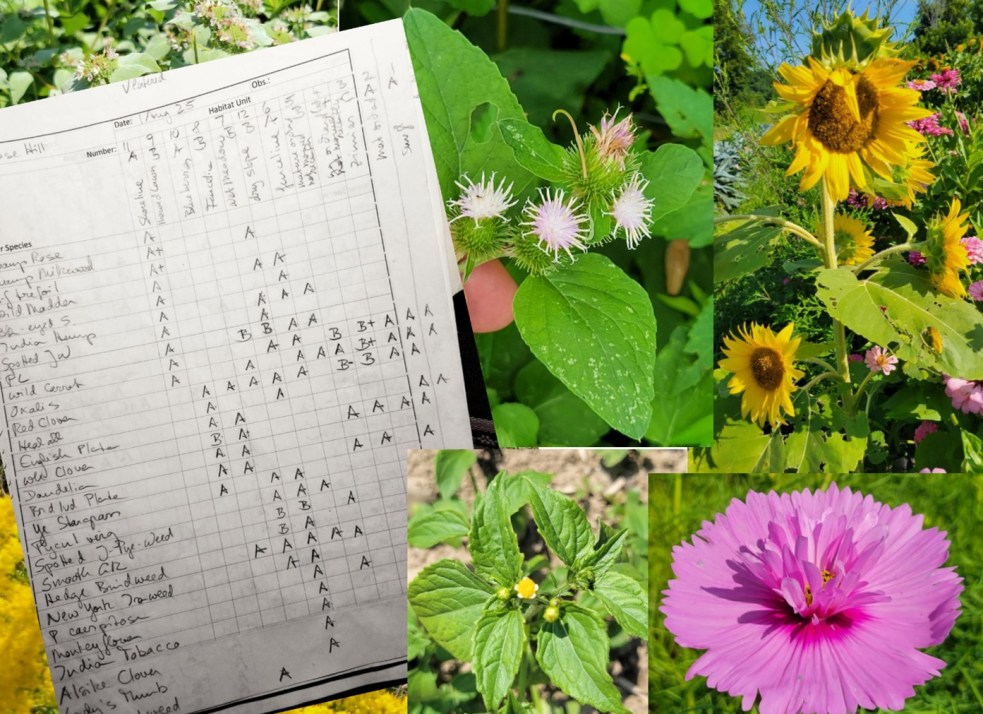
During our monthly visits (June through September), we try to spend 2-4 hours at each farm, documenting the flowers and their insect visitors in a section of the farm that includes a variety of habitats and management units. While doing the entirety of each farm would be cool, it’s beyond our current person-power. During each visit, Claudia ranks the abundance of the flowers of each species in each management unit and also assesses the overall flower abundance in each of those. She identifies each plant in flower and assigns it a floral abundance rank (A through D, with D being most common). Conrad observes and counts the insect visitors to flowers by doing five-minute ‘wandering flower watches’ for each species. For simplicity, four insect groups are presented here: Bumble Bees, Other Wild Bees, Honey Bees, and Hover Flies. During each of these strolls, new flowers of the given species are constantly being found and the observed presence of any insects is tallied. (The small print: To help correct for the effects of a particular farm or day, these flower visitation rates are standardized by the overall mean of the visitation rate for each of the four insect groups across all flowers on the given farm and then the standardized values for the focal flower are averaged across all farms at which that flower was observed.)
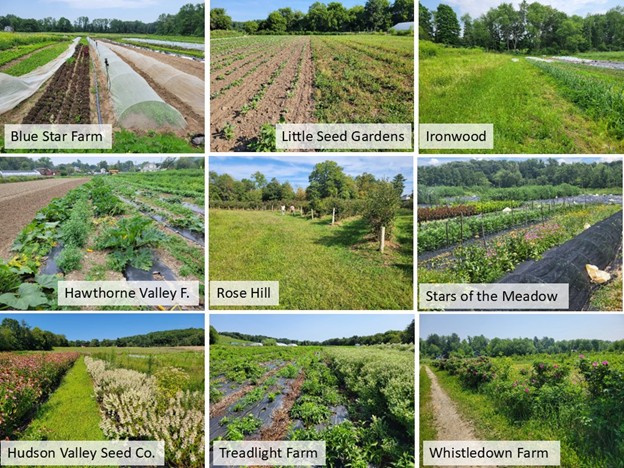
As the above map shows, the participating farms are Blue Star Farm, Hawthorne Valley Farm, Ironwood Farm, Little Seed Gardens, Whistledown Farm (all in Columbia County), Rose Hill Farm (in Dutchess County), Hudson Valley Seed Company, Stars of the Meadow Farm, and Treadlight Farm (all in Ulster County).
By jointly examining the results, we hope to help farmers see which areas of their farms might already be doing “good work” in support of certain flower-visiting insects, where there might be spatial or seasonal gaps in resources for these insect groups on a particular farm, and what might be practical ways to improve the floral offering. That said, it’s important to realize that there are factors other than just immediate flower availability which can affect bee (and other insect) abundance. These include access to suitable nesting conditions (such as good burrowing soils for ground nesters or the presence of hives for Honey Bees), conducive land use in the general surroundings (for example, freedom from pesticides or intensive car traffic), a flowering calendar that provides nectar and pollen throughout the insects’ life cycles, and, potentially, freedom from competition (under some conditions, Honey Bees are thought to compete with certain other bees species).
A Bronze Copper feeds at the flowers of Asian Greens at Blue Star Farm (we do tally butterflies, but haven’t see enough of them to warrant including them as a category).
This blog shares our observations from the first round of visits (June 5 to July 3, 2025) and illustrates our approach. The delineation of the habitats and management units is tentative and we expect to make some refinement in the next round of site visits.
Please let us know which results are most interesting to you. Is there anything else you would like us to document while we are out there? Do you have any questions?
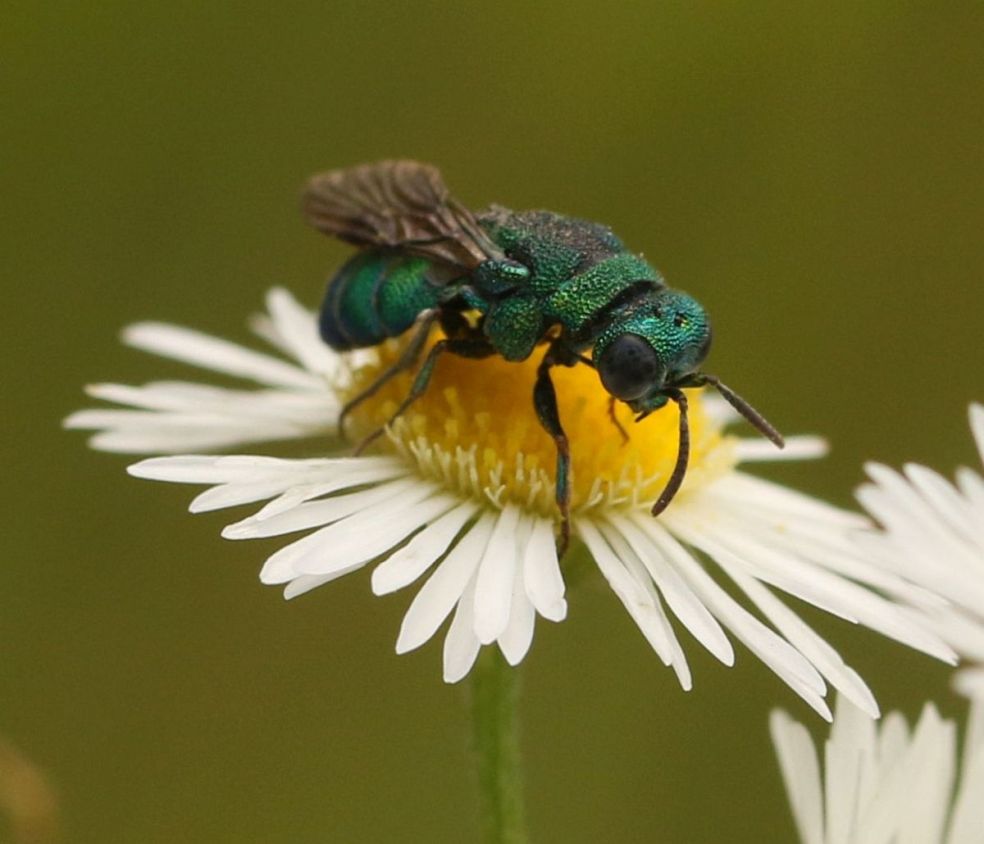
This catchy creature on an Annual Fleabane at Stars of the Meadow Farm is actually a type of cuckoo wasp – it usurps the nurseries of certain other ground-nesting wasps.
What We’ve Found So Far: Flowers on the Farms in June
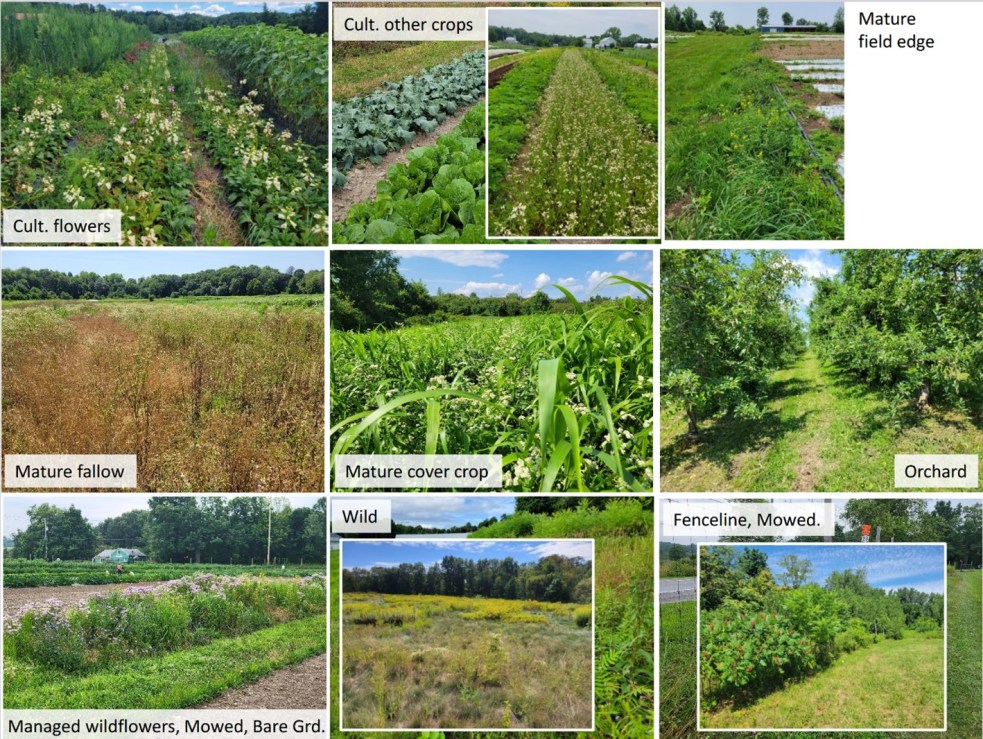
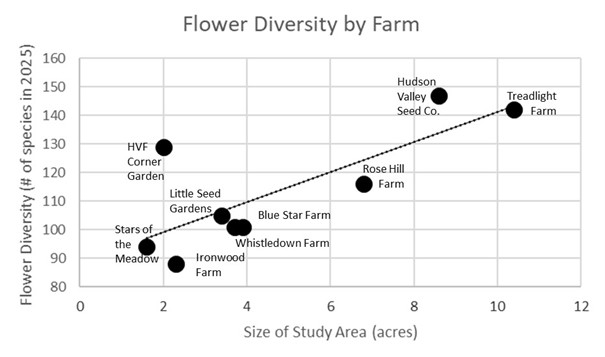
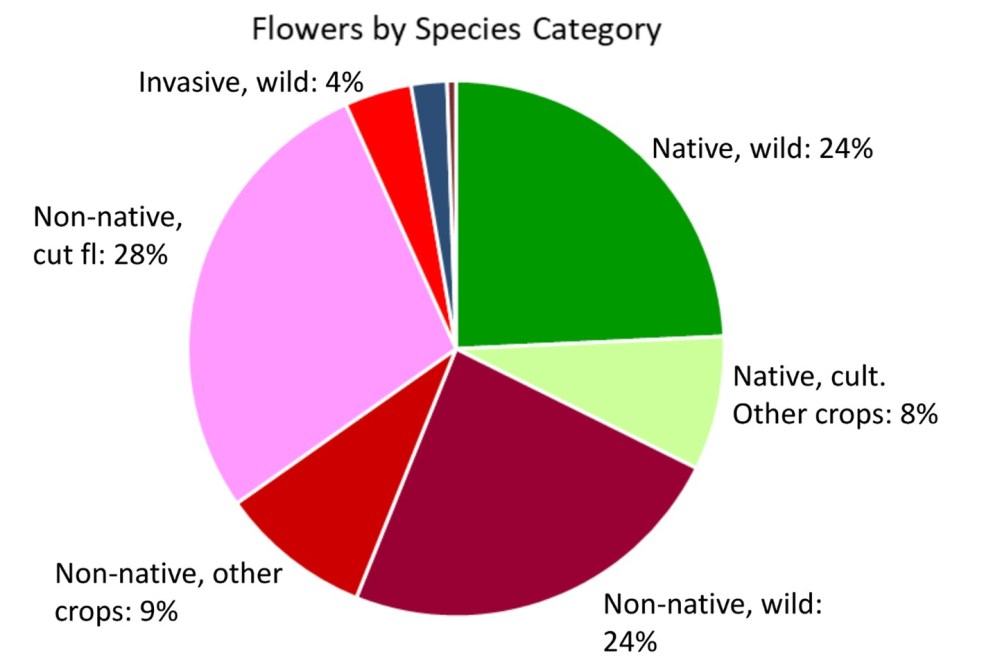
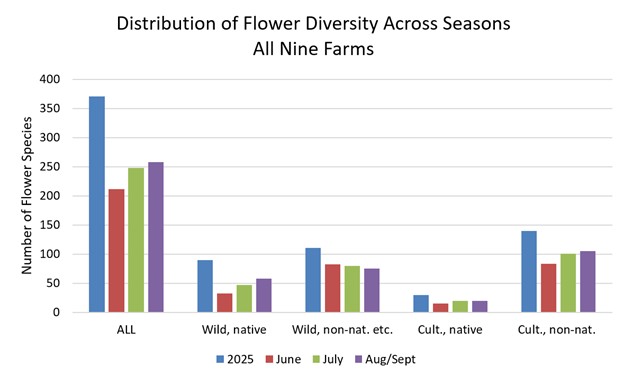
We found more than 200 species of flowers on eight of the farms (unfortunately, Claudia was unable to get to Stars of the Meadow Farm in June; Conrad did tally insects on flowers but the vegetation wasn’t mapped in detail). The most diverse group of flowers on the farms, with 83 species, were the non-native, cultivated plants. These included cover crops (such as Buckwheat or clovers, vetch and pea species), cut flowers (such as Zinnias, Snapdragons, and Marigolds), vegetables that need to bloom in order to produce the crop we eat (such as Tomatoes, Peppers, Squash and Cucumbers), as well as culinary herbs and leafy greens allowed to set flowers (such as Dill, Cilantro, Arugala, and other brassicas). Almost equally diverse, with 80 species, were the non-native wild-growing plants (“weeds”), which included ten species considered invasive in our region (such as Canada Thistle, two species of knapweeds, and Ground Ivy). Flowers were also found of 32 native wild-growing species (for example, Annual Fleabane, Common Yellow Wood Sorrel, and Common Milkweed) and on 18 native species cultivated for cut flowers (such as Fringed Loosestrife, Foxglove Beardtongue and several species of mountain-mints).
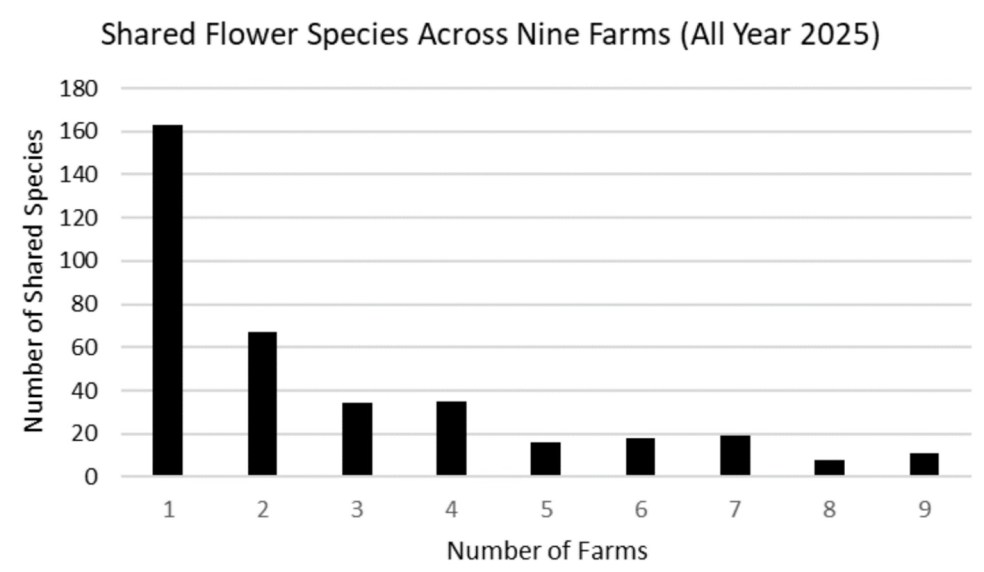
A small group of flowers were found at all nine farms. These ubiquitous flowers were Annual Fleabane, Narrow-leaved Plantain, Red Clover, White Clover, Wild Madder (aka Common Bedstraw), and Common Wood Sorrel.
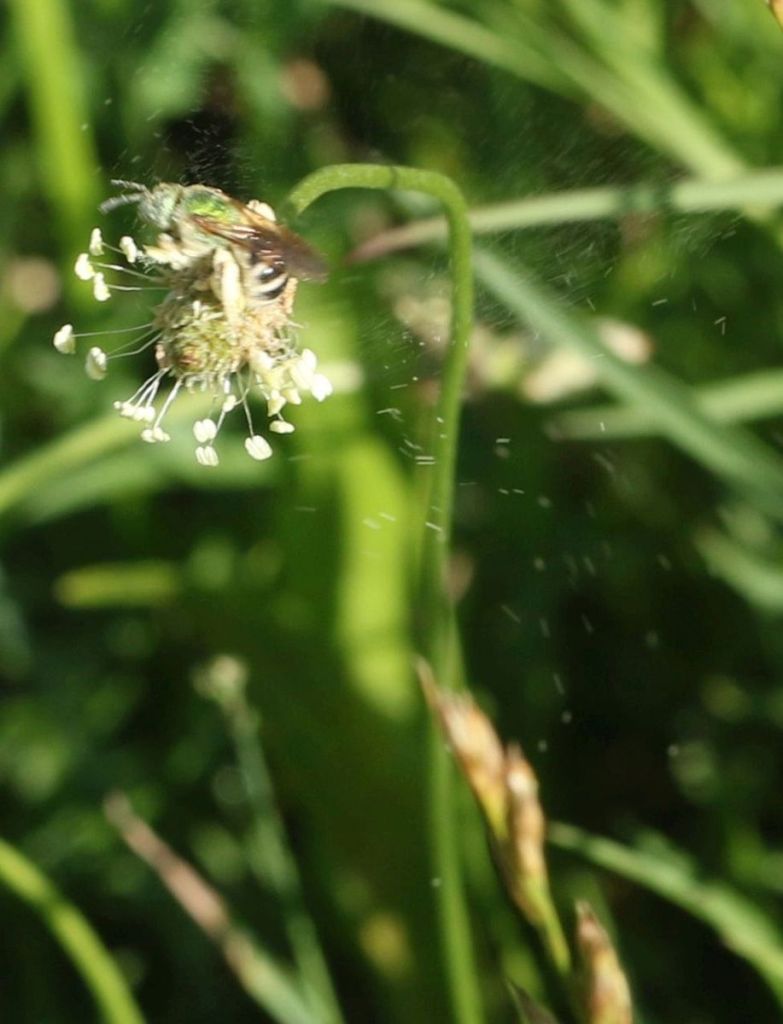
A green sweat bee takes a pollen bath on English Plantain at Rose Hill.
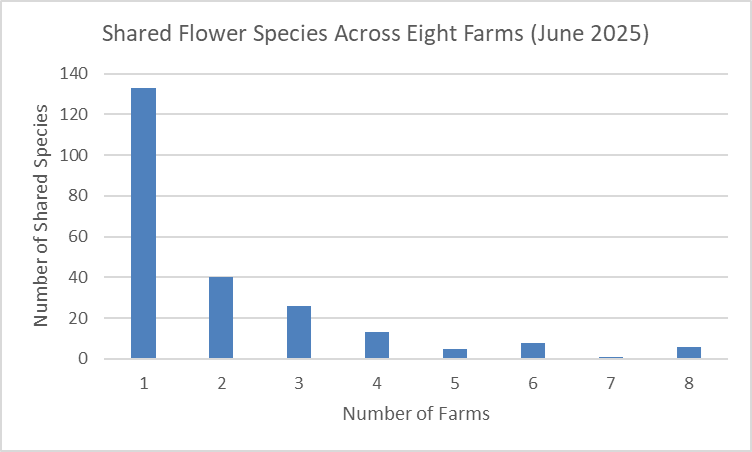
The following graph illustrates just how different the eight farms visited by Claudia were in terms of their flowers. Only the six species just mentioned were found on all eight farms she visited in June (and in fact, they were all also observed at Stars of the Meadow in July) . A few additional species were shared by more than four farms, while 133 flower species were found at only a single farm.
What We’ve Found So Far: Flower Abundance within Management Units and across Habitat Categories in June
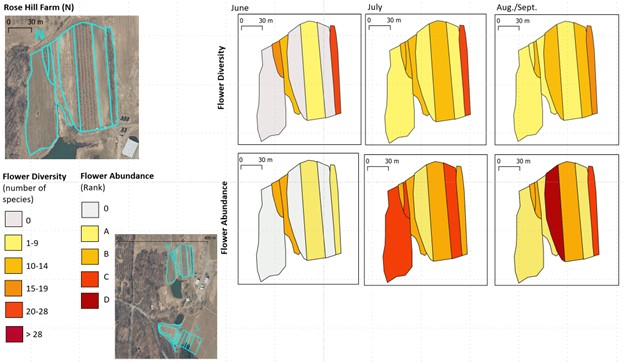
The following map shows a color-coding of the study units at each farm by rank in flower abundance, increasing from zero (no flowers), to A (rare flowers), B (medium density of flowers), C (flowers common), to D (flowers abundant). (Again, Stars of the Meadow is missing from these maps this time around, but will be added in July and subsequent months.)
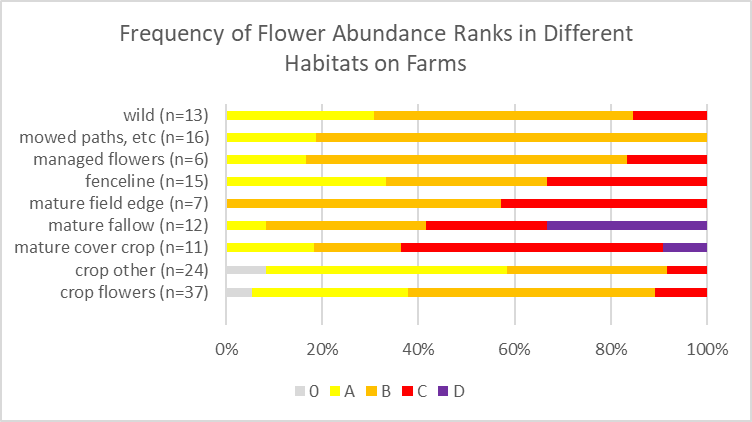
We only assigned the highest flower abundance rank D to five fields/management units in June: four of them were mature fallow fields (tilled within the last year or two, but not yet managed in 2025), of which three were dominated by the flowers of Daisy Fleabane and one by Wild Madder (Common Bedstraw). The fifth was a Buckwheat cover crop in full bloom.
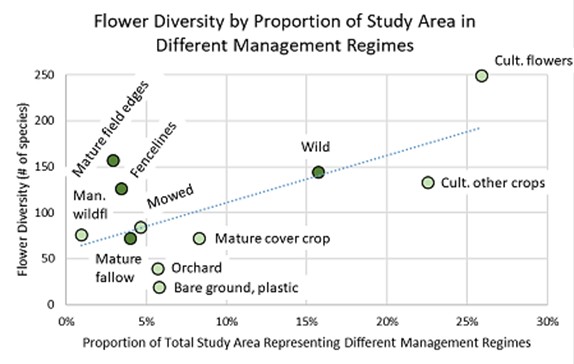
When comparing the flower abundance ranks assigned to the most common habitats we surveyed, we see that, in addition to mature fallow fields and mature cover crops, some of which reached very high flower densities, the habitat with the most consistently high density of flowers was mature field edge. Wild habitats, managed flowers, and fencelines sometimes also had a lot of flowers, but sometimes not very many. Early in the season, beds with crop flowers were quite variable in their flower abundance and still had overall relatively few flowers.
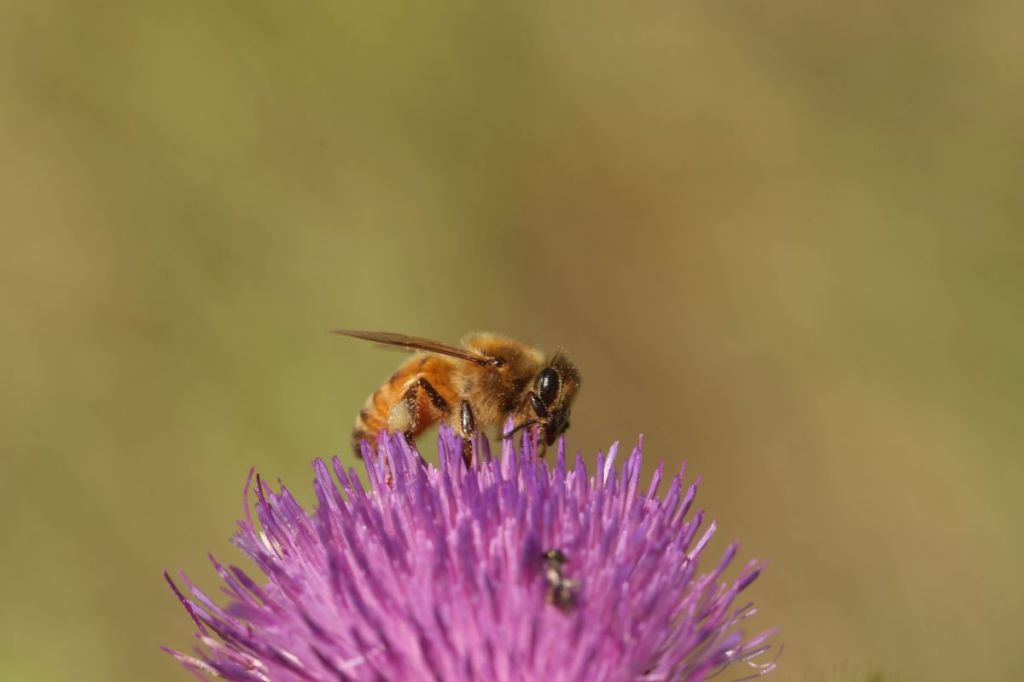
A Honey Bee with bright orange ‘panniers’ of Asparagus pollen at Whistledown Farm.
What We’ve Found So Far: Flower Diversity within the Management Units and across Habitat Categories in June
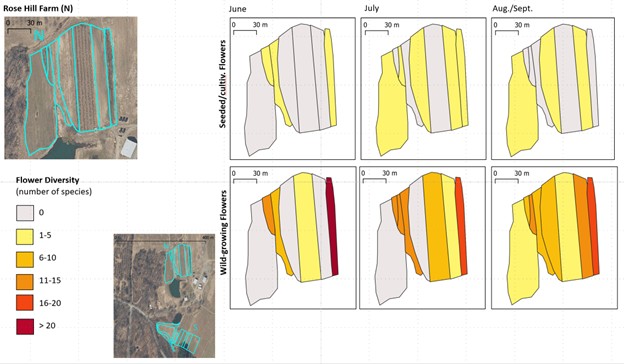
The following map shows a color-coding of the study units at each of the eight farms by number of species in flower (which did not always correlate with the abundance of flowers).
We found the most diverse (species-rich) flower communities in mature field edges and mature fallow fields. Most wild areas also had diverse flower communities, but some did not (at least not in June).
What We’ve Found So Far: Which Insects Like Which Flowers?
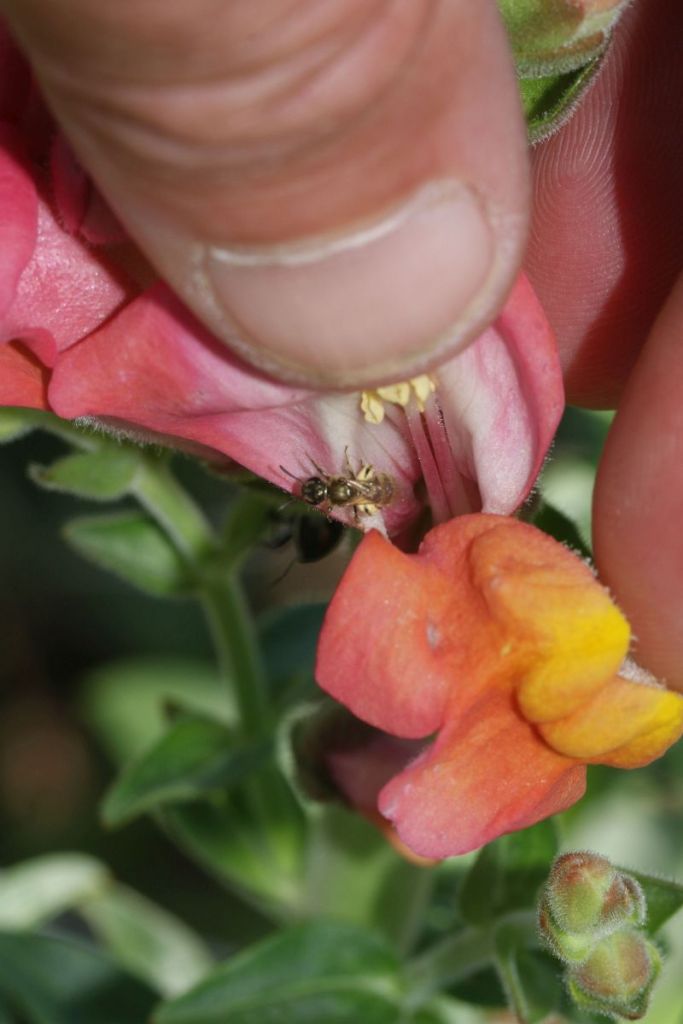
The ‘mouth’ of a snapdragon (at Treadlight) is opened to reveal a small sweat bee hidden inside. Doing an accurate visual count of visitors to snapdragons is nearly impossible.
Before summarizing the insect results, let us tell you some of the reasons these data should be taken with a grain of salt:
Our approach is based on seeing insects on flowers. This means both that smaller, less conspicuous insects surely tend to go unseen and that insects entering closed flowers like snapdragons or dangling flowers, like those of Potatoes or Horse Nettle, are unreported because they were hidden from view. Furthermore, while the stopwatch of our visual surveys only ran while our eyes were inspecting flowers, there is no doubt that more flowers (and hence potentially more insects) were observed when those flowers were growing in tight clusters than when they were growing as singlets or small clumps. Finally, the ‘ripeness’ of flowers (that is, how much nectar and pollen they are offering) is not always immediately apparent. If you spend time watching flowers, you’ll notice that, even within a single flower species, the attractiveness seems to vary across dates and even within days. For the more common flowers, we have data from multiple dates and several different farms and our averaging might iron out some of the flukes; however, some flowers were only observed for one 5-minute block on one farm and what we saw then is what you get. All this adds ‘noise’ that might confound actual patterns…
But, with these caveats in mind, what did we find?
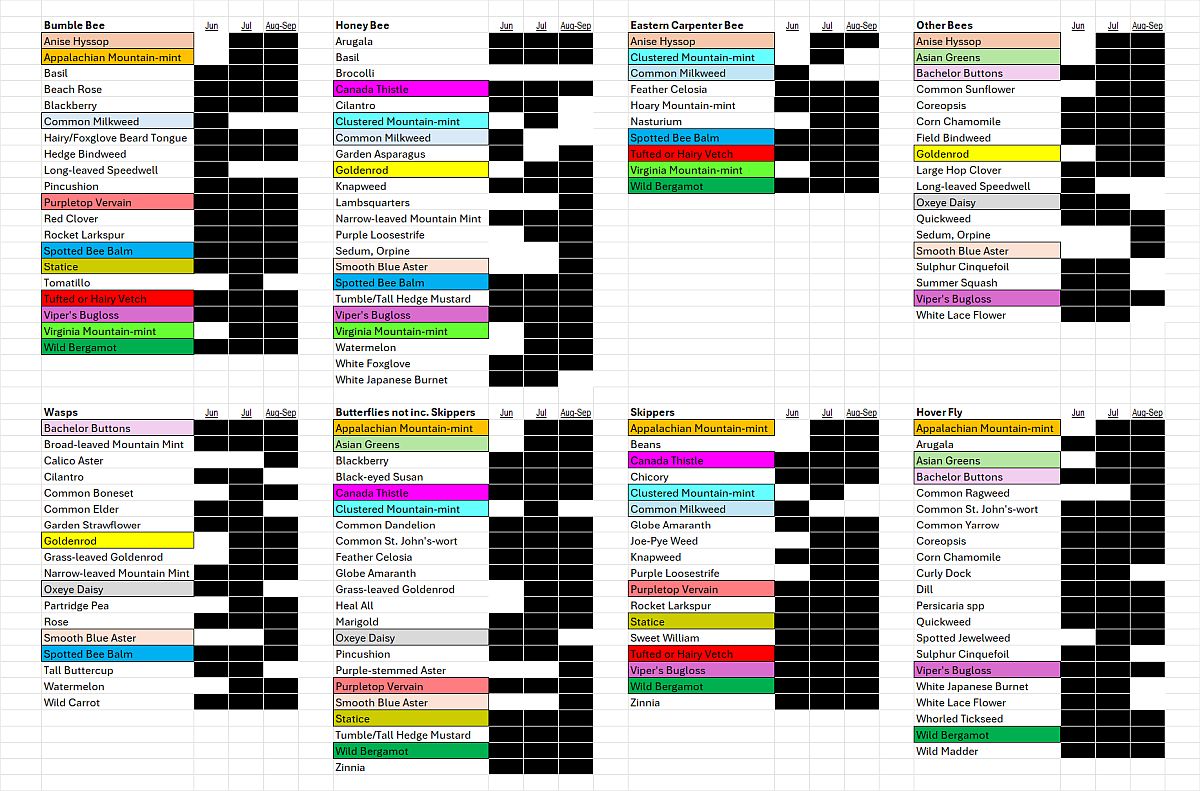
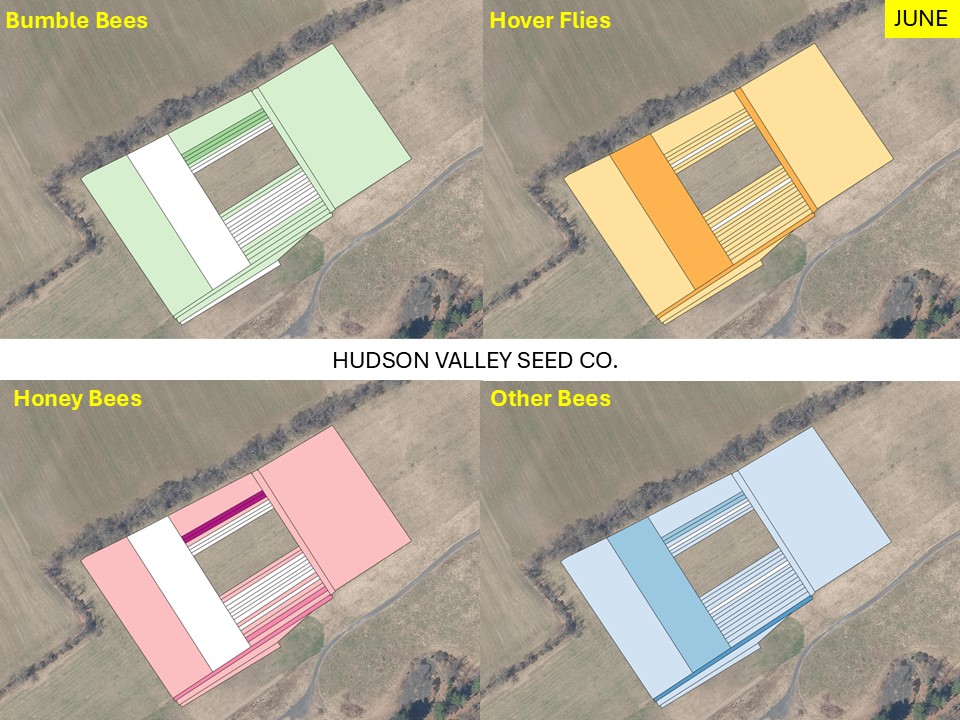
The top-ranking flowers for each insect group.
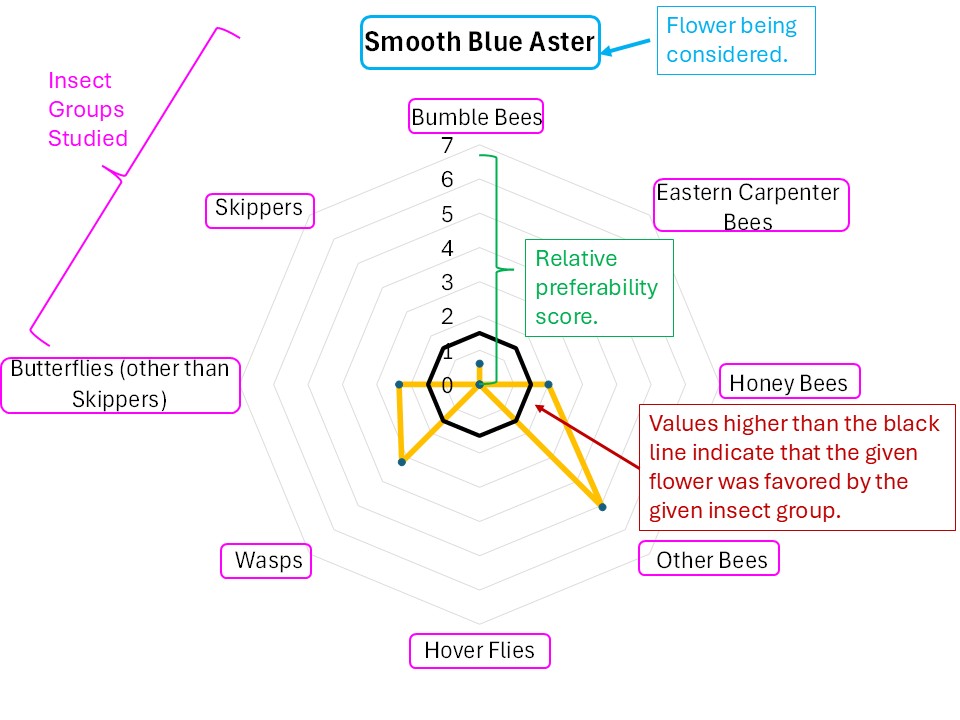
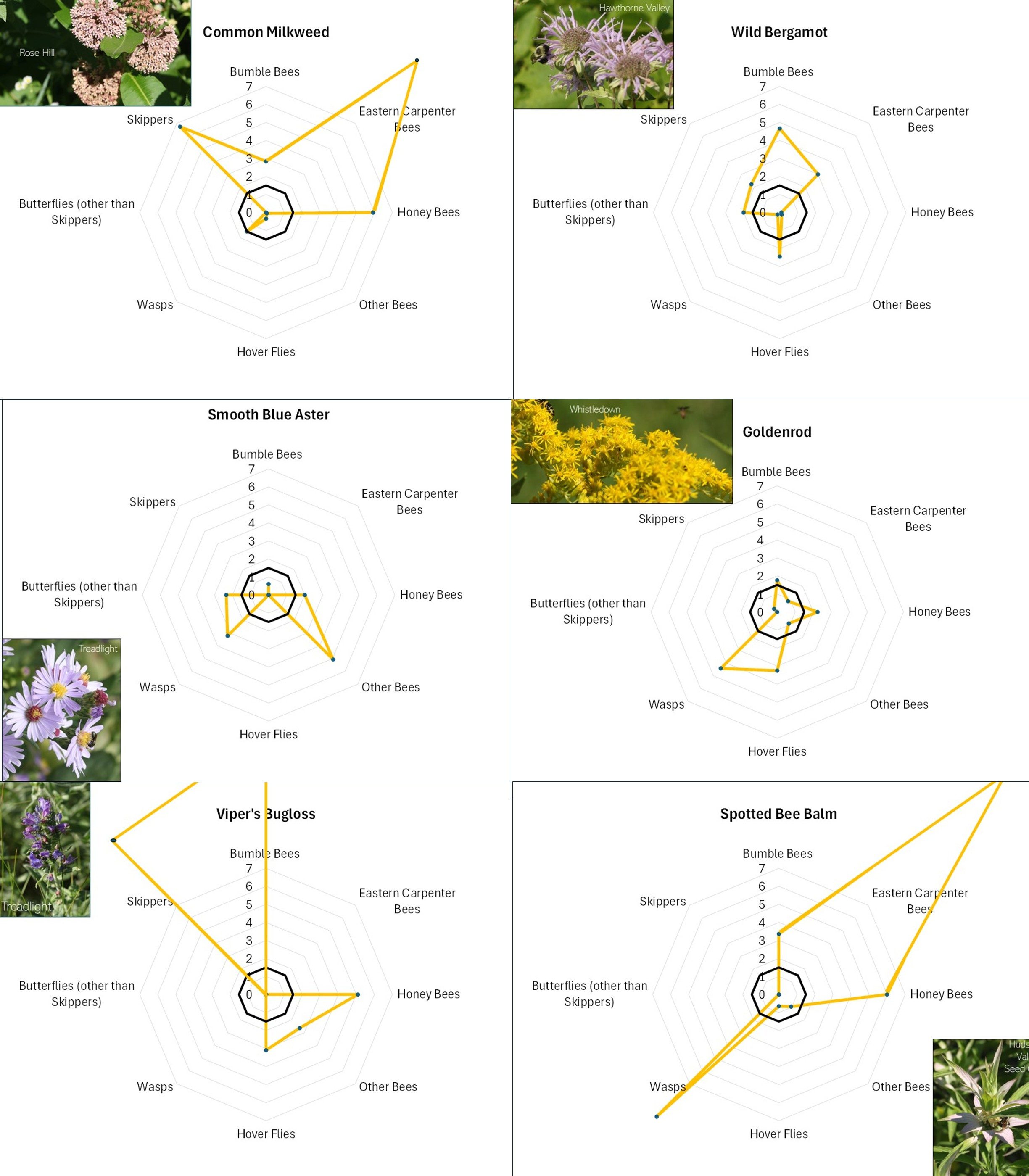
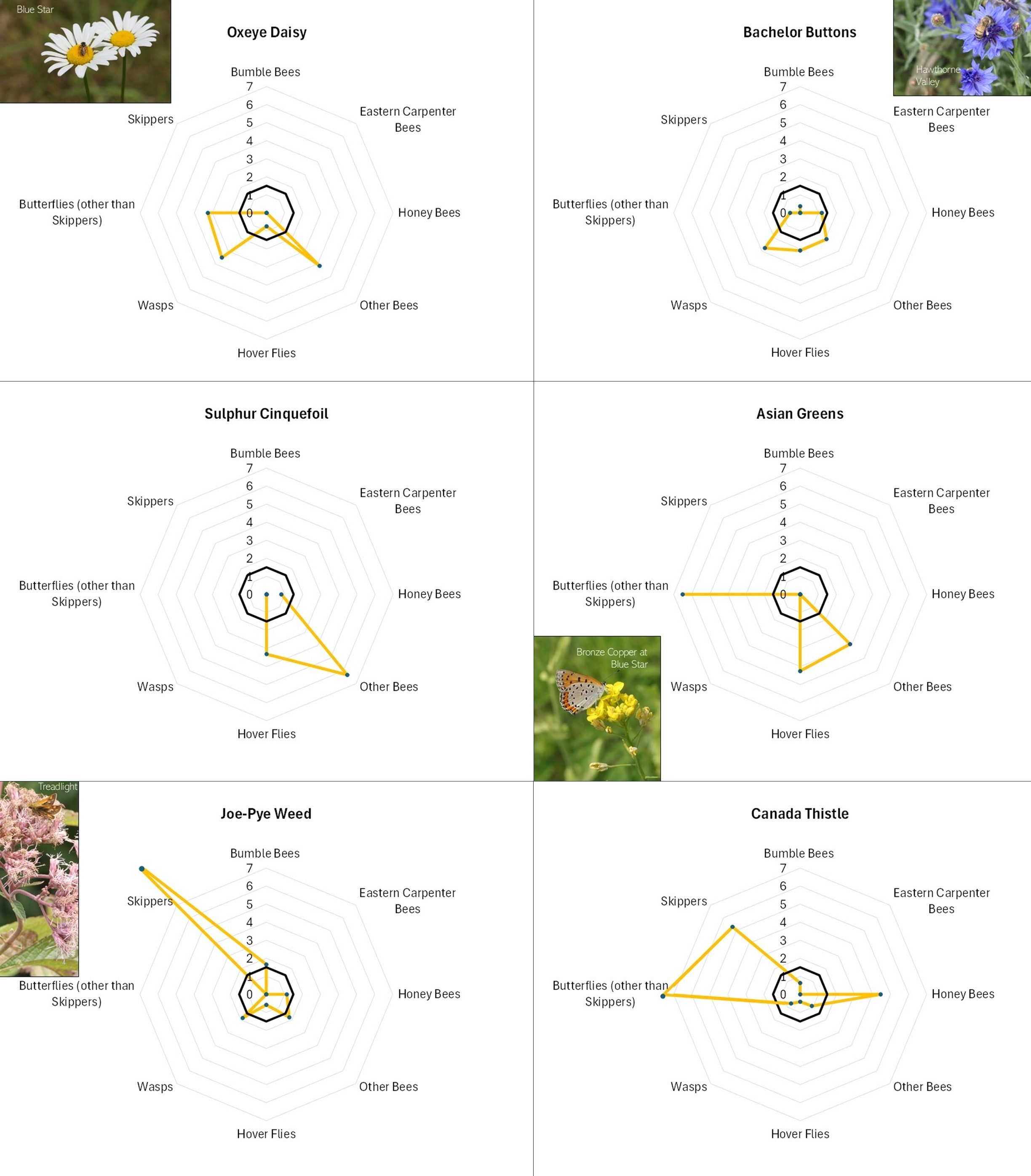
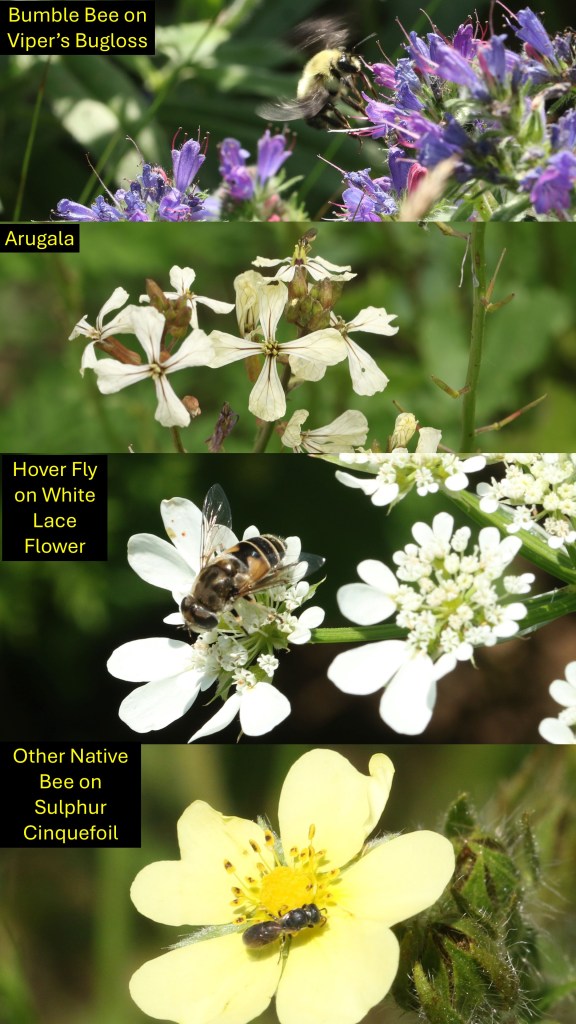
In this table, the number indicates the value of the given flower relative to the average of all flowers observed in June. For example, Viper’s Bugloss was more than 15 times as popular for Bumble Bees as the average flower. Only flowers 1.5 times or more above average are listed.Colors just highlight the same flower on different lists. You can expect these numbers to change somewhat as the season progresses and we collect more observations.
The above table shows the top flowers for each group of insect visitors. A few general comments are worth making: the same flower can differ markedly in apparent attractiveness for the different groups of flower visitors. For example, while Pasture Rose ranked second for Bumble Bees, Arugala ranked first for Honey Bees, White Lace Flower was tops for Hover Flies, and Oxeye Daisy was in second place for ‘other bees’, none of these flowers even appeared on the lists of the other insect groups. At the same time, some flowers, like Viper’s Bugloss, Chicory, and Echinacea appeared on three or even all of the lists. While the reason for the preference differences amongst the insect groups is not always clear, certain patterns might be discernible. For example, if one compares the flowers favored by Bumble Bees and Hover Flies, one notes that, relatively speaking, the Hover Flies seemed to favor shallower, smaller flowers. Perhaps we’ll be able to tease apart more of such patterns as we collect more data.
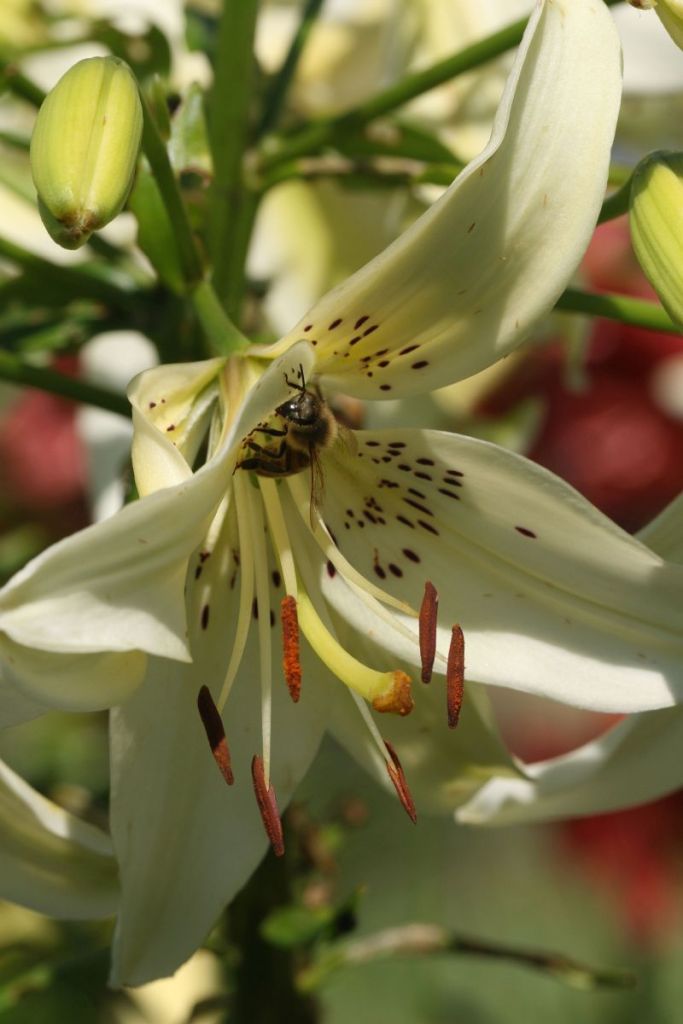
A Honey Bee on a Tiger Lily at the Hudson Valley Seed Company.
Native vs. non-native and intentionally seeded vs. spontaneous don’t seem to be great predictors of most favored flower status. For instance, Viper’s Bugloss and Chicory are non-native ‘weeds’, Arugala and Asian Greens are non-native crops, Common Milkweed and Annual Fleabane are native ‘weeds’, Bachelor Button is a non-native ornamental seeded flower, and Echinacea is a native (or ‘near native’) ornamental seeded flower. All of these flowers figured at or near the top of some insect lists. Of course, our gross categories of flower visitors may hide more specialized relationships as was evidenced by our sighting of Macropis bees, a native bee specializing on planted but native Lysmachia (aka our native Loosestrifes). These bees collect the oils that such flowers produce.
A specialist Macropis bee gathering oily pollen from a seeded Fringed Loosestrife at Treadlight Farm. This is one example of specific relationships that are hidden in the general insect categories we use.
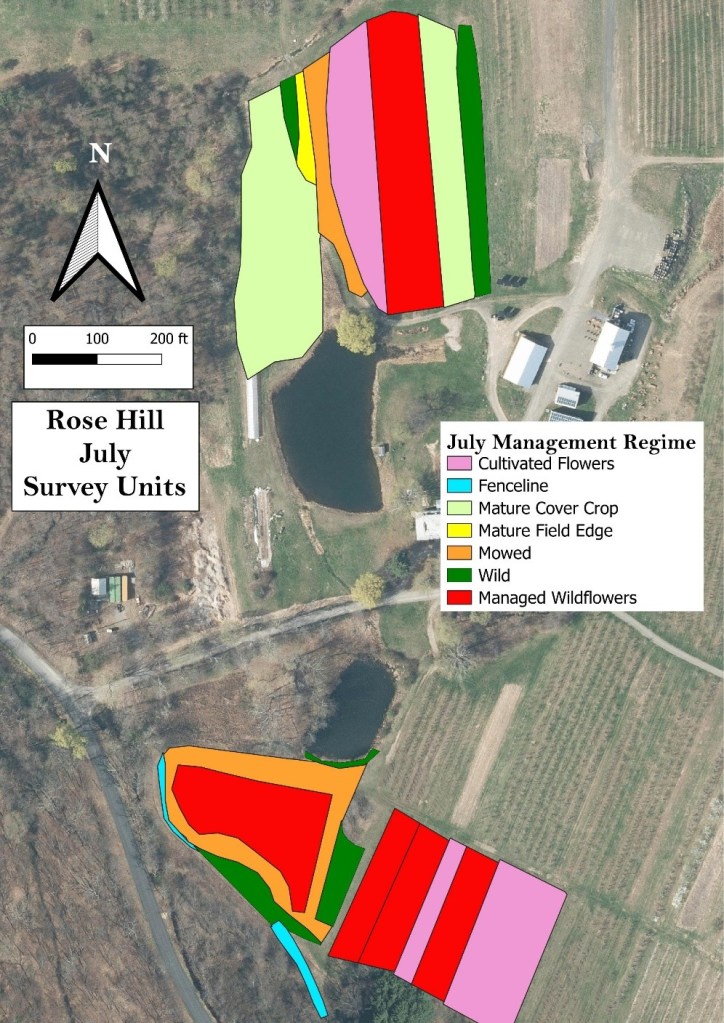
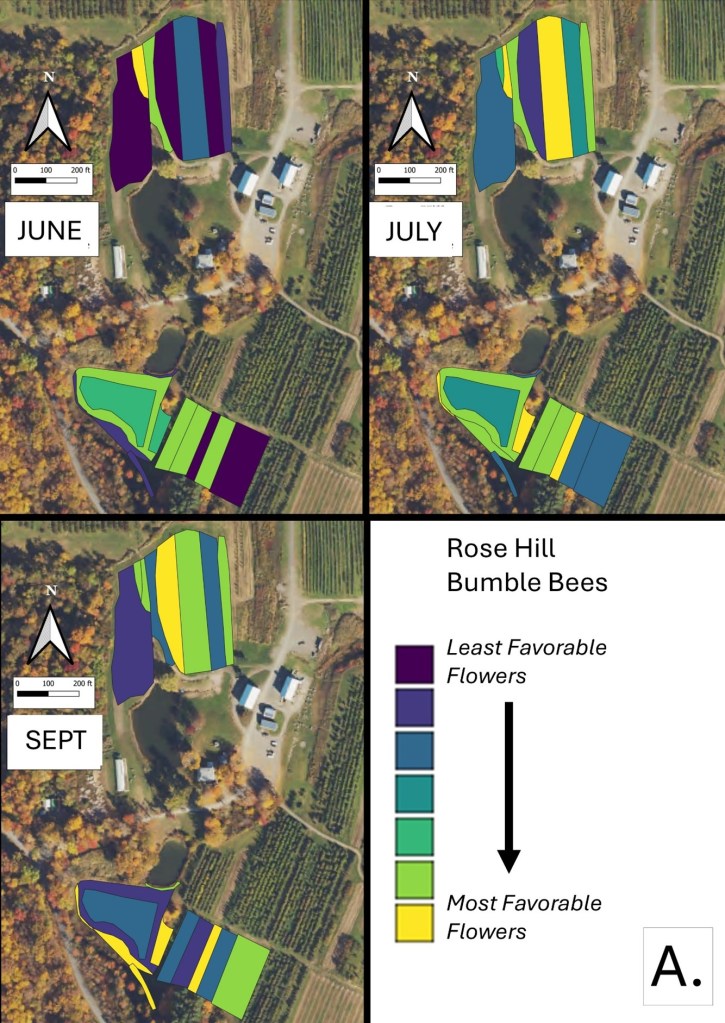
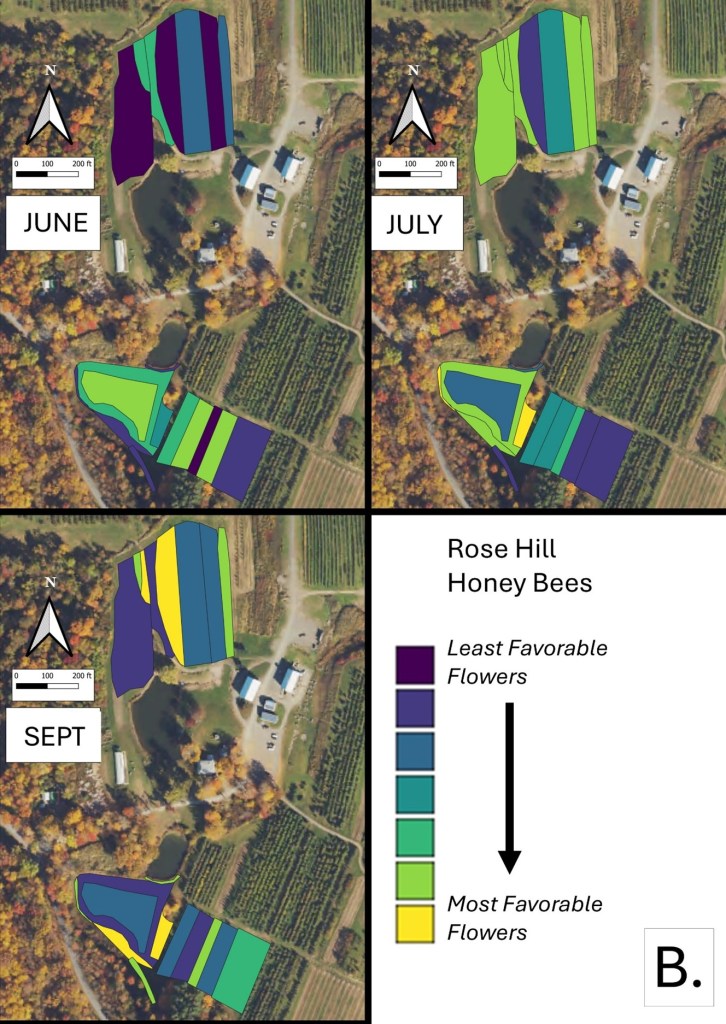
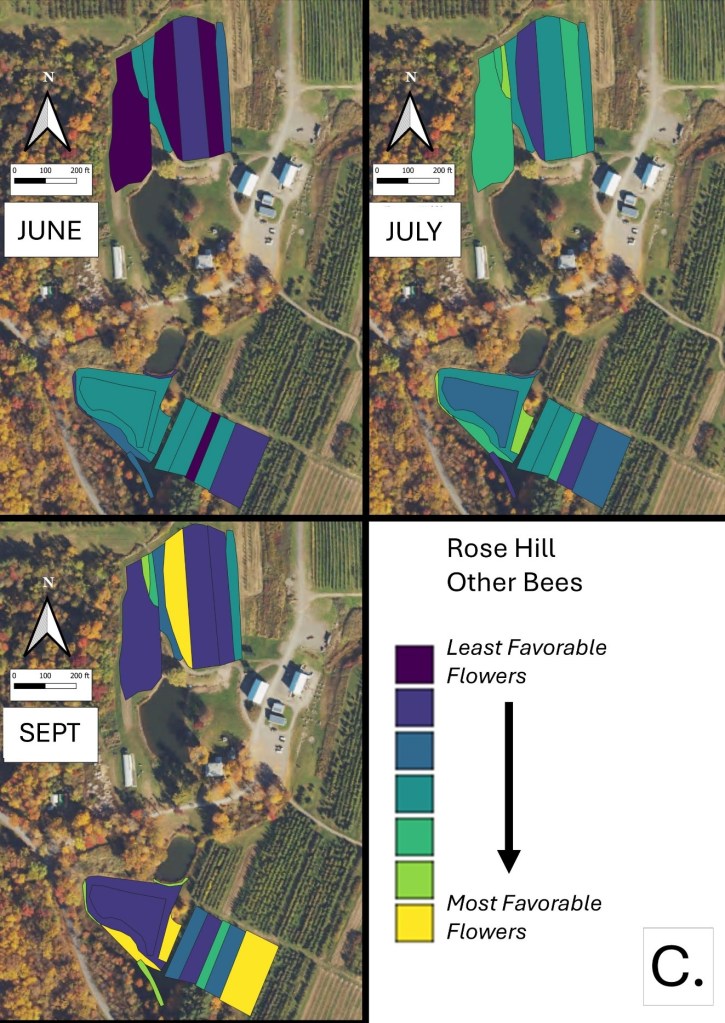
What We’ve Found So Far: Mapping Flower Suitability.
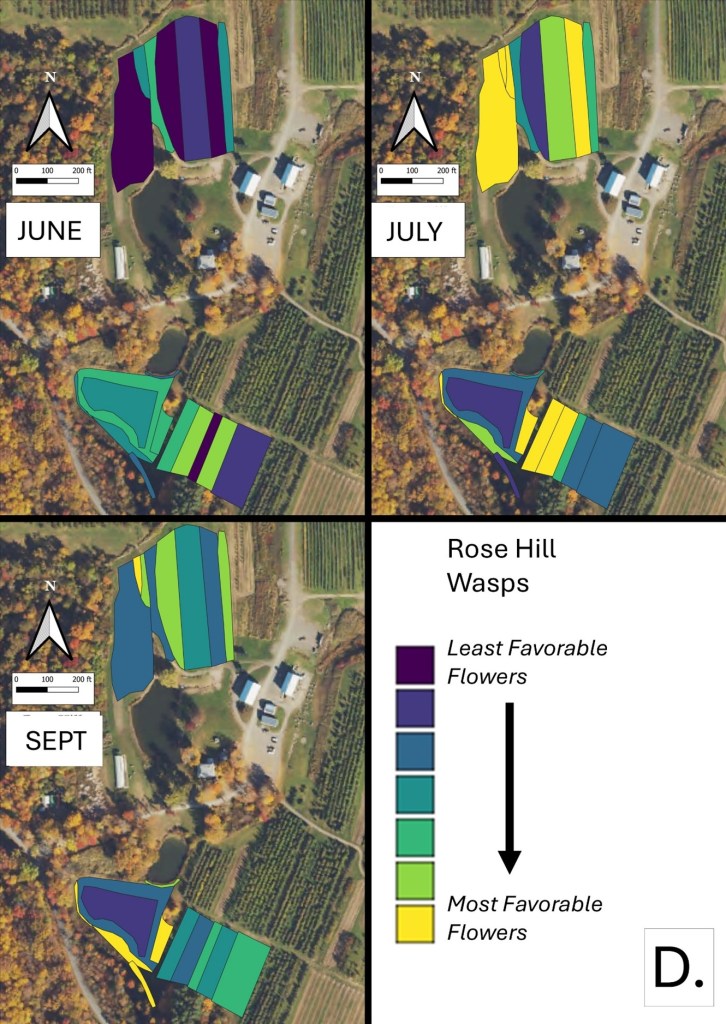
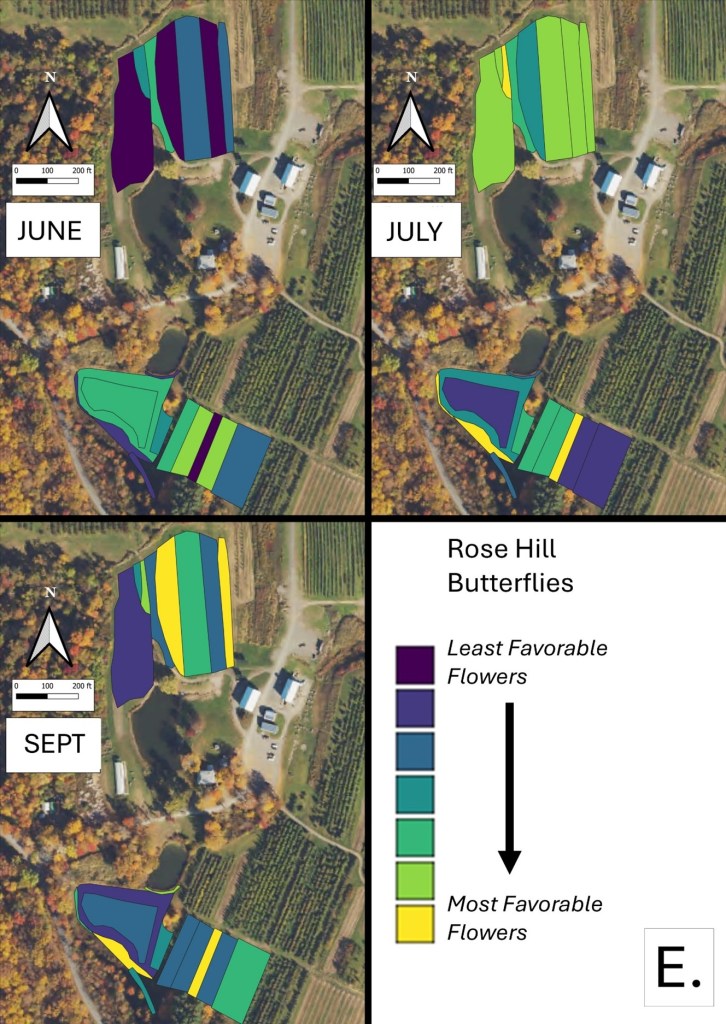
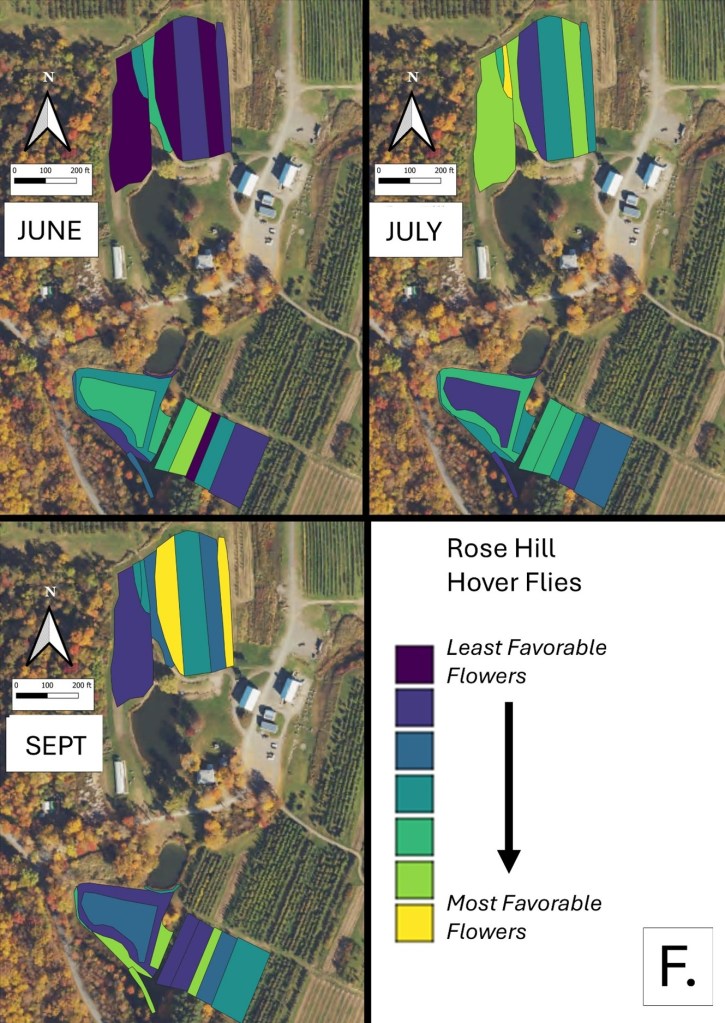
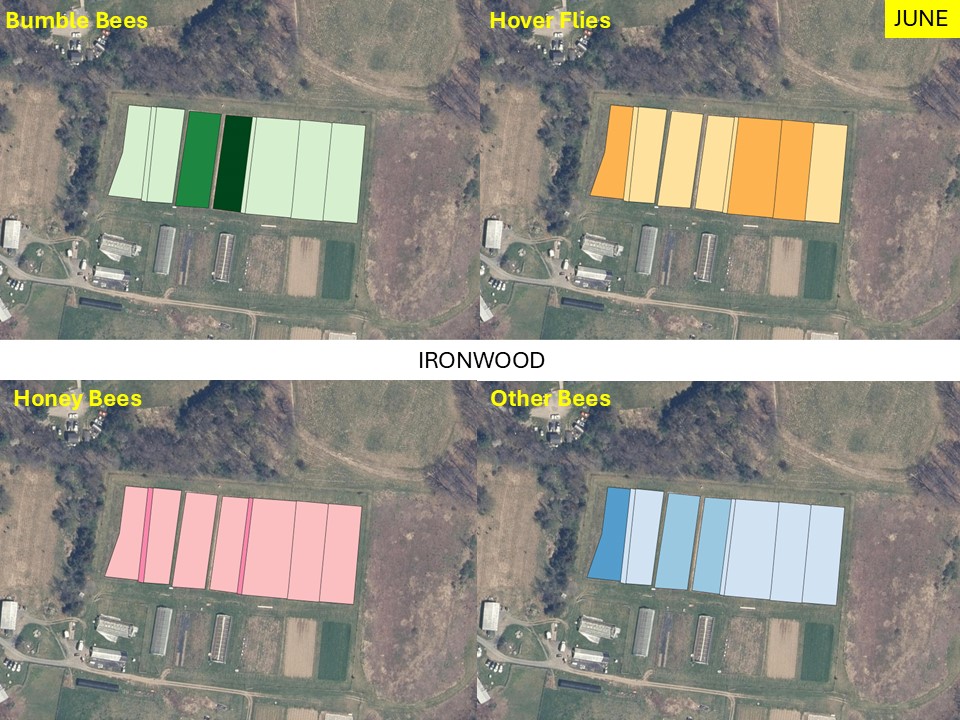
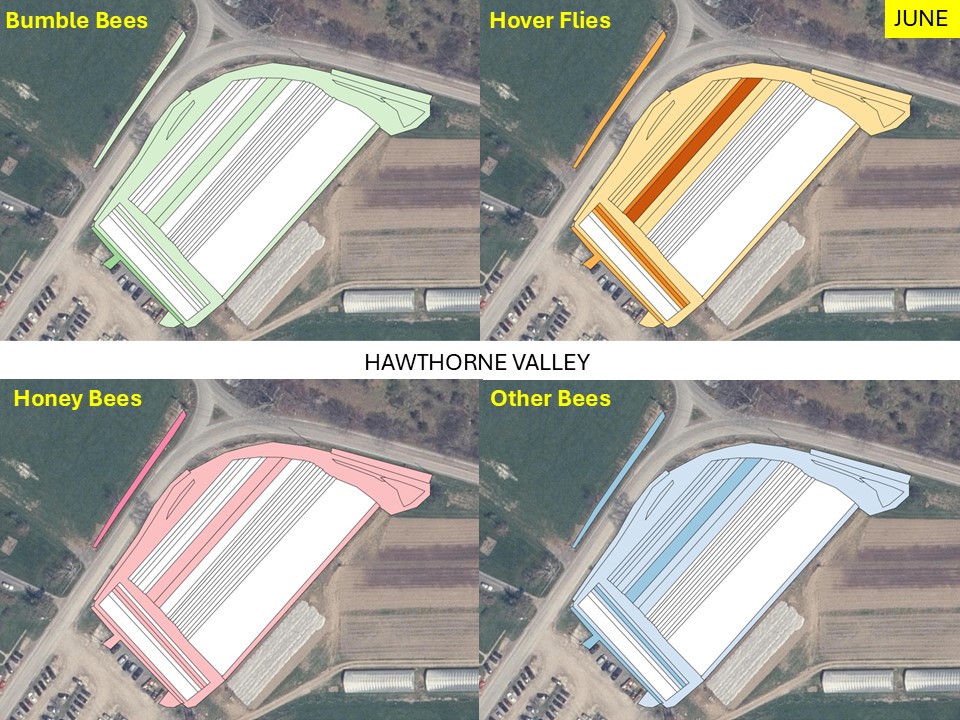
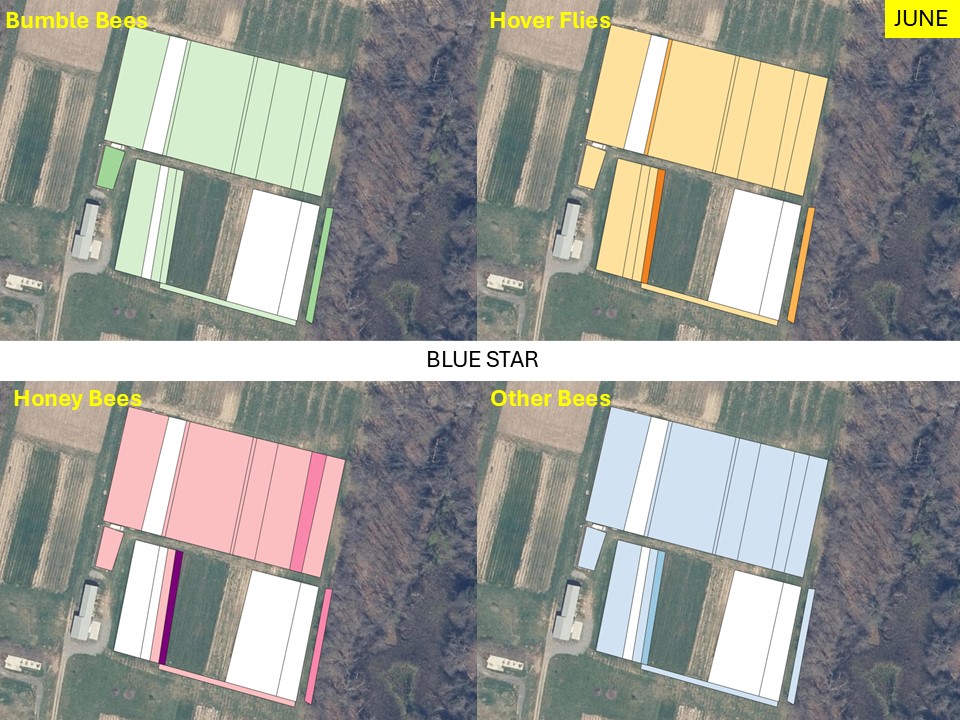
Finally, we present a series of maps showing the predicted pollinator value of each management unit on each farm. Please note these are NOT maps of where we necessarily saw the most bees, instead they’re predictive maps showing our guesses as to which patches were most attractive to the different groups based on flower composition and our flower visitor data. A logical extension of our work would be to test our models by going into each management unit and gathering an activity index for each of our flower visitor groups. Because of their crudity and the non-floral factors that can affect bee abundance (listed above in the Background section), these June maps are very much only part of a larger picture and may or may not reflect the insect abundance you observe.
In these maps a darker tone means more of the given insect group. For a given farm, each frame is a different insect group.
We realize that, unless you are familiar with the individual farm, these maps are somewhat hard to interpret. We will try to provide more individual farm details in our next blog but, in the meantime, some general patterns seem evident:
Predicted suitability can be quite patchy – attractive beds or patches abut less attractive ones. There’s nothing surprising about that given the obvious variation in flower composition across beds. Perhaps somewhat more interesting is the fact that the patterns vary depending upon the focal insect group. This derives directly from the previously described variation in insect suitability amongst flowers and the patterns of flower composition across units.
Both farm beds and edges, as well as fallows and semi-natural areas can be valuable. Flower visitors are constantly trying to make the best choices from the flower smorgasbord available to them, and these maps suggest that those offerings will lead them into suitable patches regardless of where on a farm their favored flowers are found – for example, contrast where one is likely to find flowering Arugala with where one finds Milkweed (two of the Honey Bee’s favorites).
It’s important to highlight what these maps DON’T show – were we to map suitability for particular bee species, these maps would sometimes be very different. For example, there are native bees who only feed at particular Spring ephemerals; maps of habitat suitability for these species would essentially be completely empty given that none of the beds on any of the farms supported those flowers. Likewise, a map of flower suitability for the Squash Bee would largely (but not entirely) be a map of squash beds. At the opposite end of the spectrum, some of the common members of each of the multispecies groups (Honey Bees are only one species) are single species with broad tastes – maps of their suitability might not differ too much from what is shown here. In between these extremes come the tastes of slightly more specialized bees. For example, in our current July round of visits, we found Mellisodes bimaculatus (a bee that looks somewhat like a black bumble bee with two white patches on its tail end) going to town on corn tassels at Ironewood while it was absent from most other flowers at that farm on that day. Likewise, Hyleaus, a genus of somewhat wasp-like bees, has so far seemed to show a marked preference for certain shallow flowers like Queen Anne’s Lace. In other words, our gross groups hide subtler patterns. We are trying to refine our insect categories, but will probably have to continue to rely on this somewhat anecdotal approach for the nuances.
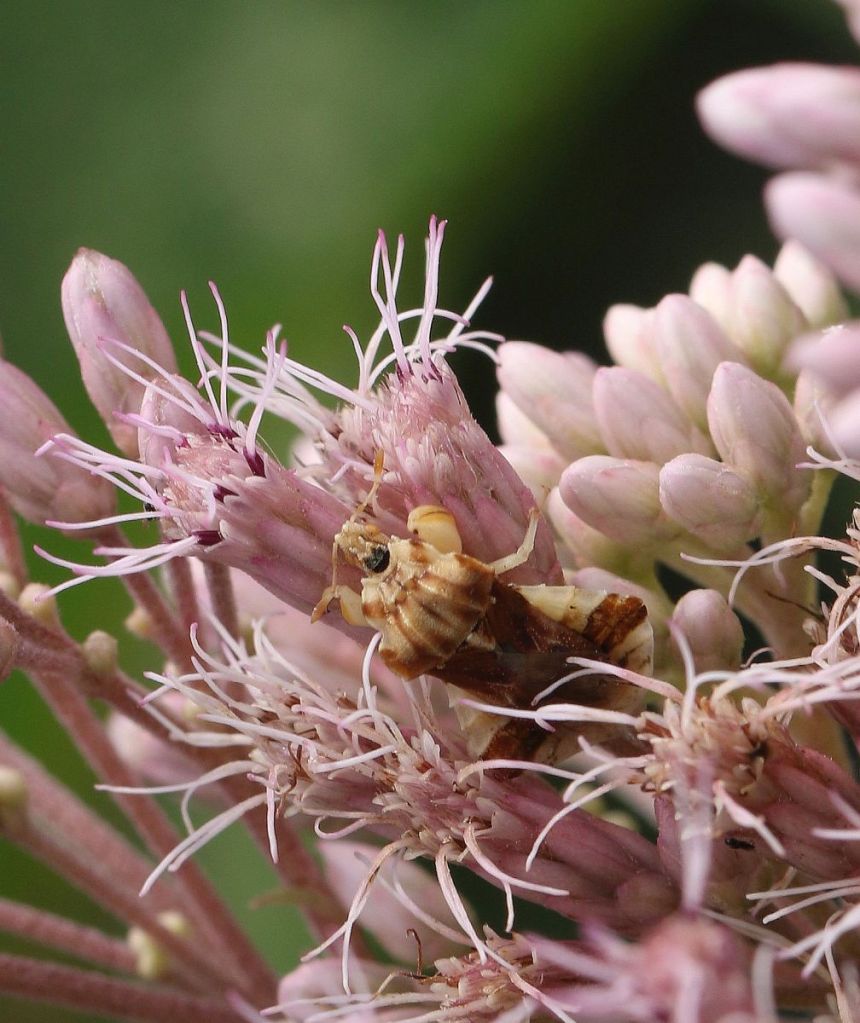
Death on Spotted Knapweed at Treadlight Farm – a pair of Ambush Bugs mate while one feeds on a Honey Bee they have captured; a fly also appears to have taken an interest in the dead bee.
Final Thunks.
Seeded flowers have value in addition to the support of insects – they have general aesthetic appeal, may be part of a commercial operation growing retail flowers, or may serve as an added pick-your-own perk for CSA members. Sometimes flowers are included as companion plantings meant to help control certain pests and, finally, certain crops are sometimes allowed to flower because it is necessary for food production (e.g., tomatoes and cucurbits) or the farmer wants to harvest their own seeds. (Of course, leaving leftovers to flower is also done as an easy way to augment local blossoms). Clearly, the results presented here are not the only way to judge the value of on-farm flowers, but we hope that if flowers for insects is one of your goals, then our observations might be useful.
Going forward, we are into our July round of visits and it is fun to see new species of flowers and bees interacting in new ways. It seems safe to say that the July round of maps will show different patterns from the June ones, but we’re also curious to see if there’s any consistency. In the meantime, if any of the above observations raise questions or provoke observations, we’d enjoy hearing them. And we always enjoy hearing of neat flowers or insects you spot!
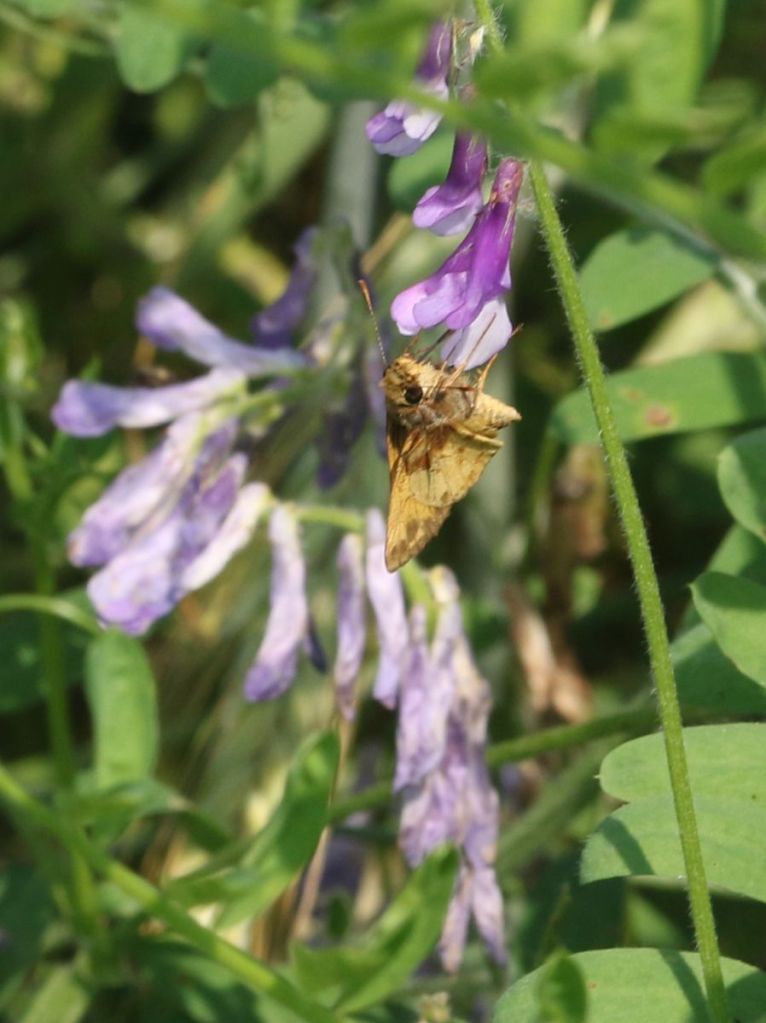
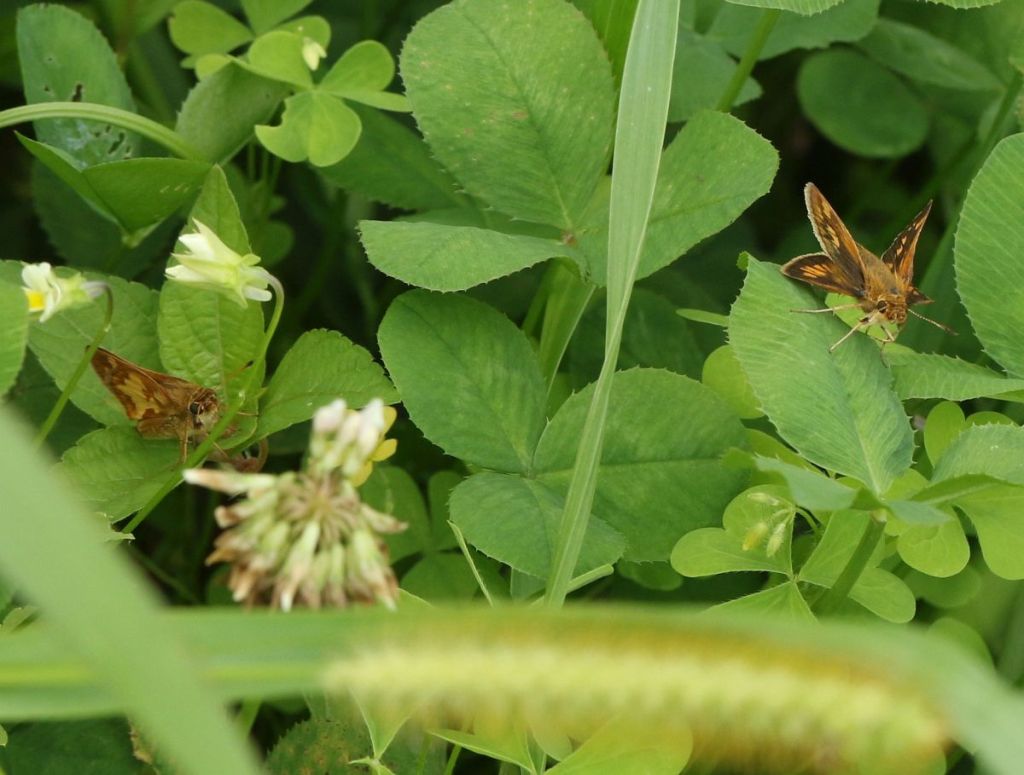
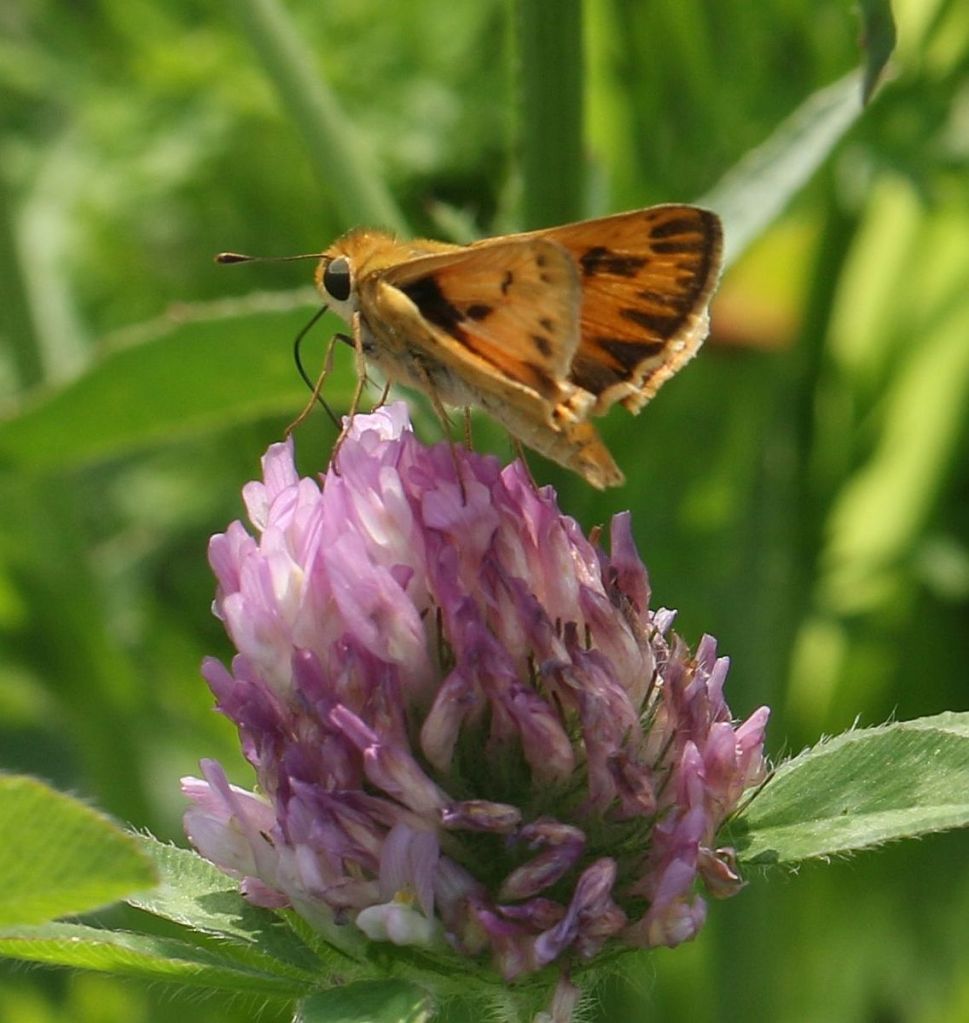
A Zabulon Skipper on Bird/Hairy Vetch at Ironwood Farm.
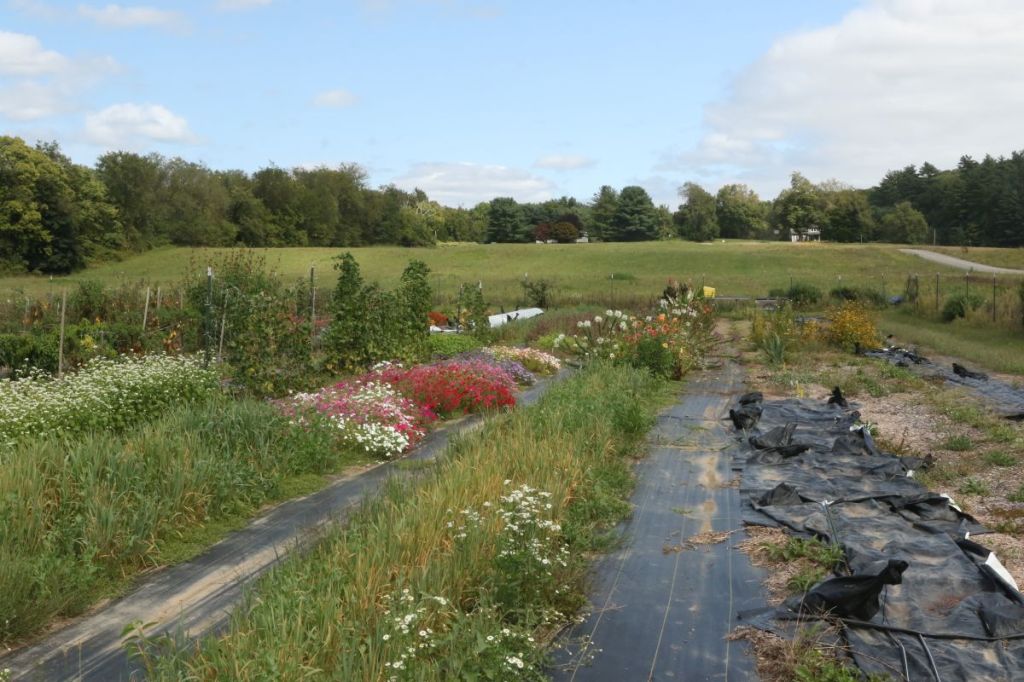
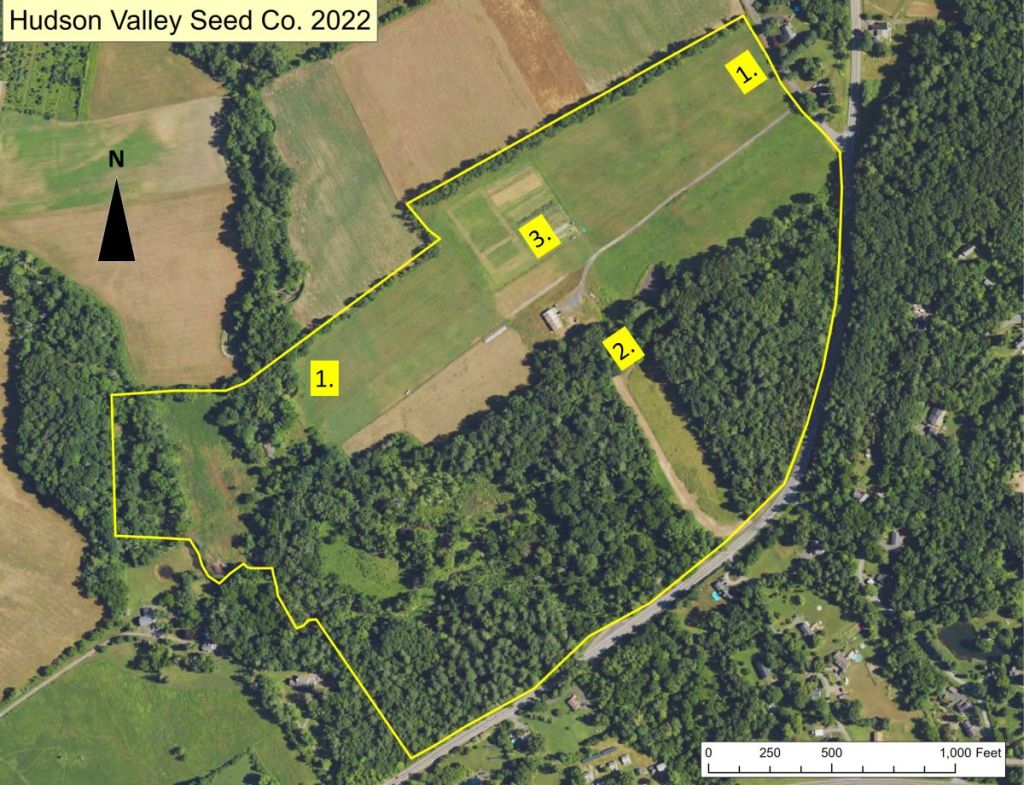
Looking northeast from around # 3 on the below aerial. We are standing within the main gardens on the site.
The new facilities of the Hudson Valley Seed Company are located on Airport Road in Kerhonkson, Ulster County, NY. This business mixes seed production (including of native wild flowers) and artwork in order to encourage and facilitate gardeners.
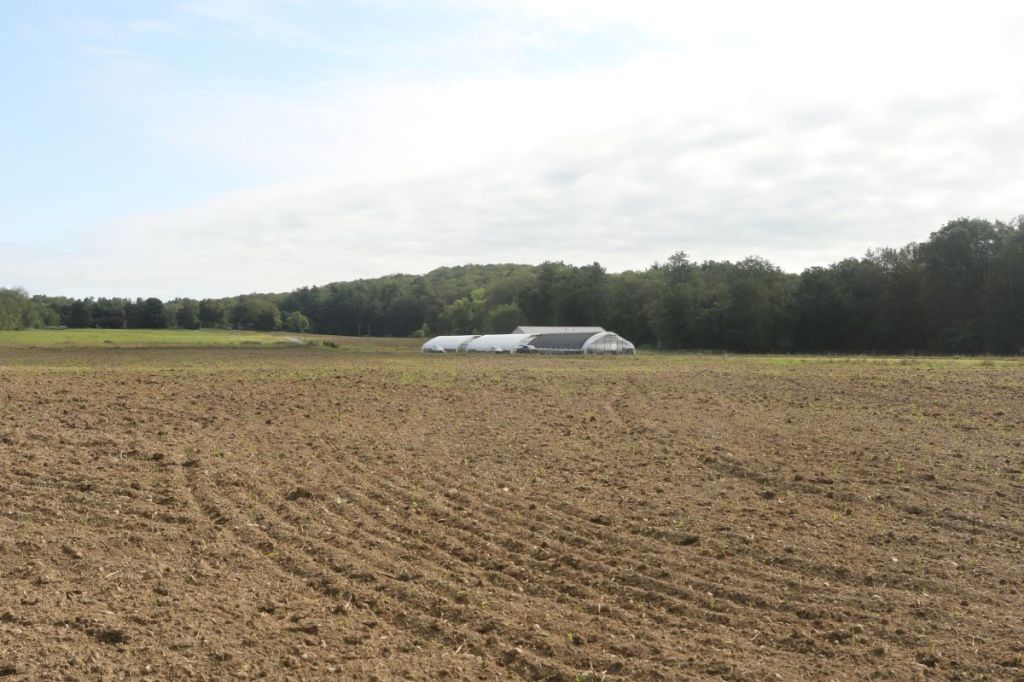
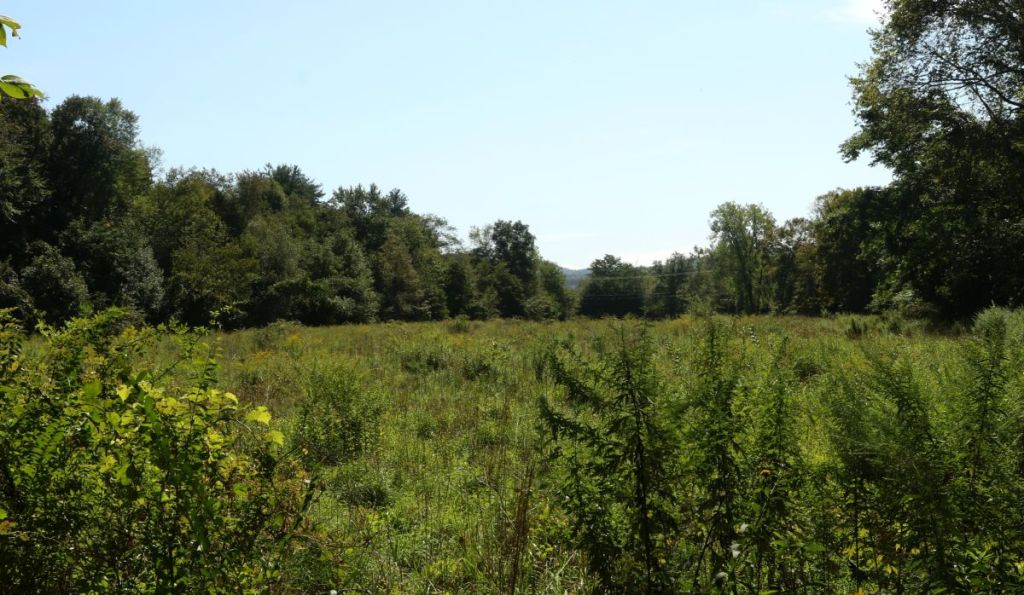
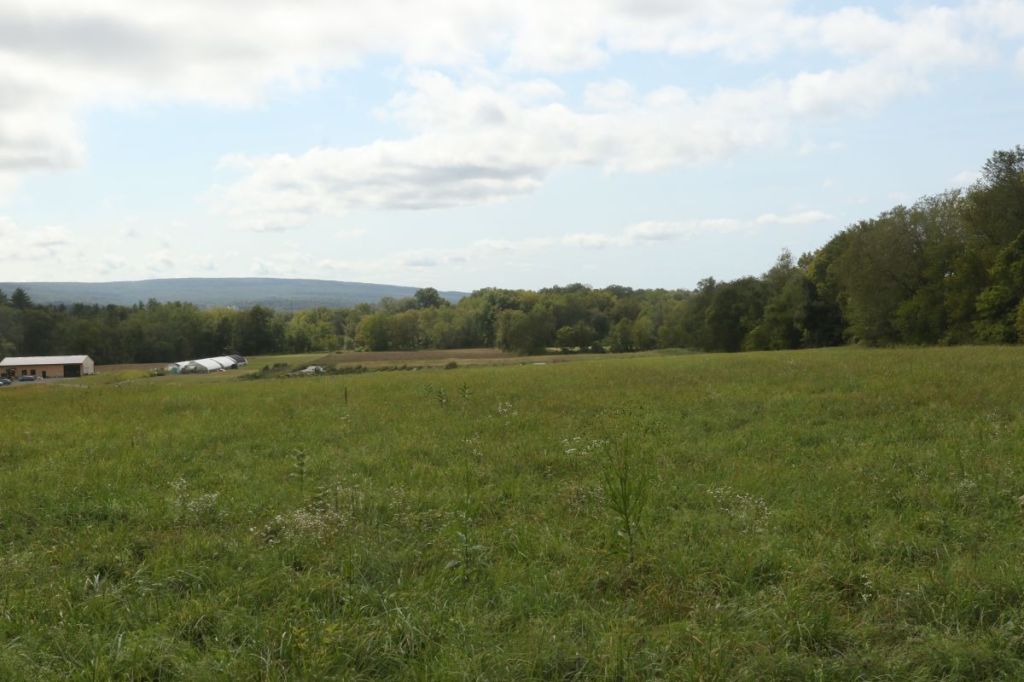
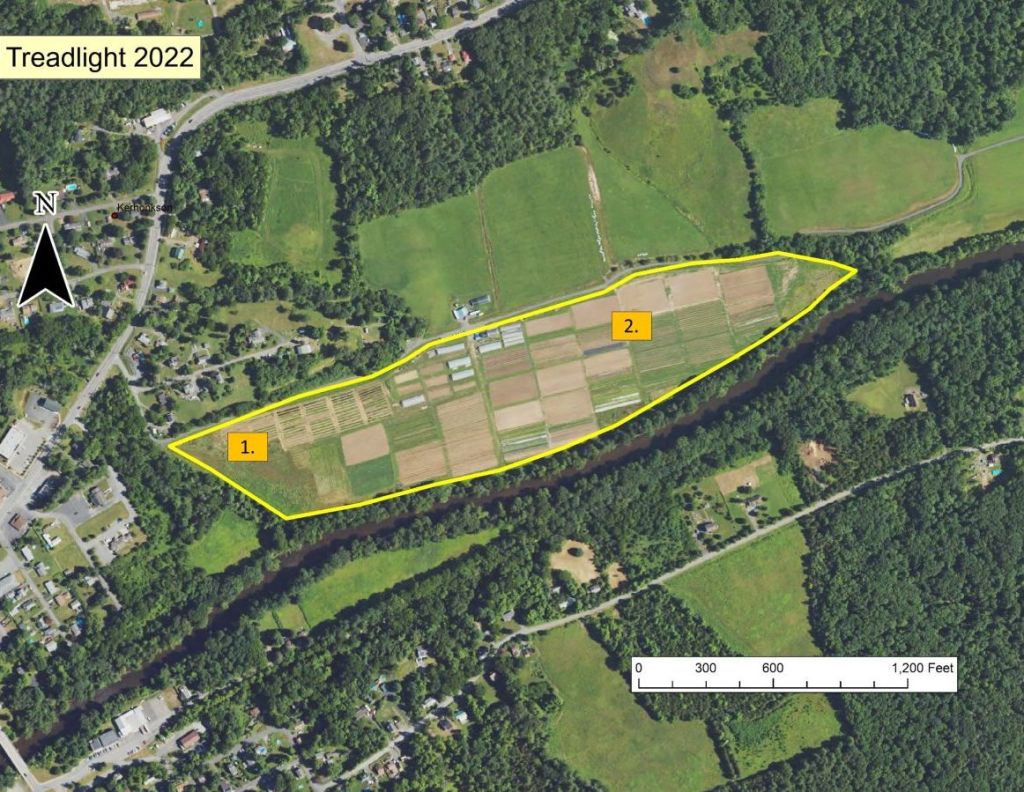
A 2022 image of the land of the Hudson Valley Seed Company, with numbered squares indicating the approximate locations from which the accompanying landscape shots were taken.
The semi-open area through the woods about 600′ due south of the #1 is the wetland that Claudia profiled in her earlier plant posting. In that same post, Claudia also describes the botany of other parts of the property. The earlier posting on creekside beetles was based on observations made just a short way southwest of #1.
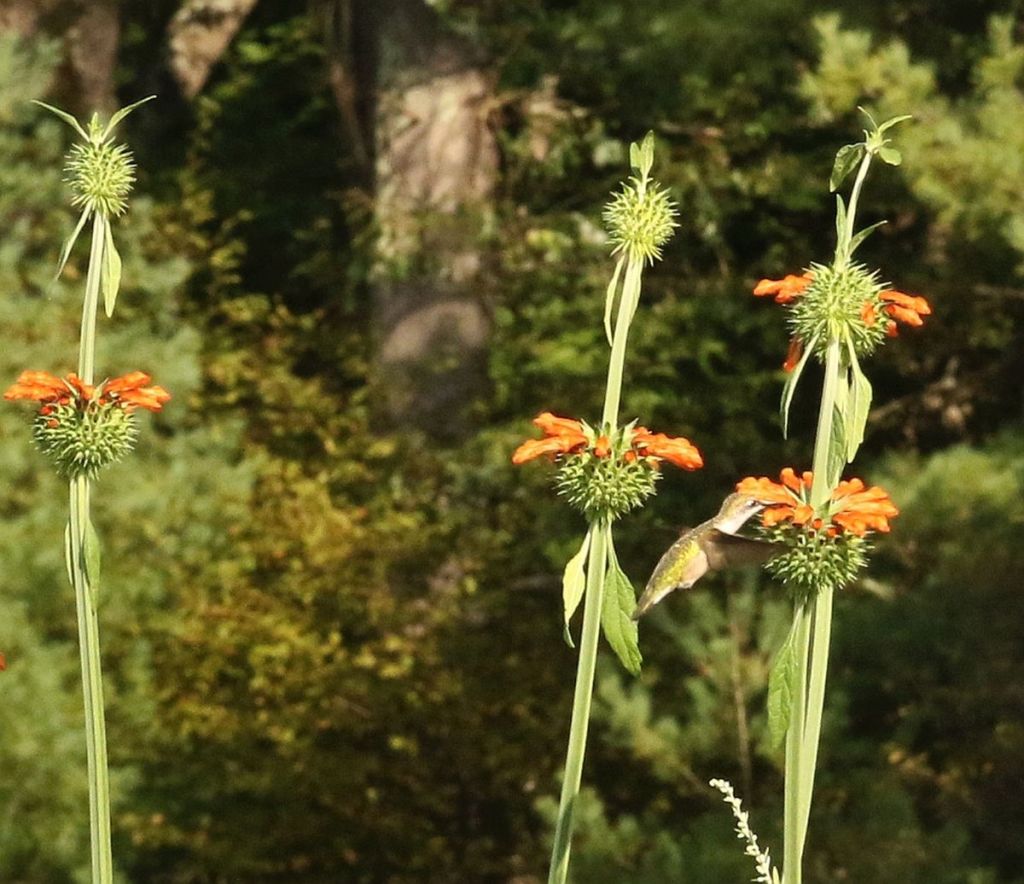
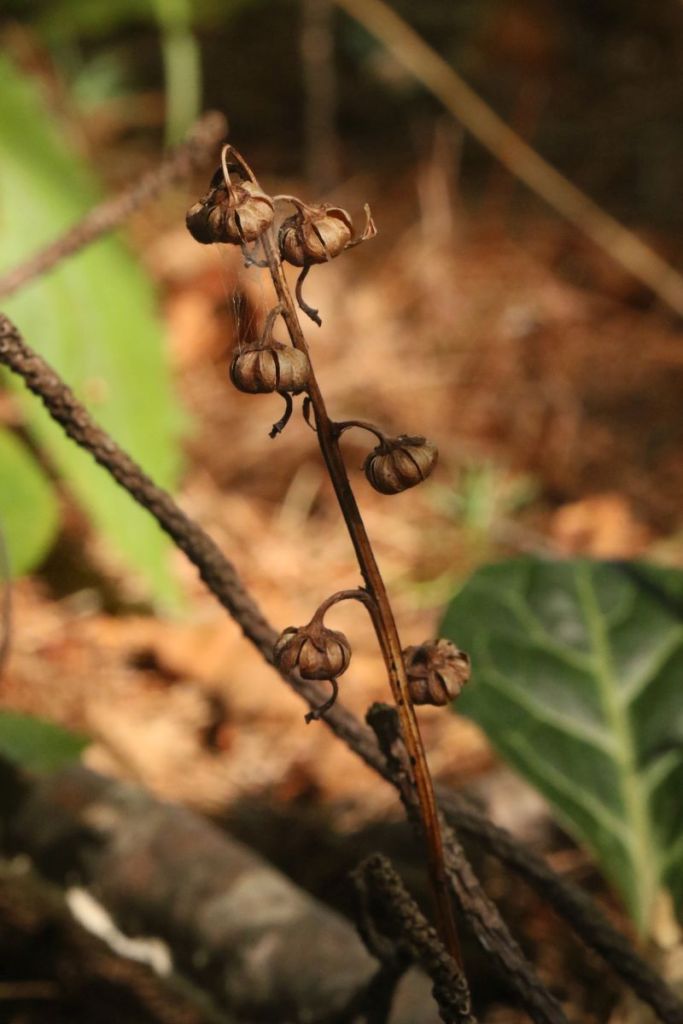
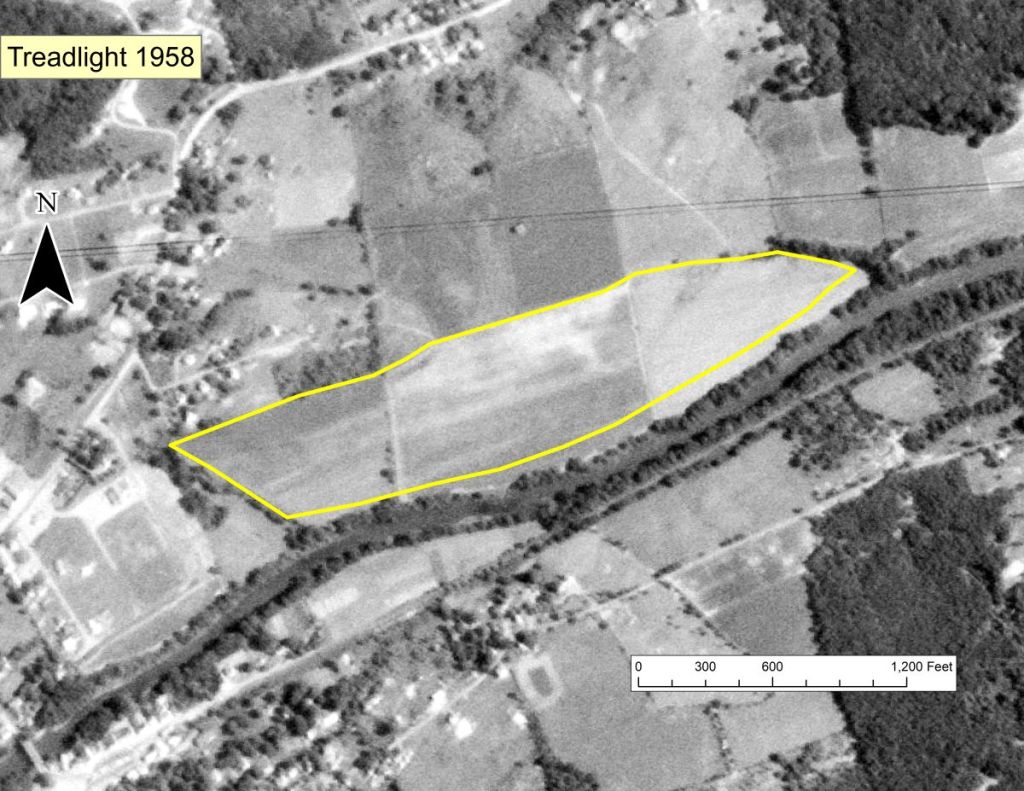
A 1958 image of the same land. Portions of the forest in the southeast half of the property appear to still be growing in this era. Looking northeast from #1 across what was, at the time of the photograph, a relatively freshly ploughed field. Looking south-southeast into the clearing from #2.Looking southwest from #3. The building in the center left is the new shop and processing facility .OK, so it’s not an insect. A female Ruby-throated Hummingbird takes a nip at Klip Dagga (Leonotis nepetifolia), a cultivated species in the mint family.Ooops, not an insect either. These are the ornate seed heads of Shinleaf (Pyrola elliptica), a wild-growing plant found in a damp, wooded area just northeast of #2. I stumbled on it while looking for butterflies. The (blurry) dark green leaf with white veins hiding in the background also belongs to this species.
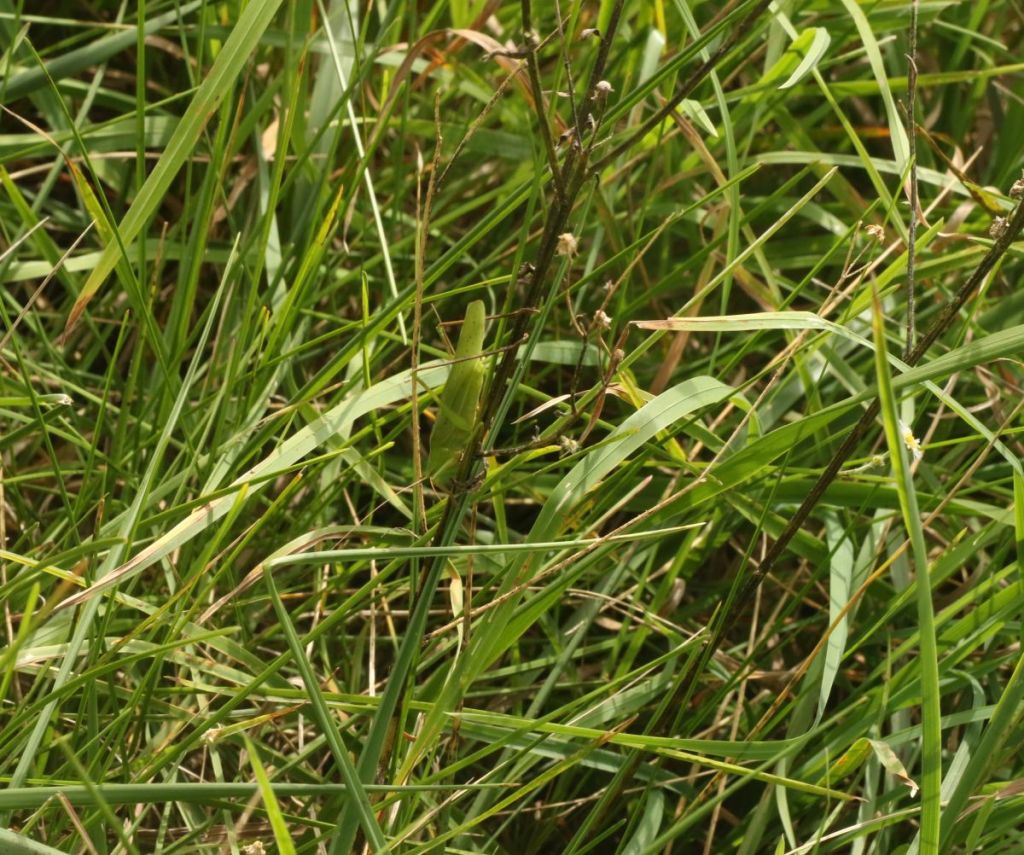
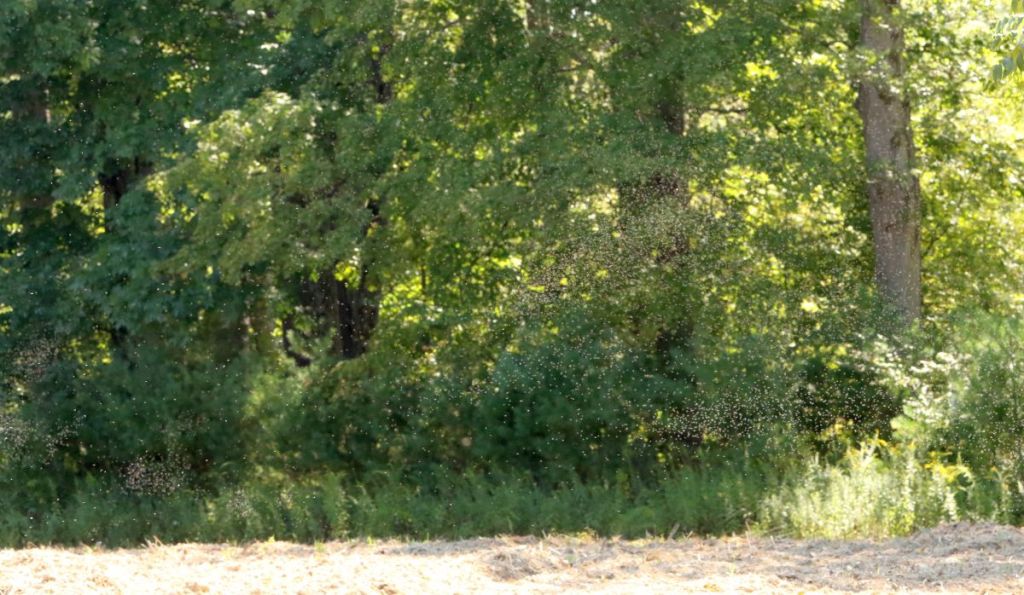
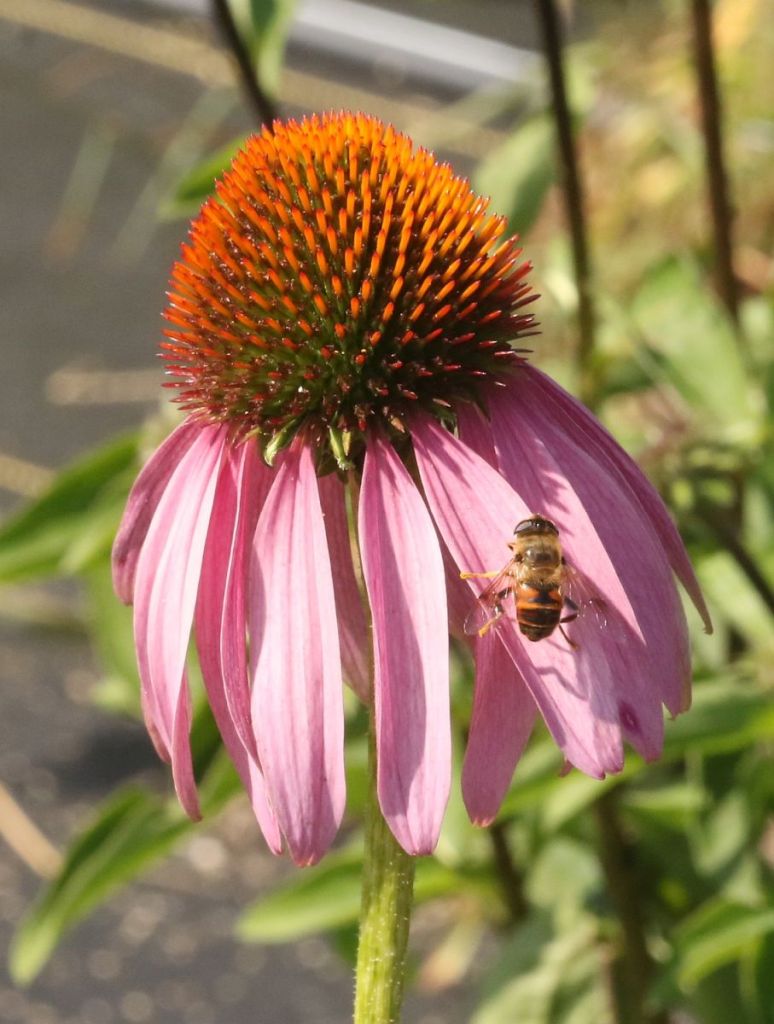
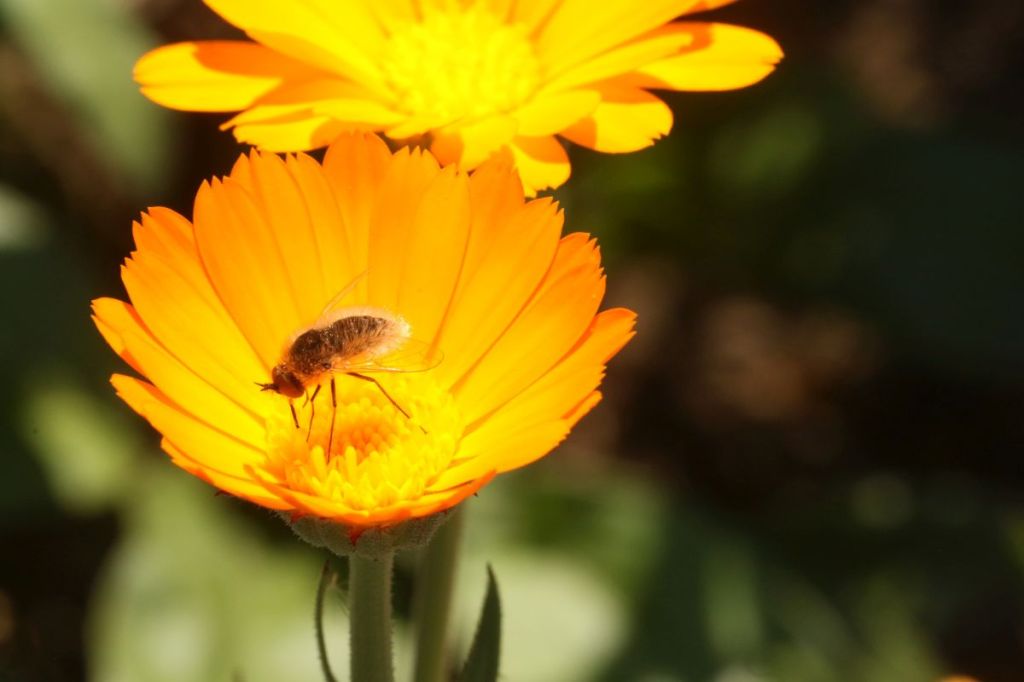
More plants, just an assortment of grasses. No, wait a second, there is an insect. Do you see it? It took me a while to figure out why I had taken this photograph. Coneheads, such as this appears to be, are among the singing insects of late-summer grasslands and edges.Another field singer was this female Short-winged Meadow Katydid. They reportedly have a relatively broad diet, eating not only plants but other insects such as aphids.The insects in this image are also not conspicuous, although video would have made them more apparent. Above the ploughed ground in front of the forest are clouds of small creatures whose dancing swarm was especially evident when seen in motion.Here, they appear as a light brown dappling in front of the foliage.Capturing one of these swarmers in a butterfly net, reveals a small fly, perhaps some sort of midge. The wavering clouds are thought to be part of their mating ritual.While we’re on flies, here’s an introduced species of drone fly; it is thought to be a mimic of Honey Bees. We’ve already seen it in at least one previous post.These fuzzy, long-legged flies are called bee flies.
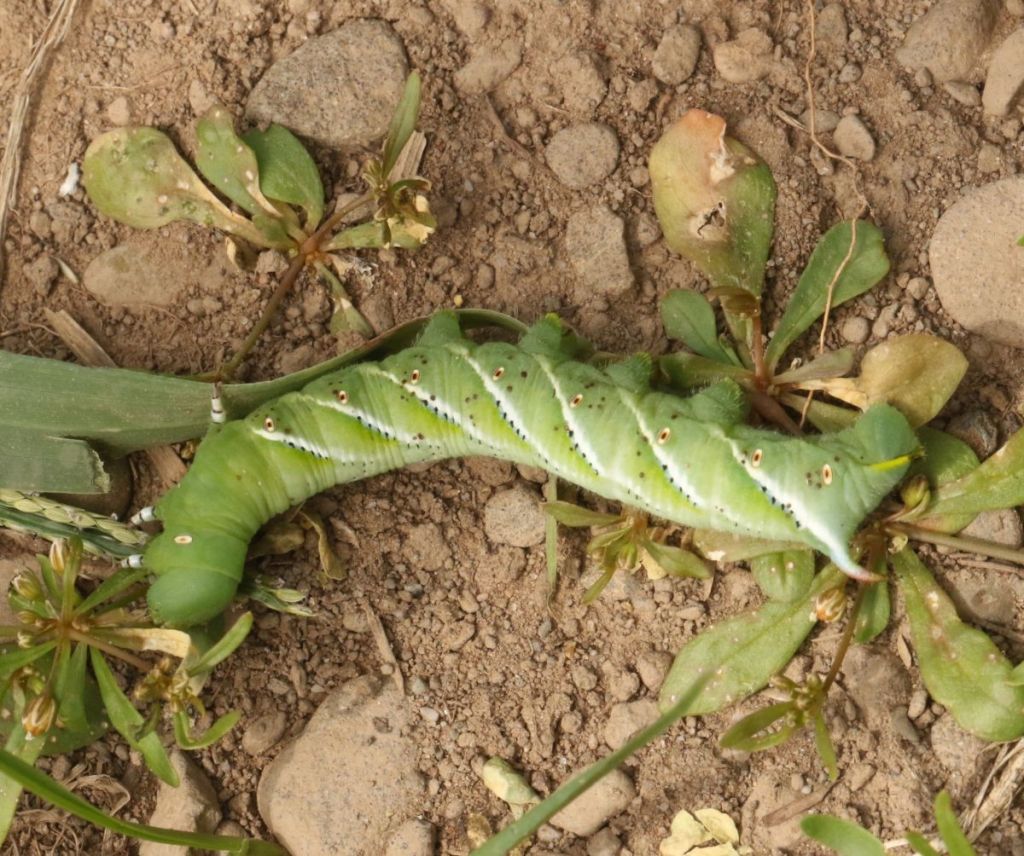
As adults, bee flies seem to be avid nectar feeders, and, while they do not appear to intentionally collect pollen, pollen does sometimes gather on their furry bodies. They are parasitoids, laying their eggs near those of a variety of insect hosts. The bee fly larvae hatch and proceed to eat their host’s larvae. At least some species reportedly have an interesting pattern of coating their eggs in sand and then aerial dropping them into or near the burrows of their hosts. The young of ground-nesting beetles, wasps and bees seem to be the most common prey of bee fly larvae.Speaking of parasitoids…. this Tobacco Hornworm (Manduca sexta, the caterpillar of a sphinx moth) was found near the tomatoes seen in the garden shown in the first photo.
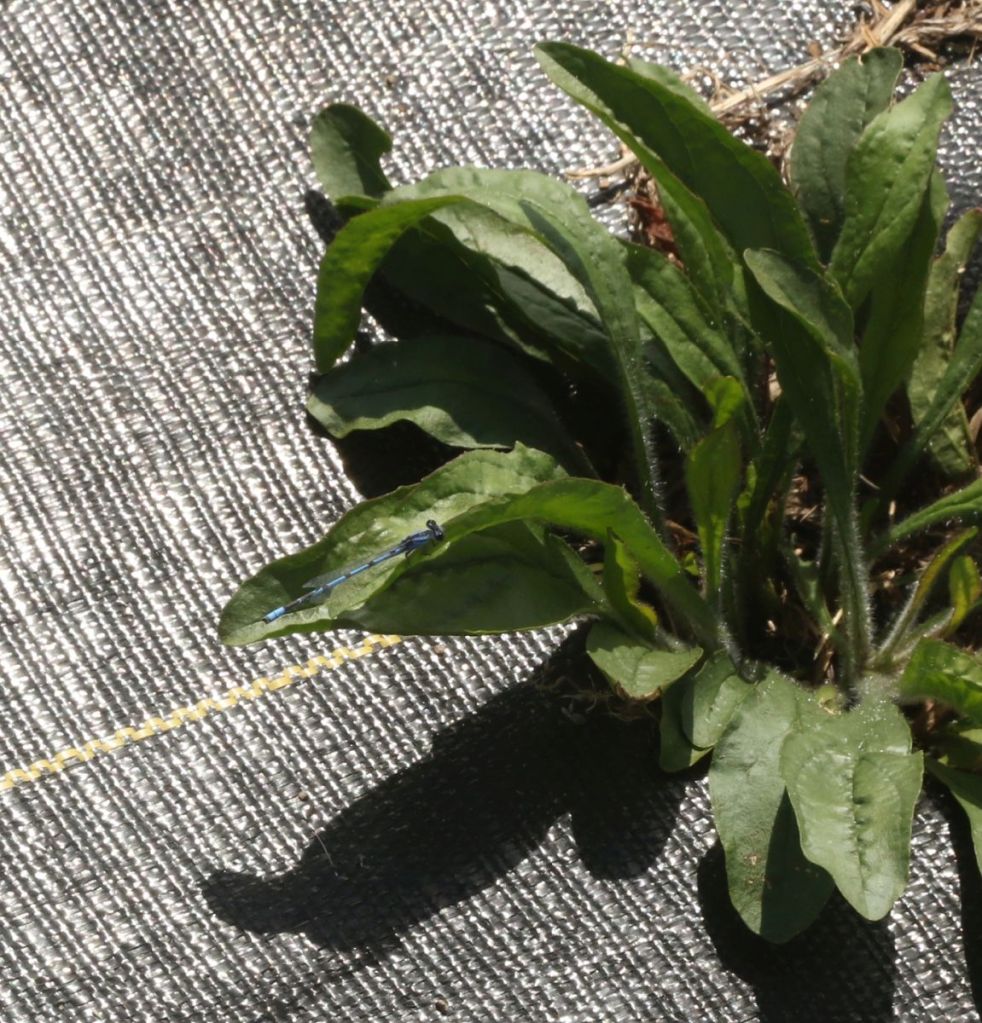
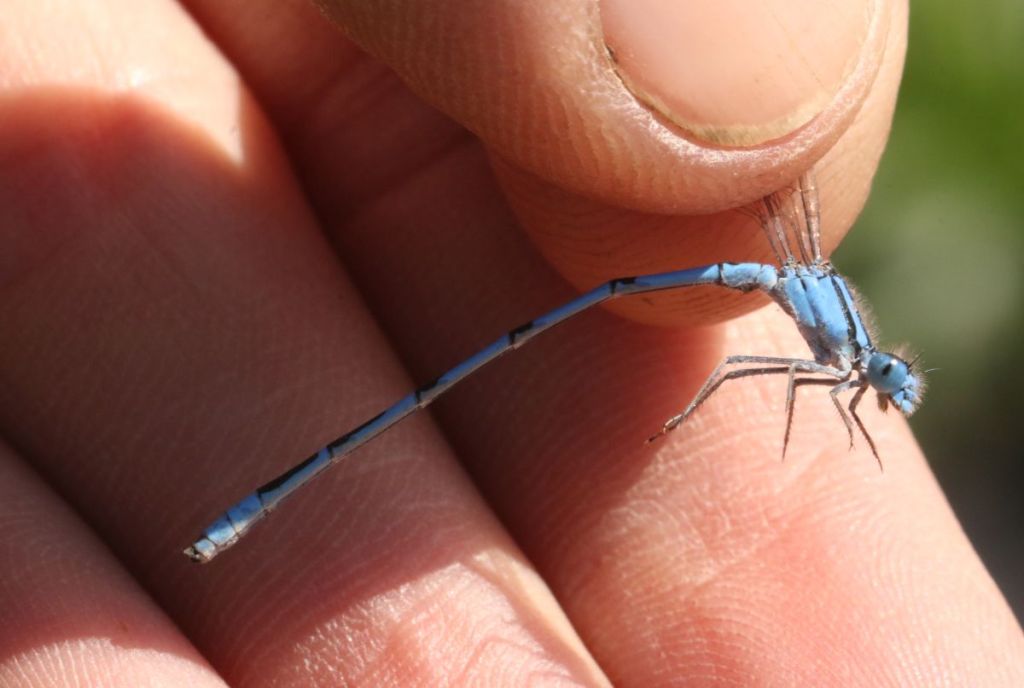
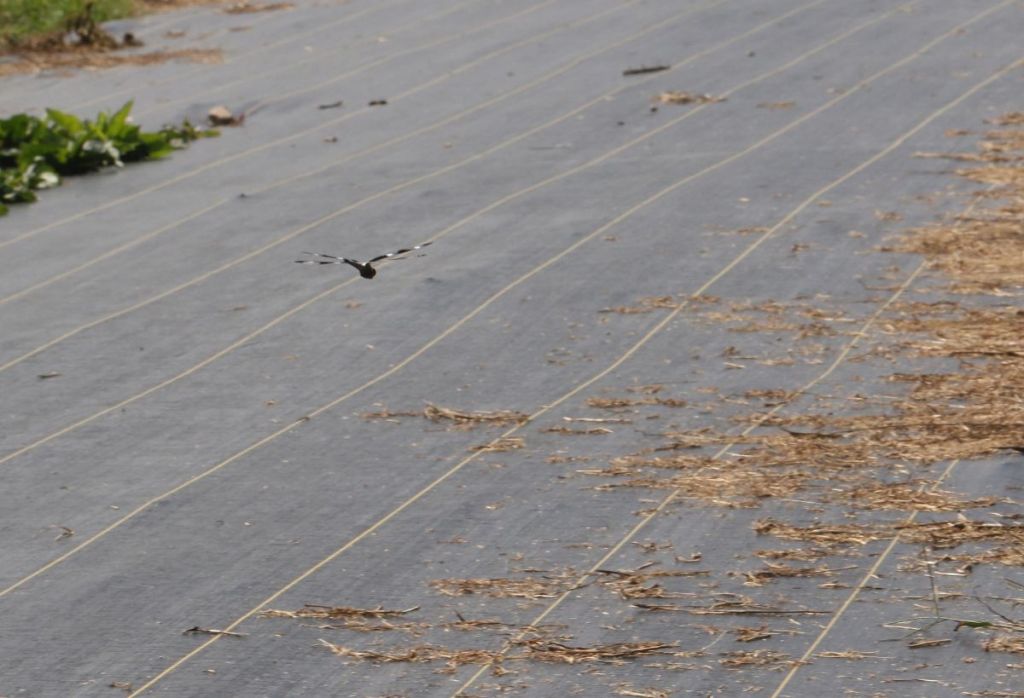
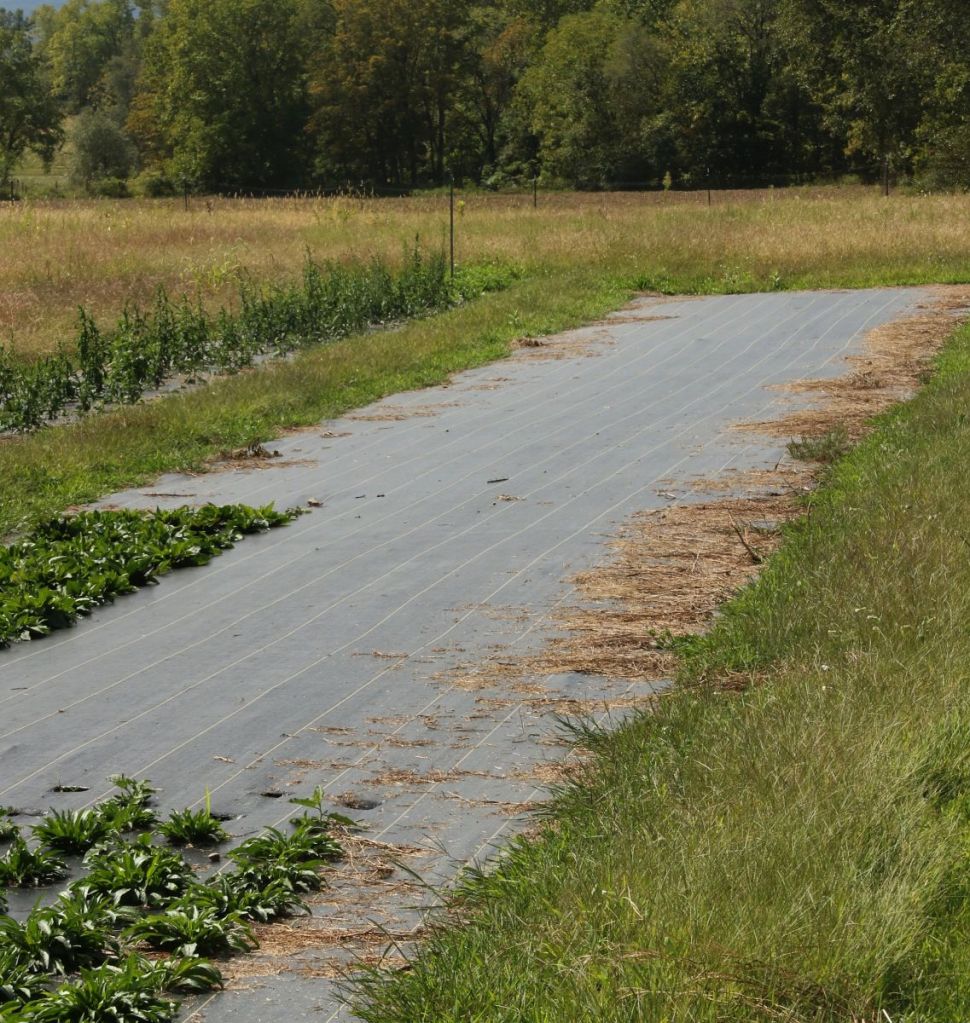
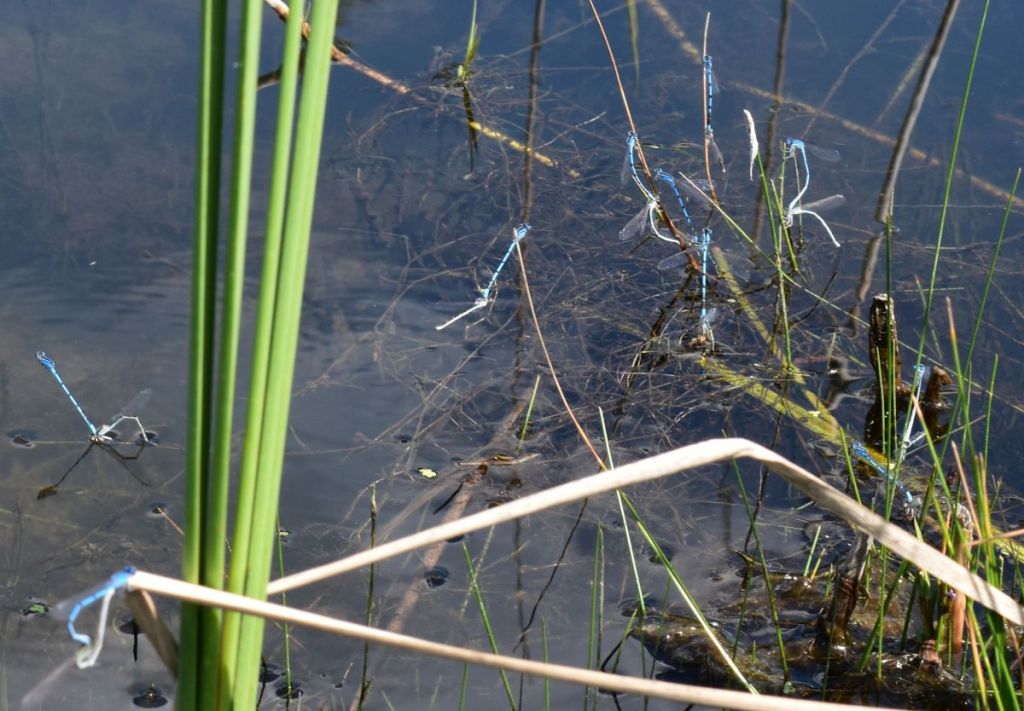
Tobacco Hornworms sometimes host a parasitoid wasp who, upon pupating, can cover a caterpillar with what looks like a coat of small rice grains. While none of those pupae are visible on this individual, the random dark points (not the ones along the white lines nor the bullseye spiracles) on its skin may be the work of a wasp. The closely related Tomato Hornworm (Manduca quinquemaculata) also occurs in our area and both species eat tobacco and tomato; both are also affected by parasitoids.What appears to be a Familiar Bluet (a type of damselfly) was hanging out on this a poking through ground cloth. As shown by the bottom photo, moderately certain ID required live-capturing one for a closer look.Twelve-spotted Skimmers and some other dragonflies patrolled overhead. Why?A ground-cloth pond?
Such a cluster of dragonflies and damselflies would make sense were there swarms of their insect prey in the air but, so far as I could tell, such prey were not particularly abundant. Watching further, I saw some dragonflies periodically dive down as if trying to touch the ground cloth with the tips of their abdomens. This behaviour is similar to what females do when depositing their eggs in water, and I am guessing that these insects were actually mistaking the smooth, reflective ground cloth for open water. Have any of you ever noticed something like this on your own farms? If so, I would be curious to hear about it.
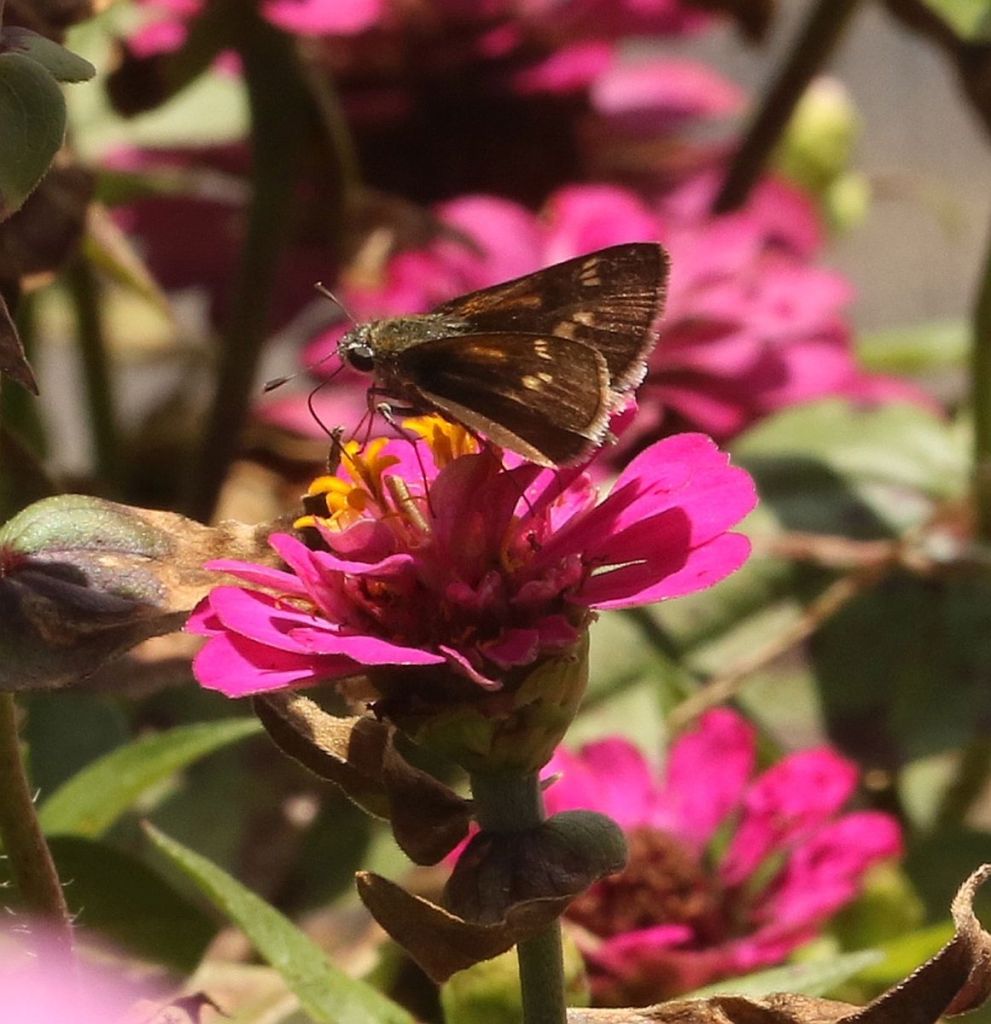
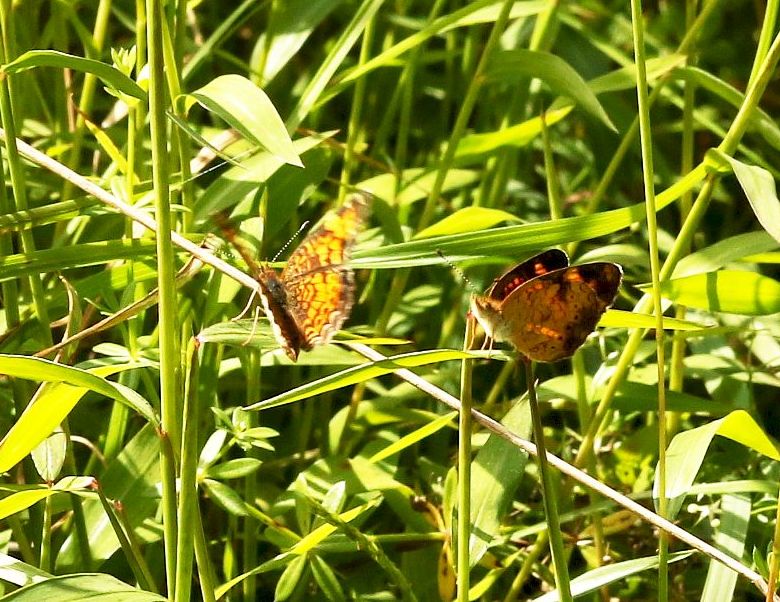
Turning finally to butterflies, I believe this is a Northern Broken Dash skipper, one of the three, hard-to-identify ‘witches’. It gets its name from the pattern formed by a dark band of pheromone-producing cells on the wings of the male. This, however, is a female. The caterpillars feed on an array of grasses. It is neither a particularly rare nor common species.Meadow Fritillaries are trim, middling-sized butterflies, who seem to be rarer than they ought to be given the prevalence of the violets that their caterpillars eat.
In general, probably because of the lateness of the season, butterflies were not particularly diverse during my visit. The rarest butterfly spotted was one of the so-called Emperors (either a Hackberry or Tawny Emperor); unfortunately for this post, it flew away before I could get a photo.
This is the last butterfly post of the season, and you should now be well-versed in our common butterflies. So, as your final exam, here are five relatively common butterflies photographed at the Hudson Valley Seed Company…
1) Who is this butterfly and, for extra points, is it male or female?2) And what about this one? And, again, extra points for male or female.3) And whose is this northern interloper?4) And this one (whose females are sometimes white and sometimes not)?5) This one gets its name from the lighter colored patch visible in the darker, underside field along the hind edge of the rear wing as seen in the right butterfly. Who is it?
Zinnias in a bed at Treadlight Farm, Kerhonkson, NY.Treadlight leases land from Arrowhead Farm. The yellow outline is not a property line – it is the deer-fenced, ca. 33.4 acre plot of land that contains Treadlight’s leased production fields, together with those of Long Season Farm. Numbers refer to the approximate locations of the landscape photographs below.These fields, located in the floodplain of Roundout Creek, have long been in production.Looking east-northeast from point #1, along some of Treadlight’s flower beds.Looking south-southwest from ca. point #1, across the fallow land at the west end of the fenced in parcel.Looking south from point #2 across some of Treadlight’s flower beds and, in the distance, some Long Season fields.Looking ca. east-northeast from near point #2, across the flower beds (whose posts are propping up a couple of King birds) towards fallow beyond that.This photo, taken from a point near the greenhouses, and looking west along the north fence, shows the lush edges found along the fencelines.
Treadlight Farm is an organic flower producer with a partial focus on raising native wildflowers for seed and retail. Its beds are located on leased land in the floodplain of the Roundout Creek. When I visited on 5 August, some beds were winding down. Most of the land is occupied by tilled flower and vegetable fields, the latter being worked by Long Season Farm; greenhouses are also present near the center of the area. The east and west tips of the parcel are fallow (or perhaps better, ‘old-field’) areas that appear to have been mowed occasionally.
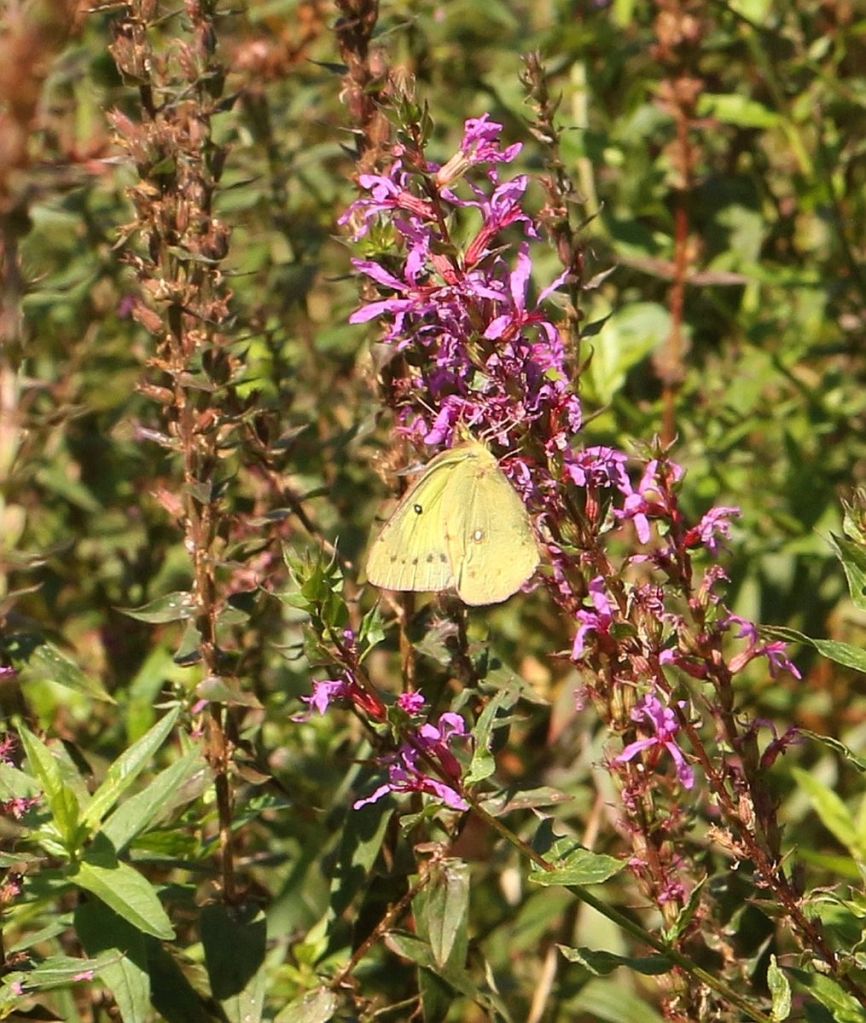
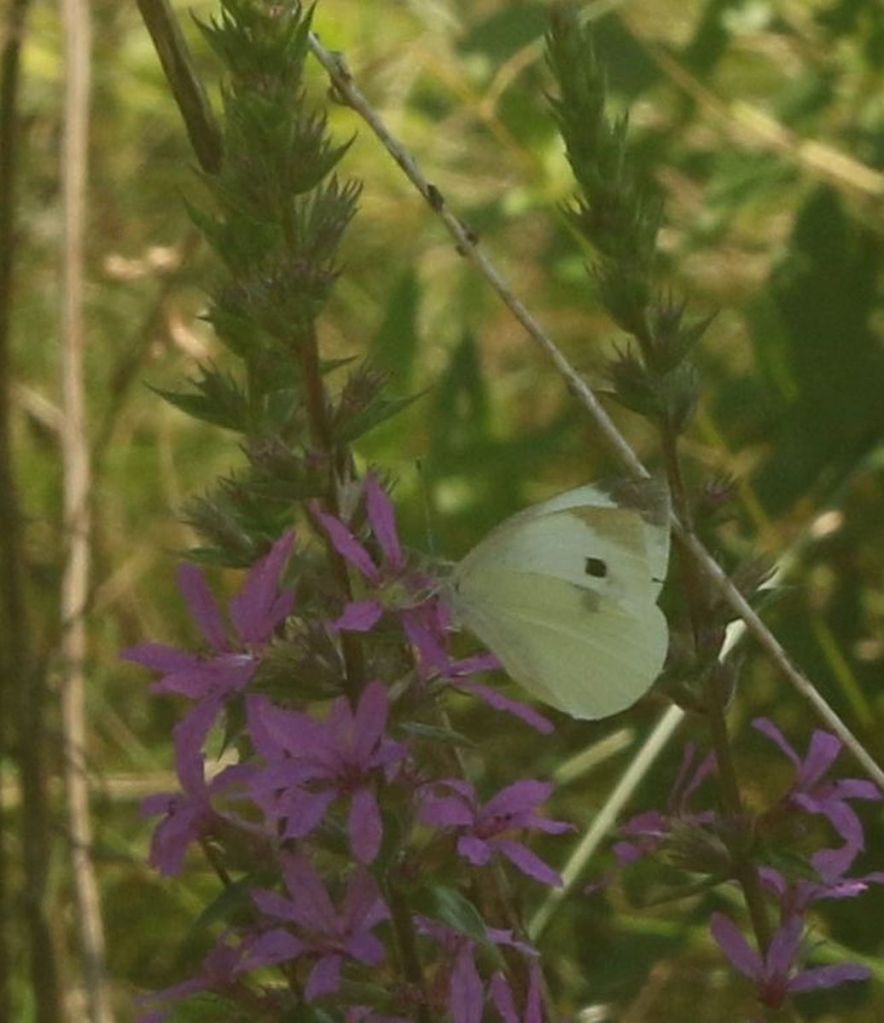
The butterflies included many of the usual cast of characters you should have come to expect if you have been reading these blogs. This shaded Cabbage White is hanging out on Purple Loosestrife, in the fallows at the very western end of the parcel.
Cabbage Whites (a European species that took hold here in the 1860s) and the Clouded Sulphur (a native) were two of the most common farm-field butterflies in our surveys, together they accounted for roughly 44% of the ca. 1500 butterflies we noted across all nine participating farms. At Treadlight, they accounted for slightly less – around 36% of the butterflies we spotted.There are actually two species of butterflies in this shot, do you see them? The most obvious is a handsome Eastern Tiger Swallowtail. For open areas, we classify this species as, ecologically, a “Visitor”. Its caterpillars feed on a range of woody plants including cherries and ashes. However, it seems to happily visit field flowers to drink nectar. A Clouded Sulphur is flitting behind it. I have several pictures of this Sulphur ‘buzzing’ this Swallowtail. Maybe it wanted to share the flower?Monarchs were also present and nectaring at various flowers, including these Zinnias.
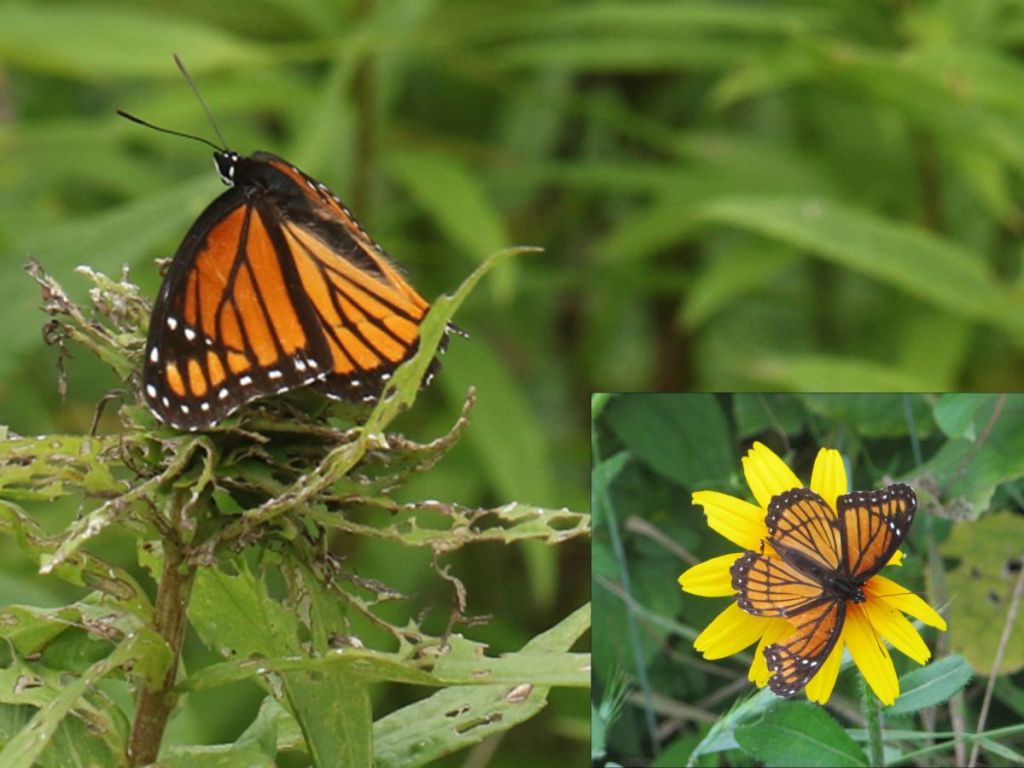
Treadlight accounted for about a quarter of all the Monarch sightings during our surveys. However, they were notably less common this year than during some past years – on 10 Sept. of 2021, on the same type of flower and on the very same farm, we had over 130 Monarch sightings in 30 minutes; our tally this year, during roughly four hours, was a relatively meager 16. Assuming Zinnia = Zinnia (not necessarily true), a variety of factors including migration patterns, weather, and fluctuations in the regional abundance of Monarchs might explain this. The Monarch look-alike, a Viceroy.
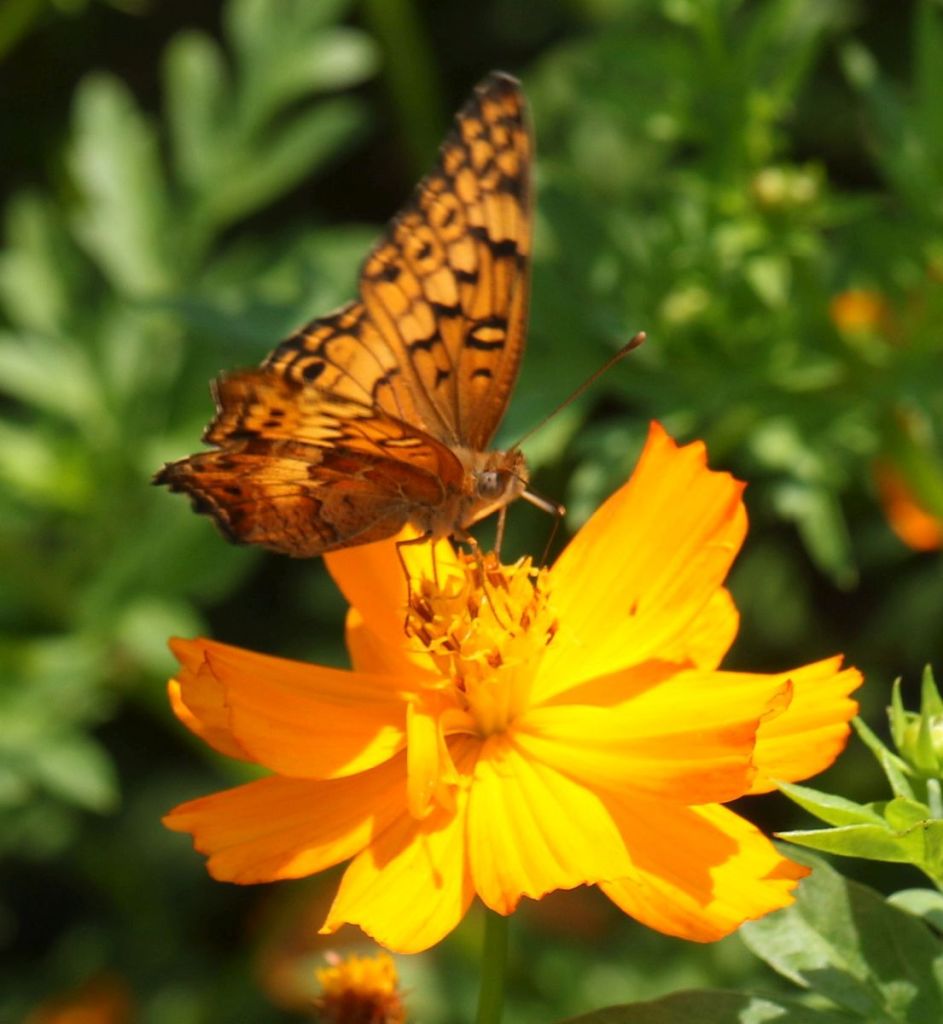
Viceroys are slightly smaller than most Monarchs, and their caterpillars feed on woody plants, such as Cottonwood. This individual is playing hard to ID – one key character to distinguish the two species is a black line which extends through the Viceroy’s hind wing parallel to the outer margin and about half way from the wing edge to the wing base. This is clear in the inset photo showing a rather battered Viceroy, photographed by our program at the Farm Hub. The subject of our main photo only has a faint suggestion of this line.In contrast, Variegated Fritillaries seemed to be having a banner year – after having gone through various years without seeing them, we found them on three different farms. This is one of the several southern butterfly species who wandered north this year.This American Lady looks like it may have had a brush with a bird.
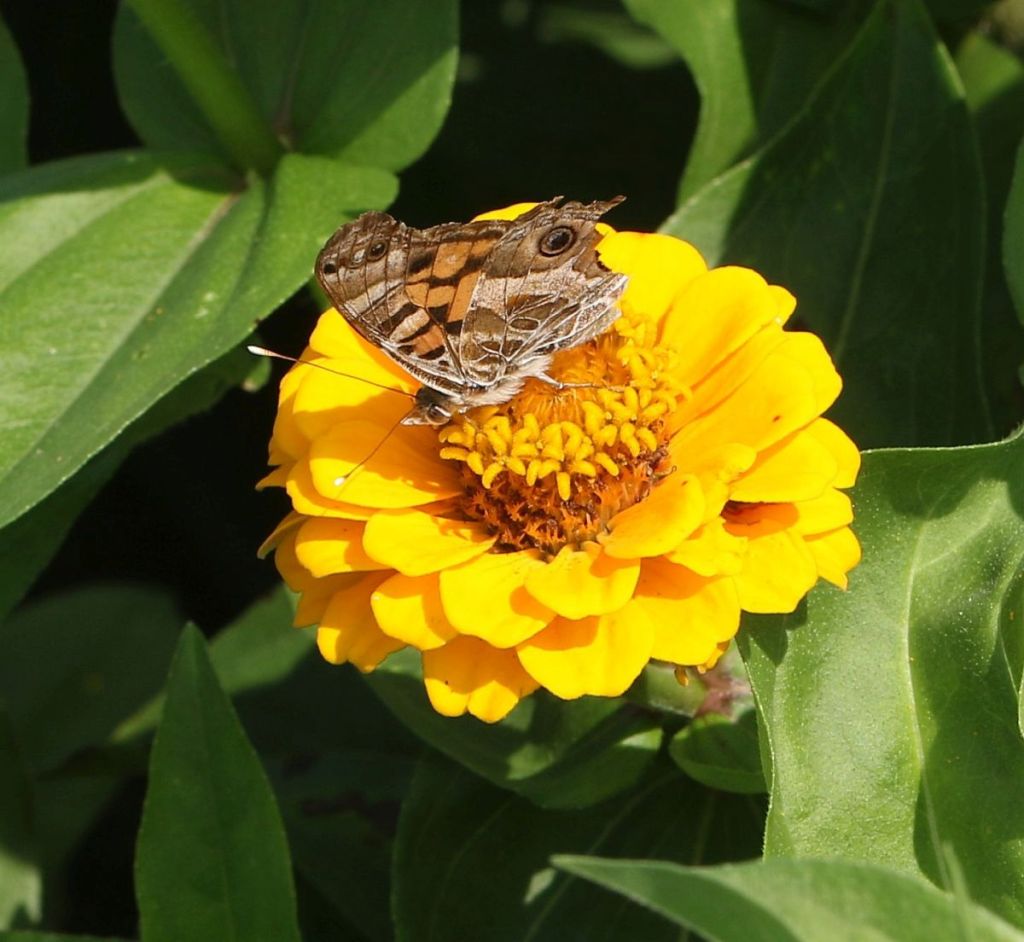
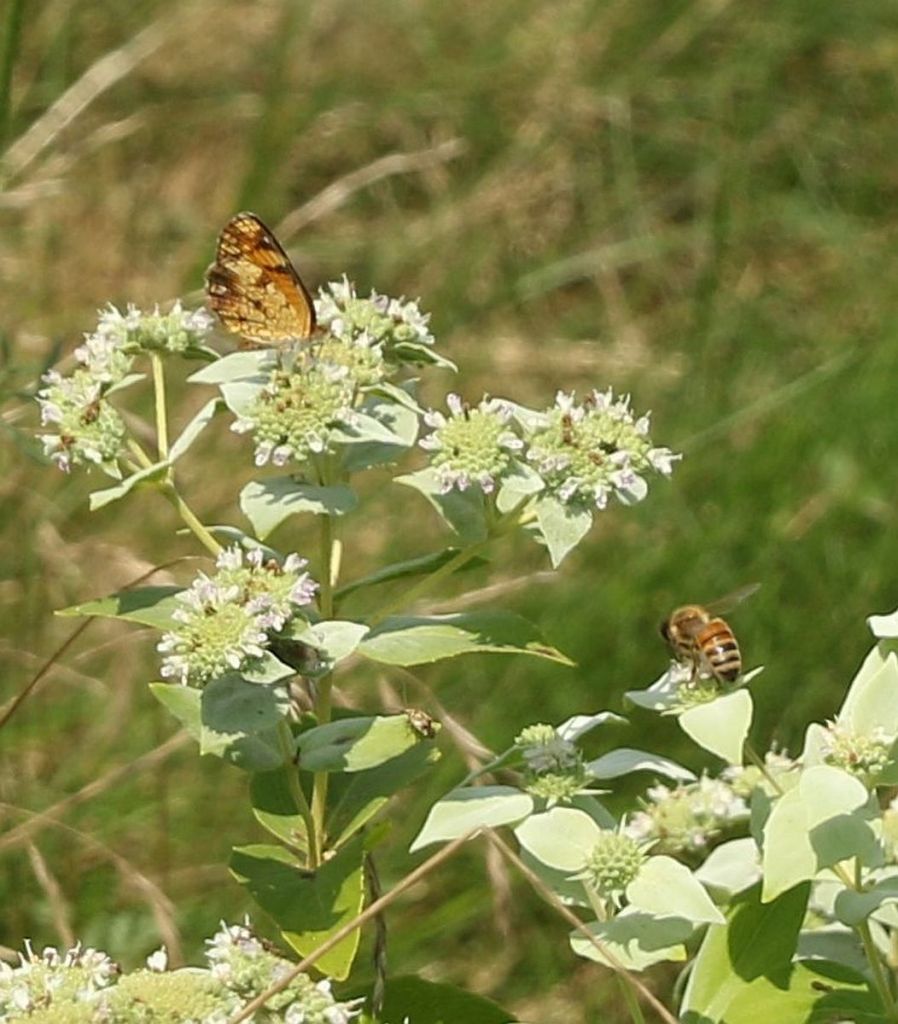
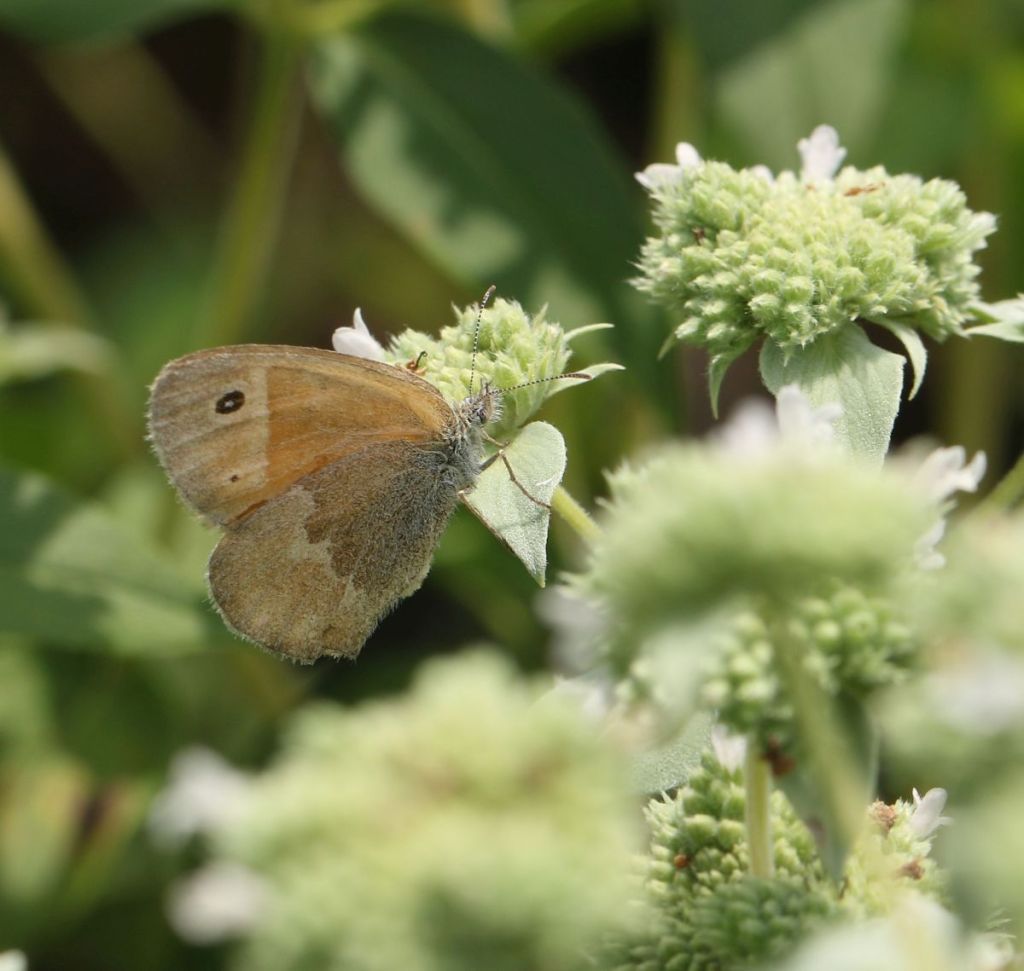
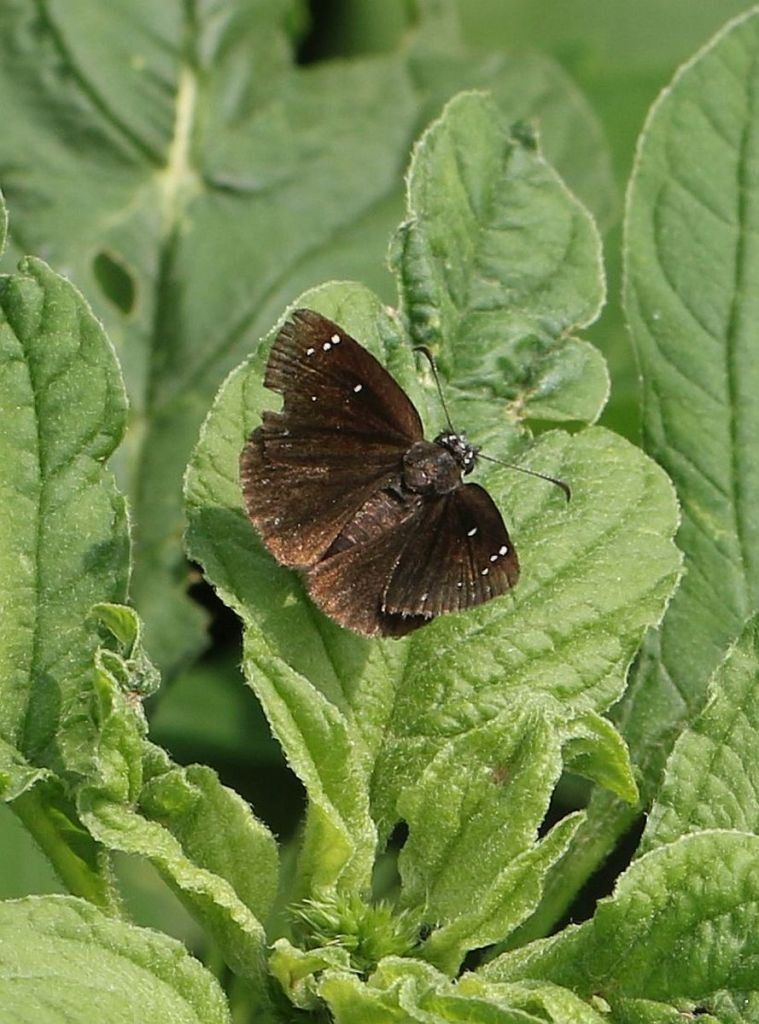
The large eyespots on the hindwing (one of which is now missing on this individual) may lead some birds to make a quick grab at the ‘wrong’ (for the bird) end. The lucky butterfly then lives to nectar another day. American Ladies are, like Monarchs, migratory. They don’t usually survive our Winters, but regularly recolonize during Summer, with late season individuals heading back south. Some of the other interlopers, perhaps including the Variegated Fritillary, have no such return trip – they’re constantly knocking on our door ecologically but, at least so far, most of the new populations that establish here during Summer then perish during the Winter. This might change if climate warming continues.Pearl Crescents were found on all nine farms this year, Treadlight was no exception. Here, one nectars at a mountain mint.Common Ringlet is, indeed, relatively common; it was also found on two thirds of the farms visited this year. This one is also nectaring at a mountain mint. Unlike the southern butterfly species pushing north, this is a northern species who, over the last three decades or so, has come south. Prior to about 1970, in the Northeast, they were not known south of Canada. They moved south because … uhhmm…. err…. ? (There’s A LOT we don’t know about butterflies!)OK, here’s the quiz butterfly for this posting. This large skipper, whose caterpillars are legume feeders, was found on two thirds of the farms we surveyed this year. Who is it?Getting into the skipper motif, this is a Common Sootywing, another one of those slightly more southerly species who seemed to have a good year regionally. The bright white spots on the deep velvety black background make me think of stars on a dark night.
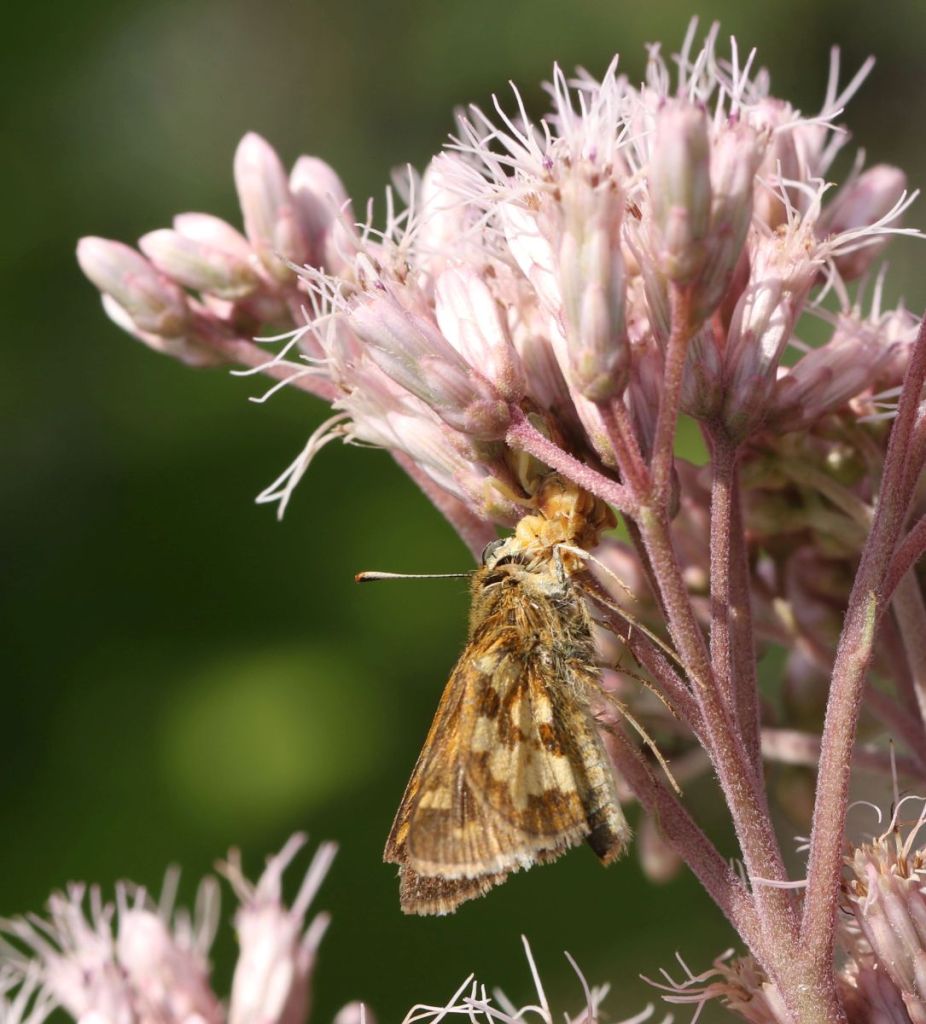
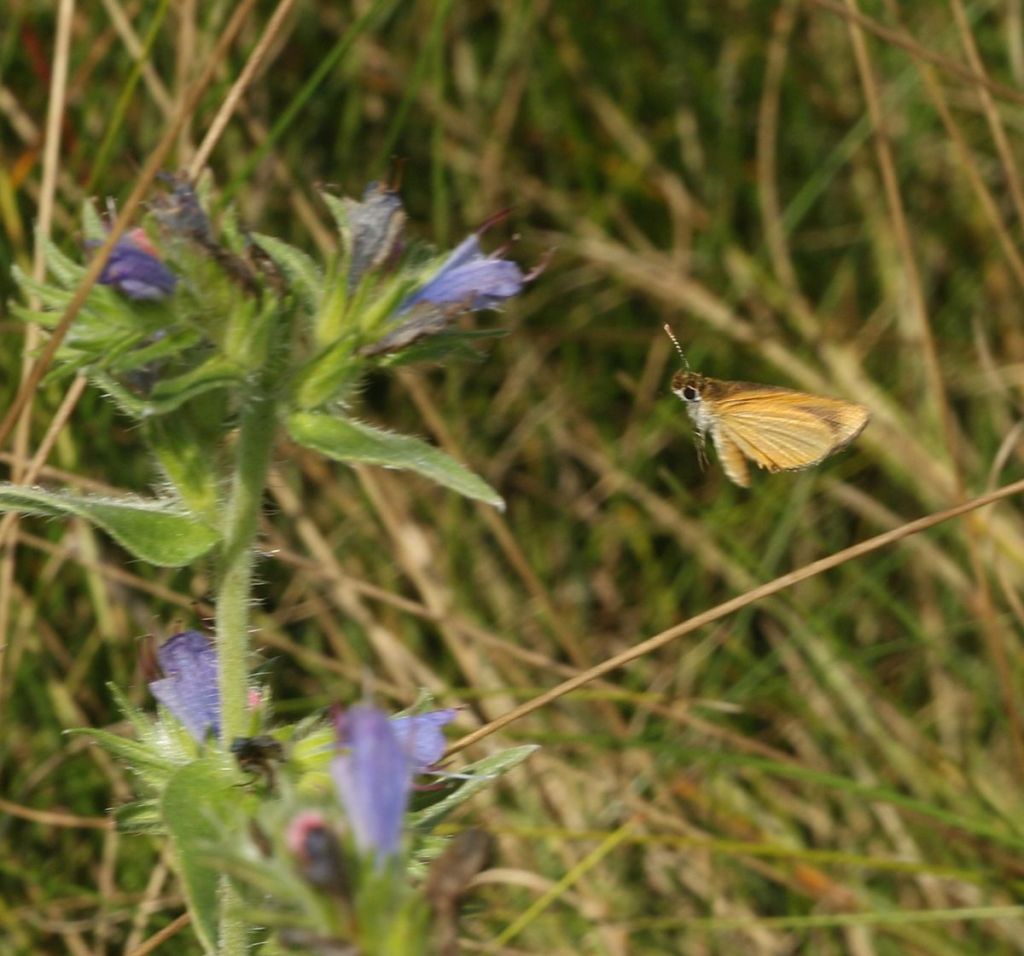
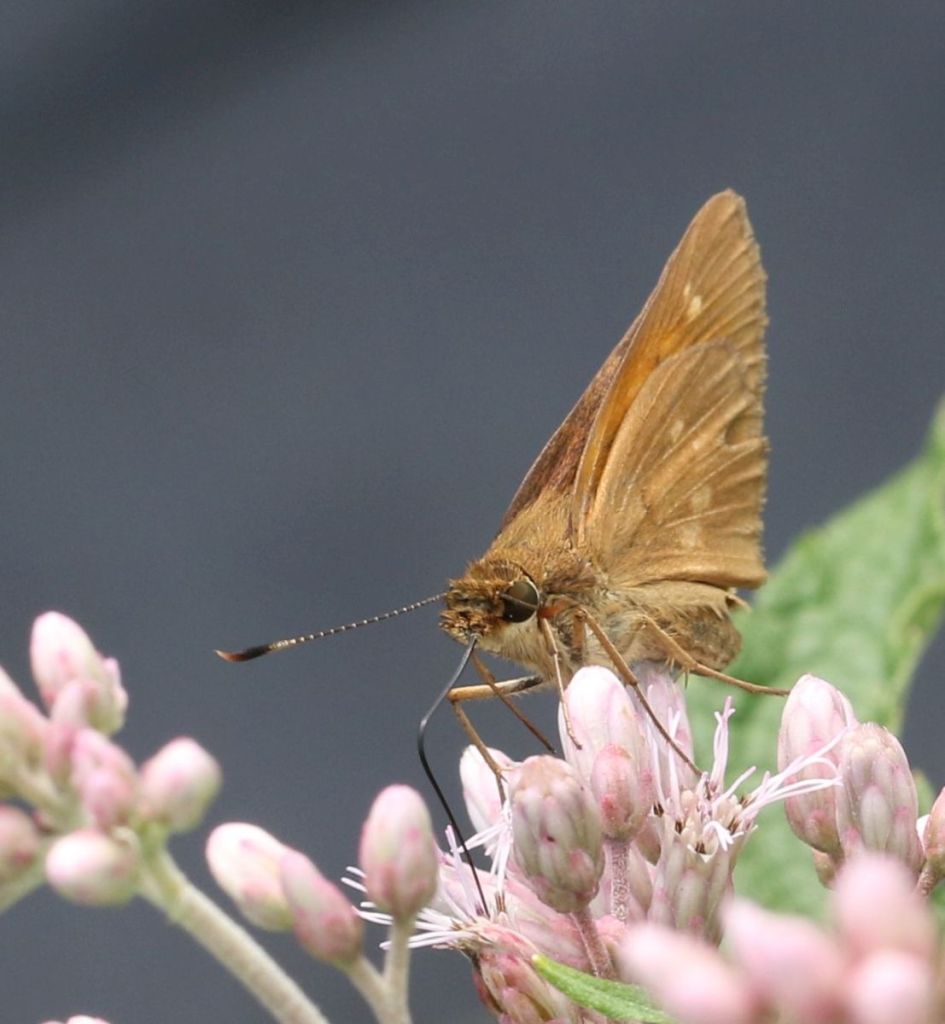
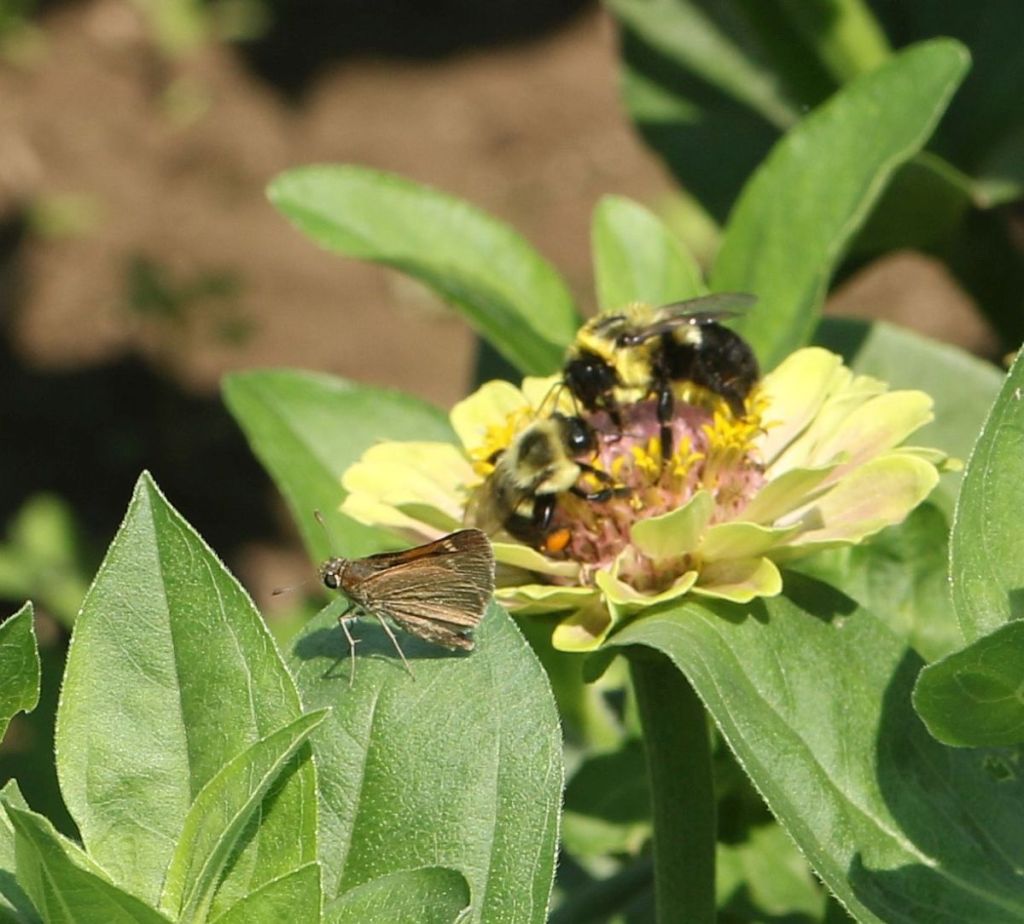
Common Sootywing, while native itself, now uses non-native ‘weeds’ as caterpillar host plants (esp., Lamb’s Quarters). As Cech & Tudor note in their Butterflies of the East Coast (still my all-around favorite East Coast butterfly book), this diet switch has allowed this little butterfly to range much more widely than it may have done prior to European colonization. While we tend to think of native organisms as helpless victims of human encroachment, it is also important to remember they are not passive actors. Genetically and behaviourally, some butterflies and other organisms (including birds, as Will has pointed out) can adapt and exploit the changes around them. Of course, some sadly cannot make the change and gradually disappear.Treadlight was a relatively skippery place. One of our most common ‘grass skippers’ (a group of small skippers whose caterpillars feed on grasses) is usually the Peck’s Skipper, however we noted it on only a pair of farms this year. This hapless Peck’s Skipper has actually fallen prey to an Ambush Bug, whose head is just visible near that of the butterfly.Ambush Bugs have confusing speckling and an odd shape, both of which probably help them avoid detection as they lay in wait in the heads of flowers, like this Joe-Pye Weed. Note those muscular forearms that let them grab the prey that they then subdue with a quick injection of poison.Here, in more uplifting circumstances, two Peck’s Skippers assess each other, perhaps as a prelude to mating.A Least Skipper arriving to Viper’s Bugloss on the wing.A Broadwinged Skipper inspects yet more Joe-Pye Weed (are you getting an idea of what one of the favorite flowers ‘in town’ was?). Broadwinged Skippers have probably benefited from the spread of a non-native variety of one of their favorite caterpillar host plants – Phragmites.A subtle Tawny-edged Skipper surveys the scene while a pair of bumble bees have a tête-à-tête. Treadlight was the only farm where we noted this species. My sense with this skipper is that it’s rarely common, but in some years it appears to be more widespread than in others. 2024 did not seem to be a particularly propitious year for it.This is the aptly named Fiery Skipper. This is another species who is wending its way north. During our surveys, we only saw it at Treadlight, although a colleague also spotted one at the Farm Hub this year.
The abundance of skippers provokes some management thoughts – two of the important habitat ingredients for butterflies are the flowers that the adults nectar at and the host plants that their herbivorous larvae (aka caterpillars) consume. Monarchs, for example, will nectar at a variety of different flowers, including the Zinnia pictured earlier, but their caterpillars specifically need milkweeds. Similarly, many of the skippers pictured above are grass feeders. Although not all of those skippers are confined to native grasses, there are a few native-grass specialists whom we have seen in the region and who might be tempted to visit were their caterpillar host plants available. Given the abundant flower resources that Treadlight provides, it might be fun to think about what additional caterpillar foods could be seeded in the fallows at either end of the fenced-in area. Maybe a native grass seed mix could attract some interesting species.
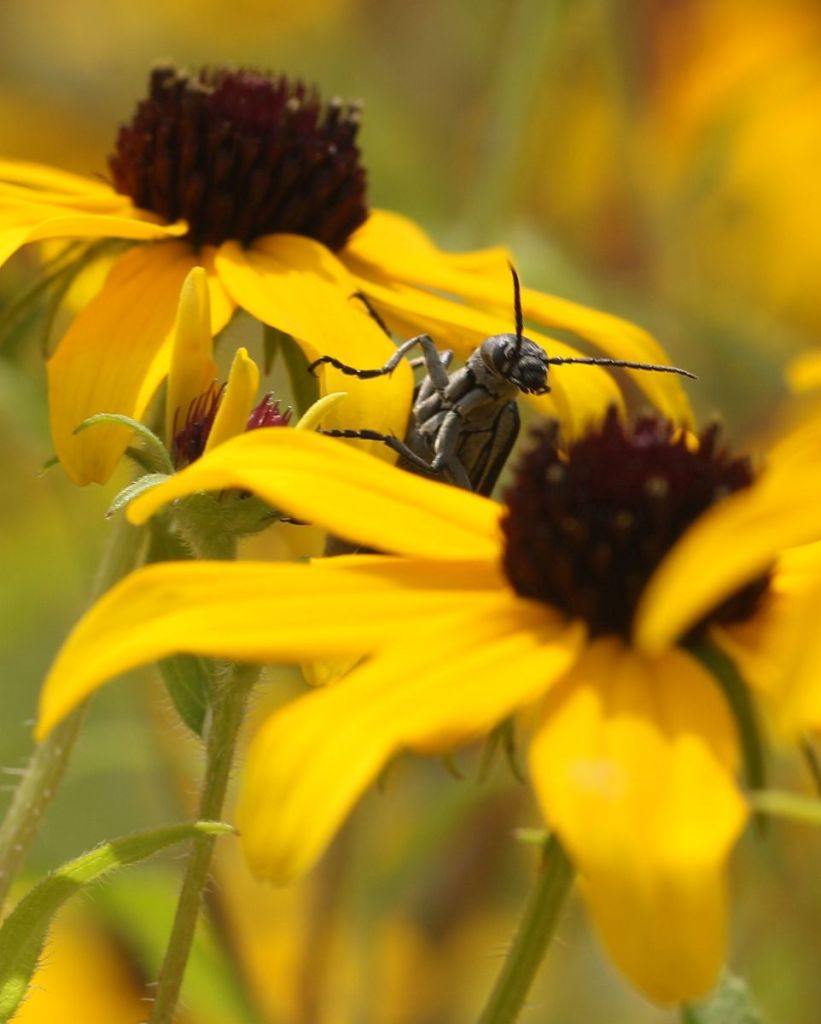
This is where I usually wrap up my insect accounts of the farms, perhaps ending with shots of one or two other insects I encountered, such as this seemingly inquisitive blister beetle. However, Treadlight’s abundance of various flowers prompted me to spend some thought-provoking time observing the bees. I saw too few of this particular species, the Golden Northern Bumble Bee (Bombus fervidus) to discern its preferences. But this globally Vulnerable species is nice to see wherever one finds it!
What I found so intriguing was how different the bee faunas of various flower types could be. Rather than getting the sense that there was one chaotic community of bees who were all visiting everything in bloom, the pattern seemed to be more one of specialization – with certain flowers hosting particular bees largely not see elsewhere. It’s likely that a variety of factors explain these patterns, including the relationship between bee and flower morphology, and bee preferences for certain pollen and/or nectar biochemistries.An Eastern Bumble Bee (Bombus impatiens) on a Zinnia. This is currently one of our most commonly spotted bumble bees.A Honey Bee forages on a thistle flower while a smaller bee explores the unfocused foreground.The mountain mint in particular was bubbling with Honey Bees.A Honey Bee hive amidst the fallow.
Honey Bees and native bee conservation is a fraught interface. Prompted in part by concern about colony collapse disorder, many members of the public probably equate Honey Bee protection with bee conservation overall. However, as mentioned in a previous post, Honey Bees are not native to North American – they were originally imported to our area from eastern and southern Europe. Increasingly, researchers are warning about the impacts of Honey Bees on native bees (e.g., see this paper and this Xerces web page). This can come about by competition for resources (there’s only so much pollen and nectar out there!), direct interaction (‘hey, that’s my flower!’), and the spread of disease. Of course, there are reasons why Honey Bees are popular. Aside from the honey, they can be diligent, early-season crop pollinators. However, in many cases, where ample natural habitat is available, native bees (which include bumble bees) are as good as or better at the job of pollination. Honey Bees are here to stay and there are now numerous feral colonies living on their own in the wild, so, even were it desired (which I doubt it would be!), removing Honey Bees from the landscape would not be possible. However if native bee conservation is one of your goals on a particular property, then avoiding Honey Bee hives on that land might be appropriate.
While that might look like a large bumble bee joining Honey Bees on the mountain mint, it’s an Eastern Carpenter Bee, as indicated by the generally bare and shiny abdomen, together with tinted wings.This Ceratina is also considered to be a type of carpenter bee. However, unlike the Eastern Carpenter Bee (who, as many of us know, excavates its solitary nests in exposed wood), Ceratina excavates its nest holes in the soft pith of annuals, herbaceous perennials, and shrubs.A native green sweat bee (a male Agapostemon) visits Joe-Pye.A chunky, native Megachile bee, part of the group known as leaf cutters, shares a thistle with a small native bee. This Megachile is conspicuously gathering thistle pollen on the collecting hairs underneath its abdomen. Most of our female bees collect pollen on their legs. Pollen is used by mother bees to provision their young, so male bees generally lack pollen-collecting hairs. In solitary ground or cavity nesting bees like Megachile, the egg is deposited together with a pollen packet, which the larva then devours upon hatching.A female sweat bee loads up her hind legs with pollen. This tiny sweat bee (looks like a Lasioglossum species to me) demonstrates the source of its common name by looking for salts on my sweaty skin.
Anthidium manicatum at the flowers of a cultivated member of the mint family.
I only found this Anthidium bee in this one patch of flowers, where it was conspicuous. Not only were these bees relatively numerous, they were interacting ardently with each other, with bees boffing each other as they perched on flowers and occasionally coupling. Males are reportedly territorial, fending off newcomers except for the females they seek. Before one runs out and plants more of this flower in order to support native bees, it should be noted that, like the Honey Bee, this is not a native species, as its common name, the European Wool Carder Bee, reveals. The males reportedly use spines at the tip of their abdomens to attack and even kill other bees, and so are thought to sometimes prevent native bees from using certain flowers. There are, however, a couple of native Wool Carders, so be careful with your IDs. They are called “Wool Carders”, because they line their solitary nest cavities with a ‘woolly’ mat of plant hairs.
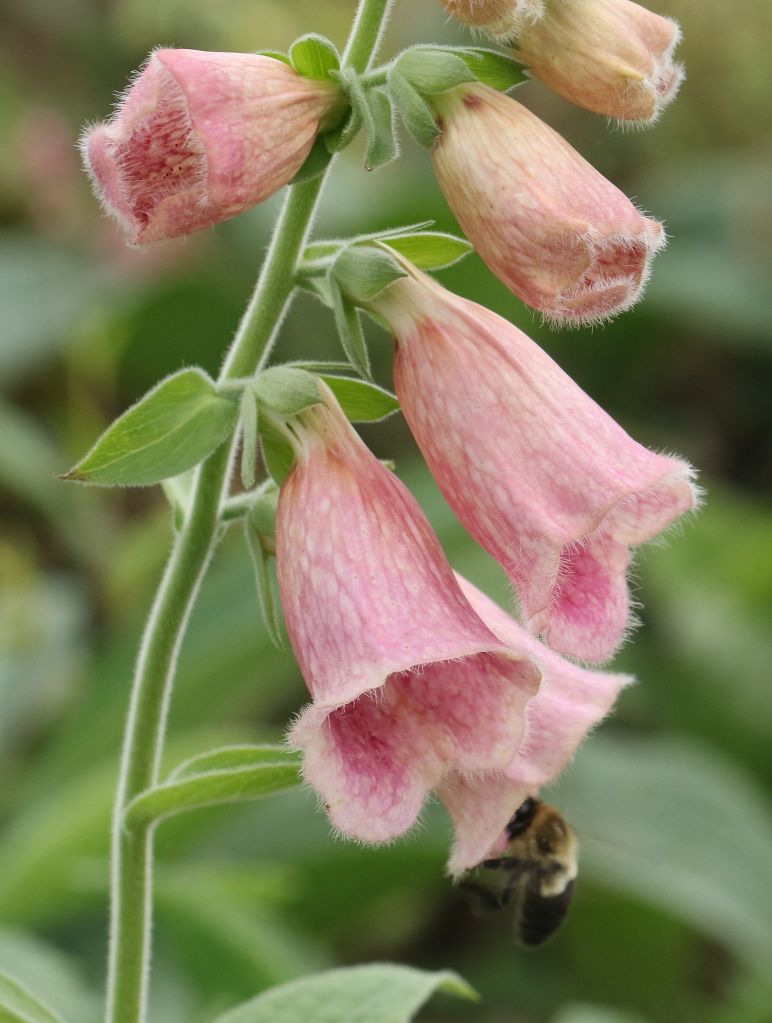
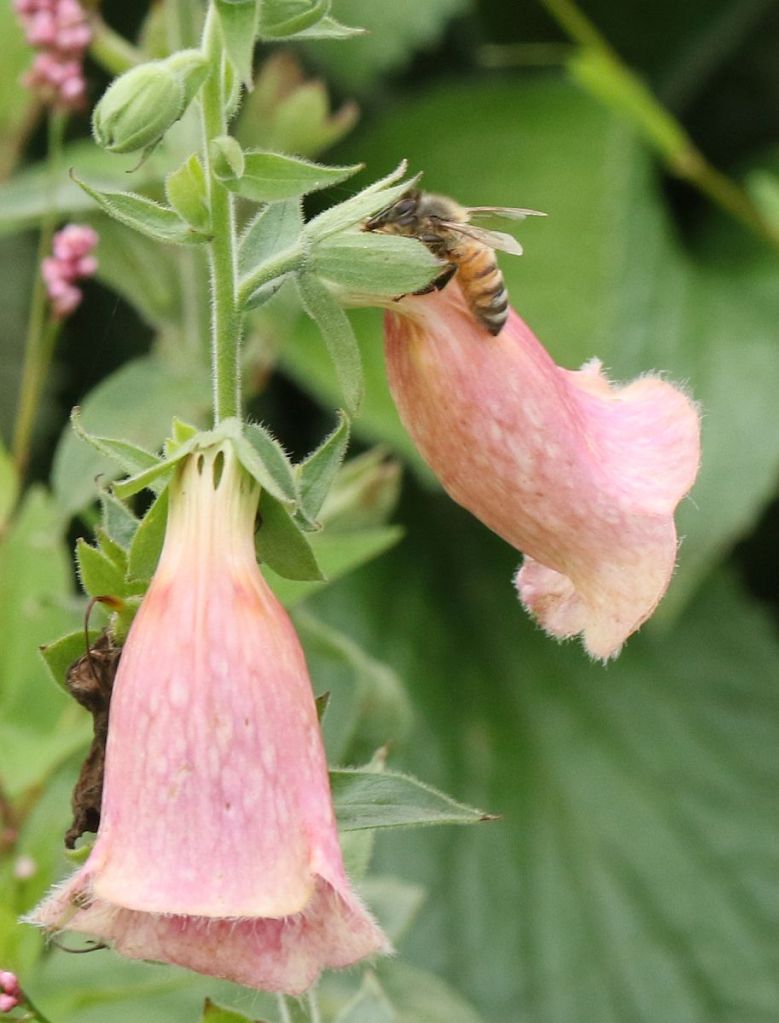
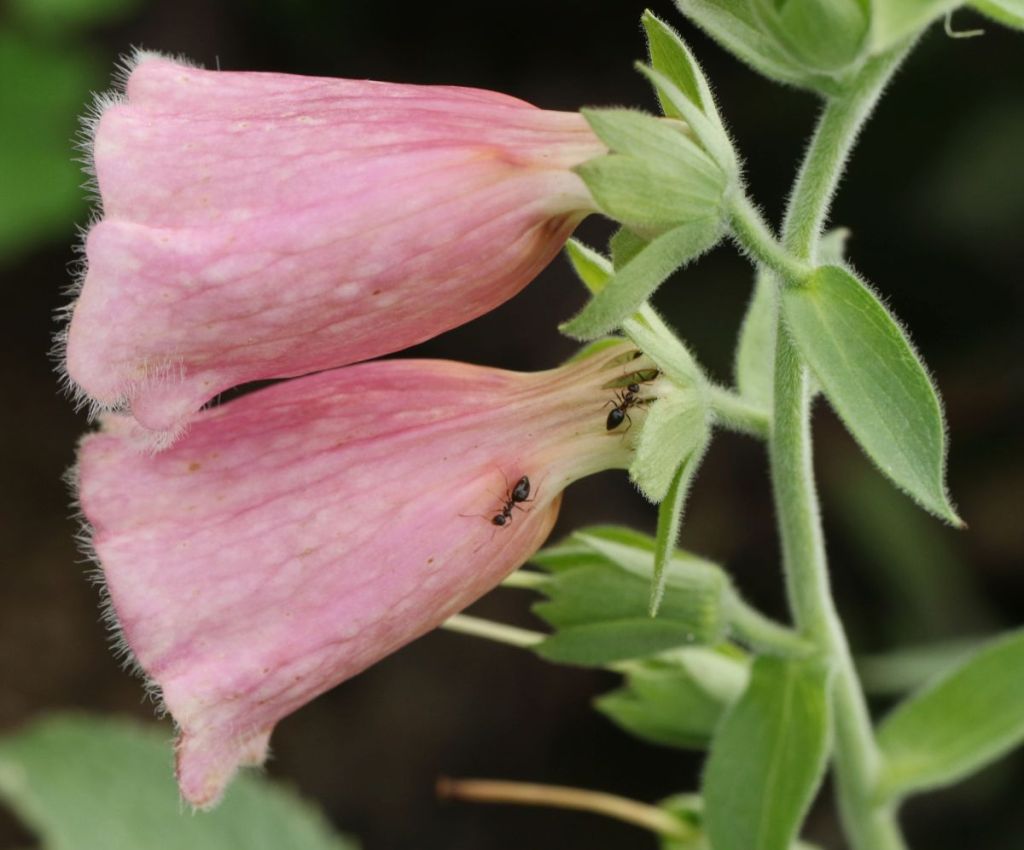
Appropriately enough given its perch, this is, according to a kindly helper on iNaturalist, Melissodes desponsa or the Eastern Thistle Longhorn Bee. Not surprisingly, it is said to prefer thistles.A bumble bee about to enter a tubular flower. This is surely what the flower, evolutionarily speaking, ‘wants’. The bee will enter the flower, encounter the anthers, intentionally or unintentionally pick up some pollen , and then depart to passively pollinate the next flower it visits. So far, so good.…But that long trip up a fuzzy tunnel can be inconvenient and slow; it’s probably not the most efficient way to gather nectar, if that’s all you’re after. What’s a wise bee to do? Cheat. This Honey Bee is feeding on nectar through some basal slits that it or an earlier bee made. These slits are clearly visible on the neighboring flower. I say ‘cheat’ because such slits let the bees take the nectar without encountering the pollen whose transport the flower was investing in.Even ants, like these Winter Ants, get in on the game.This is a bee, not a wasp.
Aside from the wasp-like coloration, the insect above is not particularly fuzzy, another waspish trait. Notice too that, as in wasps, there are no pollen-collecting hairs on the legs nor (although perhaps hard to see from this angle) on the underside of the abdomen. So, assuming this is a female bee, which is certainly possible, how is she collecting pollen?
Like our other bees, she does indeed feed pollen to her young, but it’s not pollen that she collects herself. Instead, she seeks out the nests of other solitary ground-nesting bees, most commonly those of the Eastern Squash Bee, a type of longhorn bee who is our primary squash pollinator. There she lays her egg, and, upon hatching, the new-born larva kills the host bee’s larva and feeds on the pollen hoard originally intended for the host’s young. If you’ve been following the story, then the common name, Squash Longhorn Cuckoo Bee, shouldn’t be completely surprising. (If the “cuckoo” part of the name confuses you, then look up how that bird raises its young.)
This sighting is a ‘two-fer’ – the Squash Longhorn Cuckoo Bee is only likely to be present if its host is too. It thus wouldn’t be surprising if, perhaps somewhere in a nearby cucurbit field of Long Season farm, Squash Bees were also active.Aside from butterflies, ground beetles are really ‘my thing’, but this one took an embarrassingly long time to ID, because I see this species so infrequently. I’m now pretty sure it’s Chaleanius tomentosus. This is not a species I know from Columbia County, although we have collected a couple of these beetles at the Farm Hub over the past decade.
Aside from being a nod to my entomological home-sweet-home, i.e., the ground beetles, I mention this beetle in order to bring up a small management tip. I found this beetle in the deeply sunken cavity around an irrigation spigot. Such cavities can serve as pit traps, not just for beetles but also potentially for small rodents and amphibians (think Heffalump traps in miniature). Once they have fallen in, exiting can be nearly impossible for small creatures. I don’t bring this up to ‘tsk tsk’ anybody, but rather because open holes are understandably a widespread type of occurrence on farms, when post holes go unfilled or other pits are left open. By capping the hole or simply putting in a few long sticks or stalks that rest on the cavity bottom and lean against the top lip, trapped creatures can be provided with an escape route. Elsewhere, I have even seen a similar thing occur, on a bigger scale, at abandoned silos, where a basal entry door was just high enough and the walls just smooth enough to capture passing Raccoons and other scavengers. As in the above example, a simple plank or log boardwalk could provide an easy way out.
A Hydrangea in full, if somewhat lonely, flower.
One of the most intriguing parts of doing this survey was, as I alluded to earlier, the wide variety of side-by-side flower options and so the opportunity to ask which insects liked which flowers. Scrolling through the preceding photos the variation in taste is evident – mountain mints, thistles, Zinnias, etc. But what you haven’t yet seen are the flowers to which bees were not coming. The Hydrangea above was an example – I saw little insect life on these blossoms. Why would a flower invest energy in creating showy flowers that don’t attract pollinators? Because we have asked it to. While some Hydrangea varieties are good pollinator plants, others have been bred in ways that mean pollinators are being attracted to an empty soda fountain. Breeding for beauty to the human eye can mean pollinators get short changed. This can seem like little more than an inconvenience for pollinators, but when showy flowers prompt passersby to stop for a look, then those aspiring pollinators are wasting precious energy that could be better devoted to visiting flowers that actually provide a reward and need the pollination.
If providing for pollinators is one goal of your garden, then next season think of spending some time noting which flowers are consistently attracting bees and butterflies who then actually settle to nectar or to assemble a pollen meal for their future young. Over time, you could encourage those busy buffets and perhaps think of editing out some of the less-appreciated flowers.
Two words of caution: first, before thinking of removing a flower, google its name and “pollinators” – some flowers are primarily pollinated by moths, whose visits likely go largely unseen; second, some flowers keep their petals well past their ‘sell-by date’, in other words, some flowers that were, when fresh, magnates for pollinators, lose their offerings later in the season while still looking appealing to our eye. Take it slow, watch, keep notes & don’t jump to conclusions, but see if any actionable patterns pop out.
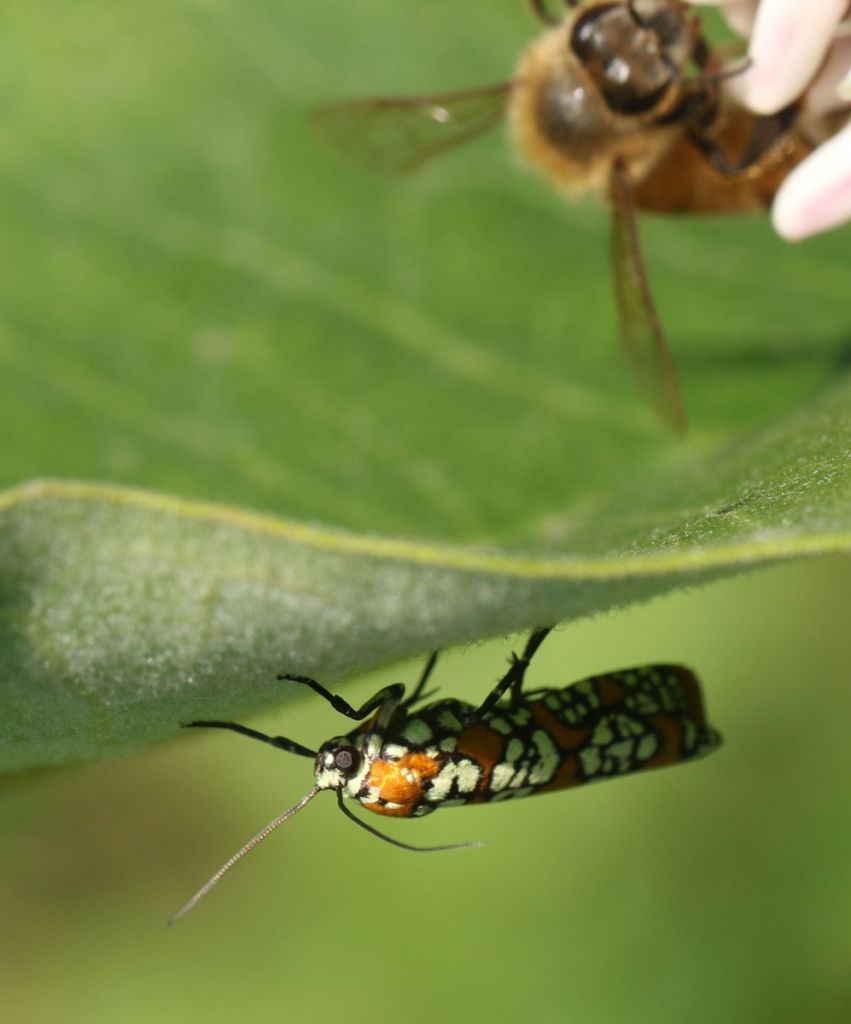
An Ailanthus Webworm Moth shelters below a Honey Bee. Originally, this native species was probably confined to the Neotropics and some tropical host, but it has followed its adopted host, the non-native Tree of Heaven, northwards.
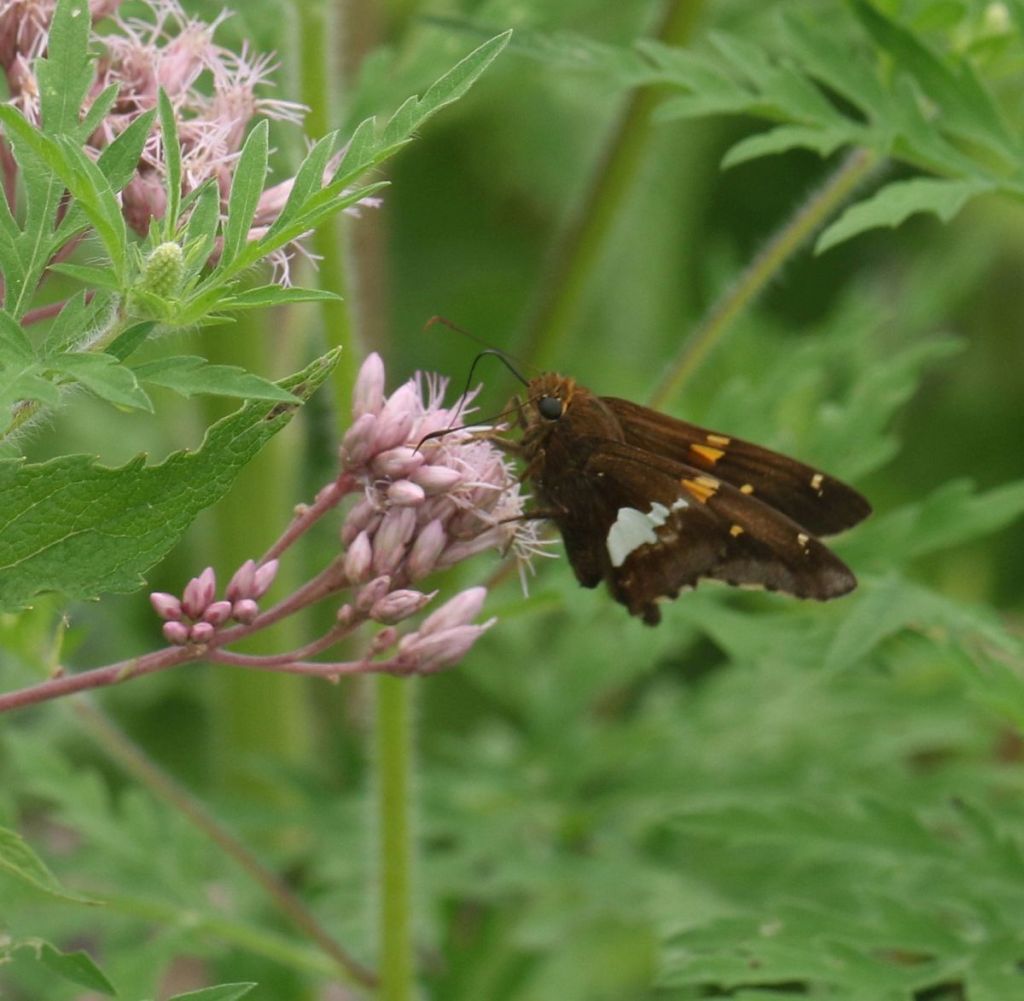
P.S. The quiz butterfly was a Silver-spotted Skipper.
This blog shares some of the botanical observations from Churchtown Dairy on 19 July 2024. Will had visited the farm separately and written about the “Birds of the prairie” at this farm in his blog posted on 13 October 2024.
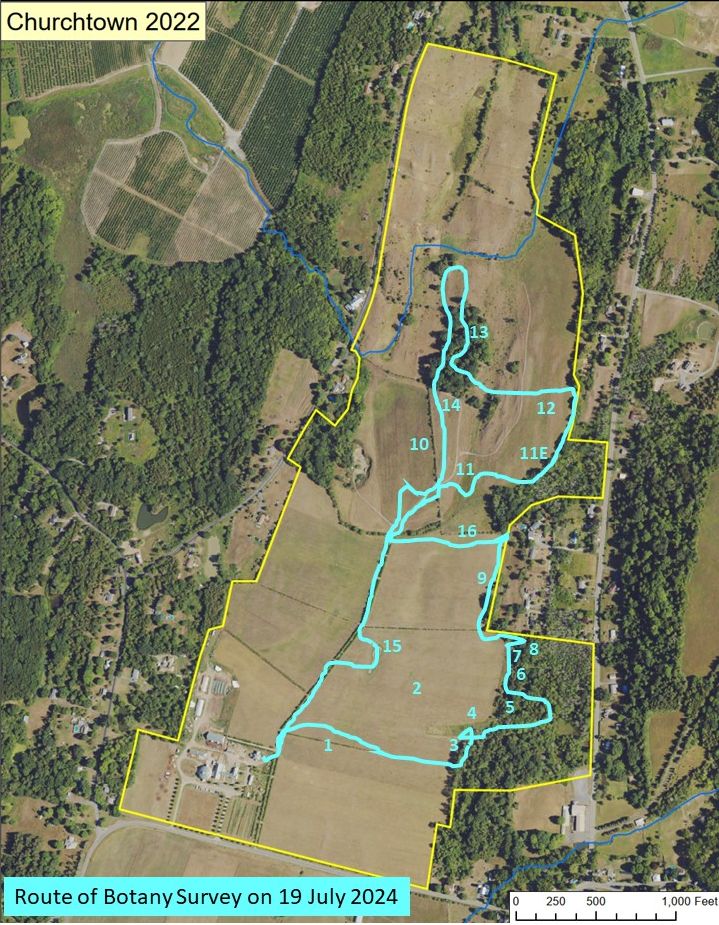
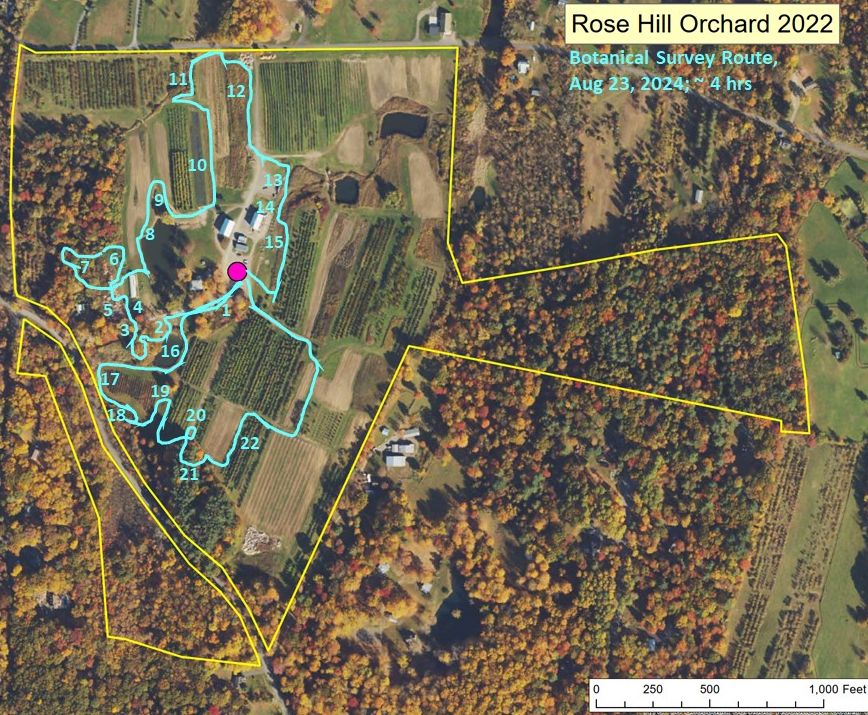
The following map shows the approximate route walked for the botany survey. The numbers (referenced throughout this blog) indicate places where botanical observations were made or pictures were taken.
Map of the approximate plant survey route (in sky blue). The numbers (referenced throughout this blog) indicate places where botanical observations were made or pictures were taken.
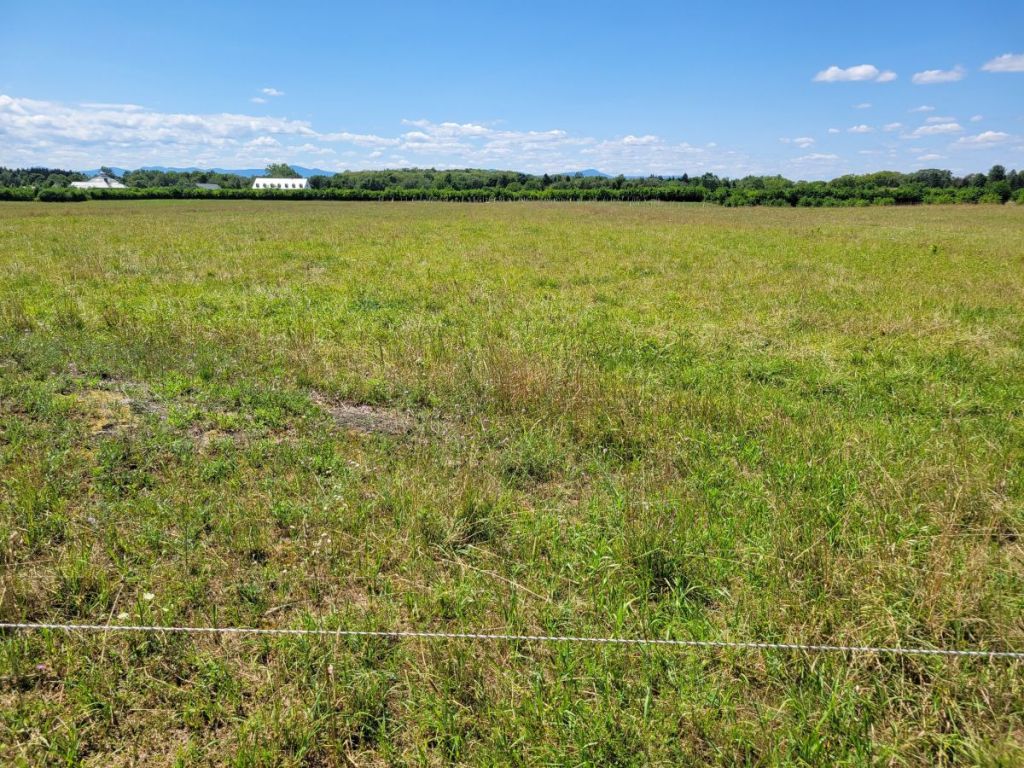
Let us begin by sharing some habitat images from the farm:
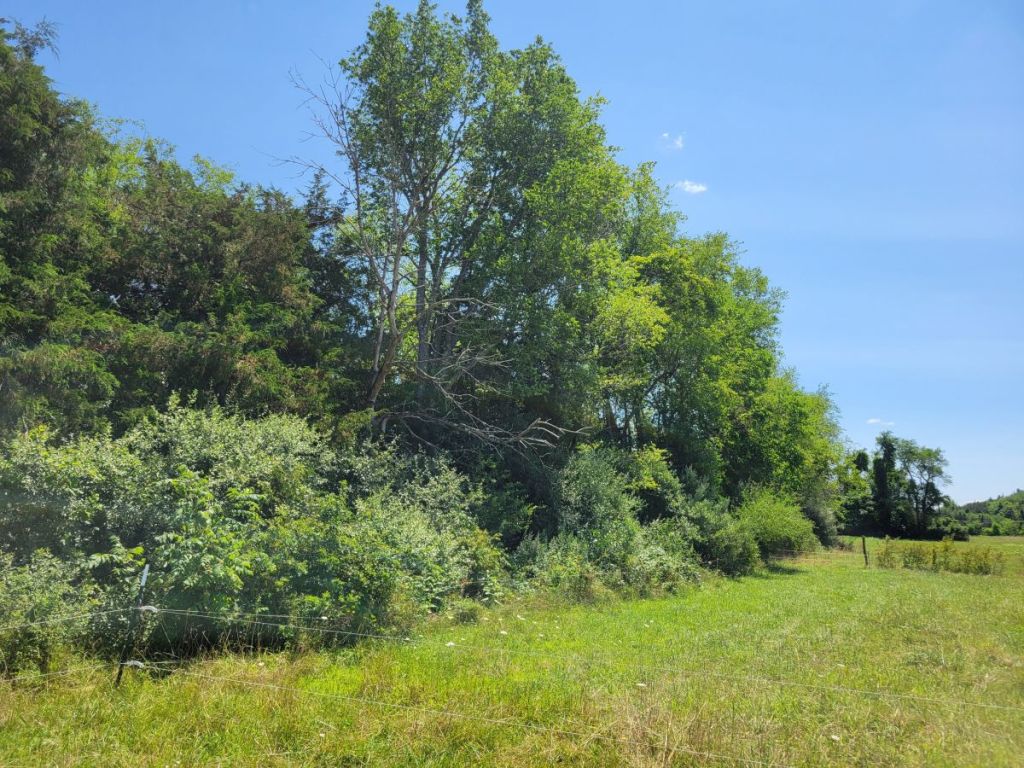
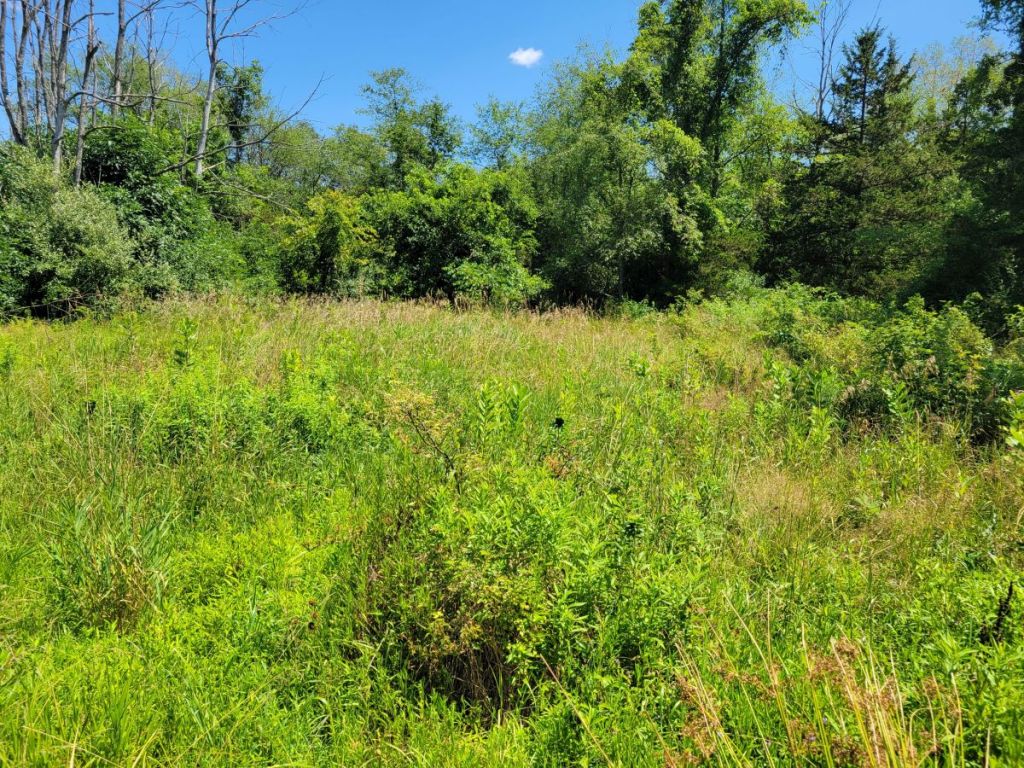
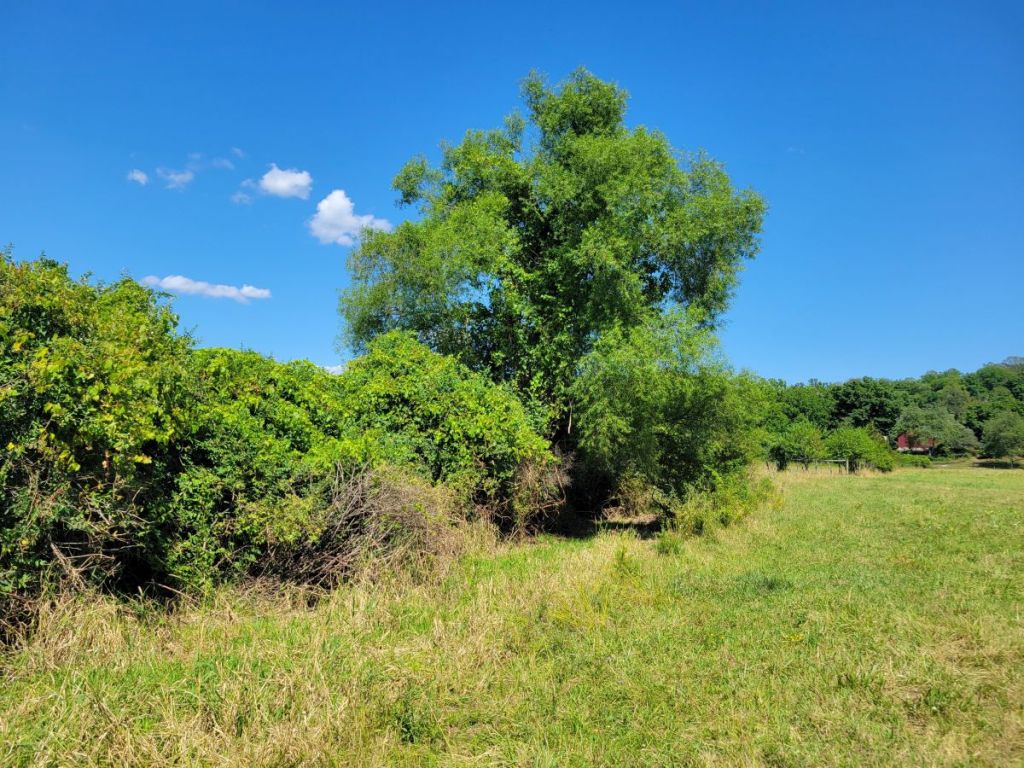
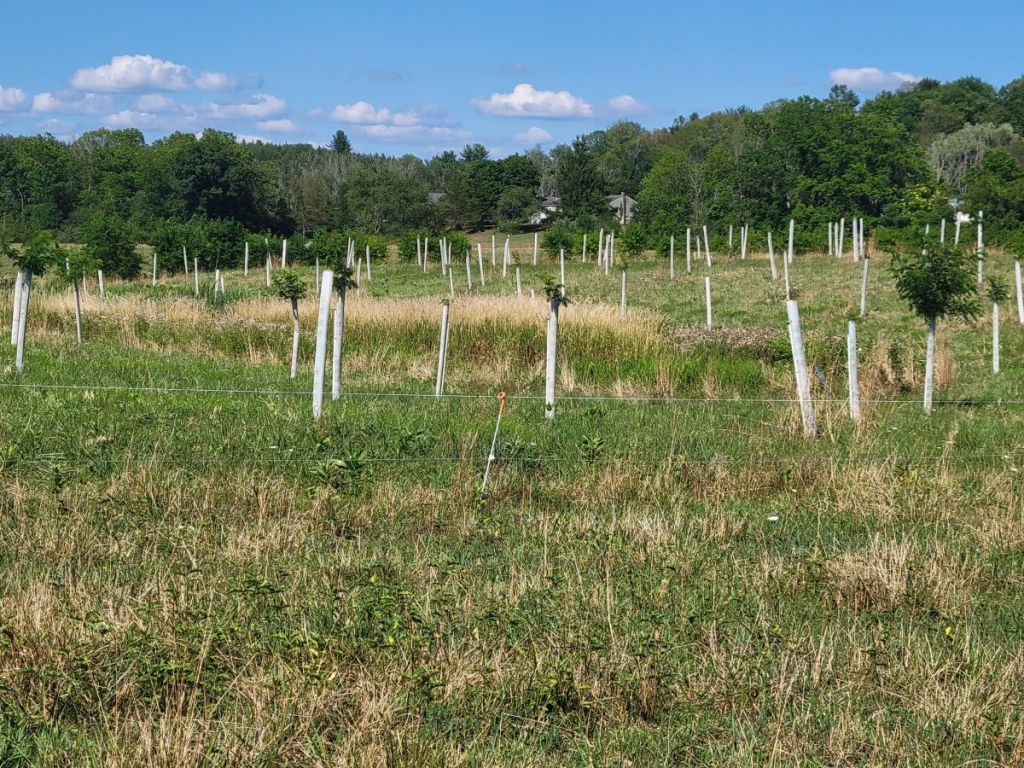
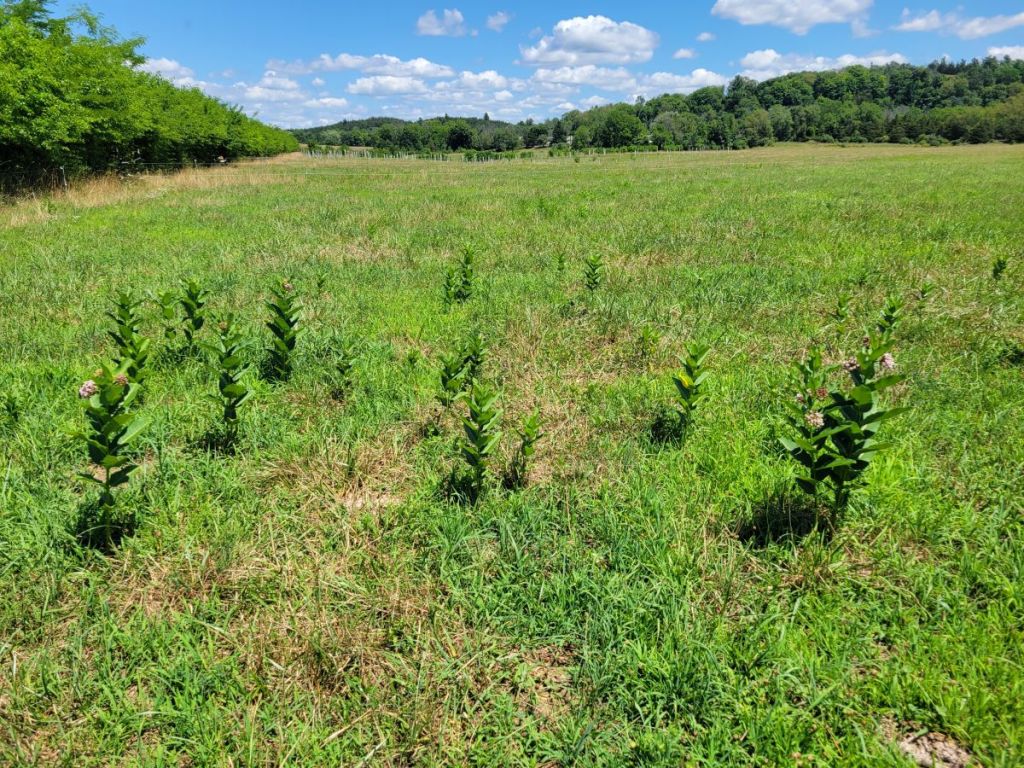
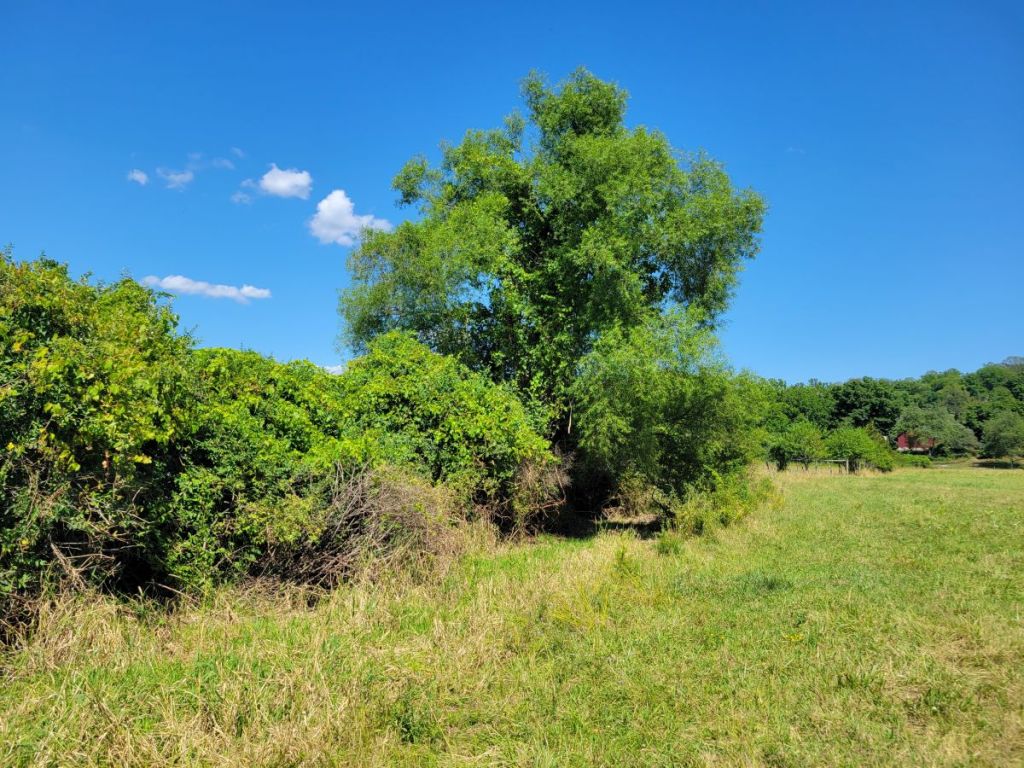
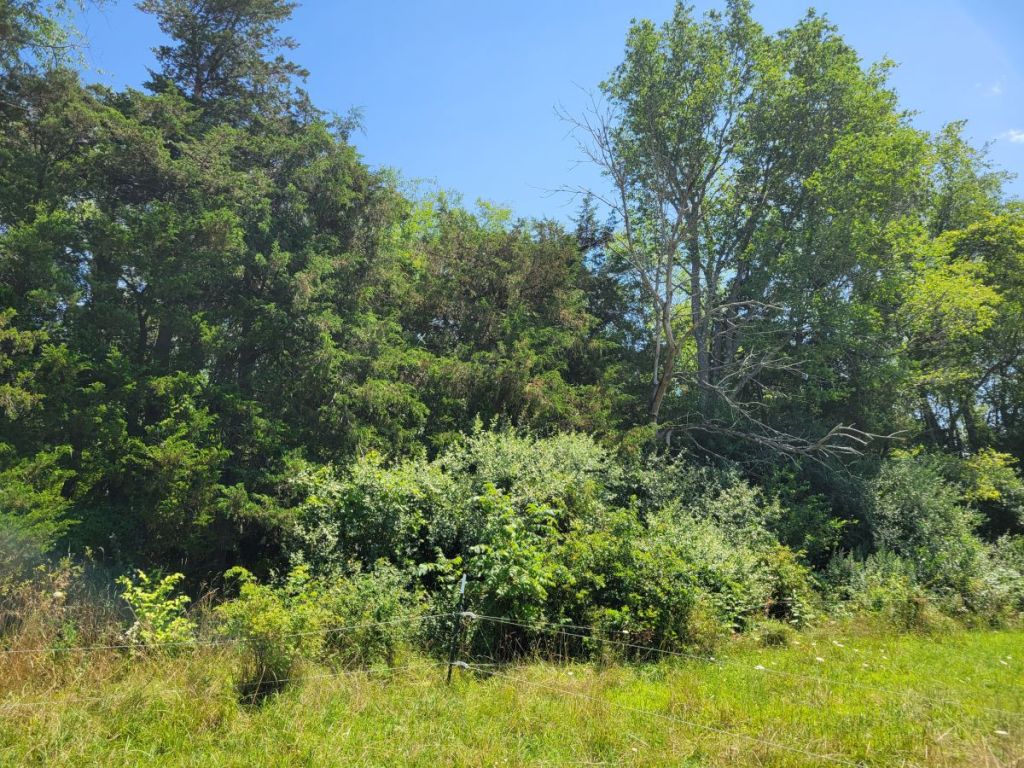
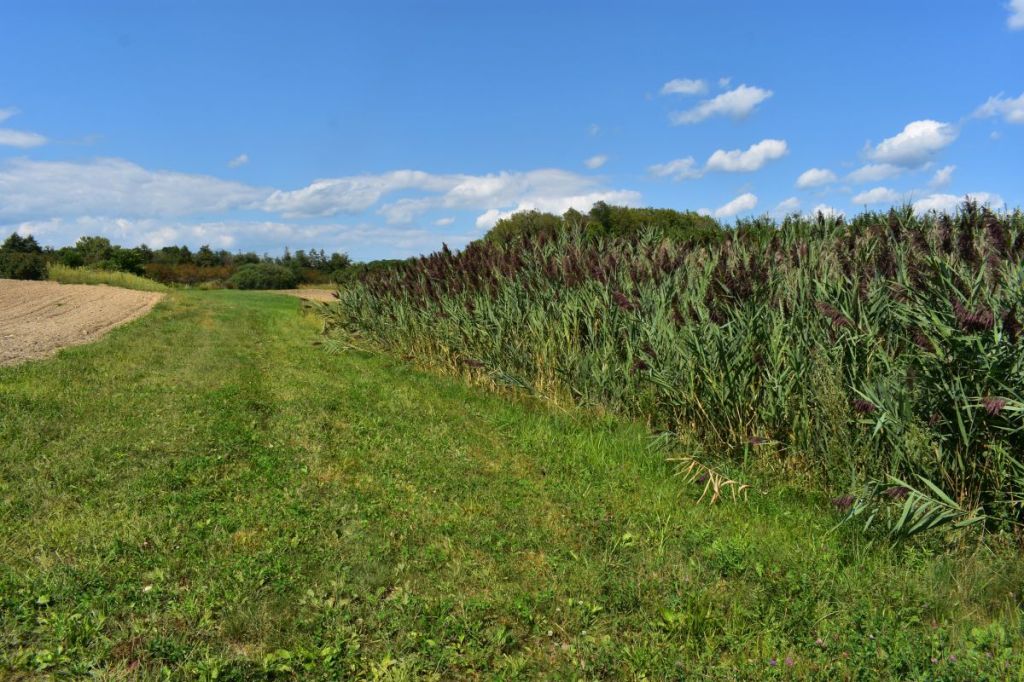
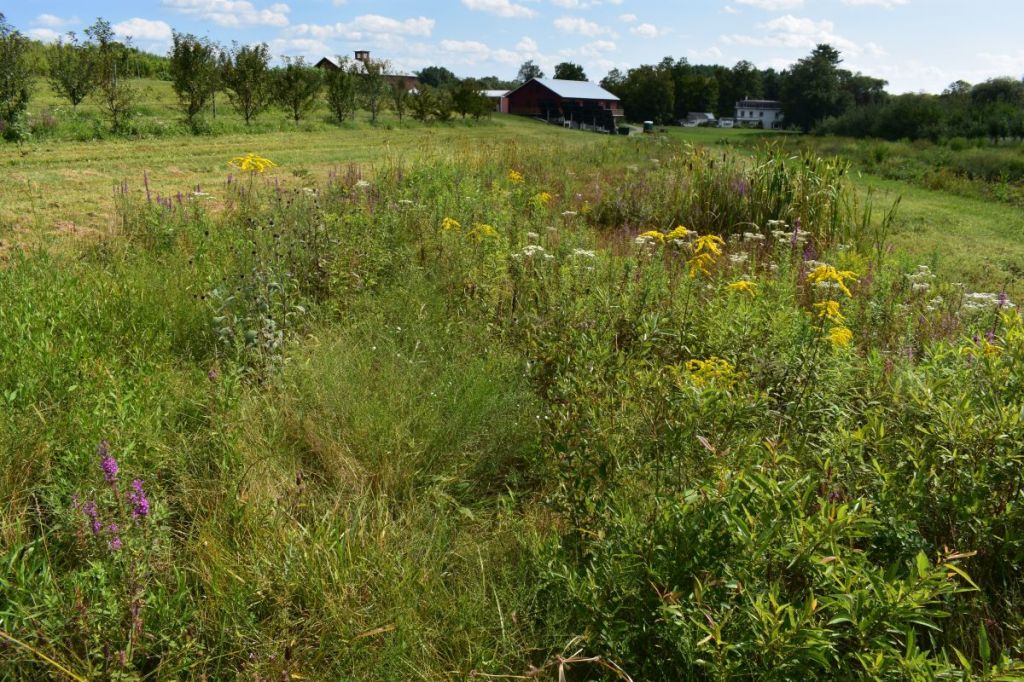
By far the largest amount of the farmland north of Route 12 is currently dedicated to pasture (view from #7 looking west).On the east, the pastures border mostly young forest and have a shrubby edge (#3).There are also pockets of wetlands along the eastern boundary (#4).Throughout the farm there are some long-established hedgerows dividing the fields (this is the view from #16). More recently planted hedges flank the main farm road.
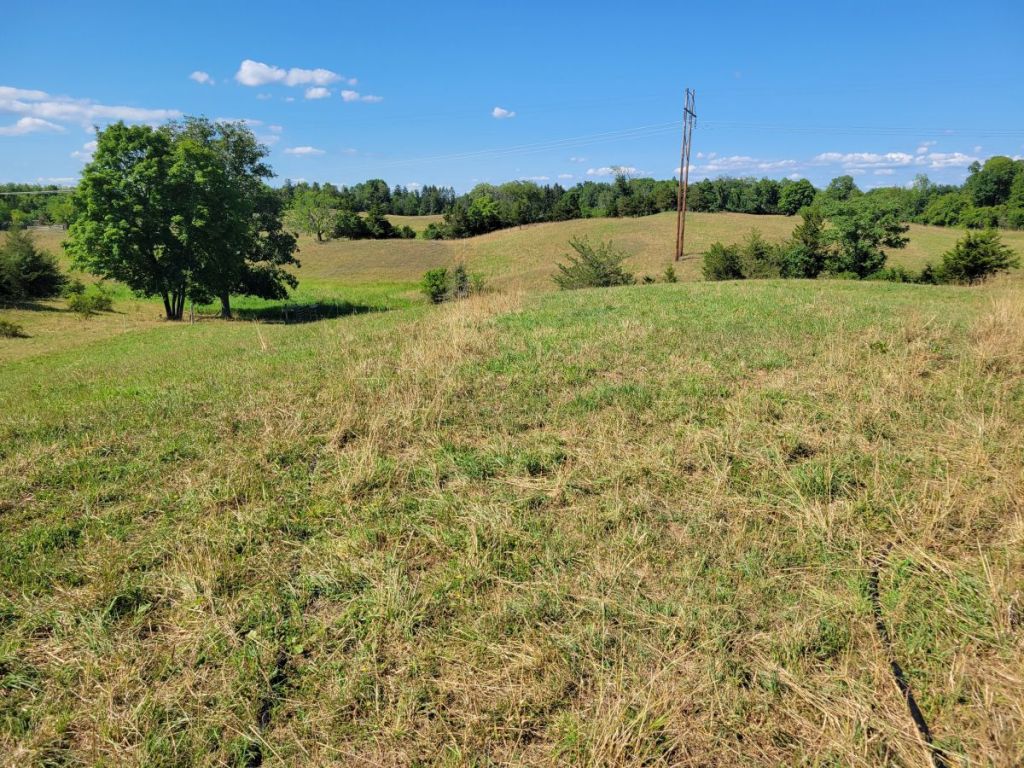
The northern part of the farm is hilly (view north from #13)
There are also a couple of ponds. This smaller one (#15) is surrounded by a recent tree planting for silvopasture.
After this brief visual introduction to the farmland at Churchtown Dairy, we’ll go into more botanical detail.
Most of the pastures were closely-grazed at this point. As typical for pastures and hayfields in our region, most of the plants in the pastures themselves were European species of grasses, legumes, and other common plants of perennial agricultural meadows. One exception stuck out immediately: many of the pastures had patches of Common Milkweed, a wildflower native to North America and one of the host species for Monarch caterpillars, as well as a number of other native milkweed-specialists. It was nice to see that the milkweed plants across the farm were at different stages of development, some going to seed, some in mid-bloom, and some just beginning to put out new leaves after having been grazed or clipped. Maintaining such diversity of developmental stages throughout the growing season is beneficial for the insect community, because it ensures the availability of a variety of resources (ranging from tender leaves for young caterpillars to nectar for adult butterflies and many other insects) for an extended time period (compared to the scenario were all plants of a species mature and go to seed at the same time).
Common Milkweed plants in a pasture (#2)
The hedgerows and forest edges bordering the pastures were composed of a variety of native and non-native woody plants. The hedgerows bordering the central laneway and separating some pastures had been planted relatively recently (10-20 years ago) with a small selection of species, including Osage Orange and Honey-locust (both considered native to areas south of here), and hawthorn and hazel (species and native status uncertain). However, the longer-established hedges and field edges supported wild-growing, native Staghorn Sumac…
One of the long-established hedgerows, including Staghorn Sumac
… Red Cedar …
Another one of the long-established hedgerows, including Red Cedar
… and even an occasional stately oak (pictured here is a Red Oak, whose leaves were partly eaten by Spongy Moth caterpillars)…
A field edge with a big Red Oak
… and a willow, probably the native Black Willow (Salix nigra).
A long-established hedgerow with a big willow tree
Non-native, invasive shrubs, such as Eurasian shrub honeysuckle (Lonicera morrowii or L. x bella), Multiflora Rose, Common Buckthorn, Autumn Olive, and Oriental Bittersweet were also quite common in many of the hedges and field edges.
A field edge with a variety of invasive shrubs
There were a few small wet meadow areas at Churchtown Dairy, such as the one in the next picture at the east end of D6 (#4 on the aerial photograph). These wet meadows support vegetation very different from that in the adjacent upland pastures. European species are also a component of these wet meadows and some, such as the invasive Reed Canary Grass, seen on the left in this image, can be quite common. However, these wet meadows are also important reservoirs of native biodiversity, because they harbor a number of native wildflowers, grasses, sedges, and ferns, which are not found anywhere else on the farm.
Wet meadow (#4)
Rough-leaved Goldenrod (Solidago patula) is one example of a regionally uncommon native species I stumbled across in the wet meadow east of D6. This goldenrod, which typically occurs in calcium-rich wetlands, does not grow in dense, rhizomatous colonies like its more common cousins typical of old fields. Instead, a few (eventually) flowering stalks emerge from a cluster of large basal leaves that have the texture of sandpaper.
Rough-leaved Goldenrod (Solidago patula)
One part of the wet meadow east of D6 supported a colony of Sensitive Fern and cattails (both native species), in addition to a patch of the invasive Reed Canary Grass visible in the front right of the image.
Wet meadow (#4)
The Black-and-Yellow Gardenspider (Argiope aurantia) builds its net in tall, undisturbed vegetation, and the wet meadow provided ideal habitat for this gorgeous hunter.
Black-and-Yellow Gardenspider (Argiope aurantia)
Another beautiful small example of a species-rich wet meadow was found in the drainage southwest of the Bobolink Field (#11). Note the diverse textures and colors in this habitat!
A small wet meadow (#11)
A closer look reveals the native species Woolgrass (Scirpus cyperinus; in front left), Smooth Goldenrod (Solidago gigantea; yellow flowers), Common Boneset (Eupatorium perfoliatum; white flowers), Blue Vervain (Verbena hastata; purple flowers), and Tussock Sedge (Carex stricta; in front right).
A closer look at a small wet meadow (#11)
Back at the east edge of D6-11, I entered the forest and found small areas of swamp forest (#5) where the canopy was dominated by Red Maple trees.
Swamp forest (#5)
Rough-leaved Goldenrod grew here and there in the understory.
Rough-leaved Goldenrod (Solidago patula)
Unfortunately, the invasive Japanese Stiltgrass had also established itself in this forest (as well as in the “grove”). This grass is currently one of the most rapidly spreading non-native species in our region and there don’t seem to be any “silver bullets” for its control. It is an annual grass with wiry stems and relatively broad (and short!) leaves, which often have a broad white line along their midrib.
Japanese Stiltgrass (Microstegium vimineum)
Black Swallowwort (Vincetoxicum nigrum) is an invasive vine with opposite, shiny oval leaves, small, dark purple flowers, and seed pods reminiscent of milkweeds. It was found only in small numbers at Churchtown Dairy. Scattered plants were spotted in the swamp forest and wet meadow east of D6-11, as well as in the “grove.” This might be an invasive species still rare enough on the farm that its spread could be curtailed by systematically pulling it out, whenever it is encountered.
Black Swallowwort (Vincetoxicum nigrum)
Another potentially troublesome species is this pretty ornamental shrub, Jetbead (Rhodotypos scandens), which probably had jumped the fence onto the young forest on the farm’s land from one of the neighboring yards. I had never seen it growing wild in Columbia County, but was told that it had spread throughout Central Park and might become more assertive in our region, in the future… This might be another species to discourage early on wherever it shows up on the farm.
Jetbead (Rhodotypos scandens)
Tree-of-Heaven is the last invasive species I want to mention. It currently occurs at a low enough density at Churchtown Dairy, that its further spread might be avoided by removing the seed-producing trees, like this one next to the “grove.” Unfortunately, if a Tree-of-Heaven is felled, its roots tend to produce sprouts which—if unchecked—can result in an entire colony of new trees. Therefore, it is important to continue to annually monitor and—if needed—manage the site where an adult tree has been felled or girdled.
Tree-of-Heaven (Ailanthus altissima); this specimen was found between #12 and #13
Returning to the east edge of D6-11, after emerging from the swamp forest, I entered a small stand of Red Cedar trees (#6), which seemed to serve as an occasional forest pasture. I made no exciting native plant discoveries in this habitat.
Red Cedar forest (#6)
Emerging out of the Red Cedar forest, I found myself on the hilly, eastern section of pasture D11 (#7). Although dry pastures like this sometimes harbor uncommon native plants, I did not observe any noteworthy native species here, either.
Dry pasture (#7)
Eventually, I found myself in the “Bobolink Field,” (#12) a hay meadow cut late in the season to give ground-nesting Bobolinks enough time to raise their young. Like in the pastures, the vegetation in this field was mostly composed of European grasses and—to a lesser extent—legumes.
Late-cut hayfield (#12) which is managed to accommodate ground-nesting birds.
Another wetland, this one dominated by shrubs and trees, including Swamp White Oak, Green Ash (many dying), and Red Maples, borders the “Bobolink Field” on the east. Native shrubs, such as Winterberry, Arrowwood, Silky Dogwood, and Wild Raisin, occur side-by-side with the common invasive shrubs that dominate the understory.
Wetland (#11E)
Spotted Joe-Pye-weed grew along the herbaceous edge of this wetland and also in some of the other wet meadows along the eastern edge of the farm.
Spotted Joe-Pye-weed (Eutrochium maculatum)
The “grove” (#13) is the only forest at Churchtown Dairy (at least north of County Route 12) that grows on land that seems to have never been completely cleared. It harbors some exceptionally large specimens of Hop-hornbeam trees and some beautiful White Oaks. At the north end, there are several Common Pear trees and Pignut Hickories. Although hardly an “old-growth” forest, this woodland fits our definition of an “ancient forest,” whose soils have not been homogenized by the plow. Therefore, they might have the potential to support soil life and understory plants that are slow to recolonize post-agricultural forests. However, its current understory vegetation is mostly composed of invasive species and European plants typical of nutrient-enriched barn yards. This is likely due to the recent use of this woodland as a pig pasture.
The “grove” (#13) might be an example of an ancient forest.
On the way back to the barns, I took a quick detour to this small, marshy pond (#15), which had very little open water. Cattails (tall green vegetation at the center) were growing in a wide band around the shore and were flanked by patches of Reed Canary Grass (tall tan vegetation left and right of the cattails). Closer inspection revealed several native wetland plants we had not noted in the other areas surveyed for plants at Churchtown Dairy that day. They included the regionally common: Water Purslane, Nodding Bur-marigold, and Soft Bulrush.
A small, marshy pond (#15) harboring some unique wetland plants
This blog shares some of the botanical observations made at Rose Hill Farm on 23 August 2024 during a 4 hour survey along the route indicated in sky blue in the aerial image below. The numbers indicate locations referenced throughout this blog posting. (Note that we shared habitat images from Rose Hill Farm in a blog posted 21 June 2024; Conrad posted about insects on 12 July 2024 and Will about birds on 16 November 2024.
Route of botanical survey on 23 August 2024
I started my walk-around from the parking area along the driveway back towards the entry gate.
Entry ally to Rose Hill Farm with a weeping willow (Salix cf. babylonica x alba) and Red and Sugar Maples (Acer rubrum and A. saccharum) beyond (seen from #1).
Along the driveway is a shrubland that contains both Tree-of-Heaven (Ailanthus altissima; left on both images below) and Staghorn Sumac (Rhus typhina; right on both images below). Both have pinnate, “feather-like” leaves, composed of a midrib with leaflets arranged opposite each other along both sides. However, the margin of the leaflets is toothed like a saw blade in the Sumac, while the margin of the Tree-of-Heaven leaflets is almost smooth, with just a couple of blunt teeth at the very base. Furthermore, the two species have very different smells: the Sumac has a (to me) very agreeable, aromatic, resinous smell, while the smell of Tree-of-Heaven reminds many people of rancid peanut butter.
Tree-of-Heaven (Ailanthus altissima; left on both images) and Staghorn Sumac (Rhus typhina; right on both images)
South of the driveway is a small wet meadow (#2) that supports a diverse plant community, composed of native and non-native species, such as Smooth Goldenrod (Solidago gigantea; yellow flowers) and Purple Loosestrife (Lythrum salicaria; deep pink flowers), respectively. I quickly tallied a total of 40 (!) species in this very small meadow.
Species-rich wet meadow south of the driveway (#2)
Just west of this wet meadow, I found a very small patch of forest on and surrounding a rock outcrop (#3). At the forest edge, there were several individuals of two native shrub species not seen anywhere else during my survey at Rose Hill (or any of the other eight farms surveyed this summer). This image shows Prickly Ash (Zanthoxylum americanum), which has pinnate leaves and thorny branches. Prickly Ash is one of the host plants for the caterpillars of Giant Swallowtail butterflies. Conrad shared a picture of a Giant Swallowtail he had seen at Rose Hill in his blog from 12 July 2024, but we don’t know yet, if they are actually successfully reproducing here or if an occasional individual flies in from further south.
Prickly Ash (Zanthoxylum americanum; #3)
Bladdernut (Staphylea trifolia), which grew right next to the Prickly Ash, has leaves composed of three leaflets (similar to clovers) and unique, three-chambered, bladder-like fruits. Both of these species tend to occur in calcium-rich soils.
Bladdernut (Staphylea trifolia; #3)
I am no geologist, but the outcrop (#3) might well be some sort of limestone or related rock that is rich in calcium.
Suspected limestone (or other calcium-rich rock) outcrop (#3)
False Solomon’s-seal (Maianthemum racemosum) also grew at the base of the rock, which was surrounded by large trees, including Sugar Maple, American Basswood, Red Oak, and American Elm.
False Solomon’s-seal (Maianthemum racemosum; #3)
I found a very different, much younger forest north of the wood chip piles (#7). It still had the remnants of Red Cedar (Juniperus virginiana), which are early-successional trees that often grow on abandoned farm fields or pastures. As the historical aerial photo in Conrad’s blog from 12 July 2024 shows, this area used to be orchard 80 years ago.
Red Cedars tend to die naturally as they get shaded out by taller trees. However, the Red Cedars in this forest might have been intentionally cut, presumably to avoid serving as hosts for the Cedar-Apple Rust (Gymnosporangium juniperi-virginianae), a fungal pathogen of apples, that needs two hosts to complete its life cycle, a Red Cedar and an apple or hawthorn.
Fallen or felled Red Cedar in young forest (#7)
Lower down in the forest along a small stream, ferns such as Royal Fern (Osmunda regalis; bottom right in the image) and Cinnamon Fern (Osmundastrum cinnamomeum; center of image) grew lush in the moist soil.
Royal Fern (Osmunda regalis) and Cinnamon Fern (Osmundastrum cinnamomeum) in young forest (#7) by stream
Back up along the forest edge (# 6), Virgin’s-bower (Clematis virginiana), which is a native vine whose stems are not woody and die back each winter, were in full bloom.
Virgin’s-bower (Clematis virginiana; #6)
The pond by the farm house (#8) had a narrow band of unmowed vegetation, which harbored some native plant species not seen anywhere else on the farm during our survey.
Pond (#8) with narrow band of unmowed vegetation
During my walk around Rose Hill Farm, I noticed New England Aster (Symphyotrichum novae-angliae) only at the shore of this pond. It was visited by a native bee.
New England Aster (Symphyotrichum novae-angliae; #8)
The damselflies were mating and laying their eggs in the pond. These little guys greatly benefit from the emergent vegetation which provides perches. They also benefit from aquatic vegetation in the pond, because it provides habitat for their aquatic larvae. Aquatic vegetation is especially important for dragonfly and damselfly larvae, when predatory fish or amphibians also live in the pond.
Mating damselflies (#8)
A big patch of the invasive Common Reed (Phragmites australis) grew in a swale (#9) draining into the pond.
Common Reed (Phragmites australis) in a swale (#9)
Another swale (#10) near the solar panels had unmowed wet meadow vegetation composed of many native species, including Common Boneset (Eupatorium perfoliatum; white flowers) and Spotted Jewelweed (Impatiens capensis; orange flowers), which were buzzing with insects.
Unmowed wet meadow in swale (#10)
The upper end of the same swale (#10) had a more diverse plant community, including native cattails (Typha sp.), Early Goldenrod (Solidago juncea), Awl Aster (Symphyotrichum pilosum var. pilosum), and Black-eyed Susan (Rudbeckia hirta).
Upper part of wet meadow in swale (#10)
Near the fenceline, I encountered a shrub thicket (#11) with two different species of willow, Heart-leaved Willow (Salix eriocephala; left) and Bebb’s Willow (Salix bebbiana; right). Both of these willows have catkins that serve as important early season pollen sources for bees.
Heart-leaved Willow (Salix eriocephala; left) and Bebb’s Willow (Salix bebbiana; right) in shrub swamp (#11)
The thicket also had a Silky Dogwood (Cornus amomum), with its metallic-blue fruits displayed on reddish branches.
Silky Dogwood (Cornus amomum; #11)
Circling back towards the buildings, I passed by a dry hillside which had been left unmowed (#12). The vegetation was a mix of common native species, including several goldenrods (Smooth, Tall, and Early) and Common Milkweed (Asclepias syriaca), with non-native species, including Spotted Knapweed (Centaurea jacea) and Wild Carrot (Daucus carota).
Unmowed dry hillside (#12)with a mix of common native and non-native wildflowers
Another unmowed, dry slope east of the parking lot (#15) had several less common native plants, including Purpletop (Tridens flavus), Purple Love Grass (Eragrostis spectabilis), and Whorled Milkwort (Polygala verticillata). I did not see any of these species anywhere else at Rose Hill Farm.
Another unmowed dry hillside (#15)with some unusual native plant species
The shore of the pond (# 16) south of the driveway had a broad band of unmowed, diverse vegetation including the uncommon native Swamp Rose (Rosa palustris), which we didn’t observe anywhere else on Rose Hill or at any of the other farms surveyed this season. Note also some “blonde” clumps of the native warm-season grass Little Bluestem (Schizachyrium scoparium), usually found in dry soils.
Band of unmowed shoreline of a pond (#16)
Along the south fence, south of the Blueberries, I was excited to find a beautiful and diverse wet meadow (# 18). Here, you see the native Spotted Joe-Pye-weed (Eutrochium maculatum; light pink) mix with the invasive Purple Loosestrife (Lythrum salicaria; dark pink). However, a closer look revealed many less conspicuous native wetland plants that we did not see anywhere else at Rose Hill. For example, Conrad included images of Yellow Stargrass (Hypoxis hirsuta) and Square-stemmed Monkeyflower (Mimulus ringens) from this wet meadow in his insect post on 12 July 2024
Diverse, unmowed wet meadow (# 18)
Another plant unique to this area was Groundnut (Apios americana), a native vine in the pea family which is occasionally found in wet, open areas. It has pinnate leaves with five leaflets and dense conical clusters of pea-shaped flowers of a very unusual, pink/purple/red-brown color. Most plants of this species in our region never produce fruits (but see our blog on the Hudson Valley Seed Company for an exception and explanation). The tubers of this species are edible and Native Americans seem to have sometimes cultivated Groundnut.
Groundnut (Apios americana; #18)
Another was Virginia Mountain-mint (Pycnanthemum virginianum), which is an uncommon native mint much visited by a large variety of pollinators.
Virginia Mountain-mint (Pycnanthemum virginianum; #18)
Finally, New York Ironweed (Vernonia noveboracensis) was also unique to this wet meadow. It is a member of the aster family, which seems to be more common further south in the Hudson Valley and is rarely found growing wild in our region.
New York Ironweed (Vernonia noveboracensis; #18)
East of the Blueberries was another dry slope (# 19) with unmowed vegetation. It was fun to see how each of these unmowed slopes supported a slightly different vegetation. This one had a lot of Little Bluestem (Schizachyrium scoparium) and Early Goldenrod (Solidago juncea), but also a variety of other native and non-native plant species.
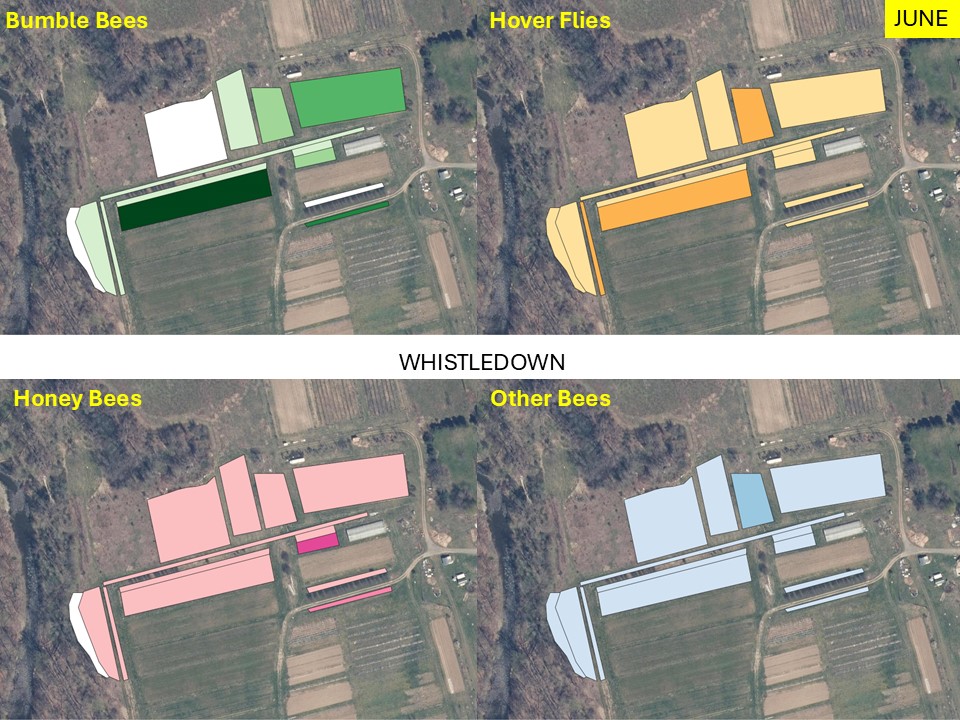
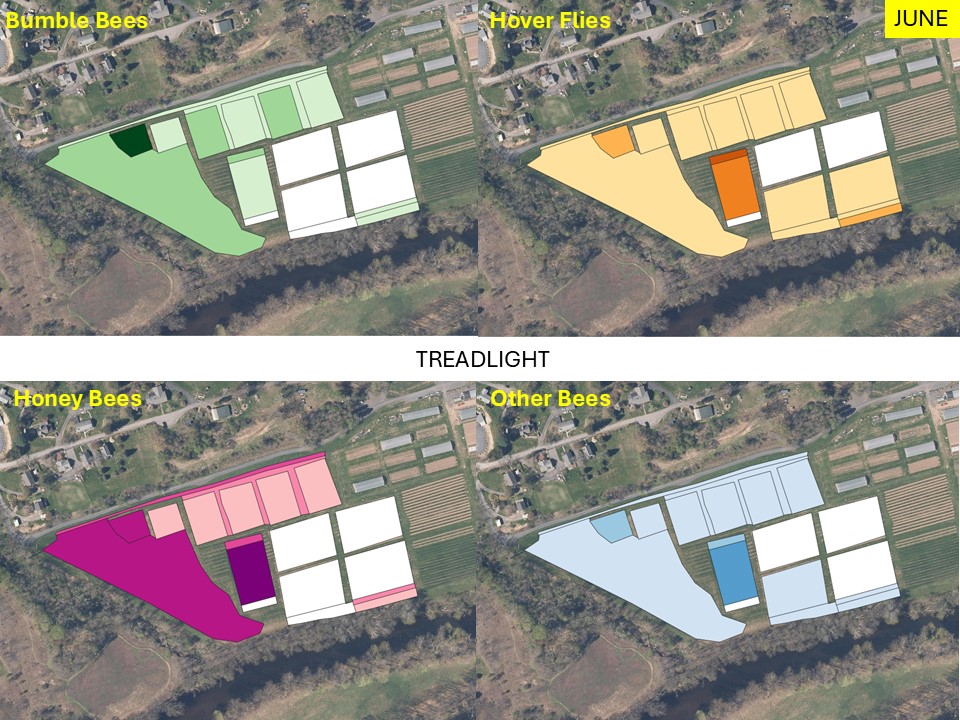
Another example of an unmowed dry slope (#19) with its own unique plant composition
The apples nearby (# 20) were getting ripe and the unmowed strips of vegetation in the tree rows were still alive with flowers, here mostly Wild Carrot (Daucus carota).
Unmowed and flower-rich strips of vegetation within the rows of orchard trees(#20)
Finally, another unmowed slope with plenty of native goldenrods and European weeds in bloom, next to a field of seeded Sunflowers. With several large areas throughout the orchard left unmowed and some annual flower plantings, floral resources for pollinators (the Honey Bees kept on site, as well as wild native bees), as well as other insects, should be available throughout the season. And Will reminds us in his post on the birds of Rose Hill Farm (16 November 2024) just how important these scruffy-looking, “feral” areas throughout the farm are for our feathered friends.
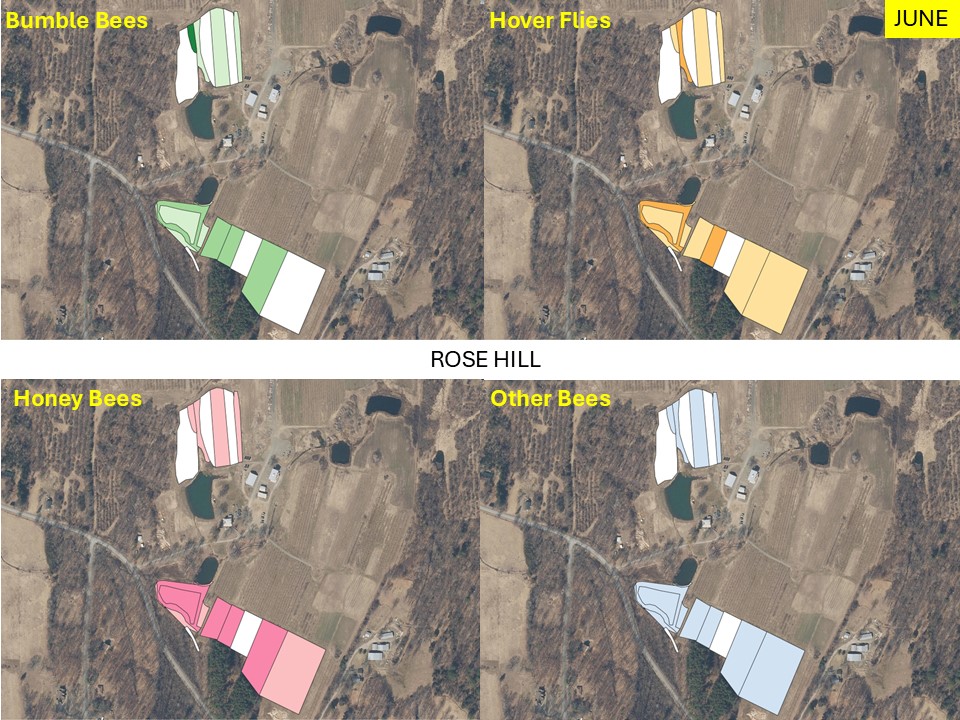
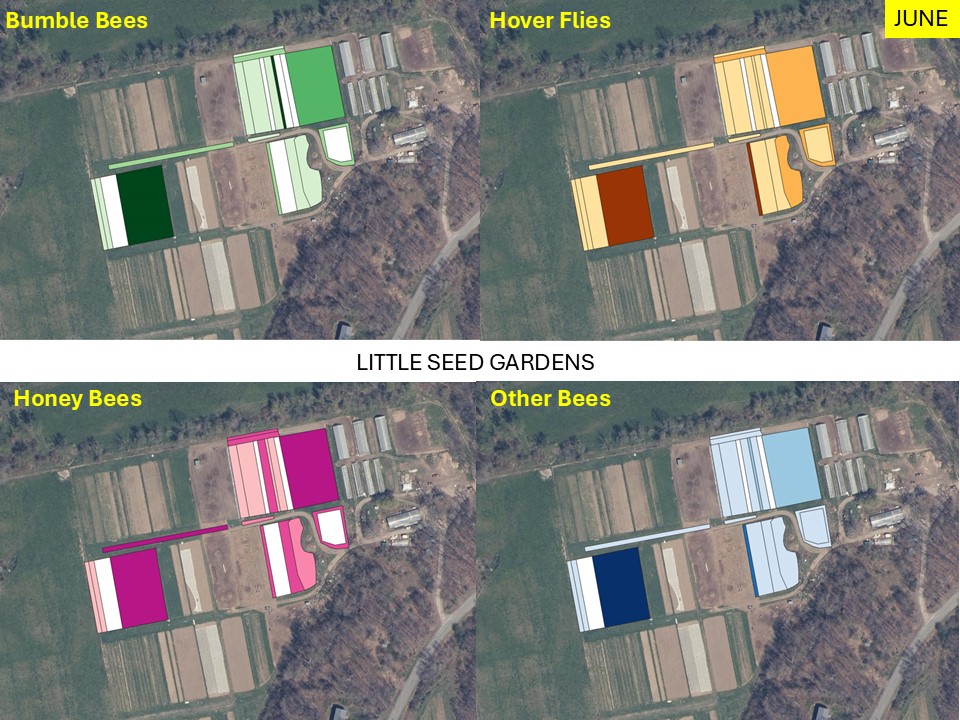
A last example of a flower-rich, unmowed dry slope (#21)