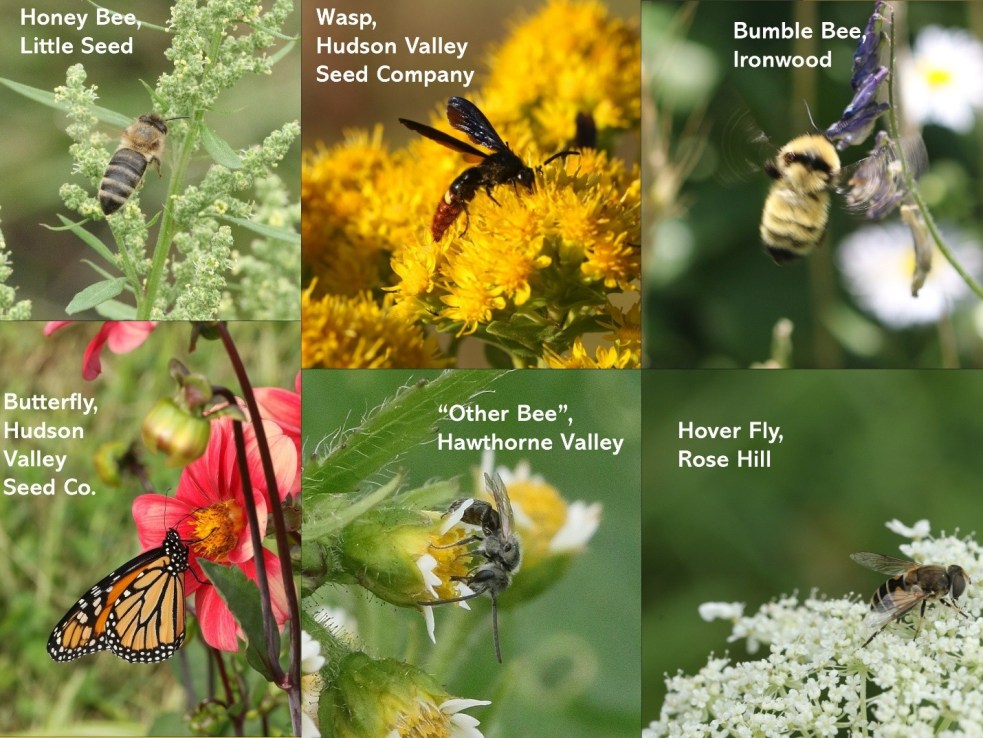
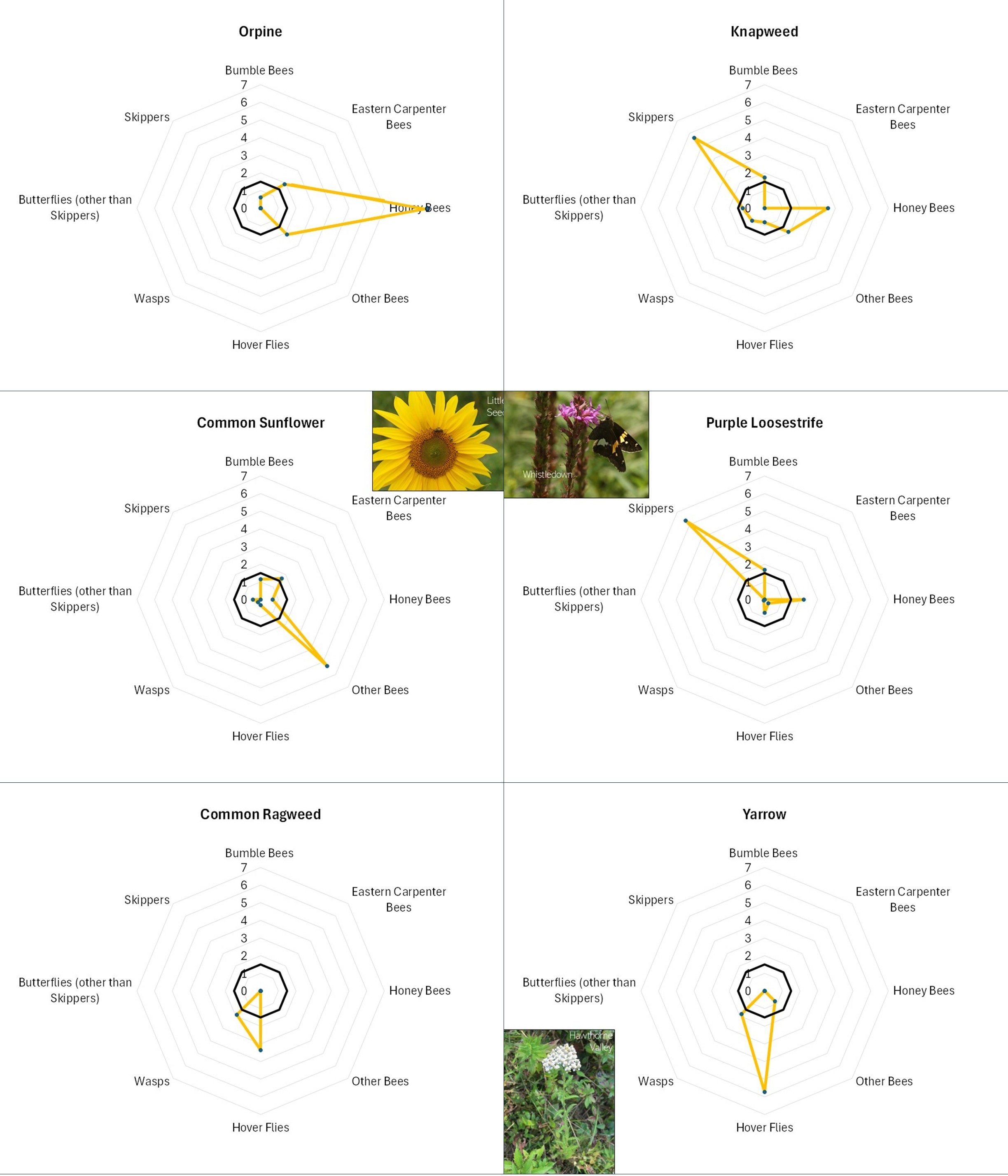
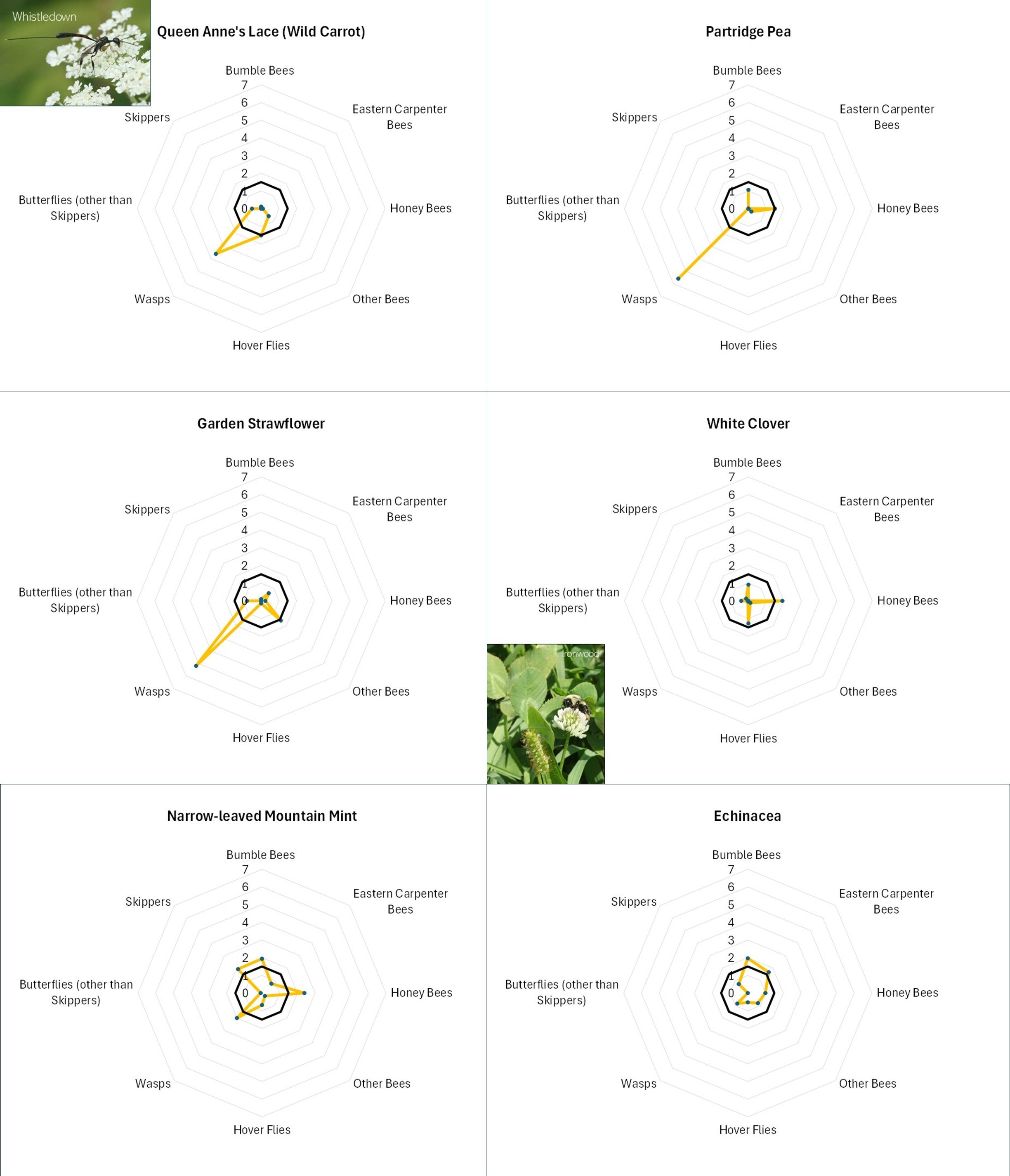
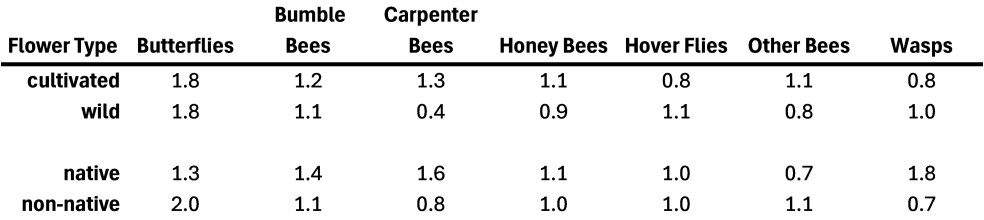
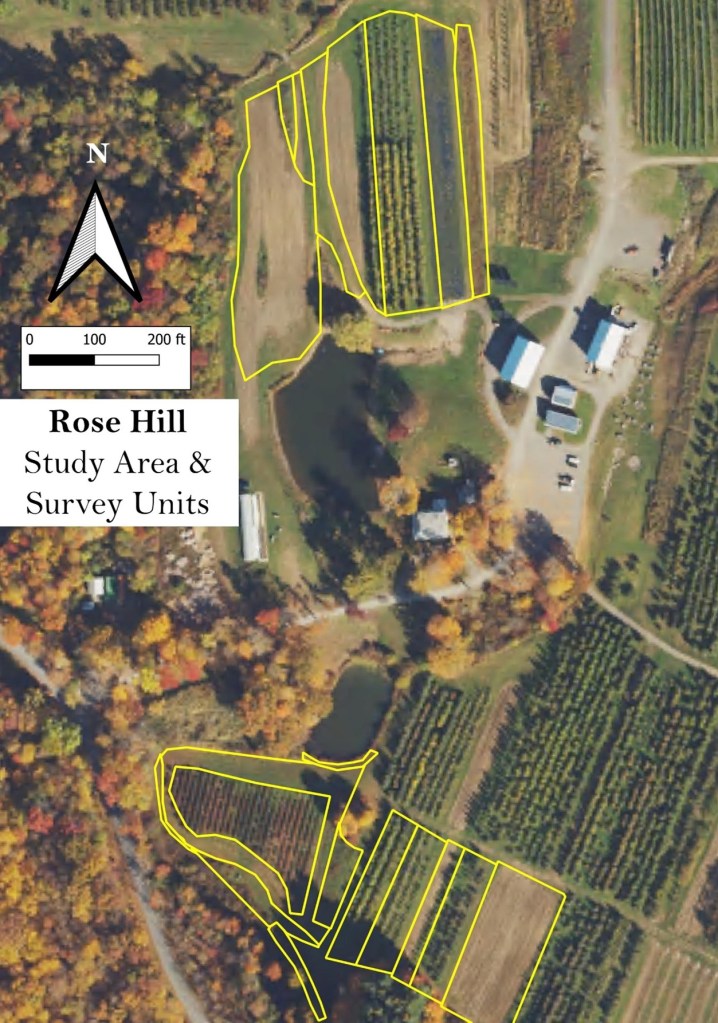
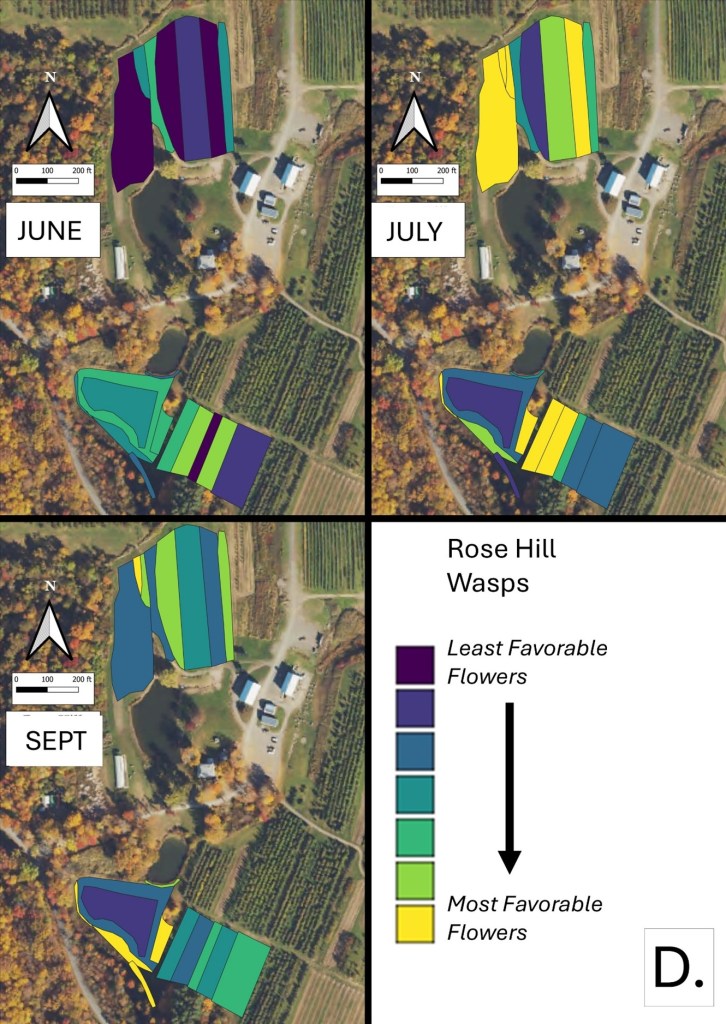
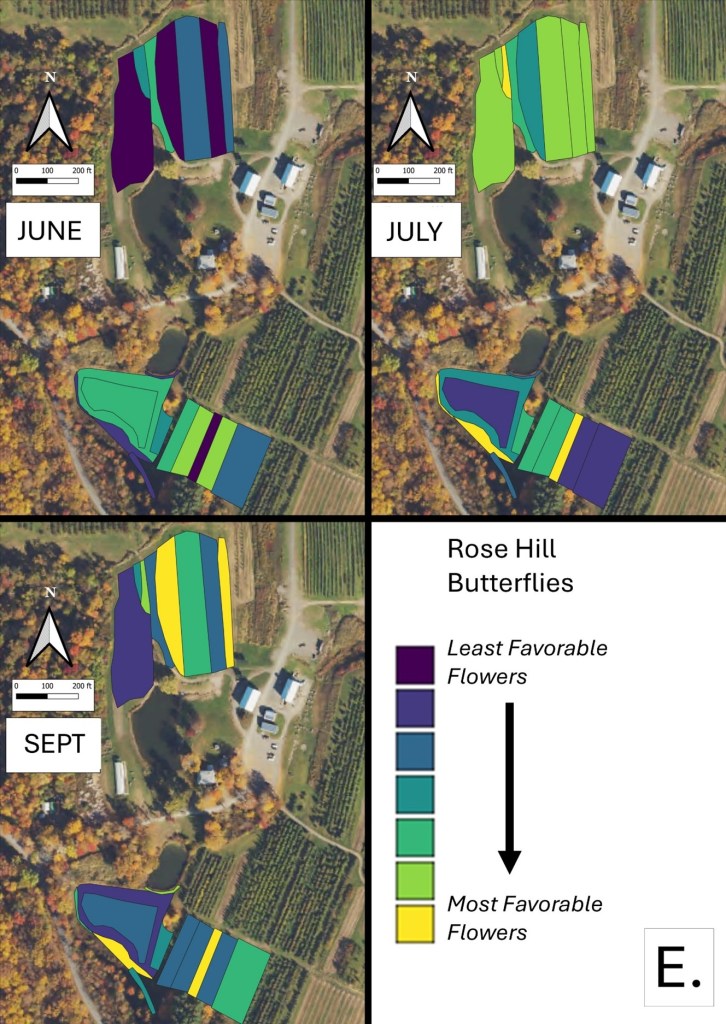
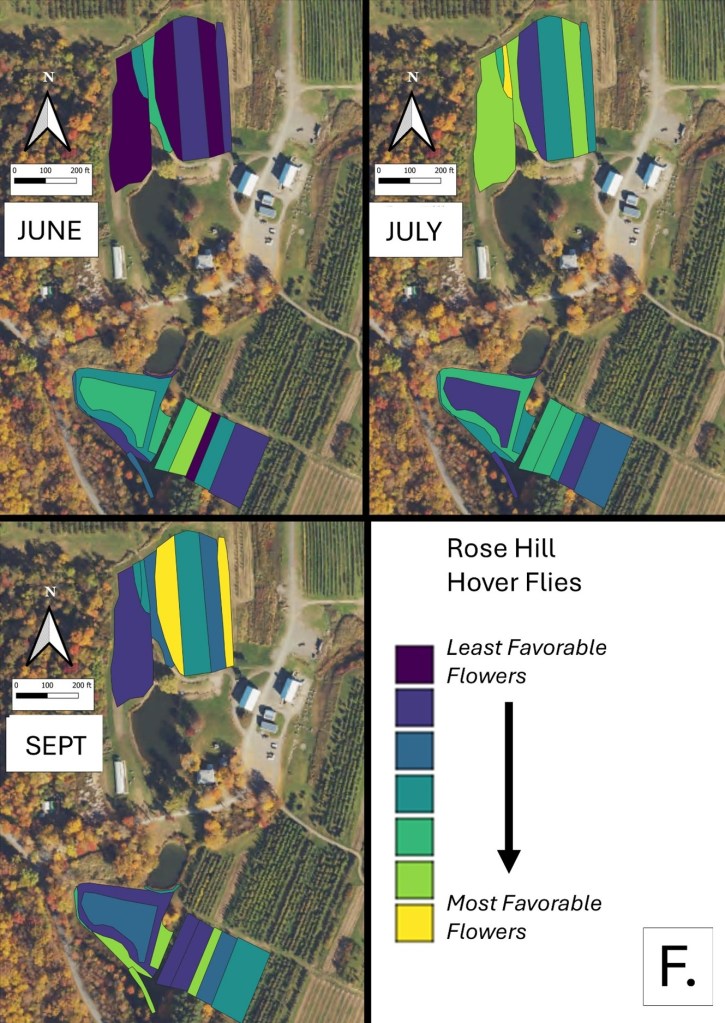
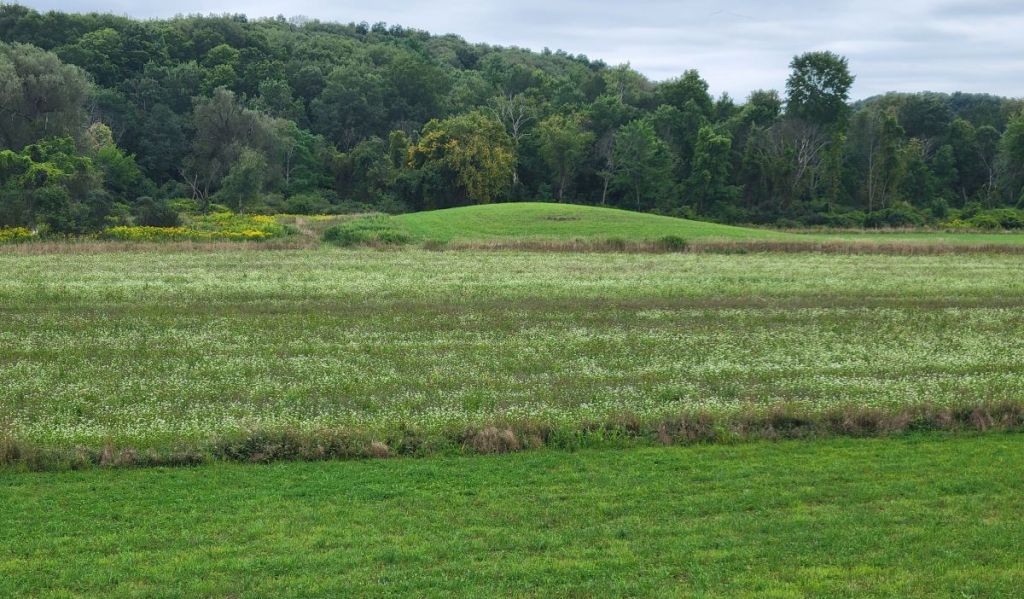
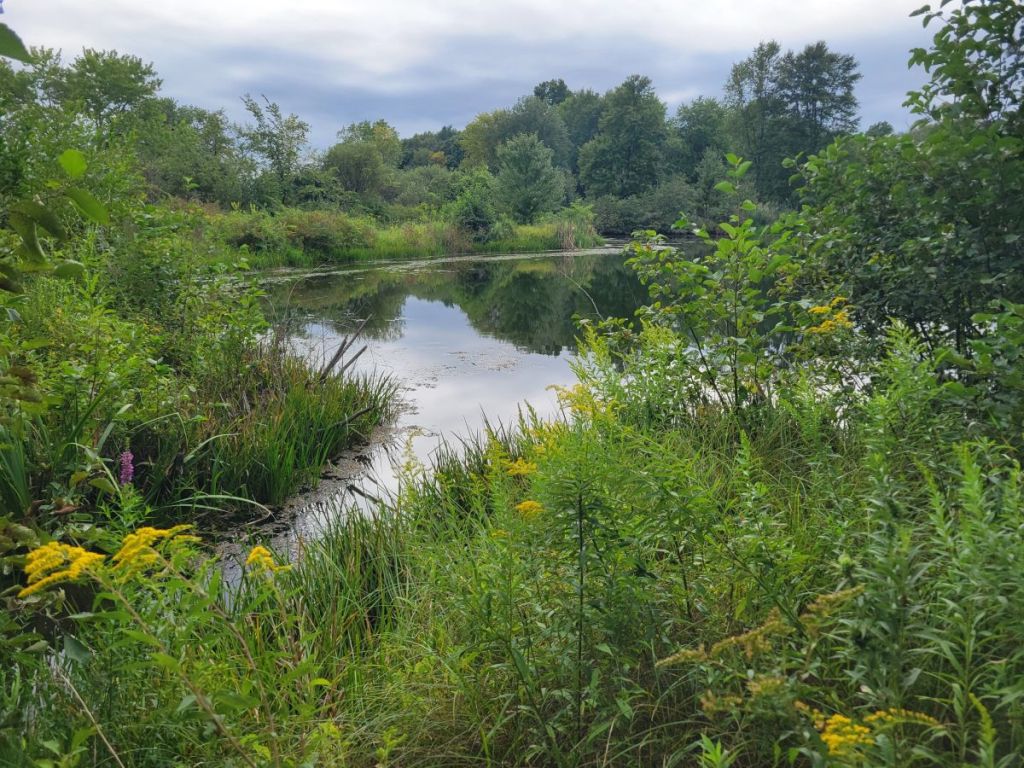
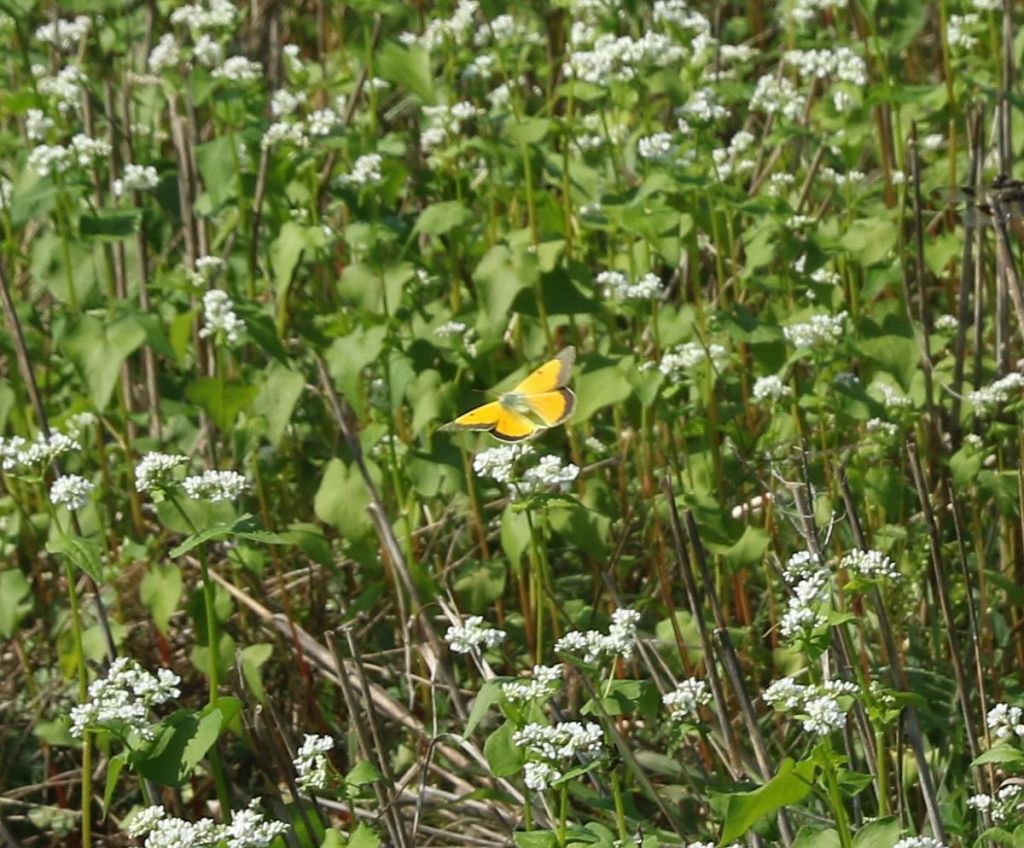
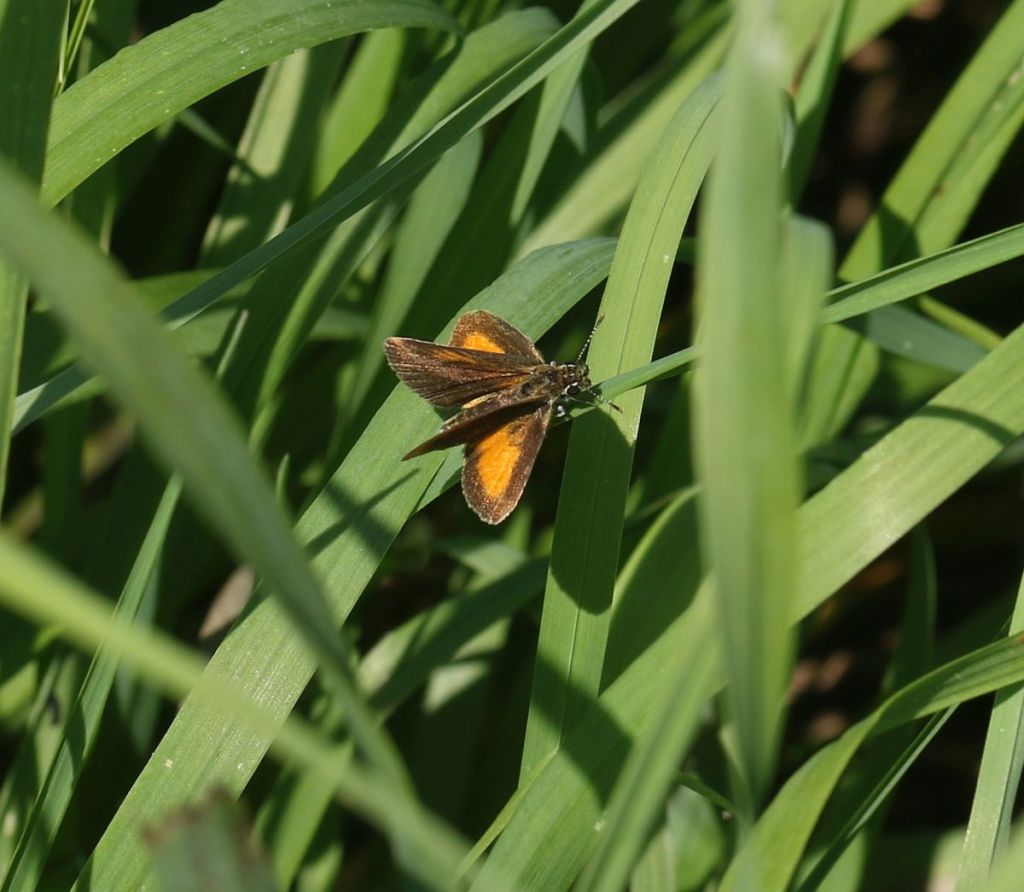
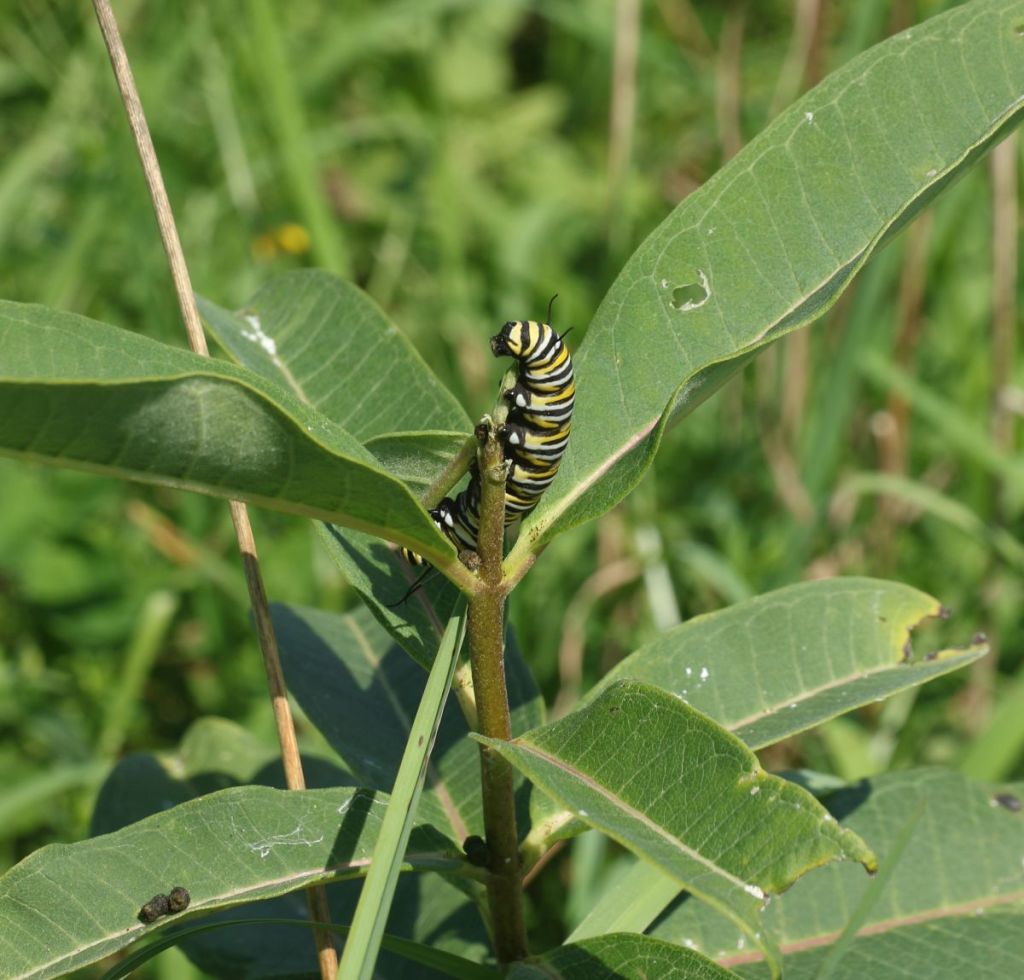
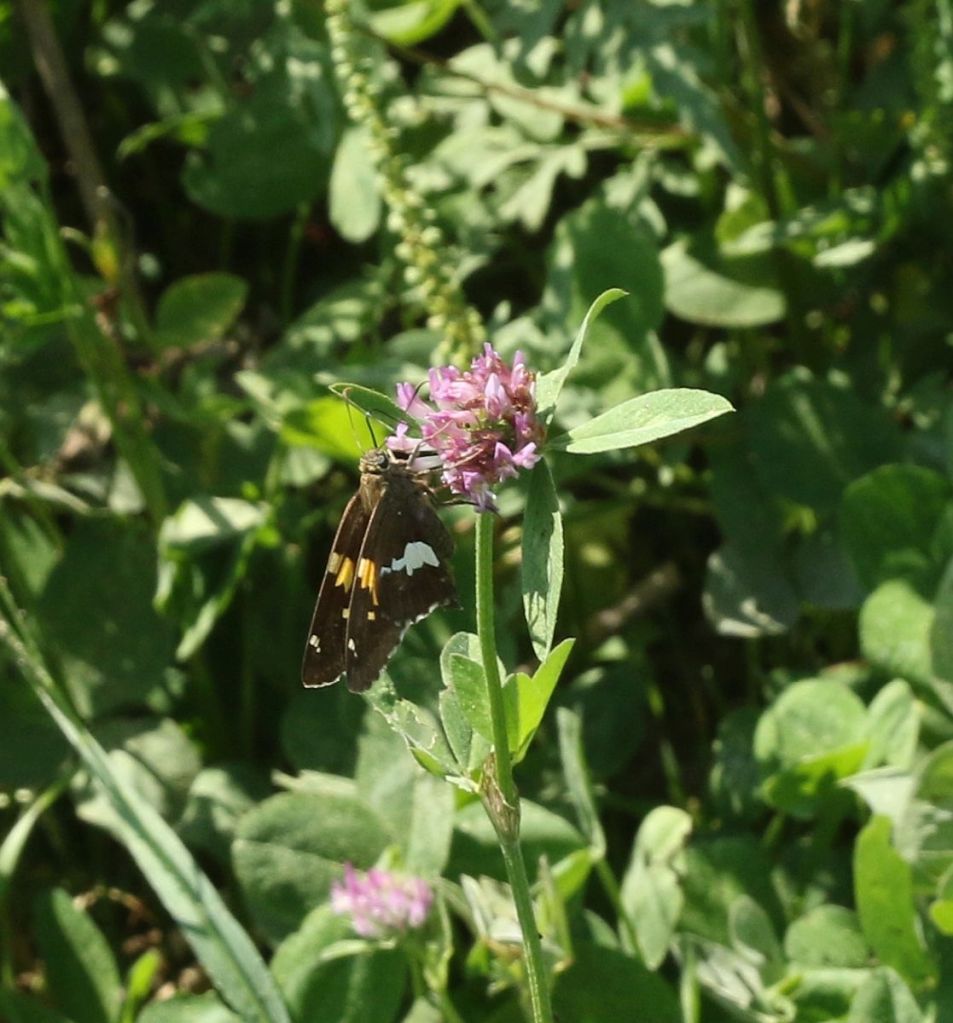
It can be useful to periodically restate what it is we’re trying to do. The following are a few words that were shared at the 17 Dec. 2025 meeting of the Research Circle. In part, they’re meant to help newcomers understand what we’re up to and to answers some questions we have received.
The Research Circle is not the project of any one person or organization. While we are fortunate to get funding from the Farm Hub and the Circle includes staff from Hawthorne Valley, it really derives from a shared desire to work together on topics of mutual interest. Some of us have been at this (on-farm ecological research, farming) for a while, and we are searching for ways to build a community of like-minded individuals to design, execute and act upon ecological research of the community’s own design.
That means that the Circle has no other existence than all of you, all of us. It exists for as long as we want it to and in the shape we choose for it. It is very much a work in progress. Some of us have tried to establish an initial framework in order to get it off the ground but this is intended as a starting point, not an end point.
Reflecting on our own strengths and weaknesses, we as the ecologist did establish one set of boundaries on our own work: There are many, many relevant research questions around farming. We cannot hope to answer them all, nor do we have the capacity to do so. While, to a certain degree, we can bring in the expertise of others, for now what we can offer as researchers is a focus on the role of on-farm habitats in supporting nature for its own sake and for its interaction with production.
In this context, the reports presented in the Fall are the research feedback from projects we all designed together the previous Spring and that were carried out during the growing season. The hope is that, over the course of the Winter, we can all consider these results and what they might mean for management and continued research. These are your results, please ask questions, be (constructively) critical – groan loudly, whoop audibly, share thoughts!
The Intentional and the Accidental: The Role of Cultivated and Uncultivated Flowers in Supporting Plant Diversity and Insect Abundance on Farms.
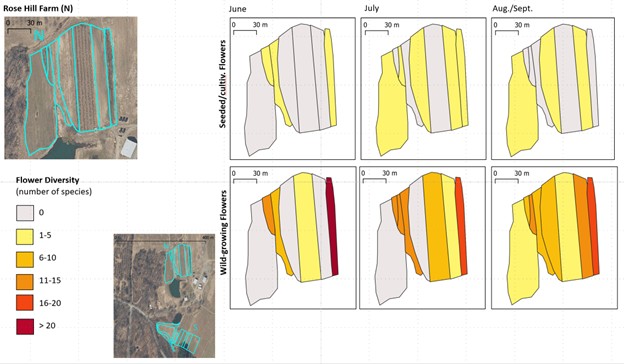
One project whose results we shared on 17 Dec involved studying the support that on-farm flowers provide to pollinators and other flower visitors. How big a contribution to plant biodiversity is provided by the uncultivated (aka “weedy”) flowers found in fallows, lawns, edges and wilder areas relative to flowers seeded for cut flowers, vegetable crops, or intentional pollinator habitat? What role do these same flower play in supporting flower visitors?
We plan a data-rich blog or two exploring these data in more detail. In the meantime, in this talkand these slides, Claudia and Conrad provide a preliminary description of the distribution of such flowers across the seasons and the farms, and summarize how popular the different flowers were with an array of flower visitors. (These links are also available from the Resources page.)
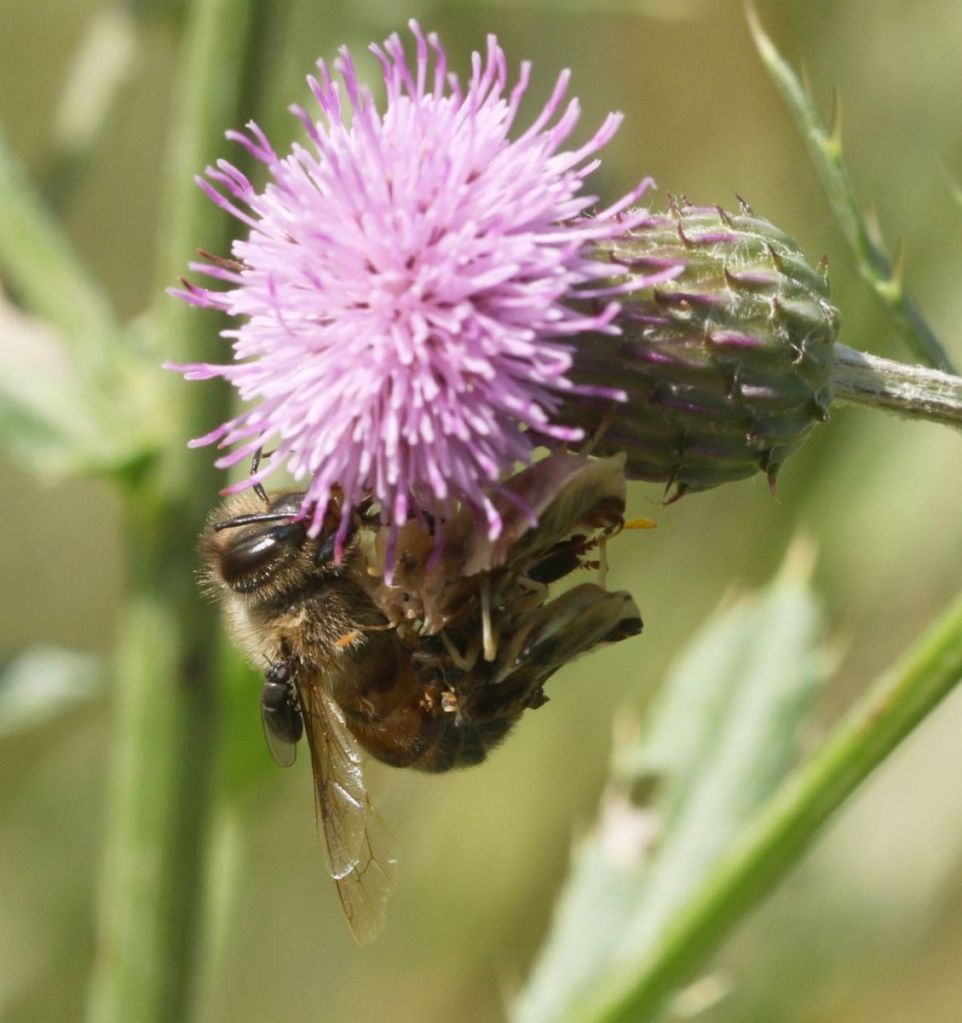
A green sweat bee visits a Black-eyed Susan at Hawthorne Valley Farm.
by Claudia & Conrad.
Background
Deriving from our conversations within the Farmer-Ecologist Research Circle during the winter and early spring of 2025, this season we are exploring a set of questions related to on-farm flowers and beneficial insects. Specifically, wild flower plantings are being promoted for a variety of reasons, including their support of insects. At the same time, the value of fallow and edge wild flowers is sometimes underappreciated. The Circle thus became interested in understanding what resources planted flowers might provide to insects relative to what wild-growing flowers are providing – are such plantings worth the extra effort? How might the seeded and the unseeded flowers best complement each other?
Specifically, our questions are the following:
Which flowers (cultivated and wild-growing, native and non-native, intentionally managed or growing spontaneously) occur on farms? Where on the farm do they occur and when in the season?
Which of the above flowers are most attractive to easily observable insect groups (such as Bumble Bees, Other Native Bees, Honey Bees, and Hoverflies)? Does one size fit all flower-wise, or is a diversity of floral shapes, sizes and colors important?
Based on the answer to the above two questions, which areas of each of the participating farms might be providng the most flower resources to each insect groups and how does that differ across the growing season?
There are various ways that one might approach answering these questions. The ‘Cadillac’ version (did we just date ourselves?) might be to do intensive surveys of flower diversity and abundance based on sampling plots and multiple counts coupled with some sort of standardized insect surveys such as with bee-bowl traps and netting. While potentially more rigorous, this would be a full-time job, plus it might not actually give much information on the value of individual types of flowers. So, instead, we decided to do something that is a bit more “quick-and-dirty,” but which, we hope, nonetheless allows us to get a good first glimpse of the answers to the above questions.
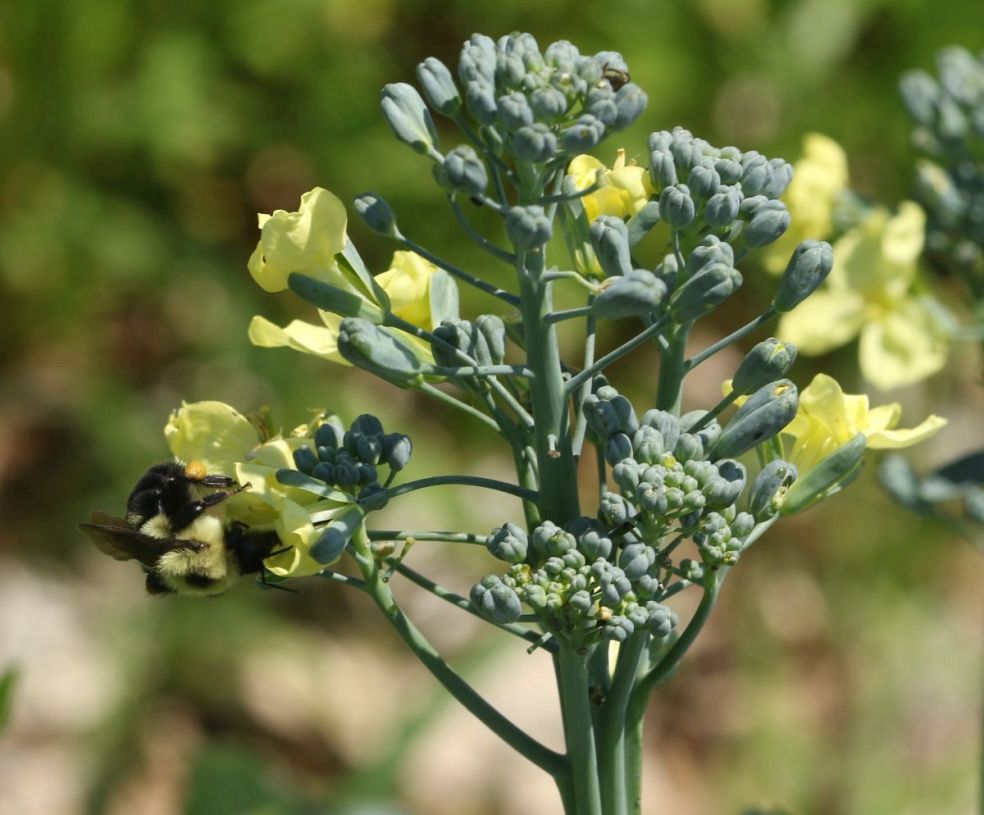
A bumble bee on Broccoli at Little Seed Farm.
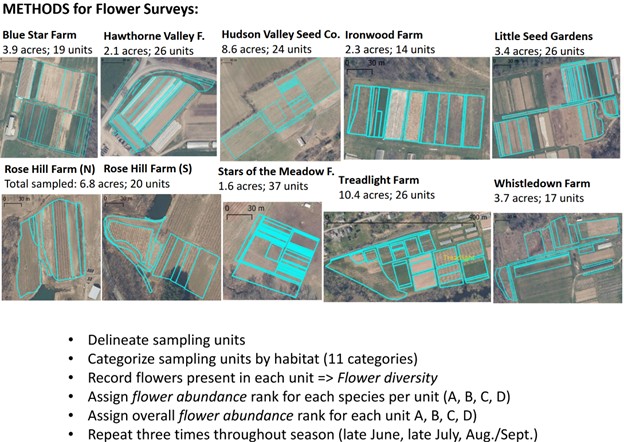
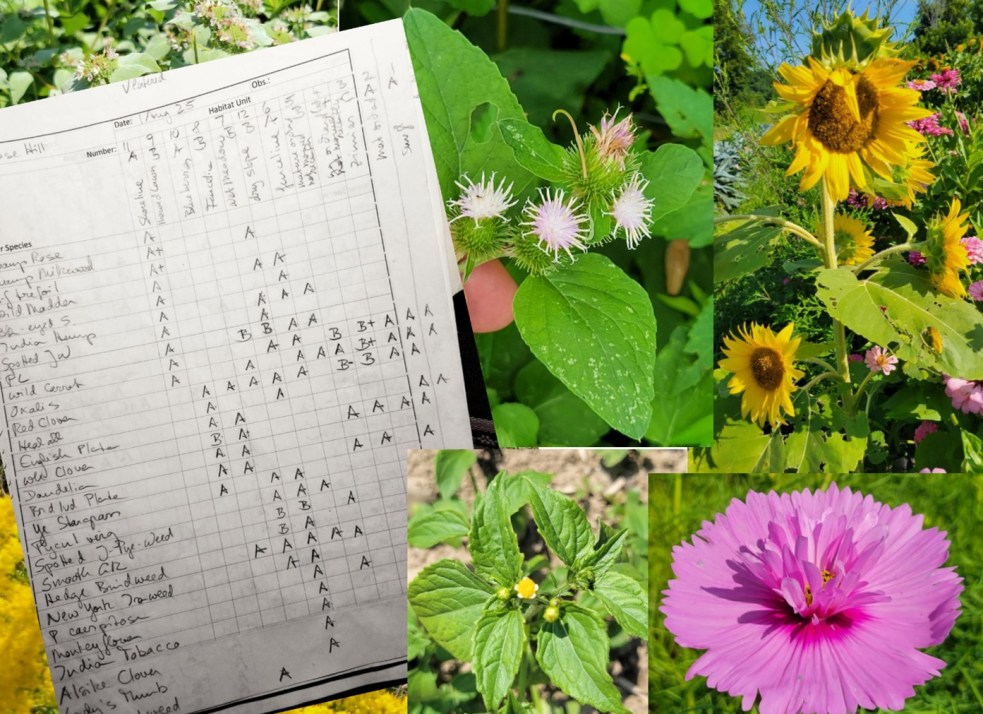
During our monthly visits (June through September), we try to spend 2-4 hours at each farm, documenting the flowers and their insect visitors in a section of the farm that includes a variety of habitats and management units. While doing the entirety of each farm would be cool, it’s beyond our current person-power. During each visit, Claudia ranks the abundance of the flowers of each species in each management unit and also assesses the overall flower abundance in each of those. She identifies each plant in flower and assigns it a floral abundance rank (A through D, with D being most common). Conrad observes and counts the insect visitors to flowers by doing five-minute ‘wandering flower watches’ for each species. For simplicity, four insect groups are presented here: Bumble Bees, Other Wild Bees, Honey Bees, and Hover Flies. During each of these strolls, new flowers of the given species are constantly being found and the observed presence of any insects is tallied. (The small print: To help correct for the effects of a particular farm or day, these flower visitation rates are standardized by the overall mean of the visitation rate for each of the four insect groups across all flowers on the given farm and then the standardized values for the focal flower are averaged across all farms at which that flower was observed.)
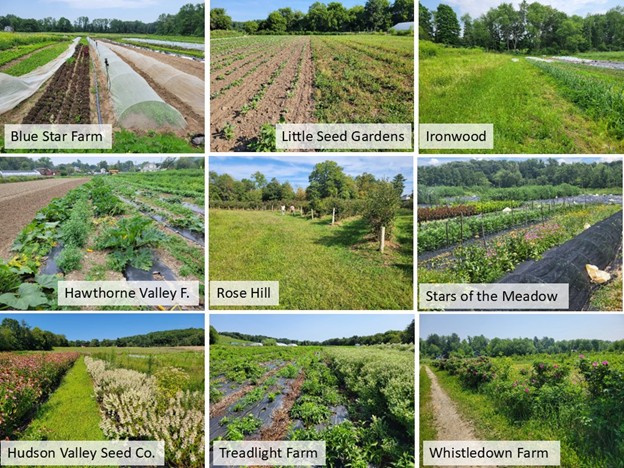
As the above map shows, the participating farms are Blue Star Farm, Hawthorne Valley Farm, Ironwood Farm, Little Seed Gardens, Whistledown Farm (all in Columbia County), Rose Hill Farm (in Dutchess County), Hudson Valley Seed Company, Stars of the Meadow Farm, and Treadlight Farm (all in Ulster County).
By jointly examining the results, we hope to help farmers see which areas of their farms might already be doing “good work” in support of certain flower-visiting insects, where there might be spatial or seasonal gaps in resources for these insect groups on a particular farm, and what might be practical ways to improve the floral offering. That said, it’s important to realize that there are factors other than just immediate flower availability which can affect bee (and other insect) abundance. These include access to suitable nesting conditions (such as good burrowing soils for ground nesters or the presence of hives for Honey Bees), conducive land use in the general surroundings (for example, freedom from pesticides or intensive car traffic), a flowering calendar that provides nectar and pollen throughout the insects’ life cycles, and, potentially, freedom from competition (under some conditions, Honey Bees are thought to compete with certain other bees species).
A Bronze Copper feeds at the flowers of Asian Greens at Blue Star Farm (we do tally butterflies, but haven’t see enough of them to warrant including them as a category).
This blog shares our observations from the first round of visits (June 5 to July 3, 2025) and illustrates our approach. The delineation of the habitats and management units is tentative and we expect to make some refinement in the next round of site visits.
Please let us know which results are most interesting to you. Is there anything else you would like us to document while we are out there? Do you have any questions?
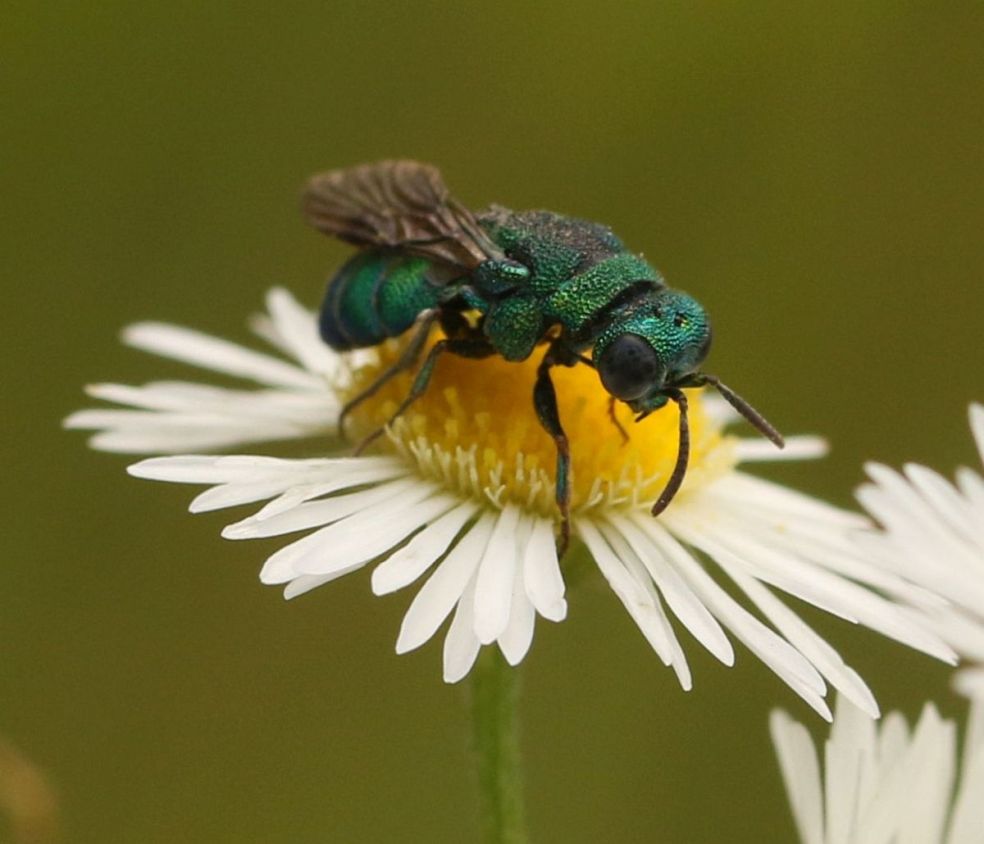
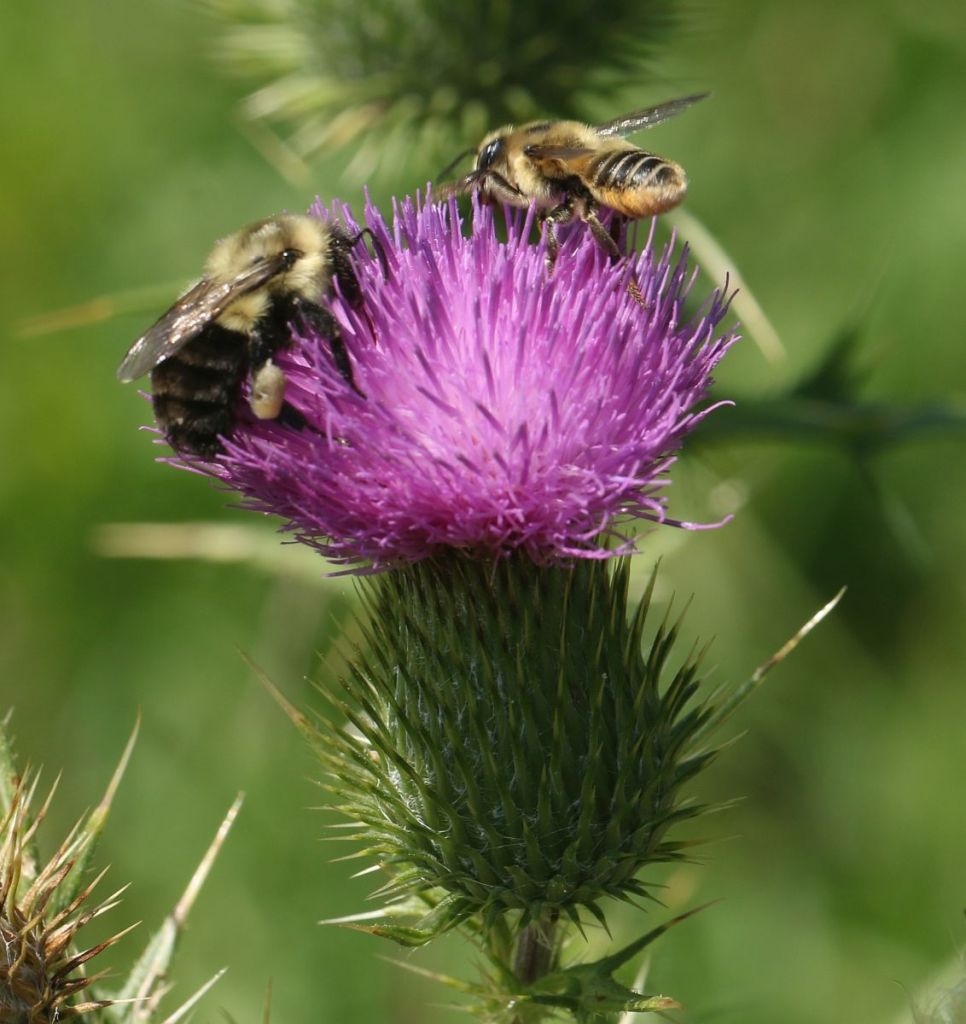
This catchy creature on an Annual Fleabane at Stars of the Meadow Farm is actually a type of cuckoo wasp – it usurps the nurseries of certain other ground-nesting wasps.
What We’ve Found So Far: Flowers on the Farms in June
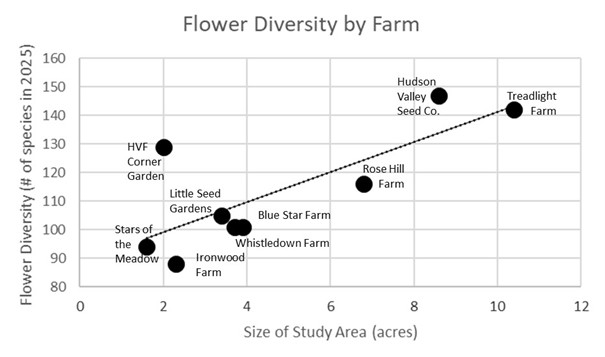
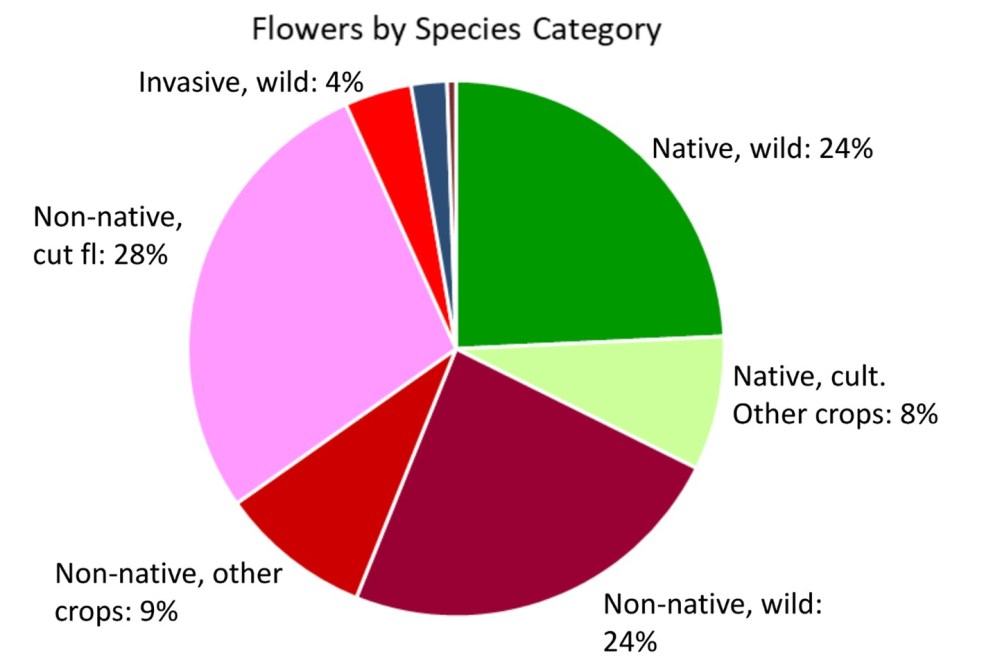
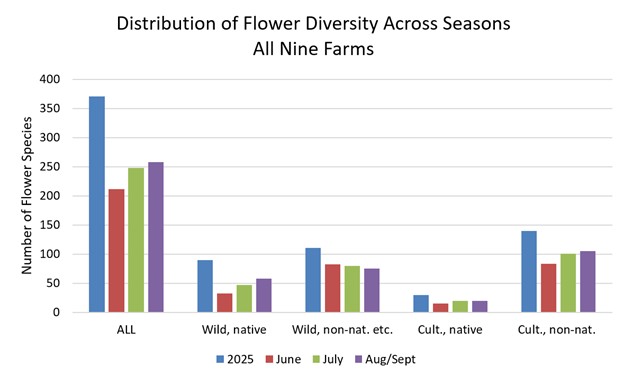
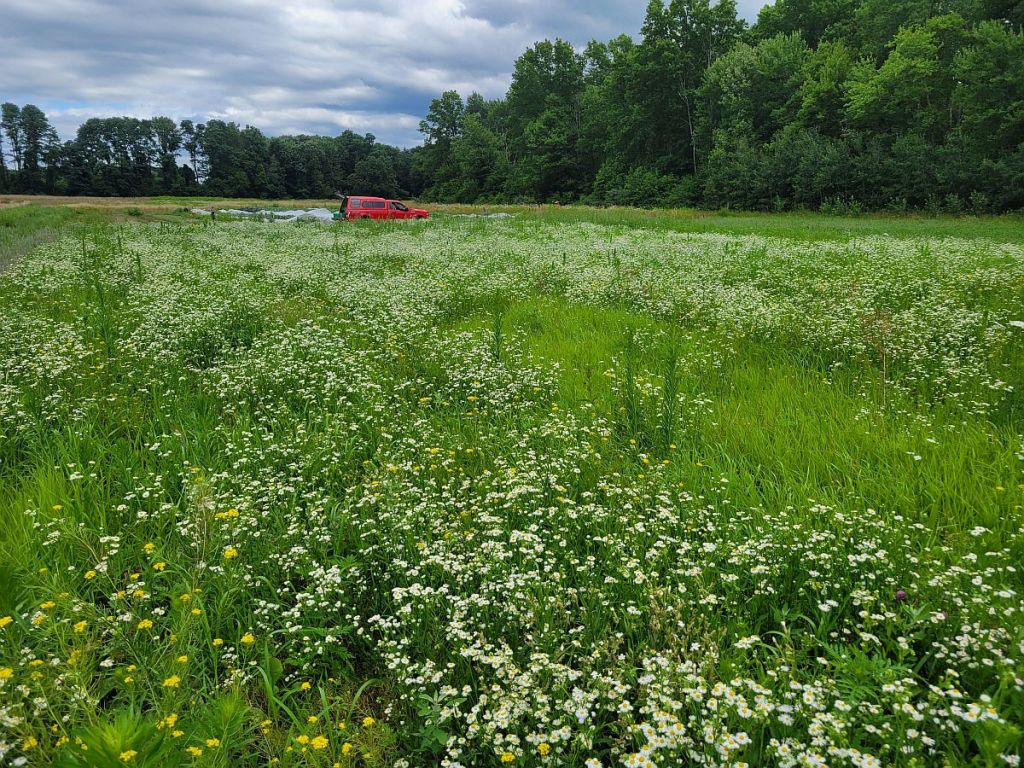
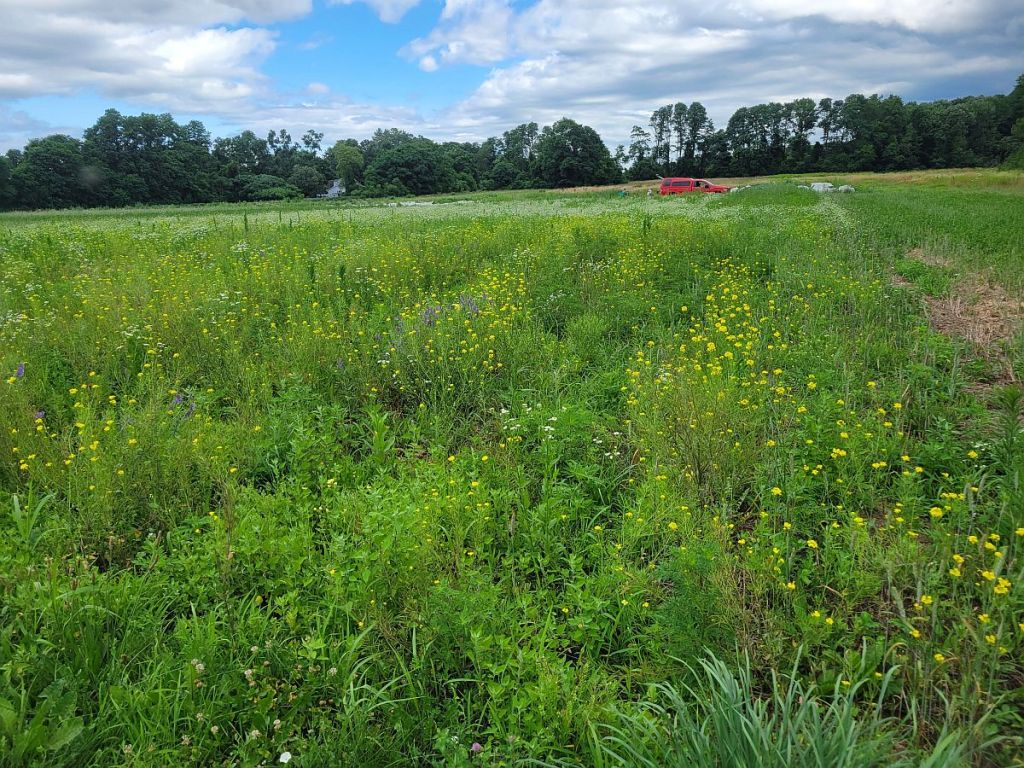
We found more than 200 species of flowers on eight of the farms (unfortunately, Claudia was unable to get to Stars of the Meadow Farm in June; Conrad did tally insects on flowers but the vegetation wasn’t mapped in detail). The most diverse group of flowers on the farms, with 83 species, were the non-native, cultivated plants. These included cover crops (such as Buckwheat or clovers, vetch and pea species), cut flowers (such as Zinnias, Snapdragons, and Marigolds), vegetables that need to bloom in order to produce the crop we eat (such as Tomatoes, Peppers, Squash and Cucumbers), as well as culinary herbs and leafy greens allowed to set flowers (such as Dill, Cilantro, Arugala, and other brassicas). Almost equally diverse, with 80 species, were the non-native wild-growing plants (“weeds”), which included ten species considered invasive in our region (such as Canada Thistle, two species of knapweeds, and Ground Ivy). Flowers were also found of 32 native wild-growing species (for example, Annual Fleabane, Common Yellow Wood Sorrel, and Common Milkweed) and on 18 native species cultivated for cut flowers (such as Fringed Loosestrife, Foxglove Beardtongue and several species of mountain-mints).
A small group of flowers were found at all nine farms. These ubiquitous flowers were Annual Fleabane, Narrow-leaved Plantain, Red Clover, White Clover, Wild Madder (aka Common Bedstraw), and Common Wood Sorrel.
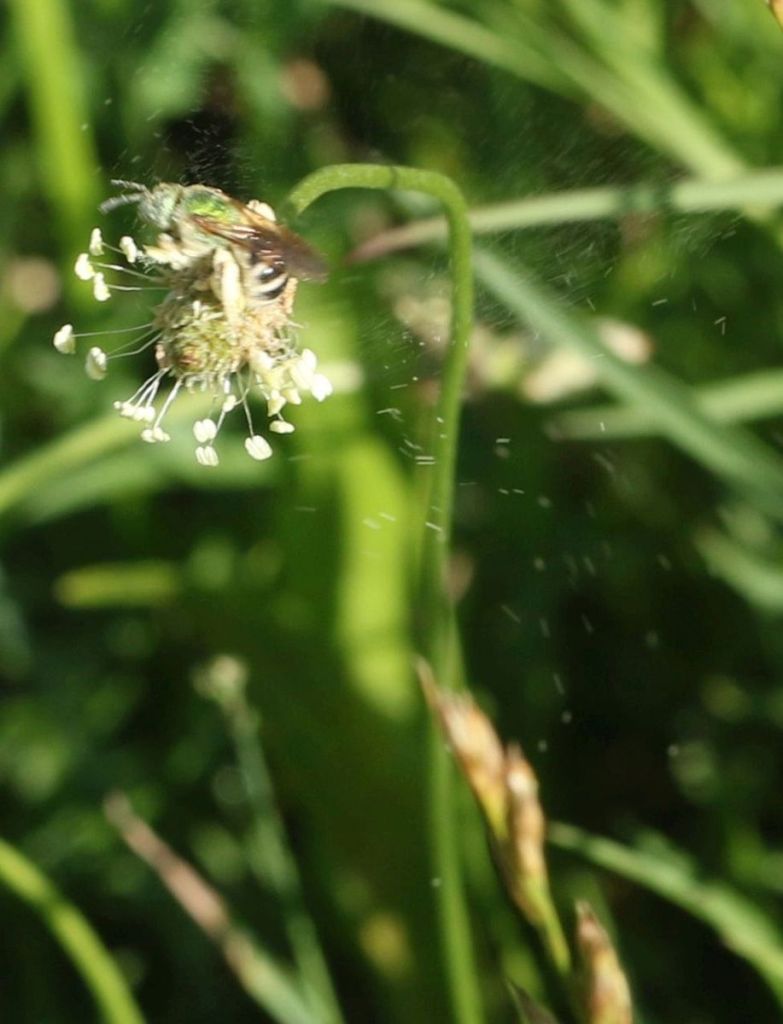
A green sweat bee takes a pollen bath on English Plantain at Rose Hill.
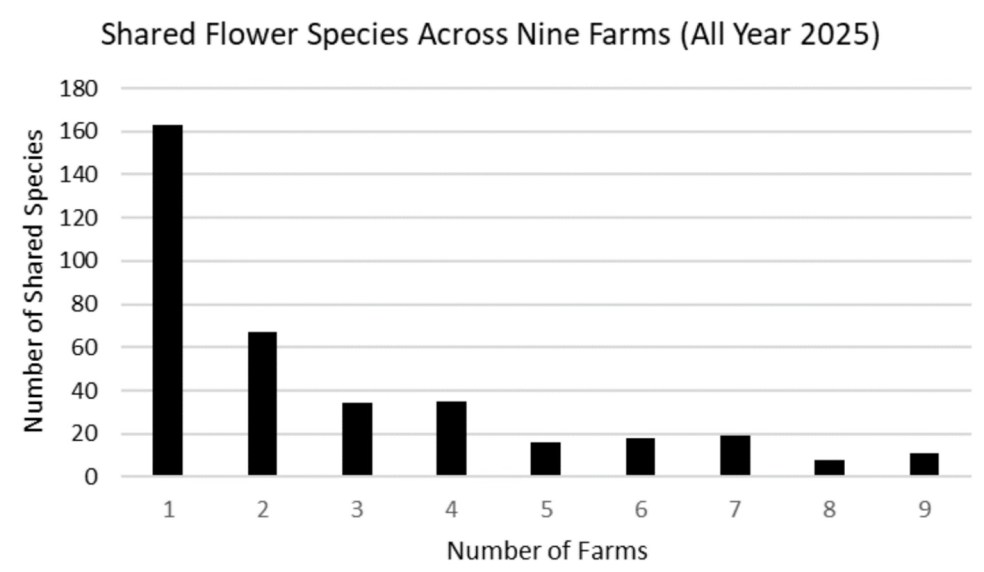
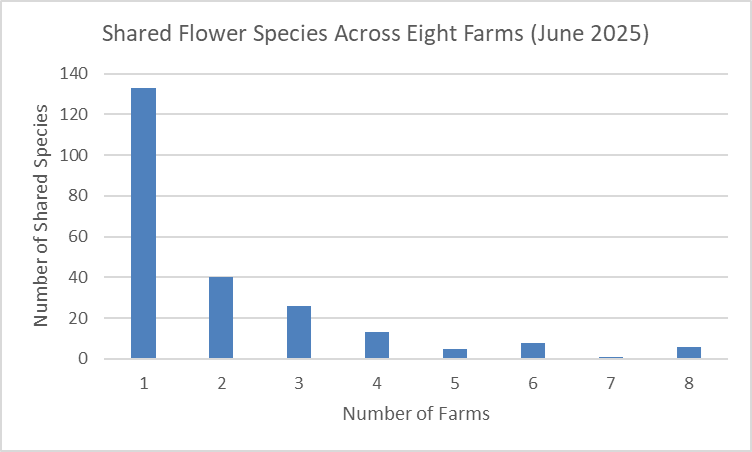
The following graph illustrates just how different the eight farms visited by Claudia were in terms of their flowers. Only the six species just mentioned were found on all eight farms she visited in June (and in fact, they were all also observed at Stars of the Meadow in July) . A few additional species were shared by more than four farms, while 133 flower species were found at only a single farm.
What We’ve Found So Far: Flower Abundance within Management Units and across Habitat Categories in June
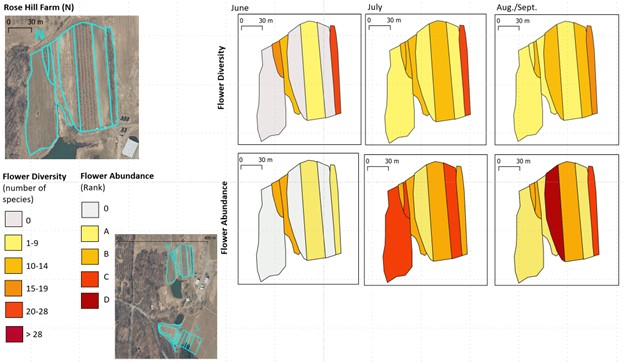
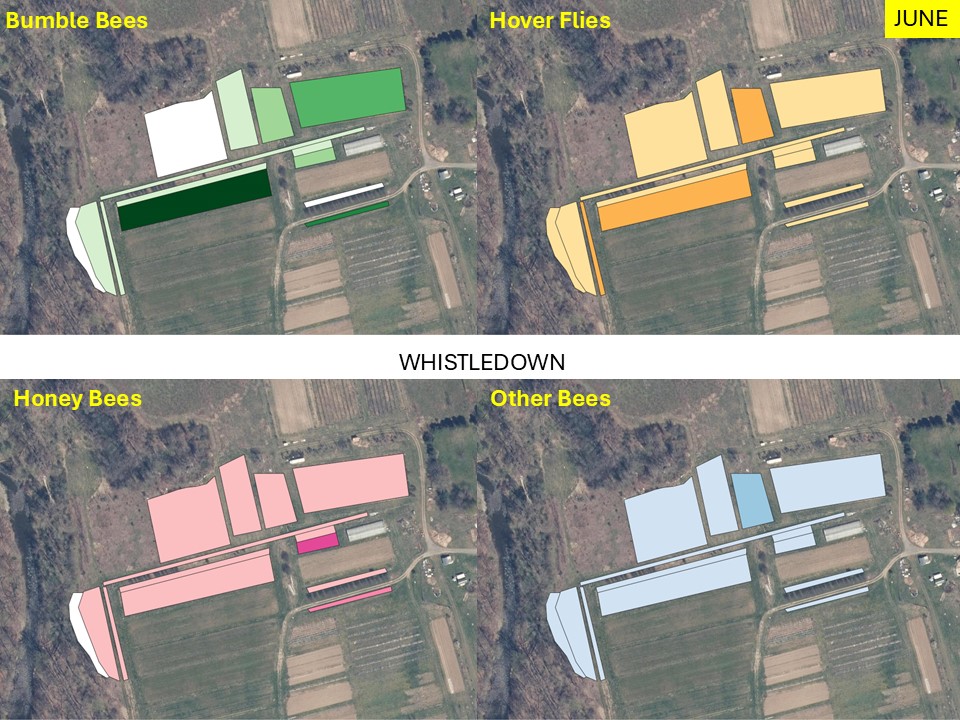
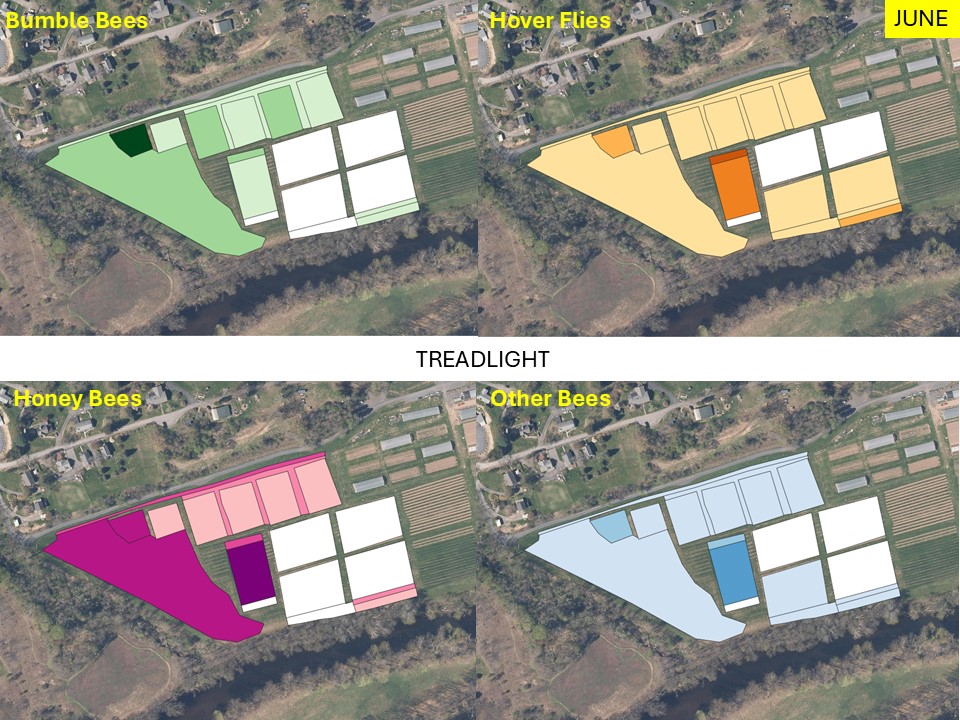
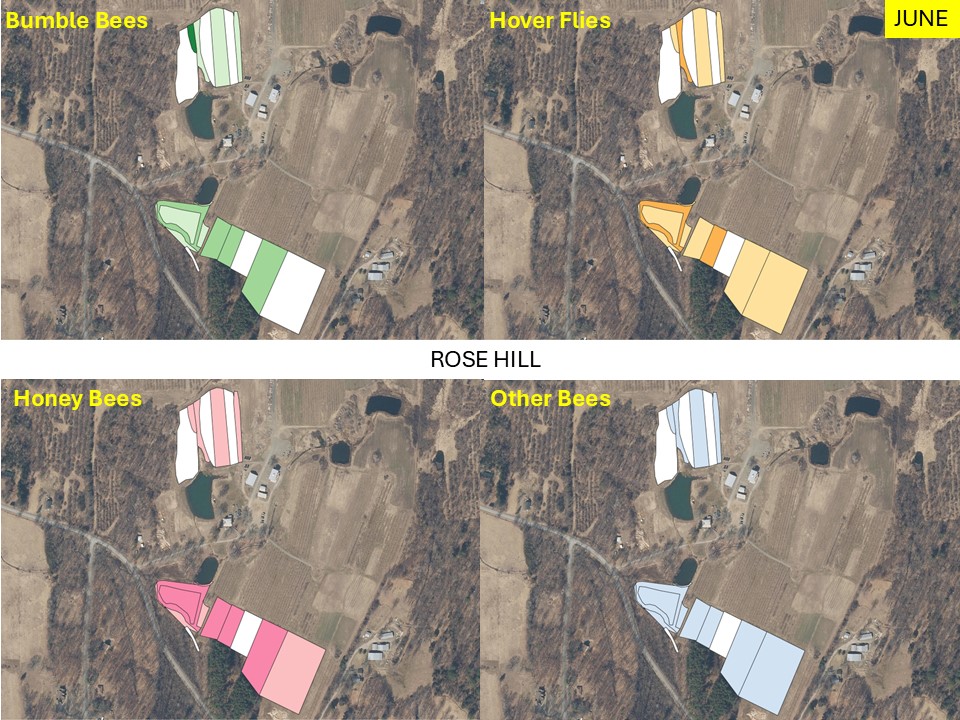
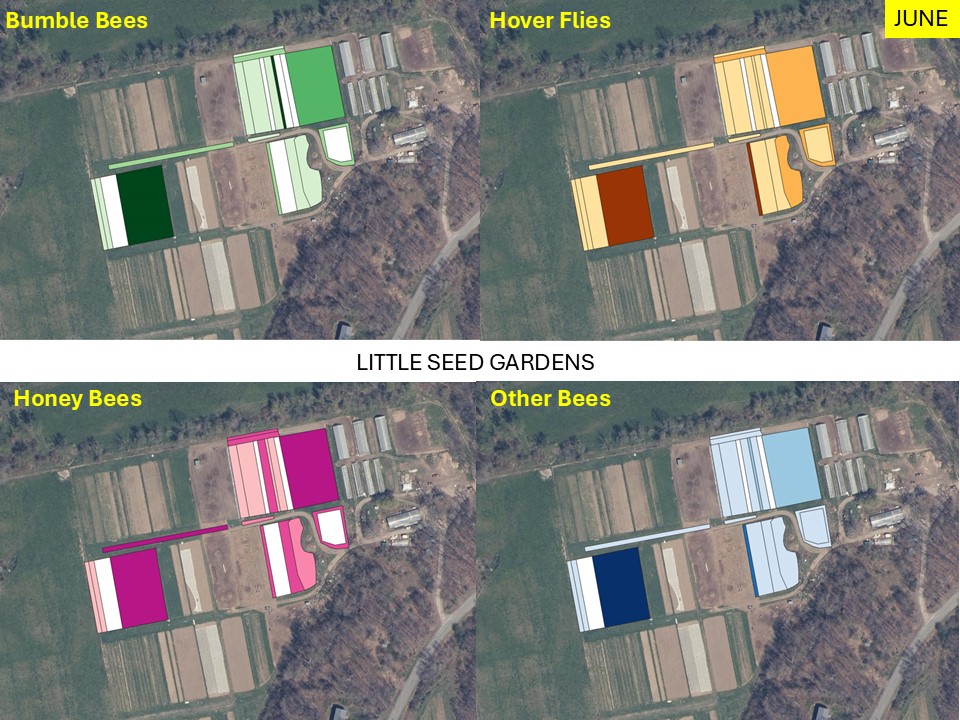
The following map shows a color-coding of the study units at each farm by rank in flower abundance, increasing from zero (no flowers), to A (rare flowers), B (medium density of flowers), C (flowers common), to D (flowers abundant). (Again, Stars of the Meadow is missing from these maps this time around, but will be added in July and subsequent months.)
We only assigned the highest flower abundance rank D to five fields/management units in June: four of them were mature fallow fields (tilled within the last year or two, but not yet managed in 2025), of which three were dominated by the flowers of Daisy Fleabane and one by Wild Madder (Common Bedstraw). The fifth was a Buckwheat cover crop in full bloom.
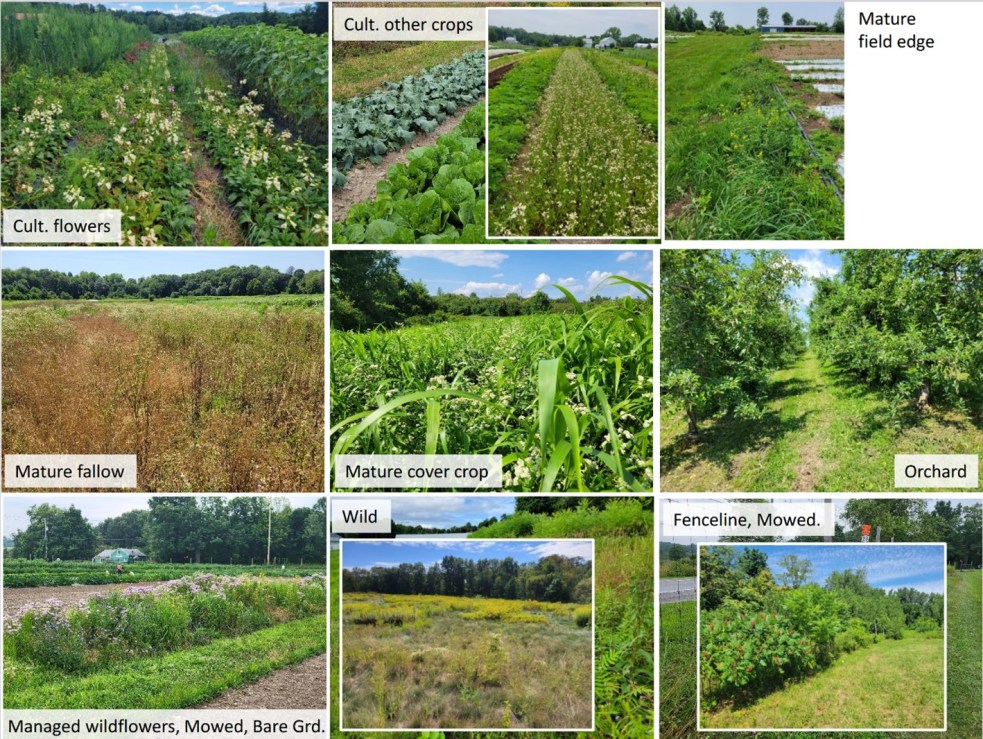
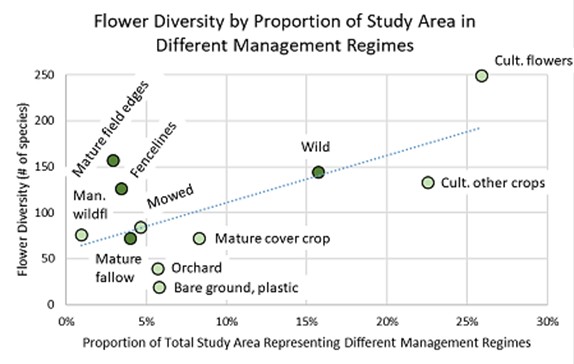
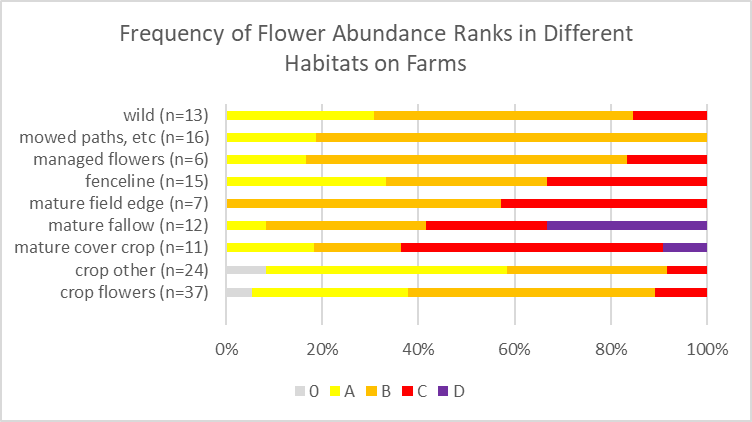
When comparing the flower abundance ranks assigned to the most common habitats we surveyed, we see that, in addition to mature fallow fields and mature cover crops, some of which reached very high flower densities, the habitat with the most consistently high density of flowers was mature field edge. Wild habitats, managed flowers, and fencelines sometimes also had a lot of flowers, but sometimes not very many. Early in the season, beds with crop flowers were quite variable in their flower abundance and still had overall relatively few flowers.
A Honey Bee with bright orange ‘panniers’ of Asparagus pollen at Whistledown Farm.
What We’ve Found So Far: Flower Diversity within the Management Units and across Habitat Categories in June
The following map shows a color-coding of the study units at each of the eight farms by number of species in flower (which did not always correlate with the abundance of flowers).
We found the most diverse (species-rich) flower communities in mature field edges and mature fallow fields. Most wild areas also had diverse flower communities, but some did not (at least not in June).
What We’ve Found So Far: Which Insects Like Which Flowers?
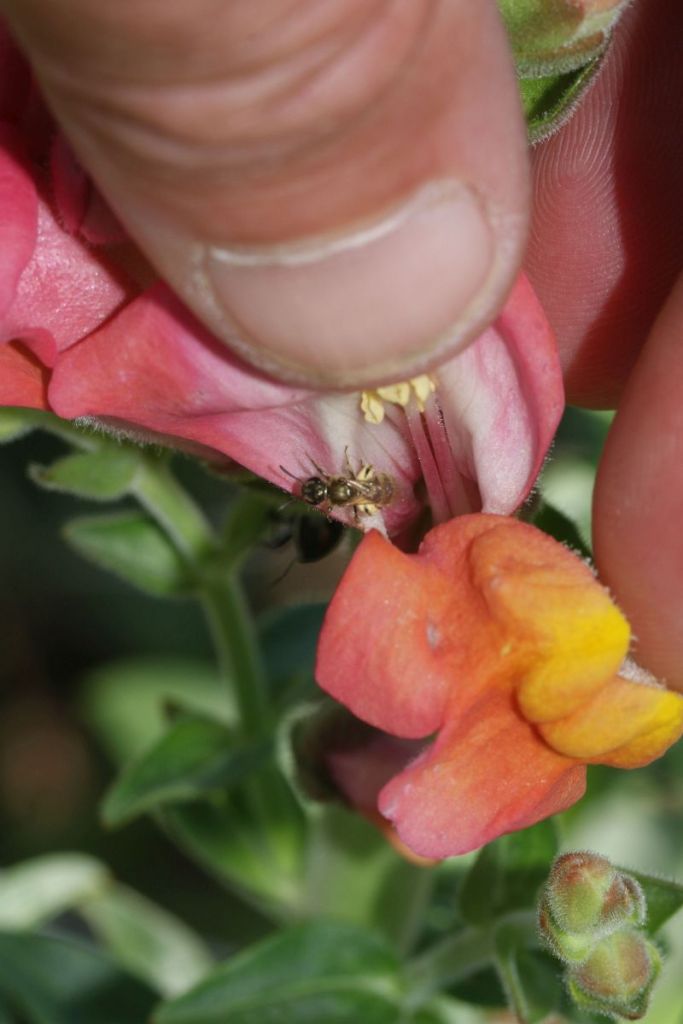
The ‘mouth’ of a snapdragon (at Treadlight) is opened to reveal a small sweat bee hidden inside. Doing an accurate visual count of visitors to snapdragons is nearly impossible.
Before summarizing the insect results, let us tell you some of the reasons these data should be taken with a grain of salt:
Our approach is based on seeing insects on flowers. This means both that smaller, less conspicuous insects surely tend to go unseen and that insects entering closed flowers like snapdragons or dangling flowers, like those of Potatoes or Horse Nettle, are unreported because they were hidden from view. Furthermore, while the stopwatch of our visual surveys only ran while our eyes were inspecting flowers, there is no doubt that more flowers (and hence potentially more insects) were observed when those flowers were growing in tight clusters than when they were growing as singlets or small clumps. Finally, the ‘ripeness’ of flowers (that is, how much nectar and pollen they are offering) is not always immediately apparent. If you spend time watching flowers, you’ll notice that, even within a single flower species, the attractiveness seems to vary across dates and even within days. For the more common flowers, we have data from multiple dates and several different farms and our averaging might iron out some of the flukes; however, some flowers were only observed for one 5-minute block on one farm and what we saw then is what you get. All this adds ‘noise’ that might confound actual patterns…
But, with these caveats in mind, what did we find?
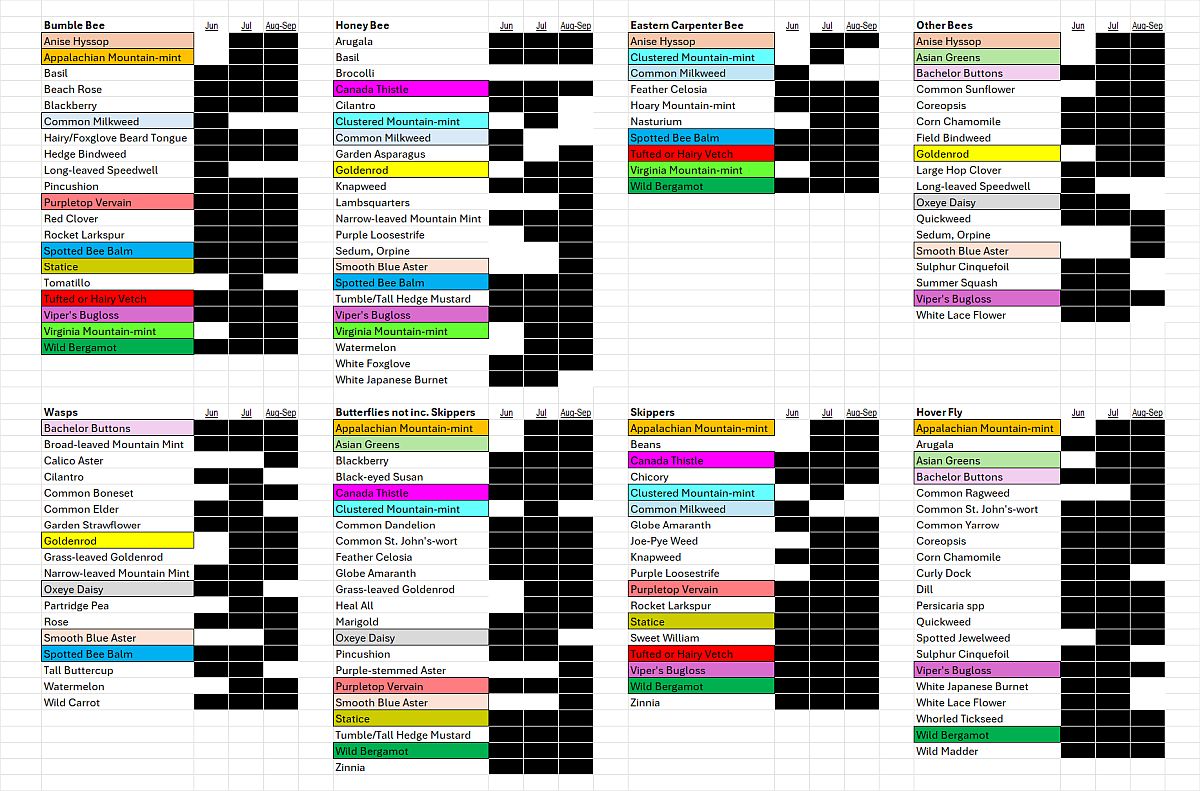
The top-ranking flowers for each insect group.
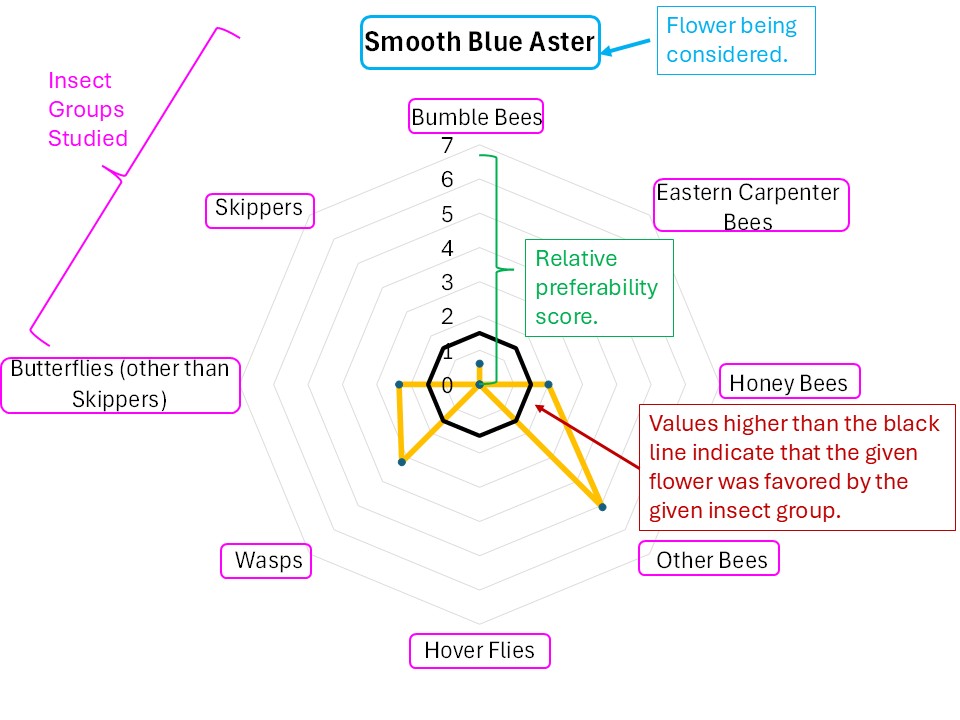
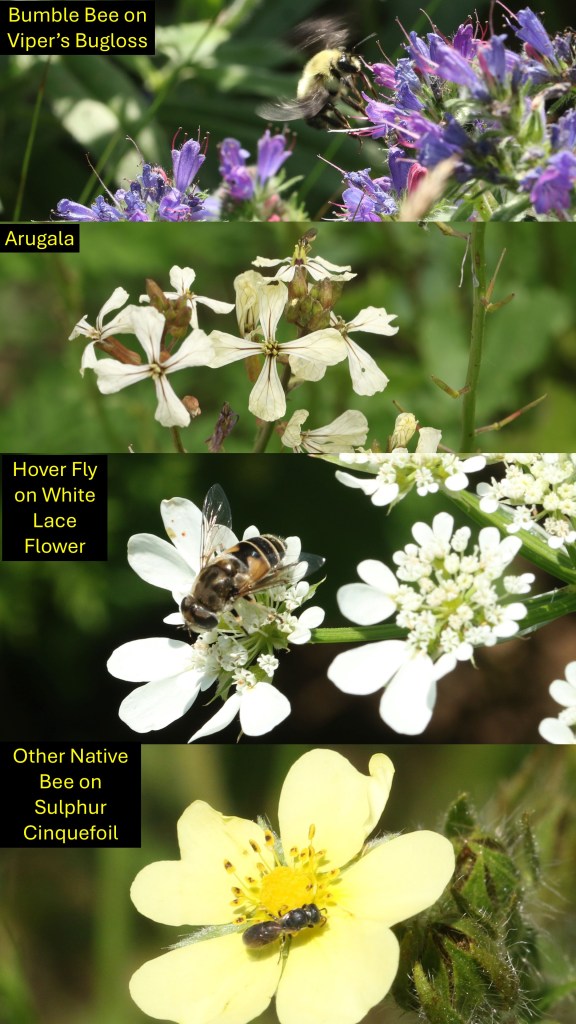
In this table, the number indicates the value of the given flower relative to the average of all flowers observed in June. For example, Viper’s Bugloss was more than 15 times as popular for Bumble Bees as the average flower. Only flowers 1.5 times or more above average are listed.Colors just highlight the same flower on different lists. You can expect these numbers to change somewhat as the season progresses and we collect more observations.
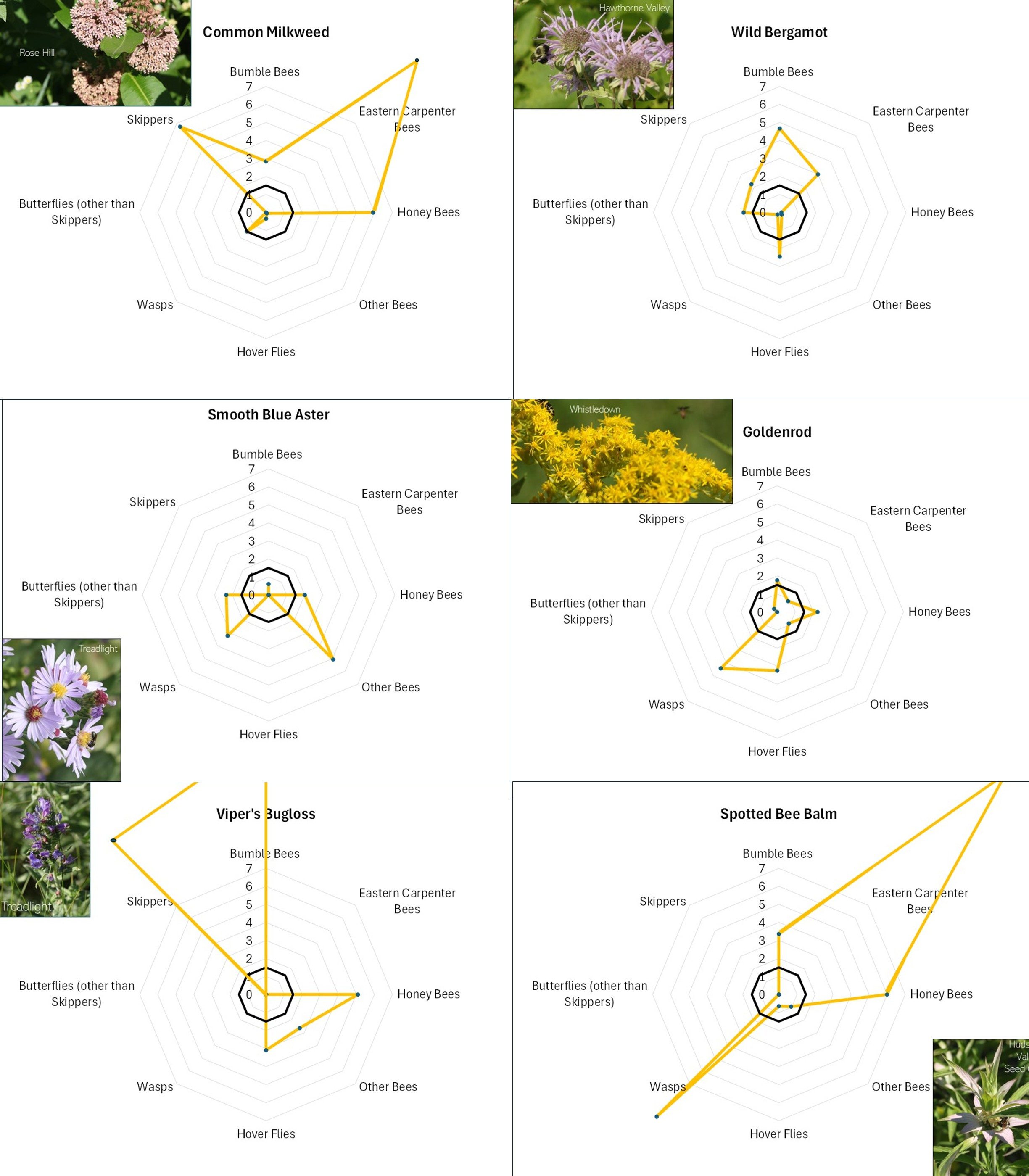
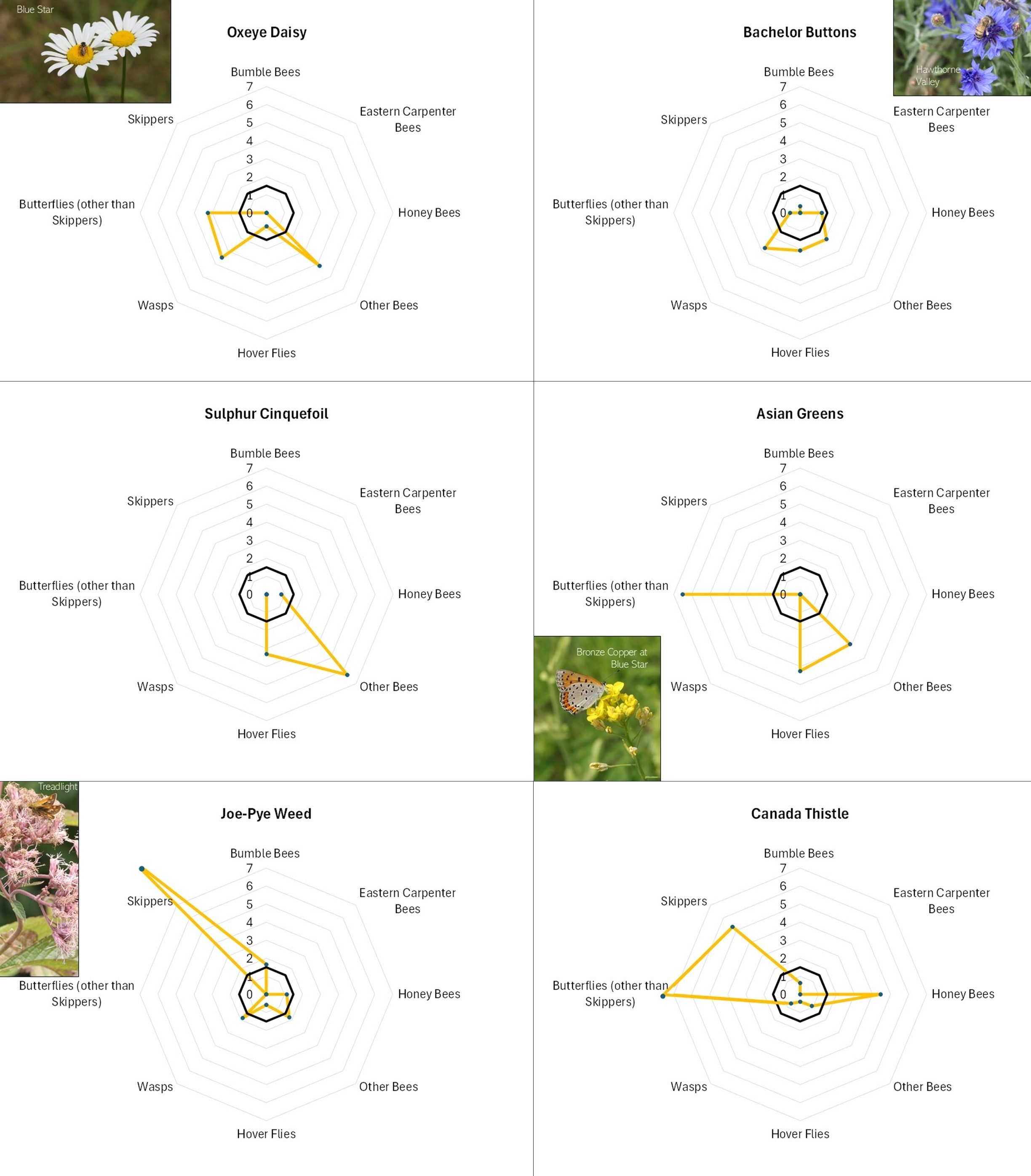
The above table shows the top flowers for each group of insect visitors. A few general comments are worth making: the same flower can differ markedly in apparent attractiveness for the different groups of flower visitors. For example, while Pasture Rose ranked second for Bumble Bees, Arugala ranked first for Honey Bees, White Lace Flower was tops for Hover Flies, and Oxeye Daisy was in second place for ‘other bees’, none of these flowers even appeared on the lists of the other insect groups. At the same time, some flowers, like Viper’s Bugloss, Chicory, and Echinacea appeared on three or even all of the lists. While the reason for the preference differences amongst the insect groups is not always clear, certain patterns might be discernible. For example, if one compares the flowers favored by Bumble Bees and Hover Flies, one notes that, relatively speaking, the Hover Flies seemed to favor shallower, smaller flowers. Perhaps we’ll be able to tease apart more of such patterns as we collect more data.
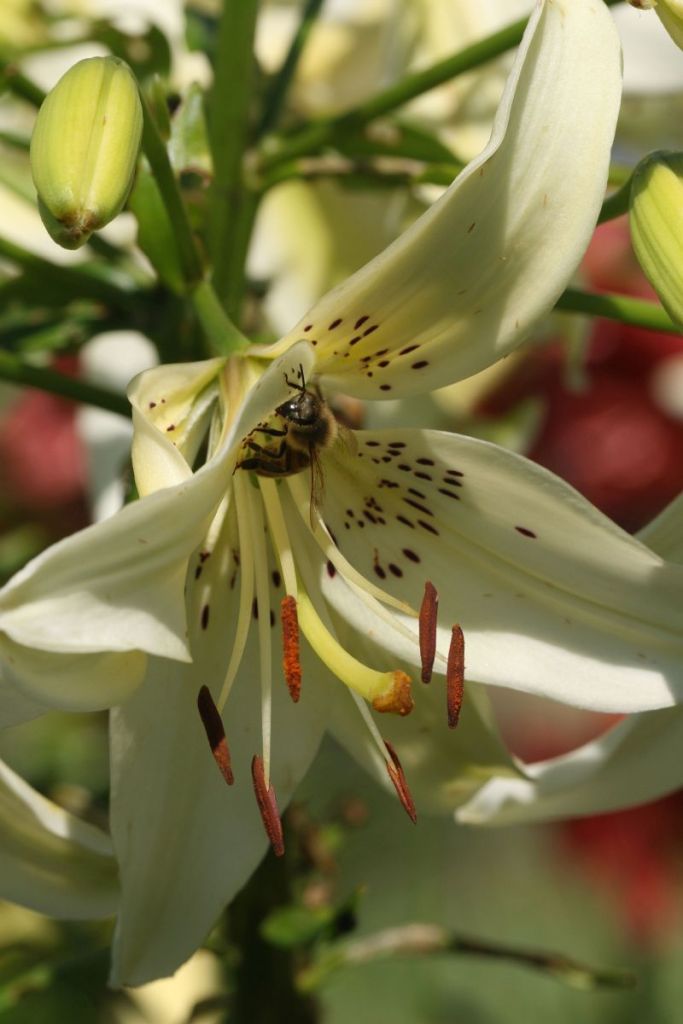
A Honey Bee on a Tiger Lily at the Hudson Valley Seed Company.
Native vs. non-native and intentionally seeded vs. spontaneous don’t seem to be great predictors of most favored flower status. For instance, Viper’s Bugloss and Chicory are non-native ‘weeds’, Arugala and Asian Greens are non-native crops, Common Milkweed and Annual Fleabane are native ‘weeds’, Bachelor Button is a non-native ornamental seeded flower, and Echinacea is a native (or ‘near native’) ornamental seeded flower. All of these flowers figured at or near the top of some insect lists. Of course, our gross categories of flower visitors may hide more specialized relationships as was evidenced by our sighting of Macropis bees, a native bee specializing on planted but native Lysmachia (aka our native Loosestrifes). These bees collect the oils that such flowers produce.
A specialist Macropis bee gathering oily pollen from a seeded Fringed Loosestrife at Treadlight Farm. This is one example of specific relationships that are hidden in the general insect categories we use.
What We’ve Found So Far: Mapping Flower Suitability.
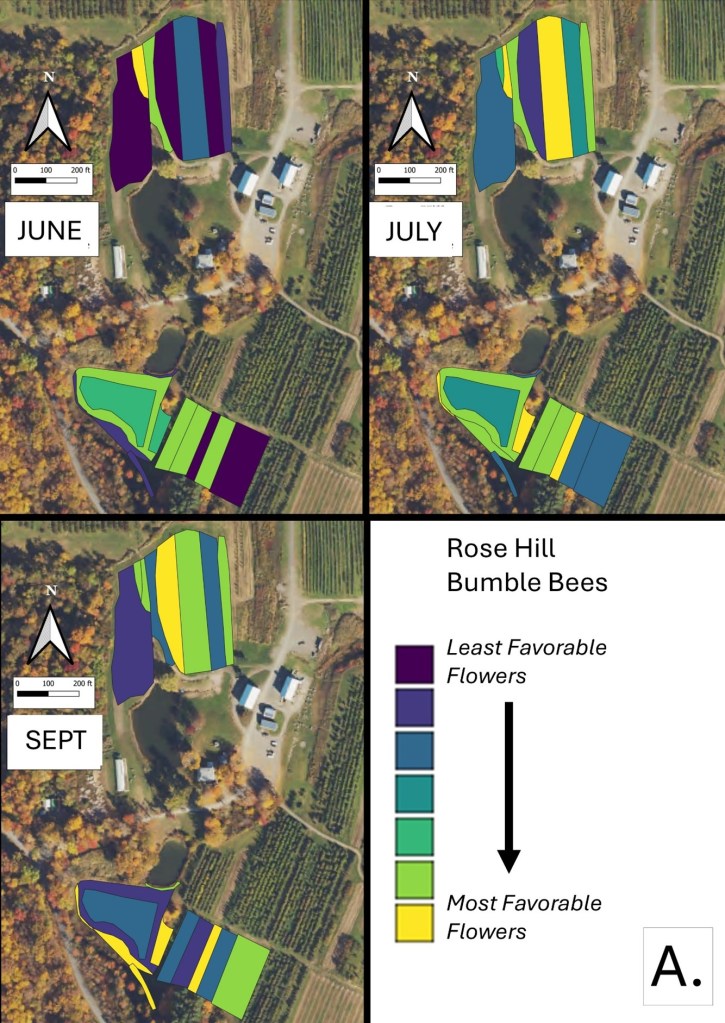
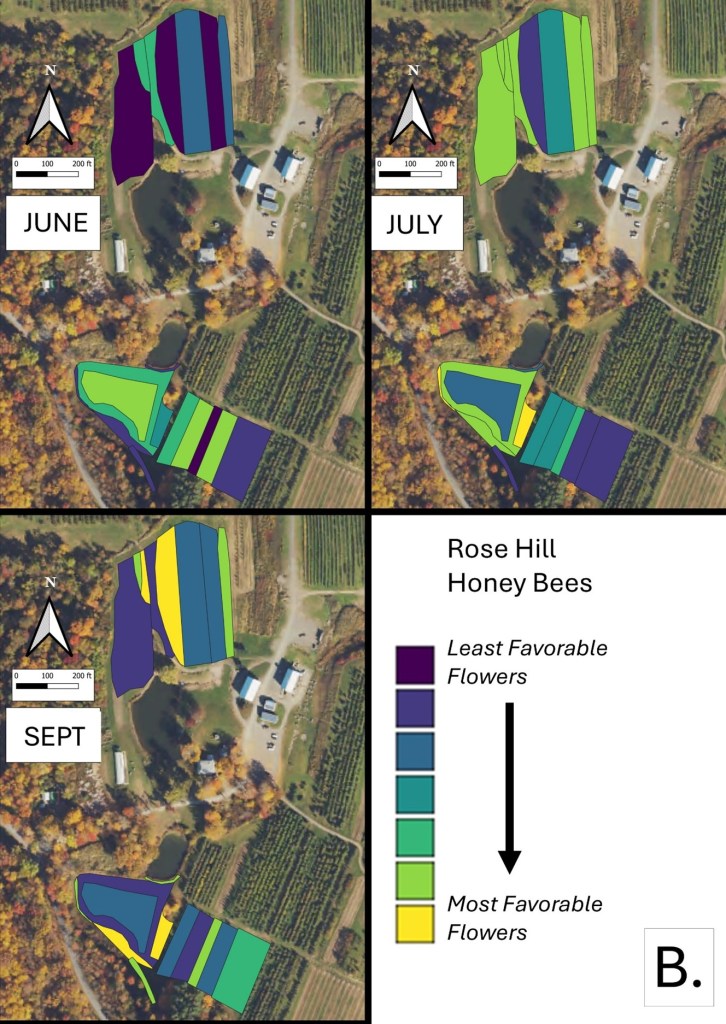
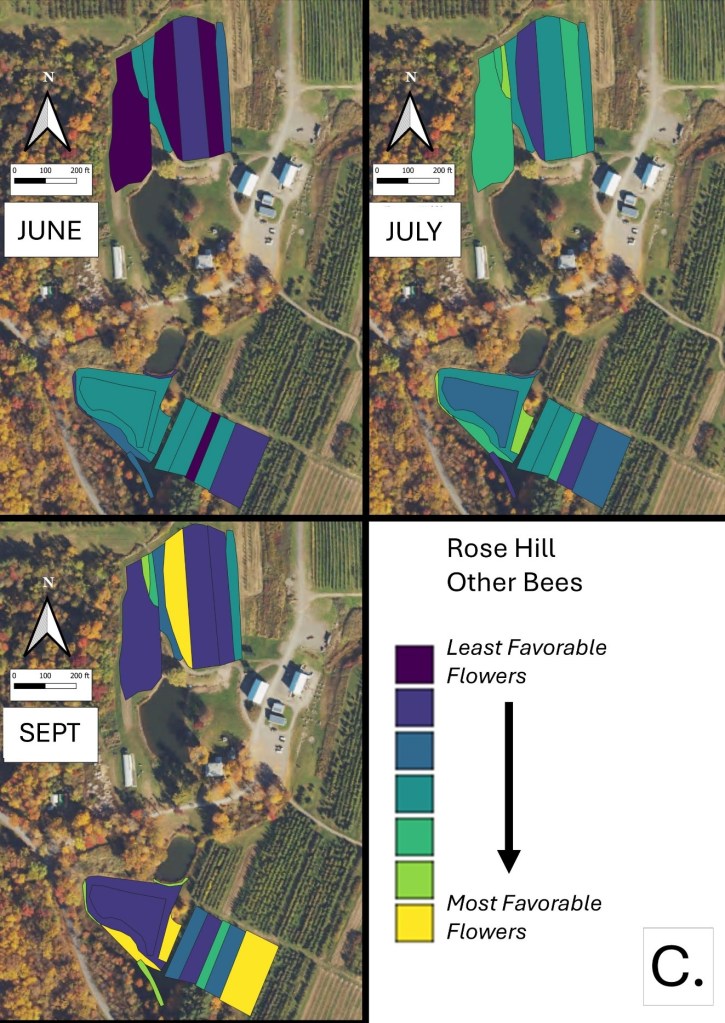
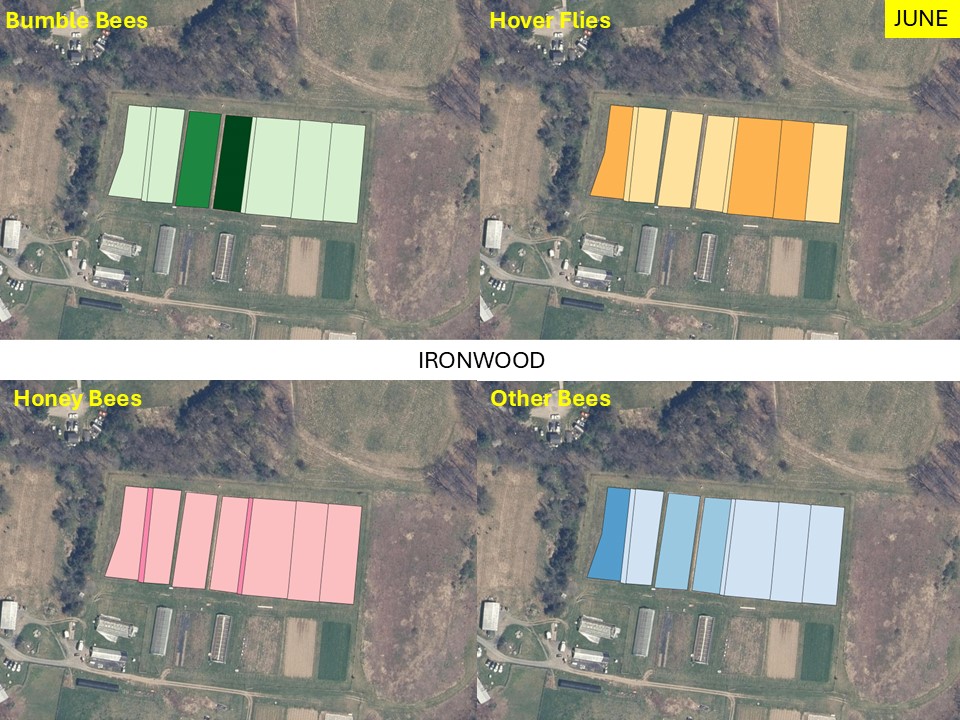
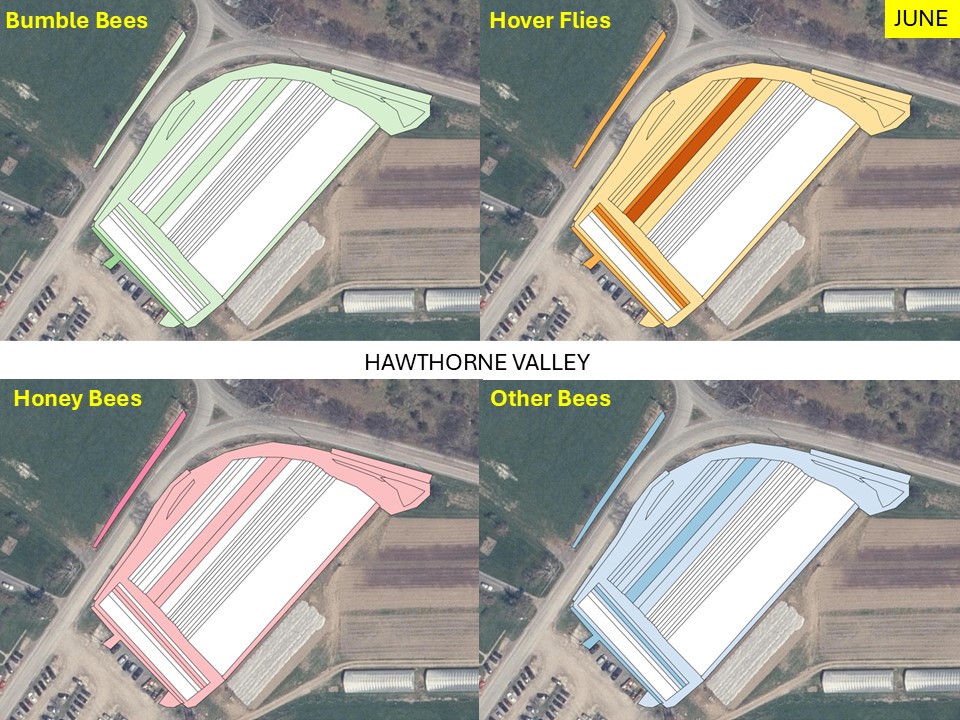
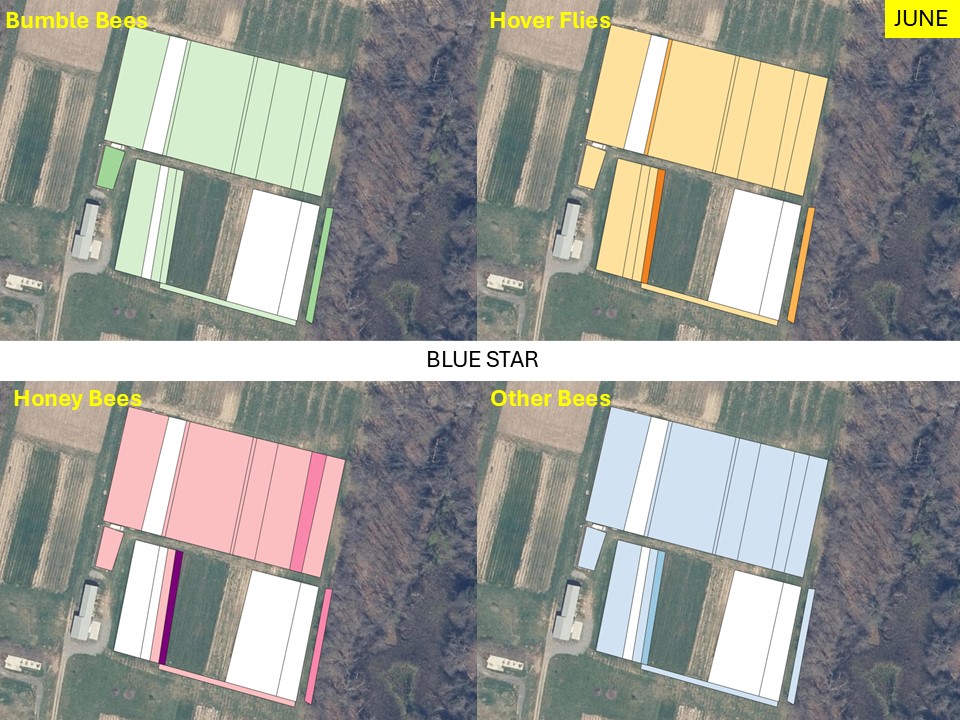
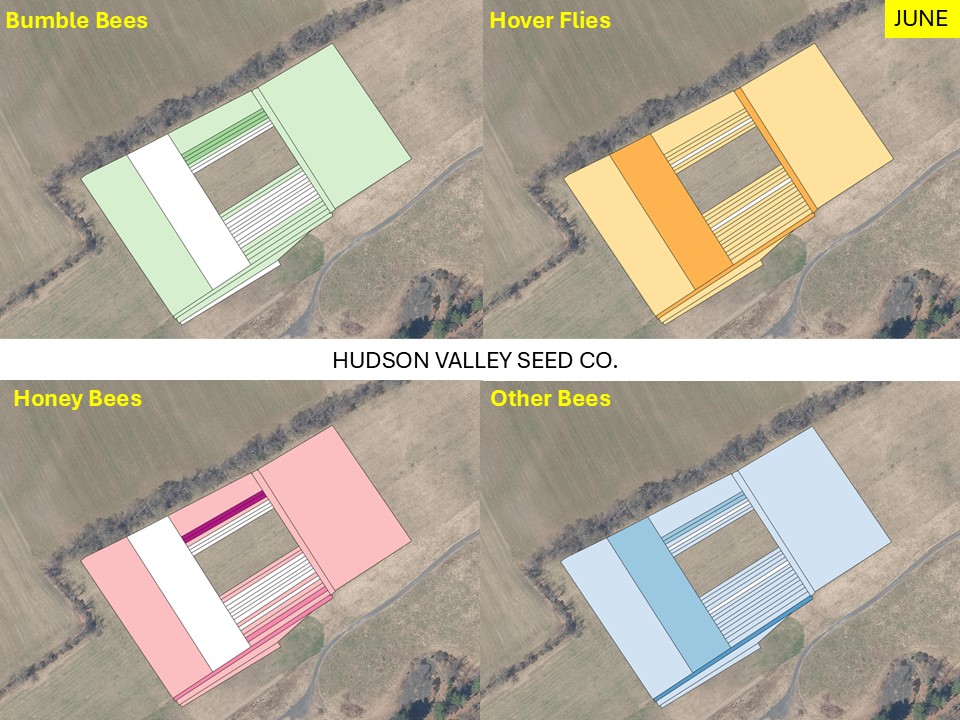
Finally, we present a series of maps showing the predicted pollinator value of each management unit on each farm. Please note these are NOT maps of where we necessarily saw the most bees, instead they’re predictive maps showing our guesses as to which patches were most attractive to the different groups based on flower composition and our flower visitor data. A logical extension of our work would be to test our models by going into each management unit and gathering an activity index for each of our flower visitor groups. Because of their crudity and the non-floral factors that can affect bee abundance (listed above in the Background section), these June maps are very much only part of a larger picture and may or may not reflect the insect abundance you observe.
In these maps a darker tone means more of the given insect group. For a given farm, each frame is a different insect group.
We realize that, unless you are familiar with the individual farm, these maps are somewhat hard to interpret. We will try to provide more individual farm details in our next blog but, in the meantime, some general patterns seem evident:
Predicted suitability can be quite patchy – attractive beds or patches abut less attractive ones. There’s nothing surprising about that given the obvious variation in flower composition across beds. Perhaps somewhat more interesting is the fact that the patterns vary depending upon the focal insect group. This derives directly from the previously described variation in insect suitability amongst flowers and the patterns of flower composition across units.
Both farm beds and edges, as well as fallows and semi-natural areas can be valuable. Flower visitors are constantly trying to make the best choices from the flower smorgasbord available to them, and these maps suggest that those offerings will lead them into suitable patches regardless of where on a farm their favored flowers are found – for example, contrast where one is likely to find flowering Arugala with where one finds Milkweed (two of the Honey Bee’s favorites).
It’s important to highlight what these maps DON’T show – were we to map suitability for particular bee species, these maps would sometimes be very different. For example, there are native bees who only feed at particular Spring ephemerals; maps of habitat suitability for these species would essentially be completely empty given that none of the beds on any of the farms supported those flowers. Likewise, a map of flower suitability for the Squash Bee would largely (but not entirely) be a map of squash beds. At the opposite end of the spectrum, some of the common members of each of the multispecies groups (Honey Bees are only one species) are single species with broad tastes – maps of their suitability might not differ too much from what is shown here. In between these extremes come the tastes of slightly more specialized bees. For example, in our current July round of visits, we found Mellisodes bimaculatus (a bee that looks somewhat like a black bumble bee with two white patches on its tail end) going to town on corn tassels at Ironewood while it was absent from most other flowers at that farm on that day. Likewise, Hyleaus, a genus of somewhat wasp-like bees, has so far seemed to show a marked preference for certain shallow flowers like Queen Anne’s Lace. In other words, our gross groups hide subtler patterns. We are trying to refine our insect categories, but will probably have to continue to rely on this somewhat anecdotal approach for the nuances.
Death on Spotted Knapweed at Treadlight Farm – a pair of Ambush Bugs mate while one feeds on a Honey Bee they have captured; a fly also appears to have taken an interest in the dead bee.
Final Thunks.
Seeded flowers have value in addition to the support of insects – they have general aesthetic appeal, may be part of a commercial operation growing retail flowers, or may serve as an added pick-your-own perk for CSA members. Sometimes flowers are included as companion plantings meant to help control certain pests and, finally, certain crops are sometimes allowed to flower because it is necessary for food production (e.g., tomatoes and cucurbits) or the farmer wants to harvest their own seeds. (Of course, leaving leftovers to flower is also done as an easy way to augment local blossoms). Clearly, the results presented here are not the only way to judge the value of on-farm flowers, but we hope that if flowers for insects is one of your goals, then our observations might be useful.
Going forward, we are into our July round of visits and it is fun to see new species of flowers and bees interacting in new ways. It seems safe to say that the July round of maps will show different patterns from the June ones, but we’re also curious to see if there’s any consistency. In the meantime, if any of the above observations raise questions or provoke observations, we’d enjoy hearing them. And we always enjoy hearing of neat flowers or insects you spot!
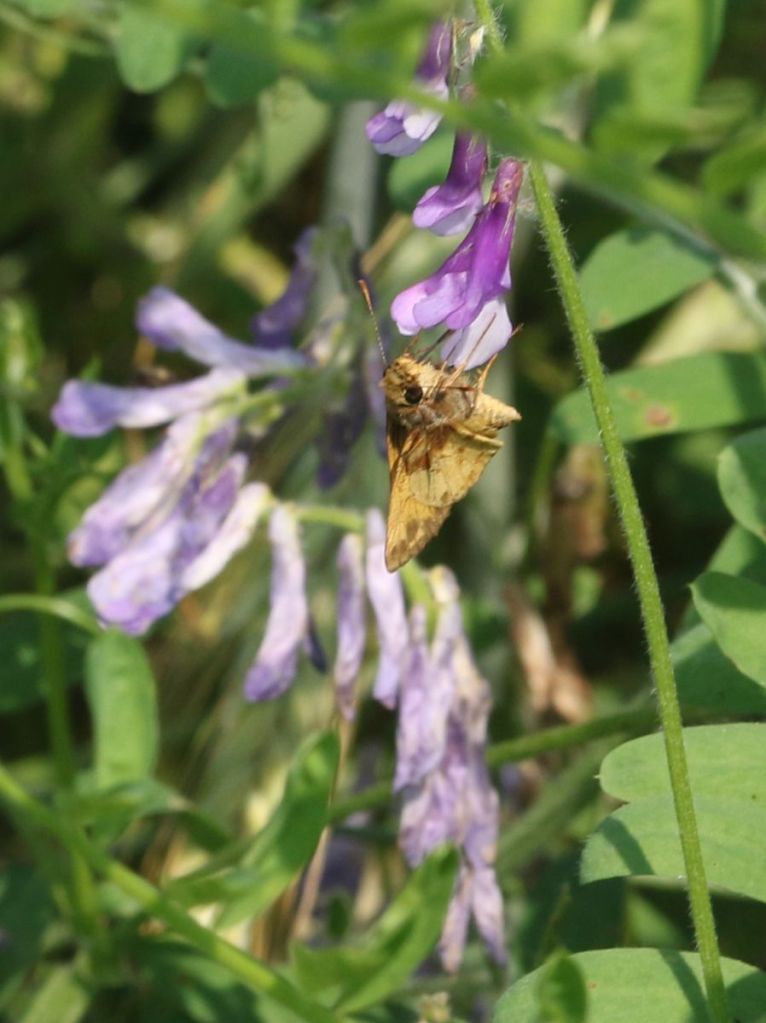
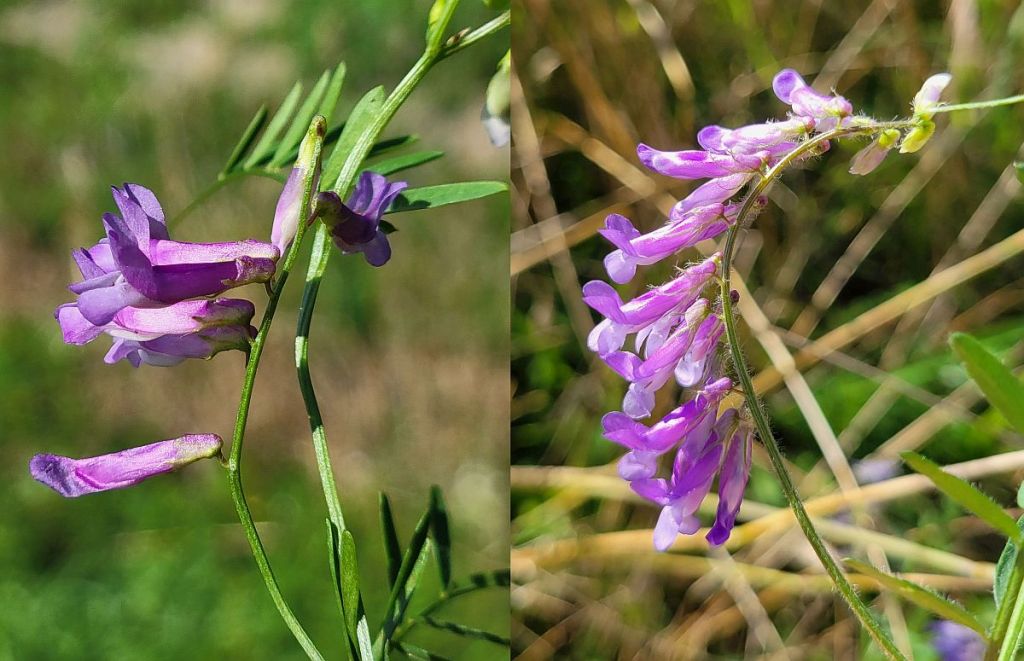
A Zabulon Skipper on Bird/Hairy Vetch at Ironwood Farm.
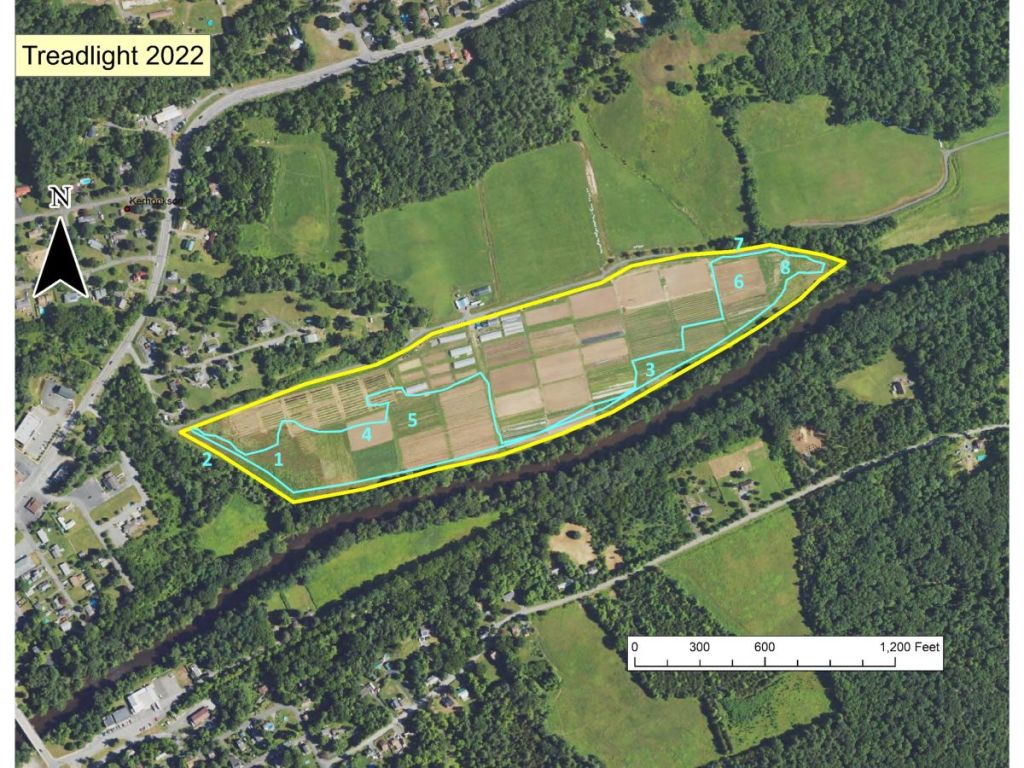
I visited Treadlight Farm in Kerhonkson on 4th Sept. 2024 to survey the wild-growing plants inside the fenced area outlined in yellow on the aerial photo below. The sky blue line indicates the approximate route of my four-hour walk-around. Numbers refer to locations mentioned below.
Aerial photo of Treadlight Farm (surrounded by deer fence indicated in yellow); the sky blue line is the approximate route taken during the botany survey, numbers refer to locations mentioned below
As Conrad has already described in the last posting, Treadlight Farm mainly grows cut-flowers and also produces plugs (mostly of native wildflowers). The farm operates on leased land that has a long history of farming and few semi-wild habitats are found within the farm’s fence. Not surprisingly, the wild-growing plants in the flower beds were largely the usual cast of regionally-common, annual, tilled-field weeds, including Common Ragweed, Daisy Fleabane, Horseweed, Lamb’s-quarters, Crabgrass, and foxtails.
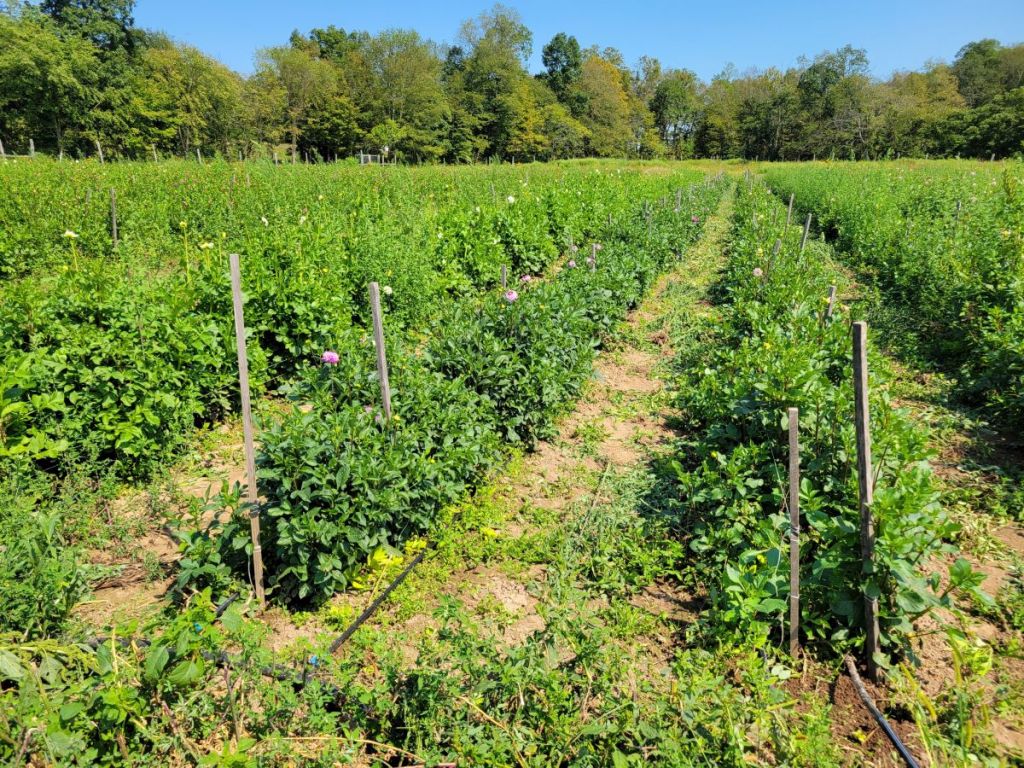
One of the cut-flower beds at Treadlight Farm (looking west from #6)
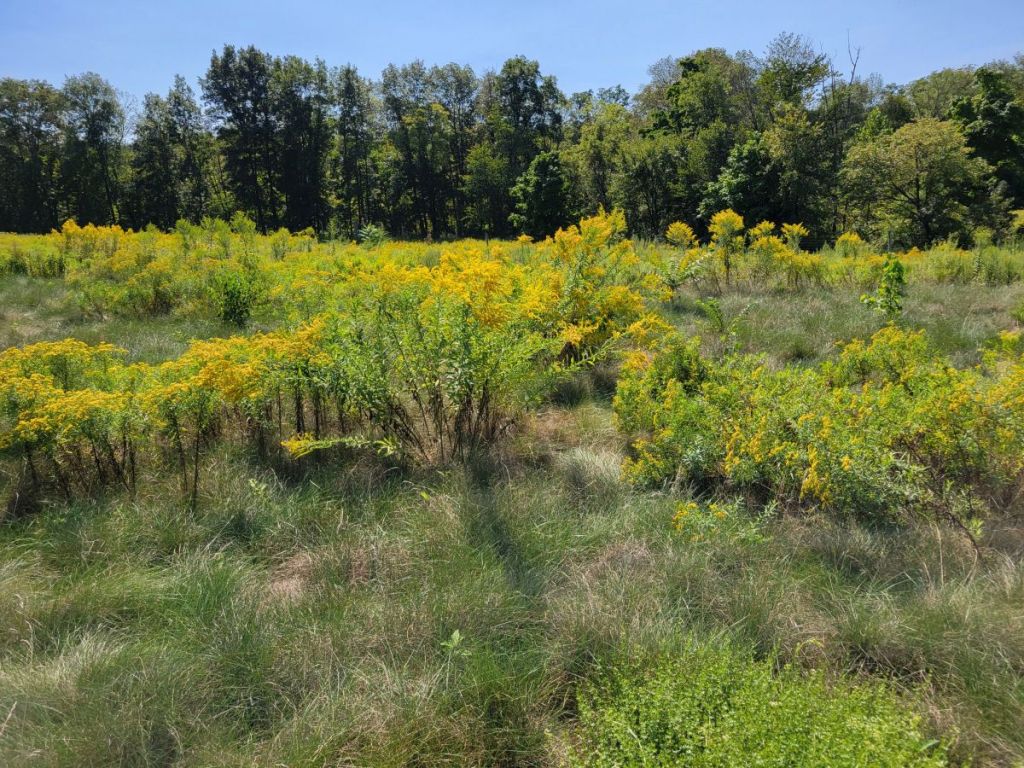
At the west and east end of the farmland are old fields, largely composed of perennial species, both native and non-native. Those old fields harbored at least five species of goldenrods and seven species or varieties of asters, all native. The “grassy” matrix at the west end (#1) was dominated in late summer by the non-native grass Hard Fescue (Festuca trachyphylla), but also included the native Path and Soft Rushes (Juncea tenuis and J. effusus).
Old field vegetation at the west end of the farm (#1)
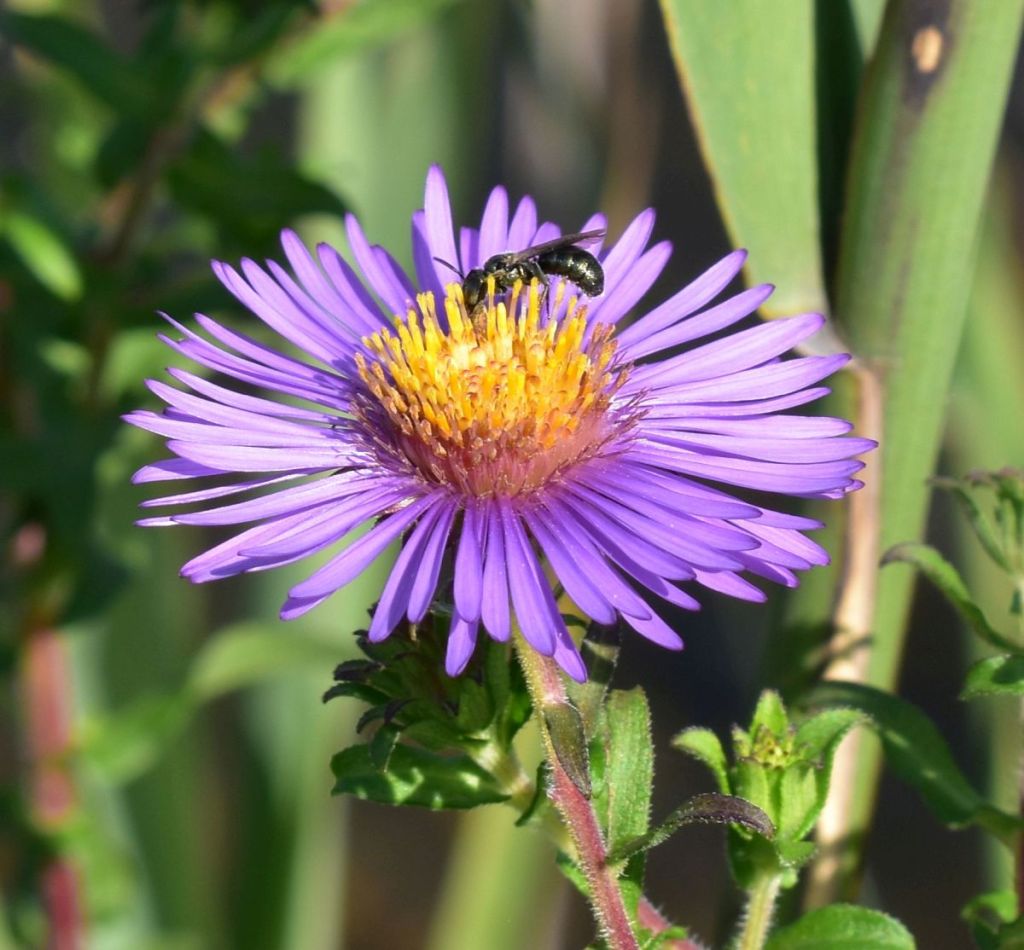
At the time of my visit (4th Sept.), the asters were just starting to flower, but the goldenrods were already in full bloom. In the image below, the golden yellow flowers of Tall Goldenrod (Solidago altissima) contrast beautifully with the purple flowers of New England Aster (Symphyotrichum novae-angliae). Tall Goldenrod (also often referred to as Canada Goldenrod) is one of four very common, rhizome-forming, old field goldenrods in our region. We know of 11 other goldenrod species in our area, all less common than the four old field species, and associated with other habitats, such as dry meadows, wetlands, and even forests. All our goldenrods are native species and—as a group—provide resources to a dazzling variety of insects, who visit the flowers for nectar and pollen, eat the leaves, bore in stems and roots, form galls, or wait for prey in the flowers.
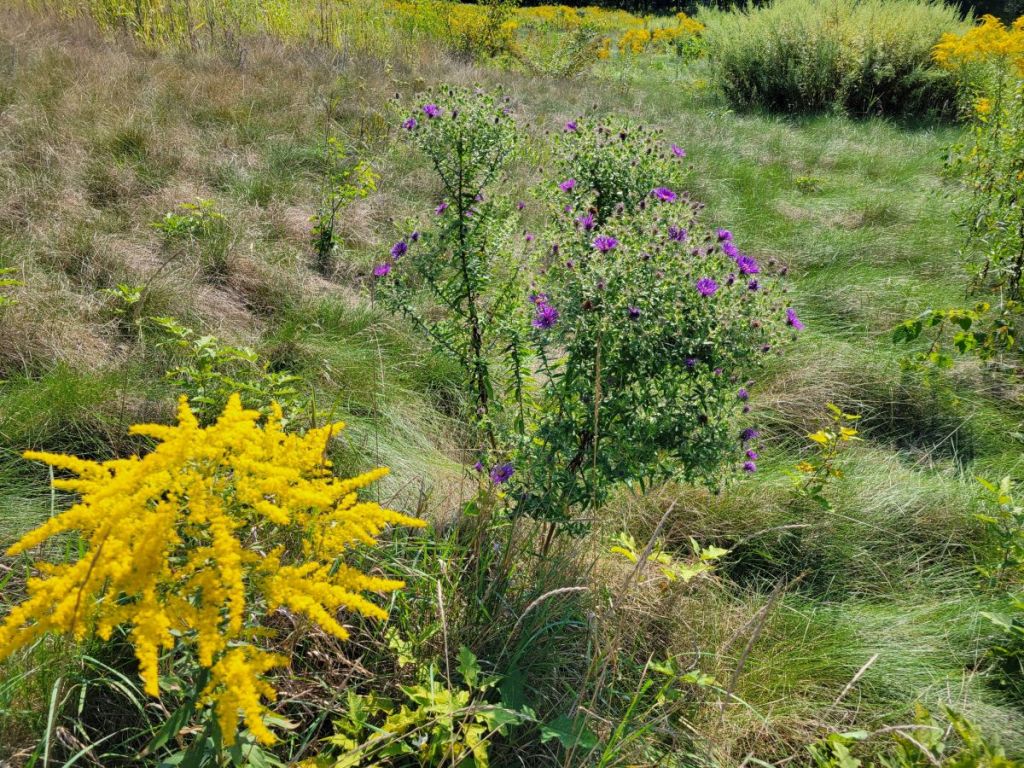
Tall Goldenrod (Solidago altissima) and New England Aster (Symphyotrichum novae-angliae)
Nearby, Early Goldenrod (Solidago juncea) was still in bloom. This is a species that does not form rhizomes and does not grow in dense colonies. In fact, it does not compete well with the more aggressive goldenrods on fertile and moist soils. Therefore, it is usually found on somewhat dryer, less nutrient-rich soils. This is one of the earliest-flowering goldenrods, it usually has a basal rosette of leaves, as well as small clusters of leaves in the axils of the stem leaves.
Early Goldenrod (Solidago juncea)
A strip of herbaceous vegetation has been maintained along the outside of the deer fence (#2), forming the edge between farmland and wooded riparian corridor along the Roundout Creek. This strip harbors some of the same species as the old field, but also some species associated with the riparian corridor, such as Sensitive Fern (Onoclea sensibilis), Deer-tongue Rosette Grass (Dichanthelium clandestinum), and a species of native sunflowers described below. Unfortunately, invasive plant species, including abundant Mugwort (Artemisia vulgaris) and Japanese Stilt Grass (Microstegium vimineum) also thrive in this occasionally mowed strip.
Strip of herbaceous vegetation outside of the deer fence (#2)
I was excited to find several patches of Thin-leaved Sunflower (Helianthus decapetalus) on both sides of the deer fence along the southern edge of the farm fields (#3). This beautiful native wildflower tends to grow in semi-shaded riparian areas and occasionally along roadsides. I would think that it could also find its place in native plant gardens and seeded wildflower meadows, but its seeds are still hard to find in seed catalogues. Would this be a candidate for the production of eco-type seeds and plugs?
Thin-leaved Sunflower (Helianthus decapetalus)
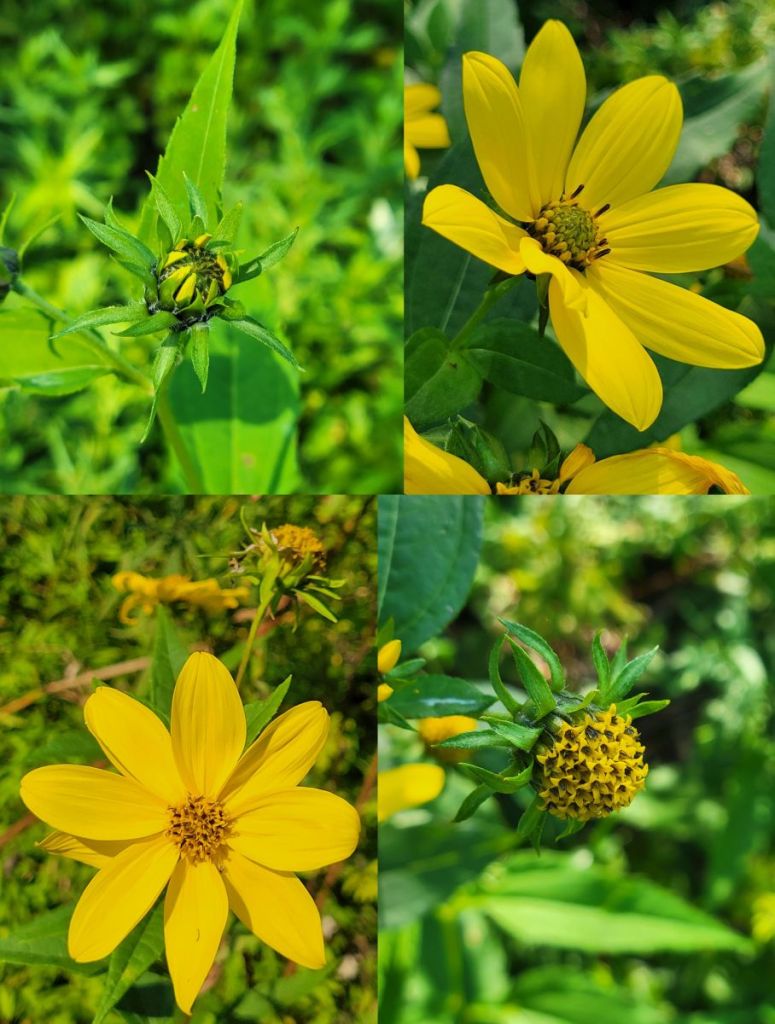
The next image shows a flower head of a Thin-leaved Sunflower in its prime. Note how this flower head is composed of two types of flowers: the large, petal-like ray flowers visually attract pollinators, while the small, star-shaped disk flowers at the center focus their energy on pollen, nectar, and—eventually—seed production. Note how the disk flowers mature first around the outside of the disk. The dark columns emerging from the open disk flowers bear the pollen. The flowers at the center of the disk are still green flower buds.
Thin-leaved Sunflower (Helianthus decapetalus)
The following collage illustrates a sequence of flower heads at different stages of development (clockwise from top left): (1) the young flower head is mostly defined by its green bracts, the disk and ray flowers are still developing; (2) a flower head just coming into bloom, with some—but not all—disk flowers spreading and receiving pollen; (3) a flower head at or just past the peak of its blooming period seems to have spent all its pollen, but might still be receptive for pollen brought in from other plants; (4) this flower head has dropped its ray flowers and is now ripening its seeds, one per star-shaped disk flower.
Thin-leaved Sunflower (Helianthus decapetalus)
Returning from the riparian corridor back towards the center of the farm, a fallow field (#4) sports a riot of weeds, including the native Daisy Fleabane (Erigeron annuus; white flowers), and the non-native grass Yellow Foxtail (Setaria pumila; orange, upright spikes) and an unusually large smartweed (probably Persicarialongiseta; drooping, pink spikes).
A weedy fallow (#4)
Nearby, I found another smartweed, the non-native Lady’s Thumb (Persicaria maculata), which also seemed particularly robust.
Lady’s Thumb (Persicaria maculata)
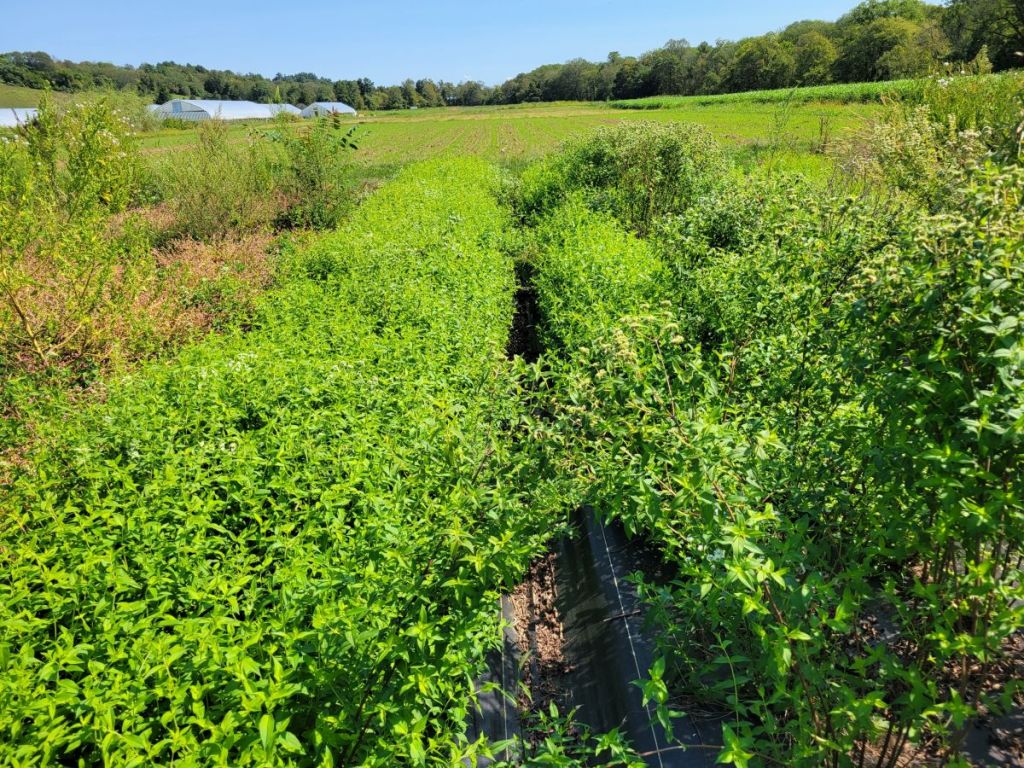
In these beds (#5), a variety of native wildflower species were cultivated. They included several mountain-mints (Pycnanthemum spp.), asters (incl. Symphyotrichum laeve), and Joe-Pye-weed (Eutrochium sp.). However, I did not attempt a complete inventory of these cultivated flowers.
Beds of cultivated native wildflowers (#5)
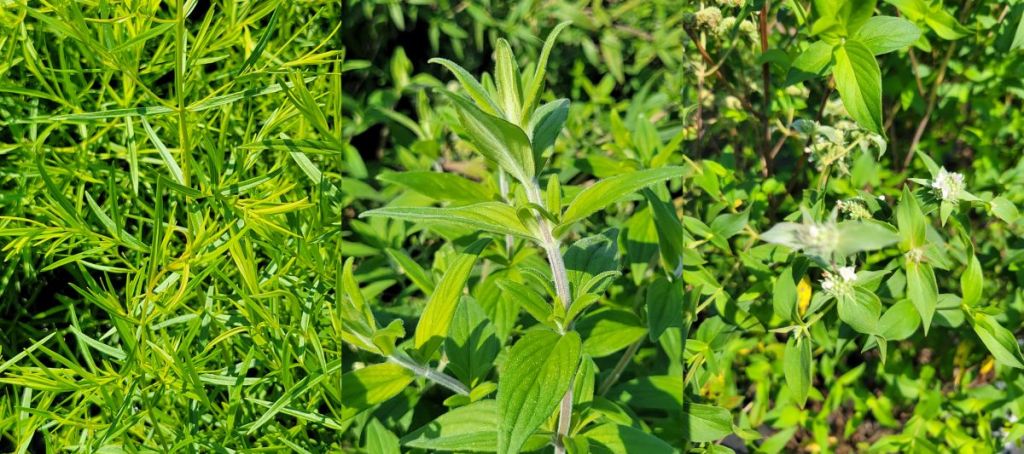
The following collage shows three different species of mountain-mints cultivated at Treadlight Farm (from left to right): Narrow-leaved Mountain-mint (Pycnanthemum tenuifolium), possibly Hairy Mountain-mint (P. cf. verticillatum), and possibly Blunt-leaved Mountain-mint (P. cf. muticum).
Examples of cultivated native mountain-mints
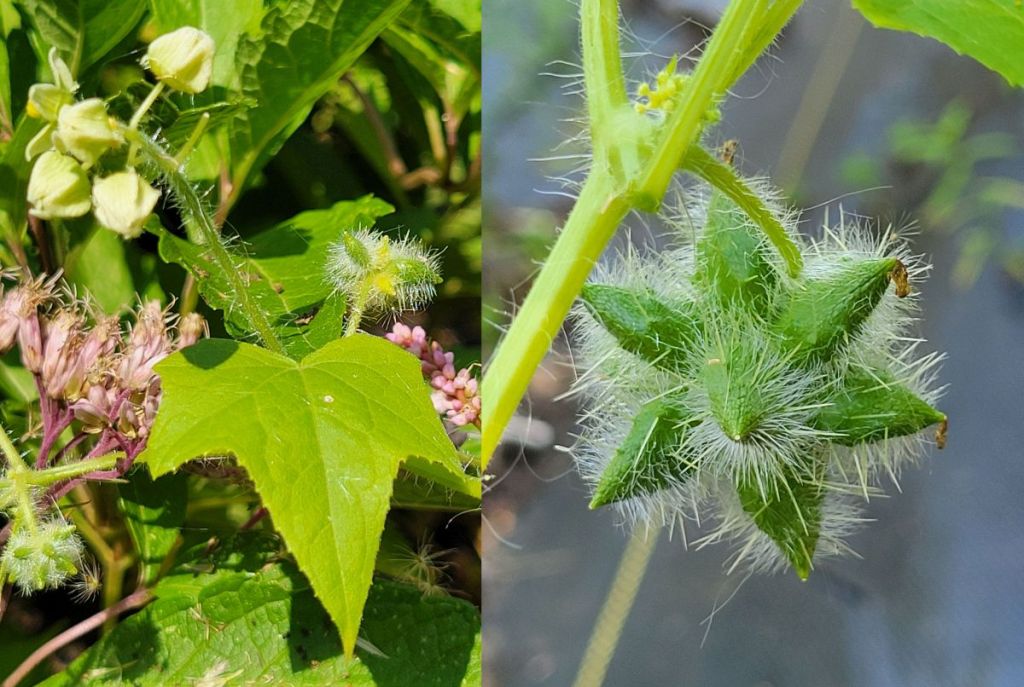
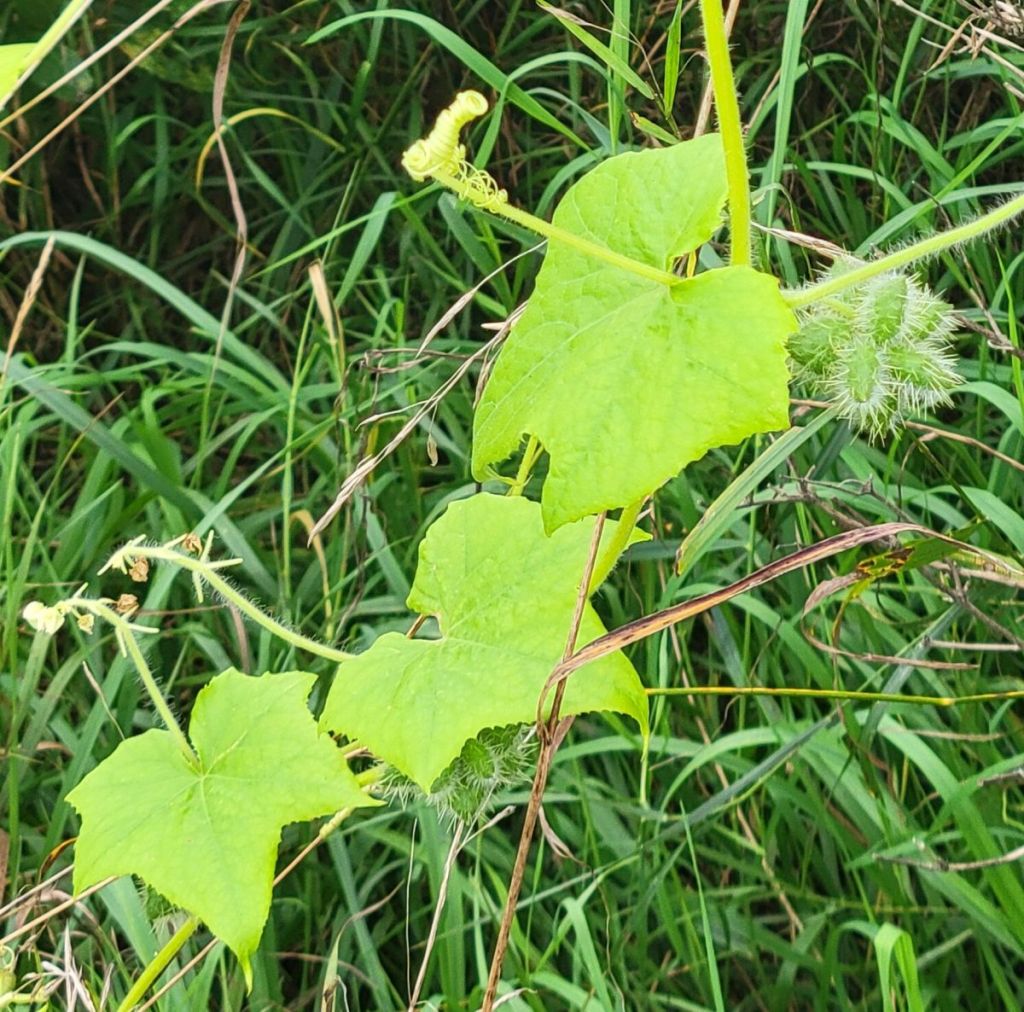
The native One-seeded Bur-cucumber (Sicyos angulatus), a wild cucurbit, was mingling with the Joe-Pye-weed.
One-seeded Bur-cucumber (Sicyos angulatus)
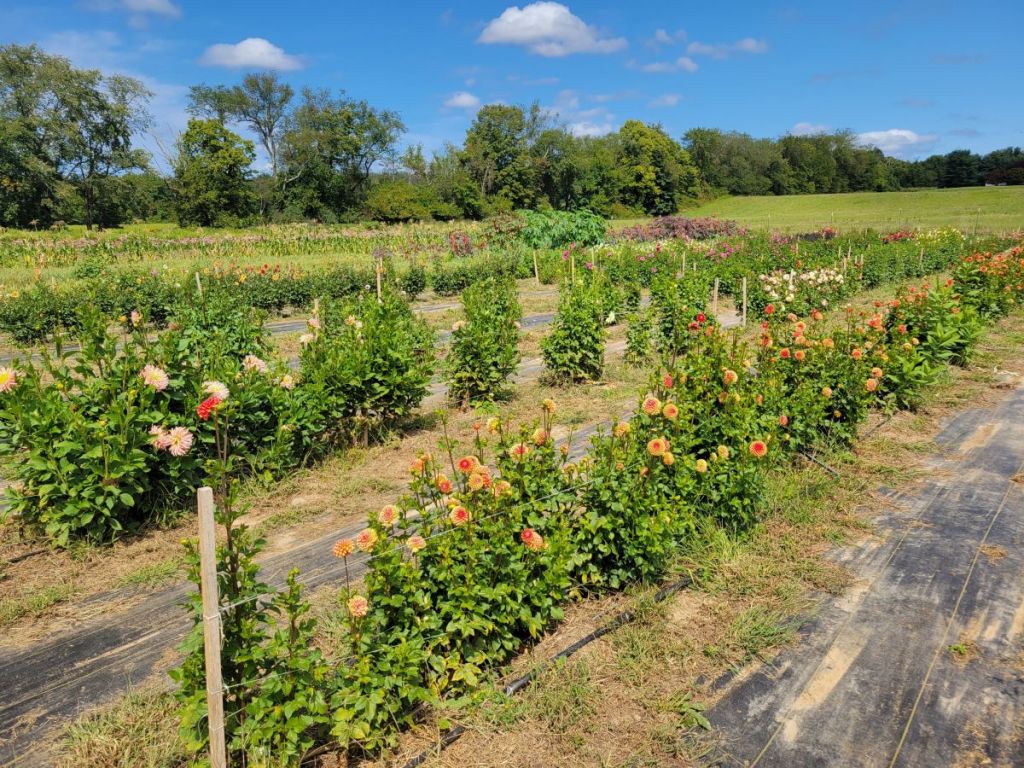
Not many native plans were thriving in the rows of dahlias (#6).
Rows of dahlias (#6)
At the northeastern corner of the farm fields, I found a small strip of old field/wet meadow (#7), which harbored some Purplestem Asters (Symphyotrichum puniceum), not seen anywhere else at TFreadlight Farm and possibly quite a few Willow-leaved Asters (S. praealtum). The latter species was not yet in bloom, so I am not 100% certain of its identity.
A strip of old field/wet meadow vegetation (#7; below) and Purplestem Aster (Symphyotrichum puniceum; above)
A pink (more typical would be lavender) flower head of Purplestem Aster in lovely contrast with the yellow flowers of Flat-topped (a.k.a. Grass-leaved) Goldenrod (Euthamia graminifolia).
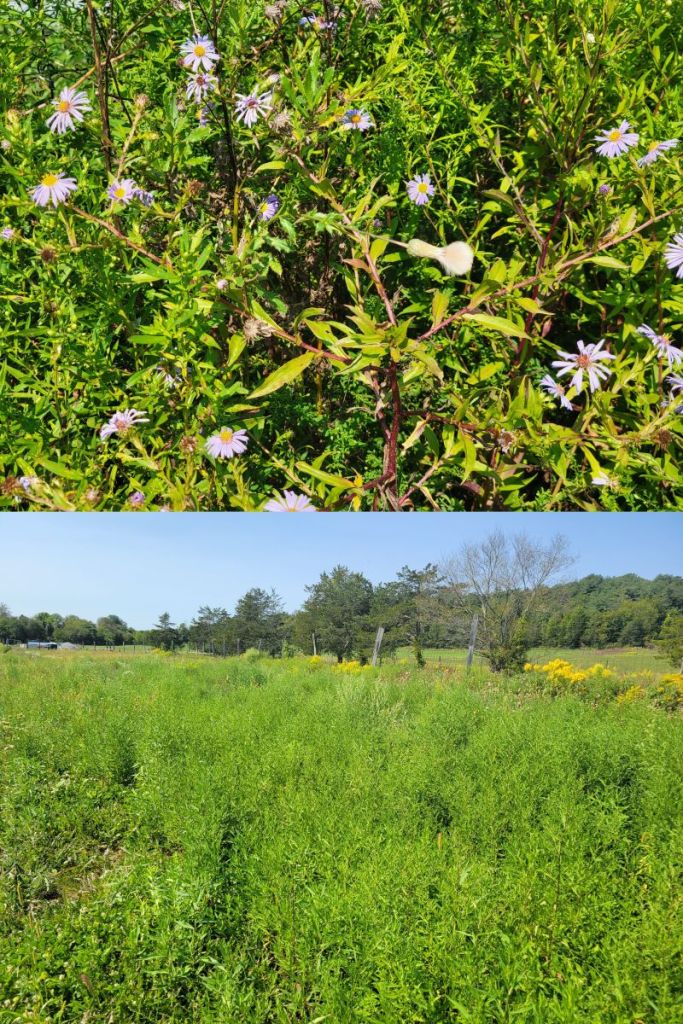
Three different native asters were common in the old field in the east corner of the farm (#8). These small-leaved, white-flowering species are notoriously hard to identify, but I suspect them to represent (from left to right): Calico Aster (Symphyotrichum lateriflorum), Pringle’s Aster (S. pilosum var. pringlei), and Awl Aster (S. pilosum var. pilosum).
Examples of three native asters, most likely (from left to right): Calico Aster (Symphyotrichum lateriflorum), Pringle’s Aster (S. pilosum var. pringlei), and Awl Aster (S. pilosum var. pilosum)
I did not find many unique native plants at Treadlight Farm—a fact easily explained by the relative homogeneity of habitats within the farm’s fences: there were no waterbodies, no substantial wetlands, no rock outcrops, and basically no woody vegetation. Therefore, the Farm supported mostly habitat generalists, which were also found at some of the other farms.
However, the old field patches at the west and east end of the farm, as well as the fence line did support more species of native asters than I had found at any of the other farms this summer. In addition to the species already mentioned above, Lance-leaved Aster (Symphyotrichum lanceolatum) was probably the most common of all asters in many places along the fence line and in unmowed interior areas, and Heart-leaved Aster (S. cordifolium) occurred mostly along the southern fence line.
The old field patch on the west side of the farm (#1)
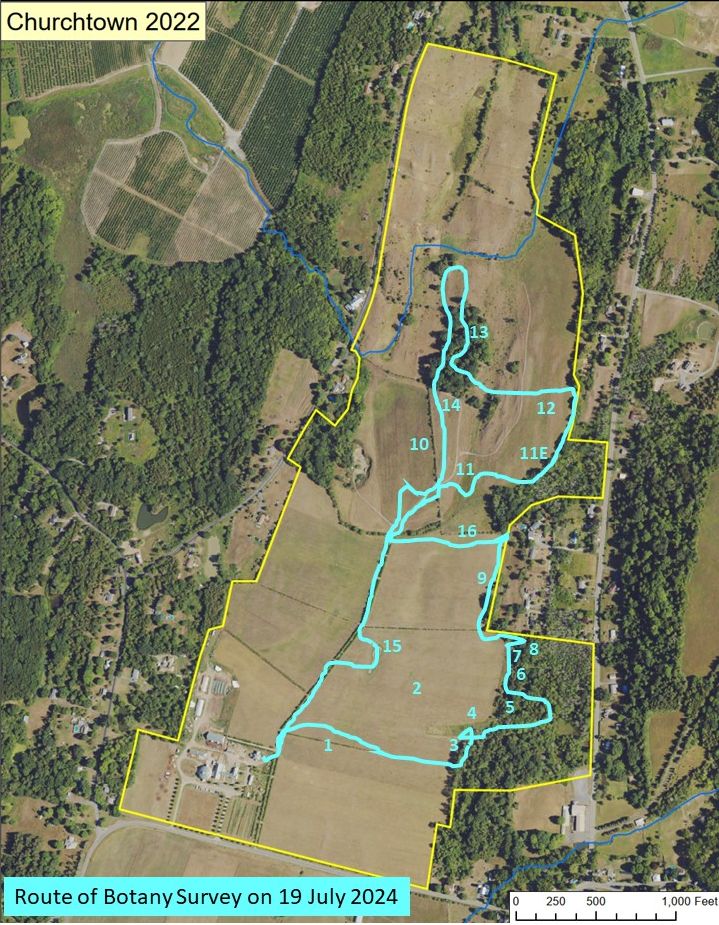
This blog shares some of the botanical observations from Churchtown Dairy on 19 July 2024. Will had visited the farm separately and written about the “Birds of the prairie” at this farm in his blog posted on 13 October 2024.
The following map shows the approximate route walked for the botany survey. The numbers (referenced throughout this blog) indicate places where botanical observations were made or pictures were taken.
Map of the approximate plant survey route (in sky blue). The numbers (referenced throughout this blog) indicate places where botanical observations were made or pictures were taken.
Let us begin by sharing some habitat images from the farm:
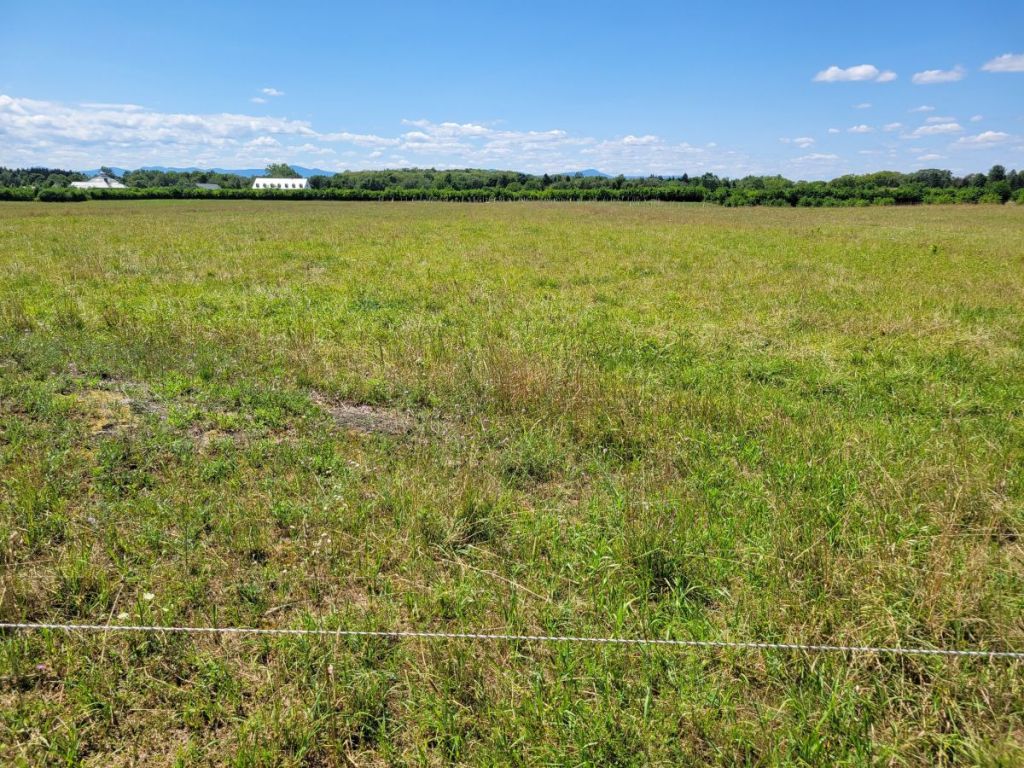
By far the largest amount of the farmland north of Route 12 is currently dedicated to pasture (view from #7 looking west).On the east, the pastures border mostly young forest and have a shrubby edge (#3).There are also pockets of wetlands along the eastern boundary (#4).Throughout the farm there are some long-established hedgerows dividing the fields (this is the view from #16). More recently planted hedges flank the main farm road.
The northern part of the farm is hilly (view north from #13)
There are also a couple of ponds. This smaller one (#15) is surrounded by a recent tree planting for silvopasture.
After this brief visual introduction to the farmland at Churchtown Dairy, we’ll go into more botanical detail.
Most of the pastures were closely-grazed at this point. As typical for pastures and hayfields in our region, most of the plants in the pastures themselves were European species of grasses, legumes, and other common plants of perennial agricultural meadows. One exception stuck out immediately: many of the pastures had patches of Common Milkweed, a wildflower native to North America and one of the host species for Monarch caterpillars, as well as a number of other native milkweed-specialists. It was nice to see that the milkweed plants across the farm were at different stages of development, some going to seed, some in mid-bloom, and some just beginning to put out new leaves after having been grazed or clipped. Maintaining such diversity of developmental stages throughout the growing season is beneficial for the insect community, because it ensures the availability of a variety of resources (ranging from tender leaves for young caterpillars to nectar for adult butterflies and many other insects) for an extended time period (compared to the scenario were all plants of a species mature and go to seed at the same time).
Common Milkweed plants in a pasture (#2)
The hedgerows and forest edges bordering the pastures were composed of a variety of native and non-native woody plants. The hedgerows bordering the central laneway and separating some pastures had been planted relatively recently (10-20 years ago) with a small selection of species, including Osage Orange and Honey-locust (both considered native to areas south of here), and hawthorn and hazel (species and native status uncertain). However, the longer-established hedges and field edges supported wild-growing, native Staghorn Sumac…
One of the long-established hedgerows, including Staghorn Sumac
… Red Cedar …
Another one of the long-established hedgerows, including Red Cedar
… and even an occasional stately oak (pictured here is a Red Oak, whose leaves were partly eaten by Spongy Moth caterpillars)…
A field edge with a big Red Oak
… and a willow, probably the native Black Willow (Salix nigra).
A long-established hedgerow with a big willow tree
Non-native, invasive shrubs, such as Eurasian shrub honeysuckle (Lonicera morrowii or L. x bella), Multiflora Rose, Common Buckthorn, Autumn Olive, and Oriental Bittersweet were also quite common in many of the hedges and field edges.
A field edge with a variety of invasive shrubs
There were a few small wet meadow areas at Churchtown Dairy, such as the one in the next picture at the east end of D6 (#4 on the aerial photograph). These wet meadows support vegetation very different from that in the adjacent upland pastures. European species are also a component of these wet meadows and some, such as the invasive Reed Canary Grass, seen on the left in this image, can be quite common. However, these wet meadows are also important reservoirs of native biodiversity, because they harbor a number of native wildflowers, grasses, sedges, and ferns, which are not found anywhere else on the farm.
Wet meadow (#4)
Rough-leaved Goldenrod (Solidago patula) is one example of a regionally uncommon native species I stumbled across in the wet meadow east of D6. This goldenrod, which typically occurs in calcium-rich wetlands, does not grow in dense, rhizomatous colonies like its more common cousins typical of old fields. Instead, a few (eventually) flowering stalks emerge from a cluster of large basal leaves that have the texture of sandpaper.
Rough-leaved Goldenrod (Solidago patula)
One part of the wet meadow east of D6 supported a colony of Sensitive Fern and cattails (both native species), in addition to a patch of the invasive Reed Canary Grass visible in the front right of the image.
Wet meadow (#4)
The Black-and-Yellow Gardenspider (Argiope aurantia) builds its net in tall, undisturbed vegetation, and the wet meadow provided ideal habitat for this gorgeous hunter.
Black-and-Yellow Gardenspider (Argiope aurantia)
Another beautiful small example of a species-rich wet meadow was found in the drainage southwest of the Bobolink Field (#11). Note the diverse textures and colors in this habitat!
A small wet meadow (#11)
A closer look reveals the native species Woolgrass (Scirpus cyperinus; in front left), Smooth Goldenrod (Solidago gigantea; yellow flowers), Common Boneset (Eupatorium perfoliatum; white flowers), Blue Vervain (Verbena hastata; purple flowers), and Tussock Sedge (Carex stricta; in front right).
A closer look at a small wet meadow (#11)
Back at the east edge of D6-11, I entered the forest and found small areas of swamp forest (#5) where the canopy was dominated by Red Maple trees.
Swamp forest (#5)
Rough-leaved Goldenrod grew here and there in the understory.
Rough-leaved Goldenrod (Solidago patula)
Unfortunately, the invasive Japanese Stiltgrass had also established itself in this forest (as well as in the “grove”). This grass is currently one of the most rapidly spreading non-native species in our region and there don’t seem to be any “silver bullets” for its control. It is an annual grass with wiry stems and relatively broad (and short!) leaves, which often have a broad white line along their midrib.
Japanese Stiltgrass (Microstegium vimineum)
Black Swallowwort (Vincetoxicum nigrum) is an invasive vine with opposite, shiny oval leaves, small, dark purple flowers, and seed pods reminiscent of milkweeds. It was found only in small numbers at Churchtown Dairy. Scattered plants were spotted in the swamp forest and wet meadow east of D6-11, as well as in the “grove.” This might be an invasive species still rare enough on the farm that its spread could be curtailed by systematically pulling it out, whenever it is encountered.
Black Swallowwort (Vincetoxicum nigrum)
Another potentially troublesome species is this pretty ornamental shrub, Jetbead (Rhodotypos scandens), which probably had jumped the fence onto the young forest on the farm’s land from one of the neighboring yards. I had never seen it growing wild in Columbia County, but was told that it had spread throughout Central Park and might become more assertive in our region, in the future… This might be another species to discourage early on wherever it shows up on the farm.
Jetbead (Rhodotypos scandens)
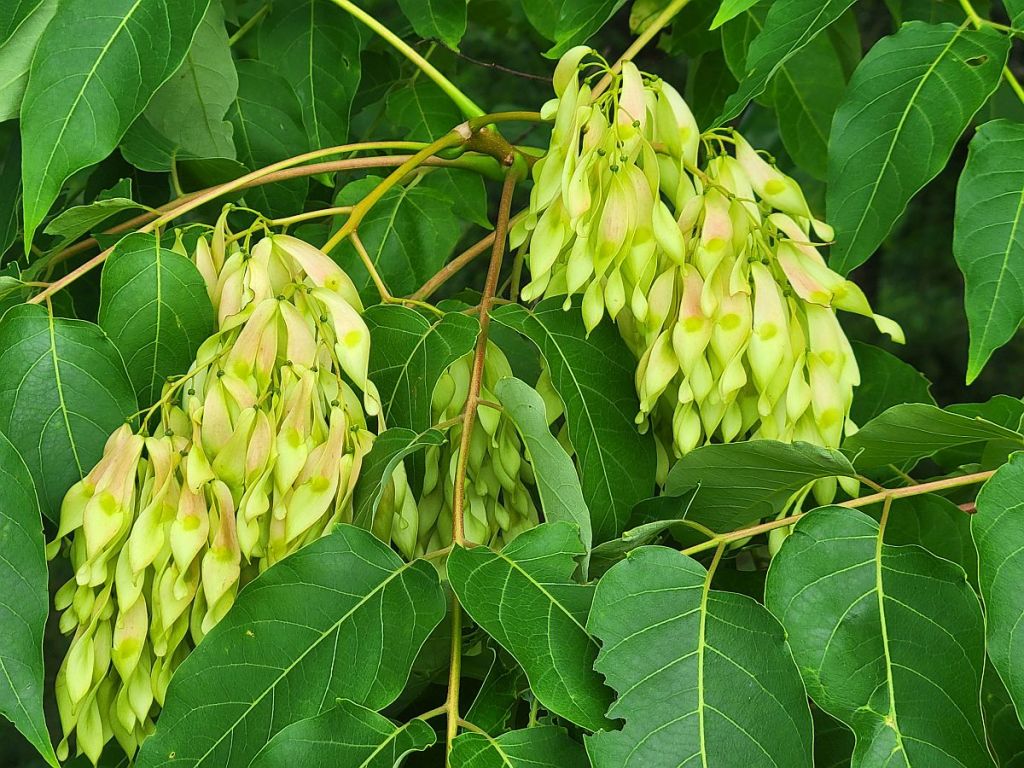
Tree-of-Heaven is the last invasive species I want to mention. It currently occurs at a low enough density at Churchtown Dairy, that its further spread might be avoided by removing the seed-producing trees, like this one next to the “grove.” Unfortunately, if a Tree-of-Heaven is felled, its roots tend to produce sprouts which—if unchecked—can result in an entire colony of new trees. Therefore, it is important to continue to annually monitor and—if needed—manage the site where an adult tree has been felled or girdled.
Tree-of-Heaven (Ailanthus altissima); this specimen was found between #12 and #13
Returning to the east edge of D6-11, after emerging from the swamp forest, I entered a small stand of Red Cedar trees (#6), which seemed to serve as an occasional forest pasture. I made no exciting native plant discoveries in this habitat.
Red Cedar forest (#6)
Emerging out of the Red Cedar forest, I found myself on the hilly, eastern section of pasture D11 (#7). Although dry pastures like this sometimes harbor uncommon native plants, I did not observe any noteworthy native species here, either.
Dry pasture (#7)
Eventually, I found myself in the “Bobolink Field,” (#12) a hay meadow cut late in the season to give ground-nesting Bobolinks enough time to raise their young. Like in the pastures, the vegetation in this field was mostly composed of European grasses and—to a lesser extent—legumes.
Late-cut hayfield (#12) which is managed to accommodate ground-nesting birds.
Another wetland, this one dominated by shrubs and trees, including Swamp White Oak, Green Ash (many dying), and Red Maples, borders the “Bobolink Field” on the east. Native shrubs, such as Winterberry, Arrowwood, Silky Dogwood, and Wild Raisin, occur side-by-side with the common invasive shrubs that dominate the understory.
Wetland (#11E)
Spotted Joe-Pye-weed grew along the herbaceous edge of this wetland and also in some of the other wet meadows along the eastern edge of the farm.
Spotted Joe-Pye-weed (Eutrochium maculatum)
The “grove” (#13) is the only forest at Churchtown Dairy (at least north of County Route 12) that grows on land that seems to have never been completely cleared. It harbors some exceptionally large specimens of Hop-hornbeam trees and some beautiful White Oaks. At the north end, there are several Common Pear trees and Pignut Hickories. Although hardly an “old-growth” forest, this woodland fits our definition of an “ancient forest,” whose soils have not been homogenized by the plow. Therefore, they might have the potential to support soil life and understory plants that are slow to recolonize post-agricultural forests. However, its current understory vegetation is mostly composed of invasive species and European plants typical of nutrient-enriched barn yards. This is likely due to the recent use of this woodland as a pig pasture.
The “grove” (#13) might be an example of an ancient forest.
On the way back to the barns, I took a quick detour to this small, marshy pond (#15), which had very little open water. Cattails (tall green vegetation at the center) were growing in a wide band around the shore and were flanked by patches of Reed Canary Grass (tall tan vegetation left and right of the cattails). Closer inspection revealed several native wetland plants we had not noted in the other areas surveyed for plants at Churchtown Dairy that day. They included the regionally common: Water Purslane, Nodding Bur-marigold, and Soft Bulrush.
A small, marshy pond (#15) harboring some unique wetland plants
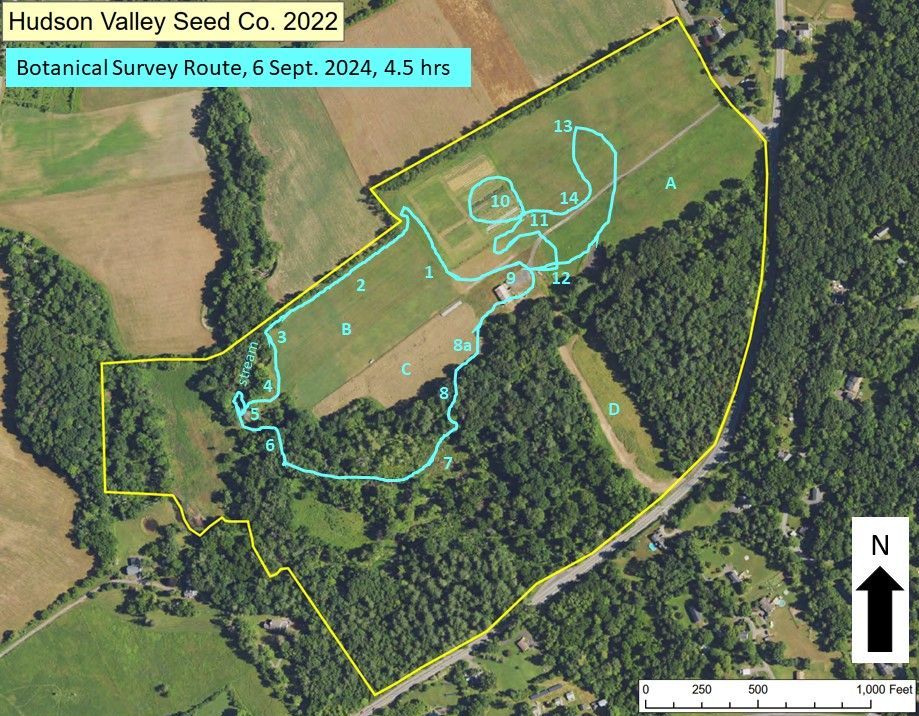
On 6 September 2024, we spent ~ 4.5 hours documenting the wild-growing plants of a cross-section of habitats at the new site of the Hudson Valley Seed Company on Airport Road in Accord. The following image highlights the approximate route taken and numbers observation points we will refer to throughout the blog.
We began our survey along the west and north edges (#1 & #2) of a large tilled field. We found the usual field edge/hedgerow mix of common native and non-native plants. Half of the 20 invasive species recorded on the property were also represented in this area: Oriental Bittersweet (Celastrus orbiculatus), Eurasian shrub honeysuckle (Lonicera morrowii or L. bella), autumn-olive (Elaeagnus umbellata), Japanese Barberry (Berberis thunbergii), privet (Ligustrum sp.), Winged Burningbush (Euonymus alatus), Black Locust (Robinia pseudoacacia), Japanese Stiltgrass (Microstegium vimineum), Mugwort (Artemisia vulgaris), and Canada Thistle (Cirsium arvense).
Hedgerow and unmowed field along northern boundary (#2 on map)
We also found an abundance of the native (but sometimes over-enthusiastic) spiny vine, Common Greenbrier (Smilax rotundifolia). Its fruits ripen in the autumn and somewhat resemble grapes, and some people consider them edible (I have never tried them). However, there are amply references on the internet of people eating the tender shoots in spring, and also using the dried roots to make a starchy powder used in a variety of ways.
Common Greenbrier (Smilax rotundifolia)
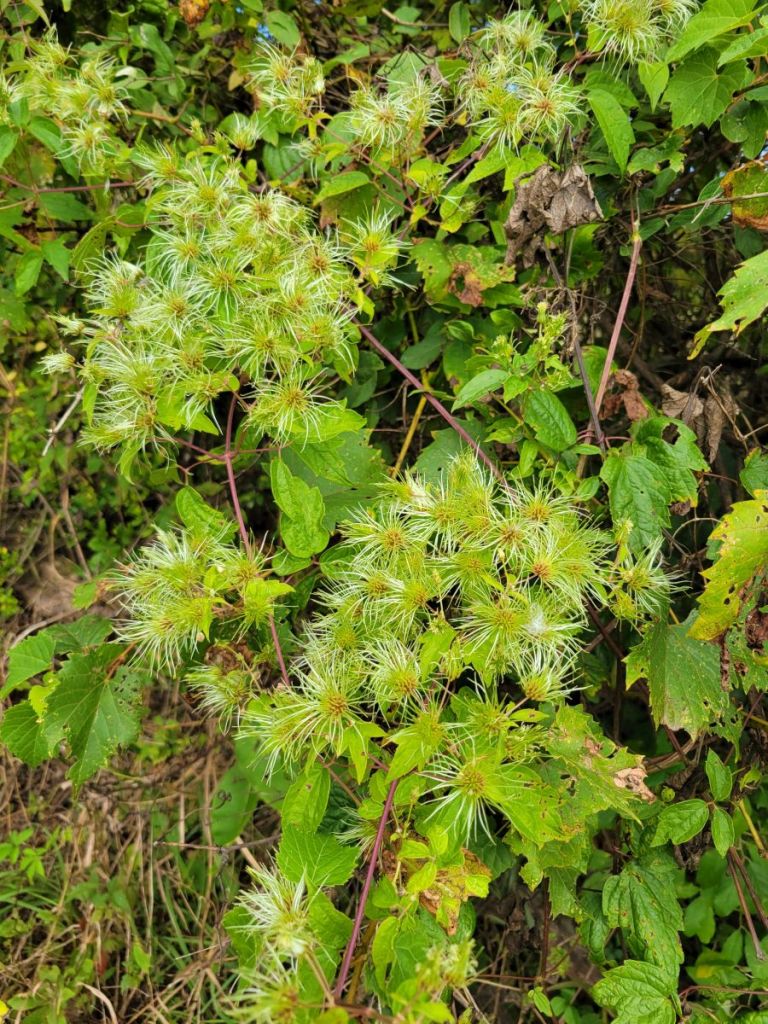
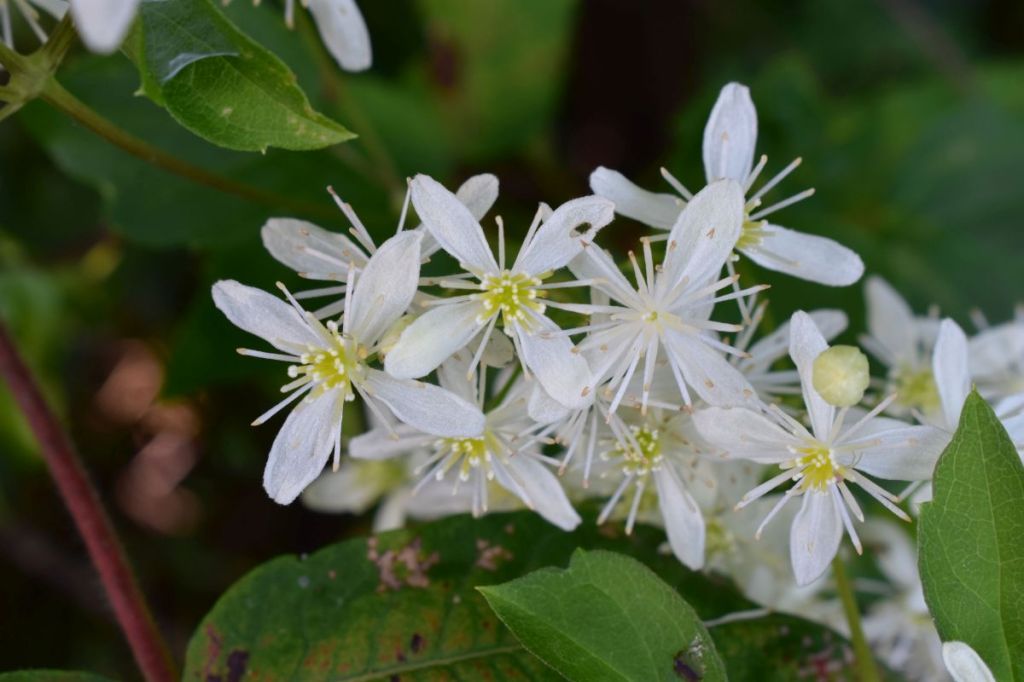
These fuzzy little seed heads belong to another native vine, Virgin’s Bower (Clematis virginiana). It is related to buttercups and, like many plants in that family, has secondary compounds that are poisonous/medicinal (depending on dosage).
Virgin’s Bower (Clematis virginiana)
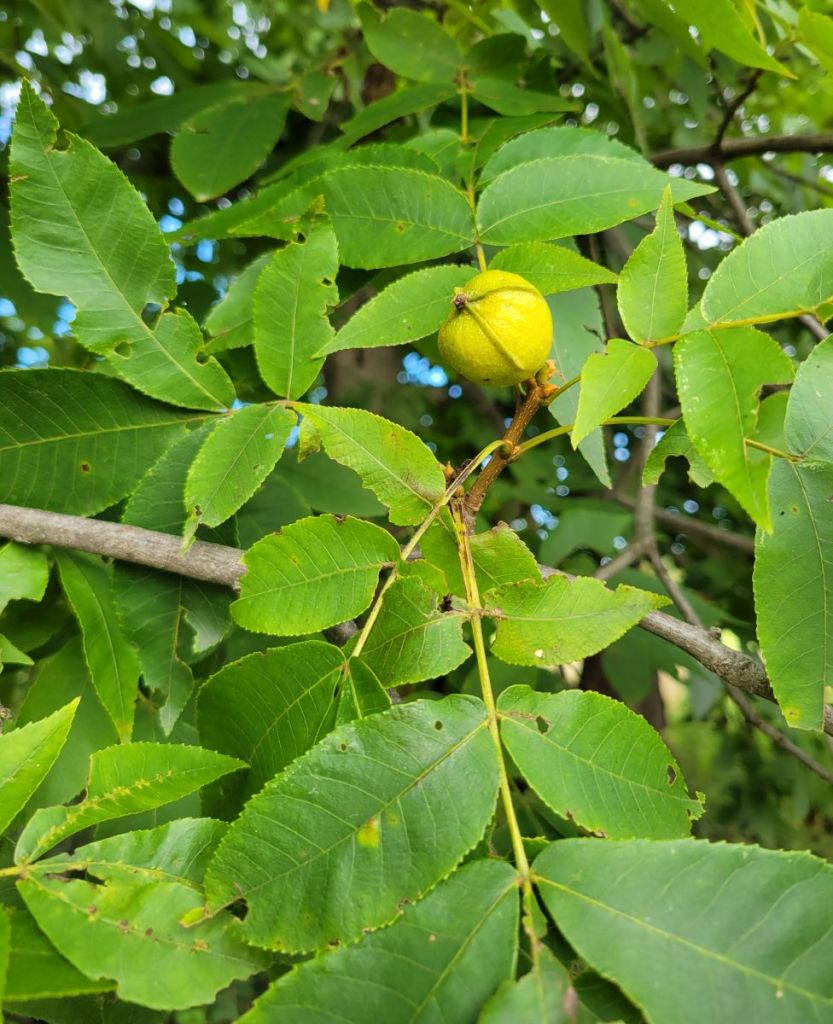
Several tall Bitternut Hickory (Carya cordiformis) trees could easily be identified by their thin-husked fruit with four “seams.” The related Shagbark Hickory (C. ovata) has a much thicker husk and Pignut Hickory (C. glabra) does not have the pronounced “seams.”
Bitternut Hickory (Carya cordiformis)
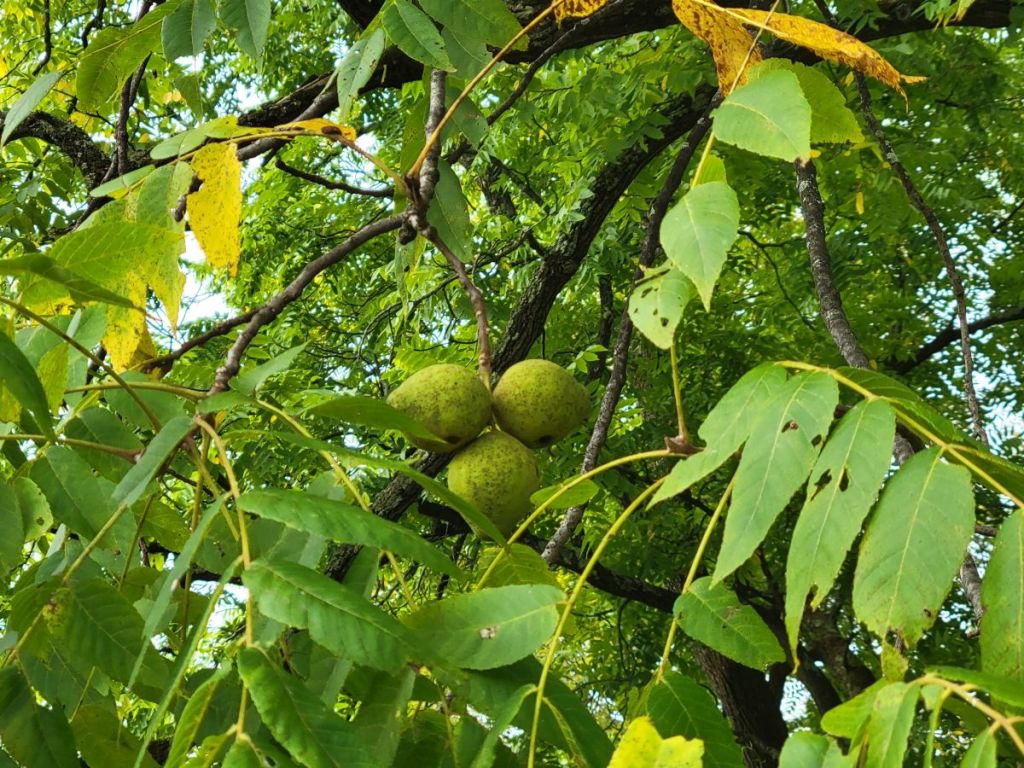
Black Walnut (Juglans nigra) was also present in the field margin (#3) and down near the stream. In the southern field margin (#8a), we also found Butternut (Juglans cinerea). These two, closely-related native species of walnuts are easily distinguished when fruits are present: the fruits of Black Walnut are almost round, while those of Butternut are more elongated (think of a stick of butter!).
Black Walnut (Juglans nigra)
At the west end of the big field, we found an unmowed meadow sloping down to the stream. The dry part of this meadow (#4) was dominated by two invasive species, Japanese Stiltgrass (Microstegium vimineum) and Brown Knapweed (Centaurea jacea; purple, thistle-like flowers visible on the bottom right in the image).
Unmowed meadow (#4 on map) on west end of farm, above stream
However, there was also a nice clump of the Fragrant Rabbit-tobacco (Pseudognaphalium obtusifolium), as well as a smattering of other native species, including Wild Bergamot (Monarda fistulosa) and one of the common oldfield asters, possibly Pringle’s Aster (Symphyotrichum pilosum var. pringlei).
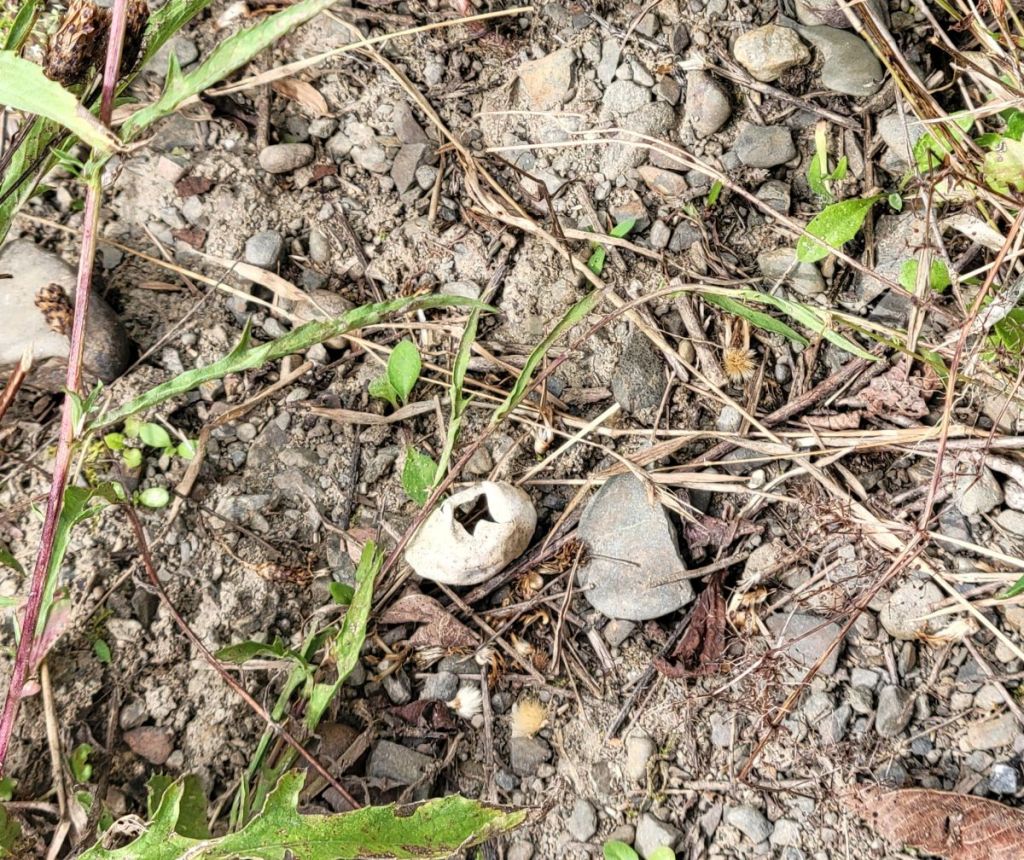
On the dry slope leading down to the stream, we also discovered a turtle egg that had been dug out of its underground nest and been preyed upon. We don’t know which turtle species had made the nest here, but the stream and adjacent floodplain forest might be home to the rare Wood Turtle.
Remnants of a turtle egg that had been preyed upon
Further down the slope and closer to the stream, the vegetation was taller and indicative of a wet meadow (#5), including Broad-leaved Cattail (Typha latifolia), Woolgrass (Scirpus cyperinus), and Tall Goldenrod (Solidago altissima). There were also large patches of the invasive Mugwort (Artemisia vulgaris),visible in the foreground of this image.
Wet meadow (#5 on map) near stream
The stream had small gravel bars with a mix of native and non-native plants, including Japanese Knotweed (Reynoutria japonica), visible in the background of this image.
Stream with gravel bars
This wetland (#7), which had a mosaic of shrub swamp and wet meadow, was a bit difficult to move through, but harbored some botanical treats, including many plants of Rough-leaved Goldenrod (Solidago patula), visible in the foreground, one of our less-common goldenrods, which seems to be a good indicator for calcium-rich wetlands.
Wetland (#7 on map)
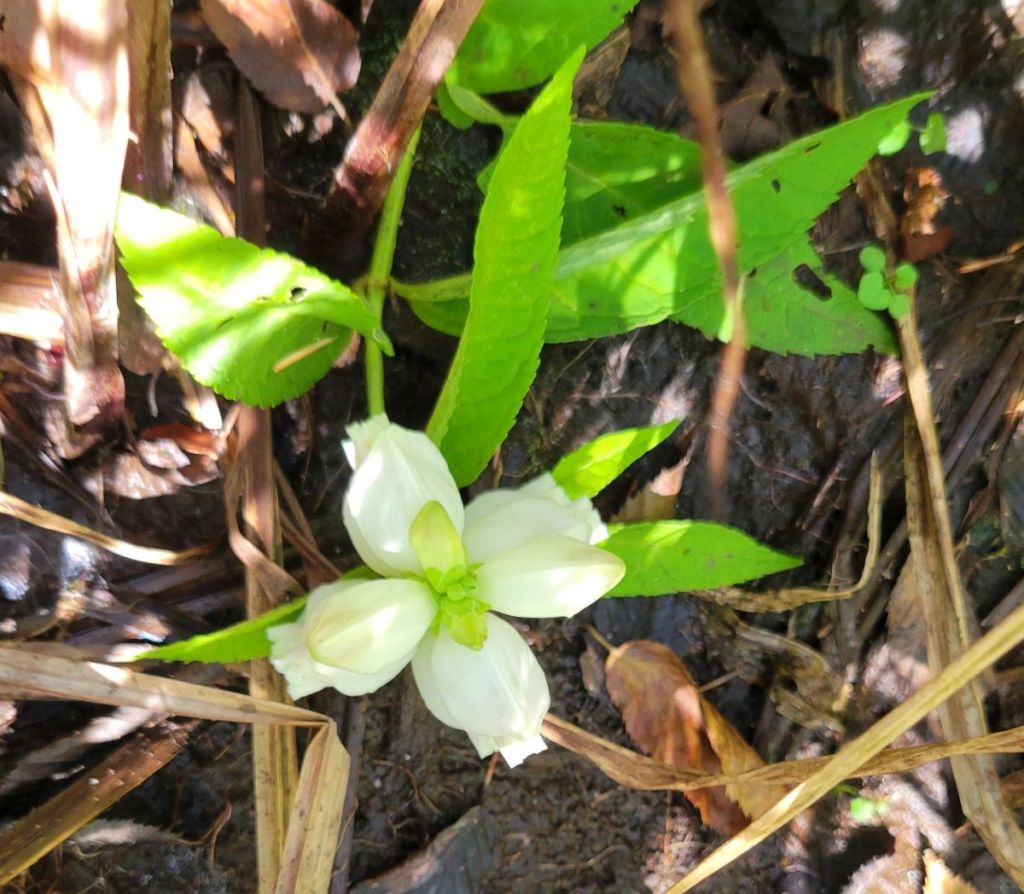
We also stumbled across the Turtlehead (Chelone glabra) in full bloom. The leaves of this species are the preferred caterpillar food of Baltimore Checkerspot butterflies.
Turtlehead (Chelone glabra)
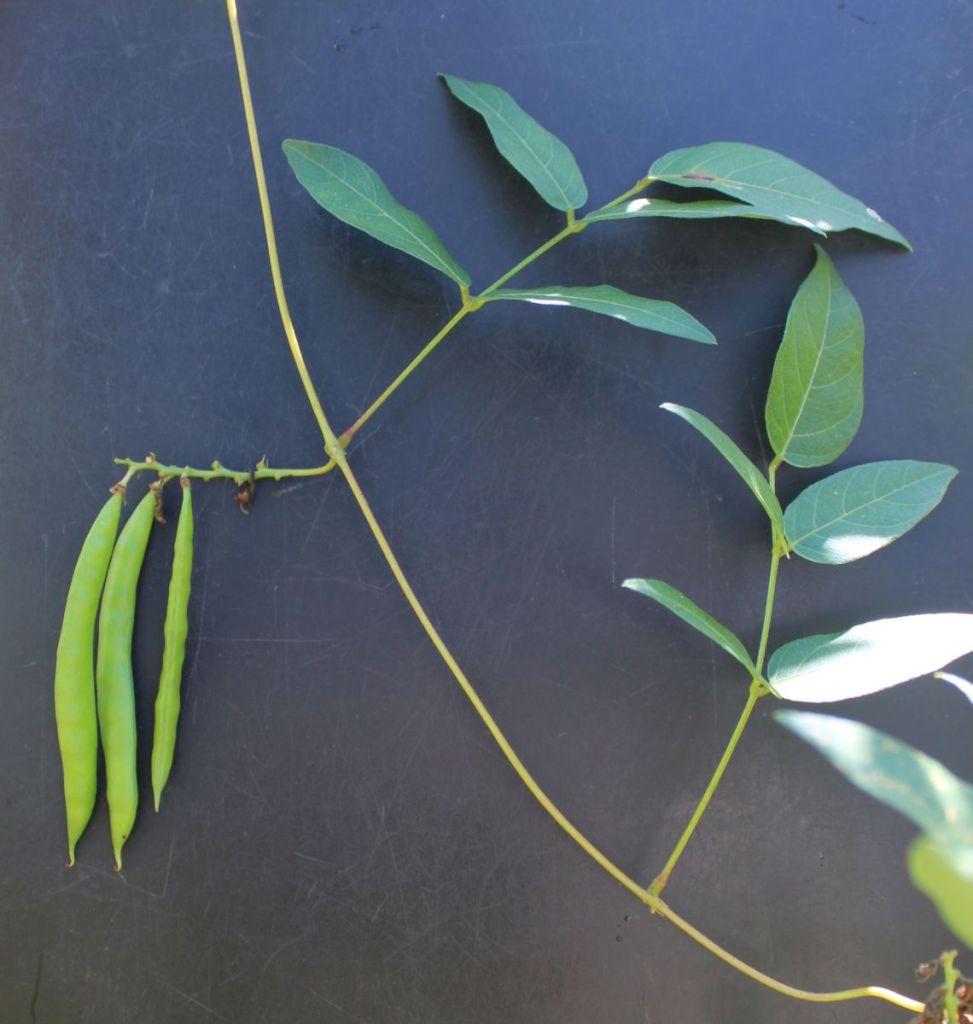
Another exciting find in the wetland was this Groundnut (Apios americana) with fruits. While we occasionally see flowers of this uncommon wetland plant in the Hudson Valley (see blog about the plants at Rose Hill Farm posted on 17 November 2024) it seems to rarely produce seeds in our region. According to Wikipedia, this species has diploid and triploid plants, with seemingly no big difference in their appearance. Only diploid plants (which tend to be more common south of our region) can produce viable seeds, while triploid plants (more common in our region and north of here) rely on vegetative reproduction.
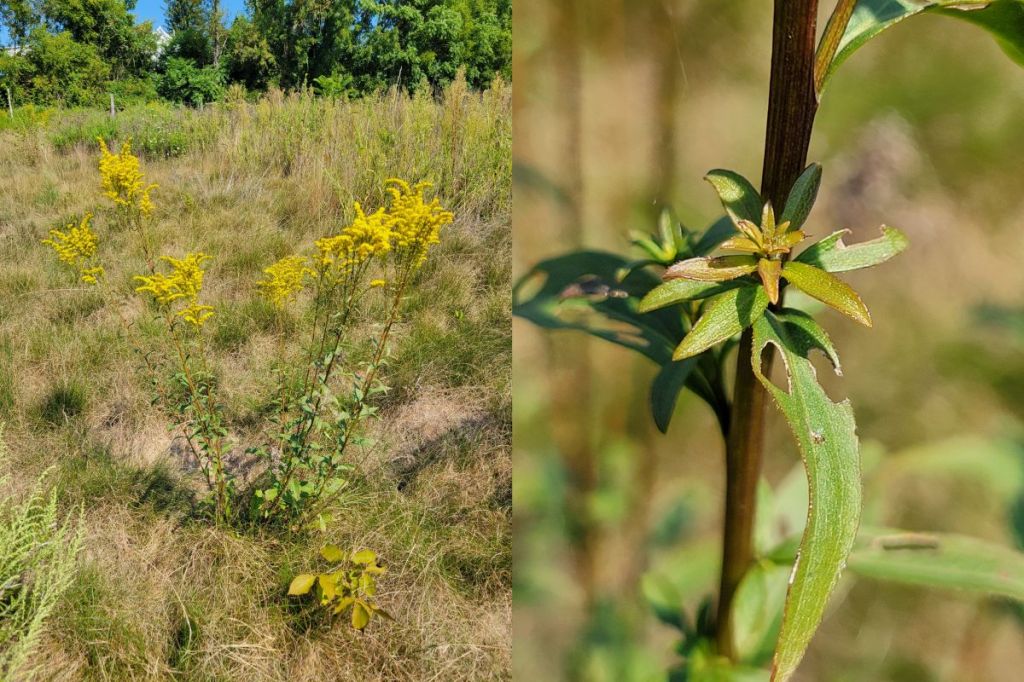
The potato-like tubers of Groundnut are edible and have a long history of use (and likely cultivation) by native Americans.
Groundnut (Apios americana)
This is a more shrubby part of the wetland with a Common Winterberry (Ilex verticillata) in the foreground.
Common Winterberry (Ilex verticillata)
Quite common among the shrubs was Poison Sumac (Toxicodendron vernix), which is an upright-growing plant closely related to Poison Ivy (T. radicans) and has the same rash-inducing urushiol resin. In contrast to our other sumacs (Rhus spp.), which have red berries, the berries of Poison Sumac are white like those of Poison Ivy.
Like the Rough-leaved Goldenrod mentioned earlier, Poison Sumac is considered a good indicator for calcium-rich wetlands.
Poison Sumac (Toxicodendron vernix)
The northern edge of the wetland supported patches of Cinnamon Fern (Osmundastrum cinnamomeum), seen here as yellowish clumps, mixed with a tall, rhizomatous (non-clumping!) native sedge, Lake Sedge (Carex lacustris), and the ubiquitous, invasive Purple Loosestrife (Lythrum salicaria).
Northern edge of wetland (#7 on map)
The edge between the upland forest (#8) and the wetland (#7) is not a straight line. In this picture, a “finger” of low ground with wetland vegetation reaches between two areas of upland forest on higher ground.
Edge between the upland forest (#8 on map) and the wetland (#7 on map)
In the edge to the field (#8a) we found the before-mentioned Butternut tree.
Field edge (# 8a on map)
This field edge also had a small patch of an interesting native plant not seen anywhere else at the Hudson Valley Seed Company, nor at any of the other farms we have surveyed this summer. Flat-topped White Aster (Doellingeria umbellata) is a northern species, common in the Adirondacks and in northern New England, but we rarely see it in the Hudson Valley south of Troy.
Flat-topped White Aster (Doellingeria umbellata)
Near the buildings (#9), we noticed a small “island” of native plants in the vegetation that was otherwise dominated by common European plants.
Small “island” of native plants near buildings (#9 on map)
Early Goldenrod (Solidago juncea), Gray Goldenrod (Solidago nemoralis), and Little Bluestem (Schizachyrium scoparium) might have been seeded here or might have come in on their own. These three species often are found growing together on dry soil.
Early Goldenrod (Solidago juncea), Gray Goldenrod (S. nemoralis), and Little Bluestem (Schizachyrium scoparium)
Yellow and Giant Foxtail (Setaria pumila and S. faberi) were very common in the recently disturbed soil around the new building. Yellow Foxtail has upright, yellow-brown spikes of seeds; Giant Foxtail has light green, nodding spikes.
Yellow and Giant Foxtail (Setaria pumila and S. faberi)The seed production garden (# 10) of the Hudson Valley Seed Company.
Common Milkweed (Asclepias syriaca; big leaves in picture below) and Indian-hemp (Apocynum cannabinum; small leaves in picture below) were two native plants growing between the cultivated rows (#10). They both belong to the same plant family and have white latex. Both produce flowers that are visited by many pollinators.
Common Milkweed (Asclepias syriaca) and Indian-hemp (Apocynum cannabinum)
The strip of meadow along the north edge of the driveway (#11) had a lot of the native warm-season grass Purple-top (Tridens flavus), while the large hayfield (#13) beyond was dominated by the European cold-season grass Orchard Grass (Dactylis glomerata).
Meadows of different plant composition north of the driveway (#11 and #13 on the map)
It was nice to see that the Orchard Grass-dominated meadow (#13) had some Common Milkweed mixed in. The fields A, B, and C were all recently-tilled and bare ground during our visit. Field D was an unmowed old field dominated by goldenrods, interspersed by Purple Loosestrife.
Plenty of Common Milkweed was found in one of the meadows (#13 on the map)
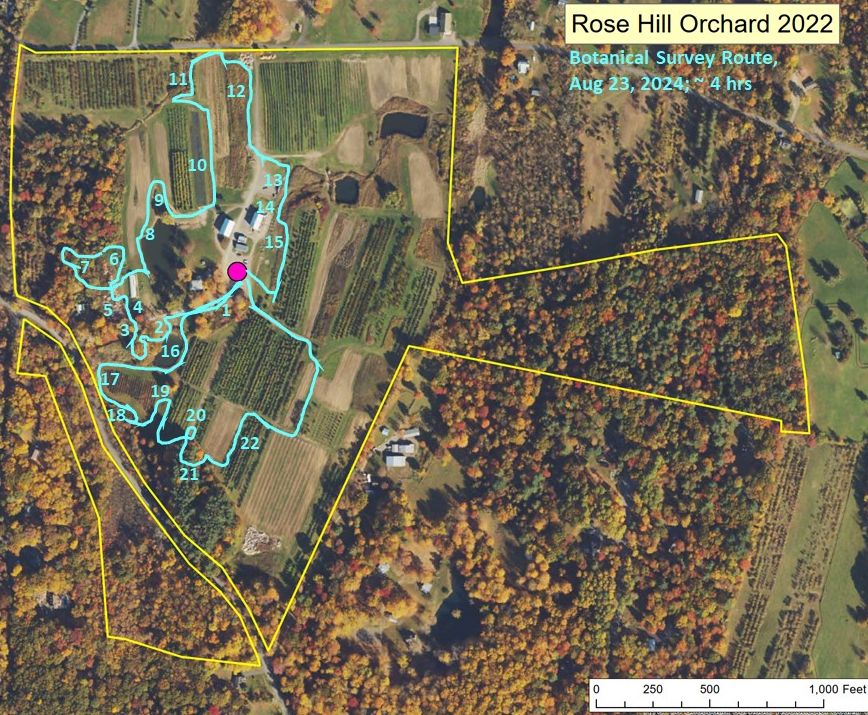
This blog shares some of the botanical observations made at Rose Hill Farm on 23 August 2024 during a 4 hour survey along the route indicated in sky blue in the aerial image below. The numbers indicate locations referenced throughout this blog posting. (Note that we shared habitat images from Rose Hill Farm in a blog posted 21 June 2024; Conrad posted about insects on 12 July 2024 and Will about birds on 16 November 2024.
Route of botanical survey on 23 August 2024
I started my walk-around from the parking area along the driveway back towards the entry gate.
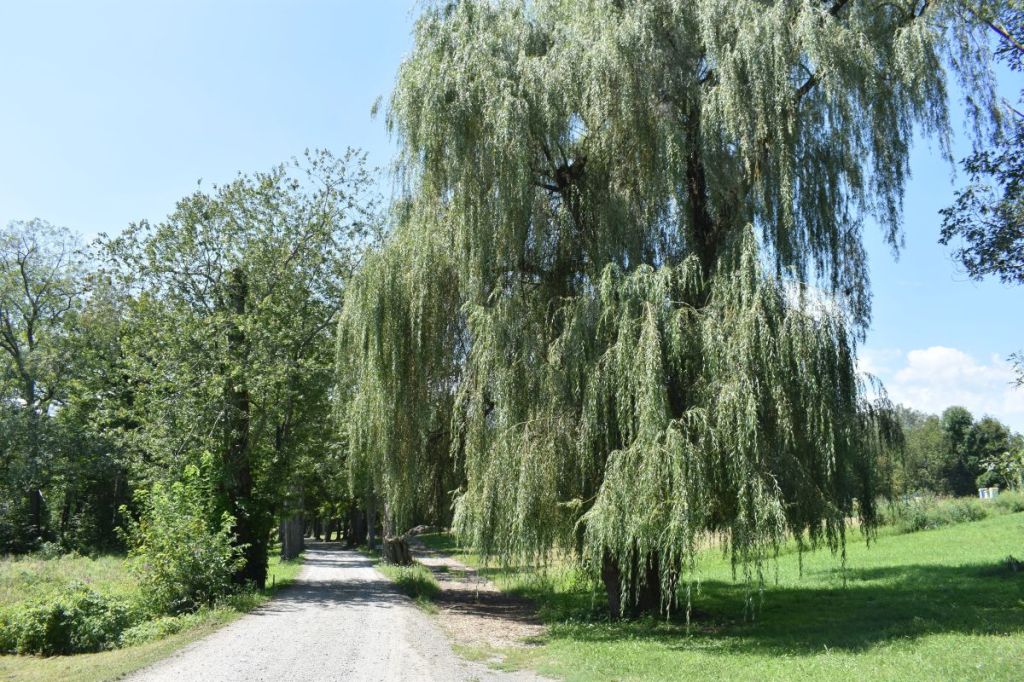
Entry ally to Rose Hill Farm with a weeping willow (Salix cf. babylonica x alba) and Red and Sugar Maples (Acer rubrum and A. saccharum) beyond (seen from #1).
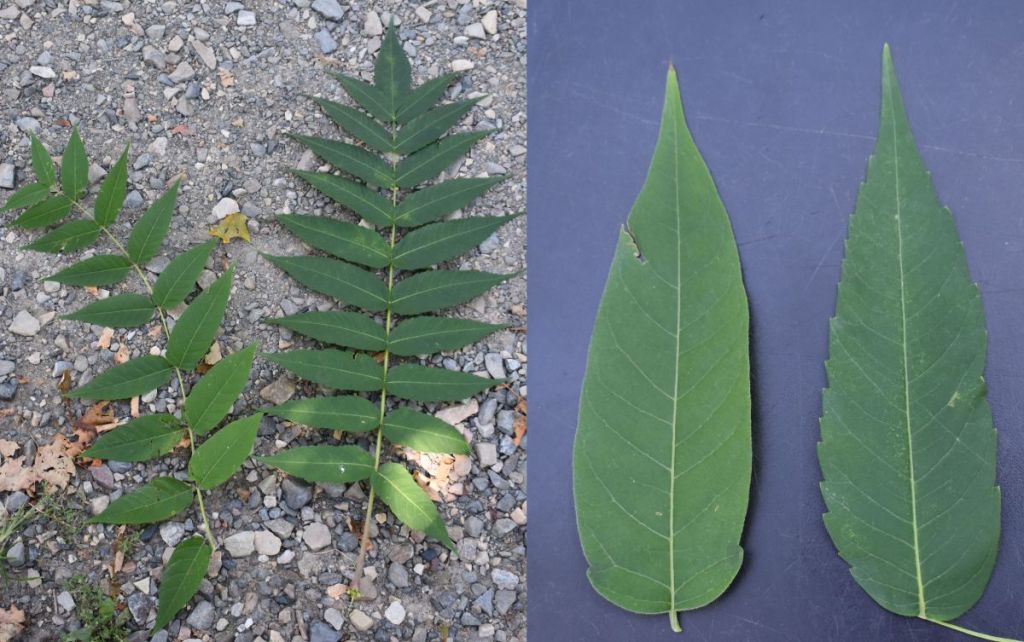
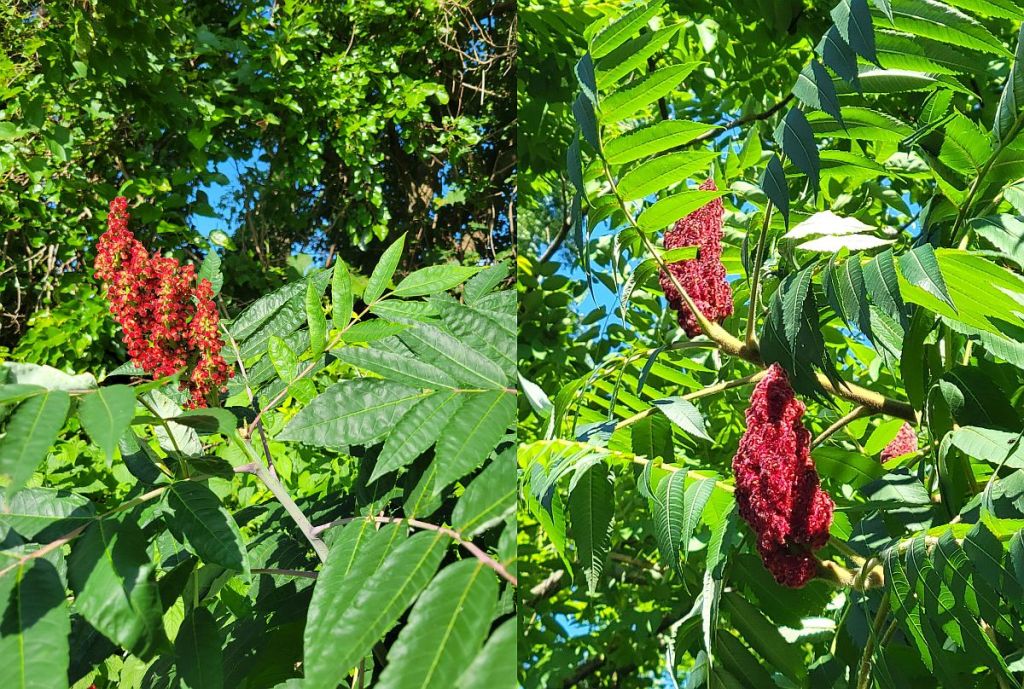
Along the driveway is a shrubland that contains both Tree-of-Heaven (Ailanthus altissima; left on both images below) and Staghorn Sumac (Rhus typhina; right on both images below). Both have pinnate, “feather-like” leaves, composed of a midrib with leaflets arranged opposite each other along both sides. However, the margin of the leaflets is toothed like a saw blade in the Sumac, while the margin of the Tree-of-Heaven leaflets is almost smooth, with just a couple of blunt teeth at the very base. Furthermore, the two species have very different smells: the Sumac has a (to me) very agreeable, aromatic, resinous smell, while the smell of Tree-of-Heaven reminds many people of rancid peanut butter.
Tree-of-Heaven (Ailanthus altissima; left on both images) and Staghorn Sumac (Rhus typhina; right on both images)
South of the driveway is a small wet meadow (#2) that supports a diverse plant community, composed of native and non-native species, such as Smooth Goldenrod (Solidago gigantea; yellow flowers) and Purple Loosestrife (Lythrum salicaria; deep pink flowers), respectively. I quickly tallied a total of 40 (!) species in this very small meadow.
Species-rich wet meadow south of the driveway (#2)
Just west of this wet meadow, I found a very small patch of forest on and surrounding a rock outcrop (#3). At the forest edge, there were several individuals of two native shrub species not seen anywhere else during my survey at Rose Hill (or any of the other eight farms surveyed this summer). This image shows Prickly Ash (Zanthoxylum americanum), which has pinnate leaves and thorny branches. Prickly Ash is one of the host plants for the caterpillars of Giant Swallowtail butterflies. Conrad shared a picture of a Giant Swallowtail he had seen at Rose Hill in his blog from 12 July 2024, but we don’t know yet, if they are actually successfully reproducing here or if an occasional individual flies in from further south.
Prickly Ash (Zanthoxylum americanum; #3)
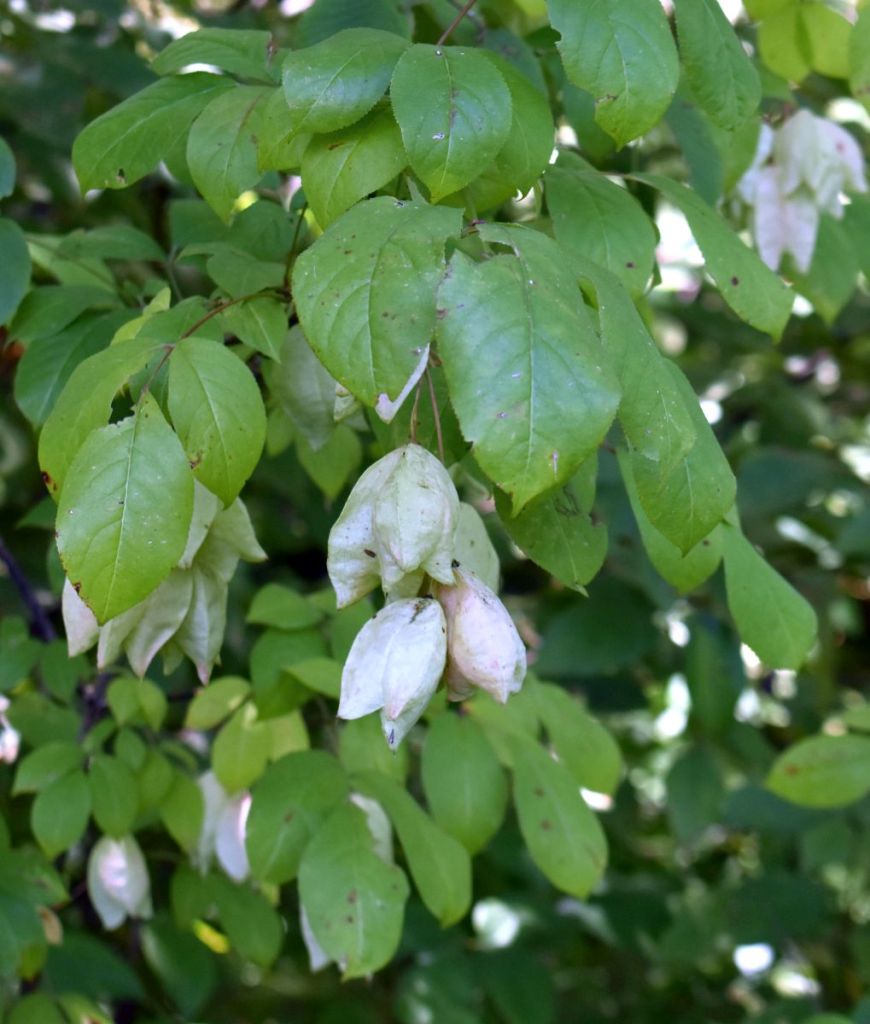
Bladdernut (Staphylea trifolia), which grew right next to the Prickly Ash, has leaves composed of three leaflets (similar to clovers) and unique, three-chambered, bladder-like fruits. Both of these species tend to occur in calcium-rich soils.
Bladdernut (Staphylea trifolia; #3)
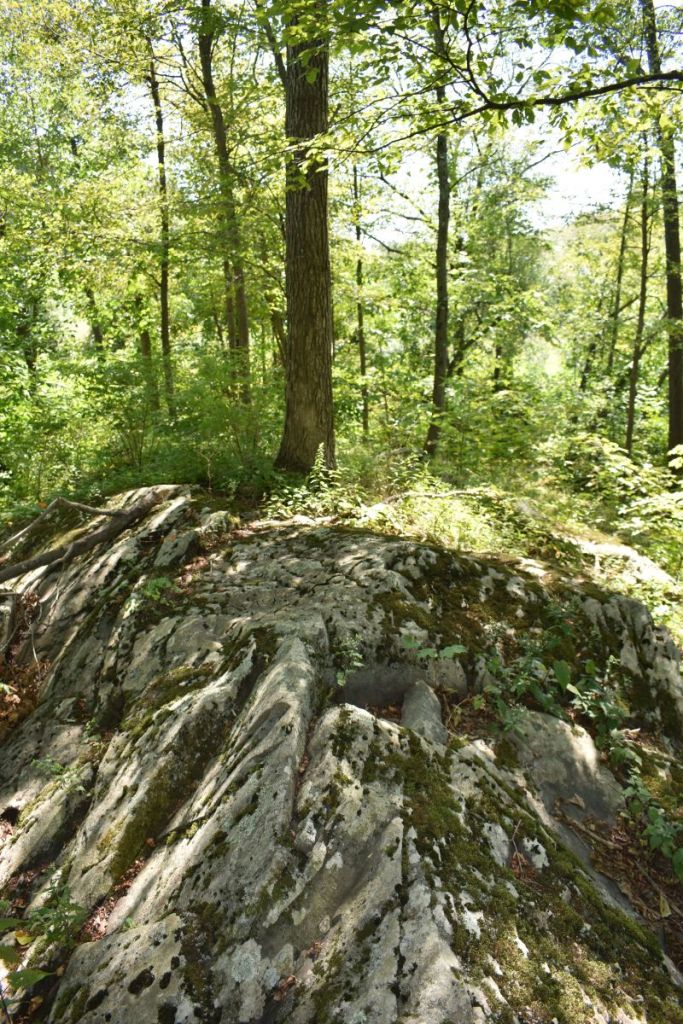
I am no geologist, but the outcrop (#3) might well be some sort of limestone or related rock that is rich in calcium.
Suspected limestone (or other calcium-rich rock) outcrop (#3)
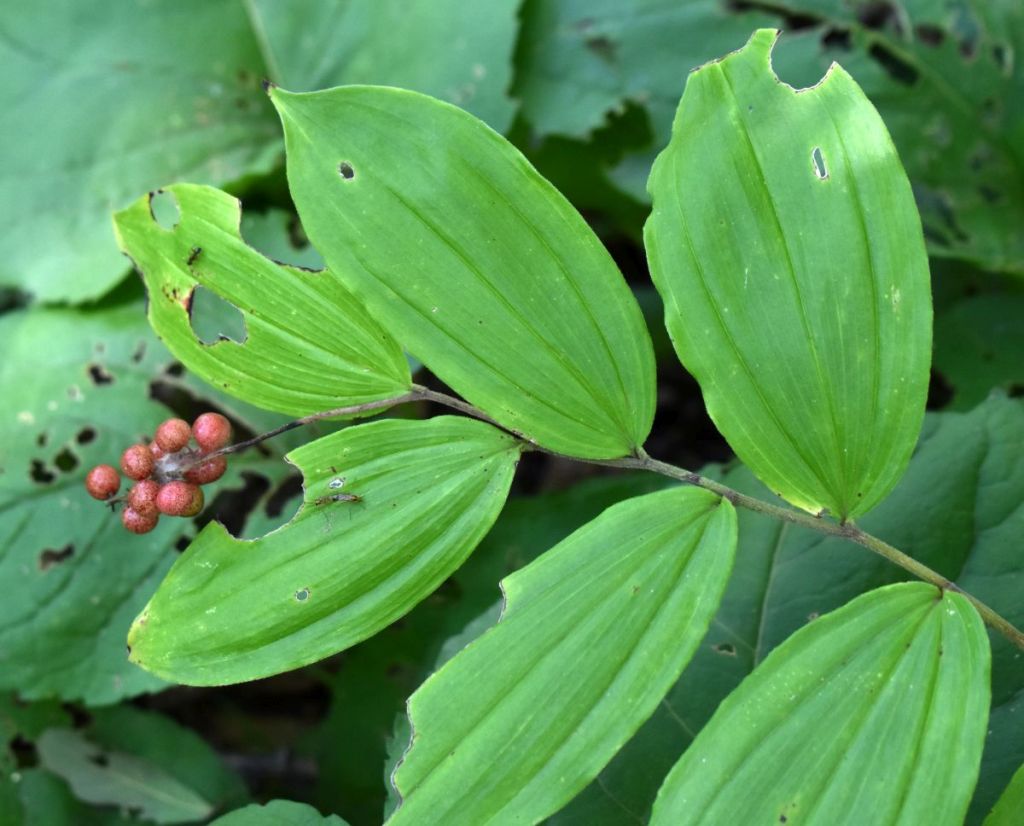
False Solomon’s-seal (Maianthemum racemosum) also grew at the base of the rock, which was surrounded by large trees, including Sugar Maple, American Basswood, Red Oak, and American Elm.
False Solomon’s-seal (Maianthemum racemosum; #3)
I found a very different, much younger forest north of the wood chip piles (#7). It still had the remnants of Red Cedar (Juniperus virginiana), which are early-successional trees that often grow on abandoned farm fields or pastures. As the historical aerial photo in Conrad’s blog from 12 July 2024 shows, this area used to be orchard 80 years ago.
Red Cedars tend to die naturally as they get shaded out by taller trees. However, the Red Cedars in this forest might have been intentionally cut, presumably to avoid serving as hosts for the Cedar-Apple Rust (Gymnosporangium juniperi-virginianae), a fungal pathogen of apples, that needs two hosts to complete its life cycle, a Red Cedar and an apple or hawthorn.
Fallen or felled Red Cedar in young forest (#7)
Lower down in the forest along a small stream, ferns such as Royal Fern (Osmunda regalis; bottom right in the image) and Cinnamon Fern (Osmundastrum cinnamomeum; center of image) grew lush in the moist soil.
Royal Fern (Osmunda regalis) and Cinnamon Fern (Osmundastrum cinnamomeum) in young forest (#7) by stream
Back up along the forest edge (# 6), Virgin’s-bower (Clematis virginiana), which is a native vine whose stems are not woody and die back each winter, were in full bloom.
Virgin’s-bower (Clematis virginiana; #6)
The pond by the farm house (#8) had a narrow band of unmowed vegetation, which harbored some native plant species not seen anywhere else on the farm during our survey.
Pond (#8) with narrow band of unmowed vegetation
During my walk around Rose Hill Farm, I noticed New England Aster (Symphyotrichum novae-angliae) only at the shore of this pond. It was visited by a native bee.
New England Aster (Symphyotrichum novae-angliae; #8)
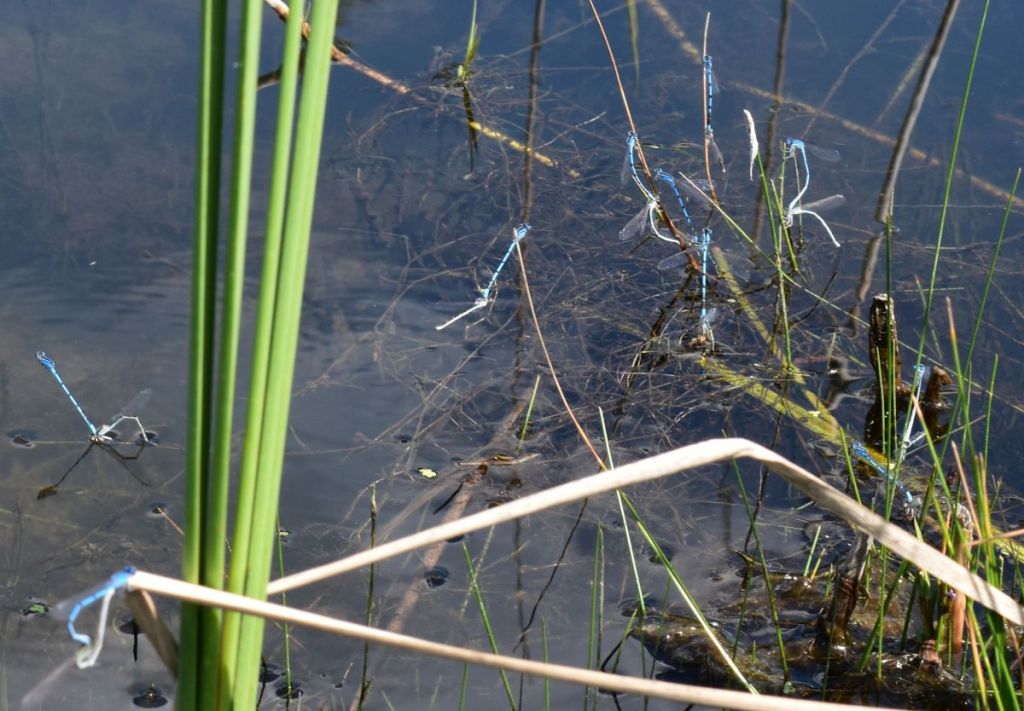
The damselflies were mating and laying their eggs in the pond. These little guys greatly benefit from the emergent vegetation which provides perches. They also benefit from aquatic vegetation in the pond, because it provides habitat for their aquatic larvae. Aquatic vegetation is especially important for dragonfly and damselfly larvae, when predatory fish or amphibians also live in the pond.
Mating damselflies (#8)
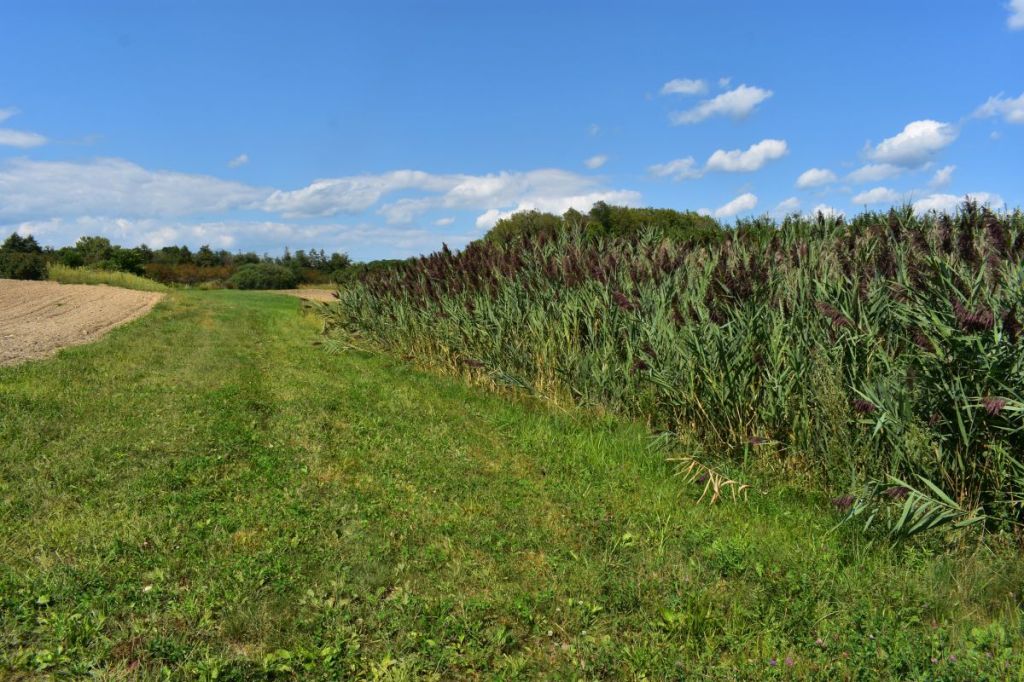
A big patch of the invasive Common Reed (Phragmites australis) grew in a swale (#9) draining into the pond.
Common Reed (Phragmites australis) in a swale (#9)
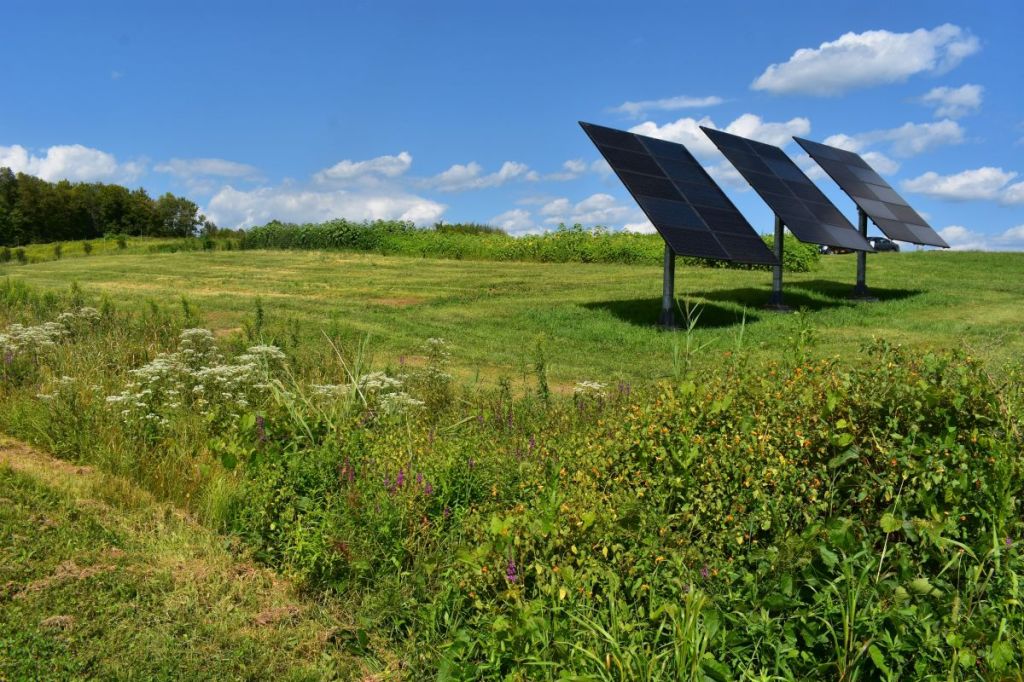
Another swale (#10) near the solar panels had unmowed wet meadow vegetation composed of many native species, including Common Boneset (Eupatorium perfoliatum; white flowers) and Spotted Jewelweed (Impatiens capensis; orange flowers), which were buzzing with insects.
Unmowed wet meadow in swale (#10)
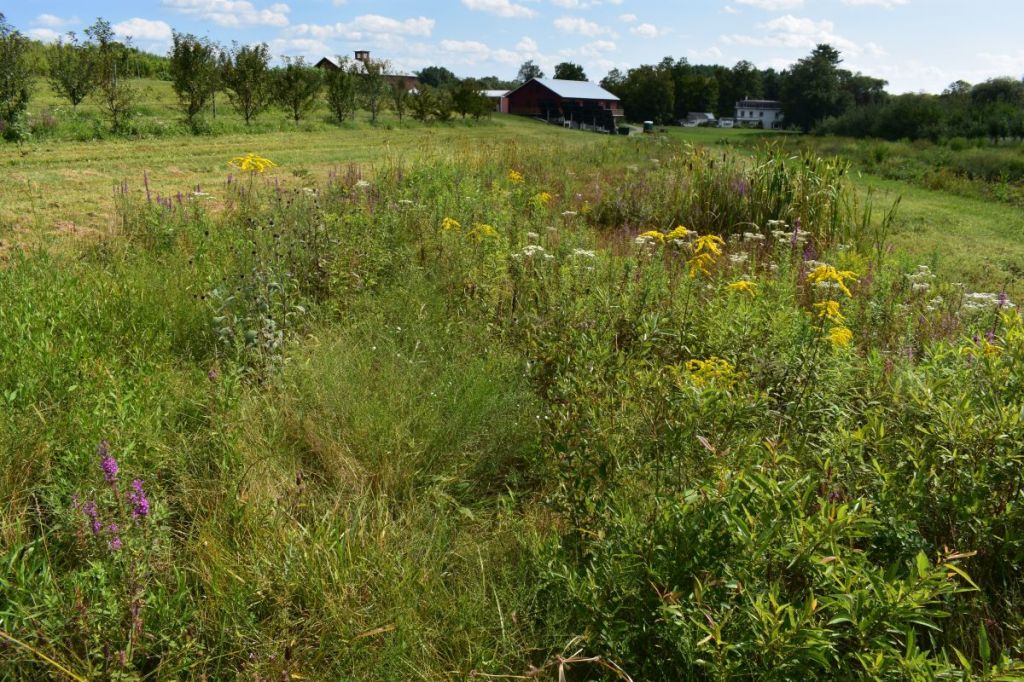
The upper end of the same swale (#10) had a more diverse plant community, including native cattails (Typha sp.), Early Goldenrod (Solidago juncea), Awl Aster (Symphyotrichum pilosum var. pilosum), and Black-eyed Susan (Rudbeckia hirta).
Upper part of wet meadow in swale (#10)
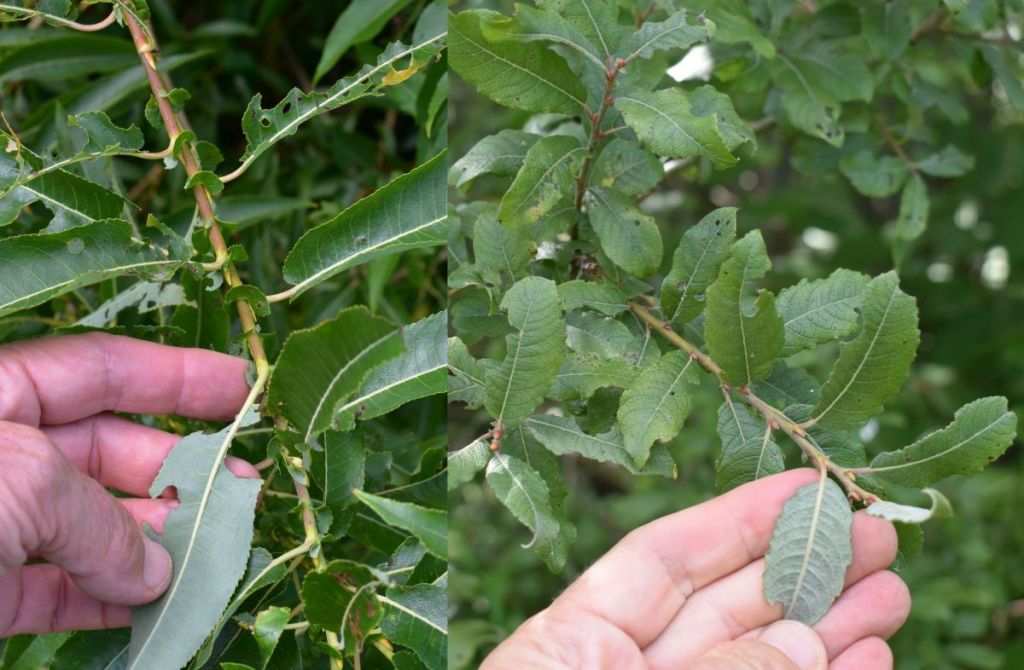
Near the fenceline, I encountered a shrub thicket (#11) with two different species of willow, Heart-leaved Willow (Salix eriocephala; left) and Bebb’s Willow (Salix bebbiana; right). Both of these willows have catkins that serve as important early season pollen sources for bees.
Heart-leaved Willow (Salix eriocephala; left) and Bebb’s Willow (Salix bebbiana; right) in shrub swamp (#11)
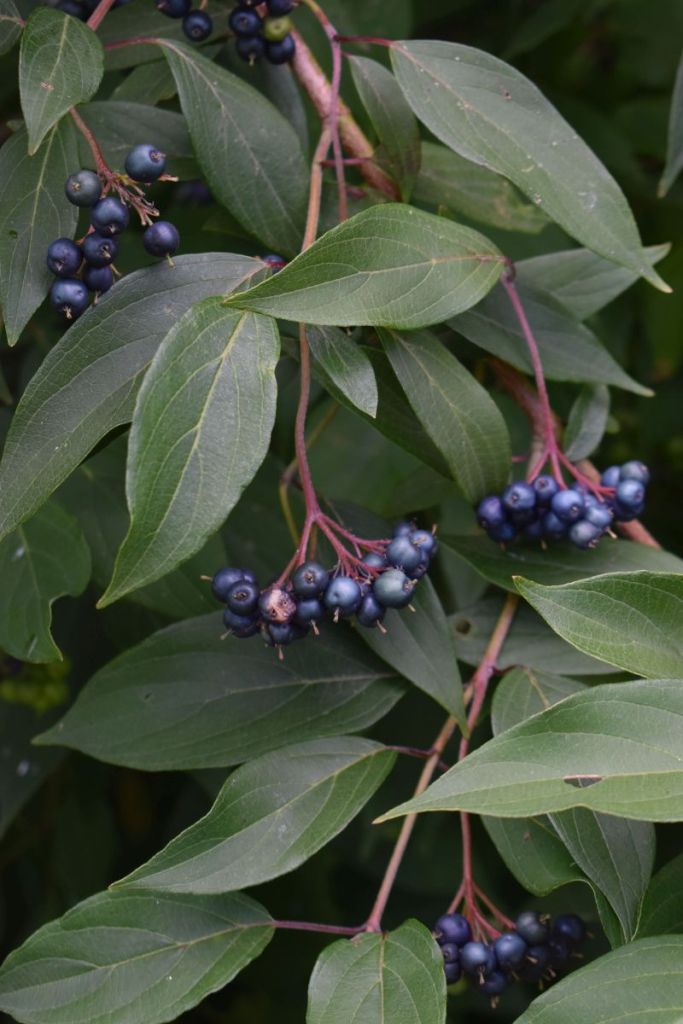
The thicket also had a Silky Dogwood (Cornus amomum), with its metallic-blue fruits displayed on reddish branches.
Silky Dogwood (Cornus amomum; #11)
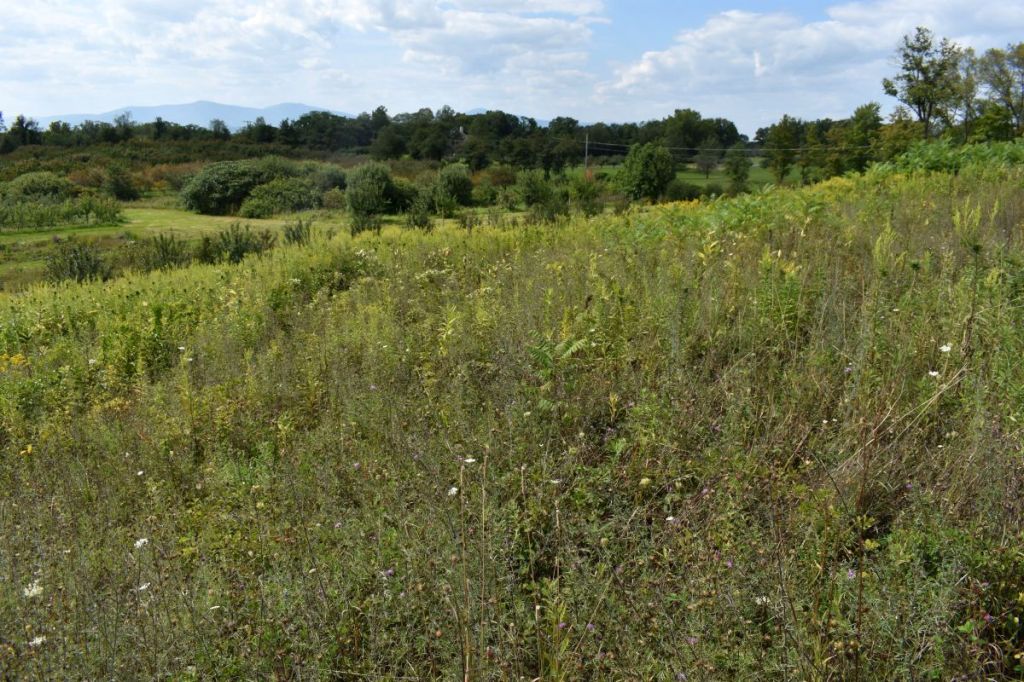
Circling back towards the buildings, I passed by a dry hillside which had been left unmowed (#12). The vegetation was a mix of common native species, including several goldenrods (Smooth, Tall, and Early) and Common Milkweed (Asclepias syriaca), with non-native species, including Spotted Knapweed (Centaurea jacea) and Wild Carrot (Daucus carota).
Unmowed dry hillside (#12)with a mix of common native and non-native wildflowers
Another unmowed, dry slope east of the parking lot (#15) had several less common native plants, including Purpletop (Tridens flavus), Purple Love Grass (Eragrostis spectabilis), and Whorled Milkwort (Polygala verticillata). I did not see any of these species anywhere else at Rose Hill Farm.
Another unmowed dry hillside (#15)with some unusual native plant species
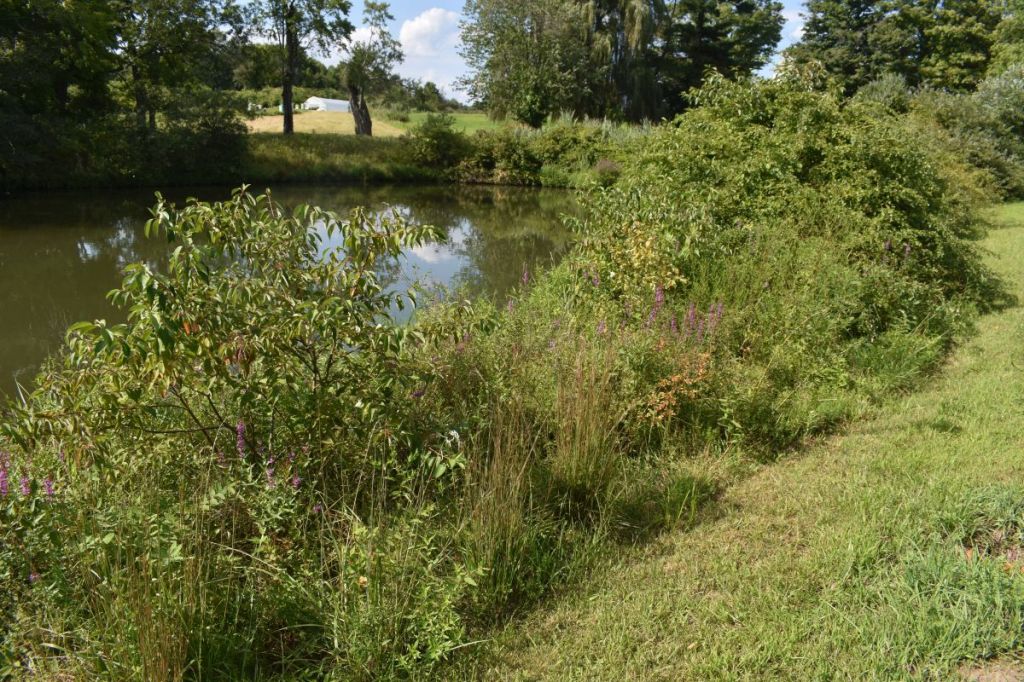
The shore of the pond (# 16) south of the driveway had a broad band of unmowed, diverse vegetation including the uncommon native Swamp Rose (Rosa palustris), which we didn’t observe anywhere else on Rose Hill or at any of the other farms surveyed this season. Note also some “blonde” clumps of the native warm-season grass Little Bluestem (Schizachyrium scoparium), usually found in dry soils.
Band of unmowed shoreline of a pond (#16)
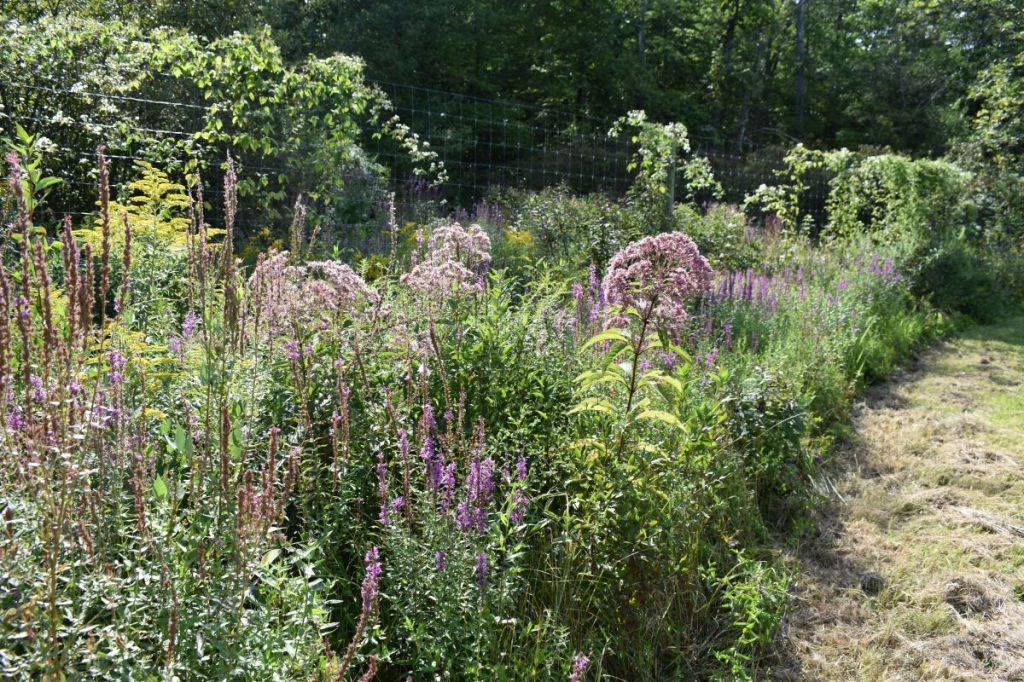
Along the south fence, south of the Blueberries, I was excited to find a beautiful and diverse wet meadow (# 18). Here, you see the native Spotted Joe-Pye-weed (Eutrochium maculatum; light pink) mix with the invasive Purple Loosestrife (Lythrum salicaria; dark pink). However, a closer look revealed many less conspicuous native wetland plants that we did not see anywhere else at Rose Hill. For example, Conrad included images of Yellow Stargrass (Hypoxis hirsuta) and Square-stemmed Monkeyflower (Mimulus ringens) from this wet meadow in his insect post on 12 July 2024
Diverse, unmowed wet meadow (# 18)
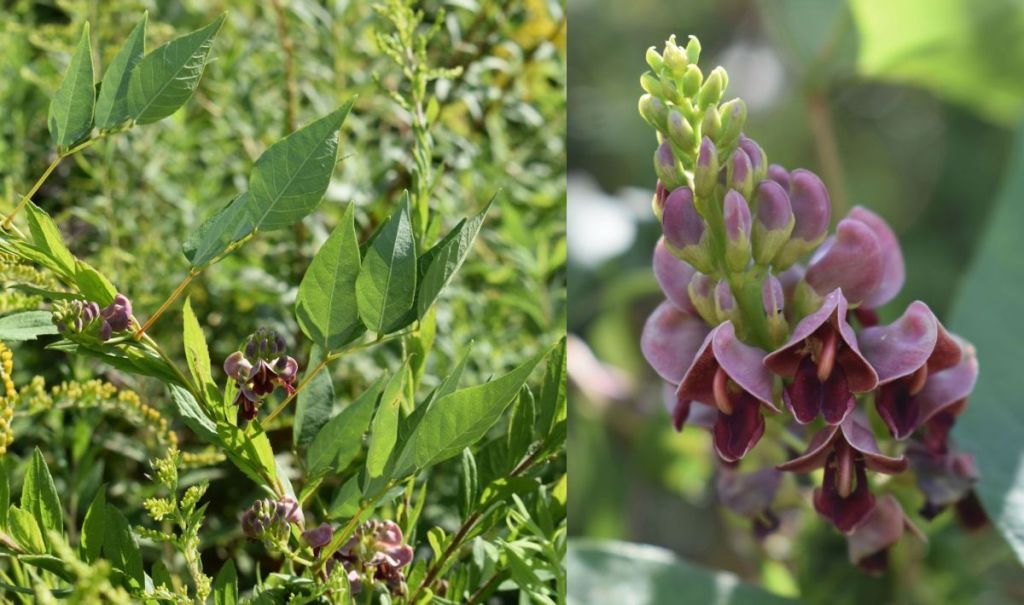
Another plant unique to this area was Groundnut (Apios americana), a native vine in the pea family which is occasionally found in wet, open areas. It has pinnate leaves with five leaflets and dense conical clusters of pea-shaped flowers of a very unusual, pink/purple/red-brown color. Most plants of this species in our region never produce fruits (but see our blog on the Hudson Valley Seed Company for an exception and explanation). The tubers of this species are edible and Native Americans seem to have sometimes cultivated Groundnut.
Groundnut (Apios americana; #18)
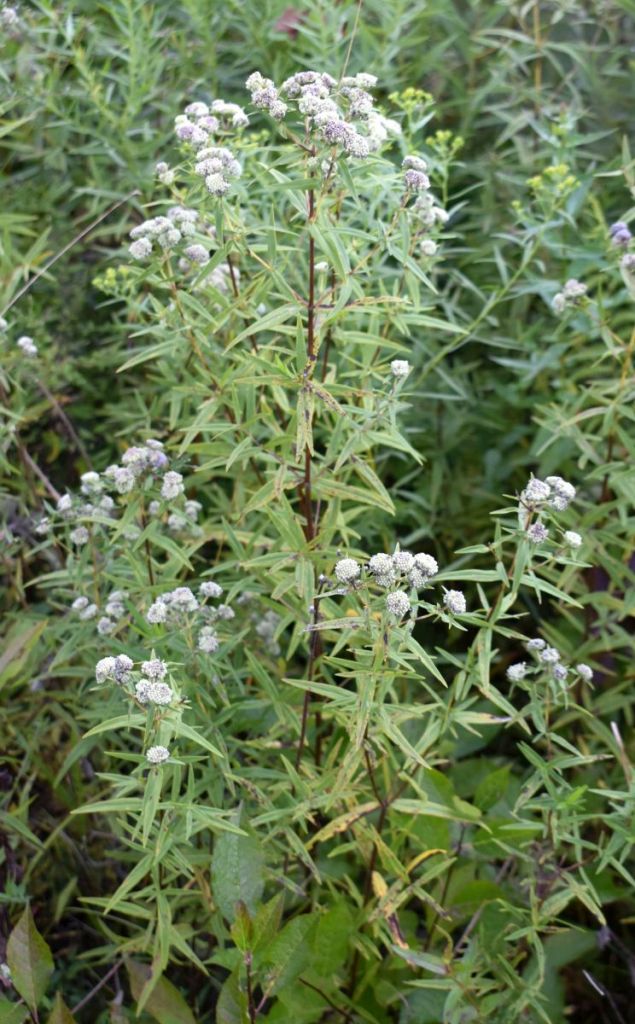
Another was Virginia Mountain-mint (Pycnanthemum virginianum), which is an uncommon native mint much visited by a large variety of pollinators.
Virginia Mountain-mint (Pycnanthemum virginianum; #18)
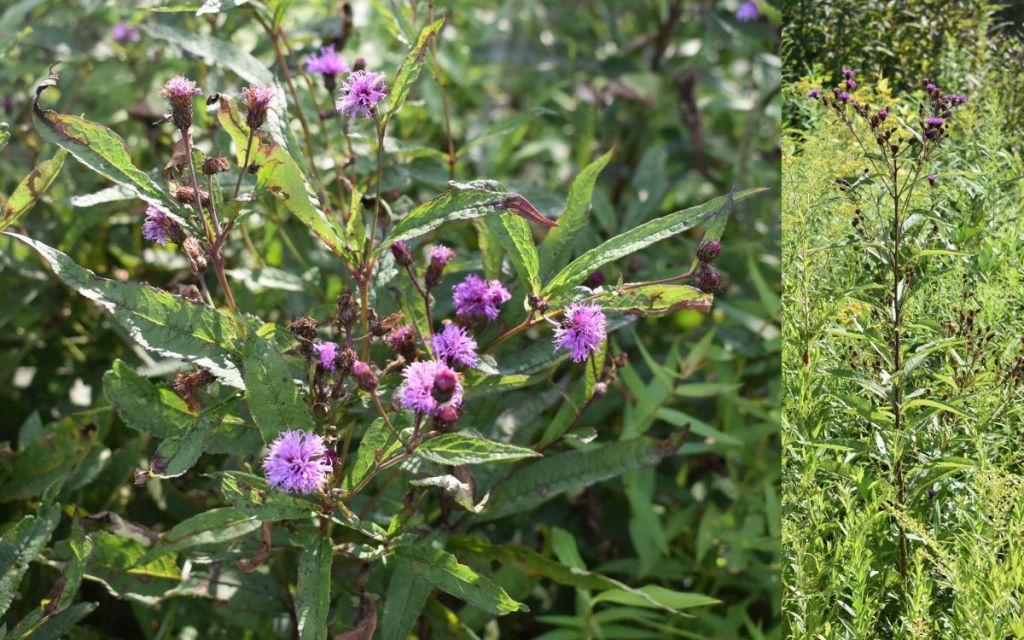
Finally, New York Ironweed (Vernonia noveboracensis) was also unique to this wet meadow. It is a member of the aster family, which seems to be more common further south in the Hudson Valley and is rarely found growing wild in our region.
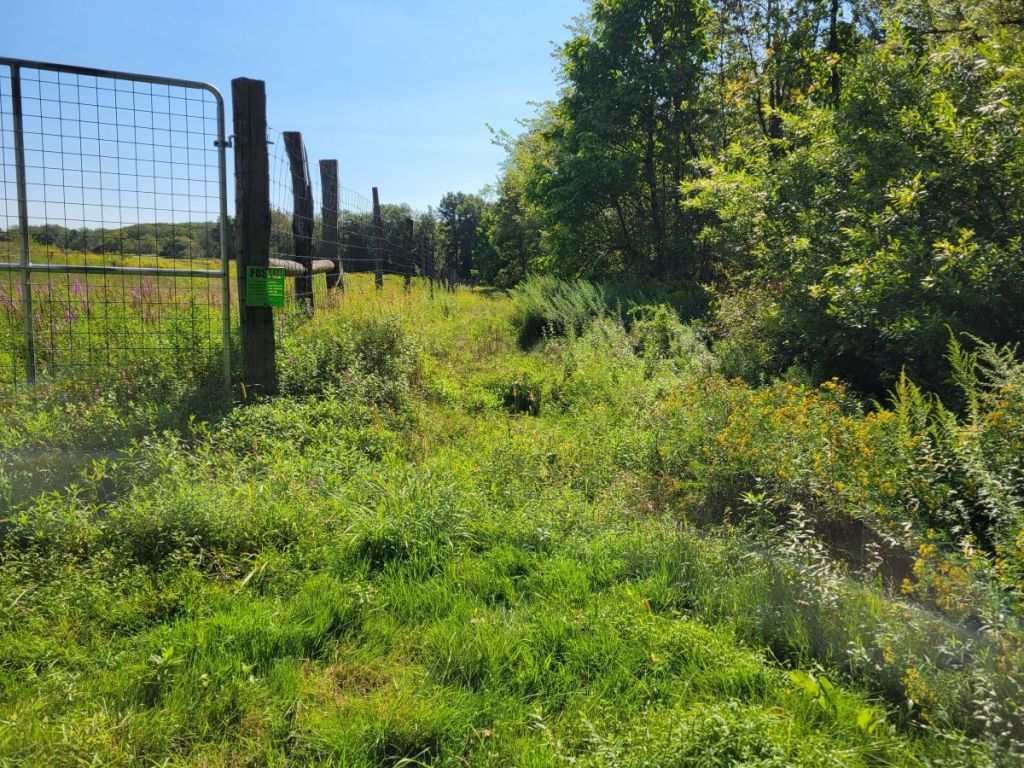
New York Ironweed (Vernonia noveboracensis; #18)
East of the Blueberries was another dry slope (# 19) with unmowed vegetation. It was fun to see how each of these unmowed slopes supported a slightly different vegetation. This one had a lot of Little Bluestem (Schizachyrium scoparium) and Early Goldenrod (Solidago juncea), but also a variety of other native and non-native plant species.
Another example of an unmowed dry slope (#19) with its own unique plant composition
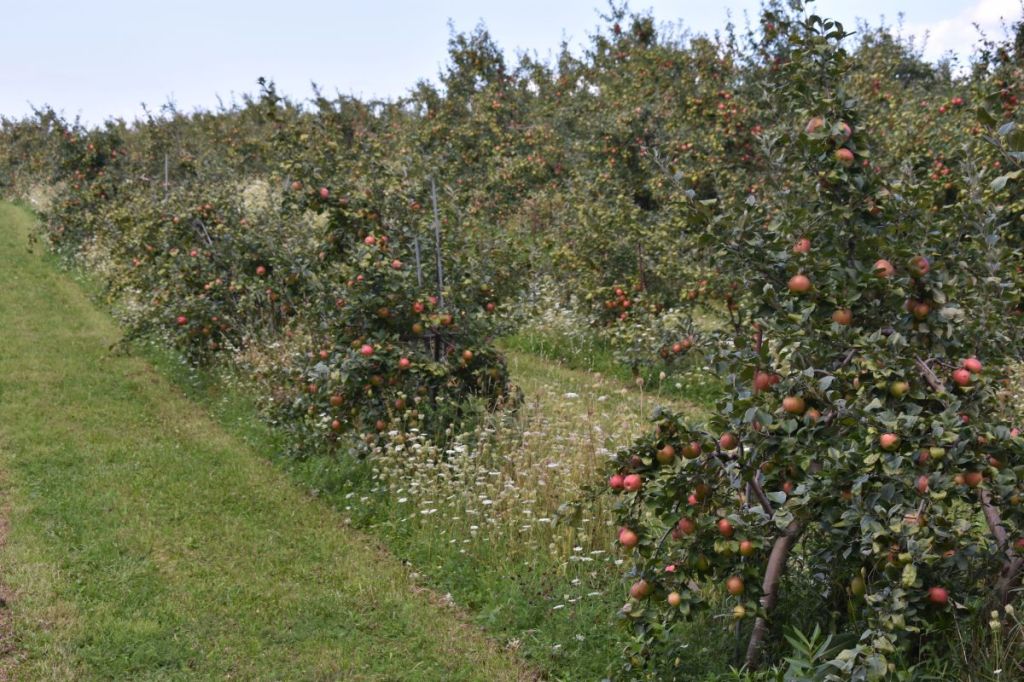
The apples nearby (# 20) were getting ripe and the unmowed strips of vegetation in the tree rows were still alive with flowers, here mostly Wild Carrot (Daucus carota).
Unmowed and flower-rich strips of vegetation within the rows of orchard trees(#20)
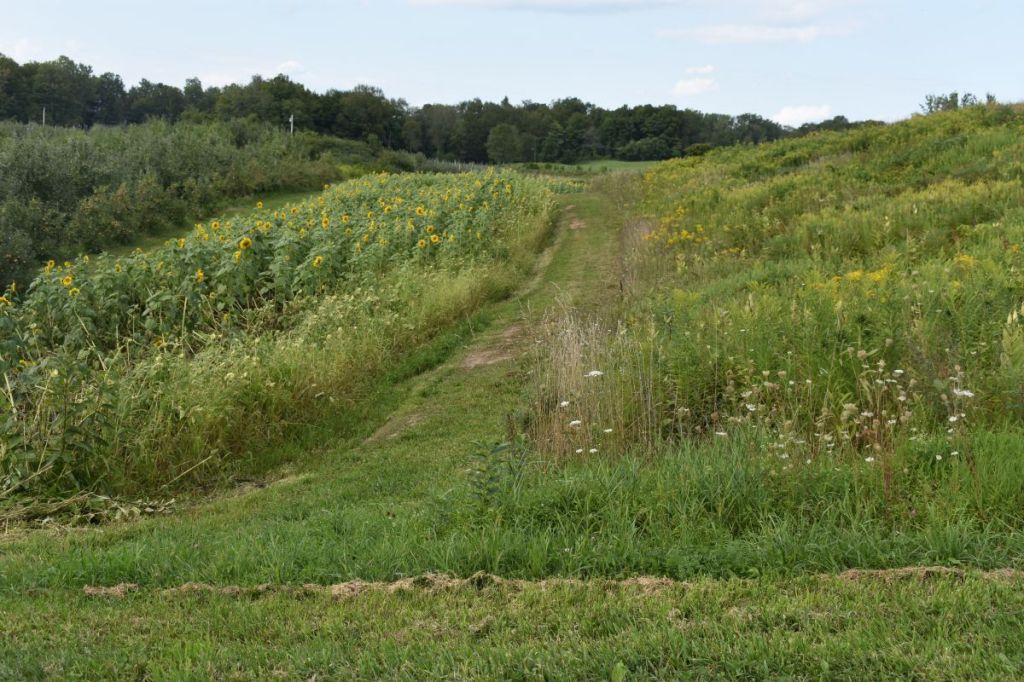
Finally, another unmowed slope with plenty of native goldenrods and European weeds in bloom, next to a field of seeded Sunflowers. With several large areas throughout the orchard left unmowed and some annual flower plantings, floral resources for pollinators (the Honey Bees kept on site, as well as wild native bees), as well as other insects, should be available throughout the season. And Will reminds us in his post on the birds of Rose Hill Farm (16 November 2024) just how important these scruffy-looking, “feral” areas throughout the farm are for our feathered friends.
A last example of a flower-rich, unmowed dry slope (#21)
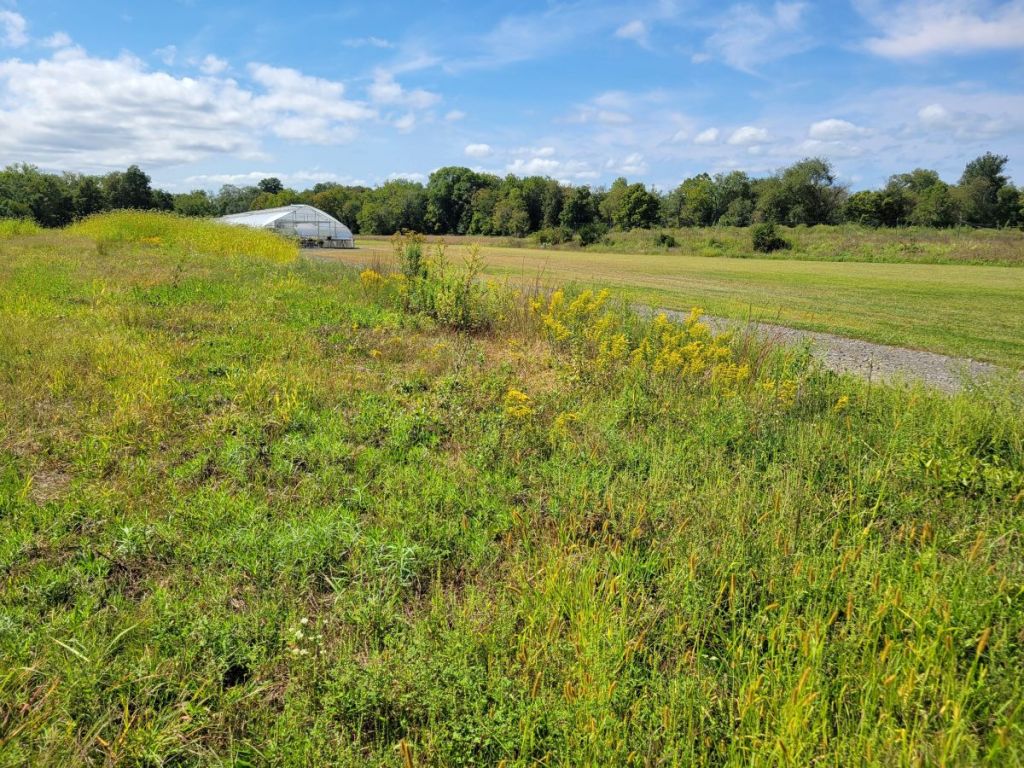
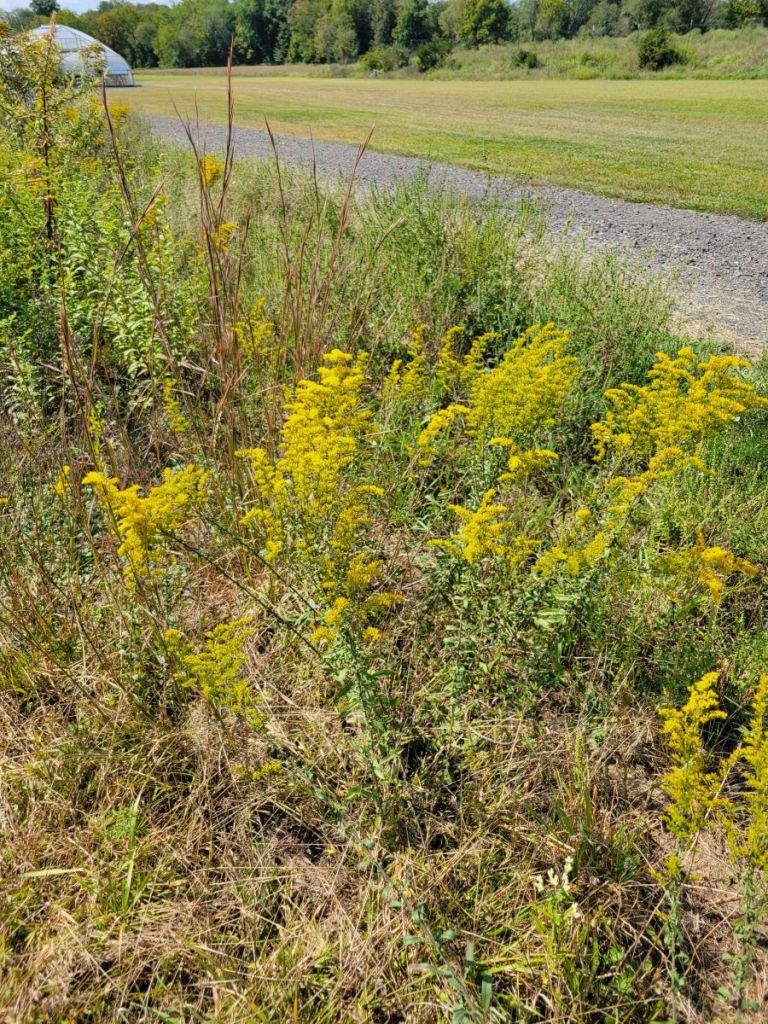
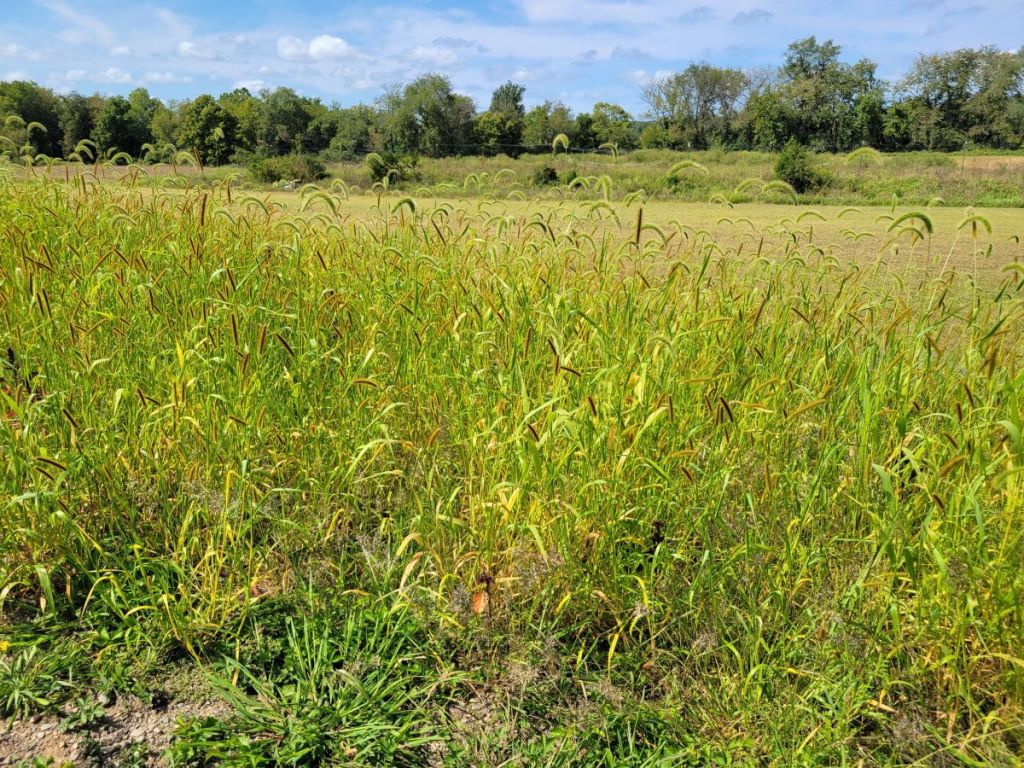
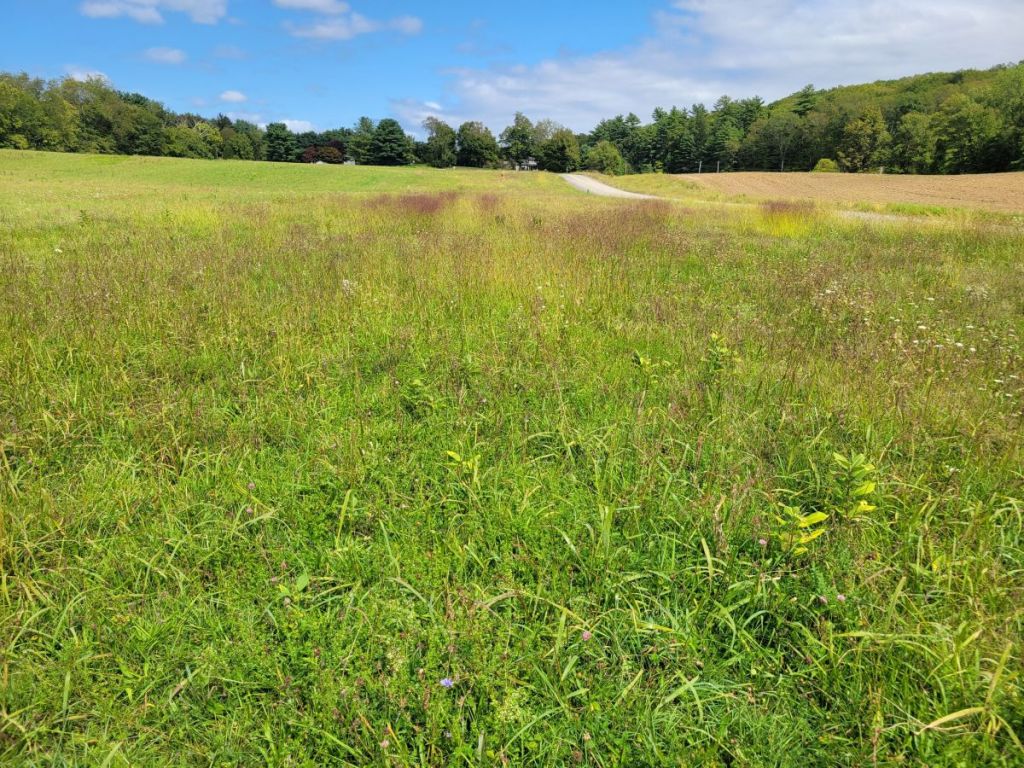
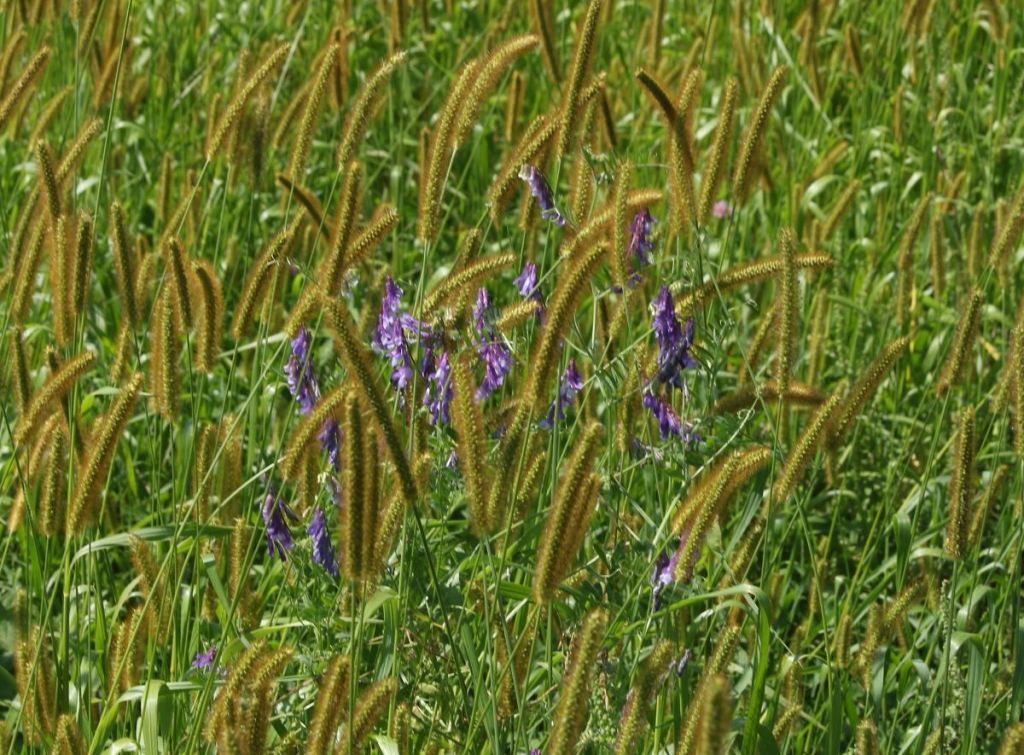
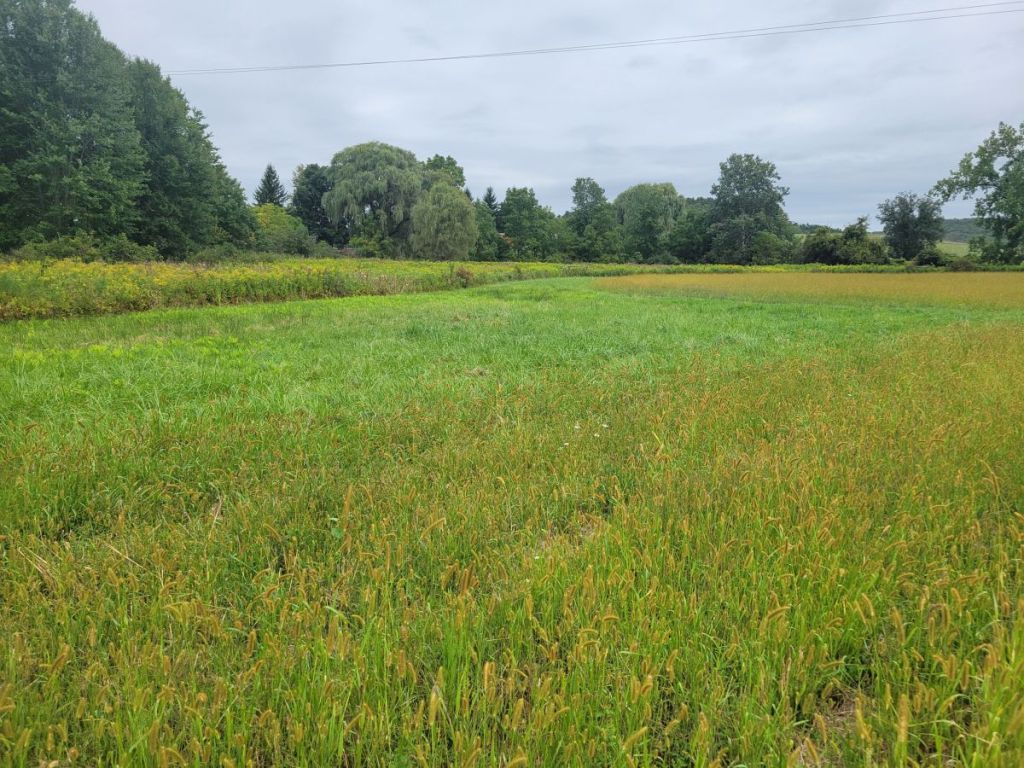
Yellow Foxtail and a vetch mix in a Carpenter Road field.
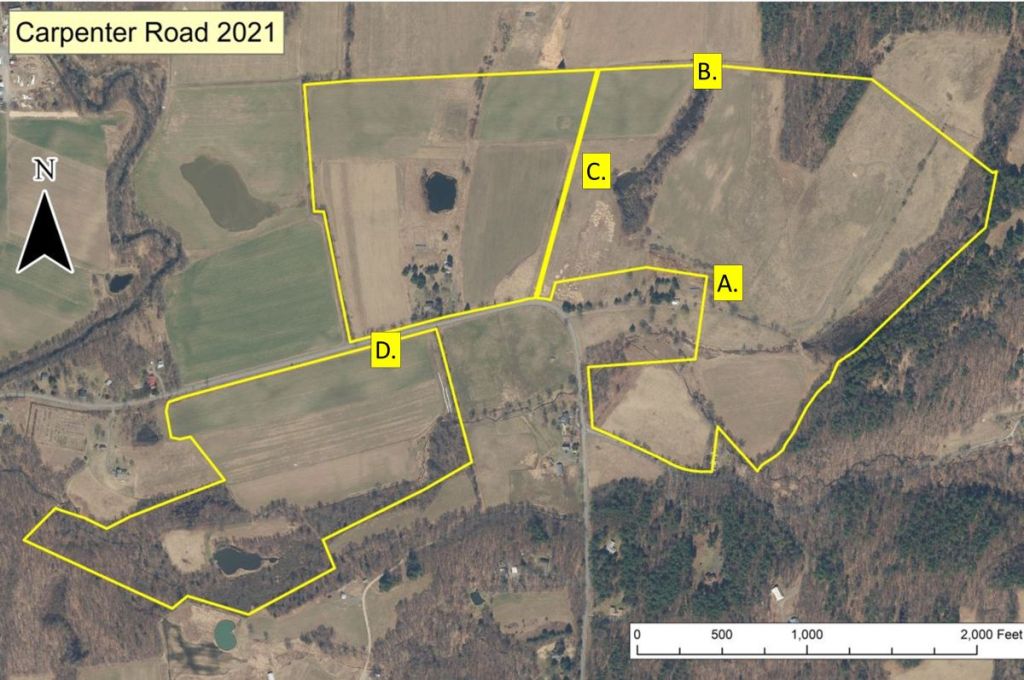
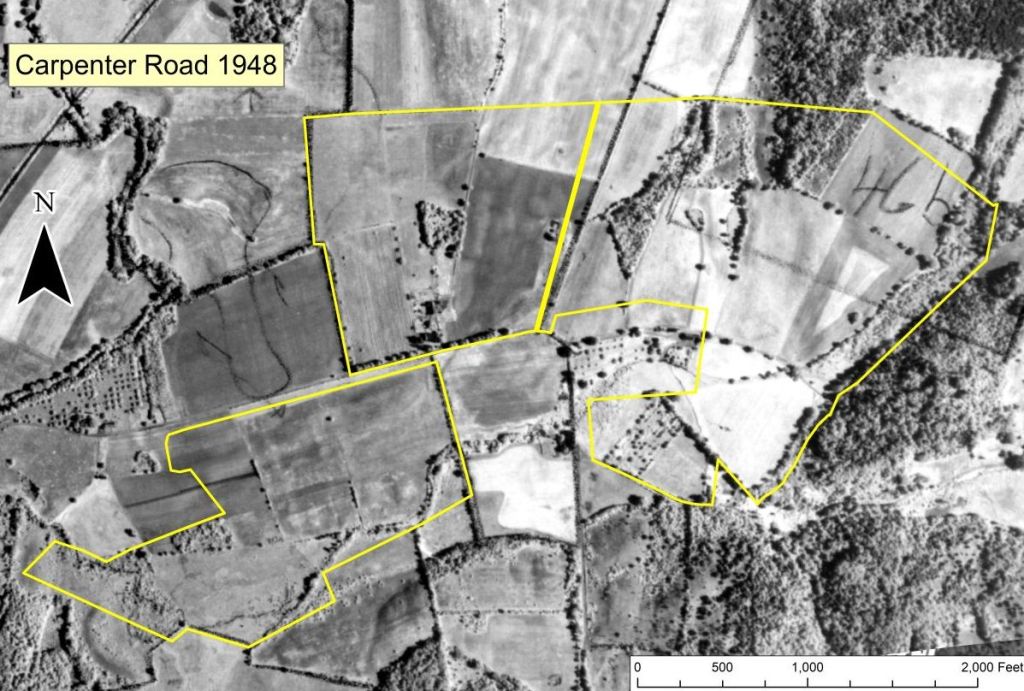
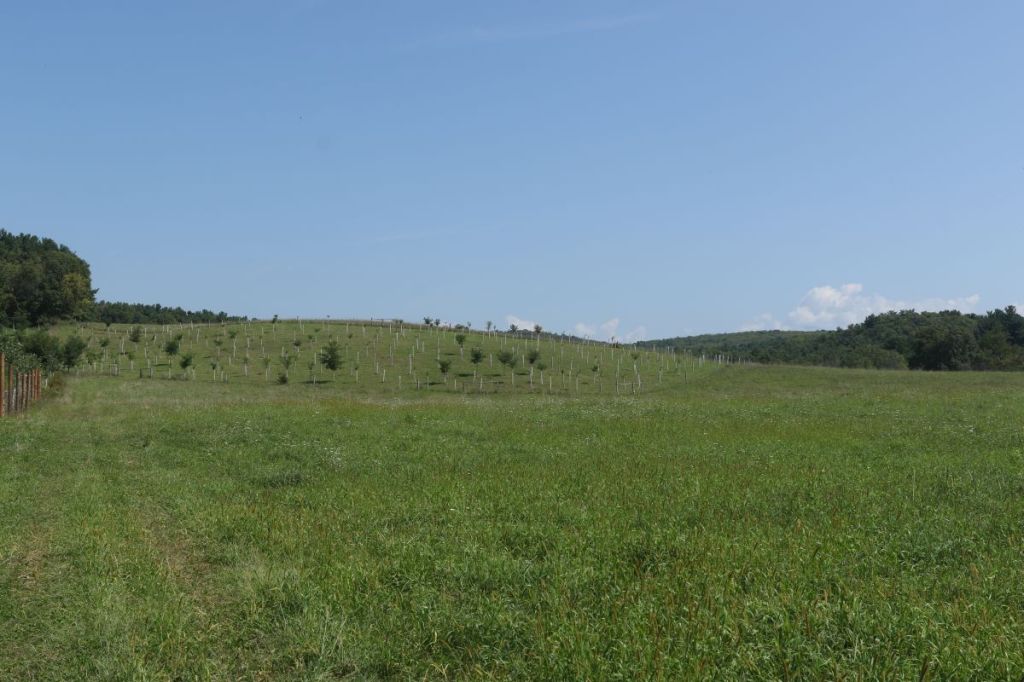
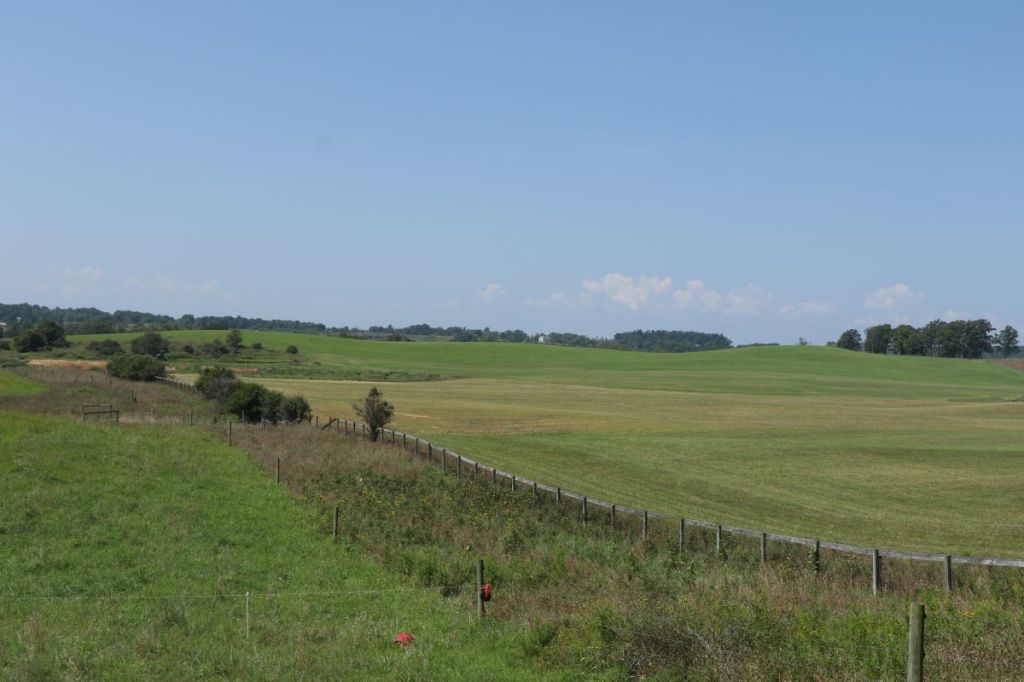
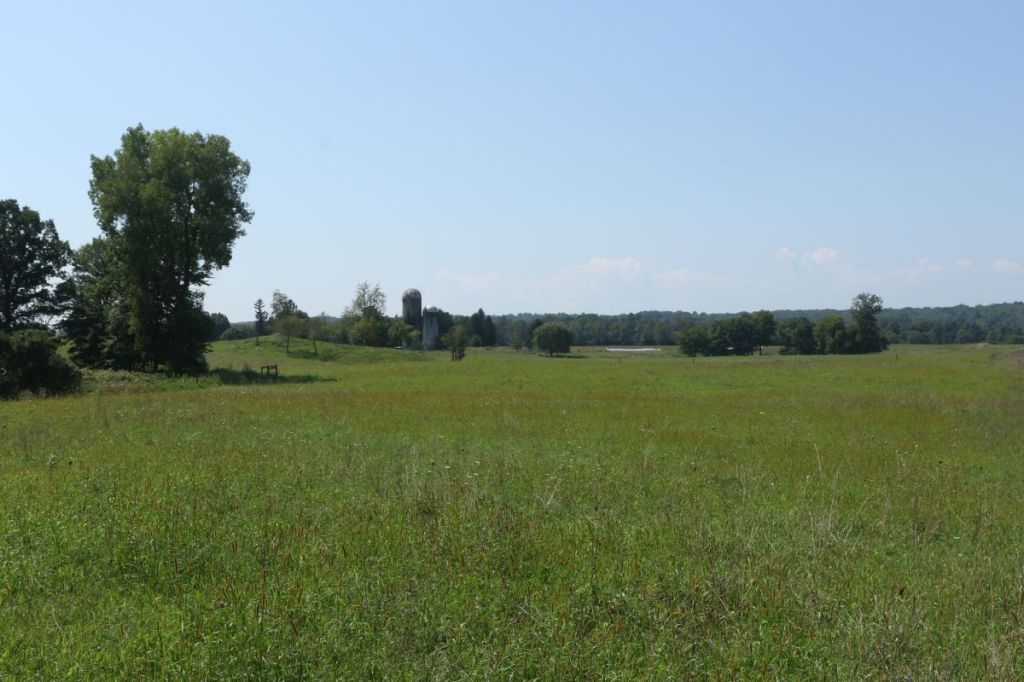
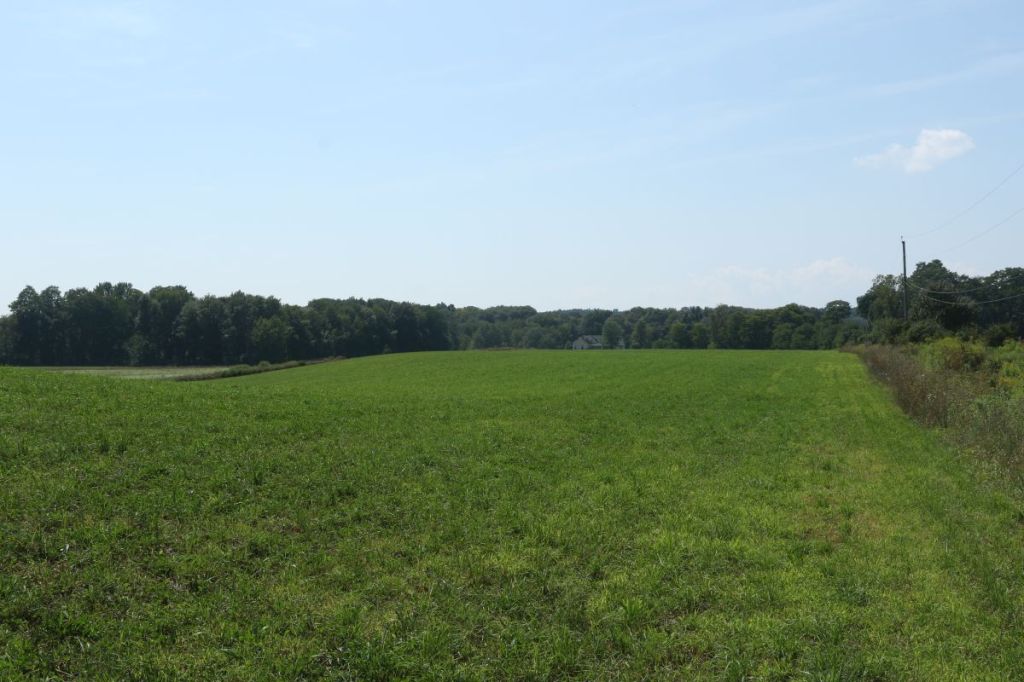
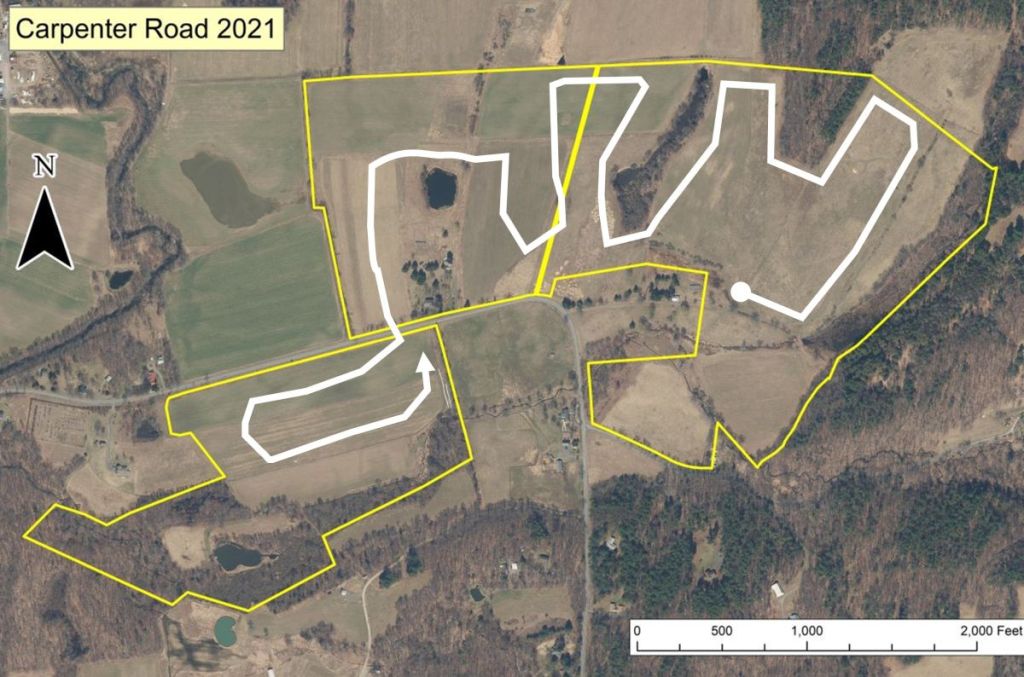
These Hawthorne Valley Farm-managed fields are comprised of hay field, pasture and ploughed ground and are leased from three nonfarmer land owners. They are interspersed with a few hedgerows and wood patches. The parcels are located along Carpenter Road, just north of Philmont, Columbia County. The eastern property belongs to Arthur’s Point Farm, a native plant nursery with ongoing reforestation/orchard establishment on some of its fields. The western property has a small apple orchard managed by the owner, but that was outside of our survey area.
A 2021 image of the fields surveyed. The lettered squares refer to the sites of the landscape photographs shown below.A 1948 aerial of the same area. Other than the pond and the southwest forest block, little has changed.Looking north-northeast from near point A. The far hill (where Black Swallowtails were later observed hilltopping) has been planted with tree-tube-protected young trees by the landowner.Looking ca. due west from point B.Looking west-southwest from point C.Looking more or less west from point D. Carpenter Road is just out of view to the right.
As we did in our Harrier Fields post, this one is a multi-organismal extravaganza, what follows is Claudia describing plants, Conrad describing mainly butterflies, and Will describing birds. You can use the below anchor points to navigate to your favorite section:
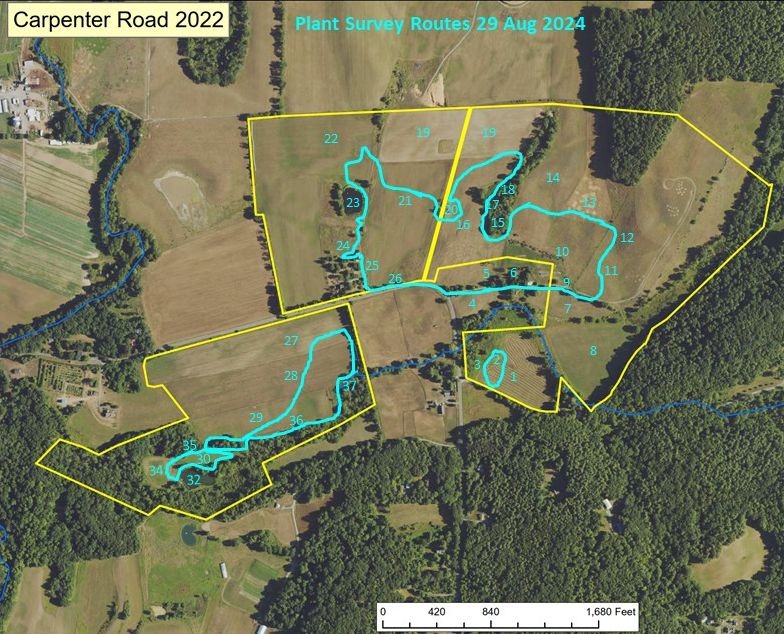
The botanical survey only included agricultural areas managed by Hawthorne Valley Farm and some adjacent non-agricultural habitats. The following map shows the approximate routes walked during the survey. Numbers indicate points/areas where botanical observations were made. I will refer to them throughout this blog.
Most of the field north of the entrance of Eagle Rock Road (#1 on the map) was dominated by Yellow Foxtail, an annual, warm-season grass originally from Europe, which seemed to be doing particularly well on tilled ground on several farms we visited this year. The area of greener, lower vegetation visible here is a wet spot in the field (#2), which supports sedges and Sensitive Fern. The yellow strip of vegetation along the edge of the field (#3) is a wet meadow that is fenced off and does not get tilled.
Field north of entrance to Eagle Rock Road (#1, 2, 3 on map)
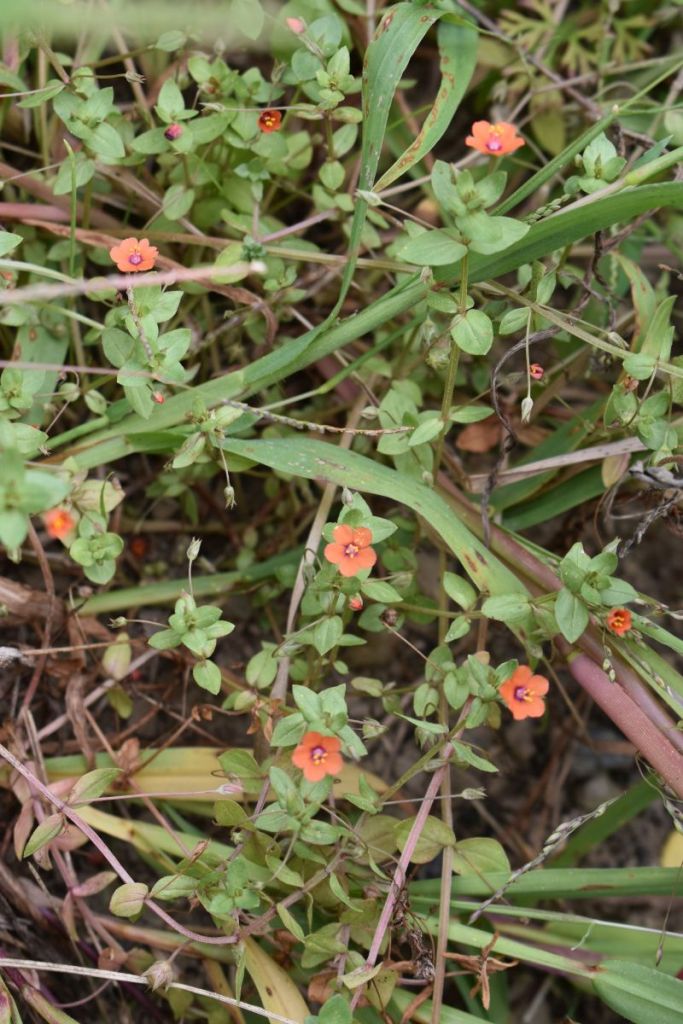
These delightful flowers of an unusual color belong to an uncommon European annual with a fun name: Scarlet Pimpernel (Anagallis arvensis), which is also referred to as “Poor-man’s Weatherglass,” because it supposedly closes its flowers when the sky becomes cloudy, “Red Chickweed,” for obvious reasons, or “Poison Chickweed,” because it contains toxins. We find this small plant occasionally along roadsides and in tilled fields (#1), but in our region, it never seems to become common enough to consider it a serious agricultural weed.
Scarlet Pimpernel (Anagallis arvensis)
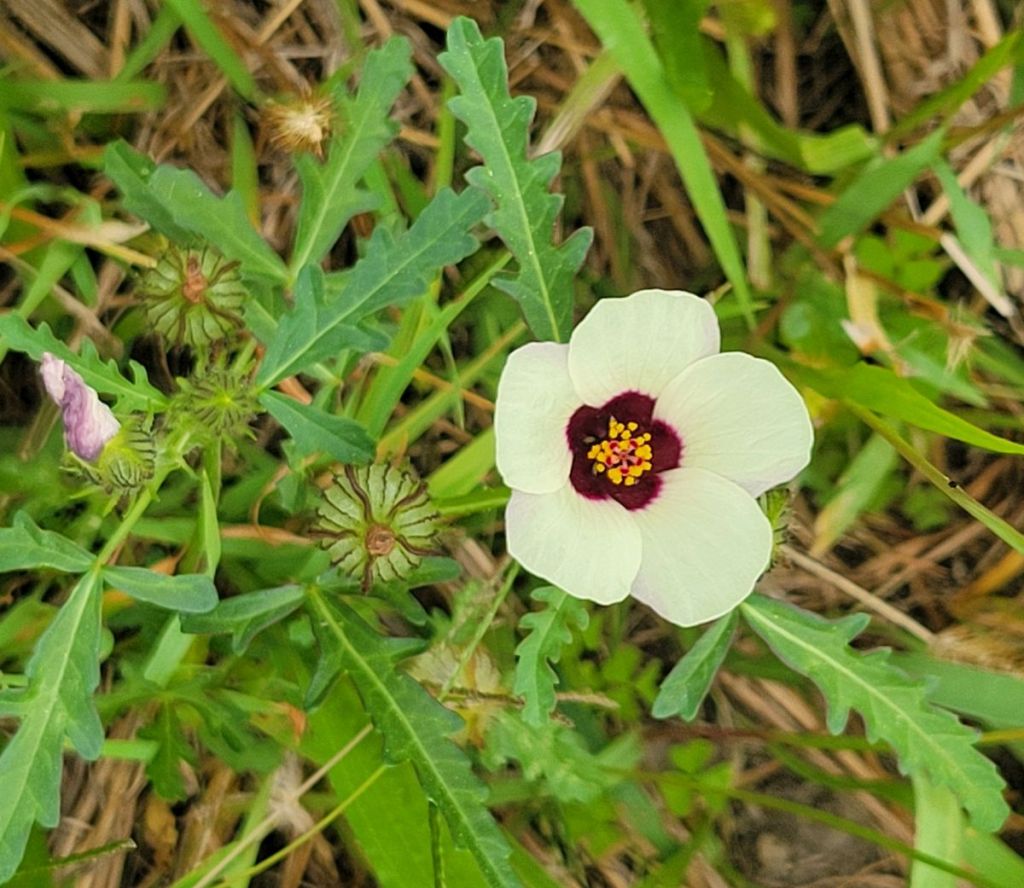
Another uncommon European weed spotted in the same field (#1) is Flower-of-an-hour (Hibiscus trionum), which has a flower of typical Hibiscus-shape, but unusual color combination.
Flower-of-an-hour (Hibiscus trionum)
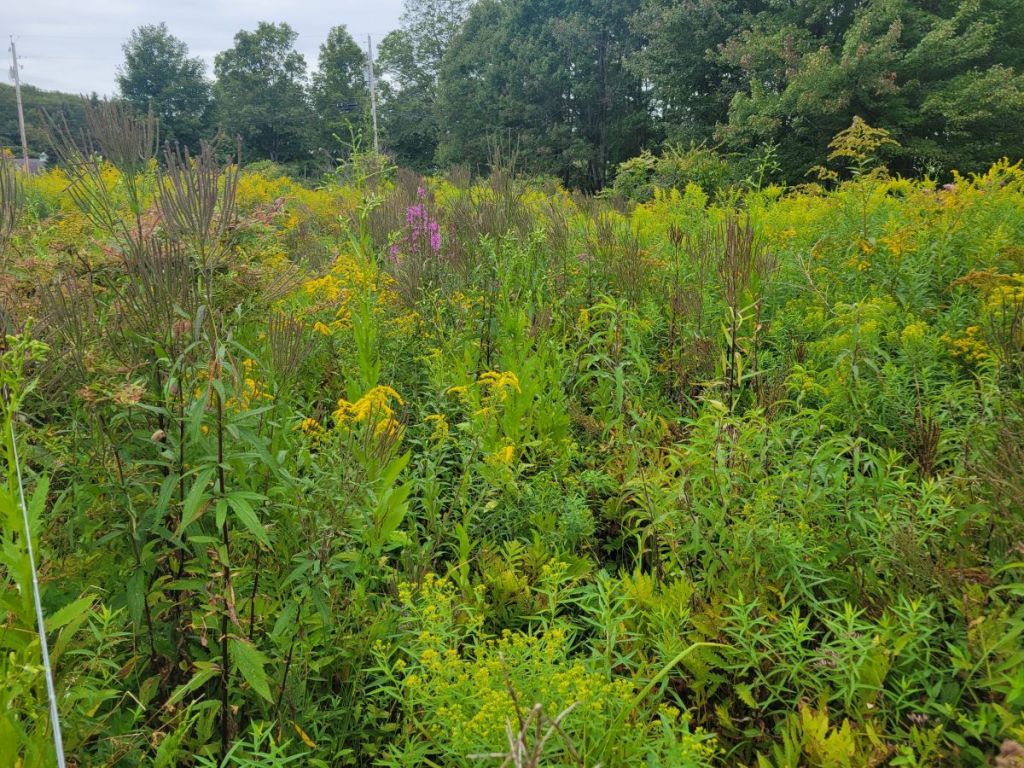
The unmowed wet meadow at the field edge (#3) was composed of mostly native wildflowers, including four kinds of goldenrods, Blue Vervain (Verbena hastata), Pilewort (Erechtites hieraciifolius), Spotted Jewelweed (Impatiens capensis), Spotted Joe-Pye-weed (Eutrochium maculatum). It also harbored some invasive species, such as Purple Loosestrife (Lythrum salicaria) and Canada Thistle (Cirsium arvense), which is a European species that might better be referred to as “Creeping Thistle,” to avoid the common misconception that this species is native to this continent.
Wet meadow (#3)
The pastures and hayfields (#11) appeared mostly green from a distance.
Pasture/hayfield (#11)
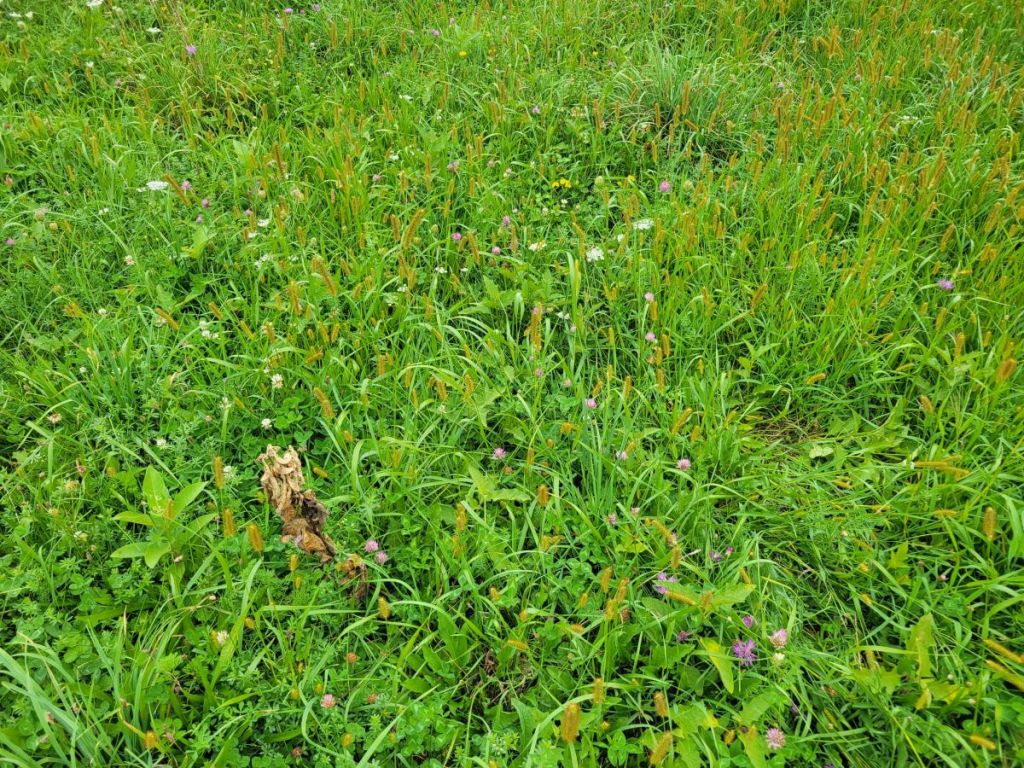
Looking closer, they were composed of quite a variety of plant species: European cold-season grasses mixed with European clovers: White Clover (Trifolium repens), Red Clover (Trifolium pratense), and Bird’s-foot Trefoil (Lotus corniculatus). One can also see the European Common Bedstraw or “Wild Madder” (Galium mollugo) and Wild Carrot (Daucus carota), as well as the ubiquitous Yellow Foxtail (Setaria pumila).
Two native species that were quite common in these perennial pastures/hayfields, were Horse-nettle (Solanum carolinense) and Common Milkweed (Asclepias syriaca).
A closer look at the plant community of a perennial pasture/hayfield (#11)
This shrub swamp (#18) is part of a small wetland complex that also includes an ancient swamp forest (#15), which seems to have never been completely cleared for agriculture. The center of the shrub swamp is dominated by the native Buttonbush (Cephalanthus occidentalis), which tolerates year-round “wet feet.” Some of the edges of the shrub swamp are dominated by the invasive Reed Canary Grass (Phalaris arundinacea; seen in the foreground).
Buttonbush shrub swamp (#18)
A closer look at the Buttonbush reveals its tell-tale spherical seed heads. In mid summer, each of these spheres was covered with small, white, tubular flowers that are very attractive to a variety of pollinators.
Buttonbush (Cephalanthus occidentalis)
This curious-looking vine is Burr-cucumber (Sicyos angulatus), a native member of the cucurbit family.
Burr-cucumber (Sicyos angulatus)
It was enthusiastically growing on Eurasian honeysuckle shrubs (Lonicera morrowii or. L. bella) around the edge of the Buttonbush swamp. This is one of the North American species considered invasive in parts of Europa and Asia.
Edge of buttonbush shrub swamp (#18)
There were several unmowed, herbaceous field edges (e.g., this east edge of #19), which support a vegetation composed of typical pasture/hayfield plants and native species, such as asters and goldenrods, which don’t tolerate mowing/grazing very well. These margins serve as sanctuaries for insects, as pantry for seed-eating birds, and provide shelter for all sorts of wildlife.
Unmowed field edge (#19)
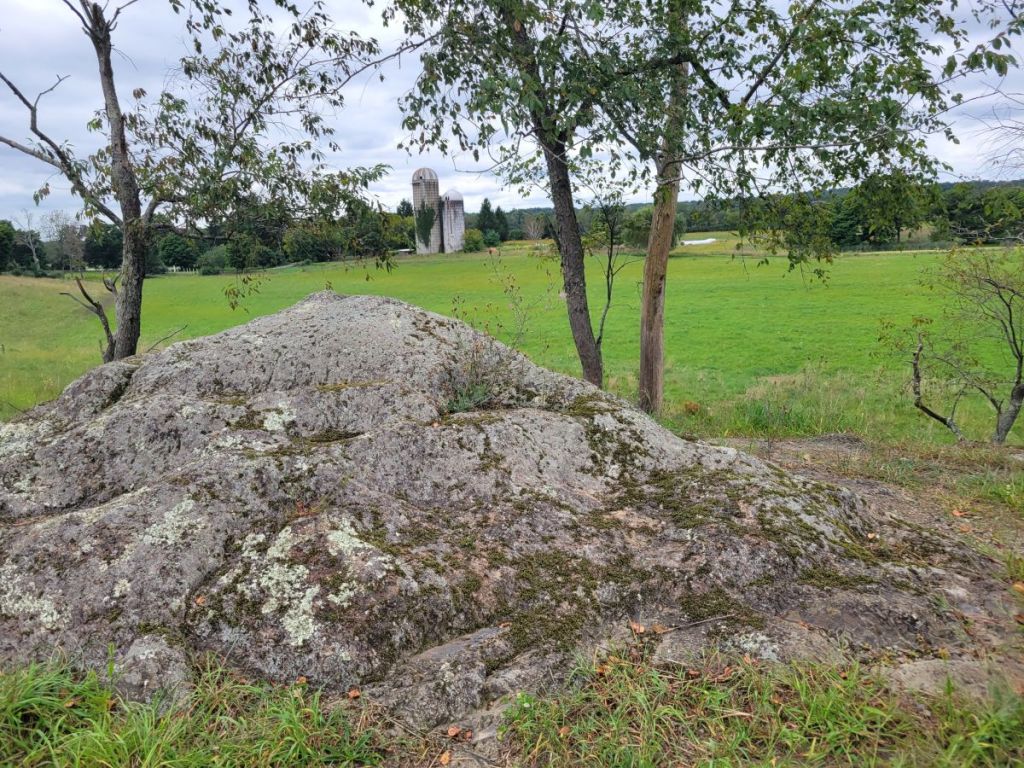
A small rocky knoll (#20) drew my attention because of its potential for unique plants.
Rocky knoll (#20)
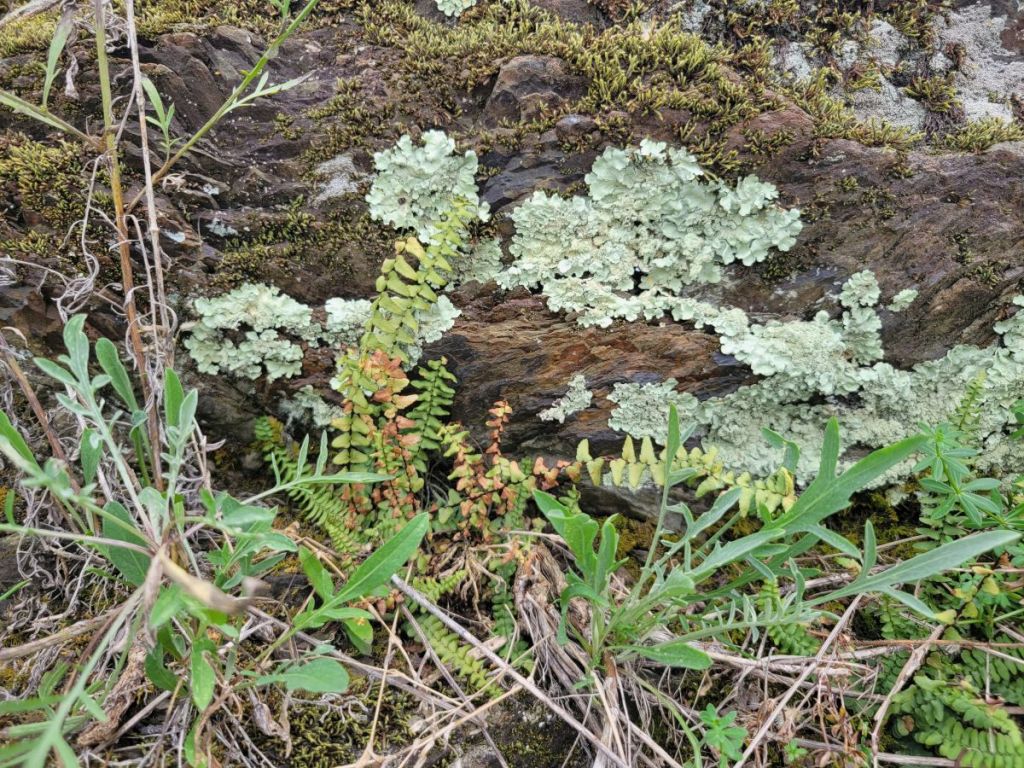
On the rocks themselves I found a number of mosses and lichens not seen elsewhere on the Carpenter Road Farmland (but not uncommon in the larger region). There was also a small patch of Ebony Spleenwort (Aspleniumplatyneuron) a native fern tolerant of dry conditions. The plants in the foreground are Spotted Knapweed (Centaurea jacea), a European meadow species with thistle-like flowers that often invades dry pastures in our area.
Some of the plants, including the fern Ebony Spleenwort (Asplenium platyneuron) on the rock outcrop.
While an interesting scenic feature, the rock outcrop and surrounding dry pasture proved to be not as botanically-rich as hoped. One reason might be that this area has the only shade trees in this pasture, which might result in heavy use and associated trampling of the vegetation by grazing animals. (A snag on the knoll did seem to be a nesting site for American Kestrels.)
View west from the rock outcrop and shade trees (#20) across a hayfield (#21)
In contrast, the unmowed shore of this nearby pond was one of the few places on the land where native wetland plants abounded. These included two species of cat-tails (Typha latifolia and T. angustifolia), several species of sedges (Carex spp.) and bulrushes (Scirpus spp.), a nutsedge (Cyperus sp.) and a spikerush (Eleocharis cf. obtusa).
Pond (#23) with unmowed shoreline and a diverse plant community
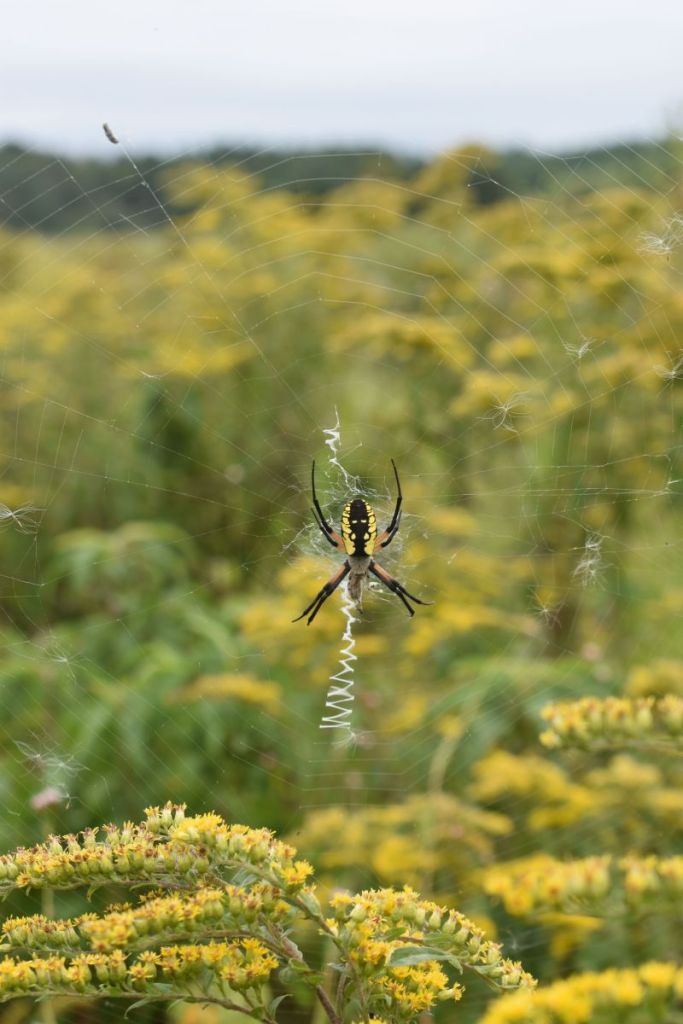
The tall vegetation next to the pond also supported the elaborate nets (with their characteristic zig-zag pattern) of several large Garden Spiders (Argiope aurantia).
Garden Spider (Argiope aurantia)
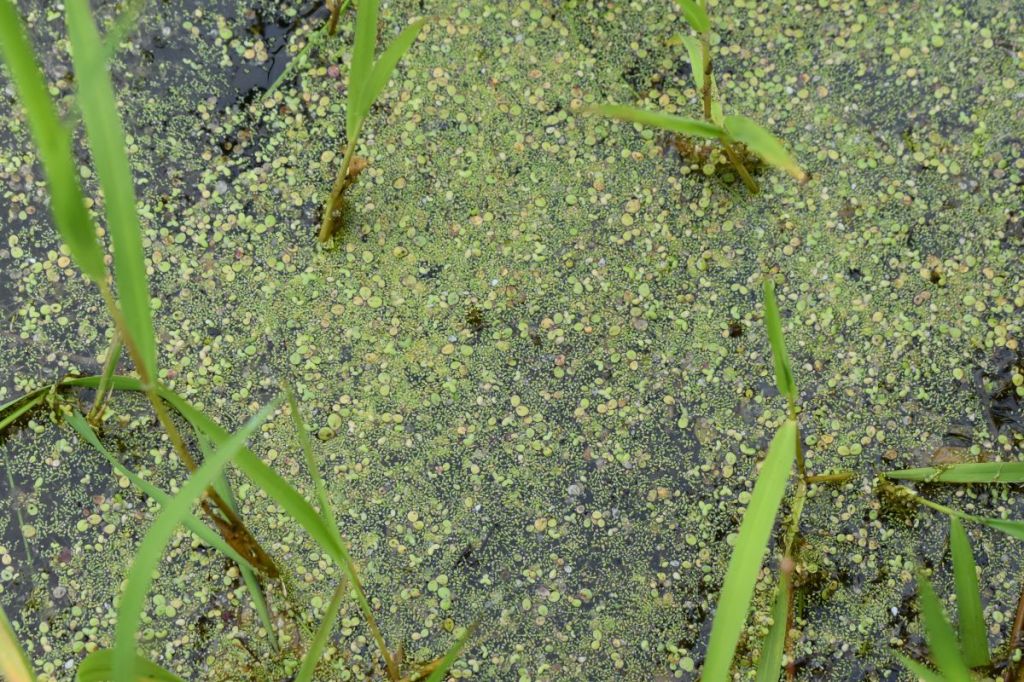
The pond itself had some patches of floating duckweeds, which are often mistaken for algae. Instead, they are miniscule plants (which actually have microscopic flowers that grow directly on the floating leaves). This floating carpet seemed to be composed of at least three different species: the largest leaves belong to Common Duckmeal (Spirodela polyrhiza), the medium-sized ones to Common Duckweed (Lemna minor), and the really tiny ones to one or several species of watermeal (Wolffia spp.).
Several species of duckweeds floating in the pond (#23)
On an old compost pile near the silos south of the pond (#24), I discovered a big patch of the invasive Japanese Hops (Lupulus japonicas).
Japanese Hops (Lupulus japonicas)
On the south side of Carpenter Road, there are three big fields (#27-29) with different plant compositions.
Three fields south of Carpenter Road (#27-29)
The unmowed, untilled field margin between #27 and #28 harbored a mix of native and non-native plants, including some tall thistles.
Unmowed, untilled field margin between fields #27 and #28
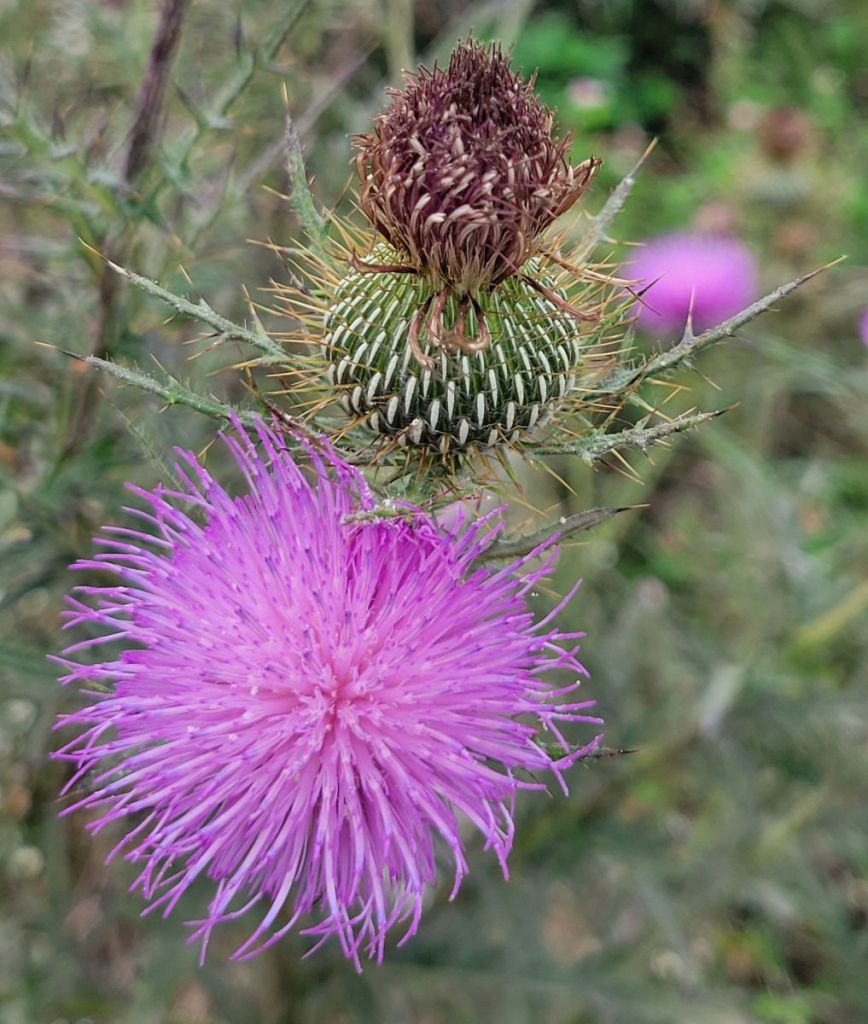
Closer inspection helped identify them as the native Field Thistle (Cirsium discolor), identifiable by their large flower heads and the characteristic white stripes on their spiny bracts (the otherwise green, little leaves that surround the flower head in a tile-like arrangement).
Field Thistle (Cirsium discolor)
The tilled field (#28) had a cover crop of Buckwheat (Fagopyrum esculentum) and an abundance of annual agricultural weeds, including the native Common Yellow Nutsedge (Cyperus esculentus; in the foreground) and three species of introduced foxtails (Setaria spp.).
A field (#28) with a cover crop of Buckwheat (Fagopyrum esculentum)
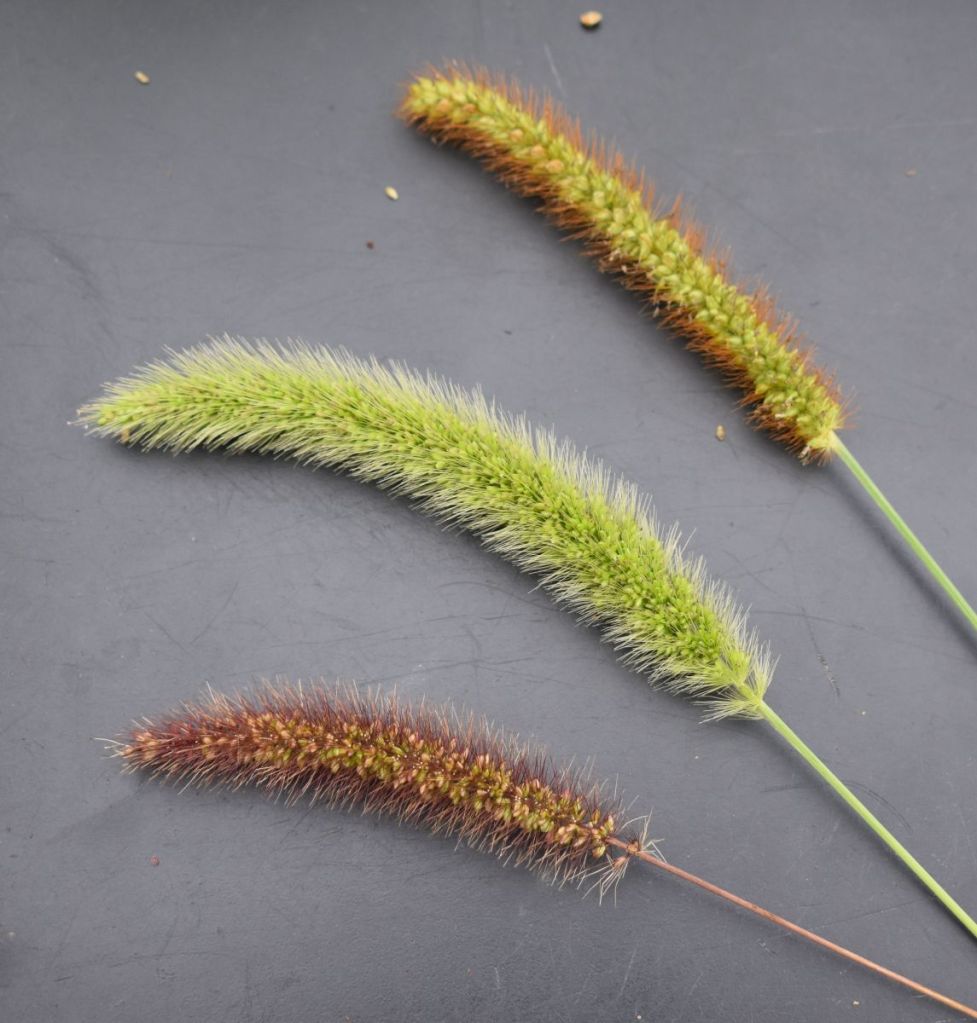
Three seed heads of foxtails growing side-by-side in the Buckwheat cover crop: Green, Giant, and Yellow Foxtail (Setaria viridis, S. faberi, and S. pumila; from bottom to top, respectively).
Green, Giant, and Yellow Foxtail (Setaria viridis, S. faberi, and S. pumila; from bottom to top, respectively)
Another pond (#32) also supported a diverse wetland vegetation along its unmowed margins.
Another pond (#32) with diverse wetland vegetation
American Bur-reed (Sparganium americanum) was one of ten native species not noticed anywhere else during this inventory.
American Bur-reed (Sparganium americanum)
The herbaceous/shrubby field margin (south edge of #29) harbored a mix of invasive (note the ample Japanese Stiltgrass, Microstegium vimineum, in the bottom left corner of the image), native (Common Milkweed, Asclepias syriaca, and goldenrods, Solidago spp.), and European (Wild Carrot, Daucus carota) species. The structural diversity of such “soft edges” attracts certain songbirds and the diversity of plant species provides floral resources for pollinators.
Herbaceous/shrubby field margin (south edge of #29)
Finally, a wet meadow (#37) along a small stream was exceptional in its density of native, late-summer flowers, including those of several species of goldenrods, Spotted Joe-Pye-weed (Eutrochium maculatum), Spotted Jewelweed (Impatiens capensis), and Purple-stemmed Aster (Symphyotrichum puniceum). The latter was not seen anywhere else during this survey.
It was a generally warm and sunny 27th of August when I made my way around the Carpenter Road fields. I more or less followed the route shown below, winding through the open farm fields.
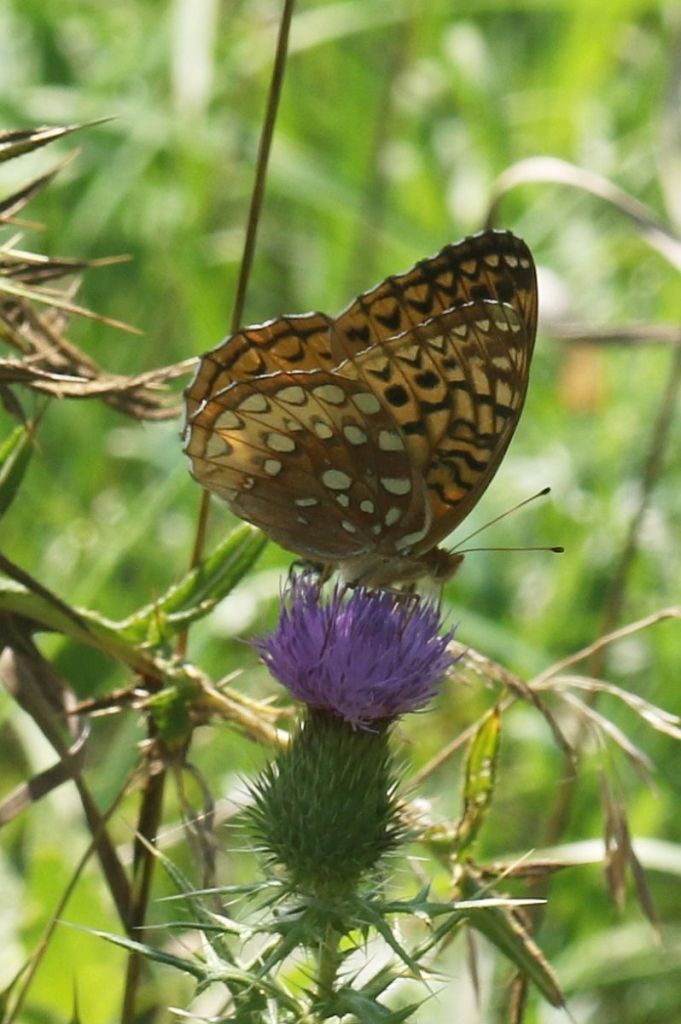
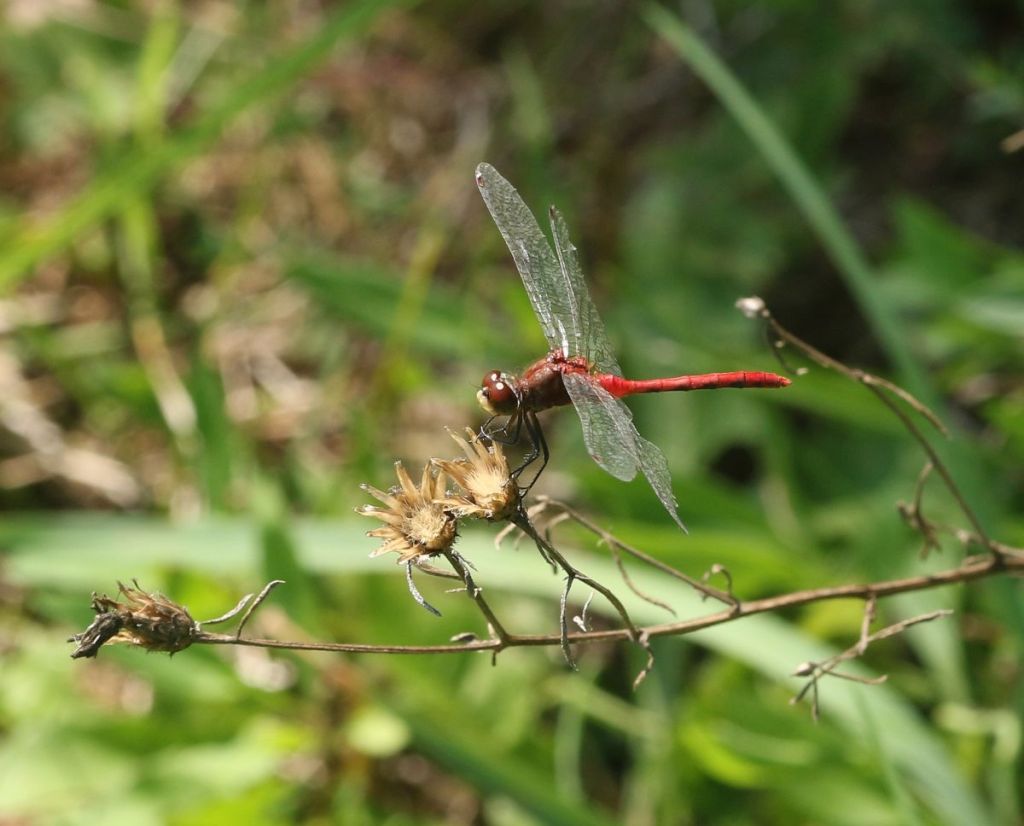
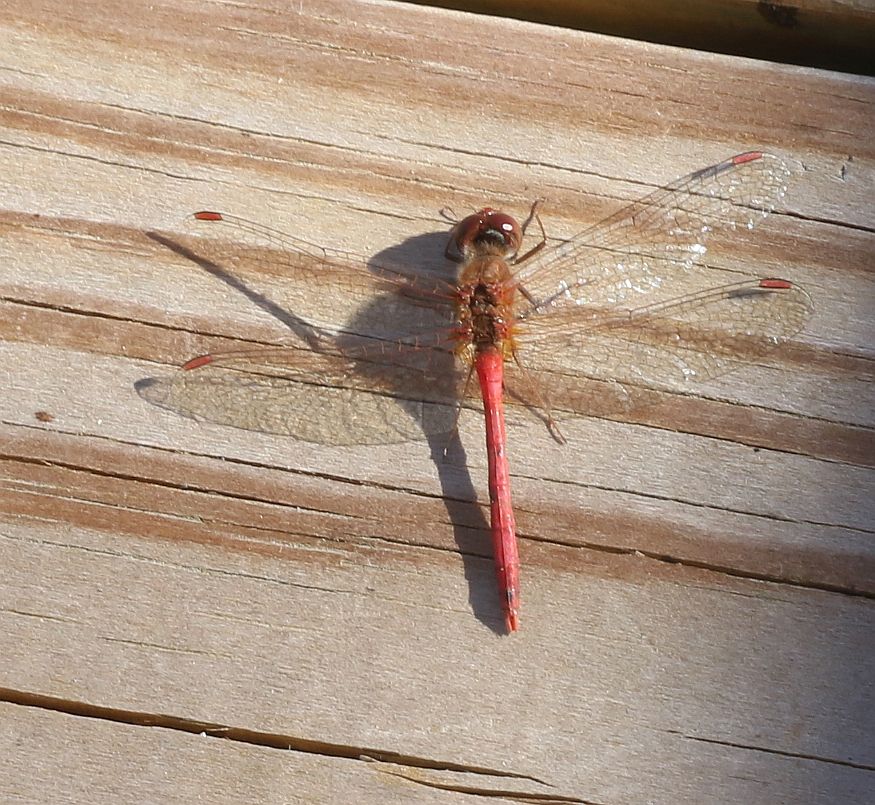
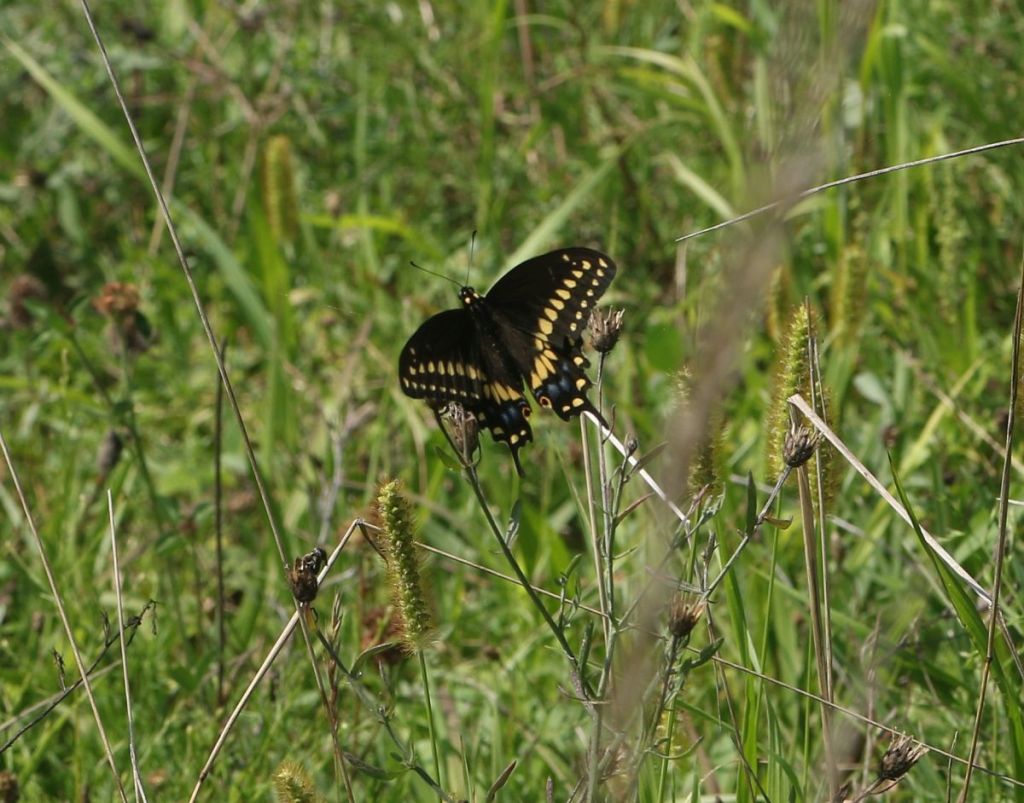
My approximate path chasing butterflies on 27 Aug.For much of my outing, I encountered the standard set of farm-field butterflies, such as this Clouded Sulphur.While this looks a lot like a Clouded Sulphur, note the slightly more orangish tinge.When it takes to the wing, that egg-yolk orange becomes strikingly more apparent.Orange Sulphurs are considered dietary “Switchers” (a term coined by Boston butterflier, Sharon Stichter). That means that, while they are a native butterfly and their caterpillars doubtless can feed on native legumes, they’ve been able to add widespread non-native legumes, such as Alfalfa, to their diets. Life doesn’t stand still!Another example, although not a butterfly I saw on this day, is the Wild Indigo Duskywing – its original food was Wild Indigo (when was the last time you saw that plant?), but it has grown to like Crown Vetch, and so is a regular in our landscape.A male Eastern Tailed-blue, top, and a female, bottom. Females are grey; males are blue.These are widespread little butterflies who feed on a range of legumes.Another of our more common butterflies (as you’ll know if you have been following our earlier posts!): the Least Skipper.A fresh looking male Monarch.This Monarch caterpillar was probably getting close to pupating. For me, the easiest way to find a caterpillar on milkweed is by looking for the frass (aka caterpillar poop). Those are the little brown pellets visible on the leaf below the caterpillar. Notice that even in late August, this caterpillar had been able to find a moderately young milkweed plant (those leave still look nice and fresh). This emphasizes a point made in an earlier post – having a range of milkweed ages on a farm is probably your best bet for supporting Monarchs, especially if you try to make sure that there’s a good stock of youngish plants come mid-Summer, when Monarchs generally seem to be most common in our neighborhood (see below).This graph shows the average number of Monarchs we have seen during butterfly surveys here in Columbia County and nearby areas. It’s a ‘napkin’ sketch, in that I didn’t try to correct for survey length, etc., but it does show that we don’t really have a Monarch turn out until July, so making sure they have fresh milkweed available then could be good. Milkweed will usually resprout if clipped, and so cutting back portions of a May or early June milkweed patch could result in nice, tender shoot for those late Summer arrivals. (The October peak shown above may well reflect passing migrants.)The Silver-spotted Skipper is relatively big and common, ergo one of the most frequently seen of our skippers.A Great Spangled Fritillary. This was not a particularly good year for this species, and we only saw them occasionally.We did, however, see relatively large numbers of their southern kin (more to come below).Not a great shot, but it does document the presence of Pearl Crescent. Some people think this “species” might actually contain two or more cryptic species.A red meadowhawk. Yes, I know, that’s not a species, but if I said it were a White-faced Meadowhawk or a Ruby Meadowhawk, then I would be whistling in the wind.As I was writing this blog post on 13 November at the nearby Hawthorne Valley home farm, this individual flew in. Air temperature was at or below 40F, albeit with a clear sun. This is likely a male Yellow-legged (aka Autumn) Meadowhawk, a relative of the above species, and just serves to indicate the fortitude of some of these late-season species. I can imagine he was finding rather slim pickings in terms of other flying insects to eat.A male Black Swallowtail.
As I’ve tried to illustrate with this photograph, Black Swallowtails seem to be especially dedicated “hilltoppers”, often gathering atop hills. Perhaps this facilitates mating, a sort of innate “I’ll meet you at the top of the hill” social club.
We’ve seen the Common Buckeye in a previous post, but it’s hard to pass up this exotic-looking creature. This is primarily a southern species, only edging it way north during some years. In fact, looking at i-naturalist, our Columbia County observations mark their northernmost forays in the Hudson Valley during 2024. Although they also extended into New Hampshire and Maine this year.
Here’s another southerner who pushed north this year – the Common Checkered Skipper. Again, this is i-naturalist’s northernmost Hudson Valley sighting this year. There were apparently no New England records in 2024, however, it’s admittedly not as eye-catching as the Common Buckeye.
Another southerner and, to me, the most surprising – a Variegated Fritillary, a relative of the Great Spangled shown earlier. We only had one or two previous records from Columbia County (where Carpenter Road is located). All of those were of single individuals. And then, lo and behold, there was not just one, but several of these cavorting in a Buckwheat field.
Clearly, ‘spider web on pumpkin’ camouflage.
And even more surprising, they were mating!
It’s a blurry picture, but it is an action shot – a pair of mated Variegateds in flight. As is understandable, only one of the mated pair tries to fly while the other forms a hanging keel of sorts. As I recall, a given species is fairly consistent in terms of which sex flies and which goes along for the ride, but I don’t think it’s the same pattern holds across all species. Something to look up when I get a chance…
As we were preparing this, Will asked me why we observed so many southern butterflies this year. Aside from the species mentioned above, elsewhere in the region we or colleagues saw Giant Swallowtail, Cloudless Sulphur, Fiery Skipper, and Little Yellow – all of whom are also southern species. It’s hard to know for sure why this was the case. These are all southern species who have been recorded to occasionally make northern forays. For some of these species there are even 19th century records of such movements. One can imagine that such species are always probing the northern margins of their distribution, and when populations are particularly high farther south and/or conditions are particularly amenable farther north, they then appear in our area. Is their local appearance due to climate change? Could well be, but I don’t think we know enough about their ecologies to really pinpoint the cause of their appearances this past year. Time will tell whether this was a fluke year or, instead, the start of a trend. An interesting management question is, should we ‘plant ahead’? For example, should we seed more Partridge Pea or Prickly Ash (also southern species) so that the Cloudless Sulphur, Little Yellow and Giant Swallowtail find welcoming host plants for their caterpillars when they show up?
What appears to be Bombus vagans, the Half-black Bumble Bee.Here we have what looks to be Bombus impatiens, the Eastern Bumble Bee, but what is most interesting to me about this picture is comparing where these two bees are carrying their collected pollen. The Bumble Bee sports leg panniers, officially known as ‘corbicula’. These are widened, largely bare portions of their hind legs that are surrounded by long, pollen-retaining hairs. The bee on the right, in the family Megachilidae (Leaf cutter bees and their kin), is taking a different approach – it sticks the pollen to the fuzz on the bottom of its abdomen. Evidently, for thistle pollen at least, both approaches work.Hey Mom, there’s some guy over here stalking butterflies…
The three Hawthorne-managed properties owned by three different households that we will simply refer to as “Carpenter Road” contains a broad range of habitats and with it, a broad diversity of birds to match. I visited these properties on June 24.
A common theme throughout my blog posts has been an investigation of unmanaged or lightly-managed edges, which can be productive foraging areas for birds seeking seeds and insects. These areas need not be designed and planted as wildlife strips, but rather through willful neglect can host a higher plant diversity than closely mowed lanes. That plant diversity often leads to structural diversity which provides cover for birds and insect diversity which provides food.
The Savannah Sparrow, a species of concern in NYS is quick to make use of unmowed edges around farm fields. Photo credit: Mike Birmingham
The diversity of native and naturalized vegetation provides many opportunities for a variety of bird to nest and feed
Barn Swallows and Red-winged Blackbirds foraged over the fields of grain on Carpenter Road and as one moved south of the road, a mature hedgerow of native trees and lightly managed meadow hosted an entirely different set of forest and shrub-loving species of birds.
American Robin, Carolina Wren, Downy Woodpecker, Field Sparrow, Gray Catbird, House Wren, Northern Cardinal, Northern Flicker, Orchard Oriole, and Yellow-throated Vireo could be found in the hedgerow. Another guild of water-loving species could be found near the small pond there including Common Grackle, Red-winged Blackbird, Warbling Vireo, and Yellow Warbler.
Because of the ephemeral nature of their preferred habitat, Chestnut-sided Warblers rarely stay in the same place for more than a decade or so. Photo: Mike Birmingham.
The song of the Chestnut-sided Warbler ‘Pleased Pleased Pleased to MEETcha!‘ rang from a group of young Red Maples. This bird can nest in a very small patch of suitable habitat, but they prefer young trees and thickets. Historically, this was a bird that followed natural disturbance or even logging, taking advantage of rapidly regrowing trees and shrubs. Once forests mature, this species moves on to other young patches. It’s likely that some part of the farm south of Carpenter Road was abandoned a few decades ago (see the 1940s aerial photo on Conrad’s post!) and the trees are in that habitat ‘sweet spot’ for this warbler.
We’ve lost about half the number of Chestnut-sided Warblers in North America since the 1960s as much of their suitable early successional forest has matured since the peak of agricultural abandonment a century ago. They likely colonized forests after fire and storm damage and in the wake of abandoned beaver meadows before European settlement. It’s possible that they were even rarer than today in the North America centuries ago of mature forest punctuated with Native American fields and encampments. This warbler has also suffered from severe habitat depletion on its wintering grounds in Central America as tropical foothills have been cleared to raise coffee. It is well documented that reputable “shade grown” coffee, from plantations that retain an intact canopy of native tropical tree species, greatly benefit this species. Something to ponder as we make our caffeine purchasing choices.
Chestnut-sided Warblers forage in leaves, searching for caterpillars, fly larvae, spiders, and leaf hoppers. They nest fairly close the the ground in shrubs, rarely more than six feet off the ground. They form monogamous pair bonds and actively defend their small nesting territories from neighboring species of warblers and other songbirds. It usually requires a good pair of binoculars to see them well, but once you track down this fast flitting species the spring males in particular can be a stunning reward of color.
To the north of Carpenter Road, Hawthorne Valley farmers have interplanted cereal grains in a matrix of clover and other cover crops.
A quick drive by and this field of wheat looks like any other…
A closer look shows that these cereal grains are not conventionally grown in a no-till regime with glyphosate herbicide because the edges and understory still host other photosynthesizing plants…
This understructure of clover and other forbs provides an essential understory for insects, the primary summer food for all North American songbirds
Conventionally grown row crops can be fairly unbirdy places since there is limited cover and very little to eat. Historic records, however, suggest that early American fields of rye and wheat were once suitable nesting sites for a variety of grassland birds and Carpenter Road fields may illustrate one reason for the difference. So-called Round-Up Ready cereal crops that are drilled and then sprayed with broad-scale herbicides create fields that are so clean, so devoid of weeds, that they are entirely new agricultural landscapes. No 19th-Century farmer, no matter how fertile their soil, or however many times they cultivated, could match the ‘cleanliness’ of even the most average conventionally grown cereal crop today. Combine that with our ability to use heavy equipment to push out and even landforms to enable farmers to plant hedgerow to hedgerow explains why grassland birds are among the fastest declining guild of birds in North America. There simply isn’t enough habitat left in the Upper Midwest (or here in the Northeast where cereal crops are declining but still a valuable crop in some areas) to provide critical shelter and food.
As I walked through these wheat fields I wondered if this land would support grassland birds and I soon noticed Eastern Meadowlarks flushing from the field. A short distance later Savannah Sparrows foraged and I heard the insect zzzzzzz of a Grasshopper Sparrow.
The striking yellow breast and black chevron on the chest make the Eastern Meadowlark unmistakable. Photo: Mike Birmingham.
We still have a lot of upland meadows in the Hudson Valley, but the vast majority of those fields are intensively hayed with multiple cuttings. As we discussed in the Churchtown blog, this recent intensification of land use presents a level of disturbance that is incompatible with the needs of many grassland breeding birds. The Carpenter Road fields consisting of grains without herbicide and lightly used pastures do provide suitable levels of land use intensity and grassland birds are likewise present.
We must always be careful in ornithology to distinguish between the positive presence of birds and positive breeding outcomes. Grassland birds have an innate biological attraction to open fields regardless of the land use intensity and their mere presence does not guarantee that they are maintaining sustainable populations at that site since they could be attracted to large open areas that ultimately serve as traps where breeding fails. That said, in only a few moments of searching I was able to locate a few nests with eggs.
This Savannah Sparrow nest with eggs was located in the exact tussock of pasture grasses shown to the right. This nest existed in a field recently grazed by cows but the stocking rate was low enough to leave a few uneaten patches of vegetation used by this sparrow.
The Arthur’s Point silvopastures and tree nursery are unique habitats, with grass species similar to adjacent pastures but with greater structural diversity and the obvious hunting perches the young saplings provide. Early successional species such as Field Sparrow, Brown Thrasher, Common Yellowthroat, and Chipping Sparrow were common. Tree and Barn Swallows foraged over the meadow and Eastern Kingbird hunted from fence posts and trees.
Landscape structures like this are inherently ephemeral in the Northeast. Somedisturbance — be it from mower or cattle — is needed to keep mature trees in check. This tension between field and forest can create a transitional habitat that is very productive for birds.
A Grasshopper Sparrow nested at the base of the white plastic electric fence post
In the short 20 minute walk up and around this hill, I counted two Grasshopper Sparrow nests and counted at least 8 birds, some possibly so-called hatching year birds that fledged at this location. This was a high-quality site for this species as several paired adults were preparing second clutches.
The Carpenter Road complex hosted about a dozen or so Grasshopper Sparrows in total which is likely the highest density for this species in Columbia County and among the highest I’ve ever found in the Hudson Valley!
Many of the farms I visited for this project have made some deliberate attempt to manage lands lightly or to leave some habitat unmanaged. In many ways these practices have led to higher-than-expected avian richness. Are there models contained in these farms that can be shared? Improved? Better studied? Will these models be enough to shelter and support birdlife as climate change mounts challenges even on protected land? Can conventional high-production farms be encouraged to leave more room for ecology as they are squeezed by market forces to become more efficient to survive? What does a farm of the 21st Century look like and who are the new stewards?
As many have written before, birds are a wonderful group of organisms for measuring, and educating others about ecological states. They are of a scale easily observed by amateurs, with memorable colors and sounds, and their populations in many instances wax and wane in rapid response to our actions. How can we coexist– or better, thrive — in same world?
Conrad captured this American Goldfinch during his end-of-summer visit to Carpenter Road
Blue Star Farm produces a variety of vegetables and the core of the farm is composed of a mosaic of intensively-managed beds, cover crops, fallow fields, and mowed drive strips. Towards the surrounding tree lines and forest patches, there are also less frequently-mowed meadow areas and narrow bands of “soft edges”, where low woody plants provide a transition from field to forest. For my exploration of the wild-growing plants on the farm, I spent around four hours on July 11, 2024 mostly in the less-intensively managed areas of the farm. This included brief visits to two adjacent patches of swamp forest, one ancient (probably not cleared for agriculture for centuries, if ever, and visible as a triangle in the historical aerial photo from the 1940s in Conrad’s blog from yesterday) and the other, just east of the current fields, recently reforested from a formerly cleared area. I also spent some time recording the plants in and around the recently dug irrigation pond. The inventory resulted in a list of 200 plant species, half of which considered native to this region. In this blog, I’ll try to provide a glimpse of the wild-growing plant life on the farm.
This first picture gives an impression of Blue Star Farm looking south from the approximate center of the fields, with the edge of the young swamp forest on the east side in the background.
A fallow field (it produced kale last year, but had not been worked this season) along the western edge features some of the most common wild-growing plants in the actively-farmed area: Daisy Fleabane (Erigeron annuus; sea of white flowers) and Horseweed (Erigeron canadensis; slender, tall plants, not yet in bloom). Both species are native to Northeastern North America and can become quite common in 1st year fallows of formerly tilled fields. Their shallow flowers provide nectar to small insects, including parasitoid wasps. The picture also shows a single individual of Pokeweed (Phytolacca americana).
Another fallow field along the eastern edge supports a similar plant community.
A closer look at the daisy-like flower heads of Daisy Fleabane. This species can be seen in bloom from May to October and has smaller flower heads than Oxeye Daisy (Leucanthemum vulgare), which also blooms in early summer. It has more white ray flowers (arranged like petals around the yellow disk flowers) than the many similar-looking aster species, which will open their flowers in August/September.
Another common wild-growing plant in 1st year fallow fields was the yellow-flowering Tall Hedge-mustard (Sisymbrium loeselii). It is a European plant that has been spreading relatively recently and rapidly across North America and is not included in my favorite field guide. Therefore, I suspect that I might have been mis-identifying it for a few years as one of the more established, and better-known species in the same genus.
This former strawberry field has a good representation of the most common weeds at Blue Star Farm, including Velvetleaf (Abutilon theophrasti), which is easily recognized by its large, heart-shaped (and velvety) leaves. Reportedly, it has been intentionally introduced to America as a source of fiber. In Asia, where this species originated, it is also used for medicinal and veterinary purposes. In a quick internet search, I could not find any reference about what an abundance of this plant might tell us about the soil conditions (this was a question Sue brought up during our visit–sorry, no new insights).
Here and there in the fallow fields and unmowed areas of the farm, one finds examples of (I think) two very similar-looking vetch species: Cow, Bird, or Tufted Vetch (Vicia cracca; left) and Hairy or Winter Vetch (V. villosa) on the right. Tufted Vetch has a larger upper petal (“flag”) and upper calyx lobes that are broadly triangular, while Hairy Vetch has a shorter flag and upper calyx lobes that are narrowly triangular. I might not be getting this right, yet, but both species are reportedly common on farms in our area. A third species, Slender Vetch (V. tetrasperma) is a very delicate plant with much smaller and fewer pink (instead of purple) flowers, and also grows at Blue Star Farm. All three are originally from Europe.
The reddish hue in the fallow field on the right is from Redtop (Agrostis gigantea), a European grass.
Two species of sumac grow along the western field edge: Smooth Sumac (Rhus glabra; left) and Staghorn Sumac (Rhus typhina; right). Note the difference in the surface texture of their shoots: that of Smooth Sumac is glaucous, with a waxy layer that can be rubbed off, while that of Staghorn Sumac is velvety hairy, like the growing antlers of a deer. Both images show female plants, which are producing berries. Their male counterparts had yellow flowers in the spring, which spread their pollen and are now wilted.
These two species are very different from Poison Sumac (Toxicodendron vernix), which is more closely related to Poison Ivy (T. radicans) and is a shrub with white berries that grows in wetlands. It is not usually found on farms or along roadsides.
The very invasive, non-native Tree-of-Heaven (Ailanthus altissimus) has leaves similar to those of the native Smooth and Staghorn Sumacs and—like them—forms clonal colonies with a joint root system.
However, the female Tree-of-Heaven plants produce wind-dispersed, propeller-shaped fruits that are very different from the red Sumac berries. If you haven’t tried it, the smell of their leaves is also a good way to distinguish the Sumacs and Tree-of-Heaven. To me, the crushed leaves of Sumacs have a pleasant, aromatic, resinous scent, while crushed Tree-of-Heaven leaves have a rank smell reminiscent of rancid peanut butter.
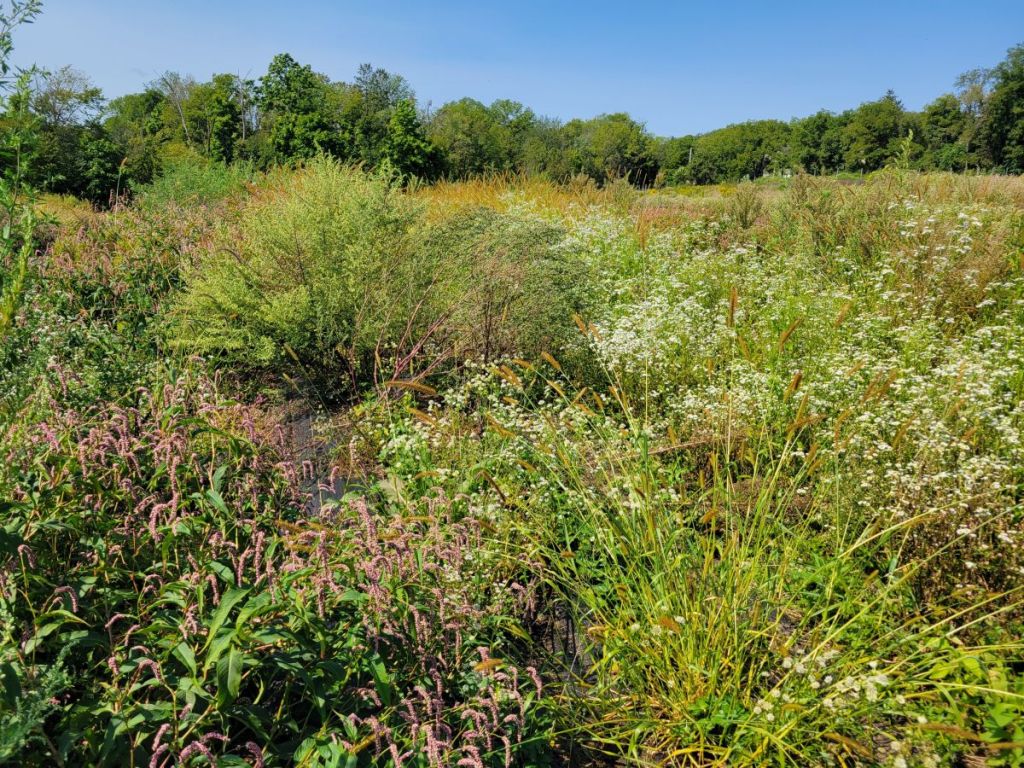
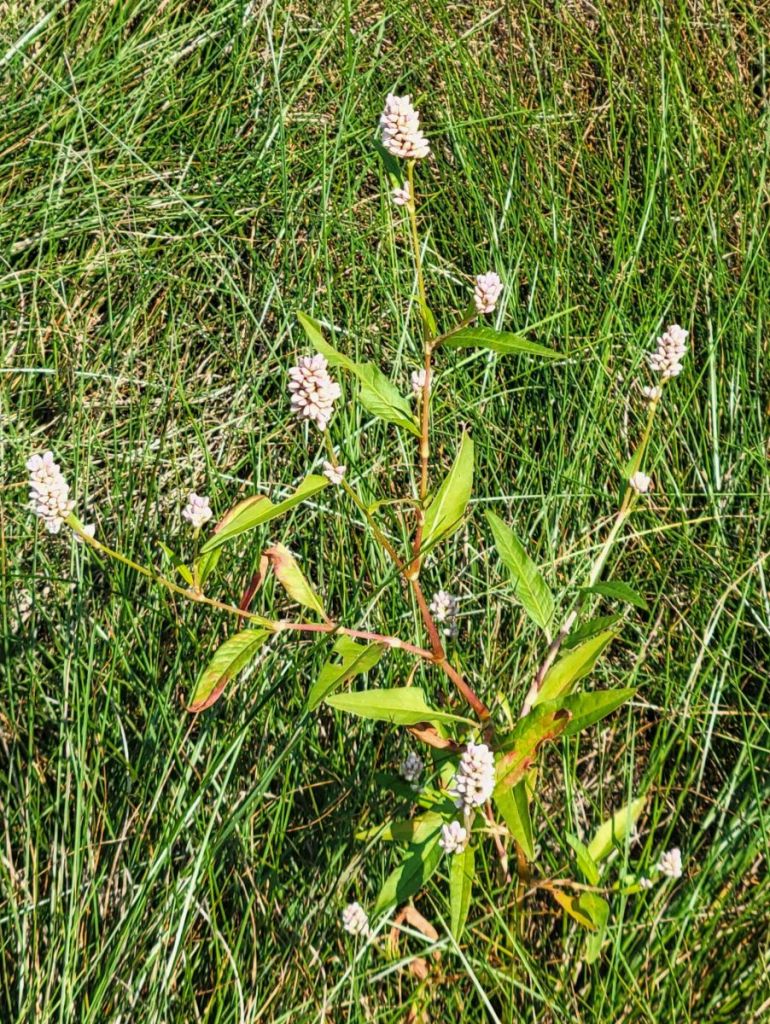
Now, let’s explore a bit the plant life in and around the newly dug irrigation pond. The tall plants right along the water’s edge are two species of native cattails. Although most of the water is clear, you can see some “greenery” floating on the surface around the shoreline.
This “pond scum” is most likely composed of filamentous green algae (not to be confused with the sometimes toxic cyanobacteria, which are often referred to as “blue-green algae”). Ecologically, the filamentous green algae are nothing to worry about if they occur in small amounts. They indicate that there are some nutrients in the water, which is not surprising, if a pond is dug in an area that has long been farmed.
In shallow water, just underneath the surface grows a native aquatic plant, aptly called Eutrophic Water Nymph (Najas minor), another indicator of nutrient-rich water.
In the shallow water along the shore, there were also some small plants of the invasive, non-native Curly Pondweed (Potamogeton crispus). As the pond matures, it remains to be seen how this species behaves… Some amount of aquatic plants is a very good thing to provide shelter and food for aquatic insects (including dragonfly larvae) and amphibians. Should the aquatic plants ever become too much, please consider mechanical removal (which has the added advantage that the nutrients stored in them get removed from the waterbody) and DO NOT introduce grass carp to control the vegetation! In our experience, these plant-eating fish turn ponds into a turbid soup without any plant life and little habitat value for aquatic insects and amphibians.
On the east side of the pond is a well-established meadow composed of at least 50 (probably many more) different grasses, sedges, wildflowers, as well as some shrubs and vines. This was one of the most flower-rich and botanically-diverse areas of the farm and is a perfect example of a “soft edge” to the neighboring forest.
Common Boneset (Eupatorium perfoliatum) is an example of a native wildflower only seen in this meadow during the botanical survey.
East of the pond is a narrow band of recently reforested swamp forest. We did not take the time for a complete tree inventory, but noted the presence of Pin Oak, Red Maple, Black Cherry, Black Locust, White Mulberry, and Trembling Aspen. This area also harbors some invasive shrubs and seems to be the epicenter of the invasive Japanese Stiltgrass (Microstegium vimineum; not pictured) on the Farm.
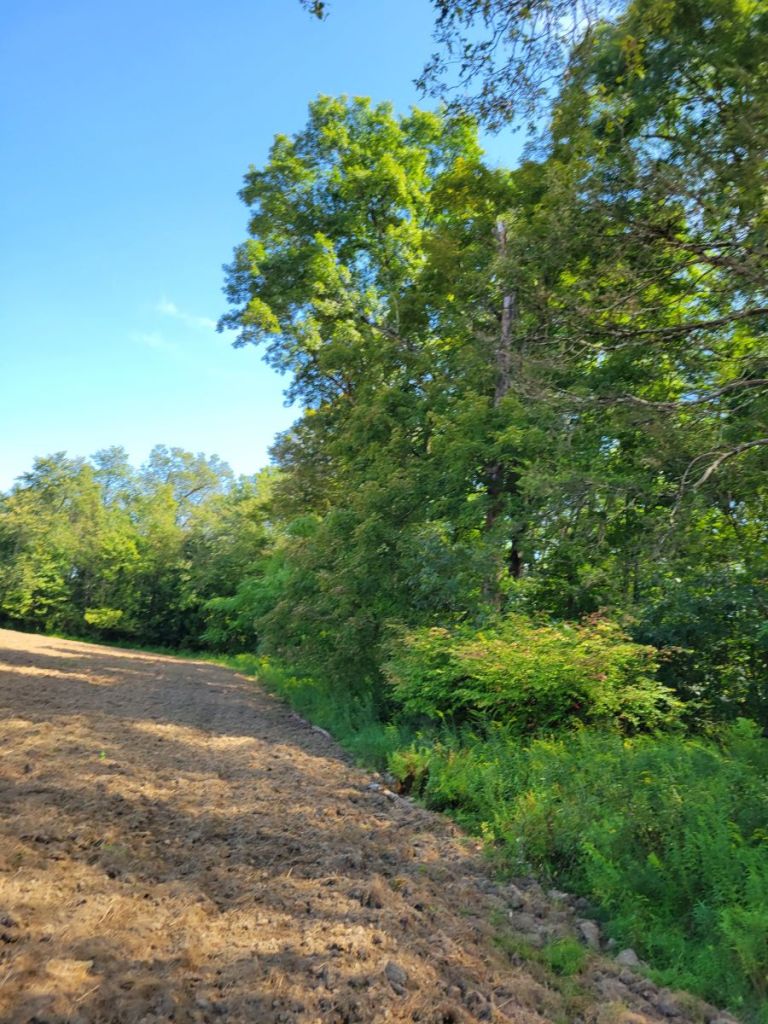
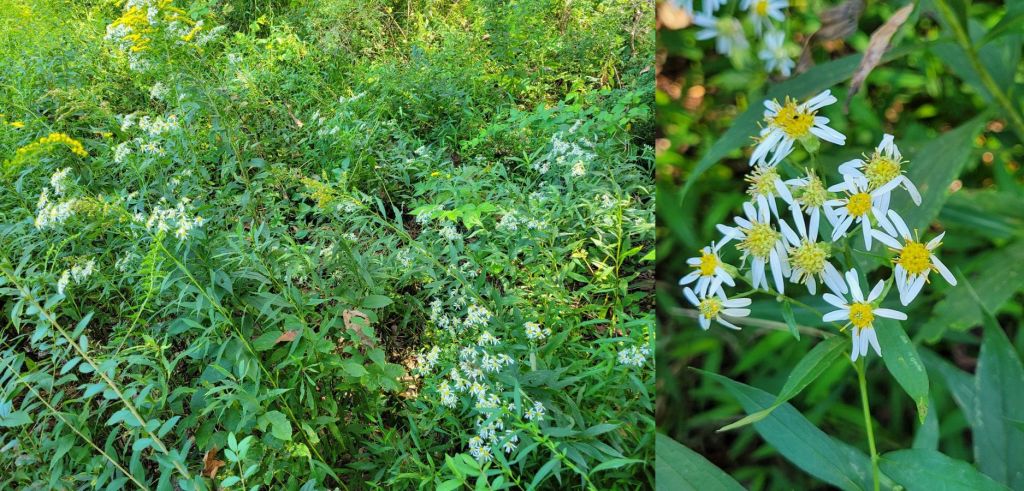
Nonetheless, there were also some native botanical treasures in this young swamp forest, such as the Spotted St. John’s-wort (Hypericum punctatum). This is one of three St. John’s-worts found at Blue Star Farm. The other two are the native Dwarf St. John’s-wort (H. mutilum), spotted on the shore of the irrigation pond, and the non-native Common St. John’s-wort (H. perforatum) which was seen here and there in the unmowed areas.
Ragged Robin (Lychnis flos-cuculi) is a European plant, related to chickweeds and carnations. It grew in the young swamp forest and was also found in the meadows east of it.
Finally, we reach the patch of ancient swamp forest further east (indicated by the triangular area of forest at the center of the historical aerial photo in Conrad’s post from 13 July). This forest is characterized by very few invasive species and by the presence of some unique tree species, seemingly not found anywhere else on the Farm. The patches without vegetation indicate seasonally flooded areas, which might serve as breeding grounds for vernal pool amphibians, if they hold water long enough in the spring to allow tadpoles of Spotted Salamanders and Wood Frogs to develop. However, the presence of these amphibians on the Farm was not confirmed during our brief survey!
Yellow Birch (Betula alleghaniensis) is easily recognized by its shiny, peeling bark and the often octopus-like, superficial roots. It is one of the two “sweet birches”, whose twigs smell of wintergreen (= root beer). In our experience, this species does not readily establish in post-agricultural forests and—at least in our area—is a good indicator of “ancient forest” (a forest that has not been cleared for agriculture during European colonization.)
At the center of this image, you see the uniquely-divided leaves of Royal Fern (Osmunda regalis), an uncommon native wetland fern. It is surrounded by Spotted Jewelweed (Impatiens capensis), which made up the bulk of the ground cover in this forest.
There are two species of native Jewelweeds at Blue Star Farm. Spotted Jewelweed (I. capensis) has orange, spotted flowers and usually no more than nine teeth along the margin of each side of its leaf. As we have seen, it grows abundantly in the ancient swamp forest. Its yellow-flowering cousin is Pale Jewelweed (I. pallida), which was found along the southern edge of the young swamp forest. Note how its leaf margins have more than nine teeth. Fortunately, the invasive, pink-flowering (and much taller!) Himalayan Jewelweed (I. glandulifera) is still quite rare in Columbia County and was not found at Blue Star Farm.
This, admittedly somewhat tattered, plant is Mad Dog Skullcap (Scutellaria lateriflora), a native member of the mint family, which reportedly is used in herbal medicine as a mild sedative and anti-anxiety treatment. In the 18th century, there was a belief that this plant could cure rabies (hence the name “Mad Dog”), but this has been disproven.
Another nice find in the ancient swamp forest was Ditch Stonecrop (Penthorum sedoides), a native wetland plant not seen anywhere else at Blue Star Farm.
Finally, this parting shot shows a Blackgum (Nyssa sylvatica) seedling, growing next to the luxuriant fronds of Interrupted Fern (Osmunda claytoniana). Blackgum is an uncommon tree in Columbia County, usually found in swamp forests and around vernal pools. Cinnamon Fern (Osmundastrum cinnamomeum) which looks similar to Interrupted Fern, but is not pictured here, was also abundant in the ancient swamp forest.